Recognizing Franklin Dalembert with the Intercultural City Award

Tomorrow night at their YUM: A Taste of Immigrant City celebration, The Welcome Project will recognize local leader Franklin Dalembert with the Intercultural City Award. For over a decade Franklin was founding director of the Haitian Coalition of Somerville. As The Welcome Project celebrates its 25th anniversary, Franklin’s story highlights how the City has changed.

From The Welcome Project‘s website:

In 1991 there was one Haitian program in the city: Haiti Vision, a SCAT television show for which Franklin Dalembert served as a producer. Under his remarkable leadership, that show would eventually grow into the Haitian Coalition of Somerville, which incorporated as a non-profit in 1998 and remains a cornerstone of Somerville cultural organizations 17 years later.

“People would come on Haiti Vision and talk about the issues they were facing,” recalled Franklin, who served as founding director of the Haitian Coalition from 1998 until early in 2015. “Young people would come. Parents would come. As we heard all those issues, we started to invite the heads of organizations and city officials to respond and talk to those people.”

These on-air conversation between Haitian residents and city officials eventually led to the creation of the city’s first Haitian Taskforce, created under then Mayor Michael Capuano.

“The taskforce was formed to serve as a bridge between the city and the community,” Franklin explained. “We would meet regularly with Mayor Capuano and others to discuss the issues faced by the Haitian community. One day, Mayor Capuano suggested we should organize as a group – that we should create an advocacy organization and advocate on behalf of the Haitian community.”

That’s how the Haitian Coalition was born.

“Not only did we create that organization, we helped to create a lot of changes,” Franklin said. One of its first steps was calling for help from the Department of Justice.

“The Department of Justice investigated treatment of Haitians at the schools and how Haitians were treated by police. A set of agreements were signed between the Haitian Coalition, the City of Somerville and the Department of Justice.”

One of the recommendations from the DOJ, Franklin said, was to create a Human Rights Commission in Somerville. After the city passed an ordinance creating the commission, Yves-Rose SaintDic, a Haitian leader in the city, served as its first director.

The issues tackled by the Haitian Coalition have shifted over the years. In the early days, the organization primarily focused on building cultural sensitivity towards the Haitian community and making sure these residents access to resources.

“At that time people felt they were not welcome, that nobody understood them,” Franklin said. “There were no people who could speak their language or understood their culture. This created a tension and a lack of understanding. People felt that their voices hadn’t been heard.”
On top of that, immigrants face unique challenges as they acclimate to life in a new part of the world, and at the time there was no one to help them through the transition.

“When I moved to Somerville in 1990,” Franklin said, “I spent a weekend in November in an apartment without heat or electricity because I didn’t know I had to call the gas company. Sometimes people take it for granted that everyone knows that basic info, but we didn’t need heat in Haiti.”

Today, the Haitian Coalition organizes around issues of affordability and gentrification.
“Twenty-five years ago, the work was welcoming immigrants in Somerville. Now we have another challenge – to keep immigrants here,” Franklin said. “People are leaving, they can no longer afford housing costs in Somerville. We have to do something about that. If we lose the immigrant community, we are losing something very important. Immigrants play a vital role in Somerville.”

Throughout it’s history, the Haitian Coalition has partnered closely with The Welcome Project.

“The Welcome Project paved the way for the Haitian Coalition,” Franklin said. “We consider them a sister organization, because we share the same mission. The Welcome Project affects all the immigrant communities, provides a voice for the immigrant community.”

The Welcome Project is thrilled to recognize Franklin Dalembert with the Intercultural City Award at the 2015 YUM: A Taste of Immigrant City celebration.

facebooktwittergoogle_plusredditlinkedintumblrmail

Kei Kawashima-Ginsberg to lead CIRCLE

I am thoroughly delighted about this announcement:

Kei Kawashima-Ginsberg has been named the new director of Tisch College’s Center for Information and Research on Civic Learning and Engagement (CIRCLE).

Dr. Kawashima-Ginsberg served as deputy director of CIRCLE since 2013, and has been a senior researcher with the team since 2008. She will be the third director in CIRCLE’s 14-year history, succeeding Peter Levine, who will remain active with CIRCLE while overseeing all of Tisch College’s research in his role as Associate Dean, and founding director William A. Galston, now of the Brookings Institution.

“It’s truly a privilege to serve as CIRCLE’s next director. I look forward to helping deepen our collective expertise and impact on opportunities for civic and political development among young people who are marginalized or disadvantaged,” said Kawashima-Ginsberg. “These young people are virtually shut out of public life, and our research can help identify barriers, test solutions, and transform the dialogue about the engagement of young people in our country.”

Kawashima-Ginsberg brings her extensive experience overseeing CIRCLE’s core research projects and producing resources, scholarly works, and reports for practitioners and researchers alike. With a background in positive youth development and an interest in diverse and marginalized youth, Kawashima-Ginsberg is primed to bring a sharpened focus to this important dimension of CIRCLE’s work. She is ideally prepared to provide organizations, communities, and the public with research that will increase civic and political learning and engagement opportunities.

Among her research projects at CIRCLE, Kawashima-Ginsberg has led studies on the leadership and political development of women and girls, the social class divide in the extracurricular experiences of youth, and the diversity of Millennials.

“Kei is the perfect choice to lead the next phase of CIRCLE’s development,” said Levine. “Her impressive background in youth development brings an important perspective to our work. She has been our lead researcher since 2008 and played an essential role in all of our activities. Many colleagues, both practitioners and scholars, already know her as a superb scholar and leader. I am excited to continue to work with her as she takes CIRCLE in important new directions.”

As Tisch College’s Associate Dean for Research, Levine will remain active in CIRCLE’s research and will support the organization.

Kawashima-Ginsberg earned her Ph.D. in Clinical Psychology with Specialization in Children and Families from Loyola University Chicago and has extensive experience in working with youth of diverse backgrounds both as a researcher and practitioner.

As it says above, I will remain deeply involved with CIRCLE–and more broadly with the research of Tufts’ University’s Tisch College of Citizenship, of which CIRCLE is a key part. In fact, my time commitment will not diminish. At the same time, Kei will be the true leader of CIRCLE, and that represents an enormous opportunity to develop and strengthen the organization in the service of youth civic engagement.

The post Kei Kawashima-Ginsberg to lead CIRCLE appeared first on Peter Levine.

Ten Pointers for More Inclusive Public Engagement

Our friends at the Orton Family Foundation recently shared a list of 10 great tips for inclusive engagement that we wanted to share with our members. Orton’s tips come from lessons learned through their engagement work, especially with their Community Heart & Soul program – which is detailed in the full post. But the list was so good, we wanted to make sure our network saw it. Check it out below or read Orton’s full post here.


Orton LogoTop 10 Tips for Inclusive Engagement

1. There’s no such thing as the “general public”

Learn who your community is (its demographics, stakeholders, and networks) and how residents get their information. This knowledge is vital to designing effective community engagement and communication activities about your effort. Identify the key connectors who can help you reach these groups. At the same time, remember that no one person speaks for an entire group. See our Community Network Analysis Tool.

2. Keep your “promise” to community members

Be clear about how resident input will be used in your project (i.e. how much influence they will actually have). Be transparent about how residents’ input is used and what actions will result.

3. Go to the people

Change up how you gather community input. Go where people hang out, whether it’s physical gathering spaces, like a coffee shop or a brew pub, the senior center or a little league game, even online spaces.

Examples – In Damariscotta, Maine local organizers went to the town’s hugely popular annual Pumpkin Fest & Regatta, set up a booth, and used candy corn voting in jars to help with early priority setting. In the North Fork Valley, Colorado the Heart & Soul team held an event at the local brew pub and gathered people’s input on coasters—and from those coasters folks were lifting pints of Love It or Leave it Ale, brewed specially for the event!

4. Spread the word

Create a communications plan that includes project branding, messaging, and tactics for persuasively talking about your project. Use communication channels and messengers that have connections with who you are trying to reach.

Example – Victor, Idaho had a community wide Heart & Soul logo contest to help shape the brand and give it local flavor. The result: “Victor: What’s It to You?”

5. Ask for people’s personal stories

To draw in new voices, the Foundation begins Heart & Soul projects by gathering people’s stories about their town. Stories allow folks to express their experiences and opinions in their own words, without needing to understand planning or technical jargon. You’ll hear from people you wouldn’t have otherwise, and build new bridges and relationships through the process.

Example – In Biddeford, Maine story gatherers went to the local boxing ring and cigar shop, fishing areas and local diners to collect people’s stories of Biddeford. And they shared them in a public event with hundreds of folks as part of rebuilding pride in their town.

6. Understand the power dynamics

Be sensitive to parts of your population who may be uncomfortable participating (e.g. newcomers who come from a culture where participation was unsafe, people whose views have been marginalized in past community efforts). Find a safe way to talk with those groups about their concerns regarding participation and let them tell you how best to engage them.

Example – In Cortez, Colorado Heart & Soul project leaders communicated directly with the Ute Mountain Ute leadership to understand how to successfully bring information to the reservation and to listen to their concerns and advice. Through this listening and trust building, the tribe members became engaged in designing public art for the City’s southern gateway.

7. Engage in their interests

For some groups you may have to participate in something that matters to them first to make a connection.

Example – In Starksboro, Vermont our project began with cleanup activities because the first thing on peoples’ minds was to clean up the neighborhood. They weren’t talking about the future. After working together – accomplishing something – we were ready to engage in a broader conversation.

8. Think about the details

When hosting a community event, think through how you can make it more inclusive. Carefully consider the most convenient timing and location depending on whom you’re looking to engage. Provide childcare so young families can attend. Make sure to offer food. And consider transportation needs and whether a translator or facilitator could make a difference.

9. Use technology…if it’s a fit

There are many great new ways to engage people, such as online forums, cell phone voting, and social media. These tools can help make your efforts more inclusive if they are a fit with the crowd you are trying to reach. While not everyone has computer access, many more people have smart phones. But remember, good, old word of mouth and personal connections are still the best ways to get people to participate.

10. Make it fun!

When bringing people together for any meaningful discussion you are also creating the potential for a community building moment. Include lots of activities that make yours a real community event (e.g. local music and food, potlucks, poetry slams, and art exhibits).

Example – Golden, Colorado held a series of neighborhood block parties where you could have your pet checked out by a vet; get a bike tune up and a BBQ lunch while also getting project information, sharing stories and participating in a visual preference survey.

And don’t forget to celebrate your achievements with the community! It’s invaluable to mark your progress and honor your volunteers publicly.

You can find the original version of this Orton Family Foundation blog post by visiting www.orton.org/blog/top-ten-tips-inclusive-engagem.

Waiting for White America

There’s this great word that has surfaced in recent years: Columbusing.

As defined by Urban Dictionary, Columbusing is “when white people claim they have invented/discovered something that has been around for years, decades, even centuries.”

I’ve mostly heard the phrase applied to elements of cultural identity. White people have Columbused jazz, blues, Motown and rap.

White people have Columbused cornrows. twerking, The Harlem Shake, and even empanadas – I mean, hand pies. It seems there is no end to the list of items that have been Columbused.

And if cultural appropriation wasn’t enough, I’ve been reflecting on another element of Columbusing – outrage over injustice.

In reading Doug McAdam’s Freedom Summer, I’ve been struck by the extent to which the whole summer was orchestrated by SNCC not only as a wake up call to white America, but as a mechanism for giving white America a stake in the fight.

In more generous terms, one could argue that in any social movement a small group of people tries to bring their message to a large group of people. But let’s be real: in this case the “small group of people” was a large number of southern blacks who had been organizing for over a decade and the “large group of people” was an elite group of white northerners who considered themselves liberal.

When these elite, white students descended on Mississippi for the summer, they were shocked by the reality they found there. They were shocked by the physical abuse, the emotional harassment, and the downright disregard for the law. Their parents were shocked by the letters home. The media was shocked at the experience of these white kids.

After over a decade of black organizing, white Americans came to Mississippi and discovered our country had a race problem. They Columbused the hell out of that shit.

That was in 1964. The dawn of the civil rights movement.

Of course it dawned long before that, but for white America, 1964 was watershed.I find this particularly interesting now, given the social context we find ourselves in.

With black deaths nightly on the television, white America is again starting to realize there might be something to this discrimination issue.

I’ve seen so many articles about what white America should do, how to talk to white Americans about race, why white Americans shut down when issues are raised.

White Americans should be a part of the conversation, of course, just as all people should be part of the conversation. As someone who is white myself, it probably makes a lot of sense for me personally to talk to other white Americans, to help them join this conversation.

But – I just can’t shake the feeling that we’re a nation just waiting for the majority of white America to Columbus social justice. Because once white Americans Columbus social justice, then we can have a real conversation, then we can have real change.

And that’s kind of messed up.

White people need to lead the change because white people are the ones with the most power. But what we really need to do is to shift power structures – to change who has the right to voice a concern and who is listened to when they speak.

I don’t know how we do that. I don’t know how I do that – as a white girl who is almost certainly Columbusing this idea from somewhere. But let’s work on that.

Let’s bring everyone into the conversation, yes, let’s make everyone part of the change.

But let’s not wait for the majority of white Americans to discover we have a racial problem before we do anything about it.

The change should have come decades ago.

facebooktwittergoogle_plusredditlinkedintumblrmail

Hillary Clinton should name a VP nominee soon

The 2016 Democratic nominating contest looks unprecedented so far. The party has neither an incumbent president with a VP already in place, nor a competitive field of potential nominees, each ready to step up if anyone else falters. Instead, the Democrats have one candidate who is so far ahead in her own party’s primary race that she resembles an incumbent president, but no one is obviously ready to replace her should she hit a major obstacle.

By the way, I am not predicting that anything will happen to her. She seems healthy enough, and most of her past has already been relentlessly vetted. But she is human and she could face a crisis in the 19 months before Election Day. Democrats have serious grounds to worry that if something does happen to Clinton, they would be left without a plausible nominee at all.

If, on the other hand, she were to name a VP candidate soon, then a strong replacement would be ready should she have to withdraw for any reason. Meanwhile, she would have a second Democratic heavyweight to campaign with her for 19 months (possibly someone who would otherwise have been a competitor). Finally, the announcement could counteract any drawbacks to Clinton’s candidacy, such as her age and her reputation as a classic insider.

There are obvious drawbacks to naming a VP more than a year before the customary date:

1. It would look arrogant. It would indicate that Clinton thinks she is positioned like an incumbent president. But she could address that impression directly, saying that she learned the hard way in 2008 that her nomination is hardly inevitable. There are other likely Democratic candidates, and she realizes that one of them could defeat her. She has simply chosen to share her VP choice with the public early; other candidates can do the same.

2. She would miss the “bounce” that usually follows a VP announcement roughly five months before the election. That is correct, but it’s called a “bounce” for a reason. It doesn’t last. VP nominations have only mattered in a negative way; a few choices have hurt the ticket on Election Day. No one had gotten a clear benefit that has lasted until November.

3. She might make a bad choice. Her prospective VP might prove a weak candidate or have a major vulnerability. But that would also be a problem if she made the choice in the summer of 2016. There is no substitute for choosing wisely.

Finally, a disclaimer: This is a tactical suggestion. It is not an endorsement. I have serious misgivings about Hillary Clinton and am hoping for a real choice in the primary campaign. Here I simply suggest that it’s in her own interest for Clinton to make a VP choice soon.

The post Hillary Clinton should name a VP nominee soon appeared first on Peter Levine.

See How PB Works Behind the Scenes on Apr. 18 in NYC

There is a unique opportunity that the Participatory Budgeting Project – an NCDD member organization – is offering to folks in NYC this week. PBP is running yet another participatory budgeting voting process in NYC this week, and is inviting folks to catch a behind-the-scenes look at the actual process. The next chance is on April 18th, so if you’re in the city, check it out! Learn more in the PBP announcement below or find the original one here.


PBP-logoWe would like to invite you to join us at voting sites across NYC between April 11 – 19 to see PB in action!

As part of this year-long process, residents of the 24 Council Districts participating in this year’s PB cycle have gotten together to discuss local needs, brainstorm ideas, and develop proposals to help meet those needs. Now it’s time to decide through a public vote which of those projects should get funded with our tax dollars!

Find out where to vote on the Council’s website!

Regardless of whether you live in a participating district, please join our staff at the following vote sites, to get a behind the scenes look at democracy in action:

  • Saturday, April 11
    • 11a-1p – District 8: Harlem RBI, 1960 1st Avenue at 101st Street, Harlem
  • Saturday, April 18
    • 11a-1p – District 39: Windsor Terrace Library, 160 East 5th St at Ft. Hamilton Pkwy, Brooklyn
    • 12-2p – District 3:  LGBT Community Center, 208 W 13th St at 7th Avenue, Manhattan
    • 3-5p – District 38, Sunset Park Library Saturday, 5108 4th Ave at 51st Street, Brooklyn

Please RSVP to – info[at]participatorybudgeting[dot]org

APRIL 11-19 PBNYC 2015 GET OUT THE VOTE! from PBP on Vimeo.

Even if you can’t join us you can find out if your district is participating and where to vote on the Council’s website!

You’ll also find out what’s on the ballot, see a map of proposed projects, pledge to vote, and volunteer to help with the Participatory Budgeting vote.

Love and democracy,
PBP

You can find the original version of this PBP blog post at www.participatorybudgeting.org/blog/join-us-for-voting-in-pbnyc.

alienation from politics in Europe

I have been invited to speak in Spain on “youth alienation from politics” this June. I have no doubt that if you ask young people in any of the wealthy democracies what they think of politics, you will get negative responses. But the question remains whether that is a special phenomenon of youth in the present moment, of youth at all times, or of all people in the present moment.

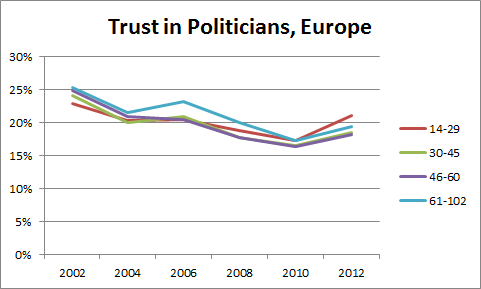
The European Social Survey asks respondents whether they trust politicians. Respondents are offered a 10-point scale, and after some experimentation, I have divided the subjects into those who gave scores between 0-5 and those who said 6-10. The available data come from even-numbered years between 2002 and 2012:

Eurotrust2

Note, first, that not many people rate politicians 6 or higher on a 10-point scale. That is not exactly startling news. Second, all age groups were more positive in 2002, less so by 2010, and somewhat more trusting again in 2012. Finally, the four major age groups show the same trends. If you wanted to identify a generational difference, you might note that seniors lost less trust between 2002 and 2004–possibly buffered from the recession by national retirement programs. The young are currently the most trusting, albeit not by much.

This graph is evidence that there isn’t really a phenomenon of youth distrust in politics in Europe. The distrust is shared. That said, I should note two caveats. First, the span of years shown above is short; it would be interesting to know how a similar question would have been answered in 1988 or 1966. Second, I didn’t track the same birth cohorts over time. People aged 14-29 in 2002 were 24-39 a decade later. It is conceivable that tracking birth cohorts would reveal a significant difference between those born in 1982 versus 1992–but that seems unlikely given the lack of a relationship between age and trust.

The post alienation from politics in Europe appeared first on Peter Levine.

The Rise of Biocultural Rights

Can law be used to protect and advance the commons?  One of the most promising new developments here is a new jurisprudence of “biocultural rights.” Biocultural rights represent a bold new departure in human rights law that recognizes the importance of a community’s stewardship over lands and waters.  Instead of focusing on individual rights and private property, biocultural rights explicitly recognize a community’s identity, culture, governance system, spirituality and way of life as embedded in a specific landscape.  In other words, it recognizes the existence of a commons. 

The history and character of biocultural rights are wonderfully explained in a recent law review article in the Journal of Human Rights and the Environment.  The article, “Community Stewardship:  The Foundation of Biocultural Rights,”  is by Kabir Sanjay Bavkiatte, a cofounder of Natural Justice, an international collective of environmental lawyers, and Thomas Bennett, a professor at the university of Cape Town, South Africa. (Vol. 6, No. 1, March 2015, pp. 7-29)

Here’s an abstract of the article:

The term ‘biocultural rights’ denotes a community's long established right, in accordance with its customary laws, to steward its lands, waters and resources. Such rights are being increasingly recognized in international environmental law. Biocultural rights are not simply claims to property, in the typical market sense of property being a universally commensurable, commodifiable and alienable resource; rather, as will be apparent from the discussion offered here, biocultural rights are collective rights of communities to carry out traditional stewardship roles vis-à-vis Nature, as conceived of by indigenous ontologies.

Certain core principles lie at the heart of biocultural rights, write Bavkiatte and Bennett.  These include “non-discrimination, protection of cultural integrity, self-government, title to lands and natural resources, together with social welfare for economic well-being.” 

The authors concede that “international lawyers have undertaken little or no research into the development of biocultural rights” – something that this article sets out to rectify. They argue persuasively, however, that these rights have clearly surfaced in a variety of international covenants, declarations, conventions and codes of conduct. 

Biocultural rights as a new field of law have not emerged magically on their own, but through the convergence of four interrelated movements that have contributed important ethical principles, legal concepts and political advocacy.  Together, these movements have brought the idea of biocultural rights into sharp focus. 

The four movements identified by the authors consist of:

“post-development” advocates who are articulating a vision for human society beyond the discredited neoliberal paradigm;

the commons movement that rejects the “tragedy” fable and empirically demonstrates the effectiveness of local self-governance;

the movement of indigenous peoples asserting their right to self-determination, cultural heritage and stewardship of the land; and

the push for a “third generation” of environmental human rights that go beyond basic civil and political rights (first generation) and socio-economic and cultural rights (second generation), to recognize community rights to self-determination, economic and social development, cultural heritage and a clean and healthy environment.

read more