Well, another election approaches next week! And we have some Civics in Real Life resources to share!
This includes our newest CRL on the upcoming mid term elections.

But don’t forget that we have so many more!
Inflation & Presidential Approval

Well, another election approaches next week! And we have some Civics in Real Life resources to share!
This includes our newest CRL on the upcoming mid term elections.
But don’t forget that we have so many more!
Inflation & Presidential Approval
Newly published on Tisch College’s CivicGreen website is “Civic Engagement in American Climate Policy: Collaborative Models,” a report from CivicGreen in cooperation with the Center for Communities by Design, the American Institute of Architects, and the Kettering Foundation. Carmen Sirianni has been a key organizer of this work, along with Ann Ward and others.
The report is a detailed guide to incorporating public engagement and public work in addressing the climate crisis. It’s not about public advocacy or popular pressure to enact environmental policies, but rather the public’s role in implementing policies–from local planning to paid service jobs that offer pathways to green careers. It draws on extensive experience with:
I observe some environmentalists framing public engagement as basically a barrier to efficient climate policy. They fear that NIMBY citizen organizations may block green projects or divert funds that were intended for climate to other purposes, thus weakening their impact.
I also see some progressives trying to redefine environmental policies to accomplish other social-justice goals using money that was earmarked for climate. I get their motivations, but diverting funds threatens climate outcomes.
In my view, public engagement is essential for making green investments actually work for their intended purposes. For instance, funds for public transportation will only cut carbon emissions if people ride the new trains and buses–and communities know what transit is needed. If more people are paid to address climate problems in their daily work, the constituency for environmental reform will grow, especially if these workers are organized, not only to advocate for wages (which is good) but also to address environmental issues. Public engagement must go well, which is by no means inevitable. This new report offers detailed, experienced-based recommendations.
See also: the major shift in climate strategy; A Civic Green New Deal; and the Green New Deal and civic renewal
As of today, I am @peterlevine@mastodon.sdf.org on the decentralized Mastodon network (https://mastodon.social/).
I would report good experiences with Twitter (as @peterlevine). I never attract enough attention there to be targeted by malicious or mean users. I don’t see fake news. (Of course, everyone thinks that’s true of themselves; maybe I’m naive.) I do enjoy following 750 accounts that tend to be specialized and rigorous in their respective domains. I read an ideologically diverse array of tweets and benefit from conservative, left-radical, religious, and culturally distant perspectives that I would otherwise miss–yet I curate my list for quality and don’t follow anyone unless I find the content useful. A bit of levity is also appreciated.
Notwithstanding my own positive experiences, I understand that Twitter does damage. At best, it’s far from optimal as a major instantiation of the global public sphere. We’d all be better off engaging somewhere else that was better designed and managed.
However, making the transition is a collective-action problem. Networks are valuable in proportion to the square of the number of users (Metcalfe’s Law). Twitter has been helpful to me because so many people are also on it, from defense logistics nerds posting about Ukrainian drones to election nerds tweeting about early ballots to political-economy nerds writing about Elinor Ostrom. For everyone to switch platforms at the same time and end up in the same place is a classic coordination dilemma.
Elon Musk may provide the solution by encouraging enough Twitter users to try the same alternative platform simultaneously. I perceive that a migration to Mastodon is underway. Joining Mastodon may offer positive externalities by helping to make it a competitive alternative. Starting anew is also pretty fun, even though the Mastodon interface isn’t too intuitive. So far, I have four followers, and the future is promising.
One deep story that’s being told about our current political crisis invokes polarization: two “poles” or ends of the spectrum are seen as moving apart and growing mutually hostile. That is a symmetrical metaphor. A different deep story emphasizes the anti-democratic and anti-constitutional turn of MAGA-style Republicans. I would add a third model that involves both parties, but not in a symmetrical way. It is also less about ideas and policies than interests and identities. It’s a story of inverted partisanship.
Envision a democracy with two main parties or coalitions. The left party favors more taxing, spending, and regulation and draws most of its votes from the lower half of the economic scale. The right party opposes government economic intervention and draws its support from the upper half.
This kind of system can be frustrating, since the median voter (who probably comes from the middle of the economic scale) often wields the deciding vote. Both socialist and libertarian principles are somewhat disfavored. However, if you are a socialist or a libertarian, you should believe that you can convince the median voter of your ideas. Meanwhile, the debate is a good one, because citizens can determine the role of government. And both sides are constrained. The left may want lots of government, but as taxes and regulation rise, so will resistance. The right may love markets, but cutting government deeply also creates opposition. The whole system is pretty stable–for better and worse–and it tends to reward ideas that benefit most people.
Now switch the demographics of the parties, so that the rich vote for the left and the poor vote for the right. In that situation, the left will not really do anything substantial to promote equity, because that would cost its affluent voters. You will see lots of virtue-signaling; superficial policies, hypocritically applied; and odd priorities, such as forgiving college debt but not medical debt. Meanwhile, the right will not get far by cutting taxes, since low-income people pay little or no income tax. The right will look for other ways to benefit its constituency, probably including appeals to racial, national, and/or religious identity.
In this situation, the path to ambitious progressive policies is blocked by the left party itself, while the right party is prone to dangerous escalation. You’ll see statements like John Daniel Davidson’s “We Need To Stop Calling Ourselves Conservatives” in The Federalist (Oct 22). Davidson floats adopting a “pro-worker, even pro-union political agenda that once belonged to the left” and displaying “a willingness to embrace government power.” But to what end? “Drag Queen Story Hour should be outlawed,” “parents who take their kids to drag shows should be arrested and charged with child abuse” and “teachers who expose their students to sexually explicit material should not just be fired but be criminally prosecuted.”
Davidson is not a political strategist, and many of his ideas would poll very poorly. In that sense, his own agenda would be constrained by voters. However, partisan political entrepreneurs on the right can develop cannier agendas that win Republican primary elections and legislative majorities in selected states and give them substantial power. They will not arrest parents for attending constitutionally protected public events, but they will arrest Black men for registering to vote in good faith or transport asylum-seekers to Martha’s Vineyard.
I think a model of a class inversion is more informative than one of “polarization,” which assumes that two durable coalitions have moved apart. In contrast, the inversion model presumes that some people have changed their parties–like the Obama-Trump voters of Luzerne County, PA.
There are signs of this class inversion in many democracies today. However, the picture in the USA is mixed, because wealth, race, and education don’t push in the same directions. Right now, according to the Washington Post-ABC poll, household income does not predict people’s opinion of the 2022 election very well. Democrats perform just a touch better among households earning less than $50,000 per year, and Republicans do better above that threshold, but the whole graph (see above) is pretty flat. That’s because income and being white correlate with support for Republicans, whereas education and being black correlate with Democratic support. The result is our somewhat mixed situation, in which the parties fumble between their traditional roles and inverted ones.
I am fully aware that race is at the heart of the issue in the United States–as it has been all along in this country. However, that observation should be the beginning of the conversation, not the conclusion. If the parties invert their class positions because of white racism, then the whole system is in trouble. Socialists, moderates, libertarians, and constitutionalists should all be alarmed. Again, this is not a new threat today; the end of Reconstruction offers a frightening precedent. But it will be a tough trap for our republic to escape.
Real constitutionalist conservatives have critical work to do on their side of the aisle. Meanwhile, Democrats need to win the votes of more low-income whites, whether that means taking Heather McGee’s advice to explain how racial injustice also harms whites, or taking Ruy Teixeira’s advice to reclaim patriotism and certain traditional values, or running campaigns like Tim Ryan’s in Ohio, or simply doing more to benefit low-income communities that include a lot of white voters.
See also the social class inversion as a threat to democracy; social class in the French election; why the white working class must organize etc.
Newly published (behind a firewall): Peter Levine (2022) Mapping ideologies as networks of ideas, Journal of Political Ideologies, DOI: 10.1080/13569317.2022.2138293.
This is an early publication from my main current scholarly project. I am concerned that several streams of research and intellectual conversations are converging on the same conclusion: people just aren’t very thoughtful or rational about politics. This stance discourages efforts to enhance democracy and the public sphere. However, the most prevalent measurement tools–standard opinion surveys–are systematically biased against detecting the complexity and individuality of individuals’ political views. Various colleagues and I are experimenting with alternative quantitative methods that involve directly asking people about the connections among their distinct beliefs and analyzing the results as networks. This sole-authored article is a pilot study aimed at validating the method.
Abstract:
Individuals in a non-representative sample of 93 US progressives were asked which social outcomes they valued and then asked about the relationships among these opinions. Did each outcome provide a reason for a different one? Would each outcome cause a different one? If each outcome came to pass, would it make them more likely to support another outcome? Network diagrams derived from these responses represent portions of these individuals’ ideologies, understood as structures of political thought. Scrutiny of the network diagrams and analysis of the aggregate data suggest that most respondents carefully and reasonably identified relationships among their own ideas. Features of their networks predicted their assessments of five prominent politicians. This exploratory study paints a strikingly different picture of the sample than what would emerge from more conventional methods, such as factor analysis. Instead of a group that looks ideologically homogeneous on a unidimensional scale or that exhibits a low level of ideological coherence (because very few of their ideas are correlated), this method displays a collection of people who hold diverse and complex structures of thought. The method should be replicated with representative samples to explore the variation and significance of such structures.
See also: what if people’s political opinions are very heterogeneous?; individuals in cultures: the concept of an idiodictuon; ideologies and complex systems; don’t let the behavioral revolution make you fatalistic, etc.
In our Introduction to Civic Studies course, we are briefly discussing both the classical tradition of republican thought (from Cicero to John Adams) and the contributions of Black American republican thinkers of the 19th century, as described by Melvin Rogers (2020). In this brief introductory video, I identify the following components of traditional republicanism:
One of our US political parties happens to be called “Republican,” and I think that is not merely coincidental. The GOP has roots in antebellum abolitionist movements that, in turn, explicitly invoked republican ideas.
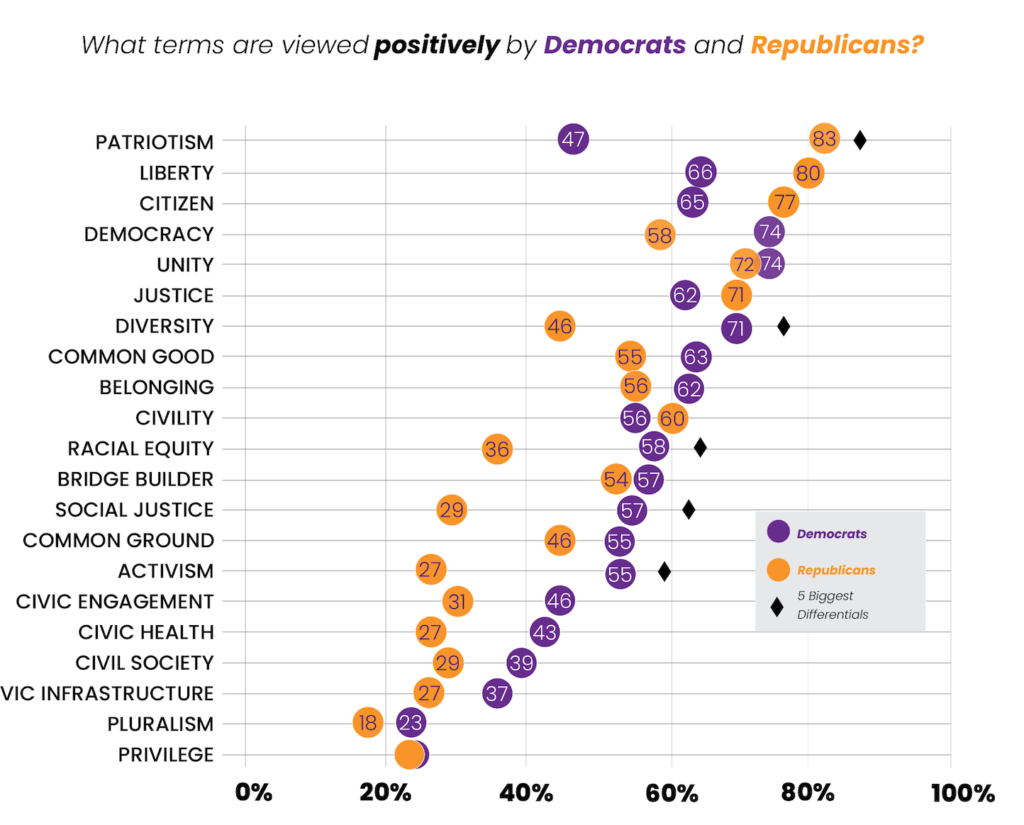
But that doesn’t mean that either of our major parties today is necessarily more republican (in the classical sense) than the other. The recent Civic Language Perceptions Project from Philanthropy for Active Civic Engagement (PACE) offers a chance to see how partisanship–as well as demographics–relate to classical republican ideals. Not all of the components of republicanism are tested, but some are. The data come from a nationally representative random sample of 5,000 registered voters conducted in 2021.
One component of traditional republicanism was an orientation to the common good. That phrase might seem like empty rhetoric, but classical republican authors placed the common good ahead of individual negative freedom, material prosperity, and pluralism, which they often decried as “factionalism.”
PACE asked respondents to react to the phrase “common good,” and it performed best among people who identified as “very liberal.” (See the graph above.)
Patriotism is not on my list of components of republicanism, but often the civic virtues have been defined in patriotic terms. Although some today may see patriotic rhetoric as conservative, it was fundamental to left-wing revolutionary republican movements, from France in 1789 to Mexico in 1910 to Russia in 1917. According to the PACE data, patriotism polls far better among Republicans than among Democrats: a 36-point gap. (See below.)
“Liberty” was the great principle for classical republicanism, and it polls better among Republicans than Democrats. However, some Americans may think of liberty as non-interference (simply being left alone), whereas for classical republicans, it meant non-domination (freedom from arbitrary will). This semantic ambiguity makes the result hard to interpret.
Both parties like “unity,” which was a classical republican value, but Democrats like “diversity” much more than Republicans do. Classical republicans tended to be skeptical of diversity. Therefore, either Democrats dissent from classical republicanism on this issue, or else the word “diversity” is being used in a new way–basically to mean racial equity, which Democrats like much more than Republican do: a 22-point gap. Classical republicans should have embraced racial equity, even though few actually did.
Republics require participation, also known as civic engagement, and that phrase is more popular among Democrats than Republicans.
Democracy is compatible with republicanism, although proponents of democracy tend to emphasize majority rule and responsiveness to mass opinion, whereas republicans want voting to play the limited role of checking elite domination. Madison writes, “If a faction consists of less than a majority, relief is supplied by the republican principle, which enables the majority to defeat its sinister views, by regular vote” (Federalist 10). In this passage and many others, he’s defining “republican” as majoritarian, but his own overall view is more complex. Democrats are more favorable to the word “democracy” than Republicans are, according to the PACE data, although a majority of Republicans do support it.
On balance, one might conclude that today’s Democrats are more republican than Republicans are; but perhaps it’s more accurate to regard the classical republican tradition as marginal all across our spectrum.
Source: Melvin Rogers, “Race, Domination, and Republicanism,” in Difference without Domination: Pursuing Justice in Diverse Democracies, edited by Danielle Allen and Rohini Somanathan (University of Chicago Press 2020). See also introducing republicanism; James Madison in favor of majority rule; every Republican president [until Trump] insisted that the US is a democracy; a Democratic Republican Federalist; what defines conservatism?; liberals, conservatives, and love of the Constitution etc.
Anna Saavedra, Meira Levinson, and Morgan Polikoff report some results from the August-September Understanding America Study that reveal what Americans believe about teaching controversial issues in schools. The sample is 3,751 representative adults, and the survey is a high-quality instrument that I have previously used myself.
The headline is that Americans broadly agree about discussing many issues that might be considered controversial in high school. There is consensus about the value of discussing issues from slavery to local politics, and from sex education to the environment–plus the contributions of both the founders and women and people of color. There are no meaningful differences by political party on those items. It also doesn’t matter how most of the issues are named. For example, similar proportions support discussing “limiting immigration” and “immigration rights,” or “2nd amendment” and “gun control.”
There is much less agreement about discussing sexual orientation and related issues. Democrats are strongly supportive; Republicans oppose. The whole sample is less supportive of teaching controversial issues at all in elementary school, and there again, issues related to sexuality and gender get the lowest support.
See also public opinion on Critical Race Theory; Teaching Honest History: a conversation with Randi Weingarten and Marcia Chatelain; etc.
Last spring, I noted that my own predictions for US politics had been badly wrong. I doubt that anyone was interested in the reliability of my crystal ball, but it can be useful to lay out one’s own expectations, test them against reality as events unfold, and then reflect on why you were right or wrong.
In that spirit, I currently expect Republicans to win the House–and quite likely the Senate–and to sweep more really extreme characters into state and federal office. I think the outlines of current federal policy will then remain basically unchanged, because Biden will be able to veto Republican bills, and the House GOP has a poor recent record of even mustering the votes on its own side. There may, however, be hair-raising showdowns over the debt limit and annual must-pass appropriations.
State policies will vary, with red states and blue states heading in opposite directions on abortion, policing, climate, education, and other key issues.
The Supreme Court will probably ban the use of race as a consideration in university admissions. That will not only have a major impact on who attends college (which is the main issue) but will also begin a deluge of litigation to investigate and alter pervasive practices within higher education. Documents will be subpoenaed; people will be deposed.
The Supreme may also gut the Clean Water Act and could decide Moore v. Harper in a way that allows legislatures to override the’ decisions in presidential elections, which would throw the 2024 election into grave question.
We are headed into a recession. That will cause social needs and dissatisfaction to rise and tax revenues to fall.
The probability of an international crisis is reasonably high, not only in Ukraine/Russia but also China/Taiwan and Iran. Justice may prevail in each of those cases, but the risks to the people of those regions and the world are serious.
At home, we will see more frequent acts of overt political violence and perhaps some really major politically motivated crimes.
Trump will be running for president, first unofficially and then as a declared candidate. He will easily dominate the GOP primary. Meanwhile, there is a substantial probability that he will face at least one criminal proceeding. He will use his prosecution as evidence of persecution by his political enemies.
Echoing the Clinton and Obama years, the new Republican majority will grow rapidly unpopular. Biden’s popularity will be suppressed by the recession but boosted by his opponents: Trump and the Hill GOP. Democrats will help to amplify the most extreme Republican voices. Biden will poll ahead of Trump through most of the 2024 election season, but there will be a real possibility that state legislatures and the US House will overrule the voters, especially if the Supreme Court exempts legislatures from judicial review regarding elections. Certainly, Trump will pre-announce that he cannot possibly lose, and a fair number of Republicans will echo that claim. I believe there would be resistance within the GOP, but that would be an intra-party struggle that would make everyone else into bystanders.
(By the way, if I did the math right, then according to the Social Security Administration’s actuarial tables, there’s a 73% chance that both Biden and Trump will still be alive in 2025, and a lower chance that both men will be healthy enough to serve.)
My predictions may be too pessimistic. Last time, I was overly positive. Regardless of how things play out, I’d offer two thoughts about addressing our situation.
First, a lot more Americans should be learning specific skills for organized nonviolent civil resistance. I am not arguing that nonviolence is morally superior or preferable in all situations. I do believe that only large-scale movements that are predominantly nonviolent will be relevant and plausibly effective in defense of democracy in the United States at this point. Here are few resources for learning. I am actually quite optimistic that the American people will prove hard to dominate and will resist effectively, but skills will help.
Second, we may have opportunities to build a better system, not merely preserve a flawed one. For instance, the Supreme Court has already played a problematic role in our government, and a crisis may be an opportunity for basic reform.
To take one example of a very bad-case scenario: Biden actually wins more Electoral College votes than Trump does in 2024, but several state legislatures award their votes to Trump, and the House certifies him as the president. That would be the beginning, not the end, of a chapter in American democracy. The end would depend on us.
See also: how I misjudged our moment; time again for civic courage; how to respond, revisited; reforms for a broken Supreme Court; etc.

“Civic tech” broadly refers to the use of digital technologies to support a range of citizen engagement processes. From allowing individuals to report problems to local government to enabling the crowdsourcing of national legislation, civic tech aims to promote better policies and services – while contributing to more inclusive democratic institutions. But could civic tech affect public issues in a way that benefits some and excludes others?
Over the decades, the question of who participates in and who is excluded from participation mediated by technology has been the focus of both civic tech critics and proponents. The latter tend to argue that, by enabling citizens to participate without constraints of time and distance, civic tech facilitates the participation of those who usually abstain from engaging with public issues, leading to more inclusive processes. Critics argue that, given the existing digital divide, unequal access to technology will tend to empower the already empowered, further deepening societal differences. Yet both critics and proponents do tend to share an intuitive assumption: the socio-economic profile of who participates is the primary determinant of who benefits from digitally mediated civic participation. For instance, if more men participate, outcomes will favor male preferences, and if more young people participate, outcomes will be more aligned with the concerns of the youth.
In a new paper, we show that the link between the demographics of those participating through digital channels, and the beneficiaries of the participation process, is not necessarily as straightforward as commonly assumed. We review four civic tech cases where data allow us to trace the full participatory chain through:
We examine online voting in the Brazilian state of Rio Grande do Sul’s participatory budgeting process, the local problem reporting platform Fix My Street (FMS) in the United Kingdom, Iceland’s online crowdsourced constitution process, and the global petitioning platform Change.org.
Change.org has been used by nearly half a billion people around the globe. Using a dataset of 3.9 million signers of online petitions in 132 countries, we examine the number of successful petitions and assess whether petitions created by women have more success than those submitted by men. Our analysis shows that, even if women create fewer online petitions than men, their petitions are more likely to be successful. All else equal, when online petitions have an impact on government policy, the agenda being implemented is much closer to the issues women choose to focus on.
In Rio Grande do Sul’s digital participatory budgeting (PB), we show that despite important demographic differences between online and offline voters, these inequalities do not affect which types of projects are selected for funding – a consequence of PB’s unique institutional design, which favors redistributive effects.
In fact, of all the cases analyzed, none reflect the standard assumption that inequalities in who participates translate directly into inequalities in who benefits from the policy outcomes. Our results suggest that the socio-economic profile of participants predicts only in part who benefits from civic tech. Just as important to policy outcomes is how the platform translates civic participation into policy demands, and how the government responds to those demands. While civic tech practitioners pay a lot of attention to design from a technological perspective, our findings highlight the importance of considering how civic tech platforms function as political institutions that encourage certain types of behavior while discouraging others.
Civic tech, it seems, is not inherently good nor bad for democratic institutions. Instead, its effect is a combination of who participates on digital platforms and the choices of platform designers and governments.
***
Post co-authored with Jonathan Mellon and Fredrik M. Sjoberg. Cross-posted from the World Bank’s Let’s Talk Development blog.
This is a 12.5-minute video in which I introduce the republican tradition (or just “republicanism”) as it is typically discussed in political theory these days. I’m drawing on authors like G.J.A. Pocock, Quentin Skinner, Philip Pettit, and Ian Shapiro. I also refer to Melvin Rogers’ important recent work on Black American republican thought and some ideas of Brooke Ackerly about how domination (which is the main concern of republican theorists) may relate to oppression. In our Introduction to Civic Studies course, we will be reading and discussing Rogers, so an immediate purpose of my video is to give our students some definitions that they can use to understand his work. But I hope that the video may be useful for others as well.
See also citizens against domination; what republic means, revisited; civility as equality; what to do about the guy behind the desk; civic republicanism in medieval Italy: the Lucignano council frescoes (etc.)