The Robin Hood Coop, an Activist Hedge Fund

Now here is an improbable idea:  an activist hedge fund.  Out of Tampere, Finland, comes the Robin Hood Asset Management Coop, which legally speaking, is an investment cooperative.  It is designed to skim the cream off of frothy investments in the stock market to help support commoners.  As the website for the coop describe it:

We use financial technologies to democratize finance, expand financial inclusion and generate new economic space.  Robin Hood’s proposition is no different than it was 600 years ago in Sherwood:  arbitrage the routes of wealth and distribute the loot as shared resources.  Today we just use different methods to achieve the same:  we analyze big data, write algorithms, deploy web-based technologies and engineer financial instruments to create and distribute surplus profits for all.  Why?  Simply, we believe a more equitable world is a better one.  

The Robin Hood Coop currently has 808 members from some 15 countries, and manages about 651,000 euros in various stock market investments.  Started in June 2012, the coop has generated over 100,000 euros for its members and to its common pool, which is used to support commons projects.  Robin Hood reports that in its first year, it had “the third most profitable rate of return in the world of all the hedge funds.” 

Anyone can join the coop for a 30€ membership fee, which entitles members to invest a minimum of 30€.  Members can then choose eight different options for splitting any profits (after costs) among their own accounts, Robin Hood Projects and the general Robin Hood Fund.  Most members choose a simple 50-50 split of profits to themselves and Robin Hood Projects.  For the past two full years of its operations, the project has been profitable. (As of November 19, however, net asset value was down 6.38%.)  Robin Hood says that its operating costs are quite low compared to normal asset management services provided by banks.

The enterprise is driven by Robin Hood’s “dynamic data-mining algorithm,” which it calls “Parasite,” because it tracks actual transactions in US stock markets and mimics the best market actors.  The coop’s website explains:  “The parasite listens to the feed of the NYSE, watching for traders and what they trade. Then it competency ranks traders, identifying ones that are constantly making money on specific stocks. When it sees that a consensus is forming among such competent traders, it follows.”   Robin Hood appears to be out-performing many leading hedge funds and reaping impressive returns, and it provides a modest but welcome source of income for some commons projects.

read more

Six Degrees of Wonder Woman: Part 2

As I mentioned previously, for one of my classes I am constructing a network of superheroes with an eye towards gender diversity in this medium.

Using data from the Grand Comics Database, I filtered down their 1.5 million unique stories to look specifically at English language comic books tagged as being in the “superhero” genre.

Each comic book record includes a list of the characters appearing in that comic book, but, unfortunately, the database doesn’t include information on characters’ identified gender. So I went through and added this information to the data set.

More generally, I also wanted to identify the unique identity of each person under a given mantel – a non-trivial task.

In the end, I ended up with the below super-hero social network. Female characters are indicated by green and make up 28% of the network. Yellow nodes indicate male characters.

hairball3

Nodes are sized by degree (number of connection to other characters), and you can see from the above that male characters have, on average, a higher degree than female characters.

Since the above visualization is not very helpful, I’ve included a visualization of the top 50 nodes (by degree), below. The top 5 men and top 5 women are labeled – I had to split it up because Wonder Woman was the only woman in the top 10. If you’re wondering, the yellow node off to the top left is one Commissioner James Gordon.

highdegree_good

Stay tuned for future analysis!


facebooktwittergoogle_plusredditlinkedintumblrmail

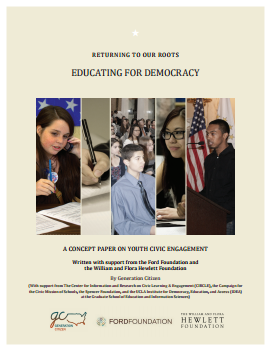
Returning to our Roots: a new white paper on educating for democracy

GCwhitepaperReleased today is a strategy paper entitled Returning to Our Roots: Educating for Democracy. The authors are Generation Citizen plus a committee from other groups, including my CIRCLE colleagues and me. I’m pleased to have been part of the discussions that generated this paper. It is distinctive in that it puts political engagement at the center of civic education and addresses both schools and out-of-school opportunities.

Generation Citizens’ executive director, Scott Warren, also has a piece entitled “Student protests reveal thirst for a dialogue on democratic process” in the Hechinger Report. Scott uses this article to summarize the recommendations of the report.

Public Agenda & WNYC Release NY Opinion Survey Results

Last month, another great D&D-public radio partnership came to fruition – this time between Public Agenda, an NCDD member organization, and WNYC. PA conducted a survey of metro NYC residents’ opinions on key public issues and released its results in an in-depth report and a series stories on The Brian Leher Show all accompanied by PA blog posts. We encourage you to check out the results of their partnership in the PA announcement below or find the original here.


PublicAgenda-logoNew York Metropolitan Area State of Mind

Over the past year, we’ve been working with WNYC to survey residents of the New York metropolitan region. We wanted to know how area residents are thinking about public issues like education, income inequality, housing costs, taxes, crime and police-community relations.

Throughout the fall, we’ll be releasing results from that survey in coordination with WNYC. Starting Monday, October 15, tune in each day to The Brian Lehrer Show at 10 a.m. ET to hear about what we found. Will Friedman and Carolin Hagelskamp, our president and director of research, respectively, will be talking with Brian about a different story each day. If you’re not in the area, you can listen online, live or after the show.

The segments will be accompanied by blog posts from us, which we’ll post below, and reporting from WNYC’s newsroom and data viz team. Don’t miss out on any of it: follow us on Facebook and Twitter, where we’ll be providing links in real time.

In November, we’ll release a couple of formal reports summarizing everything we’ve learned. Be sure you’re registered for our email list if you want to receive those reports.

The Public Agenda/WNYC Survey is the first annual Deborah Wadsworth Fund Project and is possible thanks in large part to the generosity of our donors. The survey will help inform our next annual Deborah Wadsworth project, through which we’ll seek to find collaborative solutions to an issue local residents care and worry deeply about…

Methodology

The Public Agenda/ WNYC New York Metro Area Survey was conducted between June 29 and July 21, 2015 with 1,535 residents in the New York metro area, including New York City, Long Island, Southern New York State, Northern New Jersey, and Southern Connecticut. Additional responses were collected from 219 residents on a small subset of questions between August 25 and September 4, 2015. Some questions were posed to random subsamples of the overall sample, including the reported questions on people’s view on policing and crime, which explains why the total number of responses on these questions is smaller than the total survey sample. Data were collected via phone, including cellphone, and online, and weighted to be representative of known demographics in the region.

The Results

Full Report

What’s At Issue Here?: New York Metro Area Residents on the Problems That Concern Them Most

This PDF summarizes main findings from the 2015 Public Agenda/WNYC New York Metro Area Survey.


Survey Topline

Public Agenda/ WNYC New York Metro Area Survey Topline

This document includes a full description of the questions asked in the survey, complete survey responses and a comprehensive methodology report.


Press Release, October 12, 2015

Is New York No Longer the Land of Opportunity?

New York Metropolitan Area Residents Feel Trapped by Economic Insecurity, According to New Public Agenda/WNYC Survey; Most Say Government Responds to the Wealthy, Not Them


Press Release, October 12, 2015

Public Agenda/WNYC Survey Finds Stark Racial Differences in How New York Metropolitan Area Residents View Crime, Policing

Black and Hispanic Residents Twice as Likely as Whites to View Police-Community Relations as a Serious Problem


Blog Post

What Do Residents of the Greater New York Metro Area Worry About Most?

Regardless of where they live, affordability is what residents of the greater NY metro region worry about the most.


Blog Post

New Yorkers Don’t Resent the Wealthy, But…

Most New York area residents say it’s ok for wealthy people to get wealthier as long as everyone else also has a good chance to get ahead. The problem is, people don’t feel like they’re getting that chance.


Blog Post

In Solving Region’s Problems, New York Area Residents See a Role for Government, and for Themselves

New York area residents see a place for both the government and for themselves in solutions to the region’s problems.


Blog Post

New Yorkers on Taxes: Contradictory or Common Sense?

New York area residents say high taxes are a big problem, yet they want more government spending on housing and education. What gives?


Blog Post

Police-Community Relations Strained Where Police Needed Most

Results from our recent survey with WNYC suggest that the communities that may need police the most are also likely to say their relations with the police are most problematic.


You can find the original version of this Public Agenda posting at www.publicagenda.org/pages/wnyc-new-york-metro-area-survey#sthash.F1GGrsYj.dpuf.

Behavioral Responses to Social Dilemmas

I had the opportunity today to attend a talk by Yamir Moreno, of the University of Zaragoza in Spain. A physicist by training, Moreno has more recently been studying game theory and human behavior, particularly in a complex systems setting.

In research published in 2012, Moreno and his team had people of various age groups play a typical prisoners dilemma game: a common scenario where an individual’s best move is to defect, but everyone suffers if everyone defects. The best outcome is for everyone to cooperate, but that can be hard to achieve since individuals have incentives to defect.

Playing in groups of 4 over several rounds, players were matched by a variable landscape – one group existed on a traditional lattice, while in another incarnation of the game players existed in a scale-free network.

As you might expect from a prisoner’s dilemma, when a person’s neighbors cooperated that person was more likely to cooperate in later rounds. When a person’s neighbors defected, that person was more likely to defect in later rounds.

Interestingly, in this first version of the experiment, Moreno found little difference between the lattice and scale-free structure.

Postulating that this was due to the static nature of the network, Moreno devised a different experiment: players were placed in an initial network structure, but they had the option to cut or add connections to other people. New connections were always reciprocal, with both parties having to agree to the connection.

He then ran this experiment over several different parameters, with some games allowing players to see each others past actions and other games having no memory.

In the setting where people could see past action, cooperation was significantly higher – about 20-30% more than expected otherwise. People who chose to defect were cut out of these networks and ultimately weren’t able to benefit from their defecting behavior.

I found this particularly interesting because earlier in the talk I had been thinking of Habermas. As interpreted by Gordon Finlayson, Habermas thought the result of standard social theory was “a false picture of society as an aggregate of lone individual reasoners, each calculating the best way of pursuing their own ends. This picture squares with a pervasive anthropological view that human beings are essentially self-interested, a view that runs from the ancient Greeks, though early modern philosophy, and right up to the present day. Modern social theory, under the influence of Hobbs or rational choice theory, thinks of society in similar terms. In Habermas’ eyes, such approaches neglect the crucial role of communication and discourse in forming social bonds between agents, and consequently have an inadequate conception of human association.”

More plainly – it is a critical feature of the Prisoners Dilemma that players are not allowed to communicate.

If the could communicate, Habermas offers, they would form communities and associate very differently than in a communications-free system.

Moreno’s second experiment didn’t include communication per se – players didn’t deliberate about their actions before taking them. But in systems with memory, a person’s actions became part of the public record – information that other players could take into account before associating with them.

In Moreno’s account, the only way for cooperators to survive is to form clusters. On the other hand, in a system with memory, a defector must join those communities as a cooperative member in order to survive.

facebooktwittergoogle_plusredditlinkedintumblrmail

Video of my Interview on WLOV of Tupelo

Screenshot of the interview I gave for WLOV's This Morning show with Katrina Berry.

As promised,  I’m posting here below my interview on WLOV of Tupelo’s This Morning show with Katrina Berry. Also, below that is a photo of the nice layout that Reed’s Gumtree Bookstore setup for the book signing later that day.

If you can’t see this video in your RSS reader or email, then click here.

Katrina was a lovely person who was kind and encouraging. As I said, she drove home the fact that on WLOV they like to support local authors.  It was a great experience, and also featured the fastest turnaround I’ve experienced for getting a video of the broadcast. All around, great trip.

Oh, and here’s Reed’s Gumtree Bookstore’s nice setup before the book signing. Very nice people there too. They’ve got signed books from John Grisham, George Will, and many more. Great people.

Nice table and display layout for my book signing at Reed's Gumtree Bookstore in Tupelo, MS.

If you know of TV or radio stations that would be interested in an interview about Uniting Mississippi, or groups looking for a speaker, contact me on Twitter, Facebook, or via my info on my Contact page.

Close Up Broward Youth Policy Summit Expo!

So this past week, I had the distinct pleasure of attending the Council of State Social Studies Specialists (CS4) meeting and the National Council for the Social Studies  conference in New Orleans. While there, I had a great conversation with the good people from the Close Up Foundation. Close Up “informs, inspires, and empowers young people to exercise the rights and accept the responsibilities of citizens in a democracy.” And oh my goodness do they do a good job of it. Last spring, Close Up worked with both educators and immigrant students in Broward to draft policy proposals and community improvement plans that could be shared in Tallahassee with our state leaders. An overview of their effort and their trip to the state capital is here, and worth a read!

This Friday, these same students, their mentors, and the Close Up Foundation in Broward will be sharing their work with the community. Take a look at the invitation below. It is 10am to 12pm this Friday the 20th of November at Nova Southeastern. Specifics are in the graphic below. This is an incredible opportunity to hear from young people, future citizens all, who care about their communities, their state, and this nation of ours. Let’s stop complaining about a lack of engagement from young people; let’s show them we care and are proud of them. I look forward to attending this expo, and I hope that you, as a passionate civic educator, will be able to as well. I will be sure to do a follow up on what I saw and heard if you cannot make it!

Expo invite


ideological currents in the current crises

What are these times, when
A conversation about trees is almost a crime
Because it implies silence about so many misdeeds,
When, if you’re calmly crossing the street,
It means your friends can’t reach you
Who are in need? – Brecht, from An die Nachgeborenen (1939)

Racist incidents and youth protests in the USA (including the successful protests at Yale), terror in Paris and Beirut, war in the Levant–these are vastly different topics, and yet they all feed one 24/7 stream of commentary, social media, private conversation, and presidential politics in which themes seem to recur and recombine. Everyone has different views, but I think I discern at least three importantly distinct political philosophies in the mix:

1. A kind of liberalism that we might call, with Judith Shklar, the liberalism of fear. This perspective starts with an abhorrence of deliberate cruelty, especially at a large scale. The premise is that people are more or less capable of living decent lives if left alone, although they may need and deserve economic assistance that they can use as they wish. The worst danger comes from states. Governments must be restrained by general rules that prevent tyranny even if they also block some good ideas.

From this perspective, a private college like Yale is state-like, a threat to its members even if its leaders happen to be benign at the moment. Not only free speech rules but also autonomy for departments, decentralized hiring, tenure, a very flexible curriculum–these are all constitution-like protections against tyranny. If someone proposes a good idea, such as a required course, the question becomes: Why won’t that turn into a bunch of bad course requirements? Do you really trust the administration and the dominant culture that it represents to legislate what courses students must take?

Meanwhile, ISIS is obviously a fundamental threat to freedom and happiness. But the debate within the liberalism of fear is whether to pull out all the stops in attacking ISIS or rather to be concerned that European states and the USA will violate civil and human rights in the name of fighting ISIS.

2. A kind of radicalism that draws on critical race and gender studies, the Frankfurt School, Foucault, and postcolonialism. It observes some people oppressing many other people in a wide variety of settings, often inadvertently. Oppression is built into cultures and mentalities and requires changes in people’s ideas as well as rules and practices.

From this perspective, a private institution like Yale is not only an organization that has chosen official rules to regulate its members. It is also a place dominated by certain cultural norms and populated by people who have been selected and invited (rather than rejected or excluded). Almost everyone thinks that members of the Yale community should have specific rights, such as free assembly and tenure, but this perspective attends to other issues as well. It notes that the whole community has been formed and shaped to have a certain character. The institution’s pervasive culture is biased against some of its members–not to mention the many people who were not allowed in at all. These biases must be challenged.

Meanwhile, ISIS is obviously a terrible threat to diversity and inclusion, but the question quickly arises whether one contributing cause of terrorism may be the biased behavior of countries like France and the United States toward our own religious minorities and toward the Middle East.

3. Views that confidently propose a character for public life, either within a given institution or across a whole society. When John Kasich proposes an institute to spread Judaeo-Christian values, he certainly presumes that the US should have a dominant and unifying culture, but other people have other visions of what a good society should look like. The French republican tradition, for example, is egalitarian, nationalistic, and anti-clerical. It has little in common with US conservatism except for its willingness to argue that every citizen can be, and should be, part of one community with one set of norms. People who are saying, “Don’t pray for Paris–religion is what caused the problem” are invoking a particular idea of France as secular. Some years ago, Emmanuel Todd was sure that Muslim immigrant youth in France were rioting because they have “embraced … the fundamental values of French society, such as … the dyad of liberty-equality” and because they have inherited political norms from the ancient “peasant family structures in the Parisian basin.” He seems to have changed his tune lately, but his view was perfectly franco-republican in its assumption of a unitary egalitarian political culture.

From this perspective, an institution like Yale has a powerful culture and character that may not appeal to, or serve, everyone equally. The question is, what should that character be? Political and critical? Scientific and rationalistic? Nurturing and inclusive? Competitive and demanding? Eurocentric? Postcolonial and cosmopolitan?

Meanwhile, ISIS is an evil threat for this third perspective, but not because its leaders espouse a particular vision that all must follow. Rather, ISIS has a vision that is bleak and cruel and conflicts with the ethos of, say, secular, fun-loving Paris or capitalistic, Christian-infused America.

These are simplified views. I have ignored many complications–to name one, the question of whether a private voluntary association like Yale is very much like a state. As I wrote at the outset, everyone has a position of her own. For myself, I struggle to combine elements of all three views because all seem to me to embody some wisdom.

Had a Great Visit with Katrina Berry on WLOV Tupelo

Photo of terrible rain in between Oxford and Tupelo, MS.Despite the torrential rain this morning, I made it on time to meet with Katrina Berry of WLOV Tupelo’s This Morning show.

Berry is an impressive, award-winning journalist and TV anchor. Her award was from the Associated Press for her weekly series, Heavenly Helpers. When I first got a chance to talk with her, she explained that they aim to support local authors on the show, which was great.

It can seem strange to most scholars to put a lot of effort into securing and participating in a 3 minute interview, which is what it came out to be. Consider how much advertisers spend on 30 seconds or 1 minute of television, however, and all of a sudden, you can appreciate better what 3 minutes of air-time means, in financial terms. One source estimates that even on a local show, ads can cost from as little as $200 to as much as $1,500 for 30 seconds. So a 3 minute interview could be valued from anywhere between $1,200 and $9,000. That’s worth the drive to Tupelo, MS. Those aren’t funds that come to me, of course, but they are value that the show offers for getting the word out about Uniting Mississippi.

After a few nice questions about the book, Berry asked me about the book signing that I’ll be holding from 12-1:30 pm today at Reed’s Gumtree Bookstore, here in Tupelo. Here are a few photos I snagged of my visit to WLOV. When I get a clip of the video of the interview, I’ll post it to my site also. It was a great experience.

Selfie photo of Eric Thomas Weber with Katrina Berry of WLOV Tupelo. Photo of the weatherman in front of a green screen in Tupelo, MS's WLOV TV studio. Photos from the WLOV TV studio in Tupelo, MS.

Know a TV station that might be interested in hearing about Uniting Mississippi? Let me know on Twitter or on Facebook