Political Advertising and Polarization

I think of typical political attack ads as sounding something like this quote from a new Chris Christie ad: “Hillary Clinton will be nothing more than a third term of Barack Obama.”

Or, perhaps, something like this ad from Ben Carson, “[Barack Obama] doesn’t want you to know that his and Hillary Clinton’s failed tough talk but do-nothing policies are responsible for the meltdown in the Middle East.”

If a candidate is feeling particularly devious, they may attack an opponent by quoting them out of context or by showing unflattering images, but as its most basic, an attack ad is a reiteration – often without validation – of the narrative a candidate is trying to impart upon their opponent.

So I took particular note of a new ad from Hilary Clinton which not only names and quotes several republican opponents, but which uses her air time to share footage from their campaign events.

From a marketing perspective, this is surprising on several fronts. First, there’s that old adage – often, though possibility apocryphally, ascribed to the infamous PT Barnum – “Any publicity is good publicity.” That is, simply giving air time to an opponent – even while attacking them – may ultimately help raise their profile while the details of the context are forgotten. Of course, this expression is hardly an un-alterable fact – as many disgraced companies and candidates can attest.

Second, there’s a lot of debate about the effect of negative ads. Many argue that they are effective because people tend to remember negative things better than positive things. But, as the New York Times writes, “negative ads work, except when they don’t,” and they come with the real risk of dragging the ad’s creator down into the mud as well.

But what’s particularly striking about the Clinton ad is that – aside from a clip of Christie telling someone to “sit down and shut up” – I can imagine most of the republican footage being used by the republican candidate it targets.

For example, Clinton quotes Ted Cruz: “…defund Planned Parenthood.” This isn’t something Cruz would seek to deny or hide – it is, in fact, the main selling point of Cruz’s ad, “Values“.

This type of political campaign highlights the starkness of American political polarization. Yes, the ad includes the typical attack-ad tropes of ominous music and poor lighting, but in many ways…Clinton literally lets her opponents speak for themselves and then mic-drops I rest my case.

She doesn’t need to say any more…to Democrats, the Republican candidates are disturbing enough.

I’ve noticed similar signs in more informal settings – on Facebook, for example, there’s been what I can only describe as an attack on Girl Scout cookies going around. “You deserve to know what Girl Scout cookies fund,” the image reads, going on to list the Girl Scout’s partnership with Planned Parenthood for sex education and the fact they they welcome transgender women as peers.

Of course, in my circles, most people are sharing this “attack” ad with the notes like, “Good! Let’s buy more cookies!”

And, in case you’re worried the whole thing is some sort of elaborate hoax, there are, in fact, real groups raising concerns about the Girl Scouts.

I hardly mean to indicate here that all pro-life advocates are anti-Girl Scouts or anti-sex education – but this is exactly the dichotomy that polarization sets up for us.

It’s a self-fulfilling prophesy, really. I have to imagine that in conservative circles they are similarly mocking liberal paraphernalia, and all of it serves to entrench the “us” versus “them” mindset. All of us equally horrified that the other half the countries feels a certain way.

I don’t know how we change that, or how we break through that. But it does seem like we’ve reached a whole new level of polarization when the exact same message can be greeted so differently.

facebooktwittergoogle_plusredditlinkedintumblrmail

the US frequently bans visitors on the basis of speech and opinions

I think the British Parliament made the right decision when it voted not to ban Donald Trump from entering the UK. During the debate, MPs had the opportunity to call him–and I quote–“poisonous,” “a buffoon,” “crazy,” “wrong,” “stupid,” and a “wazzock.” (The Urban Dictionary suggests, as an example of that last term, “You great useless spawny-eyed parrot-faced wazzock.”)

It’s almost never smart to respond to odious speech by keeping it out. It’s almost always better to respond with confident, reasonable, yet forceful speech on the opposite side.

That said, the British are certainly not the only ones to consider banning people on the basis of speech. Indeed, they have a long, if not spotless, record of accepting radicals and subversives of all stripes; Karl Marx is buried in Highgate Cemetery. And we–meaning the executive branch of our federal government–have a long tradition of barring people because of their speech. E.g.,

  • Gabriel Garcia Marquez: denied tourist visas on multiple occasions for having contributed to (but not belonged to) the Communist Party
  • Michel Foucault, denied a visa to attend a conference on “Knowledge, Power, History: Interdisciplinary Approaches to the Works of Michel Foucault.”
  • Pablo Neruda, 1971 Nobel Laureate in literature, denied a visa but admitted after an appeal by Arthur Miller.
  • Palestinian poet Mahmoud Darwish, unable to attend the PEN conference in New York City in 1985.
  • Andrew Feldman, a Canadian professor, denied entry in 2007, when “a border agent discovered he’d written an academic paper about taking LSD in the Seventies.”
  • Hortensia Bussi De Allende, widow of the former President of Chile, who had been murdered in a CIA-supported coup.
  • Tariq Ramadan: Swiss scholar, banned from 2004–2010 on various grounds, including  for having “endorsed terrorism.”
  • The former Cat Stevens (Yusuf Islam): denied entry from 2004-6.
  • German author Ilija Trojanov: denied entry while boarding a scheduled flight for unexplained reasons; known for his criticism of the NSA.

I omit from this list two heads of state who were banned for reasons that arguably involved action as well as speech. Former Austrian President Kurt Waldheim was barred for his Nazi affiliation in WWII. Before taking his current office as Indian PM, Nerendra Modi was denied a diplomatic visa and his existing visa was revoked for having (per the US government) “directly carried out … particularly severe violations of religious freedom.”

US policy has oscillated. The 1952 McCarren Walter Act aimed to bar anyone whose presence could be “prejudicial to the public interest,” a 1978 amendment reversed that law, and the Patriot Act excludes aliens who “endorse or espouse terrorist activity” (i.e., for speech alone). Despite these vacillations, barring people from entering the US on the basis of their speech has been rather common. If it was an unwise proposal to ban Donald Trump from the UK, we ought to reconsider our own policies.

Adding Finesse to Online Engagement Transitions in Gov’t

We encourage our members to check out this post from NCDD organizational member the Davenport Institute and their Gov 2.0 Watch blog on the ongoing transitions that local governments are making toward more online and responsive engagement – an important trend for our field to keep tabs on. Read more below or find the original post here.


DavenportInst-logo

Gov 2.0: Still A Head Scratcher

Eric Gordon of Governing’s City Accelerator lays out the challenge and opportunity that technology presents for public engagement:

This gradually building expectation that government should be responsive to residents is connected to much larger social trends: increased distrust in public institutions, a culture of connectivity prompted by the social Web, and increased expectations of social and responsive systems (think of all those apps in your pocket). In short, technology is motivating new expectations in customer service, and government is being called upon to meet those expectations. 

Recalling the journey newspapers like the New York Times made into Web-world in the late 1990s, he compares governments’ situation vis-à-vis technology today:

The big problems of e-government or Gov 2.0, despite not being fully realized, are relatively straightforward – take what is done offline and shovel it online so it can reach a baseline of efficiency. There is huge value in this, just as there was value for newspapers in initially moving content online. But the challenge now is getting beyond the shovel, and being able to recognize and confront that underlying mutation. We need to understand anew what people’s expectations are, what networks they exist within, and where and how people are empowered to take action. As the call to “do engagement” grows ever more intense, it is imperative that we not automatically reach for the shovel, but instead reach for the tool that’s right for the job (which may in some cases include a shovel).

 Read more at Governing.com, here.

You can find the original version of this Davenport Institute blog piece at http://gov20watch.pepperdine.edu/2015/12/gov-2-0-still-a-head-scratcher.

Collaborative Communication Processes and Decision Making in Organizations

The 410-page text, Collaborative Communication Processes and Decision Making in Organizations, edited by Ephraim Nikoi (University of Wisconsin-Superior, USA) and Kwasi Boateng (University of Arkansas-Little Rock, USA), was published by IGI Global in August 2013.

Collab_Communications

Although organizational decision-making can be very complex, the understanding of technology applications is significant in not only determining the usefulness of virtual groups in organizations, but also in the designing of electronic collaborative activities.

In this work’s 16 chapters, international contributors present research and global case examples in organizational decision making and communication processes for enhancing the effectiveness of organizations and educational environments. Sections deal with themes concerning: e-collaboration tools, creating effective virtual teams, and collaboration and decision making in organizations. Some specific subjects addressed include: fostering social innovation through e-collaboration, promoting critical thinking in virtual teams, and mobile phone usage in organizational communication and decision making.

This title provides academics and management teams with current research in the field of virtual teams in organizations. It is an essential resource for instructors and students of organization and group communication, and institutions that have networks of offices and employees in multiple geographical locations.

About IGI Global
IGI Global is committed to publishing scholarly books, journals, cases, encyclopedias, handbooks of research and electronic resources of the highest quality that provide comprehensive insight into all aspects of information science, business science, medical information science and engineering science. As an internationally-recognized publisher, IGI Global seeks to facilitate the availability of academic excellence and disseminate innovative knowledge worldwide.

Resource Link: www.igi-global.com/book/collaborative-communication-processes-decision-making/75842

This resource was submitted by Ann Lupold, Promotions Coordinator at IGI Global via the Add-a-Resource form.

Designing Kadikoy’s Bicycle Transport and Inonu Avenue Bike Lane Altogether (Kadikoy, Istanbul, Turkey)

For the purpose of mainstreaming utility cycling in Kadıköy, a workshop was carried out with the participation of cyclists, citizens, universities, shopkeepers and the residents of the neighborhood. The workshop targeted the rearrangement of the existing cycling routes, development of new roads for cyclists and raising awareness for bicycle use...

The Downside of Matrix-Style Knowledge Imports

Sometimes it seems as though it would be most convenient to be able to matrix-style download knowledge into my head. You know – plug yourself into a computer, run a quick program, and suddenly, it’s all, “whoa, I know Kung Fu.

Imagine for a moment that such technology was available. Imagine that instead of spending the next several years in a Ph.D. program, I could download and install everything I needed in minutes. What would that look like?

First of all, either everyone would suddenly know everything or – more likely, perhaps – inequality would be sharpened by the restriction of knowledge to those of the highest social strata.

It seems optimistic to imagine that knowledge would become free.

But, for the moment I’ll put aside musings about the social implications. What I really want to know is – what would such technology mean for learning?

I suppose it’s a bit of a philosophical question – would the ability to download knowledge obliterate learning or bring it to new heights?

I’m inclined to take such technology as the antithesis of learning. I mean that here with no value assumptions, but rather as a matter of semantics. Learning is process, not a net measure of knowledge. Acquiring knowledge instantaneously thus virtually eliminates the process we call learning.

That seems like it may be a worthy sacrifice, though. Exchanging a little process to acquire vast quantities of human knowledge in the blink of an eye may be a fair trade.

All this, of course, assumes that knowledge is little more than a vast quantity of data. Perhaps more than a collection of facts, but still capable of being condensed down into a complex series of statistics.

There’s this funny, thing, though – that is arguably not how knowledge works. At it’s simplest, this can be seen as the wistful claim that it’s not the destination, its the journey. But more profoundly –

Last week, the podcast The Infinite Monkey Cage had a show on artificial intelligence. While discussing the topic guest Alan Winfield made the startling observation: in the early days of AI, we took for granted that a computer would find easy the same tasks that a person finds easy, and that, similarly, a computer would have difficulty with the same tasks a person finds difficult.

Playing chess, for example, takes quite a bit of human skill to do well, so it seemed like an appropriate challenge.

But for a computer, which can quickly store and analyze many possible moves and outcomes – playing chess is relatively easy. On the other hand, recognizing sarcasm in a human-produced sentence is nearly impossible. Indeed, this is one of the challenges of computer science today.

All this is relevant to the concept of learning and matrix-downloads because the groundbreaking area of artificial intelligence is machine learning – algorithms that help a computer learn from initial data to make predictions about future data.

The idea of downloadable knowledge implies that such learning is unnecessary – we only need a massive input of all available data to make sense of it all. But a deeper understanding of knowledge and computing reveals that – not only is such technology unlikely to emerge any time soon, it is not really how computers work, either.

There is something ineffable about learning, about the process of figuring things out and trying again and again and again. To say the process is invaluable is not merely some human platitude, it is a subtle point about the nature of knowledge.

facebooktwittergoogle_plusredditlinkedintumblrmail

four tendencies in liberalism

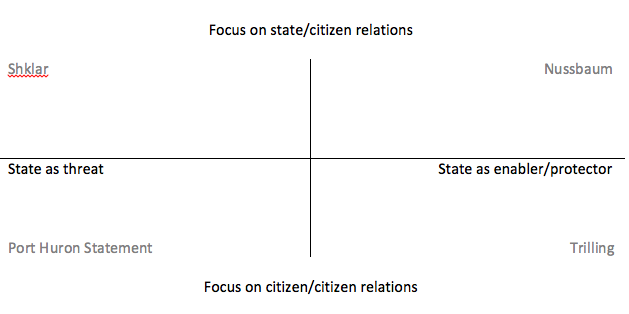
This simple typology might be helpful for distinguishing tendencies within liberal political thought. The x-axis measures attitudes toward the state, ranging from fear to enthusiasm. The y-axis measures the degree to which the state is central to politics. If you are primarily concerned with the state, you belong at the top, and if you focus on horizontal relations among people, you’re at the bottom.

Screen Shot 2016-01-20 at 8.10.05 AM

Judith Shklar exemplifies the top-left quadrant. She is explicit that the question for liberals is how the state treats citizens, and the driving concern is the state’s potential for cruelty and oppression:

Given the inevitability of that inequality of military, police, and persuasive power which is called government, there is evidently always much to be afraid of. And one may, thus, be less inclined to celebrate the blessings of liberty than to consider the dangers of tyranny and war that threaten it. For this liberalism the basic units of political life are not discursive and reflecting persons, nor friends and enemies, nor patriotic soldier-citizens, nor energetic litigants, but the weak and the powerful. And the freedom it wishes to secure is freedom from the abuse of power and intimidation of the defenseless that this difference invites.[1]

Martha Nussbaum exemplifies the top-right. She is also fundamentally concerned with the government, but she emphasizes its potential to enhance human capabilities:

In the end it is government, meaning the society’s basic political structure, that bears the ultimate responsibilities for securing capabilities. [Government] must actively support people’s capabilities, not just fail to set up obstacles. … Fundamental rights are only words unless and until they are made real by government action.[2]

Despite the manifest disagreements between these two authors, both view politics mainly as a set of relationships between the state and citizens.

Down at the bottom right is someone like Lionel Trilling, who thinks that liberalism is about relations among citizens—“discursive and reflecting persons,” in Shklar’s phrase. In a liberal culture, fellow members of a community develop close, responsive relations with one another so that they can enrich their inner lives and develop mutual understanding before they seek to influence the state, their culture, or their community. In passing in The Liberal Imagination, Trilling endorses laws and institutions that enhance freedom and happiness (that puts him on the right side of the spectrum), yet he wishes to “recall liberalism to its first essential imagination of variousness and possibility, which implies the awareness of complexity and difficulty.”[3] For Trilling, sensitive literary criticism is a characteristic liberal act because it involves the recovery of another individual’s thought.

The bottom-left belongs to people who see great importance and positive potential in human beings when they relate appropriately to each other, and who fear the state as a threat to authenticity and creativity. This is at least a thread in the Port Huron Statement, which inaugurated the New Left in America:

Men have unrealized potential for self-cultivation, self-direction, self-understanding, and creativity. It is this potential that we regard as crucial and to which we appeal, not to the human potentiality for violence, unreason, and submission to authority. …  Human relationships should involve fraternity and honesty. Human interdependence is contemporary fact; human brotherhood must be willed however, as a condition of future survival and as the most appropriate form of social relations. Personal links between man and man are needed, especially to go beyond the partial and fragmentary bonds of function that bind men only as worker to worker, employer to employee, teacher to student, American to Russian. … Loneliness, estrangement, isolation describe the vast distance between man and man today. These dominant tendencies cannot be overcome by better personnel management, nor by improved gadgets, but only when a love of man overcomes the idolatrous worship of things by man.

[1] Cf. Judith Shklar, The Liberalism of Fear, reprinted in Nancy L. Rosenblum (ed.), Liberalism and the Moral Life (Cambridge, MA: Harvard University Press, 1989), p. 27.

[2] Martha Nussbaum, Creating Capabilities: The Human Development Approach, pp. 64-5.

[3] Trilling, The Liberal Imagination: Essays on Literature and Society (New York: New York Review of Books, 2008), Preface (1949), p. xxi

Honoring Dr. King

Every year, the great Dr. Martin Luther King, Jr. is commemorated in communities around the country. Officials gather to emphasize the importance of diversity. People participate in service days to help their fellow man. Quotes from the venerable Dr. King can be found everywhere.

I have decided to stick with love. Hate is too great a burden to bear.

It is all very beautiful, meaningful, and inspirational.

There’s just one problem: it’s all just a little too nice. A little too practiced. A little too…superficial.

Particularly among the white community, Martin Luther King Day is too often a day of self-praise and hollow gestures towards justice. As if we can cram all our care into one day and thoughtlessly continue with microaggressions the next. It’s okay cause I celebrated Dr. King. I proved I am not a racist.


Too often in the white community we fail to truly grapple with the complex legacy of Dr. King and the dark history of racism in this country. We share inspirational quotes about love and brotherhood, while glibly glossing over King’s valid and harsh critiques of white privilege.

Rather than praise the great man that was, Martin Luther King Day should be an opportunity for critique and introspection. An opportunity to truly ask ourselves, which side are we on?

Consider Dr. King’s brilliant Letter from a Birmingham Jail (I especially recommend listening to the audio version here.)

One of the basic points in your statement is that the action that I and my associates have taken in Birmingham is untimely. Some have asked: “Why didn’t you give the new city administration time to act?”…Frankly, I have yet to engage in a direct action campaign that was “well timed” in the view of those who have not suffered unduly from the disease of segregation. For years now I have heard the word “Wait!” It rings in the ear of every Negro with piercing familiarity. This “Wait” has almost always meant “Never.” We must come to see, with one of our distinguished jurists, that “justice too long delayed is justice denied.”

As King addresses the criticism of his own actions, it’s easy to hear the critiques of today’s activism. It is too untimely. It is too disruptive. Too aggressive.

As we find these same arguments slipping from our mouths, we’d do well to remember this as the popular white response Dr. King received. King goes on:

I must make two honest confessions to you, my Christian and Jewish brothers. First, I must confess that over the past few years I have been gravely disappointed with the white moderate. I have almost reached the regrettable conclusion that the Negro’s great stumbling block in his stride toward freedom is not the White Citizen’s Counciler or the Ku Klux Klanner, but the white moderate, who is more devoted to “order” than to justice; who prefers a negative peace which is the absence of tension to a positive peace which is the presence of justice; who constantly says: “I agree with you in the goal you seek, but I cannot agree with your methods of direct action”; who paternalistically believes he can set the timetable for another man’s freedom; who lives by a mythical concept of time and who constantly advises the Negro to wait for a “more convenient season.” Shallow understanding from people of good will is more frustrating than absolute misunderstanding from people of ill will. Lukewarm acceptance is much more bewildering than outright rejection.

I had hoped that the white moderate would understand that law and order exist for the purpose of establishing justice and that when they fail in this purpose they become the dangerously structured dams that block the flow of social progress. I had hoped that the white moderate would understand that the present tension in the South is a necessary phase of the transition from an obnoxious negative peace, in which the Negro passively accepted his unjust plight, to a substantive and positive peace, in which all men will respect the dignity and worth of human personality. Actually, we who engage in nonviolent direct action are not the creators of tension. We merely bring to the surface the hidden tension that is already alive. We bring it out in the open, where it can be seen and dealt with. Like a boil that can never be cured so long as it is covered up but must be opened with all its ugliness to the natural medicines of air and light, injustice must be exposed, with all the tension its exposure creates, to the light of human conscience and the air of national opinion before it can be cured.

To truly honor the legacy of Dr. King, those of us in the white community should reflect on his life not with platitudes about justice, but with a critical eye to our own role in the current struggle for social justice. Despite our good intentions, are we indeed a white moderate, standing on the sidelines of change?

facebooktwittergoogle_plusredditlinkedintumblrmail

Next Stage Facilitation Intensive Feb. 23-25 in the Bay Area!

We are pleased to share the announcement below about a new facilitation training opportunity in this February that NCDD members can get a $150 discount on! NCDD Sustaining Member Rebecca Colwell of Ten Directions shared this announcement via our Submit-to-Blog Form. Do you have news you want to share with the NCDD network? Just click here to submit your news post for the NCDD Blog!


Integral Facilitator® Next Stage Facilitation™ Intensives are 3-day workshops introducing the core competencies of an Integral approach to facilitation designed to enhance your capacity to generate greater coherence and increased collaboration and dialogue in the groups you work with.

In this three-day workshop, you’ll learn:

  • How to maintain presence in the face of challenging situations
  • How to work effectively with group energetics and emotional states
  • How to effectively build connection and working with tension to deepen coherence and intimacy
  • How to engage tension, power dynamics and conflict in a group
  • How to increase the positive impact you have on others
  • How to bring an integral approach to your work

As a Next Stage participant, you’ll learn directly from master facilitator, mediator, and former Director of Dispute Resolution for the Utah State Judiciary, Diane Musho Hamilton. Diane is author of Everything is Workable, a Zen Approach to Conflict Resolution.

Your participation will include a deep dive into your personal presence as a facilitator, including how bring an Integral approach to your work with groups, and opportunities to practice new approaches that will stretch your development as a skilled facilitator. Masterful facilitators with depth and presence are more responsive to the subtleties of group dynamics and can create more rewarding and effective dialogue and collaboration.

Two Next Stage Facilitation Intensives will be taking place in North America this year, February 23-25 in the Bay Area, CA, and in Halifax, Canada September 12-14, 2016.

Sign up for an upcoming Integral Facilitator Next Stage Facilitation Intensive and use NCDD coupon “NCDDmbrs” for $150 off the February training at http://bit.ly/1Sin6eJ.

Praise from workshop participants:

“The workshop has shifted my perception of issues such as power, and allowed me to understand where my choices lie. I feel confident to run with those issues now as opposed to fighting against them and using up all my energy.” – Marissa Moore, Senior Finance Executive

“This has been my best experience ever in a 3 day training. Diane is an amazing facilitator! I’m currently figuring out how to get myself in the 1 year program as the 3 days were so exciting and promising in terms of my personal growth.” – Tremeur Balbous, Consultant & Integral coach

“Take facilitation to a whole other level. The Next Stage Facilitation three day intensive shakes you out of conventional and stifled facilitation modes and expands your view to multi-perspectival, grows your competencies toward integral–exploring what it means to work with individuals, the collective and the topic at hand in a balanced, elegant and effective way, and, it strengthens your intuitive faculties to sense and trust the energetic field of the room and respond.” – Michelle Elizabeth, Consultant

Watch Integral Facilitator’s Lead Teacher and Author, Diane Musho Hamilton’s Google Book Talk on conflict resolution:

For more information, visit www.tendirections.com/next-stage-facilitation-3-day-intensive.