does focusing philosophy on how to live broaden or narrow it?

Pierre Hadot (1922-2010) built a quietly devoted following and influenced many others indirectly, via Michel Foucault. A classicist, Hadot interpreted the Hellenistic philosophical schools (Stoicism, Epicureanism, Skepticism, and Neoplatonism) as communities of people devoted to improving themselves by employing a range of mental techniques. Argumentation was just one of their exercises, along with meditation, introspection, confession, renunciation and so on. These schools were similar to classical Indian and Chinese movements, but unlike (say) Kantianism or British empiricism, which are mainly structures of arguments.

Hadot thought that the Hellenistic tradition of “philosophy as a way of life” still echoed in the work of certain post-medieval thinkers: Montaigne, Spinoza, Goethe, Nietzsche, and Wittgenstein, among others. But it had become marginal by the 20th century, because philosophy had turned into an academic discipline, dispassionate and purely intellectual.

Hadot blamed that situation on Christianity, which–he argued–had divided the heritage of Hellenistic thought into two distinct parts. The arts of the self (meditation, confession, and the like) had been assigned to the monasteries, while abstract argumentation went to the universities. Hadot had first trained as a priest and was a learned student of early Christianity, but perhaps he had the critical bias of an ex-believer. None of Hadot’s major positive examples were Christian thinkers.

In any case, Hadot suggested a choice. “Philosophy” can mean argumentation united with mental discipline to produce communities devoted to moral improvement; or it can mean the dispassionate and often individual pursuit of truth. One can see these alternatives oscillate over time. The grand theoretical edifices of Plato and Aristotle give way to the Hellenistic Schools and their focus on self-improvement. Medieval scholasticism yields to humanistic writers like Montaigne and Erasmus, who are more concerned with particular inner lives. German idealism fades in favor of Nietzsche, Emerson, and other practitioners of philosophy as a way of life.

That is a provocative framework, but not the only available one. In The Rise of Western Christendom, Peter Brown describes how a generation of great converts to Christianity–Jerome, Augustine, and their contemporaries–debated the relevance of classical thought and “often took up extreme poses against the pagan classics.” But

such a narrowing down of culture (drastic as it was) [was not] an altogether unique event in the long history of the ancient world. It did not necessarily betray a moment of irreparable breakdown. Rather, the history of Greek and Roman civilization had always been marked by a characteristic pendulum swing. Moments of exuberant creativity were repeatedly followed by long periods of retrenchment. And this pendulum swing was marked by constant alternation between periods of creativity in literature and in speculative philosophy followed by long periods of single-minded preoccupation with ethical problems. How educated persons should groom themselves; how they should conquer their weaknesses; how they should overcome pain and console themselves in moments of grief; how they should stand in relation to their fellows and to the gods: these were issues pursued  by ancient philosophers, for centuries on end, with remarkable singlemindedness. [A footnote to Hadot follows a paragraph later.]

In Brown’s framework, moments when abstract thinkers predominate–like 5th century Athens and perhaps Vedic India, 12th century Paris, or 18th century Germany–are exuberantly creative and expansive, but they are followed “by long periods of retrenchment” in which the focus narrows to how to live, including such trivial matters as “how educated persons should groom themselves.” In Hadot’s framework, periods of disconnected, abstract, “academic” thought alternate with times when rigorous argument unites with spiritual practices to produce people who can live “in the service of the human community.”

They could both the right, because intellectual history is vast and complicated. I am left with a sense that there are two risks for any kind of thinking that we call “philosophy.” It can degenerate into mental hygiene, focused on how to live everyday life to the exclusion of challenging questions about nature and reality. Or it can turn strictly theoretical, disconnected from questions about how to live (or–worse–influenced by unexamined assumptions about the good life).

See also on philosophy as a way of lifemy notes on Pierre Hadot; and Hannah Arendt and philosophy as a way of life

Education, Democracy, and The Establishment

Last week, drawing on the work of Walter Lippmann, I raised several concerns about the about inclusion of popular voice in democracy.

In some ways, these concerns seem at odds – what is democracy if not the free governing of the people by the people? To reduce the voice of ‘the people’ in any political system is to draw it away from democracy and, perhaps more critically, to violate democratic ideals.

It cannot be denied that there is a tension here. A tension between the noble goal of empowerment of every day citizens and the truly hard work of governing itself.

What good is allowing the people to govern if ‘the people’ are not truly fit to govern?

At its core, this debate boils down to one of education versus problem solving. Myles Horton, educator, organizer, and long time director of the Highlander Folk School, spoke about this debate through the lens of organizing:

If the purpose is to solve the problem, there are a lot of ways to solve the problem that are so much simpler than going through all this educational process…But if education is to be part of the process, then you may not actually get that problem solved, but you’ve educated a lot of people. You have to make that choice.

If you’re a community organizer whose goal is to solve a problem in the community, you may need ‘the people’ in the sense that you need the strength of their support; you need the power that comes from numbers. Any good community organizer would also want the identification of the problem and definition of a solution to come from the community; but this is still a somewhat shallow form of engagement.

An organizer, working in partnership with the community they are organizing, guides the direction of action; provides professional feedback and support on what strategies and tactics are most likely to succeed. This type of organizing is more empowering than what community members might experience otherwise and can lead directly to much-needed positive outcomes in the community.

But it is not education.

Horton describes a particularly memorable scene in which, gun to his head, he refused to tell a community member what action to take. “Go ahead and shoot if you want to, but I’m not going to tell you,” he recalls.

In recollecting the moment, Horton explains his reasoning. If he had told what to do “all would be lost.”

He saw himself not as an organizer, trying to work towards a just system, but rather as an educator, developing citizens capable of building their own just systems.

From this, I find that theorists such as Lippmann are right: if we want a political system which most fairly distributes resources, which is just and thoughtful in its approach, the broad and unfiltered inclusion of the mass of public voices is not the best way to accomplish that goal.

But such a concern overlooks a critical point: is that indeed our goal?

If instead we want a political system which empowers every person to participate; which truly believes that all people – all people – have a right and responsibility to engage in public work; if we want a society that truly values the input, insights, and voice of every single member – that is a different goal to work for.

And, indeed, such an educational approach is not the best way to achieve immediate political goals.

If you want to change policy, engage the people; if you want to change systemic structures, educate the people.

Of course, all this hardly settles the debate: if no amount of education and preparation could prepare ‘the people’ to govern, such efforts would find long-term as well as short-term failure.

As a matter of practicality, one can argue this course without degrading the people too much. That is, to say that ‘the people’ are unalterably unfit for the lofty task we set them to is not intrinsically to claim that commoners are too stupid, lazy, or uncaring for this task.

The world is a complicated place. With the constant influx of information and the deep histories that have brought us to the societies we have today, no individual person could hardly be expected to have all the knowledge and expertise needed to justly rule.

Considering that this task would be deeply challenging for even an idealized world leader, whose sole task is to consider such issues and whose efforts are supported by a staff of experts – you can hardly expect an average person, whose time and worries are reasonably devoted to other matters, to be up to the task.

Arguing this path isn’t an insult to the common man; it is rather a recognition of impossible goal society’s ideals have set for them.

The challenge that I see is that we find ourselves caught between these two paths. It is a sort of pseudo-democracy, in which we comfort ourselves that we, the people, are the ones to govern, but in which we each deem the majority of our peers as unfit for the task.

In this way, we can always blame the “them”: if political engagement were only restricted to those who are correct (like us), than we could have the ideal government we long for. Such disenfranchisement would be the most efficient way to achieve our ends, but – knowing how unjust it would be if “they” were to disenfranchise “us” – we instead settle into a deep melancholia for the world.

And, if one thing is certain, such political ennui fulfills its own unfortunate goal – to maintain the status quo and cement the standing of those with the most power; effectively disenfranchising both the “us” and the “them.”

facebooktwittergoogle_plusredditlinkedintumblrmail

Host a 2016 Text, Talk, Act Mental Health Conversation

It’s the time of year again to get ready for Text, Talk, Act – the youth mental health conversation initiative launched in 2013 by NCDD-supported Creating Community Solutions (CCS). As most of you know, Text, Talk, Act comes around every Spring to help young people start talking about mental health issues that they or their friends may be facing and connecting them with ways to get help, and we always encourage our members to host their own conversation.

On Text Talk Act days, young people across the country will be having a nationwide conversation on mental health and how to help a friend in need through a text messaging platform. Small groups receive discussion questions to lead them through a conversation that seeks to help end the silence about mental health, and you can host one of these transformational discussions!

Anyone can register to host an event as part of the 2016 Text, Talk, Act days. This year’s dates are:

  • April 19th (with Active Minds’ Stress Less Week)
  • May 5th (with SAMHSA for National Children’s Mental Health Awareness Day)
  • May 21st (with the National Hook-Up of Black Women)
  • The month of June (with 4-H chapters across the country)

We know these events are helping make a difference in the lives of young people across the country, and we want to support this innovative way to engage young people in dialogue, so we encourage our NCDD members to consider signing up to organize a Text, Talk, Act event in your community! Be sure to check out the toolkit CCS created to support event organizers.

Also, don’t forget that schools, colleges, and community organizations that participate in this spring’s conversations are eligible to win the contest for one of five $1,000 prizes!

Contact Raquel Goodrich at rgoodrich@email.arizona.edu for additional information.

Want to know more about Text, Talk, Act? You can learn more in the video below or by visiting www.creatingcommunitysolutions.org/texttalkact.

A Brief History of Saint Days

So, I went down a bit of a rabbit hole this morning trying to figure out answers to what I thought were somewhat straightforward questions. First, when did people in various western European countries stop celebrating their Saints’ day – or name day, if you will – and second, how did the various reorganizations of the liturgical calendar affect name day celebrations?

I rather thought there would be plenty of information and resources to explore these questions, but I’m afraid I’ve merely found fragments.

The Catholic Church has celebrated feast days for important saints nearly since its inception. St. Martin of Tours, born in 316 in Sabaria (now Szombathely, Hungary) is thought to be the first saint – or at least the first to not die as a marytr.

Saint days quickly became a staple of the early Catholic church. As Christian Rohr has argued, these were not just days of religious observance, but were deeply seeped in the symbols and politics of their times:

When the feudal and the chivalrous system had been fully established during the High Middle Ages these leading social groups had to find an identity of their own by celebrating courtly feasts. So, they distinguished themselves from the rest of the people. Aristocratic festival culture, consisting of tournaments, courtly poetry and music, but also of expensive banquets, was shown openly to the public, representing the own personality or the own social group in general. Town citizens and craftsmen, however, were organized in brotherhoods and guilds; they demonstrated their community by celebrating common procession, such as on the commemoration day of the patron saint of their town or of their profession.

These courtly feasts were “held on high religious celebration days” – over half took place on Whitsunday. For craftsmen, Rohr points to the French city of Colmar, where “the bakers once stroke for more than ten years to receive the privilege to bear candles with them during the annual procession for the town patron.”

And, somewhere amid these deeply interwoven strands of religion, economics, and power, people began celebrating their own Saints’ day. That is, as most people shared a name with one of the saints, that saint’s feast day would have special significance for them.

It’s unclear to me exactly when or how this came about. Most references I read about these name day celebrations simply indicate that they have “long been popular.”

Name days celebrations today – though generally more secular in their modern incarnation – take place in a range of “Catholic and Orthodox countries…and [have] continued in some measure in countries, such the Scandinavian countries, whose Protestant established church retains certain Catholic traditions.”

But here’s the interesting thing: at least based on Wikipedia’s list of countries where name day celebrations are common, the practice is much more common in Eastern Orthodox countries than in Roman Catholic ones.

Now, the great East–West Schism – which officially divided the two churches – took place in 1054. My sense – though I’ve had trouble finding documentation of this – is that celebrating one’s saints’ day was a common practice in both east and west at that time. Name day celebrations do take place in the western European countries of France, Germany, and – importantly – Italy, which seems to indicate that the difference in name day celebration rates is not merely a reflection of an east-west divide.

It’s entirely unclear to me what led to this discrepancy. One theory is that this a by-product of the Reformation – during which time, at least in the UK, various laws banned Catholics from practicing.

But, I also find myself wondering about the effects of various reorganizations of the (Roman Catholic) liturgical calendar – eg, the calendar of Saint Days and other religious festivals. The calendar has been adjusted many times over the years, including as recently as 1969, when Pope Paul VI, explaining that “in the course of centuries the feasts of the saints have become more and more numerous,” wrote justified the new calendar:

…the names of some saints have been removed from the universal Calendar, and the faculty has been given of re-establishing in regions concerned, if it is desired, the commemorations and cult of other saints. The suppression of reference to a certain number of saints who are not universally known has permitted the insertion, within the Roman Calendar, of names of some martyrs of regions where the proclaiming of the Gospel arrived at a later date. Thus, as representatives of their countries, those who have won renown by the shedding of their blood for Christ or by their outstanding virtues enjoy the same dignity in this same catalogue.

Most notably and controversially, Saint Christopher was deemed to not be of the official Roman tradition, though celebration of his feast day is still permitted under some regional calendars. If you’re curious, you can read a list of the full changes made to liturgical calendar in 1969.

Many of these changes, such as the removal of Symphorosa and her seven sons, likely had little effect on anyone’s name day celebration. But, by mere probability, I would think that at some point over the years, someone had their Saint removed from the liturgy – which I imagine would probably be a rather disarming event. Though I suspect that wasn’t a big enough factor in diminishing the strength of the celebration over time.

Well, that is all that I have been able to find out. I have many unanswered questions and many more which keep popping up. If you have some expertise in Catholic liturgy and have any theories or answers, please let me know. Otherwise, I suppose, it will remain another historical mystery.


facebooktwittergoogle_plusredditlinkedintumblrmail

Innovations in Am. Government Award Accepting Applicants

We want to make sure that our members are aware of a great opportunity for recognition in public participation from Harvard’s Ash Center for Democratic Governance and Innovation – one of our NCDD member organizations.

Ash logoThe Ash Center operates the Innovations in American Government (IAG) Awards Program and the Bright Ideas Initiative, both of which are aimed at recognizing creative and effective governance models and disseminating ideas about promising government practices or programs. We are positive that many of the programs and initiatives that our NCDD members work on every day would make great candidates for these honors, so we encourage you to nominate a program you know about or apply yourself!

The winners of the IAG Award are eligible for a $100,000 grant, and even the finalists are eligible for a grant of $10,000, so what do you have to lose? The deadline to apply is April 15th, so make sure you get started soon!

Both of these prestigious awards have a long history of recognizing leading innovations in governance. Here’s how the Ash Center describes the Innovations in American Government Award:

Since its inception in 1985, Innovations in American Government Awards has identified and celebrated outstanding examples of creative problem solving at the state, city, town, county, tribal, and territorial government level. In 1995, the Innovations Awards were expanded to incorporate innovations in the federal government. The Awards program accepts applications in all policy areas; from training employees to juvenile justice, recycling to adult education, parks to the management of debt, public health to e-governance, Innovations applicants reflect the full scope of government activity.

And here is how they describe the Bright Ideas Initiative:

…[I]n 2010 the Innovations Program launched a recognition initiative called Bright Ideas that serves to further highlight and promote creative government initiatives and partnerships so that government leaders, public servants, and other individuals can learn about noteworthy ideas and can adopt those initiatives that can work in their own communities.

Beginning with these Bright Ideas, the Innovations Program seeks to create an open collection of innovations in order to create an online community where innovative ideas can be proposed, shared, and disseminated.

For more details on eligibility requirements, selection criteria, or to apply for these awards, visit https://innovationsaward.harvard.edu/IAGAwards.cfm.

Good luck to all the applicants!

The Easter Rebellion and Lessons From Our Past

I had planned today to write something commemorating the centenary of Ireland’s Easter Rising; the quickly-crushed insurrection which paved the way for the Irish Free State.

But such reflections seem somewhat callous against the grim backdrop of current world events.

Just this weekend, a suicide bomber killed at least 70 – mostly children – in an attack on a park in Lahore, Pakistan.

I debated this morning whether to write about that instead. Whether to grieve the mounting death toll from attacks around the world, or whether to question, again, our seemingly preferential concern for places like Brussels and Paris. Or perhaps to highlight the inequities evident in such headlines as CNN’s In Pakistan, Taliban’s Easter bombing targets, kills scores of Christians.

The majority of those killed were Muslim.

Perhaps these details hardly matter; it is all of it a horror.

But if I were to write about every global tragedy, these pages would find room for little else. There is no end to suffering, no limit of atrocity.

Perhaps I should write instead about Radovan Karadzic, the former Bosnian Serb leader, who – twenty years after orchestrating the ethnic cleansing of Srebrenica – was just convicted of genocide, war crimes and crimes against humanity by a United Nations tribunal.

Of course, such news also serves as a reminder that Omar al-Bashir, the current, sitting president of Sudan, is wanted by the International Criminal Court (ICC) for war crimes and crimes against humanity. He is also widely considered to be a perpetrator of genocide, though the ICC demurred from making that charge. The ICC issued its arrest warrant in 2009, citing numerous crimes committed since 2003. Bashir won reelection in 2010 and again in 2015.

It is all too much.

Perhaps I should write about the Easter Rising – a notable event for my own family – after all.

In the midsts of World War I, on Easter Monday 1916, 1,600 Irish rebels seized strategic government buildings across Dublin. From the city’s General Post Office, Patrick Pearse and other leading of the rising, issued a Proclamation of the Provisional Government of the Irish Republic:

We declare the right of the people of Ireland to the ownership of Ireland and to the unfettered control of Irish destinies, to be sovereign and indefeasible. The long usurpation of that right by a foreign people and government has not extinguished the right, nor can it ever be extinguished except by the destruction of the Irish people.

The overwhelming superiority of British artillery soon put an end to the provisional government.  Over 500 people were killed; more than half were civilians. In The Rising historian Fearghal McGarry argues that Irish rebels attempted to avoid needless bloodshed, while, according to  one British soldier, the British troops, “regarded, not unreasonably, everyone they saw as an enemy, and fired at anything that moved.”

During the fighting, the British artillery attacks were so intense that the General Post Office (GPO) was left as little but a burnt-out shell. As an aside, the GPO housed generations of census records and other government documents – making my mother’s efforts to recreate my family tree permanently impossible.

After the the rebellion had been crushed, fifteen people identified as leaders were executed by firing squad the following week.

This week is rightly a time of commemoration and celebration in Ireland. The brutality of the British response galvanized the Irish people – among whom the uprising had initially been unpopular. The tragedy of the Easter Rising thus led to Irish freedom and, after many more decades, ultimately to peace.

It’s a long and brutal road, but amid all the world’s horrors, confronted by man’s undeniable inhumanity to man, perhaps it is well to remember: we do have the capacity for change.

facebooktwittergoogle_plusredditlinkedintumblrmail

the limits of civic life

(Phoenix, AZ), While I am here today as a guest of Arizona State, I will give a version of the following talk:

The video summarizes my view of civic life in about 10 minutes. By “civic life,” I mean applying our minds, voices, and bodies to improving the world. We can do that alone, but inevitably civic life is collaborative, because individuals rarely achieve much alone and because we need other people’s opinions and perspectives to inform our goals and values.

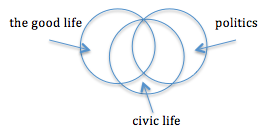
Civic life is important, but it is by no means the only important thing. It represents one circle in this Venn diagram, which also includes circles for politics–meaning all the ways that human beings govern ourselves and create a common world–and the good life.

Screen Shot 2016-03-27 at 11.51.21 AM

In civic life, certain ways of interacting are possible and desirable. We can and should be highly interactive while we are in smallish groups dedicated to improving the world. We can be responsive to one another’s needs and opinions and strive act in concert.

But a good life should sometimes be solitary and inward-looking, or directed to nature or God instead of fellow citizens. And politics should sometimes involve competition instead of deliberation and cooperation. For instance, we want incumbent politicians to be regularly challenged by outsiders who criticize them and strive to unseat them. We don’t want incumbents to get too cozy with their challengers. The same is true of business competitors and contending attorneys.

In the video, I argue—and I strongly believe—that civic engagement can enrich our inner lives and offer us psychological and spiritual benefits. But so can non-civic activities, such as observing and appreciating nature, understanding and making art, or loving and caring for other people intimately. Although I think that the spiritual benefits of civic life are often overlooked—and improving our civic culture would strengthen those benefits—I still resist the argument that the good life equals civic engagement.

Here is a typically subtle case: I love to walk in the woods with my family and dog. Enjoying those loved ones in a natural setting is not a form of civic engagement. However, it is only thanks to the Massachusetts Audubon Society and our state government—and the individuals who work in or with those organizations—that the woods have been preserved and opened for us to use. The worthy activity (a family walk) is not civic, yet it depends upon other people’s civic engagement. Still, it’s far too narrow a view of nature and of intimate personal relations to reduce them to products of civic life.

By the same token, civic life doesn’t exhaust politics or offer adequate means to improve politics. Large, impersonal institutions—such as markets and companies, governments and armies, and scientific and technical disciplines—play leading roles in 21st century politics. You and I have limited leverage over these institutions. We can form opinions about what they should do, but those opinions do not always imply meaningful actions for us to take.

If the institution in question is the United States government, I have a tiny but greater-than-zero form of leverage in the form of my vote. If the institution is Coca-Cola, I can decide whether to purchase its products or not. Allocating votes and money are worthwhile acts but hardly constitute a robust civic life. And if the institution in question is the Chinese Government or the market for oil rigs, my leverage approaches zero. In the video, I say that citizens ask, “What should we do?” rather than “What should be done?” But sometimes reasonable people realize that something should be done and yet cannot find anything to do about it themselves. That is the zone of politics that lies outside of civic life in the Venn diagram above.

In the video and almost all my work, I emphasize that “small groups of thoughtful and committed citizens” have the capacity and responsibility to change large systems. I began my professional career helping to advocate for political reform as a research associate at Common Cause, and while I worked there, Common Cause was losing its membership base due to the shrinkage of American civil society that Robert Putnam would soon diagnose in “Bowling Alone” (1995). I came to think that American politics was corrupt because citizens were not adequately organized and active, and I have spent the subsequent two decades working on civic engagement as a precondition for better government. Still, political reform eludes us in the face of hostile Supreme Court decisions, technological developments, and tenacious political opposition. When reform does come, it may be because of a massive scandal or a well-placed leader, not directly because of active citizens. In some other countries and in global markets, the scope for civic life is even narrower than it is in the US.

To discount the importance of citizens in politics is cynical, but to imagine that intentional civic action is all of politics is naive. To the extent we can, we should work to expand the overlap, so that civic life is more politically influential as well as more spiritually rewarding. But I think we will always be left with two hard questions (among others):

  1. How should we think and act and feel when bad systems are genuinely beyond our control? The Stoic and classical Indian answer was: seek equanimity and acceptance. Epictetus advised: “For if the essence of the good lies in what we can achieve, then there is no space for ill-will or jealousy. Rather, for yourself, don’t strive to be a general or an office-holder or a leader/consul, but to be free. The only road to that is contempt for things not in your power [XIX].” I am unsatisfied with that answer, because I think we have responsibilities to the world even when we cannot see a direct way to address its problems. But what are those responsibilities, exactly? And …
  2. When an aspect of the good life conflicts with civic responsibilities, how should we choose between them?