Self-Respect and a Sense of Positive Power [Essay]

Journal of Speculative Philosophy 30, Issue 1 (2016): 45-63.

My regular, public writing is starting up again, as we’re getting settled in. Over the course of a few busy months, some of my pieces have come out in academic outlets, like the essay I posted last week. Here’s a further piece published this year (2016) in The Journal of Speculative Philosophy. It’s titled “Self-Respect and a Sense of Positive Power: On Protection, Self-Affirmation, and Harm in the Charge of ‘Acting White’.” Here’s a pic of it:

Photo of my essay, 'Self-Respect and a Sense of Positive Power.'

I seek permission to post my full articles on my Academia.edu page, and I either am given it or have at least given a good faith effort to get that permission. In this case, though, this copy of the paper is the only one I have with my final edits and it’s plastered with JSTOR info (online journal database) and policies stuff. Given that, I’m posting a link to the JSTOR page for my paper instead of to a scan on my Academia.edu profile. If you have academic library access to such stuff, you can probably open the paper or manage to get access to it here (the “static” page for the on JSTOR).

This essay is one of the steps in my overarching project on culture and justice. For now, I can share my abstract for the paper:

In the liberal tradition, self-respect is most often associated with Kantian moral philosophy, which suggests a focus on individual responsibility. While the individual plays a part in the development of his or her self-respect, so, too, do his or her environmental and cultural conditions. In this essay, I distinguish between conceptions of self-respect, especially those that focus on it as a duty to oneself, and having a “sense of one’s own positive power,” a Deweyan educational ideal. A sense of positive power is partly directed by the individual but is also clearly conditioned by the ways in which one’s culture treats and reacts to one’s efforts. Thus, a sense of positive power, as a concept, reveals the powerful role of one’s wider culture in frustrating or enabling a vital element of personal growth necessary for justice. I test the distinction with respect to the difficult and harmful charge of “acting white,” which concerns self-respect and the role of oppressive forces conditioning people’s senses of their power in an unjust society.

If I can figure out a way to share the full paper without violating relevant policies, I will. In general, scholars as editors want you to share your work. A journal is better known the more it’s read. I do understand that there’s a system to this, however, and I try to always seek permission to share my work as much as I can.

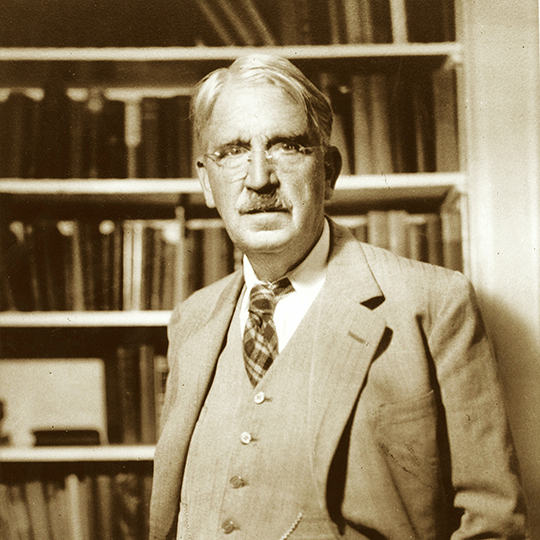
John Dewey, standing.

Despite this hurdle, I’m especially happy to have work come out in The Journal of Speculative Philosophy. It’s a classic outlet in American philosophy. John Dewey published in it as early as 1882. Also, Charles Pierce published one of his classic pieces in the journal as early as 1868 (free to access, unlike my paper). A few of Dewey’s early papers there are available for free as well, such as this one on Kant that was very helpful for my dissertation.

If you can’t access this paper and want to know more about it, let me know that. At the very least, that’ll tell me that I should probably consider a newspaper piece on the subject. For now, I’m working on an op-ed on education and another on the Presidential election.

Reach out if you’re interested and follow or “like” my pages on Twitter @EricTWeber and on Facebook.com/EricThomasWeberAuthor.

Everyday Democracy Grant Opportunity!!

Everyday Democracy is an organization that seeks to involve all citizens as change agents in their communities. Every citizen, no matter who they are, should have the opportunity to make a different in their community. To help in that work, Everyday Democracy has established a new and exciting grant opportunity! Take a look below, and please be sure to visit the grants page to apply for the support!

The next generation of leaders engaging people in creating positive change has already made waves in communities across the country.  Our goal is to attract 20-40 of those young leaders to take part in learning and networking at our upcoming national convening. Participants will learn, connect, and share their insights with changemakers of all ages.

Several young leaders will be awarded scholarships to enable them to attend the convening, and will have the opportunity to compete for grant money to support their leadership and organizing efforts in their local communities.

What we hope to accomplish:

Highlight the work of young leaders at our national convening

Provide opportunities for learning and networking among young leaders

Provide support for the critical work being done by young leaders across the country

Build our network among the next generation of changemakers

What is the grant competition?

Young leaders (ages 18-30) will have the chance to compete to win one of four all-expense paid scholarships to Everyday Democracy’s national convening in Baltimore, Md., December 8-10, 2016. The four finalists will present their work at the conference and compete for grants to support their work in their local communities.

By participating in this grant competition, young leaders will gain access to our tools, resources and coaching, as well as a national spotlight for the work they are doing.

How do I apply?

If you are interested in participating, send us a completed Intent to Apply form. We will follow up with you by providing the application guidelines and other details.

Through the application process, applicants will submit information telling us who they are, the work they are doing and what impact the convening and grant could have on their work.

The application process will likely include an essay and/or video submission. Submissions will be judged based on a demonstration of a commitment to the values of racial equity and inclusive community-building that Everyday Democracy champions. The submission details are still being determined. Those who submit an Intent to Apply will be the first to hear details on how to submit an application for the grant.

Who is eligible to apply?

Anyone from the U.S. who will be between the ages of 18-30 on December 1, 2016 who is doing great work to change their communities. Everyone who applies must be available and able to travel to the conference December 8-10, 2016 in Baltimore, Md.

You can download the Intent to Apply form here!


Girls at Dhabas

Author: 
Problem/Purpose Due to security concerns, gendered social norms constricting interaction between women and non-related men, social stigma around women in public spaces and threats of sexual harassment and rape, women’s mobility in public spaces in Pakistan is severely restricted.Such constraints also threaten a women’s decision to participate and engage in...

Western Australia’s Freight Network Review

Author: 
The transport of freight is a major issue in Western Australia. Road transport is not only key to the state's economy but also raises social and environmental issues. In order to properly take account of all the related issues, the Labor government initiated an extensive review of the regulatory framework...

Road Trains Summit

Author: 
'Road trains' are very large, long trucks used to transport freight in Australia. In Western Australia, rising community concern over road trains driving in inappropriate areas led to discussions over public safety and environmental issues in the early 2000s. The debate was polarised between communities and the trucking industry. In...

The Truth Telling Project

The Truth Telling Project is a grassroots, community-based truth telling process that is designed to share the stories of Black people in the US and their experiences with police violence; and to address the legacies of racism in the US against Black people. The Truth Telling Project arose after the murder of Michael Brown and the lack of indictment of the police officer in his murder. It is a collaborative effort between “the Peace and Justice Studies Association, The Baker Institute for Peace and Conflict Studies at Juniata College, The Fellowship of Reconciliation, the Sophia Project of St.Louis MO and the National Peace Academy”.

The Truth Telling Project developed the The Truth Telling Initiative for Ferguson and Beyond (FTI), to perform community-based hearings of Black peoples’ stories of police violence. The FTI started with an initial panel event Nov 13-14, 2015 in Ferguson, MO; and was recorded to be utilized in living room conversations around the nation. The Truth Telling Project provides support for holding living room conversations called FTI WeFi gatherings- “Watch [parties], Exchange [ideas], Formulate [a plan of action], and Implement [the plan]”; to hear and address the issues of systemic and structural racism against Black people.

To learn more about The Truth Telling Project and the FTI, check out their site here.

From the site…

The information below is excerpted from the Truth Telling Project’s Mandate, the whole document can be read on their site here

In light of the shooting death of Michael Brown on August 9, 2014 and the subsequent findings of the Grand Jury not to indict the officer who shot Mr. Brown, despite witness testimony that his hands were in the raised, “surrender” position, and

In light of the overwhelming number of incidents where unarmed black men, women and children have been assaulted, injured, or killed at the hands of police officers or while in police custody in Ferguson, and

In light of the proliferation of deaths of black men, women and children in the 21st century at the hands of police or while in police custody in the U.S. and

In light of the racist and oppressive nature of Slave Patrols, Fugitive Slave Laws, Jim Crow Laws, Racial Profiling and Stop and Frisk Practices having all served as historical and/or contemporary directives comprising four centuries of police practices violating the lives of black men, women and children in the U.S.:

The Truth Telling Project, on behalf of the citizens of Ferguson, MO calls for the conduct of the Truth Telling Initiative for Ferguson and Beyond (FTI) to allow national and international audiences to listen to first-hand accounts of persons impacted directly and indirectly by police violence in the city of Ferguson and beyond.

The FTI is not for the purpose of exacting revenge or recrimination; additionally, the Truth Telling Project does not endorse violence in any form. The Truth Telling Project supports truth sharing for the purposes of helping all members of society acknowledge the realities and consequences of violence, and work towards the collective healing needed to produce reconciliation.

The Panel charged with listening to testimonial stories will have no powers, but they will be tasked with inquiring and helping others learn how persons came to be directly or indirectly involved in instances of police violence, including harm and death while in police custody. As a necessary part of the truth seeking process, the Panel will also consider questions of individual and institutional responsibility surrounding the stories presented.

It is the firm belief of the Truth Telling Project that giving voice to the voiceless through the power of storytelling will humanize persons in a manner that no Commission report, visual representation or media interview can. Given the historical and perennial nature of violent assaults and deadly encounters between police and African Americans in the U.S., it is urgent that the national and international community be given an opportunity to hear personal accounts directly from those impacted; the FTI will provide this opportunity.

It is the position of the Truth Telling Project that addressing the legacy of structural and systemic racism and its consequences in the U.S. must begin with citizen actions to expose truths. We believe that promoting truth will increase mutual understanding and respect, and lay the foundation needed for healing the long-standing wounds and by-products of oppression in our nation.

There can be no genuine healing and moving forward without honestly, courageously and collectively involving the citizens of Ferguson, MO in confronting truths surrounding accounts of police violence and fully acknowledging the direct and indirect suffering associated with those experiences. Giving recognition to individual experiences and truths is the beginning of healing and the related processes of resolution; each is a necessary step if we are to move our society through, and then past the pain associated with the legacies of racism in the U.S.

“There comes a time in the life of every community when it must look humbly and seriously into its past in order to provide the best possible foundation for moving into a future based on healing and hope.” – The Greensboro Truth and Reconciliation Commission, 2006

Follow on Twitter: @TruthTellersUSA

Resource Link: http://thetruthtellingproject.org/

Become a Sponsor of NCDD 2016 Today!

NCDD is working hard on putting together our 2016 National Conference on Dialogue & Deliberation this October 14-16 in the Boston metro area. It’s shaping up to be our best conference yet, and like all of our conferences, NCDD 2016 will be a great opportunity to gain recognition while supporting the field by becoming a conference sponsor!

Looking to heighten the profile of your organization and work in the field? Being a sponsor is a great way to do it! NCDD conferences regularly bring together over 400 of the most active, thoughtful, and influential people in public engagement and group process work across the U.S. and Canada (plus practitioners from around the world), and being a sponsor can help your organization can reach them all.

Being an All-Star Sponsor ($3000), Co-Sponsor ($2000) or Partner ($1000) will earn you name recognition with potential clients, provide months of PR, and build respect and good will for your organization every time we proudly acknowledge your support as we promote the conference. Plus you’ll be providing the crucial support that NCDD relies on to make our national conferences so spectacular, including making it possible for us to offer more scholarships to the amazing young people and other deserving folks in our field. You can learn more about the details in our sponsorship document.

The earlier you commit to being an NCDD 2016 sponsor, the more exposure you earn as we begin to roll out our sponsor logos on our website. But the benefits go way beyond that – just look at all the perks you get for being a sponsor!

By supporting an NCDD conference, our sponsors are demonstrating leadership in D&D, showing commitment to public engagement and innovative community problem solving, and making a name for themselves among the established leaders and emerging leaders in our rapidly growing field. We expect to have between 400 and 450 attendees at NCDD 2016, and all of them will hear about our sponsors’ work!

When you sign on as a sponsor or partner of NCDD 2016, you’ll be joining an amazing group of peers you can be proud to associate with. To give you an idea, check out our sponsors and partners for our 2014 national conference in Reston:

SponsorLogosAsOf9-7-14

Interested in joining their ranks and sponsoring the 2016 National Conference on Dialogue & Deliberation? We encourage you to consider investing in yourself, in NCDD, and in the field by becoming a sponsor today! We would deeply appreciate your support – plus you get so many benefits.

Learn more about sponsor benefits and requirements here, or send an email to sandy@ncdd.org to let us know you are interested in supporting this important convening through sponsorship. And thank you for considering supporting the conference in this critical way!

Balochistan Agriculture Project: Kitchen Gardening

Author: 
History/Overview The Balochistan Agriculture Project is an initiative organized by USAID and UN’s Food and Agriculture Organization in Pakistan. The project’s primary aim is to help communities and individual farmers increase production, sales and revenues for crops and livestock.In addition to supporting local organizations, the project helps train farmers how...

Touchstone Terms: Personality Disorders and Ego-Syntony

I find the distinction between psychological disorders and personality disorders fascinating.

Consider obsession and compulsion. Someone suffering from the anxiety disorder OCD will often engage in ritualistic actions: locking and unlocking a door a set number of times, carefully arranging furniture, repetitive washing, or hoarding. A person with the personality disorder OCPD may do some or all of these things, but the key difference is that the anxiety disorder feels invasive and unwanted by the sufferer, while the sufferer of a personality disorder will endorse his maladaptive behaviors, finding them appropriate, suitable, or correct. He’ll even judge others for failing to behave likewise.

This makes personality disorders particularly difficult to treat; they may be heavily maladaptive, but the sufferer doesn’t experience the personality disorder as an illness. Someone with OCPD instead experiences the world’s failure to live up to their standards or accommodate their behaviors as the major source of their suffering. Personality disorders are thus ego-syntonic: closely tied to the person’s sense of self and their view of the nature of existence. This is different from ego-dystonic disorders, which the sufferer experiences as alien or other: a set of invasive thoughts, reactions, and compulsions at odds with the life and goals she wants.

So far, so good; this is textbook psychology, the normal science hammered out in the last few Diagnostic and Statistical Manuals (DSMs), since the revised third edition in 1988. But there’s a lot to think through here.

Sigmund Freud coined the term “ego syntonic” in his book On Narcissism, where he tried to show that what makes many disorders untreatable is our ability to find support in a partner or a group. This “cure by love” crystallizes a maladaption in what he calls “happy love,” but is supposedly anything but happy. It is merely self-assured “intact narcissism,” because it has intimate social recognition.

Is this the first account of group polarization? Anthony Greenwald thought so. In his essay, “The Totalitarian Ego,”  Greenwald argued that there was a clear connection between the narcissistic ego’s tendency to find self-supporting information and ignore self-critical information and the totalitarian state’s tendency to suppress dissent:

Interestingly, characteristics that seem undesirable in a political system can nonetheless serve adaptively in a personal organization of knowledge.

Conceiving of the ego as a self-protective organization of knowledge strikes me as a useful metaphor for some elements of our thinking. But as always with analyses of bias, especially those like Greenwald’s or Freud’s that take it as a given that everyone is biased in her own way, it raises interesting questions about where to identify disorders and illnesses: the individual ego or the community.

Like Freud, the first DSM classified things like homosexuality as “sociopathic” personality disorders. From one perspective, this makes sense: gays and lesbians don’t experience their sexuality as invasive, but rather experience the world’s hatred as the main impediment to their flourishing. But as we learned then, sometimes it is the world, and not the deviant individual, that must change.

The same thing could be said for a perfectionist with OCPD; perhaps the real problem is that the rest of us are too sloppy or not conscientious enough. Am I wrong to give so little to charity, or is Peter Singer wrong to demand I give so much? Certainly, the personality disorder carries with it a maladaption, a kind of ill-fit between self and world. What empowers the medical establishment to decide where the blame for that misfittedness lies?

It took gays and lesbians activists, sympathetic researchers, and philosophers several decades to remove homosexuality from the DSM. But perhaps other such errors are still present. Some things, like anxiety, depression, or the word salad that schizophrenia produces can be safely recognized as disorders because sufferers experience them as such. But many mental illnesses aren’t precisely ego-dystonic; they merely create a mismatch between self and world: it is the sufferers who decide that it is they who must change and not the world. In their treatments, psychologists put their finger on the scale of that decision, placing the burden on the sufferer and not the world.

That’s why philosophers who have tried to make psychological disorders contained in the DSM into viable worldviews. Activists and sympathetic researchers have embraced depression, anorexia, schizophrenia, multiple personalities, and borderline personality disorder as healthy adaptations rather than maladaptive disorders.

“We are not so inclusivist as to tolerate intolerance such as yours … I don’t see anything herrschaftsfrei [domination free] about my handling of my fundamentalist students. Rather, I think those students are lucky to find themselves under the benevolent Herrschaft [domination] of people like me, and to have escaped the grip of their frightening, vicious, dangerous parents … I am just as provincial and contextualist as the Nazi teachers who made their students read Der Stürmer; the only difference is that I serve a better cause. I come from a better province.” (Richard Rorty, “Universality and Truth,” in Richard Rorty and His Critics, edited by Robert Brandom, 2000.)

Now, if you take someone like Richard Rorty as your guide, this is the particular mission of philosophy: to supply a justification for our pre-philosophical worldviews. It’s not hard to see that what many philosophers are doing is engaging in a defense of their own lives. Bourgeois liberals defend bourgeois liberalism; excluded groups challenge their exclusions; conservatives and theists defend these perspectives. What if this is all just the process of coming to terms with our misfit with the world; all just a kind of narcissism, rooting out ego-dystonic feelings and becoming more fully ego-syntonic?

My sense is that many philosophers understand themselves to be “merely” engaged in this kind of justification and activism on behalf of excluded lifeworlds. And I think that “merely” is a product of their own disillusionment, sometimes quite legitimately. They believe that any greater project of reconciliation or unification is really destined to failure or is propaganda for permanent domination, and so we should settle for this “good enough” work.

But I’d like to believe that we’re doing something more than that: that we’re engaged in a kind of discovery, that we’re working towards some telos in that scholarship, rather than mapping incommensurables. Philosophical justification is not merely a conflict between mutually exclusive personalities, cultures, and ideologies, but the expansion of our shared horizons to find a frame of reference that is inclusive. Rorty’s deflationist account opens us up to the nonsense of Jonathan Haidt (previously here, here, and here.)

In this I find the imagery of Kant’s “kingdom of ends” (at least as interpreted by Christine Korsgaard) evocative: a world where each person finds her own connection with a rule–and a metaphysics–we make together. This necessarily involves some movement back and forth between the diversity of human personalities and the rule that allows us all to flourish. This, it seems to me, involves accepting Korsgaard’s gloss on Kant:

“If you view yourself as having a value-conferring status in virtue of of your power of rational choice, you must view anyone who has the power of rational choice as having, in virtue of that power, a value conferring status.” (Christine Korsgaard, Creating the Kingdom of Ends, 123)

All that is left is to determine how to make each act of value-conferral harmonious with all the others. It’s a difficult practical and philosophical problem that will involve regular digressions into difficult metaphysical and meta-ethical matters, and it can no longer be accomplished while embracing Rorty’s deflationism.

(This post is a part of a series on some ideas that I find particularly useful or interesting.)