What We Know Post-Election: Dialogue & Deliberation is More Critical than Ever

The Presidential election and the week following has brought the deep divides in this nation to a head, and brought to light numerous issues in our country. The results show us that huge swaths of the country feel unheard and anxious about the future, and sadly, many responses to the election and events taking place in its wake have highlighted issues of pent up frustration, racism, bigotry, and more. flag-cracked

We don’t know for sure what the coming weeks, months, and years will bring, but we do know this: dialogue & deliberation is more critical than ever. Our community may need some time to process this and think about what to do next, but we know our involvement is essential to helping bridge our divides, addressing substantive disagreements, and finding ways for us to work and move forward together as a nation.

The Needs We See & Our Network’s Response

There are many different needs that our country and our communities have right now, but we see a few key needs that stand out as ones that are especially suited for D&D solutions: bridging long-standing divides, processing hopes and fears together, encouraging and maintaining civility in our conversations, and humanizing groups who have become “the other.”

We at NCDD have been discussing bridging our divides all year, and we have an ongoing campaign focused on that work, but the election highlights that need even more. The partisan divide is always there, of course, as well as our historical racial divides. But the election also highlighted the disconnect between rural and urban communities, between people who attended college and who didn’t, and between people from different class statuses. The D&D community needs to be responding to all of these divides – exploring their origins, understanding how they impact people, and imagining how we can dissolve them. Essential Partners just released a Guide for Reaching Across Red-Blue Divides that can be a helpful tool for these needed conversations, and there are more.

After the election, people also need to process and reflect. There is a critical need for dialogue right now where people can express how they’re feeling and explore their hopes and worries for the weeks and months to come. Processes like Conversation Cafe are easy access points for people looking to have a dialogue to reflect on the election as well as what they’d like to see happen now. It’s a tool that provides the structure people need to have thoughtful, respectful conversations in person, and Essential Partners’ work to engage people about what happens #AfterNov8 is a good social media complement.

There is also a need – possibly more than ever – for civility in our discussions that allows us to disagree without attacking each other. D&D practitioners have our work cut out for us in helping people approach both public and private post-election conversations with civility and respect. Several NCDD members are leading efforts to maintain and restore it, with the National Institute for Civil Discourse leading the charge in their Revive Civility campaign, yet much more is needed.

fatima-talkingFinally and maybe most importantly, the country needs help finding approaches to humanizing the people and groups that have become “the other” – unapproachable and unredeemable caricatures – to our own groups. Conservatives are feeling unfairly vilified and misunderstood. Many immigrants, Muslims, and women are feeling threatened, at risk, and unwelcome. NCDD is continuing to support this work and promote collaboration through our new Race, Police, & Reconciliation listserv, and Not In Our Town has many resources for opposing bullying and hate groups that we recommend checking out. But this strand of potentially transformational D&D work needs much more energy and investment devoted to it in coming months and years.

Share What You’re Doing

As we look ahead, we want to ask NCDD members and our broader network, what work are you doing in response to the election and the issues that have arisen? What resources can you share to help others at this time?

Please share any efforts you are making, ideas you have, resources or tools you know of that could be helpful in the comments section of this post or on the #BridgingOurDivides campaign post. We learn so much from being in communication with one another about what we’re up to. NCDD will continue to share your responses on the NCDD Blog and our social media using the hashtag #BridgingOurDivides to continue lifting up stories and resources to a broader audience, and we’ll be working to compile the best divide-bridging resources in our Resource Center.

Furthermore, tell us what you think we can be doing together as a community to address the post-election landscape. Let’s talk with one another about how we can work collaboratively to engage the public and bring peaceful interactions and greater understanding to everyone.

It’s clear there is a lot of work to do to help our country come together, and heal the divides this election season has unearthed or widened. Our community is well suited to do this work, and we call on all of us to be supporting one another in our efforts.

Continue the conversation with NCDD on social media: FacebookTwitter, and LinkedIn.

to beat Trump, invest in organizing

To respond to Trump’s election, we must address who is organized, and how.

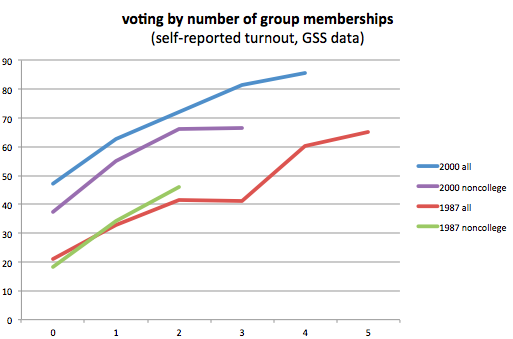
Members of organizations are more likely to vote and to take the more costly actions that will be vital during the Trump years, such as protest and resistance. As a quick-and-dirty illustration, consider the correlation between the number of groups that people belong to and the proportion who say they vote.*

screen-shot-2016-11-13-at-10-00-25-am

This graph combines all kinds of groups. When people belong to organizations that offer them voice and accountability, that address social or political issues, and that encompass at least some diversity, they are not only more likely to vote; they are also more likely to act and choose responsibly. Members of such groups learn to negotiate, to set appropriate expectations for their leaders, and to feel ownership for results.

Before the election, I proposed that Trump mainly appealed to people who lacked accountable organizations, and that’s one reason that they opted for a totally irresponsible (as well as a cruel) celebrity candidate. They behaved as alienated spectators rather than as political agents. I also expected turnout to be relatively weak among people leaning toward Trump.

Theda Skocpol finds that the rural and exurban areas where Trump performed best did have “organized networks – NRA, Christian Right, some RNC and Koch network/AFP presence – that amplified the right media attacks on HRC nonstop and persuaded many non-college women and some college women in those areas to go for Trump because of the Supreme Court.” Skocpol acknowledges that Trump himself “had no organization,” but, she says, he “made deals to get the NRA, Christian right and GOP federated operations on his side. They have real, extensive reach into nonmetro areas.” I’ve also estimated, based on Exit Poll data, that 56% of Trump voters attend church at least monthly. His turnout wasn’t great, but it was sufficient to win the Electoral College.

I was wrong in part. Trump did well because of the traditional mechanism: outreach by groups. However, I would still propose that the groups that reached Trump voters were unaccountable to them. The Koch Network, for instance, is centralized, fueled by two brothers’ money, and undemocratic and opaque in its internal organization. The relationship between such an organization and its target population is transactional and instrumental: it spends money to persuade them to vote. That is consistent with my view that Trump’s voters aren’t authentically organized. Being mobilized is not the same thing.

Meanwhile, Skocpol is definitely right about the other side:

HRC had the typical well-funded presidential-moment machine, an excellent one. We on the center left seem to treat these presidential machines as organization[s], and they are, but they are not as effective as longstanding natural organized networks. … [Off] the coasts, Democrats no longer have such reach beyond what a presidential campaign does on its own. Public sector and private sector unions have been decimated. And most of the rest of the Democratic-aligned infrastructure is metro based and focused. That infrastructure is also fragmented into hundreds of little issue and identity organizations run by professionals. HRC’s narrow loss was grounded in this absent non-metro infrastructure – and Dem Party losses in elections overall even more so.

In areas where progressive voters predominate, we need a much more authentic, democratic, and integrated base of organizations. Instead of parachuting presidential machines into diverse urban areas every four years in search of votes, the left must invest in younger and more diverse local leaders who have real authority and voice and who can work continuously. American democracy has always functioned best when organizations offer a range of goods, of which political power is just one. For instance, churches offer spirituality; unions raise salaries. Their members ultimately vote, but that’s not the main service these organizations advertise. Right now, resources should flow to multipurpose organizations and movements that will turn out voters in 2018 and 2012, but that will do much before then–starting with protecting safety and civil rights against both hateful individuals and government agencies.

The decline in votes in Wayne County (Detroit) between 2012 and 2016 (37,364) will almost certainly be larger than the final margin of victory for Michigan. Milwaukee saw a 41,000-vote decline that was bigger than the state’s margin. I suspect that scarce investment in organizing was as important in Wisconsin as voter-suppression. These statistics should ring loud alarms, if they haven’t already. How many young African American and Arab American organizers can count on paid activist jobs in Detroit in 2017 and 2018?

Meanwhile, we also need organizations in red states and red counties, in rural areas and exurbs. The point of organizing there is not to show empathy to Trump voters or to honor their concerns. The point is to win. Particularly in 2018, anti-Trump votes will be very poorly distributed–far too concentrated in the great cities to win the House and Senate back. Every extra vote in a white non-urban county will matter, and that requires organizations to change minds, to empower the disenfranchised, and to offer real benefits. By the way, although I think the Democratic Party is a necessary component of the opposition, it is not sufficient. Electing or reelecting responsible and caring Republicans in red districts is also essential.

In our October poll of Millennials, we found that just 30% of Clinton supporters had been contacted by a campaign or organization that had urged them to vote; 28% of young Trump supporters had been contacted; and 70% had not been contacted at all.  Young people who had received multiple contacts were 19 points more likely to say they’d vote than those who’d received none. That poll was a warning that young Americans across the spectrum were not being reached by organizations. Young Trump voters were almost as likely to receive outreach as Clinton voters were: another indictment of the left’s investments. The time to change this is now.

*I’m showing General Social Survey data from 1987 about whether people “always vote” and from 2000 about whether they voted in the last presidential election. Unfortunately, I can’t find more recent comparable data, but I hope the graph illustrates an important pattern. Note that the correlation applies to people who have no college experience (the working class) as well as the population as a whole.

When is a democratic innovation not a democratic innovation? The populist challenge in Australia

Australian democratic innovations typically rely on premises that are fundamentally opposed by populism: random selection and expert knowledge. This populist challenge cannot be ignored, and theorists and practitioners must meet it together.

When is a democratic innovation not a democratic innovation? The populist challenge in Australia

Australian democratic innovations typically rely on premises that are fundamentally opposed by populism: random selection and expert knowledge. This populist challenge cannot be ignored, and theorists and practitioners must meet it together.

Guide for Conversation Across Red-Blue Divides #AfterNov8

As our field continues to process the election results, we hope our members will keep sharing divide bridging projects and resources as part of NCDD’s #BridgingOurDivides campaign. We know there are many conversations that need to be had in our country, and we want to encourage you to continue to use the hashtags #BridgingOurDivides and #AfterNov8 as you have them. To help those discussions, both online and in person, we want to share a guide that NCDD member organization Essential Partners recently released for conversations across partisan divides. We encourage you to read Essential Partners’ announcement about the resource below or find the guide here.


Election’s Over. But We Still Have a Choice

Today, we gathered together in our offices in Cambridge with friends and supporters to try to begin to understand what happens now. What happens, now that half of our nation feels bereft and hopeless and half feel at last heard and recognized? How can we approach one another again?

Calls for “healing” are proliferating right now. I’m sure you’ve seen them. But I don’t think healing is a possibility until we accomplish something much more basic: simple human encounter grounded in genuine curiosity.

The choice before us as a nation is stark. We can dive into our isolated encampments and stay there, magnifying the chasm, bemoaning our own righteousness and the other side’s blindness. Or we can choose to act with courage, to walk into a room where we will encounter people who have voted for a candidate (or a President-Elect) we can’t stand and explore your most deeply held beliefs.

So, that’s what we plan to do, with your partnership. We’ve put together a guide for conversations across political differences that we hope you’ll use in your own conversations and communities. Today wasn’t the beginning of conversations across the divide, but it was a deep recommitment to pushing past media-induced stereotypes to ask each other questions that ground us in shared humanity.

Who do we want to be, and how do we want to be with those neighbors whom we have called “other”? What will we need to hold back in our own knee-jerk propensity in order to say the larger truth we need to share? What do we want that “other” to know about us and our values? And what do we want to know about theirs?

how to respond?

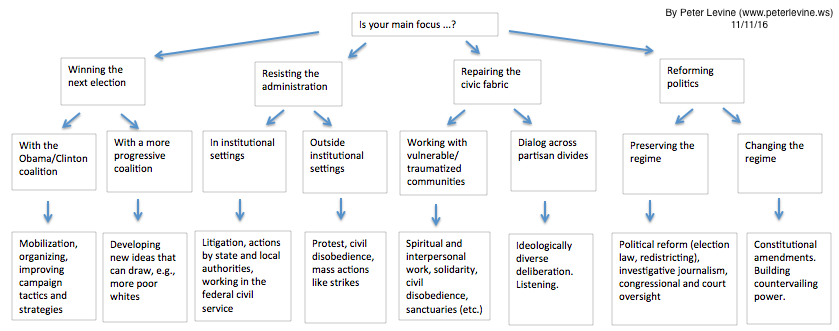
I offer this flowchart in case it can help anyone to think about how to respond to the devastating results of the election. I am sure it is incomplete. Also, it doesn’t present stark alternatives: options can be combined. In fact, I suspect we need people working on each and every one of these boxes, and an individual can address more than one. However, we cannot all do everything all the time, and I’m using this flowchart to think about how to allocate my own time and attention. (Click to expand.)

A Moment That Illuminates Our Structural Challenges

At least we have some clarity.  The mystifications and rationalizations are evaporating.  If nothing else, the election of Donald Trump illuminates many of the deep structural problems that we need to face squarely.

While most post-election commentary is focused on Trump and the political realignment in Washington, I think the bigger stories are the tectonic shifts in the neoliberal political economy and representative democracy itself.  Both are imploding.  Both are losing credibility as vehicles for human governance and betterment. And yet the lineaments of a new order – a robust realm of social innovation relatively unknown to mainstream politics – remains out of focus.

The election of a narcissistic, authoritarian bigot with no experience in politics and no serious ideas about how to solve the country’s problems, reveals the dysfunctions of the US constitutional system and its two major political parties. The rollicking, vituperative campaigns made for blockbuster TV ratings, but they were a farce in terms of democratic deliberation and governance.

And how could it be otherwise?  The venerable system devised by powdered-wig elites in the late 18th century has been eclipsed by the realities of the 21st century.  Politics is now a self-referential bubble of mass-media spectacle and social media.  As a branch of the entertainment world, it is a highly confected virtual space that caters more to emotional hot buttons and prejudices than rational deliberation or meaningful human dialogue.

Parties can’t help but regard this bizarre, modernist fun house as the real venue for getting and retaining power; solving real problems or fostering real democratic participation is a nostalgic fantasy.  In hindsight, it now seems utterly logical that an outrageous former reality-show star could prevail in this arena – much as Ronald Reagan’s long experience in Hollywood was essential to his success in politics. Let's not pretend that this is "democracy." It's a Roman circus.

read more

why political science dismissed Trump and political theory predicted him, revisited

I’m not sure what’s driving the traffic, but since yesterday, more than 2,500 people have visited my March 3, 2016 post entitled “why political science dismissed Trump and political theory predicted him.” I probably should revisit the topic now that the election is over (especially since I subsequently used standard empirical methods to predict a Clinton victory, thus acting like a political scientist instead of a political theorist).

Last March, I argued that mainstream–empirical or positivist–political science research on “American government” (as the specialty is called) has a vulnerability. Aiming to be a science, it uses data that can be amalgamated to produce models and predictions, such as data from modern US elections. The main method of prediction is to run trend lines from the past into the near future. Although normative assessment is always marginal in positivist social science, most of this research has an implied value-stance: our system works, it follows rules and norms, it’s fairly durable, the players are reasonably competent professionals who support the regime, and you should understand and respect it even you want to reform it. Any reform proposals should be informed by empirical evidence, because otherwise the reforms will have unintended consequences that are likely to be bad. As the great Theodore Lowi wrote, “Realistic political science is a rationalization of the present. The political scientist is not necessarily a defender of the status quo, but the result is too often the same, because those who are trying to describe reality tend to reaffirm it.”

In contrast, political theorists spend their time reading critical reflections on politics written in highly diverse and often tragic circumstances. Hannah Arendt’s writings from Nazi Europe and Frantz Fanon’s analysis of colonial Algeria are just two examples. Political theorists are quick to see that regimes can change, that they can be very bad, that they have debatable normative foundations, and that ideas can be revolutionary.

This means that when Trump arrived on the national scene, positivist political scientists were prone to think that he couldn’t get anywhere in our system–because no one like him had–and political theorists were ready to think that he might take over, because they spend their time considering tyrants, fragile regimes, and the power of xenophobia and authoritarianism. Although there were exceptions in both camps, I think these are reasonable generalizations.

What should we conclude now that Trump is president-elect? It’s tempting to say that the theorists were right. But there’s actually a mainstream positivist account of what just happened. Presidential elections in two-party systems tend to settle at a point where each party has a 50% chance of winning. Given the way nominees are selected in multi-candidate primaries, a smallish faction can capture either party. Its nominee will still have very close to a 50% chance of winning: that’s why Trump got about half the votes, and because of the Electoral College, he won. Furthermore, given the constraints built into the regime as a whole, Trump is likely to govern as a Chamber of Commerce Republican rather than an authoritarian. And if he pushes too far, his party will lose the Congress in two years.

The trouble with political theory is that its predictions can be unmoored from empirical reality. Some political theorists have been predicting catastrophe or revolution throughout my lifetime. The fact that regimes sometimes change does not mean that ours is always about to. I think the odds are still against our regime changing fundamentally in the immediate future.

On the other hand, our political economy is problematic in ways that are not immediately evident from empirical data about the recent past. The Constitution does not fit the present society. The document has fundamental flaws, and the society is evolving toward oligarchy. Although empirical evidence is relevant to those claims, one needs a broader, deeper, and more evaluative stance on the regime as a whole to grasp a crisis such as our present one.

Exit, Voice, and Presidential Elections, Part II

Back in February, I wroteIf elections don’t go the way we like, it shouldn’t be cause to flee, but rather a call to action: our voices would be needed more than ever.

I feel its important to repeat this as comments about leaving the country become more common. Indeed, the Canadian immigration website crashed as election results came in Tuesday night.

Albert O. Hirschman argues that in any interaction, an individual has there options: exit, voice, or loyalty.

Given the rhetoric which came out of the Trump campaign, there are many with good reason to fear for their safety and who may view exit as the only reasonable option. But for a lot of people – for me, for example – I am relatively privileged enough that in practical terms a Trump presidency will mean little more than a few years of disgust coupled with good Alec Baldwin bits.

For me, I think, exit is not a reasonable option – I have a civic duty to stay and fight, to exercise voice in shaping the future of American.

Of course, how one should exercise voice is a different conversation all together.

Should we try for unity or resist from the beginning? Should we wait until there are specific egregious actions we need to oppose, or should we fight now, chanting ‘not my president’ and urging the electoral college to vote differently?

Personally, the later approaches make me uncomfortable – I was distraught by anti-Obama protests which questioned the legitimacy of his presidency and it feels hypocritical to express similar sentiments for someone else. But I’m glad to see these questions being asked and to hear these conversations taking place within the progressive community as we all try to make sense of the world we have found ourselves in.

I have also been thinking a lot about how to be a better ally in the years ahead.  I write a lot about building bridges across our differences and listening to – and trying to understand – people with different perspective from us.

I do think that work is critically important, but it can’t be overlooked that there are fundamental inequities in those opportunities: it’s hard to have a conversation across difference when the person you’re talking to espouses hate for everything you are.

I’ve heard a lot of people saying that they feel like they woke up yesterday as strangers in their own country. It’s a feeling that many of us remember from the election of 2000. And it’s a feeling I heard echoed by conservatives in 2008.

But it’s also a feeling I heard from many people of color when Mike Brown was murdered, or when the Baltimore police officers involved in the death of Freddie Gray were acquitted, or following any of the many, many incident which seemed to say clearly: your life doesn’t matter and this country is not built for you.

And that’s just an insane reality to live in. The idea that at any given time large portions of the country feel disempowered, discounted, and disenfranchised; that some large group of people will always feel like strangers in their own land.

Months ago, a Trump supporter told me that she was miserable under Obama and that it was the Republican party’s “turn.” I may want to find that a questionable sentiment, but I also can’t deny I felt something similar after the George W. Bush presidency. Republicans had a go, and now it was our turn.

In the moment, these emotions and perspectives are reasonable and valid…but this is no way to run a country. There are no “turns.” We can’t just continue to tug-o-war the country, growing more and more polarized as we go.

We need to find ways to work together.

facebooktwittergoogle_plusredditlinkedintumblrmail