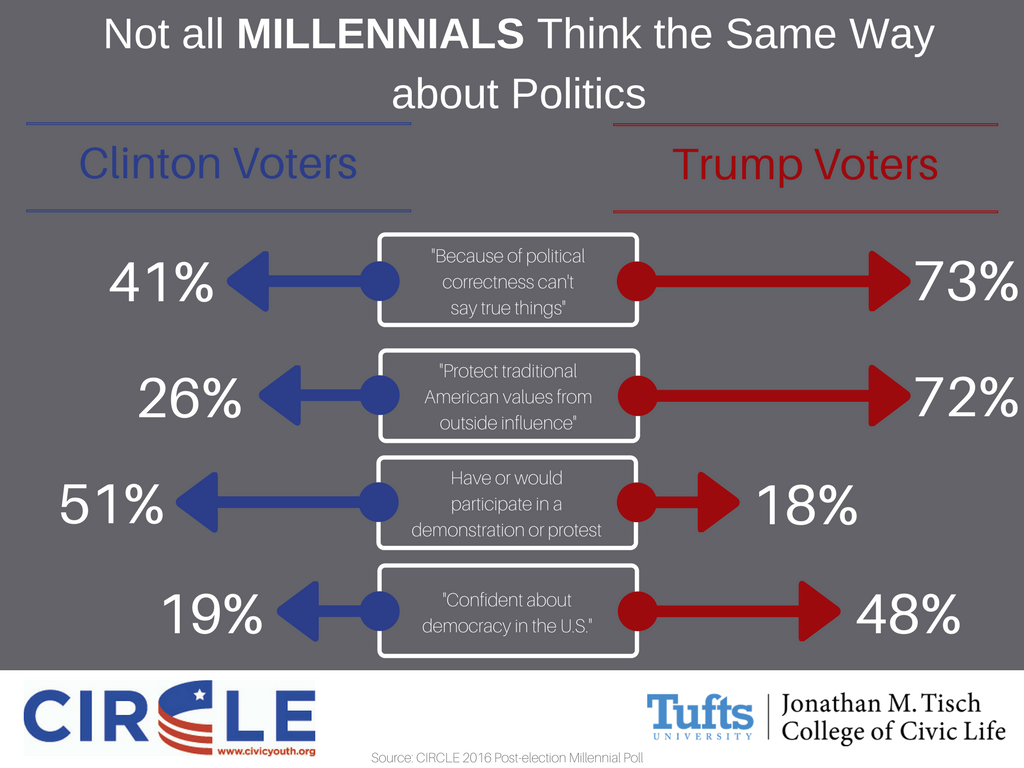
how Millennials split on some key issues

Here are some tidbits from CIRCLE’s analysis of its Millennial youth survey, the second wave of which was conducted in January. A substantial proportion of all Millennials believe that “political correctness” prevents people from saying things that are true, but that opinion is much more common among young people who voted for Trump. Three quarters of pro-Trump Millennials (who were 37% of all the youth who voted) want to protect traditional American values against influences from the outside, compared to one in four of those who voted for Clinton. Clinton voters are much more likely to be ready to participate in demonstrations and protests, and seriously lack confidence in US democracy. Much more at the link.

New NCDD Podcast Episode Featuring Bring it to the Table!

The latest episode of the NCDD Podcast is now live! You can find this on iTunes, SoundCloud and Google Play.

In this episode, NCDD Managing Director Courtney Breese speaks with Julie Winokur of Bring it to the Table. Julie is Producer and Director of Bring it to the Table, a project seeking to bridge political divides and break down partisanship through a documentary, webisodes, online platform and community engagement campaign. Julie speaks about her experiences filming the original documentary in 2012 (some of you saw the documentary at NCDD 2014!), as well as her more recent work bringing the film and table talks to college campuses. She also shares her reflections on the state of U.S. politics today and the opportunities she sees for us to come together through dialogue.

The NCDD podcast is a new format for leaders and practitioners from the D&D field to share their stories and ideas, as well as discuss opportunities and challenges in this work. The podcast will also help us to continue our conversation from the NCDD 2016 Conference about #BridgingOurDivides.

We invite you to listen to this episode and share your thoughts here, particularly about the opportunities you see for dialogue across political and other divides. In light of Julie’s story, what more can we be doing as individuals and dialogue & deliberation practitioners to bring people together across our differences? Share your thoughts in the comments below!

Our thanks to Ryan Spenser for his continued help recording and editing these podcast episodes.

Please share this episode and the podcast links with others – and let Courtney (courtney@ncdd.org) know if you have any ideas for future episodes!

Millennial women in the 2016 election

A new paper by CIRCLE Director Kei Kawashima-Ginsberg investigates Millennial women’s participation in the 2016 election, their views of democracy, and their own political engagement in the Trump era. It was published as part of a symposium on gender and Millennials convened by the Council on Contemporary Families and is cited today in a New York Times op-ed.

According to the paper, 50 percent of young white women voted for Clinton; 41 percent, for Trump. Young women of color preferred Clinton by wider margins. Only 25% of Millennial women identified as feminists, and less than 15% say that the possibility of electing the first woman president informed their vote choice. Young women were more likely than young men to be inspired by Clinton, but only 23 percent reported that feeling. After the election, they are more concerned about the future of democracy than their male peers are, but not more likely than Millennial men to be interested in political engagement.

Univ. of San Diego Hosts “Rebuilding Civility” Conference

If you work on political civility or live in the San Diego area, we encourage you to consider attending the Restoring Respect conference at the University of San Diego this April 18-19. The gathering convenes teachers, students, and community members to discuss civic engagement, dialogue, and other work that can help us in #BridgingOurDivides, as well as a plenary session panel moderated by long-time NCDD member Carolyn Lukensmeyer of the National Institute for Civil Discourse. We encourage you to learn more in the USD announcement below or learn more at the conference website here.


Restoring Respect – 6th Annual Conference on Restoring Civility to Civic Dialogue – “Rebuilding Civility”

The 2016 election was the most divisive and vitriolic in American history. From candidates’ personal attacks to paralysis and dysfunction in national government, the price tag of incivility, and resulting failure to reach political consensus, has never been greater.

Join other concerned members of our community in an ongoing discussion about how to restore respect to the local and national civic dialogue. Explore ways to better educate the next generation of citizens and community leaders on how to better build our American community.

The 6th annual Restoring Respect conference will be held April 18-19, 2017 at the University of San Diego’s Kroc Institute for Peace and Justice. The morning and afternoon of Tuesday April 18 and the afternoon of Wednesday, April 19 will be dedicated to panel discussions, practicum demonstrations and speaker presentations. Our plenary session with keynote address and our panel of regional university leaders discussing civility, community-building and higher education will be held the morning of Wednesday, April 19.

The conference is an opportunity for high school and college educators, staff, and most particularly students to gain hands-on experience in creating effective, respectful, and equitable diaogue across their campuses and their communities. The conference offers members of all private-sector and public organziations and inidivuals engaged in civic engagment an opportunity to learn about issues affecting civil discourse today and strategies for creating more effective civic engagment from the workplace to the public space.

The goal of the conference is to continue an ongoing national dialogue on how to repair the partisan divide in American politics and civic discourse, rebuild bridges of cooperation and understanding between American political and socio-economic communities, and develop pathways to more effective policy-making at the local, regional, state, and national levels.

You can find more info about this University of San Diego event at the conference website at www.sandiego.edu/cas/institute-for-civil-civic-engagement/restoring-respect.

FJCC Webinar 2: Review, Remediation, and Reteaching for the Civics EOCA Now Available

Good morning, friends. Our recent webinar is now available! It discussed some resources and tools that you can use for reteaching, remediation, and review. You can view it below.

All resources and tools discussed in the webinar are available at http://bit.ly/FJCCRRR. Our next webinar will occur in June, and address understanding the the data you receive about the Civics EOCA.


Invention as Knowledge Production

In Kenneth Arrow’s “Economic Welfare and the Allocation of Resources for Intervention,” he begins with what may seem like a bold statement: Invention here is broadly interpreted as the production of knowledge.

From this perspective, “invention” isn’t inherently about creating things, it is fundamentally about generating new knowledge. That knowledge may or may not result in new technologies or devices; knowledge itself is the creation.

Arrow uses this definition to point to a core need for the “knowledge economy.” Invention – knowledge creation – is an inherently risky business decision. As Arrow writes, “By the very definition of information, invention must be a risky process, in that the output (information obtained) can never be predicted perfectly from the inputs.”

This inherent risk multiplies. If I can’t guarantee to produce a certain knowledge you can’t guarantee to pay me for it. If you do make such a guarantee, if you agree to pay me regardless of what knowledge I create, then – under the classic economic models of utility – I no longer have motivation to generate that knowledge.

Furthermore, once and idea is generated, it is, in some respects, free. If I undertake the risk of producing knowledge and everyone profits equally from my labor, then – again, under classic economic models of utility – I no longer have motivation to generate knowledge. I’d rather free-ride off your knowledge creation.

This is, in fact, the underlying logic of the patent system: potential inventors will only have motivation to invent under a system that guarantees benefits from successful invention.

What I find particularly interesting about the “knowledge production” definition of invention, though, is that it assumes, in a certain sense, that knowledge is perfectly replicable. What’s missing from this framing is an idea that knowledge I generate can only be generated, uniquely, by me.

That’s not so say that once I generate an idea, you can’t interpret it and use it to generate your own idea. Indeed, one might say such a process is the very essence of science; as thought percolates across time and disciplines, through interpretation by human inventors. That is the very nature of progress.

Arrow’s definitions remind me of Lauren Klein’s work on Elizabeth Peabody: the transcendental scholar and educator who created impossibly complex mural charts. These charts were intentionally difficult to interpret, not as a tactic of frustration but to invite the viewer into a process of knowledge co-creation.

The interpretation of art is not the sole property of the artist; and an understanding of knowledge does not belong solely to the person who had the idea. That isn’t just an economic challenge to be overcome: it is a declaration of the very essence of knowledge. Knowledge doesn’t exist in a vacuum; it doesn’t just spring to life within one person’s brain. Knowledge only comes to be as a process of co-creation; as a slow accumulation of fuzzy recollections. It is humanity’s ultimate collective endeavor. We only make progress together.

facebooktwittergoogle_plusredditlinkedintumblrmail

to whom it may concern

It has come to my attention that the level of my age
Is now set to fifty, with more movement on the gauge.
Who authorized this increase? Who consented to the change?
The alternative is worse, you say, but we’ve breached my chosen range.
I’ve searched my files for decades past and found most data gone.
Records labeled thirties, forties seem to be withdrawn.
Those phases passed much faster than I’d been led to understand;
I can’t recall what happened then or whether it was planned.
I’m writing to request a reset, please: thirty-five and hold it there.
Oh, and reset all my family, too; just me would be unfair.
Once I see the options back, and the meter’s restored to high,
I’ll retract the review I’ve given you–but I await your prompt reply.