Affinity Groups, Enclave Deliberation, and Equity
The 42-page article, Affinity Groups, Enclave Deliberation, and Equity (2016), was written by Carolyne Abdullah, Christopher Karpowitz, and Chad Raphael, and published in the Journal of Public Deliberation: Vol. 12: Iss. 2. The article provides evidence for the practice of holding enclaves for marginalized groups within dialogue and deliberation processes, as part of a larger conversation. They have found that by creating space within affinity groups for enclaves to dialogue; processes are more inclusive, participatory, and democratic. The authors show several ways in which enclave groups can be used in democratic processes and implemented within government practice.
Read an excerpt of the article below and find the PDF available for download on the Journal of Public Deliberation site here.
From the article…
Organizers of dialogue and deliberation employ several common strategies aimed at achieving equal inclusion, participation, and influence in civic forums. In forums that are open to all who want to join, each participant typically has an equal opportunity to attend, speak, and, if applicable, an equal vote. Forums that restrict participation to a sample of the public take further steps to practice equality. To achieve proportional representation of members of marginalized groups, organizers often recruit random samples or quasi-representative microcosms of the public, or recruit participants in part through networks of social service or civil society organizations (Leighninger, 2012). Some forums subsidize the costs of participation – including information acquisition, time, and money – by providing background materials about the issues, translation services, paying stipends to participants, and the like (Lee, 2011). To create conditions for equal participation and influence, facilitators set ground rules that encourage sharing of speaking time, respect for participants regardless of status or identity, and openness to a broad range of communication styles (Gastil & Levine, 2005). Each of these strategies seeks inclusion of the disempowered on more equal discursive terms than are often found in traditional public meetings, which can be dominated by more privileged citizens, or by officials or policy experts, and which are not designed to engender cooperative talk between community members as equals (Gastil, 2008).
While these are important strategies, they can be insufficient. Even forums that most aim to create representative microcosms of a community are hard pressed to include proportional numbers of community members who are disadvantaged by their education, income, race, gender, age, and political interest (Jacobs, Cook, & Delli Carpini 2009; Ryfe & Stalsburg 2012). Research often finds that despite organizers’ best efforts, more privileged participants – white, male, highly educated, and professional – speak and influence decisions more than other participants (for summaries, see Black, 2012; Karpowitz & Mendelberg, 2014; Karpowitz & Raphael, 2014). Information, issues, and choices are often framed from the perspective of the powerful, even when presented as neutral or in terms of the “common good” (Young, 2000; Christiano, 2012).
In this article, we argue that incorporating stages of enclave discussion among disempowered people within larger political forums or processes can help move us beyond formal equality to achieve more substantively equitable dialogue and deliberation.1 Democratic theorists have long recognized that members of less privileged groups need to confer among themselves in civil society associations in order to contribute autonomously and effectively to discussion in the wider public sphere (Fraser, 1992; Mansbridge, 1996; Sunstein, 2000). We extend this insight to civic forums, processes, and institutions that aim to engage the whole community, maintaining that it would be better for equity, and ultimately for the quality of deliberation, to integrate opportunities for discussion among the least powerful. We argue that enclaves can counteract background inequalities among participants, the difficult dynamics of small group discussion among people of different statuses, and the dominance of associations and ideas of the privileged in the wider political system. And we believe these benefits of enclaves can be realized not just in advocacy groups or social movements, but in the institutions of democratic deliberation that have been developed over the past few decades, from innovative government-led methods of public consultation and stakeholder engagement to forums such as Deliberative Polls, Consensus Conferences, Citizens Assemblies, and the like.
In this light, enclave discussion is not necessarily an inferior version of crosscutting talk among a microcosm of the public, which is often the dominant ideal in deliberative democratic theory and practice. Indeed, enclaves are a feature of the traditional political institutions from which many contemporary civic forums draw metaphorical legitimacy and some design features. Consider the role of enclaves in the namesake institutions of our “21st Century Town Meetings,” “Citizens Assemblies,” “Deliberative Polls,” and the like. Citizens who want to bring proposals to Town Meetings meet in like-minded groups to develop their arguments beforehand (Mansbridge, 1983). Members of legislative assemblies form caucuses based on common issue priorities and interests. Individual polling responses are shaped in part by our networks of family, friends, and others with whom we discuss politics. Like all forms of political communication, talking in enclaves poses some threats to good dialogue and deliberation, and we discuss ways of overcoming these dangers. But we start from a belief that enclaves are natural and necessary organs of healthy political institutions rather than warts on the body politic.
We begin by defining the kind of enclaves we are advocating, which share marginalized perspectives or social locations rather than essentialized identities, and the ways in which their members may be disempowered in deliberation among heterogeneous groups. Next, we draw on the empirical literature to describe the contributions that enclaves of the disadvantaged can make to creating more equitable and higher quality civic deliberation. We also describe the potential dangers of enclave discussions – such as extremism, sectarianism, and conformism – and why we see these dynamics as pitfalls that can be avoided by good deliberative design rather than as iron laws of political communication. For us, the key is to connect enclave deliberation among the marginalized well to other elements of the political system, and so we review several ways in which enclaves have been integrated productively into larger structures of democratic deliberation in forums and institutional processes that aim to represent a whole polity. To illustrate some more specific design principles for enclave deliberation, we present an extended example drawn from a set of dialogues in the U.S., entitled Facing Racism in a Diverse Nation. Finally, we discuss conditions in which enclave deliberation is most likely to be needed to create equity and sketch out an agenda for future research on the topic.
Download the full article from the Journal of Public Deliberation here.
About the Journal of Public Deliberation
Spearheaded by the Deliberative Democracy Consortium in collaboration with the International Association of Public Participation, the principal objective of Journal of Public Deliberation (JPD) is to synthesize the research, opinion, projects, experiments and experiences of academics and practitioners in the emerging multi-disciplinary field and political movement called by some “deliberative democracy.” By doing this, we hope to help improve future research endeavors in this field and aid in the transformation of modern representative democracy into a more citizen friendly form.
Follow the Deliberative Democracy Consortium on Twitter: @delibdem
Follow the International Association of Public Participation [US] on Twitter: @IAP2USA
Resource Link: www.publicdeliberation.net/jpd/vol12/iss2/art6/

C@rds in Common: Learning about the Commons Through Play
Because the practices of commoning fly in the face of market culture, they are frequently misunderstood. What is this process of committed collaboration toward shared goals? people may wonder. How does it work, especially when many industries want to privatize control of the resource or prevent competition via commoning?
Matthieu Rhéaume, a commoner and game designer who lives Montreal, decided that a card game could be a great vehicle for introducing people to the commons. The result of his efforts is “C@rds in Common: A Game of Political Collaboration.” “I see playfulness as a sense-making tool,” Matthieu told me. “People can play casually and be surprised by the meta-learning [about the commons] that results.”
It all began at the World Social Forum (WSF) conference in Montreal in August 2016. Rhéaume decided to use the opportunity to synthesize viewpoints about the commons from a group of 50 participants and use the results to develop the card game. He persuaded the Charles Léopold Mayer Foundation and Gazibo, both based in France, to support development of the game. Fifty commoners more or less co-created the game with the help of several colleagues. (The process is described here.)
As a game designer, Rhéaume realized that successful, fun games must embody a certain “procedural rhetoric” and reward storytelling. He had enjoyed playing “Magic: The Gathering,” a popular multiplayer card game, and wondered what that game would feel like if it were collaborative.
At the WSF, Rhéaume asked participants to share their own insights about the commons by submitting suggested cards in six categories. The first four categories consist of “commoners cards” featuring “resources,” “action cards,” “project cards” and “attitude cards.” Two other types of cards -- “Oppressive Forces” cards with black backs – give the game its kick by applying “negative effects” to the “Political Arena” of play. The two negative effects are “enclosures” and “crises,” to which commoners must collectively organize and respond in time.
Intended for two to five players, the game usually lasts between 60 and 90 minutes. It has enough of a basic storyline to be easily understood, but enough complexity and sophisticated twists to be unpredictable and interesting. The key objective of the game is to “create a Political Arena resilient enough to defend the commons against encroaching enclosures.” The players win when there are no more enclosure cards in the Political Arena. They lose if there are more than five enclosures present at any one time.
The backs of the Oppressive Forces cards feature a conquistador with a spear and text reading, “I am here to take the commons.” One of the Oppressive Force card is “Trump Elected!” which demobilizes every commons campaign underway. Another OF card, “Old Inner Culture,” prohibits the discarding of “attitudes” cards (which might otherwise hasten commoning). A “Fear of the Unknown” card prohibits players from drawing new cards for one cycle.
By contrast, the commoner cards feature such things as urban gardens, First Nations, degrowth and independent media. A series of “Attitude” cards affect a player’s capacity to cooperate.
WSF participants submitted a wild diversity of 240 cards to Rhéaume giving many perspectives on commoning and enclosure. Rheaume used 120 of cards and his own knowledge of game design to produce the game, printing at a local printer. He tested C@rds in Common through 25 games and four design iterations, attempting to achieve a 50% failure rate (the forces of enclosure win). Players discovered that the complexities of cooperation grow as new enclosures introduce new variables. A game booklet describes how players can make winning more difficult (by accelerating the rate of enclosure threats and reducing the time allowed to build civil society).
Rhéaume concedes that the first play of C@rds in Common can be challenging, but there are YouTube videos to help new players learn the game. (See this video introduction to the game as a project, and this "how to play" video tutorial.)
Rhéaume would like to refine the game further – it still has elements of the WSF event, including some French-only cards – but he is pleased that the game helps introduce players into the commons worldview and start deeper conversations about it. Following most games, players reflect on what happened and tell stories about the successful collaborations that emerged and enclosures that prevailed.
The game was released in February, first with a European launch overseen by Fréderic Sultan of Gazibo. There are now more than 70 decks of C@rds in Common (in French, C@rtes en Communs) circulating there.
The Canadian launch of the game will take place in Montreal on May 11 at 17:30 to 20:30 at 5248 Boulevard Saint-Laurent in Montreal. To register for the (free) event, here is a link on Brown Paper Tickets.
A deck of the game can be bought directly, at cost, via a commercial distributor, Game Crafters, at https://www.thegamecrafter.com/games/c-rds-in-common, for $22.40. Until May 31, Canadians can acquire the game more cheaply by signing up for a bulk order at this webpage; Rhéaume et al. will then distribute the games to individual buyers.
Let me add a charming historical footnote that Rhéaume sahred with me. On the back of each commoner card, there is a drawing of a farmer with the text, “Give me my leather coat and my purse in a groat. That’s some habit for a husbandman.”
Those lines are from a song in a medieval mummers play, "The Seven Champions of Christendom." The lyrics are a heated discussion between a servingman to the king and a free and independent husbandman (commoner) about the merits and liabilities of their respective stations in life. (The song originated from Symondsbury, near Bridport, Dorset, in England -- so a shout-out to STIR magazine, which is based there!).
A sample exchange between the servingman and the husbandman:
[Servingman] But then we do wear the finest of grandeur, My coat is trimmed with fur all around; Our shirts as white as milk and our stockings made of silk: That's clothing for a servingman.
[Husbandman] As to thy grandeur give I the coat I wear Some bushes to ramble among;Give to me a good greatcoat and in my purse a grout [coarse meal], That's clothing for an husbandman.
The full lyrics of the song can be found here.
C@rds in Common: Learning about the Commons Through Play
Because the practices of commoning fly in the face of market culture, they are frequently misunderstood. What is this process of committed collaboration toward shared goals? people may wonder. How does it work, especially when many industries want to privatize control of the resource or prevent competition via commoning?
Matthieu Rhéaume, a commoner and game designer who lives Montreal, decided that a card game could be a great vehicle for introducing people to the commons. The result of his efforts is “C@rds in Common: A Game of Political Collaboration.” “I see playfulness as a sense-making tool,” Matthieu told me. “People can play casually and be surprised by the meta-learning [about the commons] that results.”
It all began at the World Social Forum (WSF) conference in Montreal in August 2016. Rhéaume decided to use the opportunity to synthesize viewpoints about the commons from a group of 50 participants and use the results to develop the card game. He persuaded the Charles Léopold Mayer Foundation and Gazibo, both based in France, to support development of the game. Fifty commoners more or less co-created the game with the help of several colleagues. (The process is described here.)
As a game designer, Rhéaume realized that successful, fun games must embody a certain “procedural rhetoric” and reward storytelling. He had enjoyed playing “Magic: The Gathering,” a popular multiplayer card game, and wondered what that game would feel like if it were collaborative.
At the WSF, Rhéaume asked participants to share their own insights about the commons by submitting suggested cards in six categories. The first four categories consist of “commoners cards” featuring “resources,” “action cards,” “project cards” and “attitude cards.” Two other types of cards -- “Oppressive Forces” cards with black backs – give the game its kick by applying “negative effects” to the “Political Arena” of play. The two negative effects are “enclosures” and “crises,” to which commoners must collectively organize and respond in time.
Audience Response Systems (ARS)
Method: Audience Response Systems (ARS)
D&D Partnerships with Libraries Can Change Communities
As we hope you’ve heard, NCDD is partnering with the American Library Association to build the capacity of local library staff across the country to host and support dialogue, deliberation, and public engagement gatherings. We know these kinds of D&D-library collaborations can have huge impacts on issues facing any given community, and today we wanted to share a few great examples of what it can look like. NCDD member organization Common Knowledge published the piece below on three library-based dialogues they hosted, and we encourage you to read it below or find the original here.
Have you partnered with a local library? We’d love to hear how it went and what you learned – tell us about it in the comments section!
We Learned it at the Library
Common Knowledge was originally founded to put a more inclusive “public” in public participation. Over the years, we’ve grown to see it’s equally important to put more “unity” in community.
At Common Knowledge, we’ve designed hundreds of programs and trainings that bring people together to listen together and learn together. This cumulative experience leads us to one powerful conclusion: greater inclusion leads to greater innovation. And much of what we’ve learned has resulted from projects based in California public libraries. Libraries today are uniquely positioned to be the neutral “safe space” for inclusive community conversations that let people connect as humans and learn about what is possible when we listen and learn together.
Our cumulative experience leads us to one powerful conclusion: greater inclusion leads to greater innovation.
Here are three examples of library-based dialogues that sparked meaningful outcomes:
Engaging new voters
The “average” voter has higher education and higher income than the U.S. population as a whole. The Key to Community Project worked to close this education gap by inviting adult students to help design their own program for engaging with civic issues and voting. They started by inviting fellow students to help choose topics they were interested in and co-facilitated dialogues on topics such as jobs, criminal justice and education. These discussions led to significant shifts in perspectives, as one student told me: “My whole world opened up.” Thinking went from “it’s too overwhelming and I don’t have a say” to “hey, we could do something about this. At least I can start by voting.”
The discussions created increased demand for fun, hands-on voting workshops, also facilitated by the adult students. The Key to Community Project also led to the creation of the popular Easy Voter Guide, published for each statewide election in five languages, used over the years by 60 newspapers and thousands of organizations and libraries across the state. Ultimately, though, it was these real, personal and engaged dialogues on topics that the community identified that stimulated the most dramatic increases in voter engagement, including a doubling of turnout among audiences least likely to vote.
Bridging social divides
There’s been a lot of publicity and inflamed public commentary about the tech workforce displacing longer-term residents in the Bay Area. Two years ago, a focus group at the San Francisco Public Library invited tech workers and low-income residents to talk together about the challenges of living in San Francisco. Because the discussion was framed as a human-to-human conversation between equals rather than a polarized debate between “haves” and “have-nots,” participants empathized with each other and came to see that they were all struggling with some aspect of the changing city.
The opportunity to trade stories is powerful. Some of the low-income participants were surprised to discover that the young tech employees were having difficulty affording rent too. One tech worker shared that he camps out at least three nights a month so he can rent his apartment on Airbnb to make extra income. That was his solution to making ends meet. One of the participants who lives in a single room occupancy hotel responded: “Geez, at least I know where I’m going to sleep every night.”
The point of the focus group was not to reach a conclusion or solution about the city’s changing demographics. In the spirit of non-partisan community connections, the session led to a later partnership with library literacy students helping local leaders working in the field of civic tech. Together they tested a “co-discovery” process that puts direct contact with city residents at the heart of civic tech development projects.
Making it safe to talk about housing
Outside of the formal policy-making process, the Novato Public Library provided a “safe” space for community members to come together, share their experiences with housing issues, and learn about the current state of housing and transportation in their county. The attendees included a mix of ages and professions: a nurse, teacher, insurance broker, dog walker, health manager, administrative assistant and others. Their commonality is that they were not organized advocates who already had a strong point of view.
When they were invited to help pilot the “What’s Next Marin?” dialogue, a few expressed concerns based on past dialogues they had attended. “Will I need to wear a flak jacket?” one asked. By the end of the evening, however, the group confirmed that it was “informative” and “gave them hope.” They had a better understanding of how everyone was experiencing current conditions and identified some areas of common ground. They discovered more options for things they themselves could do to help the situation along with ways to get involved in the policy process. They thanked the facilitators for making this “a different kind of meeting.” That pilot launched additional forums at other branches, including a recent session specifically for young adults 21–29.
This fall Common Knowledge is pleased to be piloting Libraries Lead the Way, a comprehensive project-based Community Engagement and Facilitation Skills Training program, with public libraries across Northern California. We will keep you posted about the great examples of local leadership and what else we are learning at the library. And we invite you to support public libraries’ efforts to create and sustain community connections.
You can find the original version of this Common Knowledge blog post at www.ckgroup.org/we-learned-it-at-the-library.
Ostrom, Habermas, and Gandhi are all we need
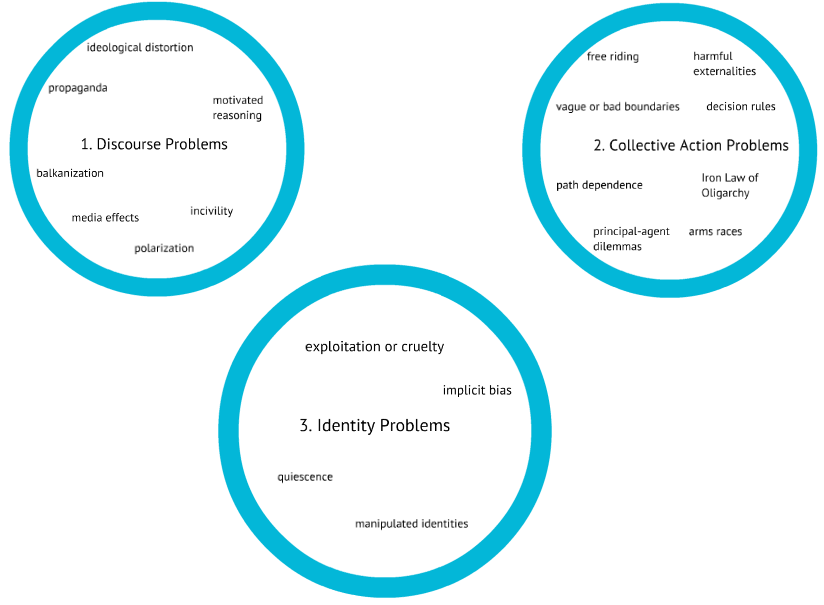
(Rancho Palos Verdes, CA) Back in 2014, I argued: [Elinor] “Ostrom plus [Jürgen] Habermas is nearly all we need.” I define a good citizen as anyone who seriously asks the question “What should we do?” Citizens face a dizzying variety of hard issues, but underlying them are general categories of problems. As of 2014, I thought these were the two basic categories:
- Problems of discourse make our thoughts and conversations go badly, so that we believe or desire the wrong things. Example include our susceptibility to propaganda and our strong tendency to “motivated reasoning,” or picking facts and theories because they yield the results we want.
- Problems of collective action cause us to get results that we do not desire, even when we agree about goals and values. An example is the temptation to “free ride” on other people’s contributions, or the tendency of small groups of specialists to dominate even democratic organizations (“The Iron Law of Oligarchy”).
Habermas and the postwar Frankfurt School provide a robust theoretical tradition, linked to practical experimentation, about how to address problems of discourse. Elinor Ostrom and the Bloomington School provide an equally robust theory/practice tradition about how to address problems of collective action. That was my basis for saying that Ostrom and Habermas nearly sufficed for a civic theory.
But I now think there is a third general category:
- Problems of identity and exclusion arise when some people simply won’t deliberate or collaborate with other people because they regard the latter as fundamentally different and inferior. Relatedly, sometimes people feel that they themselves don’t deserve to deliberate or collaborate because they are inferior.

The theoretical resources of Habermas and Ostrom are not sufficient for that third category, and we can learn more from theorists and practitioners of nonviolent social movements. That is the tradition that tells us what to do about problems of identity and exclusion if we choose to take violence off the table.
Therefore, I now believe that Ostrom, Habermas, and Gandhi are all we need–assuming that each name is synecdoche for a whole tradition of theory and practice.
| Ostrom | Habermas | Gandhi | |
| Fundamental problem | People fail to achieve what would be good for them collectively | People manipulate other people by influencing their opinions and goals. | People fail to view others (or themselves) as fully human |
| Exemplary case of the problem | We destroy an environmental asset by failing to work together | Government or corporate propaganda distorts our authentic values | One national or ethnic group exploits another |
| Characteristic starting point | People know what they want but can’t get it | People don’t know what they want or want the wrong things | Some people won’t recognize other people |
| Essential behavior of a citizen | Working together to make or preserve something. | Talking and listening about controversial values. | Using nonviolent sacrifice to compel change |
| Instead of homo economicus (the individual who maximizes material self-interest) we need … | Homo faber (the person as a maker) | Homo sapiens (the person as a reasoner) or homo politicus (the participant in public assemblies). | A Satyagrahi (the person as a bearer of soul force) |
| Role of the state | It is a set of nested and overlapping associations, not fundamentally different from other associations (firms, nonprofits, etc.) | Citizens form public opinion, which should guide the state, which makes law. The state should be radically distinct from other sectors | A target of demands |
| Modernity is … | A threat to local and traditional ways of cooperating, but we can use science to assist people in solving their own problems | A process of enlightenment that liberates people, but it goes wrong when states and markets “colonize” the private domain | (for Gandhi) an imperialist imposition, undermining swaraj |
| Main interdisciplinary combination | Game theory plus observations of indigenous problem-solving | Normative philosophy (mainly achieved through critical readings of past philosophers) plus system-level sociology. | Critical theology plus military strategy |
Voter Information Services
Method: Voter Information Services
deeper learning, civic learning
Newly published from Harvard Education Press is Rethinking Readiness: Deeper Learning for College, Work, and Life, edited by Rafael Heller, Rebecca E. Wolfe, and Adria Steinberg. It is an important overview of current efforts to make education “deeper,” meaning that students learn from guided but direct experience how to think critically and collaboratively about multidimensional problems. The Hewlett Foundation has been a leader in this work, and its Deeper Learning webpage is a useful introduction.
My colleague Kei Kawashima-Ginsberg and I contribute the chapter on civic education. We argue that the deeper learning movement can revitalize civic education–and that civic education is an important opportunity for deeper learning. Subsections examine changes in the context of civics (such as political polarization and the rise of online citizenship), trends in civic education, and the relevance of the whole curriculum and school climate–not just civics courses–to youth civic development.
Suggested citation: Peter Levine and Kei Kawashima-Ginsberg, “Preparing for Civic Life.” In Rafael Heller, Rebecca E.,Wolfe & Adria Steinberg (eds)., Rethinking Readiness: Deeper Learning for College, Work, and Life (Cambridge: Harvard Education Press, 2017), pp. 59-79
Networking
Having attended a conference last weekend, I meet a lot of people and had a lot of conversations…and had a lot of conversations about meeting new people.
One thing that kept coming up was people’s dislike of utilitarian networking – the idea that, especially when at a conference, you should talk to specific kinds of people or intentionally work on building certain relationships out of a pure utilitarian desire to leverage that relationship for your own good.
Perhaps I simply haven’t attended enough conferences, but I don’t find this concern very…concerning. To be clear, I do find the very idea of utilitarian networking to be distasteful, but I don’t find networking to be inherently utilitarian.
Or perhaps I’m just not doing it right.
In a previously life, I would go to social events and not talk to anyone. Not necessarily out of distaste for networking, but out of a general malaise about life. Then, some how, at some point along the line, I started talking to people.
And what I found was that people are really interesting.
Every conversation is like a window into a whole other universe of personhood. And the less you know the person, the more there is to learn.
So now when I go to events, I talk to people. As many people as meaningfully possible. Not out of a utilitarian drive to advance myself through connection, but out of a genuine desire to meet and learn from other.
Maybe I’m wrong, but I just though that’s what networking is.