Method: LiquidFeedback
Jul 29 '17
LiquidFeedback is an online proposition development and decision-making tool which seeks to operationalize the concept of 'liquid democracy'.

The Department of Political Science and the Jonathan M. Tisch College of Civic Life at Tufts University invite applications for the Newhouse Professor of Civic Studies in Arts & Sciences. Civic Studies encompass civic engagement, political participation, social capital, civil society, citizenship, civic virtue, the public sphere, and related topics. The Newhouse Professorship is a joint appointment between the School of Arts & Sciences and the Jonathan M. Tisch College of Civic Life at Tufts University. The Newhouse Professorship will promote the intellectual inquiry into civic life necessary to fulfill the University’s mission to shape students into active and engaged citizens. Teaching responsibilities will focus on the undergraduate level.
From the perspective of Tisch College: this is one of a small set of senior faculty positions that we are filling across the University. The new professors will form the nucleus of an intellectual community here that is dedicated to understanding civic life in all of its aspects. They will also connect to numerous existing Tufts scholars and students who study relevant topics. Our goal is to develop new approaches to defining, investigating, and improving civic engagement in the US and around the world.
QUALIFICATIONS
The position requires a Ph.D. in Political Science or a related field, and a record of excellence in scholarship and teaching. Current rank of Full Professor or advanced Associate Professor is required. The position is open with respect to subfield and methodological approaches.
APPLICATION INSTRUCTIONS
All application materials must be submitted via Interfolio at: https://apply.interfolio.com/43187. Applicants should submit a cover letter describing their research and teaching, a curriculum vitae, two representative scholarly works, and contact information for three references. References will only be contacted with prior candidate approval. Review of applications will begin on September 15, 2017, and will continue until the position is filled. Please contact Peter Morency, Administrative Assistant, at peter.morency@tufts.edu with any questions.
We wanted to lift up this piece from NCDD member org, the Kettering Foundation, to tap the NCDD network thoughts on how people are sorting themselves and what are some best practices for bridging diverse groups. Amy Lee of Kettering sat down with Bill Bishop, coauthor of The Big Sort, in which he talks about the ways people are now sorting themselves into groups by like-minded lifestyles. In the interview, Lee expresses how much more problematic this can make it for people to view shared problems and come together in collaborative action to address issues. We want to know what are your thoughts on this? What are some best practices for bridging these like-minded communities?
Let us know in the comments section below. You can read the article and watch the interview below, as well as, find the original on Kettering’s site here.
 Bill Bishop, coauthor of The Big Sort, was at the Kettering Foundation earlier this month to deliver the first Hodgkinson Lecture, named in honor of Harold L. (Bud) Hodgkinson, a renowned lecturer, writer, and analyst of demographics and education.
In a lively and spirited exchange, Bill helped us unpack some of the major themes in The Big Sort, specifically how people have “sorted” themselves out along lines of race, class, and ideology. Kettering, of course, sees this sorting as problematic because it makes it hard for already tough problems to come to be seen as shared problems. The “big sort” makes it much more difficult for people to deliberate across differences and make decisions together.
Kettering program officer Amy Lee caught up with Bill after the research session for some closing thoughts. You can watch those below and learn more about Bill Bishop’s work.
You can find the original version of this blog piece on Kettering site at www.kettering.org/blogs/bill-bishop.
In a world that is falling apart (no further elaboration needed), how shall we understand the dynamics of survival and collaboration? How does life persist and flourish in a world that is hellbent on commodifying and privatizing every aspect of human relations and the natural world?
For anthropologist Anna Lowenhaupt Tsing, the answer is to study the strange life of the humble matsutake mushroom, which tends to grow in North America but is a prized delicacy in Japan. The social and commercial systems by which the mushrooms are harvested, sorted, transported and sold – blending gift economies and global commodity-chains in the process – hold some penetrating insights into contemporary capitalism.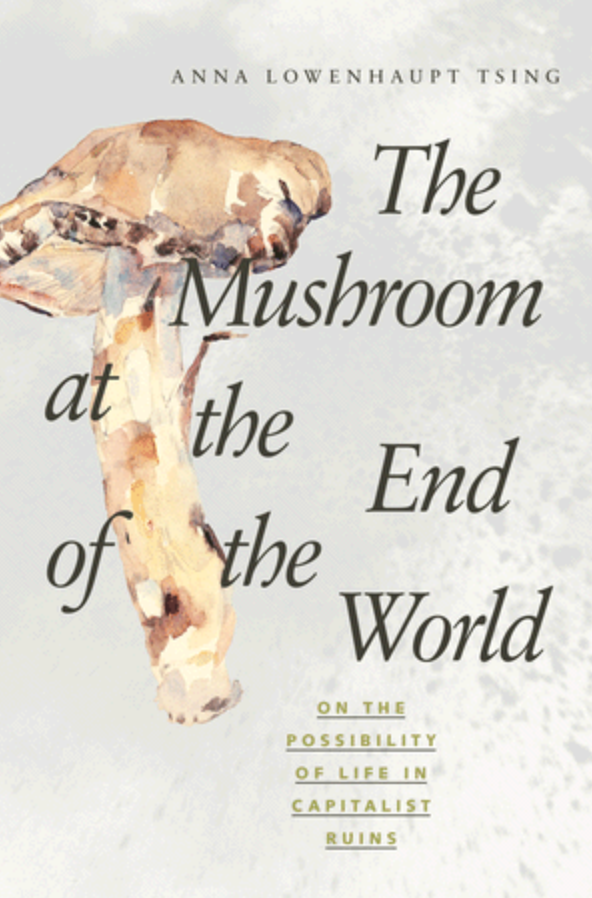
Tsing, a professor at the University of California, Santa Cruz, tells this story in The Mushroom at the End of the World: On the Possibility of Life in Capitalist Ruins (Princeton University Press, 2015). The book bills itself as “an original examination into the relation between capitalist destruction and collaborative survival within multispecies landscapes, the prerequisite for continuing life on earth.” It’s a brilliant premise: explore the deep dynamics of capitalism by telling the unusual ecological life and commercial journey of a mundane fungus.
The book is a wickedly wonderful ethnography. The matsutake mushroom is not just a metaphor for showing how this mushroom species devises strategies of survival for itself (in this case, entering into a symbiosis with trees and other plants and microbes); the mushroom is a partner of sorts with humans who take, steal, gift and sell it in various contexts.
Why so much attention to matsutake, a wild mushroom that cannot be grown in captivity? Because Tsing sees it as a proxy for the fate of human beings in today’s near-ruined world. The hardy, resourceful mushroom tends to grow in disrupted ecosystems and ruined landscapes -- just as billions of people around the world must now scrape out an existence in the face of ubiquitous, often-predatory capitalist systems and blighted environments. As a subterranean fungus of northern landscapes, matsutake play a valuable role in helping trees grow in forbidding locations. You might say that mushrooms are experts in dealing with precarity.
Oddly enough, so are the people who harvest the mushrooms. Matsutake foragers in the US Pacific Northwest tend to be refugees from Laos and Cambodia, American veterans, and itinerant poor people. They either can’t get regular jobs or don’t want them, preferring the “freedom” of being on their own in the open spaces of nature.
“Mushroom foragers work for themselves,” writes Tsing. “No companies hire them. There are no wages and no benefits; pickers merely sell the mushrooms they find. Some years there are no mushrooms, and pickers are left with their expenses. Commercial wild-mushroom picking is an exemplification of precarious livelihood, without security.” After a harvest in Oregon, say, the mushrooms are bought by pop-up wholesalers who ship them promptly to sorters, who classify them and export them to Japan, where a large and ready market of high-end customers eagerly buy them, usually to give as gifts.
Tsing rejects rejects the standard narratives about “progress” that tend to be the axis for understanding the future, in both capitalist and Marxist accounts Instead, in an analysis appropriate for our time, Tsing presents to us a capitalism of “disturbance-based ecologies in which many species sometimes live together without either harmony or conquest.”
Studying the mushroom trade is illuminating because it shows how investors commodify everything today and treat people and elements of nature “as if the entanglements of living did not matter. Through alienation, people and things become mobile assets; they can be removed from their life worlds in distance-defying transport to be exchanged with other assets from other life worlds, elsewhere.” Tsing’s primary message is that the whole “progress narrative” has been supplanted by a messy patchwork of precarious survival: the very life-strategy used by matsutake mushrooms.
She writes:
Global supply chains ended expectations of progress because they allowed lead corporations to let go of their commitment to controlling labor. Standardizing labor required education and regularized jobs, thus connecting profits and progress. In supply chains, in contrast, goods gathered from many arrangements can lead to profits for the lead firm; commitments to jobs, education, and well-being are no longer even rhetorically necessary. Supply chains require a particular kind of salvage accumulation, involving translation across patches. The modern history of U.S-Japanese relations is a counterpoint of call-and-response that spread this practice around the world.
Tsing rejects the idea of a comprehensive, unitary critique of capitalism, arguing instead that the world is full of “patchiness, that is, a mosaic of open-ended assemblages of entangled ways of life,” which the capitalist growth-paradigm obscures. Tsing accordingly presents the reality of precarity – for both mushrooms and people – in all their particularity and ephemerality. Living things are not fungible parts of machines; they are singular and improvisational -- something our critiques ought to acknowledge. Contemporary capitalism certainly recognizes this reality by “translating” the local and peculiar into usable inputs for ongoing capital accumulation.
Tsing wishes to show that no single rationality can begin to describe today’s economy, where “supply chains snake back and forth not only across continents but also across standards…” Not only are supply chains wildly heterogeneous, they often rely upon non-capitalist social forms, much as Facebook relies upon social sharing and Airbnb and Uber have colonized people’s private lives by marketizing their apartments and cars. For Tsing, “capitalist and noncapitalist forms interact in pericapitalist spaces.”
Despite the messy contingencies of this arrangement, capitalism still manages to amass assets for further investment. “How does this work?” Tsing asks. The short answer is that capital accumulation proceeds through a process of “salvage accumulation”:
Civilization and progress turn out to be cover-ups and translation mechanisms for getting access to value procured through violence: classic salvage.” In today’s global supply chains, this means “coerced labor, dangerous sweatshops, poisonous substitute ingredients, and irresponsible environmental gouging and dumping.
The Mushroom at the End of the World is no dry social-sciences monograph; in its poetic expressiveness and subtle depictions of social reality, the book often reads like a novel. There are no tidy conclusions, just a series of penetrating vignettes, analyses and observations. The ultimate point is to open up a new grand narrative. Once we can get beyond the stark divide of “Man” and “Nature” as dual opposites, Tsing writes:
all creatures can come back to life, and men and women can express themselves without the strictures of a parochially imagined rationality. No longer relegated to whispers in the night, such stories might be simultaneously true and fabulous. How else can we account for the fact that anything is alive in the mess we have made?
If The Mushroom at the End of the World describes the survival techniques of precariat mushroom foragers working under capitalism -- a story of ingenuity, commitment and proud autonomy -- the next step is to tell more of the stories of how precariat commoners are emancipating themselves through commons. Tsing is right: once the market/progress narrative is exposed as a cover-story, a range of different narratives become possible.
In the Washington Post, Michael Chwe argues that the “beliefs and values” of James M. Buchanan “conflict with basic democratic norms.” Buchanan (1919-2013) was a hugely influential public choice economist. Chwe is intervening in the debate about him that has been provoked by Nancy MacLean’s recent book Democracy in Chains. Although I haven’t read MacLean, I want to offer a theoretical point.
If freedom means non-interference, and if democracy means equitable decision-making in groups, then freedom and democracy are in tension.
“Non-interference” means not being told what to do or what not to do. “Equitable decision-making” means a process that yields a result binding on the whole group, based on everyone’s input. It need not mean majority-rule; democratic processes can be more complex and demanding than that. But democracy does yield binding outcomes, which may interfere with what individuals want to do. Therefore, democracy as equitable decision-making conflicts with freedom as non-interference.
This means that libertarians and classical liberals should own up to the fact that they are critics of democracy. Yes, they favor certain forms of liberty and equity, but those don’t equal democracy. Libertarians are leery of binding decisions by non-voluntary groups.
For their part, strong democrats–people who want to defend and expand the scope of democratic decision-making–should admit that they are critics of freedom as non-interference.
But one can compromise. I happen to think that non-interference is a real good. People rightly don’t like to be told what they may and may not do, except when it is strictly necessary. I also happen to think that democratic decision-making is a real good: people should deliberate and shape their common world. If the two goods trade off, then we can design institutions that offer elements of democracy along with strong constraints to protect individuals from unjust interference by the group. For those who favor a compromise, Buchanan’s work is full of important insights and cautions, but is not a satisfactory political theory all by itself.
Two important complications:
