Unrig the System Summit in NOLA Next Week

If you’re tired of political corruption and looking to improve our democracy, then check out what’s being convened next week! If you hadn’t heard already, Debilyn Molineaux, Co-Founder and Director of the Bridge Alliance – an NCDD member org – will be speaking at the upcoming Unrig the System Summit. The summit is February 2-4 in New Orleans, and is being hosted by BA member, Represent.Us. Convening folks from across the political spectrum, this conference will be an excellent opportunity to network and collaborate on next steps to improving our democratic environment. You can read the announcement in post below or find more information on BA’s site here.


Join us at Unrig The System Summit in NOLA!

We are thrilled to announce that Debilyn Molineaux, our Co-Founder & Director, will be a speaker at the Unrig The System Summit hosted by Bridge Alliance member Represent.Us in New Orleans on February 2-4.

Convening the Brightest Minds from the Right and Left to Fix American Politics…and Party in New Orleans

Unrig The System Summit is no ordinary conference. No endless panels and speeches. It’s fast-paced and fun, with plenty of time to self-organize as you mingle with top advocacy leaders, academics, comedians, musicians, celebrities, activists, philanthropists and journalists. This is about crossing partisan and ideological divides and working together on concrete solutions to unrig America’s political system…. with plenty of New Orleans fun mixed in. The Summit runs from Friday, February 2nd, 1pm through Sunday, February 4th, 2pm CT. Key programming will take place all 3 days, so plan on being in attendance for the entire event.

Click here to register – We hope to see you there!

Program tracks for Advocacy, Policy and One Helluva Good Time 
Shape the future of: Money in Politics, Gerrymandering, Citizens United, Voting Reform, Transparency and more. See the hour-by-hour agenda here, or get the Unrig Summit App to plan your personal agenda.

Advocacy Track Sneak Peek:

  • The Power of Storytelling – Learn the narrative skills that power winning campaigns from the experts who have organized some of the best. From gaining new recruits to getting press coverage, so much of what we do relies on our ability to tell a compelling story about our work and ourselves.
  • Fighting Big Money While Running for Office – If you’re running for office, thinking about running for office, supporting a candidate, or just interested in any of the above, come learn about how candidates can embrace a pro-democracy agenda on the campaign trail. You will learn about how to use the right language, how to raise money, how to run a winning campaign and build the next generation of elected champions who will fight to end the influence of big money.
  • Campaign Design Lab – In this interactive training, you’ll join a team to create a campaign live at the summit. You will be guided through a campaign planning 0simulation, and walk away with the recipe for designing and building groundbreaking new campaigns! After the workshop you may continue by participating in one of several follow-up workshops during the Summit. Build something great and it may even be showcased live from stage on Sunday!

Policy Track Sneak Peek:

  • At Our Whit(ford)’s End With Gerrymandering? – Join the lawyer who argued on behalf of Wisconsin’s voters in the Supreme Court’s recent Gill v. Whitford gerrymandering case and other redistricting experts to find out how the Court might rule, and how to prepare for next steps in each possible scenario. Gill v. Whitford is a potential blockbuster case to decide whether partisan gerrymandering is constitutional — and we expect a decision soon after the Summit.
  • From Russia, with Facebook: Foreign Influence in American Elections – Join leading experts in a discussion on how we can limit the influence of people who are beyond the reach of our laws — and if we should. The 2016 presidential cycle showed how vulnerable our elections are to foreign influence.
  • What to Do About Citizens United? – Hear from the best legal minds in the country about how we can fight Citizens United, super PACs, dark money, and more. What are the most promising avenues for legal reform, and where should we be focusing our efforts? What’s the near- and long-term game?

Entertainment

  • Friday Night Welcome Party – Join us for a night on the town, and meet the movement at one of New Orleans’ most prolific venues: The Howlin’ Wolf, featuring local live music from Meschiya Lake and the Little Big Horns, and Brass-A-Holics. Make sure to arrive on time to catch the open bar happy hour sponsored by Center for Secure and Modern Elections. This mixer is designed to help you meet new allies. Don’t be shy! 
  • Saturday Night Live Performance – Saturday night is the marquee event of the Summit: an inspiring evening of live music, stand-up comedy, and short speeches in a 1,800-seat historic New Orleans theater. The evening will be hosted by Jennifer Lawrence and Adam McKay and will be livestreamed on multiple platforms. Speakers include Represent.Us Director Josh Silver; Professor Richard Painter; comedians Nikki Glaser, and Adam Yenser; astronaut Ron Garan; former State Senator and Our Revolution President Nina Turner and more, with live music from HoneyHoney, and the legendary New Orleans-based Preservation All-Stars. 

Remember to follow the #UnrigTheSystem hashtag on Twitter for more in-the-moment happenings!

You can find the original version of this announcement on Bridge Alliance’s site at www.bridgealliance.us/unrig_the_system_summit.

Climate Initiative Essen – Action in a new Climate Culture

Author: 
The project is one of the victorious competitive contributions within the scope of a competition of the German ministry for education and research (BMBF) named „Energy-Efficient City“. It pursues the aim to promote climate protection in Essen with a Bottom Up strategy, i.e. to realise a vivid climate culture by...

watching democratic cultures decline

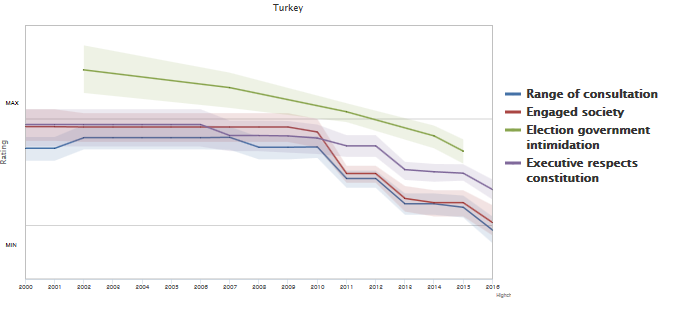
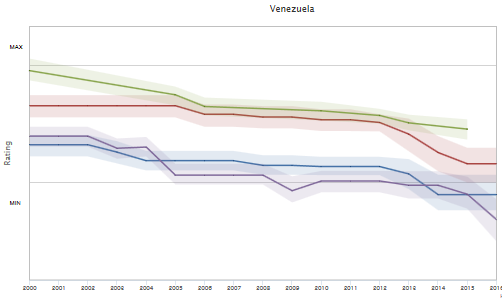
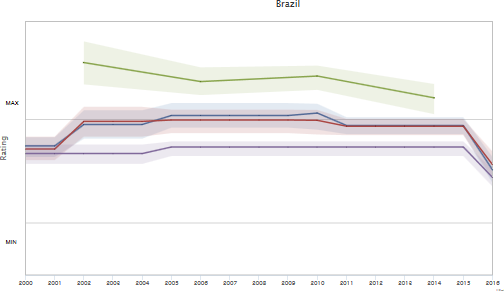
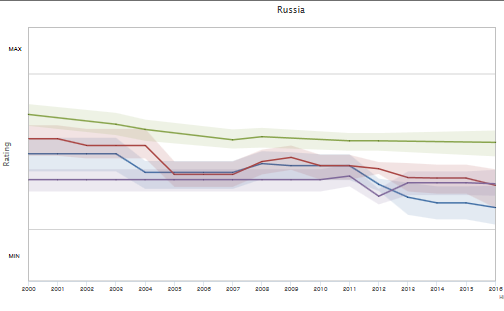
Yesterday, I offered some evidence that broad public deliberation declines when authoritarianism rises. I used data Varieties of Democracy, which asks 2,800 experts questions about specific countries in specific years.

For this purpose, I’ll define “authoritarianism” as a system that relies on the arbitrary will of leaders. It’s a system of rulers without many rules. Its opposite, then, is “republicanism” in Philip Pettit’s sense: a system in which nobody can be told what to do without a justification. Many variables in the V-Dem database relate to authoritarianism, but I’ve selected two: (1) whether the executive branch respects the constitution of its country, and (2) whether elections are held without intimidation. I chose this election-related variable because regular and fair elections provide a check on arbitrary rule, and also because a typical tactic of an autocrat is to interfere with elections.

Pettit, citing Quentin Skinner, emphasizes that “one of the central themes” of the civic republican tradition is “belief in dialogical reason.” The connection between republicanism and deliberation is not definitional. In other words, you could imagine an authoritarian state that encourages deliberation or a genuine republic that is weak on deliberation. But republicanism and deliberation have often been connected because one way to make decisions non-arbitrary is to encourage discussion of them.

V-Dem offers two measures of deliberation: 1) to what extent do “large numbers of non-elite groups as well as ordinary people … discuss major policies among themselves, in the media, in associations or neighborhoods, or in the streets”?; and 2) to what extent do leaders consult a wide range of stakeholders? Along with the two measures of authoritarianism, we have four variables whose relationships interest me.

In Turkey, for example, all four measures have fallen since 2010. The fair elections variable began to decline first; then the other three fell in tandem.

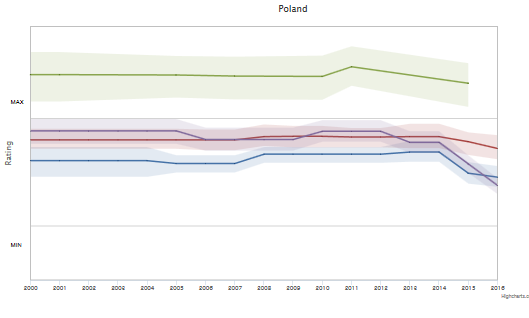
The pattern is less pronounced but similar in Poland since 2011.
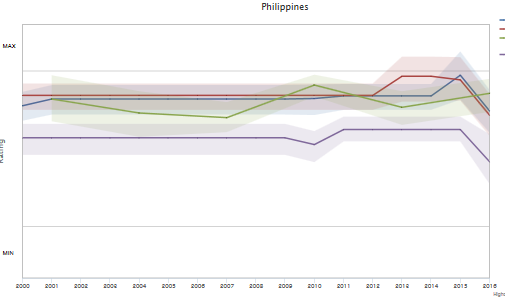
In the Philippines, election intimidation has not grown worse, but the other three variables have taken a dive since 2012.

In Venezuela, it’s been steadily downhill since 2000.

Brazil’s elections got a little worse first (starting at a high baseline), and then everything plunged after 2015.

Russia has seen fairly steady declines from a lower baseline.

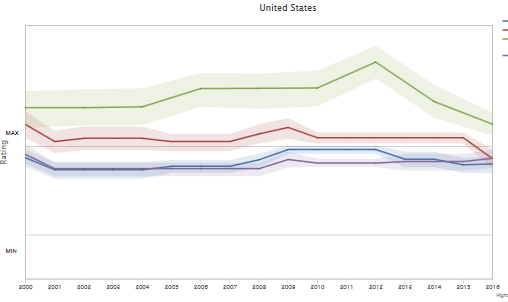
And the US saw declines before 2016 in elections and in public dialogue that may presage rising state authoritarianism in 2017 and ’18 (not shown yet).

Register for NCDD’s February Tech Tuesday with Iceland’s Citizens Foundation!

NCDD is happy to announce our February Tech Tuesday, featuring Iceland’s Citizens Foundation and their digital democracy tools. This event takes place Tuesday, February 13th from 2-3pm Eastern/11am-Noon Pacific – register today to join us!

Róbert Bjarnason, from the nonprofit Citizens Foundation in Iceland, will present digital tools for upgrading democracy in Iceland and beyond, outlining the Foundation’s digital democracy work since 2008. Projects including policy crowdsourcing and participatory budgeting using open source tools will be demonstrated in this webinar. As highlighted in the Financial Times, since 2011 the citizens of Reykjavik have voted online to select close to 1,000 community improvement projects totaling over $20 million dollars.

The Citizens Foundation open source digital democracy tools have been used in over 20 countries and by over 1 million people to change policy and help rebuild trust between citizens and their governments. Collaborating with E-Democracy.org in the United States to help others deploy and measure civic digital outreach efforts, a new case study (request a copy) comparing paid Facebook and Google advertising used to reach nearly every citizen of Iceland will be shared in brief.

Róbert is a successful entrepreneur that introduced the web to Iceland in 1993 and in 1995 to Denmark. Before co-founding the Citizens Foundation in the year 2008 he worked in the online gaming industry where his team received many industry awards.

Robert has many years experience and much success in using digital tools for democracy, and he is looking forward to sharing his knowledge and experience with us. Don’t miss out on this unique opportunity – register today!

Tech Tuesdays are a series of learning events from NCDD focused on technology for engagement. These 1-hour events are designed to help dialogue and deliberation practitioners get a better sense of the online engagement landscape and how they can take advantage of the myriad opportunities available to them. You do not have to be a member of NCDD to participate in our Tech Tuesday learning events.
authoritarianism and deliberative democracy

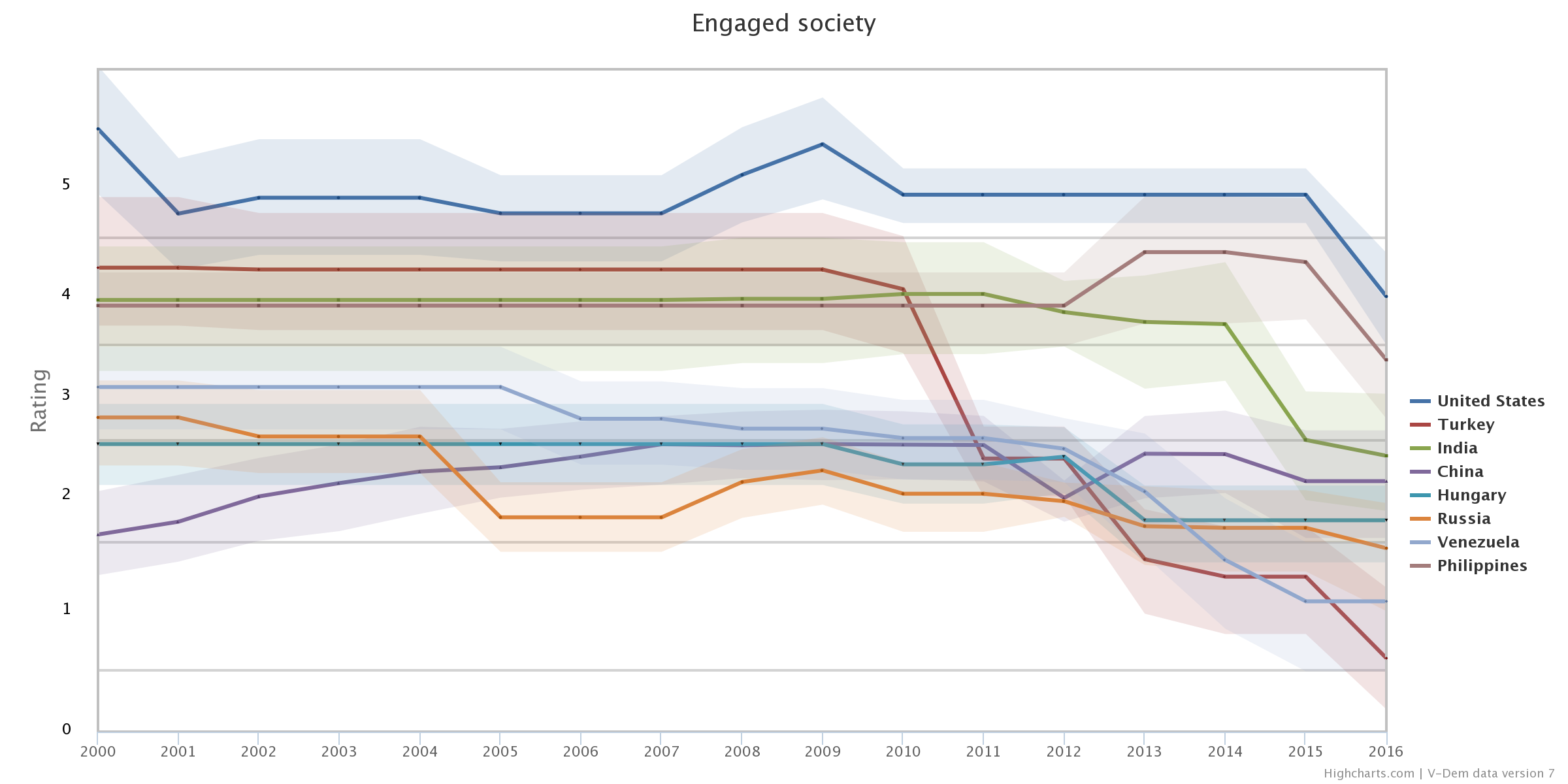
The Varieties of Democracy project asks 2,800 experts many questions about specific countries in specific years. One question is “When important policy changes are being considered, how wide and how independent are public deliberations?” The scale ranges from zero (“Public deliberation is never, or almost never allowed”) to 5 (“Large numbers of non-elite groups as well as ordinary people tend to discuss major policies among themselves, in the media, in associations or neighborhoods, or in the streets. Grass-roots deliberation is common and unconstrained”).

Below is a graph that shows the change in public deliberation (so measured) since 2000 for eight countries that I see as increasingly authoritarian. My choice of these countries is subjective. (Why not the Central African Republic, which Freedom House names as the single-biggest “backslider” on democracy in the world? Because I don’t know much about the CAR.) But of the countries that I selected in advance to serve as examples of growing authoritarianism, all but one showed declines in the V-Dem measure of broad public deliberation.

This pattern may seem self-evident or even tautological. Perhaps countries that are tending toward authoritarianism see less deliberation because authoritarianism is the opposite of deliberation. But I find the graph at least somewhat meaningful. At the core of authoritarianism is a reliance on powerful leaders who disdain constitutional limits. It’s possible for authoritarians to run a state even while “large numbers of people … discuss major policies among themselves, in the media, in associations or neighborhoods, or in the streets.” Some authoritarian states even choose to expand deliberative fora. For example, China’s Communist Party is implementing deliberative processes, which it probably sees as devices for blunting criticism and improving satisfaction with its deeply undemocratic regime (He & Warren 2017). Caroline W. Lee (2015) has argued that small-scale deliberation co-opts resistance in the USA, and Cristina Lafont (2017) worries that creating ideal deliberative fora can delegitimize regular democratic processes.

So the question arises whether authoritarianism is really contrary to deliberation at all. One might even suspect that the biggest threats to deliberation arise in mass capitalist societies, where corporate and partisan propaganda drown out reasoned conversation on poorly designed platforms, like Twitter.

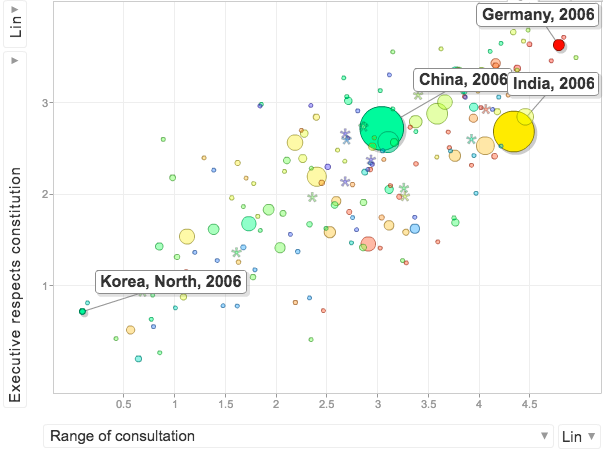
But this is partly an empirical question, and I do see evidence of a negative correlation between authoritarianism and deliberative values. Above I showed that countries well known for turning more authoritarian are also seeing less public deliberation. Below are two graphs showing a different relationship–between leaders’ respect for the constitution and the government’s tendency to consult a wide range of stakeholders. Again the source is V-Dem data, but unfortunately from 2006.

I take respect for the constitution as an inverse measure of authoritarianism, and consultation as a sign that a government wants to deliberate. The correlation is pretty clear. Most countries fall on a line between North Korea and Germany. India’s government consults more than China’s does. Neither respects its own constitution more than the other, but the Indian constitution is much better on civil liberties. The US is a circle between those two countries but a little higher up.

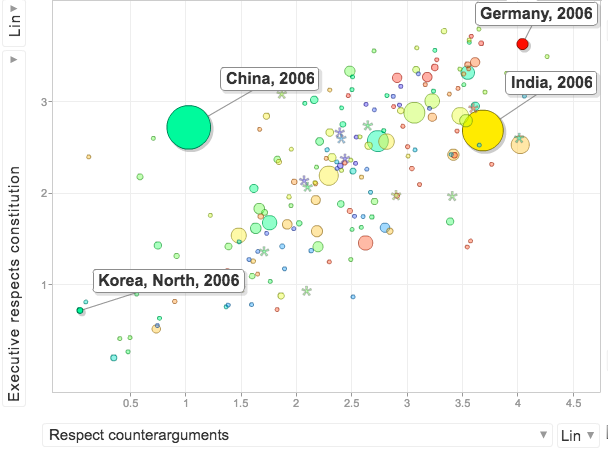
The next graph shows the same y-axis (respect for the constitution) plotted against the degree to which politicians respect counter-arguments. A high score on that measure means that they generally feel compelled to give explanations when they are challenged. Again, the line is defined by North Korea and Germany. On this plot, China is an outlier, showing decent respect for its own constitution but reluctance to consult diverse stakeholders.

Much more analysis could be done (and it would be better to use more recent data than 2006). Still, this seems to be evidence of a correlation–in practice, if not in theory–between respect for constitutional restraints and deliberative values. One reason may be that political leaders tend to model deliberation in societies where they also respect limits, and they fail to do so when they turn authoritarian. Or it could be that when publics are organized and motivated to demand discussion, they also block authoritarianism.

Sources: Baogang He  & Mark E. Warren “Authoritarian Deliberation in China,” Daedalus, 146, 3, 155-166; Caroline W. Lee, Do-It-Yourself Democracy: The Rise of the Public Engagement Industry New York: Oxford University Press, 2015; Cristina Lafont, “Can Democracy be Deliberative & Participatory? The Democratic Case for Political Uses of Mini-Publics,” Daedalus 2017 146:3, 85-105.

Healing Through Conversation and Connection

We wanted to share this piece from longtime NCDD member Parisa Parsa, Executive Director of Essential Partners, which was posted on the blog of NCDD member org, the Bridge Alliance. In the article, she speaks on the lack of connection and trust amongst people today and all-too-common feelings of isolation and avoidance despite technological advances in communication. Our ability to be in conversation with people, especially those with whom we disagree, is one of our greatest connections to our humanity; and we need to repair it in order to heal our society and ourselves. We encourage you to read the article below or find the original on BA’s site here.


Staying Connected in the Midst of Differences

In 1989, a group of therapists engaged in some commiseration at their shared Cambridge practice. They discussed a concern about what had become of sane discourse about weighty issues of policy in the United States. At that time one of the therapists, Laura Chasin was a doctoral student of government with a special interest in the philosophy of John Dewey, who in the late 1800’s expressed his profound belief in expressing how democracy and ethical ideals of humanity were synonymous.

In the office with the others, Laura shared how she was particularly distressed by the chaos and ineffectiveness of public debates about abortion. Her colleagues Corky Becker, Dick Chasin and Sallyann Roth, along with researcher and editor Maggie Herzig, puzzled at how much was lost in the public shouting matches that passed for debate. The mutual understanding, restoration of trust and sheer humanity that was the bedrock of effective family therapy were utterly absent from the publicly televised conversations about some of our most critical social and political issues. What was common however, were disjointed policies, stalemate and a devolution of the social fabric in communities around the country, just when our democracy needed solutions most.

From the confines of those pivotal hours of discourse, the question the group considered was, “Could the practices of family therapy be engaged to build relationship and understanding, and restore trust among folks who were deeply divided on issues that were rooted in their core values?” That question motivated years of research and the development of the practices at the core of the Public Conversations Project, now Essential Partners.

In the last 28 years, the United States has seen a continuing rift between what passes as public discourse and the practices that have been developed to be effective in building and sustaining personal, direct relationships. Today as much as anytime since, the same question that brought our founders together is a source of dismay, concern, alarm or despair for people across the political and social spectrum.

At least as far back as Plato, the notion of public discourse has been engaged and debated in philosophical treatises. Questioning the effectiveness and relevancy of open dialogue is part of democratic ideals. Within a democratic system, the common person is assumed to have the right to engage in discussion about the realm of truth and justice. In that regard, which topics warrant engagement, and what qualifications ought one have to properly engage? If we are to have a system of government in which each person has a vote, it is assumed then that we can express freely, differences in ideas, opinions, world views. The free exchange of ideas, the ability to argue, debate and dialogue has been central to the democratic experiment — not just in forming public policy, but in considering what defines the common good.

The spirit of public, civilized debate that operates according to competing arguments that proceed rationally until there is an objective winner, has become a charming anachronism, especially in our current political arena. Persuasive strength of one side’s logic often pushes into the shadows the ideals of democratic discourse and goals. In the lead up to the 2016 election, there was much hand-wringing about the lack of reasoned argument and loose treatment of facts in the formal debates. Even the moderators were subject to personal attack from candidates. And then it was open season on everyone — candidates, moderators, audience members, on social media, on broadcast television and in public.

The issue we have today is not the lack of access to information – it is a lack of connection and trust. Added to our political polarization are alarming rates of afflictions borne of isolation and despair: rates of depression and anxiety have skyrocketed; addiction rates are escalating and, in the case of opioids, are now being declared epidemic; suicide rates increased by 24% from 1999-2014. Measured as cultural trends, these point to a deep need to relocate ourselves in relationship with caring others and with a sense of purpose and meaning that goes beyond the struggles within us. This can be accomplished through therapy, of course, but the practices of connection, relationship, trust and understanding need to be activated among us in community as well. After all, the wider definition of human community includes agreements despite conflicting perspectives.

“Apart from conversation, from discourse and communication, there is no thought and no meaning, only just events, dumb, preposterous, destructive.”  These words of John Dewey in 1922 seem to capture well the malaise of our times. We live a frustrating paradox: the many vehicles at our fingertips for pumping out information have not resulted in an increase in communication. The real interchange of ideas beyond lobbing insults or competing “facts” at one another has been the true casualty of our times. The advent of social media simply provided an accelerant.

While working on this article, in fact, I overheard another coffee shop patron discussing the news of the day with a companion: “I feel like I have so much to say and nowhere to say it,” he said, “I think I’ll open a Twitter account just to have somewhere to vent it all.” We are good at talking about those “dumb, preposterous, destructive” events, but lack the corresponding opportunities for the kind of discourse that makes meaning of those events and our relationship with them. It is only through conversation, that shared experience of knowing and being known, that we arrive at a sense of our purpose, and what comes next.

At Essential Partners, we believe our times demand a refreshed public discourse. Our approach rests on the fact that behind every belief is a person with a story. Our practices help to build a web of relationships that assumes difference and can remain connected even through deep disagreement. When we have a foundation in the honoring of one another’s humanity, a relationship built on the trust that our neighbor or political opponent comes at their view honestly, we can hold our disagreements alongside the fact of the others’ fundamental dignity. And then our passionate, principled differences remain grounded in the fact that we are mutually interdependent.

Conversation is the simple and profound act of sharing who we are with one another. It has been the primary mode of human connection for as long as humanity has existed. Connection between ideas and their implications in real lives. Connection between our pain and our joy: the recognition of the arc of human living that includes isolation, loss, despair and also exalted moments of the pleasure and privilege of being alive. Connection between our past, rife with wrongs done and wrongs done to us, and a future in which we demand and strive for better. The suffering of generations that is born anew with each tends to be given too short a story arc in our imaginations and in our societal awareness: our short memories are stunting not just our sense of history but our sense of compassion as well. Our ability to tell one another our stories – and tell them fully, truly, in all their complexity – is what builds a sense of the truth that honors the depth and breadth that those old philosophers may have been getting at.

In our current cultural moment, we hear constantly that people avoid or suppress the desire to be in this kind of conversation with folks who think or believe differently. The loss in this turning away, in this avoidance, is one that cannot be overstated. Because it confuses our political ideas with our humanity, and allows us to build destructive stereotypes of each other based on exaggerated differences. That practice, no matter how principled ones opposition is to the other side’s views, always leads to terrifying conclusions. The rampant conversation right now about whether one should entertain views that are “simply wrong and destructive” forgets that those views are held by people. We don’t get to cast fellow human beings to the wayside because their ideas are wrong to us, lest we too find ourselves on the wrong side of that equation. We can disagree with our opponents ideas and still hold a bedrock conviction in their humanity and their dignity. This has been the core outcome of our sustained dialogues among folks in leadership on different sides of the biggest divides.

In our pluralistic society we can never expect to be without difference and even conflict. In the world of conflict resolution we know that the process of moving through conflict is not about tying things up in a neat little bow, but about building practices that help us transform conflict in ways that are generative. Rather than imagining conflict is something to be avoided, suppressed, or expelled, we believe we can build a kind of public discourse that opens up the creative possibility when conflicting ideas meet. We can always learn something about ourselves and one another and realize a new truth: our ability to stay connected in the midst of our differences. These practices are critical to sustaining a healthy culture.

Ultimately, when people enter the public sphere with opinions and values informed by the deep, relational connection with others who believe differently, the whole quality of our public discourse can be transformed. Through this education and growth we can learn to embrace passionate views that sharply differ without dehumanizing our opponents.

Almost 30 years after the meeting between the founders of Essential Partners, we have come to a critical point in our self-evaluation of democratic ideas. If our collective social values are dependent on communication and dialogue, then this new norm can truly allow difference to flourish, while sharpening our understanding of how our beliefs, ideas, policies and actions affect others. And through all this, we can rebuild our democracy.

You can find the original version of this article on Bridge Alliance’s site at www.bridgealliance.us/staying_connected_in_the_midst_of_differences

DACA and justice

About 800,000 people are “DREAMers”–enrolled in Deferred Action for Childhood Arrivals (DACA). They are subject to deportation unless Congress reverses Donald Trump’s executive order rescinding DACA. Their cases represent 800,000 potential tragedies. When so many people are faced with such brutal and deliberate hardship, it can seem bloodless to consider subtle theoretical questions–especially when one isn’t personally threatened.

But politics is often a matter of life and death, and it’s important to debate abstract issues of justice as long as one also retains empathy and commitment. A refusal to address contrary arguments can come across as fear that those arguments may actually be right. Here are some thoughts on three issues that have come up in the debates so far.

Does amnesty violate the rule of law?

Attorney General Jeff Sessions invoked the rule of law when he announced that DACA would be rescinded:

No greater good can be done for the overall health and well-being of our Republic, than preserving and strengthening the impartial rule of law. Societies where the rule of law is treasured are societies that tend to flourish and succeed.

Societies where the rule of law is subject to political whims and personal biases tend to become societies afflicted by corruption, poverty, and human suffering.

To have a lawful system of immigration that serves the national interest, we cannot admit everyone who would like to come here. That is an open border policy and the American people have rightly rejected it.

Therefore, the nation must set and enforce a limit on how many immigrants we admit each year and that means all can not be accepted.

This does not mean they are bad people or that our nation disrespects or demeans them in any way. It means we are properly enforcing our laws as Congress has passed them.

It is with these principles and duties in mind, and in light of imminent litigation, that we reviewed the Obama Administration’s DACA policy.

Here Sessions echoes prevalent talking points on the anti-immigration side. The idea is that it’s illegal to bring a child here without authorization; and for the government to ignore illegality is to erode the rule of law, which is a buttress of the republic. Sessions cites the fact that President Obama enacted DACA by unilateral executive order as additional evidence that the policy is arbitrary.

I endorse the rule of law as an aspect of justice. But I think Tyler Cowan offers the right response to Sessions’ argument:

What is striking about immigration, and immigration policy, is the very simple but oft neglected fact that it concerns human bodies. Any exercise of immigration law thus requires some violence, either explicit or implicit, against those bodies. It will mean the rounding up and forcible restraint of bodies, the widespread use of prisons and other coercive holding chambers, and tearful scenes of airport separation. Those methods will be applied to individuals who do not enjoy the full protections of the U.S. Constitution, who are vulnerable to mistreatment during the process, and who do not always have full fluency in the English language or a full understanding of their legal rights. … A somewhat lax enforcement of immigration restrictions is in fact the friend of the future of the rule of law, not the enemy.

If you have faith in the government to execute laws impartially and efficiently, you could conclude that rule-of-law arguments support deporting people who are present in the United States against the law. (You might think that even if you also see stronger reasons to support DACA). On the other hand, if you doubt that our actual government can deport hundreds of thousands of people without demonstrating partiality, without committing arbitrary violence, and without violating legal rights, then the way to preserve rule of law is to offer amnesty. This is a point where insights from classical liberalism and Public Choice theory are pertinent.

In Origins of Totalitarianism, Hannah Arendt defines citizenship as “the right to have rights.” Without DACA, DREAMers are people inside the United States who have no right to have rights. That status threatens the rule of law for all. Removing them is not only cruel but also impossible to accomplish without permitting the state to act lawlessly against a large category of people. In principle, a wise state could follow its own laws as it made decisions about people who lacked rights. A real state will surely not do that.

Is migration an intrinsic human right?

Arendt argues that everyone must be a citizen somewhere; statelessness is a profound human rights violation. But that doesn’t mean that everyone has a right to be a citizen anywhere.

If you believe that every human being has a right to reside anywhere, then the DREAMers should obviously not be deported. Neither should anyone else, nor should anyone be stopped at any border.

For my own part, I don’t believe it. There are many countries where I would like to be able to live and work, but I think I have a moral (as well as a legal) obligation to follow the immigration laws of those countries. They have a right to keep me out unless I am a refugee in immanent danger. My reason for being highly sympathetic to migrants to the USA, regardless of their legal status, is that I regard US relations with many of their home countries as unjust. I don’t see their decision to move to the US as simply “free,” because the economic and political conditions in their home countries were beyond their own control and are sometimes the result of US foreign policy. When, however, highly educated citizens of wealthy nations sneak into the US illegally, I am unsympathetic.

Most Americans do not share this worldview. Quite the contrary: they believe that we are generous with foreign aid and brave in defending democracy abroad. This premise is factually incorrect, but skepticism about immigration follows logically enough from it.

Is there a basis for distinguishing the DREAMers from other undocumented residents?

Perhaps we are debating DACA separately right now because of sheer political necessity. There is no immediate opportunity to accomplish a reform that would cover people other than the DREAMers. The DREAMers won precarious rights through DACA that Congress is actually considering enacting by statute. That would be half a loaf, but it’s better than none.

If the reason to separate DREAMers from other undocumented immigrants is nothing but political necessity, it’s important to say so publicly and clearly. Otherwise, we might inadvertently justify denying rights to other people, including the DREAMers’ parents. We might allow that distinction to harden.

It’s clear that the DREAMers have won more public support than other immigrant groups. One explanation could be their own skillful, innovative, and courageous organizing. I suspect two other reasons as well. First, people who’ve lived in the US since their childhood are especially likely to suffer if they are suddenly deported; and suffering is to be avoided. That is a utilitarian rationale for offering a unique policy to DREAMers. But clearly, DREAMers are not the only people who suffer from deportation (or the threat of it), and some may suffer more.

A different argument involves intention. Since the DREAMers did not choose to immigrate, they should not be held responsible for their parents’ choices. I’m sure that this argument is widely held, but it is problematic. It assumes that adults’ choices to migrate were free (in a morally relevant sense), and it justifies imposing very dire penalties on individuals because they were adults when they migrated.

Both arguments have some plausibility, but neither really justifies a bright line between the DREAMers and other undocumented residents. If it’s a matter of justifiable expediency to single out the DREAMers, we should constantly say so.

Transparency International School on Integrity 2018

Transparency International School on Integrity (TISI) is an annual state-of-the-art anti-corruption and accountability training for future leaders. The upcoming TISI 2018 will take place during 2-8 July, 2018 in Vilnius, Lithuania. TISI exposes its participants to the latest developments in the field of anti-corruption and accountability and offers real opportunities...

British Columbia Referendum on Electoral Reform (2005)

BC's referendum was the culminating event of a lengthy process of government debate and public engagement on the issue of electoral reform. By putting the issue to a referendum, the government sought to ensure any decision on the replacement of the first-past-the-post system was made with the support of at...