Recap on our Tech Tues Feat Iceland’s Citizens Foundation

NCDD hosted another one of our informative and exciting TechTues calls earlier this week! We were joined by around 100 participants from across the world to learn more about Citizens Foundation, their digital democracy solutions, and how they are working to strengthen civic engagement in Iceland and internationally.

We recommend you listen to the recording if you weren’t able to make it because it was a great call!

On the call, Robert Bjarnason of Citizens Foundation walked participants through a brief history of how democracy has evolved throughout the last millennium in Iceland and set the stage for the work they are doing today. Founded in the aftermath of Iceland’s economic collapse in 2008, Citizens Foundation sought to improve public participation in government and policy change, by creating open source tools and implementing more democratic processes. They specialize in participatory budgeting, policy crowdsourcing, and other open source projects spanning several countries in Europe and in Australia.

Some of our favorite quotes from Robert during the Tech Tuesday:

  • “A key factor is to make participation fun. Make it informational and educational, but it can’t be boring. People have too many other options, there’s competition for attention, so make it an enjoyable experience”
  • “Lower the barrier to reach more people and not just the usual suspects”
  • “It’s key to let people know about the effort, they can’t participate if they don’t know about it.”
  • “If you listen to the people, the people will listen to you.”
  • [In response to a question on how do you make participation fun?] “Complicated is how you kill fun, make it simple and use pictures!”

If you were unable to join us on the call, never fear! We recorded the webinar which can be found on the archives page here. Access to the archives is a benefit of being an NCDD member, so make sure your membership is up-to-date (or click here to join).  We had an active chat discussion which raised some really interesting questions and examples, and you can check out the transcript of this chat by clicking here. Robert also shared the slides from his presentation, which you can find by clicking here, in case you wanted to scroll through them.

Tech_Tuesday_BadgeBig thank you to Robert and everyone who participated on the call to make it engaging and informative! We encourage you to check out the TechTues recording and learn more about Citizens Foundation’s ongoing work at https://citizens.is/. To learn more about NCDD’s Tech Tuesday series and hear recordings of past calls, please visit www.ncdd.org/tech-tuesdays.

Finally, we love holding these events and we want to continue to elevate the work of our field with Tech Tuesdays and Confab Calls. It is through your generous contributions to NCDD that we can keep doing this work! That’s why we want to encourage you to support NCDD by making a donation or becoming an NCDD member today (you can also renew your membership by clicking here).

Piano urbano della mobilità sostenibile di Perugia [Sustainable Urban Mobility Plan of Perugia City Council]

Il Comune di Perugia intende dotarsi di un Piano Urbano della Mobilità Sostenibile (PUMS) definito dalle linee guida europee Eltis quale piano strategico di medio-lungo periodo (orizzonte temporale decennale) finalizzato a promuovere un sistema di mobilità in grado di garantire i bisogni di spostamento dei cittadini nelle diverse condizioni sociali,...

Ethiopian Qero Management of the Gaussa-Menz Grasslands

Author: 
An “indigenous management system” (IMS) – in reference to the Ethiopian Qero management system over the Gaussa-Menz – is a collaborative and participatory form of environmental sustainability and conservation practice led by local indigenous groups within a state. It involves the creation of an inclusive indigenous regulatory framework for environmental...

ALERT: POTENTIAL CIVICS360 DOWNTIME

360

Friends, one of the most requested things that districts have asked of us when it comes to Civics360 is the ability to integrate it into Single Sign On within a district level LMS. In order for us to test this capability, we must see how the ‘live’ site works. While we do NOT expect there to be any problems at all, or expect any interruption in service with the Civics360 platform, please be aware that there MAY be periods of unavoidable downtime as we test and troubleshoot integration with Classlink. We will strive to ensure that this downtime is as limited as possible. We apologize for any inconvenience this may cause.

Advertisements

Habitat Conservation Planning in the U.S.

Author: 
Habitat Conservation Planning is a process in the United States allowing nonfederal parties to obtain permits for the incidental taking of threatened and endangered species. HCPs are prepared according to the Endangered Species act to calculate the anticipated ecological effects of the proposed permit.

MetroQuest Webinar on Finding Common Ground, Feb. 28th

Coming up at the end of February, NCDD member org MetroQuest will be hosting the webinar, How to Design Public Engagement to Find Common Ground; co-sponsored by NCDD, IAP2, and the American Planning Association (APA).  This webinar will be an opportunity to learn more on how to design public engagement efforts that uplift the common ground amongst the community and create solutions that demonstrate these shared ideals. You can read the announcement below or find the original on MetroQuest’s site here.


MetroQuest Webinar: How to Design Public Engagement to Find Common Ground

A 5-star recipe for public engagement – how to find common desires and build a winning plan!

Wednesday, February 28th
11 am Pacific | 12 pm Mountain | 1 pm Central | 2 pm Eastern (1 hour)
Educational Credit Available (CM APA AICP)
Complimentary (FREE)

REGISTER HERE

When it comes to urban and transportation planning, motivated groups with competing demands often emerge in community outreach efforts. On February 28th, learn how online community engagement can help find common ground to build a plan citizens will support.

Mark Evans from BartonPartners and Mary Young with the Town of Westport will share their success in engaging the public to inform the Saugatuck Transit Oriented Design Master Plan. Find out how online engagement provided a fun and safe way for citizens to provide input without fear of reprisal from local insurgent groups. The result? A master plan that meets the common desires of the local community.

Register for this complimentary 1-hour live webinar to learn how to …

  • Create a public engagement process to find common goals
  • Ensure privacy in the process to uncover the true priorities
  • Optimize citizen engagement to go beyond motivated groups
  • Collect informed, constructive input from all demographics
  • Find the balance between livability, character, and transportation
  • Gain transparency with actionable data to support your plan

You can find the original version of this announcement on MetroQuest’s site at http://go.metroquest.com/Westport-City-Plan-Barton-Partners

Sicurezza e sviluppo per l’area Fontivegge e Bellocchio di Perugia [Security and development for Fontivegge and Bellocchio areas in Perugia]

“Sicurezza e sviluppo per Fontivegge e Bellocchio” è il progetto integrato di riqualificazione e rigenerazione urbana concernente interventi di tipo urbanistico, architettonico, sociale ed economico destinato all’area della stazione ferroviaria di Fontivegge (e dei quartieri immediatamente limitrofi). Si tratta di un progetto che l’Amministrazione Comunale di Perugia ha posto al...

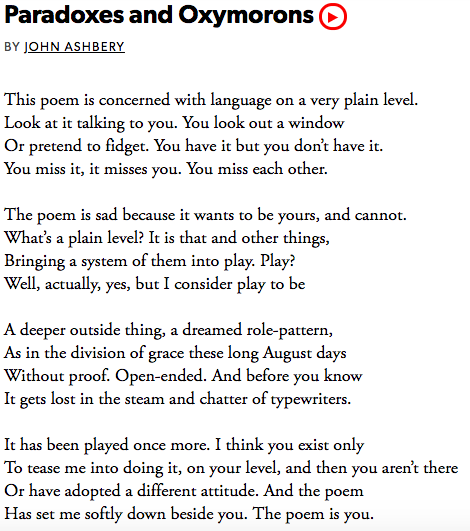
notes on John Ashbery, Paradoxes and Oxymorons

A “plain” is a level place. Some plains are places that were leveled. Isaiah 40:4: “Every valley shall be raised up, every mountain and hill made low; the rough ground shall become level, the rugged places a plain.”

A “level” is a device for seeing whether things are flat. It helps us put different objects on the same level or on the same plane.

If you “level” with people, you give them the plain facts, no playing around.

“Play”: an activity conducted for enjoyment, not for a practical purpose. It is activity without an end. Two people can play, which requires cooperation as well as competition. You can be played. “To play”: to turn written music into sound. A play is also a thing with an opening and an ending.

“Attitude” is the orientation of an object, such as an airplane, relative to the level ground. A level would be needed to measure a plane’s attitude. If you were trying to hit a target with a plane, a level would help you keep the attitude right so that you wouldn’t miss it.

If you Google “division of grace,” the first hit is Thomas Aquinas’ Summa Theologiae, First Part of the Second Part, Question 111, “The division of grace,” which begins, “Whether grace is fittingly divided into sanctifying grace and gratuitous grace?” Part of his answer: “gratuitous grace … is bestowed on a man … not to justify him, but rather that he may cooperate in the justification of another …” Aquinas proves this point with authorities and reasons.

John Ashbery didn’t have Google. I have no idea whether these obscure puns that I found by searching the Web were on his mind. But he already lived in a world of words, excessive words, words that referred to each other, that demanded attention, that bored, that confused. “It gets lost in the steam and chatter of typewriters.”

(“It?” There is literally a missing word “it” in the phrase “And before you know /It gets lost …” What gets lost? “It” is so lost that it’s not even printed in the poem.)

A poem is just a string of words. That is all it is at a “plain level.” We are deluged with words. Most text is not poetry, but even poems are enormously common, and most of them are worth very little. To write something that qualifies as a poem is easy–you just type. You make a keyboard chatter until you have rows of words. Unless your name is John Ashbery, chances are low that anyone will read those lines.

Still, if you’ve poured yourself into those words, you want someone to follow them, to play with them, to concentrate on their levels of meaning, including the levels that were plain and the ones you never noticed. You don’t want them looking out a window and fidgeting. (Let alone pretending to fidget! Who pretends to fidget?)

A poem and you are like possible lovers, but the poem doesn’t have much of a chance; there are so many other words that you could notice instead. The poem will be sad if you don’t play with it.

But suddenly, in the final stanza, you and the poem are joined by a third party. “And the poem / Has set me softly down beside you. The poem is you.” Who is this “me”?

As long as the story is about a poem wanting to connect and feeling sad, it’s all fun and games: wordplay. But when you realize that the poem is the voice of a human being who wants to connect with you, suddenly it’s not just play but also love.

“Paradoxes and Oxymorons” from Shadow Train by John Ashbery. Copyright © 1980, 1981 by John Ashbery. Source. See also “signal” and “a poem should.”