NCDD2018 Session Proposal Deadline Extended Until 5/23!

A few weeks back we announced the call for session proposals were open for the upcoming 2018 National Conference on Dialogue & Deliberation in Downtown Denver, November 2-4. We’ve had great proposals come in so far and have seen folks collaborating on the NCDD discussion listserv to develop exciting sessions.

We’d like to give more time for the network to connect with others and craft their session proposals, so we are extending the deadline and now accepting applications until May 23rd!

If you’re still looking for collaborators on your sessions, you can review the calls for session partners that some of our members have put out on the discussion listserv – check out the session inquires from the last few weeks in our listserv archives or consider joining the listserv and ask for collaborators yourself! Click here to read our advice for potential session leaders.

Remember the super early bird tickets are NOW AVAILABLE! Get yours at this great low rate before it goes up!

Here is some guidance for those thinking about presenting sessions at NCDD 2018…

Our theme for the 2018 conference is Connecting and Strengthening Civic Innovators, and we invite workshop proposals that in some way build upon or engage the ideas around this theme.

NCDD 2018 is taking place the weekend before the November midterm elections and these are vital times for using the skills and tools of the dialogue and deliberation community to continue to bring people together. We have heard from so many, both in our field and particularly those unfamiliar with D&D work – how do we come together and talk with each other despite the divisiveness that pervades our society? There are many in our country that are unaware of the D&D field’s work to better engage people and improve democratic processes.

Our goal of the conference is to explore how to bring dialogue, deliberation, and public engagement work’s many tools and processes into greater visibility and practice within our society. At the conference, we will dig into how to bring D&D to the more widespread awareness and use by:

  • Cultivating new partnerships and connections with other fields utilizing these approaches, including government, libraries, and journalism;
  • Developing our skills, and building our toolkits to address the emerging needs of the communities we work with and live in;
  • Making the case for public engagement, by elevating the stories of how people are coming together across divides, making decisions and taking action together, as well as demonstrating the value and impact of this work;
  • Growing the skills of D&D in our young people, and cultivating leaders who are drawn to D&D;
  • Building the skills and capacities of others in our communities to do this work;
  • Reaching out to and engaging with those less drawn to D&D, including conservatives, activists, and others;
  • Highlighting the ways D&D can be fun, and exploring innovative methods for public engagement – including the arts.

We invite session proposals that will highlight the work being done to tap D&D into the peoples’ daily lives, build democratic participation, and better expose D&D work through the above connections. Your proposal will be evaluated, in part, by its relevance to our theme and goals.

We are thrilled to see what session folks develop for NCDD2018!

Florida Civics EOCA Review Resources

It’s that time of year again, where we start preparing our kids for the upcoming Civics End of Course Assessment here in Florida. So here are some decent resources from across the internet that you might find useful. Of course, we must always keep in mind that any review should begin with making sure your kids are familiar with the Civics Test Item Specifications, because it tells you, and them, exactly what they need to know.

specs


But let’s start our review resource tour with the Florida Joint Center for Citizenship at the Lou Frey Institute‘s own pride and joy.

Civics360

Civics360 is a free, interactive civics review tool to help Florida students improve their understanding of civics. It provides a flexible approach to instruction and review, and features:

  • Narrated Students Friendly Videos review the important content for most benchmarks
  • Viewing guides for each video
  • Student Friendly Readings for each Benchmark Clarification, available in English, Haitian-Creole, and Spanish
  • Vocabulary activities
  • End-of-Course Assessment-style guided review questions for each benchmark
  • End-of-Course Assessment practice tests
  • Additional Civics Resources to Facilitate Learning and Review

You can sign up for Civics360 here. It’s always free, but registration IS required!

The Florida Practice Tests (ePATS)

TestNav

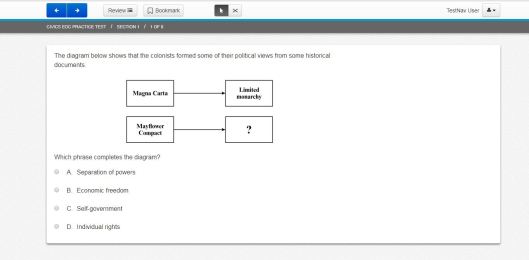
Here you will find a practice version of the Civics EOCA. This will give you some sense of what the assessment is like and how to use the different tools for an online version of the test, as well as what the questions are like. This is provided by the Florida Department of Public Instruction.

Florida Students Civics Tutorials

tutorial

We have written about these tutorials before, and they are the first resource I recommend for both instruction and review. They are excellent for a flipped classroom model as well. If you are planning on using them as a review resource, I recommend assigning students only the parts of the tutorials they need, and it would be more effective to perhaps set these up in learning stations across the classroom. You could require that students screen-capture or write down responses to the assessment elements in order to ensure completion and comprehension.

Florida Virtual School Resources

RRSFLVSThe recorded review sessions, available for free at the bottom of the FLVS page, do a good job covering elements of each of the four reporting categories that will be assessed on the EOC. Because they are about 2 hours long, you will want to preview each one and determine where you might want students to focus their attention. They may also provide you with a model for your own approach to classroom-based reviews. I especially appreciate how an effort is made to integrate assessment elements. Please be aware that you will need to download Blackboard Collaborate to run the videos. 

You will also want to check out the FLVS Civics EOC Practice test, which may be of use to you, though as with anything, you should decided how effective or appropriate it will be for your kids. Again, however, this shouldn’t be the first time that students are being exposed to these types and styles of items. Answers to the practice test items are available here. Note that answers are actually explained as well, which is an excellent element of review. I would suggest actually having students explain WRONG answers. If they can tell you why an answer is wrong, they should have a much easier time of figuring out why an answer might be right!

Civics EOC Boot Camp Model

We wrote about this review model before, and it may be one that you find useful as well. It worked well for Randall Middle School, and it is a positive way to mix things up a little for both you and your students. We explored this model in great detail in this post, and I encourage you to take a look and see if it is something you might like to do.


TEACHER WEBSITES

Civics With Mr. Kula

Kula

Mr. Kula, social studies teacher at Westpine Middle School in Broward County, has compiled a number of quality content rich and illustrated study guides for the Civics EOC that could be useful for you. While they don’t cover every benchmark, what IS there is effective, and broken down by topic. These would be appropriate for students to use in conjunction with a written review or in small groups using an ‘expert group’ teaching model.

Mrs. Hirsch’s Civics Page

hirsch

Mrs. Hirsch, a teacher at Fruit Cove Middle School in St. John’s County, has gathered a number of excellent tools for EOC review. The EOC Content Review sheets that she has provided are well done and engaging, and definitely worth sharing with your own students:
Q1 Civics What You Need to Know

Q2 Civics What You Need to Know

Legislative Branch Content Review

Executive Branch Content Review

Judicial Branch Content Review

Civics Assessment Strategy Guide

Kotkin Strategies

Here is an EXCELLENT and short powerpoint covering strategies for the EOC.

Ruckel Middle School Civics Flashcards

ruckel

Ruckel Middle School, in Okaloosa County, has developed a tool using Quizlet that provides students with flashcards for review. These might be useful as a bellringer or exit slip activity as you wrap up content this year and start to transition to in depth review.


These are just a few of the quality review resources that you might find beneficial. If you have any additional resources to share, please shoot me an email or leave it in the comments!

Tapping in D&D Work with Engaged Journalism

While this piece on the growing movement of engaged journalism was written last fall, we find its lesson to still be of great importance. NCDD sponsoring org, the Jefferson Center wrote on the increasing emergence of engaged journalism, a facet of journalism that seeks to elevate the needs of the community, not just push out click-bait style media. Something that has become quite apparent lately, is the seeming disconnect between the work of the D&D field and the public’s awareness this work is going on – a phenomenon that can significantly be decreased with stronger relationships with community-centered journalism and better exposure of the many efforts going on in the field.

Public News Service gave excellent coverage of last week’s National Week of Conversation that we encourage you to check out:

There is a lot of still-untapped potential between the D&D community and our media makers. The NCDD network has been deepening our relationship with journalists over the last several years, exploring how the D&D community can create stronger partnerships with journalists; and it is our hope to continue to nurture this bond. For additional exploration on how to improve this opportunity, check out our Journalism-D&D Confab call, our podcast with Journalism That Matters, and the recorded media panel from the last NCDD conference in 2016 (click here for the recording). Below is the article from the Jefferson Center and you can also find the original here.


Exploring Engagement & Participation in Journalism

Journalism has had a rough couple of months (or years, if you’re watching closely). News agencies are discredited, criticized, and attacked daily. Partisan news outlets seem to spring up every week, making it difficult to find neutral information.These trends compound another major problem in the journalism world: with the growth of social media, ad-blockers, and the domination of Facebook and Google (and soon, Amazon) in the digital advertising market, traditional models of ad-supported journalism are collapsing. Many citizens also don’t see the news, on a local or national scale, as representing their needs and interests. This is not just a crisis for journalism, it’s a crisis for our democracy.

Like us, many organizations are rolling up their sleeves to embrace the challenge, supporting engaged journalism approaches. Engaged journalism seeks to inform and empower communities, with news organizations prioritizing community needs above those of advertisers. Engaged journalists use the knowledge and talents of their community to cover critical stories and challenges. Instead of driving profit through clickbait news, engaged and participatory journalism focuses on (re)building relationships between journalists and the communities they serve.

What are others doing?

Around the globe, a few large newsrooms, startups, and nonprofits are experimenting with new business models, leading community engagement efforts, working to restore local trust in news, and building a sustainable subscriber base of community members.

To target media “deserts” in rural and urban regions of Ohio, where traditional media outlets don’t exist, Journalism That Matters is exploring deliberative ways to design local news media and information communication systems. Similarly, the News Voices initiative from Free Press uses community organizing and public engagement events as a way for journalists to carve out a new niche in their communities by supporting citizens. Hearken offers newsrooms a model called “public-powered journalism” to meaningfully engage the public throughout the development of stories.

If you’re interested in diving into engaged journalism yourself, visit Gather, a platform to support community-minded journalists and other engagement professionals. The site officially launches October 2nd, 2017, but for now you can explore their mission, request to join, and follow the latest engagement strategy stories on their Medium page. Gather is a product of the Elevate Engagement workshop, which explored how engaged journalism can help communities thrive. After the workshop, our director Kyle Bozentko worked with engagement strategist Joy Mayer and journalist and author March Twisdale to draft the Elevate Engagement Manifesto,which establishes guidelines and goals for this emerging community of journalists, media researchers and educators, and engagement practitioners.

Research, support, and will to try audience-driven and collaborative journalism is just starting to take off, but there are a few barriers in the way. Many small and medium-sized news outlets might hesitate to embrace engaged journalism because of a lack of organizational capacity, uncertainty about the impact of new techniques, or a fear of losing their long-held identity. However, the growth and determination of the programs and organizations above (and these are just a few examples) could help provide the capacity and resources to make long-lasting changes in local journalism.

The Role of the Jefferson Center

We’re excited to announce the launch of Your Voice Ohio and Media Seeds, two collaborative programs that will test, evaluate, and refine sustainable methods for engaging and serving communities through better, more participatory journalism. We’ll explore the complementary roles of public deliberation and discussion, community organizing, digital engagement, media collaboration, and other journalistic approaches in helping communities, and journalism, thrive. Dozens of print, radio, and television newsrooms have already signed onto Your Voice Ohio to create a statewide news collaborative. The collaborative will share experiences and align reporting resources to better serve more Ohio communities.

Media Seeds, through a partnership with Journalism That Matters, will support media innovations in communities lacking daily local news. The project will support community residents and stakeholders using JTM’s “Create or Die” model, which includes community dialogue, innovation gatherings, and community communication pilot projects.

These projects are funded by a $250,000 grant from the Democracy Fund and a $75,000 grant from the John S. and James L. Knight Foundation, with additional support from individual donors. These projects build on the work of Your Vote Ohio during the 2016 election, focused on supporting journalists to produce political coverage tailored to the diverse needs of communities across Ohio. Your Voice Ohio and Media Seeds are also a way to move forward the principles, goals, and values our organization committed to in the Elevate Engagement Manifesto. Joy Mayer was also a recipient of a Knight Foundation Grant under the “Trust, Media and Democracy” initiative.

Our main goals:

  • Through experimentation and shared learning, increase the capacity of newsrooms around Ohio to practice engaged journalism.
  • Partners will create new examples and local case studies of engaged journalism, with more detailed information about implementing engaged journalism practices.
  • Provide better comparative data about the value of engaged journalism approaches, as multiple communities systematically experiment with similar efforts.

You can download our official press release, visit the official Your Voice Ohio website, and follow the program on Facebook and Twitter for updates.

You can find the original version of this article on the Jefferson Center’s site at www.jefferson-center.org/exploring-engagement-participation-in-journalism/.

**The Jefferson Center recently did a follow up piece on this effort which you can find at www.jefferson-center.org/conversation-to-build-collaboration/.

SDGs Kenya Forum for Sustainable Development: ‘Leave No One’ Behind National Dialogues

Author: 
The SDGs Kenya Forum for Sustainable Development is a participatory platform for civil society organizations (CSOs) within Kenya to collectively contribute to the implementation of the 2030 Agenda for Sustainable Development. Established in 2015, the SDGs Kenya Forum for Sustainable Development is currently comprised of thirty committee member organizations, each...

Involved Survey

Author: 
Definition Involved is a subscription-based micro-polling software for government that allows representatives to send out single question surveys through their mailing list, social media and our app. Residents can respond in one click, leave private comments, and share with friends and neighbors. The ease of use and focus on a...

World Commons Week, October 4-12

Finally, a designated global event to celebrate the commons and explore it in serious ways!

The International Association for the Study of the Commons – the academic body founded by the late Professor Elinor Ostrom and other scholars – is helping organize World Commons Week from October 4 to 12. At many locations around the world, commoners will host public talks and discuss various aspects of the commons, especially from a scholarly perspective.

Three main activities are planned: a policy seminar and conference in Washington, D.C., several dozen local events in different places worldwide, and a marathon of webinar talks for 24 straight hours by commons scholars. (I’ll be doing one of the talks!)

The policy seminar will take place on October 4 at the International Food Policy Research Institute, in Washington, D.C., organized by Dr. Ruth Meinzen-Dick of the Institute. The next day, October 5, you may want to attend the conference “Celebrating Commons Scholarship” at Georgetown University on October 5, co-organized by Professors Sheila Foster and Brigham Daniels.

The local events range from teach-ins and workshops to mini-conferences and talks delivered by local scholars or commons practitioners. In Mexico, there will be a conference on watershed sustainability. In Germany, a talk on “Pseudo-Commons in Post-Socialist Countries.” In Africa, an examination of transboundary wildlife protection, “Commons Without Borders.”

If you’d like to host your own event and have it noted on the World Commons Week website, contact Professor Charles Schweik of the UMass Amherst School of Public Policy at cschweik /at/pubpol.umass.edu.

Pera Natin ‘to!: An Initiative by the Philippines Public Transparency Reporting Project

Author: 
Launched in March 2010, Pera Natin ‘to (It’s our money!) was an online initiative run by the Philippines Public Transparency Reporting Project (PPTRP) that aimed to educate Philippine citizens about local government practices and fostered efforts in citizen journalism.

deliberation or simulated deliberation? choices for the classroom

In an article published today (“Deliberation or Simulated Deliberation?” in Democracy and Education, 26, 1, Article 7), I respond to a valuable previous piece by Margaret S. Crocco and her colleagues, “Deliberating Public Policy Issues with Adolescents: Classroom Dynamics and Sociocultural Considerations.” These authors analyze classroom “deliberations” of current events and find disappointing results. Their analysis is rigorous and insightful. One finding particularly caught my eye.

It is interesting that even students at the school with a large immigrant population tended to talk about immigrants as “they” when they deliberated about national policy. They were essentially role-playing the government or perhaps a body of influential citizens of the United States. As Crocco and her colleagues write, “Participating in the public debate about immigration in U.S. classrooms positions one as an insider with all the privileges of excluding outsiders that result from this status” (Crocco et al., 2018). This is evidence that the students experienced the discussion as a kind of role-play.

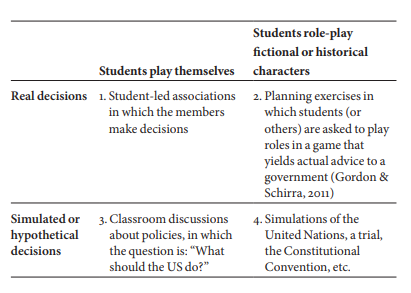
That finding leads me to propose that discussions can vary on two dimensions. Talking can result in an actual decision, or it can be about a simulated or hypothetical decision. And the participants can either speak for themselves or role-play characters. Those distinctions produce four types, all of which can be found in actual classrooms (and in settings for adults, such as community fora.)

I think Crocco et al. provide some grounds for skepticism about simulated decision-making discussions in which the speakers represent themselves (cell 3). When we ask students (or adults) to discuss what “we” should do, where the “we” is actually a vast or distant entity, such as the US government, we position them as insiders even though they know they are outsiders. This disjunction could be fun or interesting, but I think often it just alienates.

The other cells are more promising. It’s better to be able to: (1) govern a real entity, such as a student-led association, (2) give advice to a real decision-maker, or (4) pretend that you hold a decision-making role, such as a Senator in a fictional Congress.

There are benign reasons to turn national issues into topics for small-group discussions. The goal is to make students (or others) feel that the government is theirs. It does belong to them, as a matter of justice, and it’s great if they take away that feeling. But we must be serious about their limited power, or they will perceive the discussion as fake and perhaps draw the conclusion that democracy is fundamentally a false promise. As I write in the article:

The students in these three classes did not actually decide about immigration. At most, they might shift their individual opinions on that topic, and if they encouraged others outside the class to change their opinions in similar ways, that could possibly affect national policy by influencing those people’s votes. But that is a remote form of impact for any citizen to consider, and especially for students who are not old enough to vote themselves. The United States is an “Imagined Community” (Anderson, 1991), not a group of people who literally make decisions. The real group—a classroom full of students—was pretending to deliberate.

That is how I would explain why the results were disappointing.

Inaugural Hidden Common Ground Report Released

NCDD member org, Public Agenda, in collaboration with fellow NCDDer the Kettering Foundation have recently released the inaugural report of their Hidden Common Ground Initiative. This is an effort which seeks to dive deeper into issues that have been polarizing, in order to illuminate where there is common ground; with the hopes of better uniting the public around concrete, actionable solutions. This first round of research explores incarceration, and the following report that is slated to be released in May will revolve around healthcare. You can read the press release from Public Agenda below and find more information on the Hidden Common Ground Initiative here.


New Research Initiative Fights Narrative of Absolute Division of Americans on Critical Issues

Inaugural project of the Hidden Common Ground Initiative elevates areas of agreement on incarceration and criminal justice reform in America

The state of America’s national politics has led many to believe the country is irreparably polarized and gridlocked. Recently, a storyline has taken hold that portrays this dysfunction as a reflection of our profound divisions as a people. However, a new research initiative launched by Public Agenda, in collaboration with the Kettering Foundation, shows that Americans can find common ground on many of the problems our nation faces.

It has taken decades for our national politics to become as polarized as it is today, leading to stagnation on critical issues like gun control, immigration and health care. While it is important to acknowledge the differences and disagreements that do exist, our divisions are hardly the whole story. The Hidden Common Ground Initiative aspires to tell the story of where the public agrees on concrete, actionable solutions and make those areas of agreement more salient and potent in our public life.

“We believe that dispelling the myth that we are hopelessly divided can not only help fuel progress on a host of issues, but also help us better navigate our real, enduring divisions.” said Will Friedman, President of Public Agenda. “We are grateful to have the Kettering Foundation as a collaborator on this initiative that has the potential to fight the often-inflated narrative of an America that is so divided, progress is impossible.”

The Hidden Common Ground Initiative will explore a variety of issues facing our nation and will include the release of a series of reports on our research findings. The first report, “Where Americans See Eye to Eye on Incarceration,” focuses on hidden or otherwise underappreciated common ground in the realm of incarceration and criminal justice reform.

In cross-partisan focus groups held around the country, reinforced by a review of existing survey research, we learned that:

    • The focus group participants felt incarceration serves important functions, such as keeping dangerous people off the streets, but agreed that the criminal justice system can be unfair and make mistakes.
    • Participants were strongly focused on preventing people from becoming criminals in the first place.

For drug crimes, and possibly some other nonviolent offenses, alternatives to incarceration made good sense to most people in the focus groups. But they were unwilling to accept alternative sentencing for violent crimes.

  • Eliminating mandatory minimum sentences was a confusing, unresolved issue for participants.

Focus group findings are summarized in the new report, “Where Americans See Eye to Eye on Incarceration.” Three focus groups were conducted in September 2017 across the United States in urban Hamilton County, Ohio; rural Franklin County, Missouri; and suburban Suffolk County, New York.

The next report from the Hidden Common Ground Initiative, scheduled to be released in May, will explore how people talk across party lines about the problems facing our health care system and what people agree should be done to make progress.

You can read more about the Hidden Common Ground Initiative on Public Agenda’s site at www.publicagenda.org/pages/hidden-common-ground-where-americans-see-eye-to-eye-on-incarceration.

Katie Lisa

As Director of Development, Katie works collaboratively with senior staff to raise funds for Public Agenda's projects and operations. Prior to joining Public Agenda, Katie was the Associate Director of Institutional Giving at the Solomon R. Guggenheim Museum in New York City and she worked for six years at the Brooklyn Museum in many capacities, including Interim Co-Head of Development and Senior Development Officer. Katie brings with her a wealth of experience in fundraising and development, having worked as the Associate Director for Donor Stewardship at Columbia College and the Grants Writer at the Osborne Association, an organization that works with incarcerated populations and their loved ones.

Katie has a Master's from Columbia in Fundraising and Nonprofit Management and a Bachelor's degree from Rutgers College, where she graduated with honors.


Email: klisa@publicagenda.org