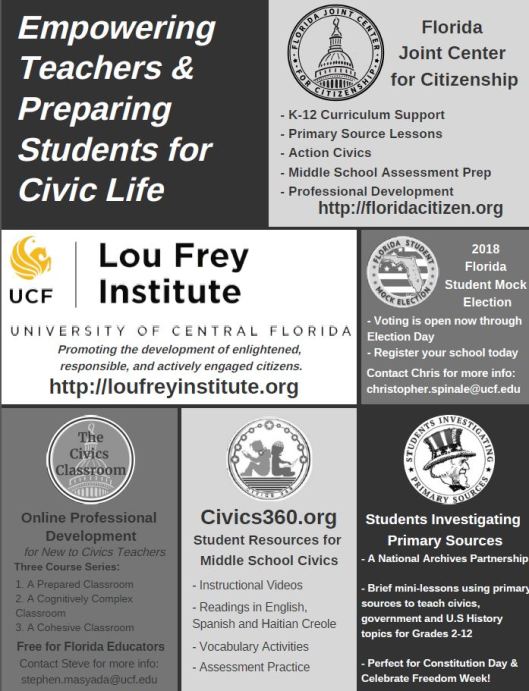
The Lou Frey Institute and FJCC: Empowering Teachers and Preparing Students For Civic Life!
Reply

[W]e addressed the factual question whether members of the Trump Campaign “coordinat[ed]”-a term that appears in the appointment order-with Russian election interference activities. Like collusion, “coordination” does not have a settled definition in federal criminal law. We understood coordination to require an agreement–tacit or express–between the Trump Campaign and the Russian government on election interference. That requires more than the two parties taking actions that were informed by or responsive to the other’s actions or interests. We applied the term coordination in that sense when stating in the report that the investigation did not establish that the Trump Campaign coordinated with the Russian government in its election interference activities.
— from the Mueller Report
That faint sound you hear is hundreds of philosophers paging through their thumb-worn copies of seminal books and articles about shared agency and collective intentionality and revving up their word processors to write lecture notes and articles.* I have not investigated this literature sufficiently to have useful views, but it is a rich topic of current investigation that bridges ethics, metaphysics, and philosophy of language and mind.
What does it mean to say, “We are doing something?” Is the “we” a real thing or just a shorthand for several “I’s”? If a bunch of people all run for shelter at the sound of thunder, are they coordinating? What if they take exactly the same actions as part of a dance? Does the “we” mean something different in the sentences “We all ran for shelter” and “We all performed a dance”? (This is from Searle.)
What if I say to you, “Let’s go for a walk”? Do I then have an ethical obligation to coordinate my itinerary and pace with you? (From Gilbert). Is the obligation just the usual one to honor a promise, or does it stem from my new relationship to you?
Let’s say that all the members of the Supreme Court believe that something is unconstitutional and issue a unanimous ruling to that effect. Later, the same nine people all think that dinner was awful. In one case, did the Supreme Court make a judgment, whereas in the other case, nine people made separate judgments? What if the nine issued a ruling and then found out that it was invalid because they weren’t properly in session at the time? Did they incorrectly believe that they were acting as a group? (Inspired by Epstein).
Robert Mueller says that whether the Trump campaign and Russia coordinated is a “factual question.” But it requires a definition of coordination. Apparently, the legal definition of that word (from statutes and/or precedents) is unsettled. But in any case, the deeper issues are philosophical–and not simple to resolve.
*e.g., Brian Epstein, The Ant Trap: Rebuilding the Foundations of the Social Sciences (Oxford Studies in Philosophy, 2015); Margaret Gilbert, “Walking Together: A Paradigmatic Social Phenomenon” in her 1996 book Living Together: Rationality, Sociality, and Obligation, pp. 177–94; Larry May, Sharing Responsibility (Chicago: University of Chicago Press, 1992); Philip Pettit and David P. Schweikard, “Joint Actions and Group Agents,” Philosophy of the Social Sciences, vol. 36, no 1, 2006, 18–39; John Searle, “Collective Intentions and Actions,” in P. Cohen, J. Morgan, and M.E. Pollack (eds.), Intentions in Communication (Cambridge, Mass. MIT Press, 1990); Raimo Tuomela, “We Will Do It: An Analysis of Group Intentions;” Philosophy and Phenomenological Research, vol. 51, no. 2 (1991), pp. 249–77; David J. Velleman, “How to Share an Intention,” Philosophy and Phenomenological Research, vol 57 (1997), pp. 29–51; and other such papers.
This year, the National Issues Forums Institute – an NCDD member org, has published three issues guides to support conversations in deliberative forums on major issues facing this country. The three issue guides, House Divided, Keeping America Safe, and A Nation in Debt, each offer multiple talking points on both “sides” of the issue to give participants additional perspectives and help lead to a more robust deliberation. You can read the announcement below and find the original version on the NIFI blog here.
 The National Issues Forums Institute (NIFI) has released three new issue guides for 2019. A House Divided, Keeping America Safe, and A Nation in Debt are all available to purchase in digital and hard-copy formats on the NIFI website.
Brad Rourke, Kettering Foundation program officer and executive editor of issue guides, provided this note:
These new NIFI issue guides are highly salient and reflect some of the biggest concerns on the minds of Americans right now:
A House Divided: What Would We Have to Give Up to Get the Political System We Want?
“Division,” “polarization,” and “hyperpartisanship” are front and center throughout the current political discourse. This framework comes at the question not from a social perspective but from a political one. If we are so divided, how then shall we self-govern? This is not about “getting along” but rather about what we should do even as we don’t get along.
Keeping America Safe: What Is Our Greatest Threat? How Should We Respond?
The world is increasingly volatile, and the question of just what America’s role on the world stage should be lies at the root of many global conversations. This is not just a dry (yet important) question of geopolitical strategy; it also includes trade, our general stance toward other nations, and our relationships with traditionally stabilizing institutions.
A Nation in Debt: How Can We Pay the Bills?
The national debt has roared past the $21 trillion mark and appears on a course to keep increasing. The size of this debt, and the interest it takes simply to maintain it, is more and more a topic of concern as people think about how our economy can keep growing, what size government is right, and what direction tax rates should go. Should we take drastic action to shrink the debt, or would that upend the economy? (This guide was produced in partnership with Up to Us.)
These issue guides are nonpartisan supports for moderated, deliberative conversations among small groups. We try to portray the chief tensions that citizens need to work through to form sound judgments on difficult public problems. Kettering researches and develops them for publication by the National Issues Forums Institute, which makes them available to the NIF network of local convenors.
You can read the original version of this announcement on the NIFI blog at www.nifi.org/en/brad-rourke-about-three-new-issue-guides-2019.
Register here. Some events have limited space. Friday, April 26: UMass Boston Campus Center, Alumni Lounge (all day)
Friday, April 26: UMass Boston Campus Center, Alumni Lounge (all day)
9:00-9:30 Welcome, Coffee, Introductions
9:30-12:00 Pre-texts Workshop: Doris Sommer (Harvard)
Friday Afternoon: Discussion of NEH Grant/Boston Harbor Islands Boat Tour
12:00-1:30 Lunch: NEH Connections Grant: UMass Boston collaboration with Boston Harbor Islands National Park: UMass Boston team
1:30-4:00 Harbor Boat Tour, Thompson Island Visit
Friday Evening: Website Launch/Graduate Student Lightening Rounds/Dinner
4:15-5:45 Graduate Student Lightening Rounds
6:00-6:30 Round-Up of NEPH Ways Forward/Burning Issues/In-Progress Work (discussion continued over dinner):
Approx. 6:30 Dinner
Saturday, April 27: UMass Boston Campus Center, Alumni Lounge (morning) Chinatown Pao Art Center/Tufts (afternoon)
Saturday Morning: NEPH Concurrent Sessions
9:00-9:10 Coffee, Introductions
9:10-10:00 Film, Social Justice, and Public Humanities
Dario Guerrero, ROCIO (Documentary Film): DACA Harvard student filmmaker, goes home to Mexico to care for mother, not allowed to return to US (sponsored by UNAM at UMassBoston)
10:00-11:00 Concurrent #1 OR #2: New Practices
Concurrent #1: Exhibitions and Museum Practice
Concurrent #2: Digital Public Humanities
11:00-12:00 Concurrent #3 OR #4: New Initiatives/Institutionalizations
Concurrent #3: Journal of the Public Humanities, Case Method for the Humanities
Concurrent #4: Grants: Institutionalizing New Models of the Public Humanities (Mellon Foundation Grants)
12:00-1:30 Lunch
Presentation of new NEPH website: Micah Barrett (Yale)
Saturday Afternoon: Panel/Discussion of Chinatown Partnerships
1:30 Leave UMass Boston to travel to Chinatown via “T”: Pao Arts Center, One Greenway, Boston
2:30-4:30 Tisch College at Tufts and Boston’s Chinese Community: Two Conversations about Projects and Partnerships
2:30-2:40: Opening Remarks
2:40-3:30: The Impact of a Community Arts Center on Gentrification: an NEA-funded Project between the Pao Center and Tisch College
4:30 Reception at Pao Art Center
Every era has heroes. Every society has villains. Every community must learn that sometimes heroes and villains can in fact be one and the same. Come to the 2019 FCSS Conference here in Orlando and explore this theme! And please consider submitting a proposal that aligns with our theme. Villains make a difference. But so do heroes. So can you, in our field!


The Florida Council for the Social Studies is accepting session proposals for the 2019 FCSS Conference at Florida Hotel and Conference Center in Orlando, Florida on October 18 – 20, 2019.
Submit your session proposal prior to June 1, 2019 –
http://bit.ly/FCSS19Proposals
· Presenters will be notified by July 15, 2019
· Presenters of accepted sessions must register by August 15, 2019 to confirm participation in the conference
Information about the FCSS conference can be found at: http://fcss.org/meetinginfo.php
Online registration is available at http://bit.ly/fcss19registration
The FCSS Conference hotel rate is $131 per night . The Florida Hotel and Conference Center $18.00 per day for amenities is waived. Reservations must be made prior to September 26, 2019.
We look forward to receiving your proposal,
The 2019 FCSS Conference Committee
Some students are on their way to occupy their university’s central administration building to demand a minimum wage of $17 for all employees. They are surprised to encounter the ghost of John Rawls (JR):
JR: I see your signs and determined faces and presume that you are engaged in an act of civil disobedience. What is your demand?
Students: Social justice!
JR: Hmm, what does that require?
Students: A living wage!
JR: Which is?
Students: $17/hour.
JR: Is that your ideal outcome? Does social justice entail that every employee be paid no less than $17? Every employee of this university? Every American? Everyone in the world? Is there a maximum just salary? For instance, does your college president make more than justice permits?
Students: Look, we don’t get to write the rules. We’re just trying to boost the take-home pay of some people in our community. We’d go higher if we thought it was realistic.
JR: Would you go higher if that required cuts in financial aid?
Students: We are just applying pressure for one aspect of social justice. Figuring out the right balance is not our job.
JR: OK, but you also have other jobs. For instance, voting. If you think $17/hour constitutes justice, you should vote for a moderate Democrat or perhaps a liberal Republican. If you want much more equity, you should join Democratic Socialists of America.
The ghost of Mohandas K. Gandhi [MHK] emerges, to the surprise of everyone except John Rawls, who is Gandhi’s roommate in Purgatory. (Everyone goes to Purgatory.)
MHK: Don’t let him to deter you with these questions about ultimate ends. None of us has sufficient knowledge, wisdom, or moral rectitude to know what social justice entails. Our job is to make ourselves the best agents of change that we can be.
You plan to put yourselves at some risk. That is good; as I’ve written, “a life of sacrifice is the pinnacle of art, and is full of true joy.” However, you will also impose some costs and inconvenience on the university, and your demand might not be right. Are you sure that you have purified your own motives?
Students: Well, we’ve acknowledged our positionality and checked our privilege.
MHK: Awkward terminology, but it sounds like what I’d advocate. Have you created a group that represents all, and do you live together truthfully?
Students: Could you clarify?
MHK: For me, the main issue was making sure that the movement for Indian swaraj (independence, in the spiritual as well as the political sense) incorporated Muslims, Harijans, women, and others, and that we related to each other appropriately. If we organized ourselves right, we were already making the world better. The political consequences were beyond our control. As Krishna teaches in the Baghavad Gita, “Motive should never be in the fruits of action.”
JR: I’m Kantian enough to agree that a good action is one that has the right motives, not one that turns out to make the world better. But surely you need a North Star, a sense of what the goal should be?
MHK: Only in the vaguest sense, because–again to quote myself–“man is not capable of knowing the absolute truth.”
JR: Well, I agree with that and would leave much to be decided in a just society by deliberating citizens and their elected representatives. But surely we can propose provisional theories of justice?
Students: Um, this is interesting and all, but we have got like a building to occupy?
[Exeunt]
See also: Gandhi on the primacy of means over ends; a real alternative to ideal theory in political philosophy; why study social justice?; Abe Lincoln the surveyor, or the essential role of strategy; and how to think about other people’s interests: Rawls, Buddhism, and empathy.
This week’s roundup features webinars from NCDD member orgs New Directions Collaborative, Zehr Institute for Restorative Justice, Living Room Conversations, MetroQuest, and National Civic League, as well as, from International Association of Facilitators and Global Partnership for the Prevention of Armed Conflict (GPPAC). We are excited to offer our upcoming Tech Tuesday next week, April 23rd, where we will learn more about the participatory decision platform, Ethelo. Register ASAP to save your spot for this free call and learn more in the post below.
NCDD’s online D&D event roundup is a weekly compilation of the upcoming events happening in the digital world related to dialogue, deliberation, civic tech, engagement work, and more! Do you have a webinar or other digital event coming up that you’d like to share with the NCDD network? Please let us know in the comments section below or by emailing me at keiva[at]ncdd[dot]org, because we’d love to add it to the list!
New Directions Collaborative webinar – Working as an Ecosystem

Wednesday, April 17th
9 am Pacific, 12 pm Eastern
Activating the full potential within an organization, community, or network requires us to see how our work fits into a larger whole and how we can connect what are often fragmented “parts.” Some wisdom, collective strength, and innovative solutions can only be activated when we engage and connect all parts of an organization, community, or system.
After working with many collaborative initiatives and seeking out tools and processes, Beth Tener of New Directions Collaborative, has combined what she has learned in this introductory workshop to build skills in working as an ecosystem. In this workshop, you will learn: principles of how systems work, practical tools to help people “see the system” and make relationships visible, participatory processes for how to connect and cross-pollinate the work and wisdom of diverse perspectives, and how and why accessing and engaging marginalized voices is critical to this work.
REGISTER: www.ndcollaborative.com/events/
Zehr Institute for Restorative Justice – Love and Living Soil – Restoring Justice for Land and Community
 Wednesday, April 17th
1:30pm Pacific, 4:30pm Eastern
Guest: Jonathan McRay
Host: Johonna Turner
Restorative justice is a social movement, but it must also be an ecological one in order to answer its guiding questions: What are the needs of those harmed and those who harmed? What’s the process we can participate in to hold ourselves accountable and heal? What are the root causes of the harmful behavior in the community, and culture? What are the structures and relationships we desire? The truth is we cannot have restorative justice without restoring our relationship to land and water. However, this integration can’t be a messy mashup of mainstream environmentalism and social justice. Instead, we’re talking about power and sustenance, the ways we order our lives with nurturance or with exploitation. This is about what makes for healthy community: the ability to love, be loved, and be free from violence and waste – from hunger and landlessness to colonization and white supremacy – so we can meet our needs with a sustaining and nurturing power in which all creatures have enough.
REGISTER: http://zehr-institute.org/webinars/love-and-living-soil.html
International Association of Facilitators webinar – 2019 Facilitation Impact Awards
 Wednesday, April 17th
2 pm Pacific, 5 pm Eastern
Join our webinar to explore any questions you have about how to prepare a submission. Our guest awardee is Tamara Eberle who has, with her clients, received 4 Platinum and 2 Gold Facilitation Impact Awards over the past 5 years. A great achievement Tamara! If you can’t join us feel free to send any questions you have for Tamara to fia@iaf-world.org. A recording of the session will be available.
REGISTER: www.iaf-world.org/site/events/webinar-2019-facilitation-impact-awards
Living Room Conversations Training (free): The Nuts & Bolts of Living Room Conversations

Thursday, April 18th
1 pm Pacific, 4 pm Eastern
Join us for 60 minutes online to learn about Living Room Conversations. We’ll cover what a Living Room Conversation is, why we have them, and everything you need to know to get started hosting and/or participating in Living Room Conversations. This training is not required for participating in our conversations – we simply offer it for people who want to learn more about the Living Room Conversations practice.
Space is limited to 12 people so that we can offer a more interactive experience. Please only RSVP if you are 100% certain that you can attend. This training will take place using Zoom videoconferencing. A link to join the conversation will be sent to participants by the Wednesday before this training.
REGISTER: www.livingroomconversations.org/event/free-training-the-nuts-bolts-of-living-room-conversations/
NCDD April Tech Tuesday featuring Ethelo
 Tuesday, April 23rd
11 am Pacific, 2 pm Eastern
In this free one-hour webinar, we will be joined by John Richardson, founder and CEO of Ethelo, a participatory decision platform. John will give a quick overview of the software and walk through some real-world examples of how its been used by different clients to engage stakeholders in solving contentious, real-life problems. Ethelo is particularly helpful for stakeholder engagement and communications professionals in the government, business and nonprofit space who need to engage large groups of people on sensitive and challenging issues.
REGISTER: http://ncdd.org/29489
Living Room Conversations webinar – Status and Privilege
Tuesday, April 23rd
3:30 pm Pacific, 6:30 pm Eastern
We joke about “keeping up with the Joneses” — but there’s real competition in our society for status and the accompanying privilege. How do we decide what we most value that bestows this status? While our country seems to favor wealth, there are other forms of status and privilege. What privilege do each of us enjoy? And how does that correspond with our status? This conversation examines our own status and how we use our status in everyday life. From education to wealth to gender to race, let’s talk about what we have…and what we desire. Please see the conversation guide for this topic.
REGISTER: www.livingroomconversations.org/event/online-living-room-conversation-status-and-privilege-2/
MetroQuest webinar – Public Engagement Jackpot | How Your Agency Can Win Big
 Wednesday, April 24th
11 am Pacific | 12 pm Mountain | 1 pm Central | 2 pm Eastern (1 hour)
Educational Credit Available (APA AICP CM)
Complimentary (FREE)
The stakes are high in planning for regional growth in Reno, Sparks, and Washoe County. On April 24, Truckee Meadows RPA will reveal the winning strategy for online public engagement! You’ll see resident survey data in action, providing a clear path to the best regional plans. Jeremy Smith will share how TMRPA used public engagement to build broad public support for infill development in core areas to stop the sprawl. You’ll also hear how Lauren Knox used 53,290+ survey data points to inform their 20-year Truckee Meadows Regional Plan.
REGISTER: http://go.metroquest.com/Public-Engagement-Jackpot-How-Your-Agency-Can-Win-Big.html
Global Partnership for the Prevention of Armed Conflict (GPPAC) webinar – Lessons Learned from 3 Decades of Peace Education Work
 Wednesday, April 24th
12 am Pacific, 3 am Eastern
During this webinar, peace education expert Loreta Castro will present lessons she has learned over the course of her peace education work, including insights and suggestions that might be helpful to educators who are in similar contexts.
REGISTER: www.gppac.net/peace-education-webinar-series
National Civic League AAC Promising Practices Webinar – Community Approaches to Inclusive Healthy Housing
 Thursday, April 25th
9 am Pacific, 12 pm Eastern
Join the National Civic League to learn more about two organizations that are bringing healthy housing to their communities. Suzanne Mineck, President of the Mid Iowa Health Foundation and Emily Yu, Executive Director of BUILD Health Challenge will speak about Healthy Homes Des Moines and the BUILD Health Challenge. Leroy Moore, Sr. Vice President and Chief Operating Officer at the Tampa Housing Authority will join us to talk about project ENCORE!
REGISTER: www.nationalcivicleague.org/resource-center/promising-practices/

Recently, our friends at the Civics Renewal Network announced the finalists and winner of a 200,000 dollar Annenberg Institute for Civics grant. While we here at FJCC/LFI did not make the cut (but were honored being able to apply!), we are excited to see such success for the wonderful folks at the Edward M. Kennedy Institute for the US Senate. They do such excellent work, and we hope to have the opportunity to work with them again in the future. Check out the winner and the finalists below!
The Edward M. Kennedy Institute for the United States Senate is the winner of the 2019 Leonore Annenberg Institute for Civics Award. Its project, Civil Conversations, will create a community of practice of teachers leading conversations about current, and sometimes contentious, civic issues with their students as well as build a nationally scalable curriculum for broad dissemination. The project will be implemented in collaboration with Essential Partners, global leaders in dialogue and deliberation; the Multiplying Good Students in Action project, a national program that develops high school students into community leaders; and Dr. Karen Ross of the University of Massachusetts, who will design and conduct project evaluation.
The three finalists were:
Center on Representative Government: An extension of its successful Engaging Congress app with modules on the executive branch and judicial branch.
National Constitution Center: The Classroom Exchange project in which students engage with their peers across the country in a healthy, civil dialogue about current, relevant constitutional questions.
Youth Leadership Initiative: A relaunch of its popular A More Perfect Union campaign simulation.
And of course, be sure to check out the great resources (including ours!) curated and shared through the Civics Renewal Network! You won’t find a better and more diverse collection of civics education resources anywhere!
I’m sure others have made this point or are typing it this minute, but I will pile on …
Notre-Dame de Paris is a stunning building but not a well-preserved medieval one. It has been through a lot, including the 18th-century removal of the original stained glass in the nave, the smashing of statuary and most of the remaining glass during the French Revolution, and a profound reconstruction that began in 1844. Some of the most famous features of the cathedral are the work of Eugène Viollet-le-Duc, a Romantic-era restorer who was comfortable redesigning medieval buildings in ways that are now obvious to us. The gargoyles, the spire that collapsed yesterday, portions of the interior architecture, and much of the stained glass is by Viollet-le-Duc, not by anonymous craftsmen of the 12th and 13th centuries. Many other Gothic buildings are much better preserved.
John Ruskin wrote in 1849 (not specifically about Notre-Dame but about the general approach to restoration in his time):
Neither the public, nor those who are responsible for the maintenance of public monuments, understand the true meaning of ‘restoration’. It signifies the most complete destruction that an edifice can suffer; a destruction from which not a single vestige can be recovered; a destruction that comes from the false description of the thing destroyed. It is impossible, as impossible as it is to bring the dead back to life, to restore whatever might have been grand or beautiful in architecture….the enterprise is a lie from the beginning to the end.
Notre-Dame is not a “lie,” but it is to a large degree a legacy of the French Romantic period, as much a creation of Victor Hugo and Viollet-le-Duc as of the first builders in 1160-1260. It is part of the city that we know today, which was profoundly influenced by Georges-Eugène Haussmann (1809-1891), the flattener of ancient neighborhoods and planner of boulevards:
Old Paris is gone (no human heart
changes half so fast as a city’s face) …
There used to be a poultry market here,
and one cold morning … I saw
a swan that had broken out of its cage,
webbed feet clumsy on the cobblestones,
white feathers dragging through uneven ruts,
and obstinately pecking at the drains …
Paris changes … but in sadness like mine
nothing stirs—new buildings, old
neighbourhoods turn to allegory,and memories weigh more than stone
From Richard Howard’s translation of Baudelaire, Les Fleurs du Mal
It is not a criticism to place Notre-Dame in the 19th century. The years from 1848-1870 mark the apogee of a certain Parisian culture that is admirable and attractive. It was the age of boulevards and cafes, Seine embankments, and Impressionist cityscapes, all of which shape our view of Notre-Dame. The reason the history matters is that we can reconstruct late-19th-century buildings when they are well documented, as every stone of Notre-Dame is. In contrast, we would have neither the materials nor the craftsmanship to reconstruct the stained glass of the nearby Sainte-Chapelle if that were lost.
The fire is a tragedy; the crown jewel of 19th-century Paris will be badly damaged for some time. But in the long run, this will be a footnote.
See also: seeing Paris in chronological order; Paris from the moon; and Basilica of Notre-Dame, Montreal.