Weekly Online D&D Roundup – June Confab Announced!

This week’s roundup features webinars from NCDD member organizations MetroQuest, National Civic LeagueLiving Room Conversations, and National Issues Forums Institute (NIFI), as well as, from the International Association of Facilitators and Global Partnership for the Prevention of Armed Conflict (GPPAC).

We’re excited to include the announcement of our upcoming Confab call on Thursday, June 6th, where we’ve teamed up with Bridge Alliance to explore how Slack can be used for collaboration and network building in the Democratic movement. We’d love for folks who have used Slack or are still currently using it to join the call and share their experience. Learn more and register to save your spot for this free call here!

NCDD’s online D&D event roundup is a weekly compilation of the upcoming events happening in the digital world related to dialogue, deliberation, civic tech, engagement work, and more! Do you have a webinar or other digital event coming up that you’d like to share with the NCDD network? Please let us know in the comments section below or by emailing me at keiva[at]ncdd[dot]org, because we’d love to add it to the list!


Upcoming Online D&D Events: Nat’l Civic League, MetroQuest, Living Room Conversations, NIFI, GPPAC

MetroQuest webinar – Cleaning Up Toxic Public Discourse for Meaningful Engagement

Wednesday, May 22nd
11 am Pacific | 12 pm Mountain | 1 pm Central | 2 pm Eastern (1 hour)
Educational Credit Available (APA AICP CM)
Complimentary (FREE)

Are you facing increasing contention in your public engagement processes? You’re not alone. Planners and public engagement practitioners across the country increasingly find themselves on the front lines of highly polarized debates and misinformation campaigns. There’s a fix! You’re invited to this special webinar with James Hoggan – a world leading authority on the topic. James will share what’s causing increased polarization and offer ways to detoxify public engagement. A renowned author and speaker, James literally wrote the book on it.

REGISTER: http://go.metroquest.com/james-hoggan-on-cleaning-up-toxic-public-discourse-for-meaningful-engagement.html

International Association of Facilitators webinar – Becoming a CPF with the IAF

Wednesday, May 22nd
1:30 pm Pacific, 4:30 pm Eastern

Making the decision to seek the IAF Certified™ Professional Facilitator (CPF) accreditation can be hard. Common questions people ask are What’s involved? How much time will it take? Will I meet the requirements? and What if I don’t pass? In response to strong interest from members, we will be exploring these questions at a webinar with hosts that have years of experience as professional facilitators and as IAF Assessors.

REGISTER: www.iaf-world.org/site/events/webinar-becoming-cpf-iaf-8

National Civic League AAC Promising Practices Webinar – Equitable and Collaborative Economic Development

Thursday, May 23rd
10 am Pacific, 1 pm Eastern

Join the National Civic League to learn about two communities that are being mindful about collaboration and equity in their economic development projects. Ubax Gardheere, Equity Strategies Manager at the City of Seattle’s Office of Planning & Community Development will speak about Seattle’s approach to equitable development. Kevin Mitchell, Town Engineer in the Town of Mount Pleasant’s Planning and Engineering Department will talk about the town’s collaborative Shem Creek Revitalization project which ensured that the waterfront was accessible to all residents.

REGISTER: www.nationalcivicleague.org/resource-center/promising-practices/

Online Living Room Conversation: Peace Building in the United States

Thursday, May 23rd
12:30 pm Pacific, 3:30 pm Eastern

The US has in many ways always been a divided society, but what is causing fierce political, social and ethnic divides in the United States today? Hate crimes and hate groups are increasingly visible, and political leaders are using ethnic identity, socio-economic identity — and an “us v. them” mentality — to create fear and increase polarization. How did we get here and what are the peacebuilding solutions for a country that has long been considered the world’s most stable democracy? Check out the conversation guide.

REGISTER: www.livingroomconversations.org/event/online-living-room-conversation-peace-building-in-the-united-states-2/

Global Partnership for the Prevention of Armed Conflict (GPPAC) webinar – Peace Education: Experiences on 13 years of “Peace School”, Mexico

Thursday, May 23rd
7 am Pacific, 10 am Eastern

In this webinar, peace education expert Diana Lepe Sanchez will share lessons learned from the project Escuela de Paz (Peace School). As part of the project, workshops were given for activists and human rights defenders from all over Mexico on a method for conflict analysis and conflict transformation.

REGISTER: www.gppac.net/peace-education-webinar-series

CGA Forum on Americas Energy Future: How Can We Take Charge?

Monday, May 27th
10 am Pacific, 1 pm Eastern

Please join us for a Common Ground for Action (CGA) online deliberative forum on Monday May 27th @ 1:00pm ET/10:00am PST on ” Americas Energy Future: How Can We Take Charge?” If you’ve never participated in a CGA forum, please watch the “How To Participate” video before joining. If you haven’t had a chance to review the issue guide, you can find a downloadable PDF copy at the NIF website: https://www.nifi.org/es/issue-guide/americas-energy-future

REGISTER: www.nifi.org/en/events/cga-forum-americas-energy-future-how-can-we-take-charge

NCDD June Confab on Using Slack for D&D Movement Building

Confab bubble image

Thursday, June 6th
11 am Pacific, 2 pm Eastern

We are excited to co-host another Confab Call at the beginning of June, this time with our friends at the Bridge Alliance to explore the use of the collaboration tool, Slack. On this free call, we will discuss the capabilities of the platform for movement building around civic action and learn more about the development of Bridge Alliance’s new joint project, the Democracy Movement Slack Forum.

REGISTER: http://ncdd.org/29763
Present at the 2019 Florida Council for the Social Studies Annual Conference!

HaV

Heroes. Villains. Rogues. Legends. Our history is filled with those who made a difference, for good or ill. And the question of how we teach about heroes and villains, good and evil, challenges and victories, is one that has always plagued our field. Teaching in turbulent times means rising to meet the challenges posed by heroes and villains. Come to the 2019 FCSS Conference here in Orlando and explore this theme! And please consider submitting a proposal that aligns with our theme. Villains make a difference. But so do heroes. So can you, in our field!

cityheroes4

The Florida Council for the Social Studies is accepting session proposals for the 2019 FCSS Conference at Florida Hotel and Conference Center in Orlando, Florida on October 18 – 20, 2019.

Submit your session proposal prior to June 1, 2019 –
http://bit.ly/FCSS19Proposals

· Presenters will be notified by July 15, 2019

· Presenters of accepted sessions must register by August 15, 2019 to confirm participation in the conference

Information about the FCSS conference can be found at: http://fcss.org/meetinginfo.php

Online registration is available at http://bit.ly/fcss19registration

Plan your stay!

The FCSS Conference hotel rate is $131 per night . The Florida Hotel and Conference Center $18.00 per day for amenities is waived. Reservations must be made prior to September 26, 2019.

We look forward to receiving your proposal,

The 2019 FCSS Conference Committee

marginalizing odious views: a strategy

If you looked out at the National Mall on any Inauguration Day from 1944 to 2012, you might conclude that Nazism had been effectively marginalized in the USA. The president who was being sworn in might be leading a war against actual Nazis (Roosevelt) or might be a veteran of such a war. The growing array of monuments, memorials, and museums along the Mall included explicit repudiations of Nazism (the United States Holocaust Museum, the WWII Memorial), and lots of images and statements at odds with Nazi ideology. Even a white-supremacist like Jefferson was represented–selectively but not falsely–as a proponent of values antithetical to Nazism. And certainly no one would feel the need to explain why no Nazis were invited to this party.

As further evidence that Nazism was marginalized in the USA between 1941 and 2017, consider that:

  • No censorship was required to keep Nazi materials off respectable shelves, except sometimes as historical evidence of evil.
  • The word “Nazi” was an epithet, not requiring an explanation as to why it was bad.
  • People who shared a lot of beliefs with Nazis remained prevalent, but they denied that they were Nazis or resembled Nazis.
  • The word got misapplied as an insult to people who didn’t deserve it. The debate was not about whether it was OK to be a Nazi but whether it was OK to call someone that.
  • The word gained a penumbra of moral seriousness and shame. Joking about it was generally off-color, although it did produce some brilliant satire.
  • [We did still read Heidegger and Carl Schmitt, which shows either that the marginalization was incomplete or that it’s possible to make judicious exceptions.]

Marginalizing Nazism was an achievement. It was a form of self-governance, the imposition of values on a population by the population. Even if you’re not a purist about First Amendment principles, you might still agree that successful marginalization of an odious view is more effective than state censorship. It is also in some respects safer, because states that censor may easily abuse that power. (And censorship is ultimately backed by the gun.)

Although marginalization need not employ state censorship, it does make heavy use of authoritative rhetoric, rituals, social norms, selective invitations to speak, and refusals to listen. It is incompatible with engaging alternative views, listening to learn, being open to changing one’s mind, seeing the good in everyone, etc. It explicitly repudiates dialogue. We can either engage in dialogue or we can marginalize; we can’t do both to the same target.

As such, marginalization can be misused. For instance, socialism hasn’t been fully marginalized in the US since the Palmer Raids of ca. 1919–but close. Many people who share views with actual social democrats or democratic socialists deny that they do. In many circles, the term “socialist” suffices as a critique and doesn’t need an argument–it functions as an epithet.

Again, the marginalization of socialism has never been complete. There have always been socialists in the US with significant influence and secure positions. Just lately, we are seeing a real resurgence. Still, the degree of marginalization has been sufficient to distort the public debate. I happen to be mildly skeptical of socialism on several grounds, yet it seems obvious that the policies employed in thriving countries like Norway and Germany deserve consideration in the USA–and are, in fact, sometimes employed here. Marginalizing the word that best describes those policies prevents the public from considering them on their merits.

The temptation to marginalize is felt across the spectrum. For instance, neoliberalism is perhaps the reigning orthodoxy of our era. Yet no one calls himself a “neoliberal.” The word is almost always used in circles where people oppose market capitalism, as an epithet. It substitutes for an argument. It is hard to define “neoliberalism” in a way that (a) accurately describes the views of the alleged proponents, and (b) is actually bad. A commitment to personal freedom is something that alleged neoliberals would acknowledge but that also seems attractive. A preference for corporations over people is something that they would deny. Once you propose a precise and accurate definition of neoliberalism, you are engaged in an argument rather than marginalizing anyone–but you risk losing the argument. Now you are no longer just charging opponents with being neoliberals but considering whether choice and competition might be helpful under specific circumstances.

To the target, marginalization feels like censorship. When a university refuses to invite a certain kind of speaker to give a formal talk, or disinvites someone who was invited, that is not–in an important, technical sense–censorship. The university has a right and even a responsibility to invite selectively. However, when the university is part of a larger movement to marginalize a given view, then holders of that view face what feels like censorship when they are not invited. If those people are Nazis, then their marginalization is an achievement. But if they are merely out of step with dominant views on college campuses, then they may have a legitimate complaint.

In short: marginalization is a powerful and appropriate strategy when the target deserves it. The power to marginalize is a political resource. It is a form or aspect of governance. But its power is so tempting that we must be careful not to abuse it. One reason not to marginalize any given view is that we may then fail to learn from it.

See also responsiveness as a virtue; civility, humility, tolerance, empathy, or what?; civility: not too much, not too little; and (from 2009) a theory of free speech on campus.

Constitutional Democracy in Florida Civics Benchmarks

As we move forward in thinking about how we might re-imagine civic education here in Florida, one of the most common questions we hear is ‘Do kids learn about the Constitution and American principles at all?’ This is certainly an important question, especially as we increasingly see questions about such things as checks and balances and civil rights in the news. Recently, we took a closer look at our state standards and benchmarks to see if we could answer that question affirmatively. So let’s take a short dive into things!

Our first consideration addresses reference to the Declaration of Independence, the US Constitution, the Founding Fathers, and the principles of the Market Economy.

The table below is broken down by grade level.

Declaration of Independence, the U.S. Constitution, the Founding Fathers, and the Market Economy
9th-12th Grades SS.912.C.1.1 – Evaluate, take, and defend positions on the founding ideals and principles in American Constitutional government.
SS.912.C.1.2 – Explain how the Declaration of Independence reflected the political principles of popular sovereignty, social contract, natural rights, and individual rights.
SS.912.C.1.3 – Evaluate the ideals and principles of the founding documents (Declaration of Independence, Articles of Confederation, Federalist Papers) that shaped American Democracy.SS.912.C.1.4 – Analyze and categorize the diverse viewpoints presented by the Federalists and the Anti-Federalists concerning ratification of the Constitution and inclusion of a bill of rights.SS.912.C.1.5 – Evaluate how the Constitution and its amendments reflect the political principles of rule of law, checks and balances, separation of powers, republicanism, democracy, and federalism.
SS.912.C.2.1 – Evaluate the constitutional provisions establishing citizenship, and assess the criteria among citizens by birth, naturalized citizens, and non-citizens.SS.912.C.3.1 – Examine the constitutional principles of representative government, limited government, consent of the governed, rule of law, and individual rights.
SS.912.C.3.3 – Analyze the structures, functions, and processes of the legislative branch as described in Article I of the Constitution.
SS.912.C.3.4 – Analyze the structures, functions, and processes of the executive branch as described in Article II of the Constitution.
SS.912.C.3.6 – Analyze the structures, functions, and processes of the judicial branch as described in Article III of the Constitution.

SS.912.C.3.11 – Contrast how the Constitution safeguards and limits individual rights.

SS.912.C.3.14 – Examine constitutional powers (expressed, implied, concurrent, reserved).
SS.912.C.3.15 – Examine how power and responsibility are distributed, shared, and limited by the Constitution.
SS.912.W.2.8 – Describe developments in medieval English legal and constitutional history and their importance to the rise of modern democratic institutions and procedures.

8th Grade SS.8.C.1.2 – Compare views of self-government and the rights and responsibilities of citizens held by Patriots, Loyalists, and other colonists.
SS.8.C.2.1 – Evaluate and compare the essential ideals and principles of American constitutional government expressed in primary sources from the colonial period to Reconstruction.
SS.8.A.3.3 – Recognize the contributions of the Founding Fathers (John Adams, Sam Adams, Benjamin Franklin, John Hancock, Alexander Hamilton, Thomas Jefferson, James Madison, George Mason, George Washington) during American Revolutionary efforts.
SS.8.A.3.7 – Examine the structure, content, and consequences of the Declaration of Independence.
SS.8.A.3.10 – Examine the course and consequences of the Constitutional Convention (New Jersey Plan, Virginia Plan, Great Compromise, Three-Fifths Compromise, compromises regarding taxation and slave trade, Electoral College, state vs. federal power, empowering a president).
SS.8.A.3.11 – Analyze support and opposition (Federalists, Federalist Papers, AntiFederalists, Bill of Rights) to ratification of the U.S. Constitution.
7th Grade SS.7.C.1.1 – Recognize how Enlightenment ideas including Montesquieu’s view of separation of power and John Locke’s theories related to natural law and how Locke’s social contract influenced the Founding Fathers.
SS.7.C.1.2 – Trace the impact that the Magna Carta, English Bill of Rights, Mayflower Compact, and Thomas Paine’s “Common Sense” had on colonists’ views of government.
SS.7.C.1.3 – Describe how English policies and responses to colonial concerns led to the writing of the Declaration of Independence.
SS.7.C.1.4 – Analyze the ideas (natural rights, role of the government) and complaints set forth in the Declaration of Independence.SS.7.C.1.5 – Identify how the weaknesses of the Articles of Confederation led to the writing of the Constitution.
SS.7.C.1.6 – Interpret the intentions of the Preamble to the Constitution.
SS.7.C.1.7 – Describe how the Constitution limits the powers of government through separation of powers and checks and balances.SS.7.C.1.8 – Explain the viewpoints of the Federalists and the Anti-Federalists regarding the ratification of the Constitution and inclusion of a bill of rights.
SS.7.C.3.3 – Illustrate the structure and function (three branches of government established in Articles I, II, and III with corresponding powers) of government in the United States as established in the Constitution.SS.7.C.3.5 – Explain the constitutional amendment process.
SS.7.C.3.8 – Analyze the structure, functions, and processes of the legislative, executive, and judicial branches.

SS.7.C.3.13 – Compare the constitutions of the United States and Florida.
SS.7.E.1.1 – Explain how the principles of a market and mixed economy helped to develop the United States into a democratic nation.

6th Grade SS.6.C.1.1 – Identify democratic concepts developed in ancient Greece that served as a foundation for American constitutional democracy.
SS.6.C.1.2 – Identify how the government of the Roman Republic contributed to the development of democratic principles (separation of powers, rule of law, representative government, civic duty).
SS.6.W.3.2- Explain the democratic concepts (polis, civic participation and voting rights, legislative bodies, written constitutions, rule of law) developed in ancient Greece.
SS.6.W.3.10 – Describe the government of the Roman Republic and its contribution to the development of democratic principles (separation of powers, rule of law, representative government, civic duty).
5th Grade SS.5.C.1.2 – Define a constitution and discuss its purposes.

SS.5.C.1.4 – Identify the Declaration of Independence’s grievances and the Article of Confederation’s weaknesses.

SS.5.C.1.6 – Compare Federalist and Anti-Federalist views of government.

SS.5.C.3.2 – Explain how popular sovereignty, rule of law, separation of powers, checks and balances, federalism, and individual rights limit the powers of the federal government as expressed in the Constitution and Bill of Rights.

SS.5.C.3.4 – Describe the amendment process as defined in Article V of the Constitution and give examples.
SS.5.A.5.10- Examine the significance of the Constitution including its key political concepts, origins of those concepts, and their role in American democracy.
SS.5.E.1.2 – Describe a market economy, and give examples of how the colonial and early American economy exhibited these characteristics.

4th Grade SS.4.C.1.1 – Describe how Florida’s constitution protects the rights of citizens and provides for the structure, function, and purposes of state government.
SS.4.C.3.1 – Identify the three branches (Legislative, Judicial, Executive) of government in Florida and the powers of each.
3rd Grade SS.3.C.1.3 – Explain how government was established through a written Constitution.
SS.3.C.3.3 – Recognize that every state has a state constitution.SS.3.C.3.4 – Recognize that the Constitution of the U.S. is the supreme law of the land.
2nd Grade SS.2.C.3.1 – Identify the Constitution as the document which establishes the structure, function, powers, and limits of American government.

SS.2.C.3.2 – Recognize symbols, individuals, events, and documents that represent the United States.

1st Grade SS.1.C.3.2 – Recognize symbols and individuals that represent American constitutional democracy.

As we can see, even from first grade, students begin learning about American constitutional democracy, especially the Founding Documents!

Our next section considers civil rights and amendments to the Constitution.

Rights, Amendments to the U.S. Constitution
9th-12th Grades SS.912.C.2.6 – Evaluate, take, and defend positions about rights protected by the Constitution and Bill of Rights.

SS.912.C.2.7 – Explain why rights have limits and are not absolute.

SS.912.C.2.9 – Identify the expansion of civil rights and liberties by examining the principles contained in primary documents. (Preamble, Declaration of Independence, Constitution, Emancipation Proclamation, 13th, 14th, 15th, 19th, 24th, and 26th Amendments, Voting Rights Act of 1965)
SS.912.A.2.4 – Distinguish the freedoms guaranteed to African Americans and other groups with the 13th, 14th, and 15th Amendments to the Constitution.
SS.912.A.5.7 – Examine the freedom movements that advocated civil rights for African Americans, Latinos, Asians, and women.
SS.912.A.6.4 – Examine efforts to expand or contract rights for various populations during World War II.

8th Grade SS.8.C.1.5 – Apply the rights and principles contained in the Constitution and Bill of Rights to the lives of citizens today.

SS.8.C.1.6 – Evaluate how amendments to the Constitution have expanded voting rights from our nation’s early history to present day.

7th Grade SS.7.C.2.4 – Evaluate rights contained in the Bill of Rights and other amendments to the Constitution.

SS.7.C.3.6 – Evaluate constitutional rights and their impact on individuals and society.

SS.7.C.3.7 – Analyze the impact of the 13th, 14th, 15th, 19th, 24th, and 26th amendments on participation of minority groups in the American political process.

5th Grade SS.C.5.1.3 – Explain the definition and origin of rights.
SS.5.C.1.4 – Identify the Declaration of Independence’s grievances and Articles of Confederation’s weaknesses.
SS.5.C.1.5 – Describe how concerns about individual rights led to the inclusion of the Bill of Rights in the U.S. Constitution.SS.5.C.2.3 – Analyze how the Constitution has expanded voting rights from our nation’s early history to today.
SS.5.C.3.1 – Describe the organizational structure (legislative, executive, judicial branches) and powers of the federal government as defined in Articles I, II, and III of the U.S. Constitution.
SS.5.C.3.2 – Explain how popular sovereignty, rule of law, separation of powers, checks and balances, federalism, and individual rights limit the powers of the federal government as expressed in the Constitution and Bill of Rights.SS.5.C.3.4 – Describe the amendment process as defined in Article V of the Constitution and give examples.

SS.5.C.3.5 – Identify the fundamental rights of all citizens as enumerated in the Bill of Rights.

2nd Grade SS.2.C.2.3 – Explain why United States citizens have guaranteed rights and identify rights.

Again, learning begins early! Students start getting a sense of their individual rights as early as 2nd grade.

Finally, we took a look at the legal system and the US Supreme Court, the final bulwark for (or sometimes impediment to) civil and constitutional rights.

The Legal System / Supreme Court Cases
9th-12th Grades SS.912.C.3.7 – Describe the role of judicial review in American constitutional government.

SS.912.C.3.8 – Compare the role of judges on the state and federal level with other elected officials.

SS.912.C.3.9 – Analyze the various levels and responsibilities of courts in the federal and state judicial system and the relationships among them.

SS.912.C.3.10 – Evaluate the significance and outcomes of landmark Supreme Court cases. (Examples are Marbury v. Madison, Plessy v. Ferguson, Brown v. Board of Education, Gideon v. Wainwright, Miranda v. Arizona, Tinker v. Des Moines, Hazelwood v. Kuhlmeier, United States v. Nixon, Roe v. Wade, Bush v. Gore, Texas v. Johnson, Mapp v. Ohio, McCulloch v. Maryland, District of Columbia v. Heller.)

SS.912.C.3.11 – Contrast how the Constitution safeguards and limits individual rights.

SS.912.C.3.12 – Simulate the judicial decision-making process in interpreting law at the state and federal level.
SS.912.A.7.8 – Analyze significant Supreme Court decisions relating to integration, busing, affirmative action, the rights of the accused, and reproductive rights (Plessy v. Ferguson [1896], Brown v. Board of Education [1954], Swann v. Charlotte-Mecklenburg Board of Education [1971], Regents of the University of California v. Bakke [1978], Miranda v. Arizona [1966], Gideon v. Wainwright [1963], Mapp v. Ohio [1961], and Roe v. Wade [1973])

7th Grade SS.7.C.2.5 – Distinguish how the Constitution safeguards and limits individual rights.

SS.7.C.2.6 – Simulate the trial process and the role of juries in the administration of justice.

SS.7.C.3.10 – Identify sources and types of law.

SS.7.C.3.11 – Diagram the levels, functions, and powers of courts at the state and federal levels.

SS.7.C.3.12 – Analyze the significance and outcomes of landmark Supreme Court cases (Marbury v. Madison, Plessy v. Ferguson, Brown v. Board of Education, Gideon v. Wainwright, Miranda v. Arizona, In re Gault, Tinker v. Des Moines, Hazelwood v. Kuhlmeier, United States v. Nixon, and Bush v. Gore, District of Columbia v. Heller)

5th Grade SS.5.C.3.6 – Examine the foundations of the United States legal system by recognizing the role of the courts in interpreting law and settling conflicts.

So when we look at the standards and benchmarks as a whole, I believe we can say that yes, we ARE teaching the principles of American constitutional democracy IF we are teaching to the standards and benchmarks. Admittedly, that can be a VERY big IF. What does our pedagogy look like, and do we understand the content that we are suppose to be teaching? These are more difficult questions that require a great more detail and nuance to answer effectively. We hope to explore those very questions at some point soon.

We are always happy to answer questions about Florida Civics as well. In a later post, we will begin tracing how we got to our current point in civic education here in the Sunshine State.

June Confab on Using Slack for D&D Movement Building

We are excited to co-host another Confab Call at the beginning of June, this time with our friends at the Bridge Alliance to explore the use of the collaboration tool, Slack. We will discuss the capabilities of the platform for movement building around civic action and learn more about the development of Bridge Alliance’s new joint project, the Democracy Movement Slack Forum.

This free call will be on Thursday, June 6th from 2-3 pm Eastern, 11 am-12 pm Pacific. Register today so you don’t miss out on this engaging call!

reg-button-2

Slack is a collaboration platform that streamlines communication amongst members by consolidating text, email, group and instant messaging into one app. For the last few years, the platform has quickly grown in popularity as a great tool for connecting individuals and driving action. For this Confab, we hope to explore how can Slack be used to further reduce silos amongst people doing dialogue and deliberation work and better cultivate connections to facilitate change. Our hope is that all of us who drive civic change can learn from other’s experiences with the platform to help our collective efforts thrive.

We’d love for folks who have used Slack or are still currently using it to join the call and share their experience. What are some of the benefits of using it and are there any challenges? This conversation will offer insight for a new effort underway on Slack by the Bridge Alliance, called the Democracy Movement Slack Forum; a co-creation with the National Association of Nonpartisan Reformers, RepresentUS, and Unite America. This new project is in its developing stages now and is intended to be a transpartisan space for those in the Democracy Movement to communicate and collaborate.

We will be joined by the Bridge Alliance and their partners, who will share more about the new Democracy Movement Slack being developed and how the experience has been so far. We’ll also ask others on the call to share their experiences or questions. The Confab will be an opportunity for those on the call who are also Bridge Alliance members to learn more about how to join the Slack group.

Make sure you register today to secure your spot!

About Our Confab Co-Hosts 

Bridge Alliance is a coalition of over 90 organizations dedicated to rejuvenating America. With each organization focusing on a different sector of the movement, our members represent a combined three million supporters in the burgeoning field of civic reform and civil discourse.

About NCDD’s Confab Calls

Confab bubble imageNCDD’s Confab Calls are opportunities for members (and potential members) of NCDD to talk with and hear from innovators in our field about the work they’re doing and to connect with fellow members around shared interests. Membership in NCDD is encouraged but not required for participation. Confabs are free and open to all. Register today if you’d like to join us!

views of abortion by gender

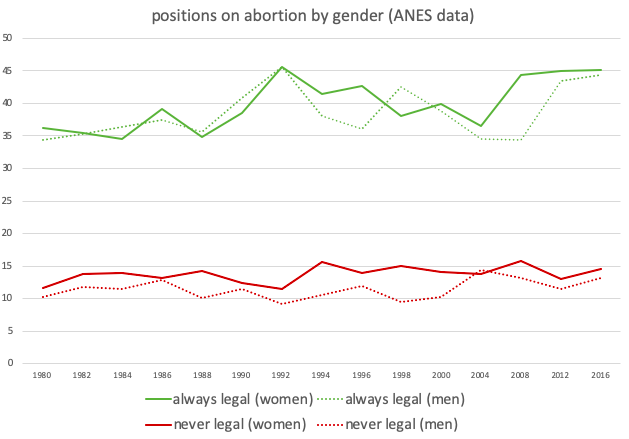
I didn’t know how women and men differ in their views of abortion or how opinions have changed over time. So I ran the numbers using American National Election Study data since 1980.

Here are the strong pro-choice and anti-abortion views by gender:

More people favor always allowing rather than never allowing abortion. Differences by gender are small and not significant, but women are currently just a bit more likely to take both the strongest pro- and anti- positions. The trend over time is slightly favorable to choice.

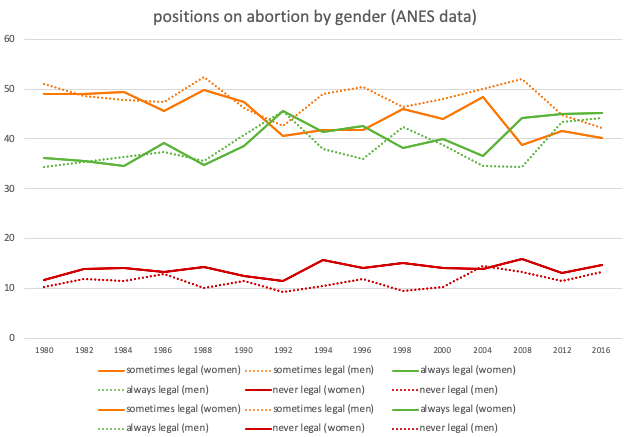
The graph is noisier if we add a middle view as defined by the ANES (abortion should be legal in cases of rape, incest, or medical risk to the mother):

Making abortion sometimes legal is the most popular position, and men are somewhat more likely than women to adopt it, but again, the gender difference is small.

Register Now for Florida Council for the Social Studies Annual Conference!

It’s that time year again! As we wrap up the school year, it’s time to start thinking ahead to next year, and to new opportunities for collaboration, camaraderie, and cognition. The Florida Council for the Social Studies annual conference happens this October 18-20 and you can register now for the conference, held in Orlando at the Florida Hotel and Conference Center. The theme is Heroes and Villains: Teaching in a Polarized World. This bodes well for some really fascinating sessions!

There is an excellent keynote speaker lined up, the wonderful and nationally recognized Dr. Susan MacManus!

MacManus

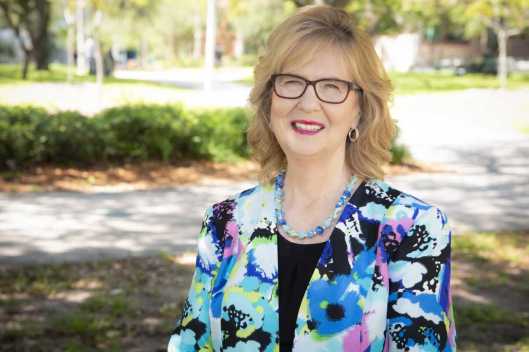
Dr. Susan A. MacManus is a USF Distinguished University Professor Emerita in the Department of Government and International Affairs, School of Interdisciplinary Global Studies. MacManus received her M.A. from the University of Michigan and Ph.D. from Florida State University.

MacManus has authored or co-authored numerous publications on Florida politics, including Florida’s Minority Trailblazers: The Men and Women Who Changed the Face of Florida Government, Politics in Florida, Young v. Old: Generational Combat in the 21st Century? and Targeting Senior Voters. MacManus and her mother, Elizabeth, authored two local Florida history books: Citrus, Sawmills, Critters & Crackers: Early Life in Lutz and Central Pasco County and Going, Going, Almost Gone: Lutz-Land O’ Lakes Pioneers Share Their Precious Memories.

From 1998 to 2015, she served as political analyst for WFLA News Channel 8 (Tampa’s NBC affiliate). Since 2016, she has been the political analyst for ABC Action News (Tampa’s ABC affiliate). She is a featured columnist on sayfiereview.com—a widely read Florida-based political website. MacManus has appeared on every major broadcast and cable television and radio network and been interviewed by major newspapers in Florida, the U.S., and abroad. She chaired the Florida Elections Commission from 1999-2003 and is Florida’s most-quoted political scientist. MacManus is not affiliated with any political party.

We’ll have more on the topic of her keynote in a later post, and we will highlight some of the sessions you might find most interesting!

Register here for the conference today! 

Two New Civic Awakening Works Released from Eric Liu

If you are looking for some fantastic D&D content to enjoy this weekend, we encourage you to check out the new works from Eric Liu on awakening our civic power. He released his new TED talk, “How to revive your belief in democracy”, in which he offers a framework for democratic participation. As well as, his new book, “Become America: Civic Sermons on Love, Responsibility, and Democracy” which compiles the civic sermons he gave at the first 19 Civic Saturday events, hosted throughout the country last year by Citizen University. You can read the announcement in the Citizen University newsletter shared below, sign up for the CU newsletter here, and please share these two exciting resources with your networks!


Citizen University Updates: New TED talk and new book!

I’m excited to be bringing two works into the world this week! Both flow from our mission at Citizen University to spark a great civic awakening in our country. And I’m writing to ask for your help getting both these works into wide circulation.

The first is my brand-new TED Talk on what I call “civic religion” — a framework of belief and practice for sustaining democracy. I’ve got to admit, I wasn’t sure how people at the TED conference last month would receive a talk using a religious metaphor. But it turns out that at TED, as everywhere and especially in the U.S. today, people are yearning for a frame of shared purpose and civic spirit. For an invitation to do more and be more. The response in the room was electric. And I hope it can be so in the wider world now. You can watch the video below and will you please share and post the talk today?

The second work is my new book called BECOME AMERICA which contains the civic sermons I wrote and delivered at the first nineteen Civic Saturdays our team organized around the United States. These essays challenge us to rehumanize our politics and rekindle a spirit of love and hope in civic life. Become America will prompt you to contemplate our ongoing story as Americans and energize you to help rebuild a country you’re proud to call home. I’ll be holding a special event for the book in DC on May 18. Will you order the book today or join us at one of our book events?

Both the TED Talk and BECOME AMERICA are rooted in history but also products of this moment — a moment of peril and possibility in democratic life. This is a time for us all to ask what we believe, and what it takes to live up to our ideals. It is also a time to ask for help from friends — and to make new friends by asking for help.

I’m so grateful for your support, and gratified that we get to share in such purposeful work. – Eric

You can receive these announcements in your inbox and sign up for the Citizen University newsletter by clicking here.

some notes on receiving tenure

This week, the Tufts Trustees voted to grant me tenure and make me a full professor. I am very grateful to them, the Political Science Department (which is my tenure home), the Tisch College of Civic Life (which will remain my main base) and its dean, Alan Solomont, and the other people–known and anonymous to me–who were involved in advancing and reviewing my case.

I have been working full-time in universities (Maryland and then Tufts) since 1993. However, I don’t believe I should have held tenure until now. Tenure means job security for teaching. It’s a way of protecting instructors’ intellectual freedom. Until now, I have never held a teaching position. More years than not, I’ve taught at least one credit-bearing college course, but not as part of my paid employment. Instead, my salary has come from external sources (philanthropy, contracts, and–in the early years–a state appropriation). These funds have supported me and my colleagues to serve external constituencies with research and organizing. That kind of work must be contingent on funding and performance or it would turn into a sinecure.

So really the big change in my life is that I will be teaching virtually full time, starting in 2019-20. One motivation is our new Civic Studies major at Tufts, which is a major commitment of mine. This major is also part of a more general strategy of making the study of civic life a core academic focus at Tufts, which is another personal commitment for me and a key strategy for Tisch College. At the same time, I am looking forward to the role of a teacher/individual scholar, because that should allow me to explore certain topics more deeply than I have so far–mainly, topics in political theory.

My career is unfolding in backwards order. My degree is in a humanities field, philosophy. Humanists usually start by teaching alone and doing single-authored research: in short, reading, writing, and presenting. Some of them gradually begin leading departments, serving on committees, planning conferences, conducting collaborative and interdisciplinary research projects, and interacting with publics.

I started in an externally-funded center within a state school of public policy, where our work was applied, interdisciplinary, collaborative, and done in public. From an early age, I was heavily involved in working with other people. I was rarely in a classroom but almost constantly on the phone or email, communicating with peers. My most significant publications were co-authored; the Civic Mission of Schools report lists 60 authors.

I will not give up that kind of work but I do plan to spend more time teaching and conducting individual research. If this backwards order makes any sense intellectually, the advantages will be: 1) Breadth–I never sought tenure in a discipline that would have expected me to demonstrate deep specialization, but I had to learn a bit about a lot of things, and 2) Experience in how knowledge, power, money, networks, and organizations relate to each other in the 21st century. I’m hoping to make that second topic a focus of my research.

The immediate plan is to keep doing the collaborative work that I’m doing now (so don’t be alarmed if you are a collaborator) while developing several new courses in 2019-20. I have completed a book manuscript that is under review, so if that goes reasonably smoothly, I will feel free to focus a lot of attention on curriculum and pedagogy during the next academic year. I also have a sabbatical coming up, and I plan to spend that time learning network science and continuing to collect network data of different kinds, toward one or two books on networks and political/moral thinking.

It’s very rare for someone to switch to the tenure track after 26 years in the business. It’s like lifting a heavy locomotive and putting it down on different rails. Tufts has been tremendously supportive, flexible, welcoming, and creative in making this possible in my case. I feel a deep sense of gratitude and loyalty to this institution and my colleagues and students.