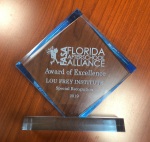
Florida Afterschool Alliance Recognizes the Efforts of the Lou Frey Institute!

Some happy news, friends! The Lou Frey Institute of Politics and Government (LFI) was recently recognized for their work with the Boys & Girls Clubs of Central Florida’s After School Zone by the Florida After School Alliance (FASA).  LFI was honored with the inaugural Special Recognition Award for their contribution to the civic well-being of Florida’s youth.

Since 2017, LFI and the Boys & Girls Clubs of Central Florida have partnered to provide a hands-on, civic learning experience for students in their after school program.  The Civic Action Project (CAP), was designed in collaboration with the Constitutional Rights Foundation (CRF), and is a free resource available to schools and community groups from CRF. CAP provides young people with opportunities to deliberate, collaborate, and form civic relationships with their peers as they investigate issues that matter to them. The premise of the project is to get young people to be thinking about their community, the impact public policy has on their community, and the ways they can interact with the decision makers to positively affect the issues they identify happening in their community.

In their nomination of the Lou Frey Institute to the FASA Awards Committee, the Boys & Girls Clubs of Central Florida said,

“The UCF Lou Frey Institute collaborative supports our Boys & Girls Clubs of Central Florida After School Zone mission of inspiring and enabling all young people including those from disadvantaged circumstances to reach their full potential as productive, responsible, and caring citizens. The Civic Action Project equips our middle school students with the tools for positive participation in local politics, social advocacy, and community engagement. Through the community involvement of the Lou Frey Institute, our young people are empowered to work as a team with their peers and adult leaders to promote historic initiatives that have the potential for lifelong benefits within the Central Florida region and beyond.”

Young people participating in the After School Zone have addressed projects that include, but are not limited to:

  • Cyber bullying prevention
  • Advocacy for adapting school and community playgrounds for children with disabilities
  • Elevating education for middle school students
  • Mental health support services for students
  • School gun violence prevention
  • Food waste prevention among school cafeterias in Orange County, Florida

Kelvin Curry, Boys & Girls Clubs of Central Florida’s Director of Middle School programs said,

“The Civic Action Project truly inspires and enables our young people to have a real voice and leave their positive mark on society as those who can stand on the right-side of history.”


The Lou Frey Institute was honored at the Florida After School Alliance’s annual awards banquet held at the end of September.

If you are interested in learning more about the Civic Action Project for your school or community group, please contact the Florida Joint Center for Citizenship’s Action Civics Coordinator, Chris Spinale. You may also reach out to LFI Interim Director Steve Masyada for more information.

Event: The Role of Play in Human Evolution and Public Life: Work, or Play?

Please join us for this month’s Ludics Seminar at Harvard’s Mahindra Center to explore the role of play in human evolution and public life. Details are below:

Peter Gray, Boston College

Peter Levine, Tufts University

The Role of Play in Human Evolution and Public Life: Work, or Play?

Monday, October 28, 2019 – 6:00pm

Location TBA

PANEL SYNOPSIS

The Ludics Seminar, Mahindra Humanities Center, Harvard University will kick off its 2019-2020 series of talks with a panel discussion between Professor Peter Gray, Boston College, and Professor Peter Levine, Tufts University, on play and public life. Peter Gray will speak about his recent work on play and egalitarianism in hunter and gatherer cultures. Peter Levine will speak about Harry Boyte’s notion of public work, teasing out this binary between work and play in public life. If play is a corollary to egalitarianism as Peter Gray suggests, then why is the business of contributing to public life most often associated with work?

“The Role of Play in Human Evolution”
Peter Gray, Boston College
Humans are the only primate (apparently) that can live peacefully, or at least relatively so, in multi-male, multi-female social groups. From an evolutionary point of view, how did we manage that? I will suggest here, based on research among contemporary band hunter-gatherers, that we did it at least in part by expanding upon the general mammalian capacity for play and bringing it into adult social interactions.

“Civic Engagement as Public Work, or Play?”
Peter Levine, Tufts University
Often, acts of civic engagement are defined as acts that people undertake voluntarily without being paid, such as voting, protest, or discussing issues. The very definition of “volunteer service” is any work for other people that isn’t remunerated. This distinction between work and citizenship goes back to Aristotle. Harry Boyte and other proponents of “Public Work” have criticized it, arguing that it trivializes civic life by reducing it to after-work voluntarism and marginalizes the many ways that paid, employed people contribute to public spaces and institutions. The democracy of ancient Athens was not just a discussion among gentlemen; it was also a set of physical spaces–like the Pnyx, where discussions occurred–that people had built with their hands. However, we are not just public workers and artisans in the common world; we also like to play. We are homo ludens as well as homo faber. Designing civic engagement to be more play-like or game-like has been shown to make it more attractive and productive. So how should we think about the relationship between work and play in the civic domain? And what may happen to that relationship if work disappears for many human beings while opportunities for play expand?

BIOS
Peter Gray is a research professor of psychology at Boston College who has conducted and published research in neuroendocrinology, developmental psychology, anthropology, and education. He is author of an internationally acclaimed introductory psychology textbook (Psychology, Worth Publishers, now in its 8th edition, co-authored with David Bjorklund), which views all of psychology from an evolutionary perspective. His recent research focuses on the role of play in human evolution and how children educate themselves, through play and exploration, when they are free to do so. He has expanded on these ideas in his book, Free to Learn: Why Unleashing the Instinct to Play Will Make Our Children Happier, More Self-Reliant, and Better Students for Life (Basic Books). He also authors a regular blog called Freedom to Learn, for Psychology Today magazine. He is a founding member and president of the nonprofit Alliance for Self-Directed Education (ASDE), which is aimed at creating a world in which children’s natural ways of learning are facilitated rather than suppressed. He is also a founding board director of the nonprofit Let Grow, the mission of which is to renew children’s freedom to play and explore outdoors, independently of adults. He earned his undergraduate degree at Columbia College and Ph.D. in biological sciences at the Rockefeller University many years ago. His own current play includes kayaking, long-distance bicycling, backwoods skiing, and vegetable gardening.

Peter Levine is the Academic Dean and Lincoln Filene Professor of Citizenship & Public Affairs in Tufts University’s Jonathan Tisch College of Civic Life. He has tenure in Tufts’ Political Science Department, and he also has secondary appointments in the Tufts Philosophy Department and the Tufts Clinical and Translational Sciences Institute. He directs the Civic Studies Major at Tufts. Levine graduated from Yale in 1989 with a degree in philosophy. He studied philosophy at Oxford on a Rhodes Scholarship, receiving his doctorate in 1992. From 1991 until 1993, he was a research associate at Common Cause. From 1993-2008, he was a member of the Institute for Philosophy & Public Policy in the University of Maryland’s School of Public Policy. During the late 1990s, he was also Deputy Director of the National Commission on Civic Renewal. Levine was the founding deputy director (2001-6) and then the second director (2006-15) of Tisch College’s CIRCLE, The Center for Information and Research on Civic Learning and Engagement.
Levine is the author of We Are the Ones We Have Been Waiting For: The Promise of Civic Renewal in America (Oxford University Press, 2013), five other scholarly books on philosophy and politics, and a novel. He has served on the boards or steering committees of AmericaSpeaks, Street Law Inc., the Newspaper Association of America Foundation, the Campaign for the Civic Mission of Schools, Discovering Justice, the Kettering Foundation, the American Bar Association’s Committee for Public Education, the Paul J. Aicher Foundation, and the Deliberative Democracy Consortium.

The Economist Magazine Gets Religion on the Commons

It’s only a short article with not much analysis or detail, but The Economist magazine seems to have embraced the commons. This is a stunning reversal for a publication that has long regarded Garrett Hardin’s “tragedy of the commons” fable as gospel and sufficient reason to expand private property rights.

Yet there it was, in the September 12 issue: “The alternatives to privatization and nationalization,” the headline declared, proposing commons as a better way to manage wealth. This was followed by the heretical subheadline: “More public resources could be managed as commons without much loss of efficiency.”

Gobsmacked by this conclusion from a champion of market economics, I immediately pored through the unsigned article to see the reasoning behind the article. Alas, there was not the indepth analysis that I had hoped for. Still, it was encouraging to see The Economist reconsider the English enclosure movement. Instead of celebrating the Industrial Revolution as a necessary Great Leap Forward, the article questioned whether enclosures actually resulted in productivity gains, as frequently claimed by capitalist historians.  

“Privatising shared resources, it turns out, does not always lead to a productivity boom,” writes the author, nor does it “always lead to a productivity boom.” Citing research by Robert Allen of NYU Abu Dhabi, the author notes that English lords did not necessarily reinvest their profits to improve productivity and spur innovation: “Most indulged in fine living; many were debtors rather than savers.” 

The author goes on to reference Ostrom’s research showing that commons are often stable and durable, such as the Swiss commons of Törbel, which have managed shared irrigation systems for 500 years. “An exclusive focus on states and markets as ways to control the use of commons neglects a varied menagerie of institutions throughout history,” the author concludes. 

In a final note, the author invites us to consider how commons could change society: “A world rich in healthy commons would of necessity be one full of distributed, overlapping institutions of community governance. Cultivating these would be less politically rewarding than privatization, which allows governments to trade responsibility for cash. But empowering commoners could mend rents in the civic fabric and alleviate frustration with out-of-touch elites.”

The author even cites Ostrom’s Nobel Prize acceptance speech, in which she called on policymakers to “‘facilitate the development of institutions that bring out the best in humans’.  This prompted the author to offer a benediction: “That sounds like common sense.”

I remain amazed that this piece was able to survive a gauntlet of business-minded editors at The Economist. While I appreciate the good press for the commons (instead of the umpteenth retelling of the "tragedy" story), I frankly would have welcomed a deeper analysis of the larger cultural and political ramifications of commons.

But relax, I tell myself, this is a moment to be gracious. Thank you, Economist, for opening the door a little on the realities of commoning. May you find the courage to entertain a richer treatment of the non-capitalist possibilities already unfolding all around us.

Register for Next Week’s Online Facilitation Unconference!

The sixth Online Facilitation Unconference (OFU) is happening on Oct 7-13, 2019! This digital gathering is hosted by the Center for Applied Community Engagement LLC, and is a great opportunity for anyone interested in virtual facilitation – no previous experience needed! OFU is part of the International Facilitation Week and members of the International Association of Facilitators (IAF) can receive a 30% discount! This global event is happening next week so make sure you register and get your tickets ASAP! Follow OFU on Twitter with the hashtag #OFU19 for more #FacWeek updates. You can read the announcement below for more info or find the original on the OFU Exchange site here.


Online Facilitation Unconference 2019

Welcome to the sixth Online Facilitation Unconference (OFU), the week-long international learning exchange exploring the art and practice of facilitating in virtual environments.

Join us on October 7-13, 2019. Tickets on sale now!

REGISTER TODAY!

Who should attend?

OFU aims to connect people from these three broad groups:

  • Facilitators
  • Practitioners from other fields whose work also includes facilitation
  • Technology providers

We welcome participants from all backgrounds and across all levels of expertise regarding facilitation and the use of online technology.

For example:

  • You are a senior facilitator who has just recently started to deliver your services in virtual settings. Do you have questions or roadblocks you’d like to discuss?
  • Or maybe you are already an expert in virtual facilitation. Are you currently exploring some cutting edge method and would like to try it out in a friendly, constructive environment?
  • Or maybe you work in an entirely different field (e.g., business management, education, the non-profit sector) and you are frequently tasked with leading productive online meetings or expect your staff to be able to so. Do you have insights you can share? Or are you looking for approaches to training that fit your needs?

What to expect?

OFU provides an opportunity for attendees to explore, share, learn, and connect with colleagues from around the world. We hope you will:

  • Explore a wide range of topics related to online facilitation
  • Find answers to questions or challenges you have encountered in your work
  • Discover new tools, methods, resources, etc.
  • Make new connections with colleagues from around the globe!
  • Come away with new energy and plenty of new ideas to try out next!

As is the nature of unconferences, our attendees are active participants who will create the agenda collaboratively based on their shared interests and needs. Yes, you will help shape what will be talked about!

Event timeline

  • October 7–9 – Join one of several live welcome sessions (each approximately 45 minutes long via videoconferencing) as well as several other pre-scheduled sessions. More details soon!
  • October 10–12 – Unconference sessions
  • October 13 – Room for spill-over sessions (if needed)
  • Later in October – Event follow-up

A few key things to note:

  • The Online Facilitation Unconference (OFU) is an annual learning exchange on the art and practice of facilitating in virtual environments. It is a community-driven event that brings together people from diverse backgrounds from all around the world whose work includes, or who otherwise have an interest in, facilitating in the virtual realm.
  • OFU is an event for newbies and experts alike. Whether you are a seasoned facilitator pro or a beginner, whether you are already highly skilled using technology for this work or still trying to figure out the possibilities – OFU provides a venue where you can ask and answer questions, share and solicit advice, discuss your latest project, challenge or idea, explore new tools, discover new tricks, and find like-minded colleagues.
  • Aside from a handful of pre-scheduled sessions, OFU is an unconference (an event where the participants co-create the agenda). OFU is a blank slate for you to pitch your ideas in collaboration with fellow attendees. The agenda will emerge based on your and everyone else’s needs and interests.
  • OFU is a not-for-profit event. It is important for us to keep the event open and accessible for everyone who is passionate about the topic. If you aren’t in a position to pay full price, please make use of our low-income options and encourage others to do the same.
  • Sometime in early September, we will announce a more detailed schedule that will specify the various main time slots during which the majority of unconference sessions are expected to be held. These time slots are optimized for trans-continental collaboration and sharing (Americas, Europe/Africa, and Asia/Australia). We highly encourage our session hosts to schedule their sessions within these designated time slots as much as possible so as to maximize global participation.
  • Session hosts are encouraged to record or otherwise document their sessions. Following each session, any available recordings or documentation will be posted to the OFU website in a timely manner.
  • OFU works best the more people contribute. Don’t miss this unique opportunity to learn and share about facilitation in virtual environments and bring along your friends and colleagues from around the world!

Learn more about the session offerings on the OFU Eventbrite site at www.eventbrite.com/e/online-facilitation-unconference-2019-registration-71022166211.

You can find the original version of this on the OFU site at www.ofuexchange.net/.

the “America in One Room” experiment

On the New York Times op-ed page today, James Fishkin and Larry Diamond report the results of convening 523 randomly selected registered voters for several days of deliberation. These voters were surveyed before and after the discussions. Their appraisal of democracy rose markedly. They also shifted their views in specific ways:

The most polarizing proposals, whether from the left or the right, generally lost support, and a number of more centrist proposals moved to the foreground. Crucially, proposals further to the right typically lost support from Republicans and proposals further to the left typically lost support from Democrats.

I have known Jim Fishkin and his work for 20 years and admire it a lot. These experiments are illuminating, and they open possibilities for reform. They also remind us that the politics we see around is the outcome of specific institutional arrangements that could be changed. For instance, we are not hard-wired to fall into two partisan camps; that is a feature of our electoral system. If we were randomly recruited into deliberative bodies, we would see very different results. If we can change something, we should consider changing it.

But I do have some worries:

  • Does the shift to moderate opinions demonstrate that deliberation is desirable? It could also be interpreted as a bias: putting people together in heterogeneous groups disadvantages the radicals and their ideas. I try to challenge myself by seriously engaging several opposing political movements with which I disagree. That is my own approach to deliberation, and it could be considered a form of moderation. But I don’t find myself shifting to centrist positions, many of which I find thin gruel and incommensurate to our problems.
  • What is the overall theory of change? If we like this alternative form of politics–much more deliberative, and also more moderate, than the status quo–how should we institutionalize it? The easy part is to invent policies that would make democratic deliberation mandatory. The hard part is figuring out who would fight for those policies, and why. More people are motivated by political agendas and identities than by procedural ideals, and especially procedures that favor the center.
  • What about people who are not invited to deliberate, or who don’t like the results of the deliberation? Do we see them as worse qualified to express themselves?
  • Is this experiment a form of civic education that teaches people to value interactions that are civil, professionally organized, calm, and “invited”–thereby implicitly devaluing such forms of politics as social movements, strikes, competitive elections, and litigation? If that is the lesson, is it an acceptable one?

See also: John Gaventa on invited and claimed participation; civic engagement and the incarceration crisis; saving relational politics; why study real-life deliberation?

Wednesday Webinar Roundup with Courageous Leadership Project, NCL, and more!

Here are the upcoming D&D online events happening over the next few weeks, including NCDD sponsor org The Courageous Leadership Project, NCDD member orgs National Civic League, National Issues Forums Institute and Living Room Conversations, as well as, from the International Association of Facilitators (IAF) and the International Associate for Public Participation (IAP2).

NCDD’s online D&D event roundup is a weekly compilation of the upcoming events happening in the digital world related to dialogue, deliberation, civic tech, engagement work, and more! Do you have a webinar or other digital event coming up that you’d like to share with the NCDD network? Please let us know in the comments section below or by emailing me at keiva[at]ncdd[dot]org, because we’d love to add it to the list!


Upcoming Online D&D Events: The Courageous Leadership Project, National Civic League, Living Room Conversations, NIFI, IAF, IAP2

Living Room Conversations Training (free): The Nuts & Bolts of Living Room Conversations

Thursday, October 3rd
2 pm Pacific, 5 pm Eastern

Join us for 90 minutes online to learn about Living Room Conversations. We’ll cover what a Living Room Conversation is, why we have them, and everything you need to know to get started hosting and/or participating in Living Room Conversations. This training is not required for participating in our conversations – we simply offer it for people who want to learn more about the Living Room Conversations practice.

Space is limited so that we can offer a more interactive experience. Please only RSVP if you are 100% certain that you can attend. This training will take place using Zoom videoconferencing. A link to join the conversation will be sent to participants the day before the training.

REGISTER: www.livingroomconversations.org/event/training-free-the-nuts-bolts-of-living-room-conversations-19-2/

Online Living Room Conversation: Relationships Over Politics – 90-Minute Conversation w/ Optional 30-Minute Q & A with Hosts!

Thursday, October 3rd
4 pm Pacific, 7 pm Eastern

Is it possible to use Living Room Conversations with our families and close friends? It is ultimately challenging, because family are more likely to break ‘host and guest’ social norms. The emotional stakes are higher, conversations are colored by long, deeply personal histories and it can feel easier to ‘take the gloves off’ and fight dirty, unconstrained by the politeness usually offered acquaintances. How might we hold the tension of our differences while working to repair connection and not further deepen division within our circle of family and friends?

All sorts of people tell us they want to use the skills they practice in Living Room Conversations to help restore connection with friends and family. So, let’s use a Living Room Conversation to talk about just that! This Living Room Conversation will help us listen and learn about where we have different opinions, along with shared ideas about how to best navigate time with family & friends (who may not share our view of the world). HERE is the conversation guide.

REGISTER: www.livingroomconversations.org/event/relationships-over-politics-90-minute-conversation-w-optional-30-minute-q-a-with-hosts-2/

Online Living Room Conversation: Race and Ethnicity – A Special Three-Part Series

Tuesday, October 8th
10:30 am Pacific, 1:30 pm Eastern

Check out this four-minute video from our first Race & Ethnicity Conversation Series to get a taste of this conversation! In this series of three conversations, participants explore the complexities of the concepts of Race, Ethnicity, and their impacts on people from all walks of life. We will cover new questions from the three Race & Ethnicity conversation guides found here. The following conversation series will occur on October 15th and 22nd.

REGISTER: www.livingroomconversations.org/event/race-and-ethnicity-a-special-three-part-series/

IAP2 Monthly Webinar – 2019 IAP2 Projects Of The Year (USA & Canada)

Tuesday, October 8th
11 am Pacific, 2 pm Eastern

We are excited to feature the two Core Values Award winners for Project of the Year.

The Portland Bureau of Transportation (PBOT) won the USA Project of the Year award for “PedPDX”. This project addresses discrepancies in pedestrian infrastructure around the Rose City, and involved people of a variety of different ethnic and social groups. One city council member referred to the public engagement process as the most robust and comprehensive he had ever seen.

The Canadian Partnership Against Cancer used a variety of techniques and approaches in reviewing Canada’s Cancer Strategy, focusing on “underserviced” populations — people in remote areas, Indigenous people, new Canadians, LGBTQ people, for example — often don’t get the same level of cancer care and treatment that others do. The Partnership managed to bring these voices to the table and help re-design a cancer strategy that puts them on an equal footing.

REGISTER: https://iap2usa.org/event-3404391

International Association of Facilitators webinar – Becoming a CPF with the IAF

Tuesday, October 8th
3 pm Pacific, 6 pm Eastern

Making the decision to seek the IAF Certified™ Professional Facilitator (CPF) accreditation can be hard. Common questions people ask are What’s involved? How much time will it take? Will I meet the requirements? and What if I don’t pass? In response to strong interest from members we will be exploring these questions at a webinar with hosts that have years of experience as professional facilitators and as IAF Assessors.

REGISTERwww.iaf-world.org/site/events/webinars

International Association of Facilitators webinar – Knowing Me, Knowing You – Why do we do/say the things we do?

Wednesday, October 9th
10:30am Pacific, 1:30 pm Eastern

Remember building sandcastles at the beach? As soon as the structure reached a certain height, any amount of sand that we added on top fell to the sides. Why? The base was not wide enough to go any taller. The base or foundation determines the height of the sandcastle.

The same applies to the Altitude we want to reach in our lives. That base is determined by our Beliefs and Values. Becoming aware of what drives us and strengthening the same by conscious living makes our roles purposeful and meaningful. What we do and say shape the results, which in turn affect our reputation and credibility as a professional.

REGISTERwww.iaf-world.org/site/events/webinars

The Courageous Leadership Project webinar – Brave, Honest Conversations™

Wednesday, October 9th
9 am Pacific, 12 pm Eastern

Some conversations are hard to have. Fear and discomfort build in your body and you avoid and procrastinate or pretend everything is fine. Sometimes you rush in with urgency, wanting to smooth things over, fix them, and make them better. Sometimes you go to battle stations, positioning the conversation so you have a higher chance of being on the “winning” side. NONE OF THIS WORKS. Instead, it usually makes a hard conversation harder; more divided, polarized, and disconnected from others. The more people involved, the harder the conversation can be. I believe that brave, honest conversations are how we solve the problems we face in our world – together.

In this webinar, we will cover: What is a Brave, Honest Conversation™? Why have one? What can change because of a brave, honest conversation? How do you have one? What do you need to think about and do? How do you prepare yourself for a brave, honest conversation?

REGISTER: www.bravelylead.com/events/bhcfreewebinar

October CGA Forum Series: A House Divided: What Would We Have to Give Up to Get the Political System We Want?

Friday, October 11th
11 am Pacific, 2 pm Eastern

Please join us for a Common Ground for Action (CGA) online deliberative forum on A House Divided: What Would We Have to Give Up to Get the Political System We Want? If you’ve never participated in a CGA forum, please watch the “How To Participate” video before joining. You can find the video link here. If you haven’t had a chance to review the issue guide, you can find a downloadable PDF copy at the NIF website here.

REGISTER: www.nifi.org/en/events/october-cga-forum-series-house-divided-what-would-we-have-give-get-political-system-we-want

Online Living Room Conversation: Race and Ethnicity – A Special Three-Part Series

Tuesday, October 15th
9 am Pacific, 12 pm Eastern

Check out this four-minute video from our first Race & Ethnicity Conversation Series to get a taste of this conversation! In this series of three conversations, participants explore the complexities of the concepts of Race, Ethnicity, and their impacts on people from all walks of life. We will cover new questions from the three Race & Ethnicity conversation guides found here. The following conversation series will occur on October 15th and 22nd.

REGISTER: www.livingroomconversations.org/event/race-and-ethnicity-a-special-three-part-series/

October CGA Forum Series: A House Divided: What Would We Have to Give Up to Get the Political System We Want?

Tuesday, October 15th
1 pm Pacific, 4 pm Eastern

Please join us for a Common Ground for Action (CGA) online deliberative forum on Climate Choices: How Should We Meet the Challenges of a Warming Planet? If you haven’t had a chance to review the issue guide, you can find a downloadable PDF on the National Issues Forums Institute website here. If you’ve never participated in a CGA forum, please watch the “How To Participate” video before joining. You can find the video link here.

REGISTER: www.nifi.org/en/events/october-cga-forum-series-house-divided-what-would-we-have-give-get-political-system-we-want

National Civic League AAC Promising Practices Webinar – Leadership Academies: Turning Ordinary into Extraordinary

Wednesday, October 16th
10 am Pacific, 1 pm Eastern

This webinar will highlight two leadership academies that have evolved to offer a more innovative and advanced civic learning experience. Registrants will hear from the City of Wichita, KS and the City of El Paso, TX. Cindy Claycomb, a Council Member for the City of Wichita, KS, will discuss how the city transformed its Citizens Academy into a Civic Engagement Academy. Olivia Montalvo-Patrick, Interim Neighborhood Services Coordinator for the City of El Paso, TX, will discuss the city’s Neighborhood Leadership Academy and Advanced Leadership Training.

REGISTER: www.nationalcivicleague.org/resource-center/promising-practices/

Session Highlights of the 2019 FCSS Annual Conference: Florida CUFA Sessions

agenda

Good afternoon friends! Don’t forget that the 2019 Florida Council for the Social Studies Annual Conference is coming soon (and you can register here!). Not only do we have some excellent regular sessions planned, but we also have our friends and colleagues from the Florida College and University Faculty Assembly joining us! Let’s take a look at some of their featured sessions, which targets those interested in some specifically research focused or driven sessions around the social studies! Please note that this list features only some of the planned sessions. 

Session 1

Complexity & Connections: Archaeology Addresses AP World History
Shannon Peck-Bartle, University of South Florida


Changes in the Advance Placement World History curriculum limit students’ ability to develop complicated webs of connections and human interactions. The use of material culture and archaeological methods are suggested to “thicken” the curriculum.

“I don’t want to cause trouble”: A white history teacher’s negotiation of racial boundaries in a diverse rural school
Travis Seay, University of Florida

whs1


This narrative case study of a white history teacher uses a framework of cultural memory to situate racial and historical knowledge in the teaching and learning setting.

Session 2

The LGBTQ-Inclusive Curriculum: An Imperative for the Social Studies
Bárbara C. Cruz, Katty B. Francis, and Cristina M. Viera, University of South Florida


LGBT Bug_CMYK_update


This presentation provides a brief history of LGBTQ content in the K-12 social studies curriculum. Discussion focuses on popular approaches for integrating LGBTQ issues in the curriculum, current legal challenges, and trends in the field.

Incorporation of Cross-Curricular Training in Social Studies and English Language Arts Pre-Service Teacher Preparation Programs
Allison Sheridan, Mary Dougherty, and Chris Spinale, University of Central Florida

04-jigsaw-round-e1515536828663 

For this study, the researchers aimed to examine how university programs are preparing pre-service teachers to incorporate social studies standards into ELA classrooms and vice versa. 

Session 3

Adolescent Identity Exploration and Civic Identity Development in a U.S. Government Classroom
Sarah Mead Denney, University of South Florida


adolescent

This multiple case study examined adolescent identity exploration and civic identity development in an AP U.S. Government class. Findings suggest the promotion of these processes is both possible and practical, but require intentional, purposeful teaching.

How Do I Get My Ideas Published?
Scott Waring, University of Central Florida


This session will include general publishing tips and an overview of four social studies journals currently edited by the presenter.  The remaining time will allow for discussion and an opportunity to pose questions.

Be sure to check this space for more! Register for the conference today! 

Learn here about the keynote!

Check out some of the sessions! and here!  and here! 

Check out some of the exhibitors here! and here!


Join Confab TODAY Feat Purple Project for Democracy

Join us in just a few hours for our September Confab call featuring the new initiative about to launch called Purple Project for Democracy. Purple is a non-partisan coalition, campaign and movement to rediscover and recommit to democratic values and institutions.  The folks behind the project are building momentum for their November launch, and on this Confab we’ll learn more about how dialogue and deliberation can play a role in it.

This free call will be today, September 30th from 1-2 pm Eastern, 10-11 am PacificRegister today so you don’t miss out on this exciting opportunity!

reg-button-2

Purple is aiming to help people recommit to democratic values, but also to stimulate civic engagement. This is where the dialogue and deliberation field might be able to help most!

It begins this November with a media and education campaign that will “illuminate and dramatize the many glories of American democracy.” Participants in this campaign will include media outlets, schools, libraries, and other organizations committed to sharing the message of the importance of democracy and our participation in it. Their vision is to gain visibility and build a movement for civic participation and democracy across differences, that then leads to increased action, including volunteering, voting, serving, and participating in civic life.

During the month of November, Purple hopes to have local conversations which can help to stimulate the national effort. The hope of the organizers is that members of NCDD will participate in this effort by hosting conversations in their communities. To learn more about this aspect of the project, please take a look at this document from Purple.

On the call, we will be joined by Bob Garfield, one of the key organizers for this movement. Bob is co-host of public radio’s On the Media. He is also the founding co-host of Slate’s podcast on language, Lexicon Valley, and Amazon Channels’ The Genius Dialogues. Bob will share with us the vision for Purple, and discuss opportunities for the dialogue and deliberation field to contribute to the November campaign and the next phases following this launch.

Please be sure to check out the Purple Project for Democracy website, and bring your questions and ideas for how dialogue & deliberation can contribute to this effort. Make sure you register ASAP  to secure your spot!

About NCDD’s Confab Calls

Confab bubble imageNCDD’s Confab Calls are opportunities for members (and potential members) of NCDD to talk with and hear from innovators in our field about the work they’re doing and to connect with fellow members around shared interests. Membership in NCDD is encouraged but not required for participation. Confabs are free and open to all. Register ASAP if you’d like to join us!

why I am optimistic about the impeachment process

I find myself less anxious than most friends and commentators. Here are my largely sanguine responses to several current concerns about the impeachment process:

It’s a mistake to focus on one specific scandal. Congress should persuade the American people to condemn a whole pattern of corruption in the administration. (See David Atkins, for example).

Congress can focus on one or two articles of impeachment in order to handle those charges well. (The best current guess is that the articles will involve: 1. Trump’s interaction with Ukraine, and 2. the administration’s obstruction of Congress across many issues.) Meanwhile, the press, presidential candidates, pundits, social movements, and regular citizens will inevitably conduct a wider inquiry and debate. I don’t think the big picture will be lost just because the articles in Congress are precise and narrow.

The Ukraine story also implicates Hunter Biden, and hence (in some way) Joe Biden. That either means that it’s a poor choice of a scandal for the Democrats to use in an election year, or that it’s bad for the public, because both parties will end up defending crony capitalism.

Joe Biden has an opportunity to make a case that he is truly blameless in the Ukraine matter. If he is persuasive, fine. If he fails to persuade, then it’s better that he should fail now, rather than during the general election. Meanwhile, Elizabeth Warren has every incentive to broaden the issue to encompass crony capitalism writ large. Her voice (and others’, too) will ensure that the whole Democratic Party is not soft on corruption.

Impeachment will drown out the Democratic primary campaign, overwhelming an important debate about our future.

During the primary season, a party wants its own faithful to pay attention to the rival proposals, critiques, counter-arguments, endorsements, gaffes, etc. It’s generally fine if other voters pay little attention until a nominee emerges to address the whole public. With vast attendance at primary campaign events and a lively debate online, there is little chance that core Democratic voters will tune out the primary. The intended audience is paying attention.

The impeachment debate will arbitrarily affect the outcome of the Democratic primary.

If it takes Joe Biden down, he was doomed anyway. If he turns it to his advantage, it will reinforce his best argument: his electability. If Warren benefits because she makes the sharpest critique of corruption–well, she is raising a real issue. And if someone else (say, Kamala Harris during a Senate trial) uses the impeachment effectively, it’s evidence of that candidate’s skill.

The Speaker seems to want a short, narrow impeachment process. That will not persuade the American people of the deeper problems with Trump. Pelosi is resigned to an unpopular process and doesn’t understand that impeachment hearings could change Americans’ opinions.

Don’t take what Speaker Pelosi says precisely at face value. I’m not saying that she’s lying; she would genuinely prefer a shorter and tighter process. But she knows that impeachment is likely to extend and expand. She wants unconvinced voters to believe that Democrats are trying to make this quick so that they can move onto other matters. She is also putting mild pressure on her caucus to move things along. I would be very surprised if things actually do wrap up by Thanksgiving, or if she believes that they will.

(By the way, I am continually surprised by strong partisans’ assumption that when someone on their side says something conciliatory about the other side, that person really means it. Do you really think Nancy Pelosi’s main reaction to this situation is to be “heartbroken and prayerful,” as she told ABC News? Are you sure Joe Biden actually believes the Senate Republicans are reasonable? It is not only the other side that sometimes doesn’t say exactly what they think.)

The Senate will acquit, Trump will survive, and as a result, not only will impeachment be further weakened as a tool for accountability, but Trump’s electoral prospects will improve.

Yes, the Senate is overwhelmingly likely to acquit, and Trump will still hold office on Election Day in 2020. But the American people should by then have a clear account of his criminality, which should weigh, at least mildly, against his reelection prospects. That is a sanction. Subsequently, he may face a federal jury on related charges.

If anything, I would have some qualms about actually removing him less than a year before the election. Who would the GOP nominate? What kind of mandate would a Democratic president hold? My ideal outcome might be for the House to impeach, a majority of US Senators to vote to remove Trump, for him to hang on because fewer than 67 Senators voted against him, and for the American people to finish the job in November.

Impeachment creates (at best) a tough vote for Democrats in districts that voted for Trump. Why “punish” the president by giving his party a boost in the congressional election?

This matter has received vast amounts of attention. My tentative takeaway is that any electoral impact will be small and may be a wash–a few Democrats losing in conservative districts and states (like Alabama), but a few Republican Senators facing very tough votes as a result of impeachment. There is a long tail of possible outcomes in either direction, but the best bet is a limited effect.

It’s a mistake to give many House committees a role in impeachment. One committee should handle it.

Pelosi is trying to build support by giving several leaders and groupings within her caucus a stake. Also, one of the articles is likely to be obstruction, and the Administration has obstructed several committees.

The Democrats grandstand amateurishly in hearings. They don’t know how to cross-examine and build a case.

True. And there’s a reason for it: individual politicians want to talk on camera, even though the inquiry would be much better handled by professional counsel. This problem is worth worrying about, but surely the Democrats will finally get it together now ….?

only in America!

When informed that the Lord Mayor of Dublin, Ireland, was Jewish, Yogi Berra exclaimed, “Only in America!”

I was in the jury pool in Middlesex County, Mass. a couple of weeks ago. Of the dozen cases before the court that morning, 11 were settled with pleas, and one proceeded to a bench trial because the defendant waived his right to a jury.

The judge came out to thank us for our service, explaining well that our presence in the jury chamber was a reminder to both sides that they could face a panel of citizens. Warming to his theme, he informed us that only in the United States do we have a right to a trial by jury.

Actually, the number of countries in which juries play important roles is about fifty. Even in the USA, we have juries because England has required them since 1215. Some seminal American jury trials took place while Massachusetts was still a British colony: the libel case against John Peter Zenger, the Boston Massacre Trials.

The jury pool in a diverse American city is a beautiful thing: people come together from all walks of life and all nations of the earth to deliberate as equals. The instructional video was appropriately inspirational, showing diverse Massachusetts citizens at work as jurors. In the video, they even wear varied costumes in the jury box: a guy in a hardhat, an athlete in uniform, etc. It’s a symbol of equity + diversity.

But why the impulse to defend democratic and liberal institutions as unique to the USA? The most common claim of this type is that we are uniquely a nation of immigrants. By my calculation, the US ranks 67th in the world in the percentage of its people who were born overseas, just behind Germany and far behind the republic just to our north (which also uses juries).

Can’t something be good even if it also happens in other countries? What anxiety underlies this urge to claim exceptionalism? Could it be in the back of the judge’s mind that the US ranks below all comparable countries in both public safety and incarceration?

If patriotism depends on the empirical claim that we perform better than everyone else, it is a thin reed. One response is to assume that our form of government is literally unique: only in America! Then no empirical comparisons are needed. But that’s not a viable response, because often many other countries do the same thing. The right response is to be proud of the good things–like jury trials in Massachusetts–and to work to change the bad things (like racial bias in Massachusetts’ criminal justice). That is patriotism that isn’t contingent on exceptionalism.

See also: American exceptionalism and anxieties about American exceptionalism.