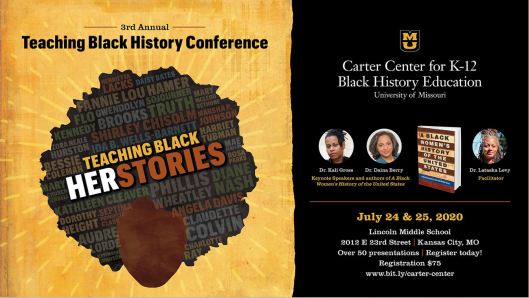
Are you a K-12 social studies educator looking for some quality professional development this summer? Consider attending the 3rd Annual Teaching Black History Conference, held in Kansas City, Missouri this July 24th and 25th. This year’s conference will be held at Lincoln Middle School which is located at 2012 East 23rd Street, Kansas City, MO 64108 and will run from 8 am to 5 pm each day. From the Center’s director, the excellent Dr. LaGarrett King:
This year’s conference theme is “Teaching Black Herstories” which seeks to engage and prepare teachers, at all levels, to teach about the contributions of Black women throughout World history. Black Herstories explores the distinct lived experiences and frameworks that deepen our understanding of the entanglements of race, class and gender and enrich our analysis of what it means to be human. Workshop presentations are informative and interactive, providing participants with teaching culturally relevant and sustaining strategies and resources to incorporate Black Herstories throughout the school year and across curriculum disciplines.
This multi-day conference aims to bring together educators who seek transformative and engaging ways to teach Pk-12 Black history, not only through history classes but also through other humanities courses. The conference is teacher centered/friendly. This means that workshops are not too theoretical and teachers will leave the workshops with tangible strategies to incorporate in their classrooms that will (1) focus on content and pedagogy, (2) incorporate active learning, (3) support collaboration, (4) model instructional approaches, (5) provide teachers with materials/notes, and (6) leave space for reflection.
This year, Dr. Kali Gross and Dr. Daina Berry will serve as our featured presenters. They are the authors of the new book, “A Black Women’s History of the United States.” We will have national organizations such as the African Diaspora Consortium presenting on the new African Diaspora Advance Placement Course as well as workshops from Teaching Tolerance, Zinn Education Group, Rethinking Schools, and Teaching for Change.
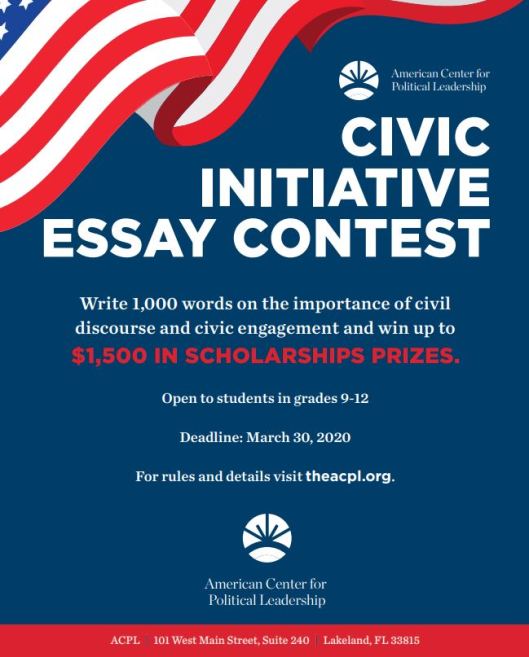
Friends in Polk County, we wanted to take a moment and share with you something that comes to us from our friends and colleagues at the American Center for Political Leadership. The Center’s executive director, former Congressman Dennis Ross, is launching an essay contest open to students in grades 9-12 (and this may expand into other grades next year!). High school students can win up to $1,500 in scholarship prize money with a winning essay.
“The first step to advancing civic engagement is to invite opportunities to get involved,” said ACPL executive director Dennis Ross. “This essay contest allows the next generation of leaders to express their reasoned opinions on the importance being involved in the political process and the need for civil discourse. This generation has the talent and the drive to make this nation better. This essay contest gives them the opportunity to get started.”
Open to high school students who reside in Polk County, the essay contest revolves around promoting civil discourse, civic engagement and civic renewal. Students may enter one essay by March 30, 2020, that answers the prompt, “Why is civic engagement and the need for civil discourse important in our current political climate?”
Ten finalists will be selected to advance to the second round of judging and present their essay to a panel of five judges. On April 30, 2020, three winners will be selected. The scholarship award for first place is $1,500, second place is $1,000 and third place is $500.
The contest will be judged by college professors and community leaders.
This is really a cool opportunity, and allows students to really share why civic engagement matters…and why we need to learn how to TALK with each other.
I am teaching a seminar on the political philosophy of Martin Luther King, Jr. The salient issues include race and racism, peace and violence, the nature of democracy, and the meaning of American history. At the same time, I am personally interested in what it means to treat King as a philosopher and to define philosophy to include what King does.
His words are meant to affect events in the world. Often he reflects on what has just happened. His written and spoken words belong to episodes (such as specific boycotts), campaigns (like Montgomery or Birmingham), and the Freedom Movement as a whole. These episodes and campaigns are expressions of ideas that King puts into words, as do his colleagues in the same movement.
King is often obviously strategic. To name just one example, he says that he “should indicate why” he has come to Birmingham. The answer he gives–he is the president of the Southern Christian Leadership Conference, which has a Birmingham chapter that asked him to come–is not in any respect false. But it is also far from the whole truth. King has good strategic reasons not to write, “We struggled in Albany, GA because the police chief there was savvy and media-friendly and avoided confrontation. His counterpart in Birmingham, Eugene ‘Bull’ Connor, is an overtly white supremacist bully who can be counted on to react violently, and we have rushed here just in time to confront him on national TV before his term in office ends.” This would be part of the truth but would not be smart strategy to say.
A more troubling example is the opening sentence of Stride to Freedom: “On December 1, 1955, an attractive Negro seamstress, Mrs. Rosa Parks, boarded the Cleveland Avenue Bus …” In these pages, King evades the fact that Rosa Parks was a deeply experienced and trained organizer whose main issue had been sexual violence against Black women, which (as he neglects to say) was relevant to the Montgomery Bus Boycott because White drivers harassed Black female passengers. But again, King is being strategic: picking his battles, reading his audience.
King is also prophetic, in a particular sense. The Hebrew prophets don’t have crystal balls and don’t pretend to make forecasts. They admonish their audiences to action. They are prophetic not in the sense of prediction but exhortation; they try to make things true. Thus, when King writes, “the goal of America is freedom,” that is not a description of a trend over time. It is an effort to make freedom become America’s goal. “Human progress never rolls in on wheels of inevitability; it comes through the tireless efforts of men willing to be co workers with God.”
A frequent interpretive question is whether we should take any given argument strictly on its face. For instance, King makes a quick but tight argument for natural law in the Letter from Birmingham Jail. To paraphrase: human beings have certain natural capacities to flourish; a law is just if it “uplifts” those capacities and unjust if it “degrades” them.
Does King believe in natural law? Or is this a strategic move in a letter to pastors? (I would say: both.) This exegetical question doesn’t really matter if you view King as a political leader, but it is important if you want to take him fully seriously as a theorist.
One view of philosophy is that it is all about truth and is carefully distinct from strategic discourse and prophesy (and religious faith). There is a sense in which King is less of a truth-teller than, say, James Baldwin in the same years. He is more likely to think about how a specific audience (including a morally unreliable white audience) will react to his words and tailors them accordingly to produce the results he wants. He is more likely to express ideas that he hopes will prevail in order to make them come true, even though he knows they have not ever yet been true.
On the other hand, all moral and political philosophy is writing (or speech) that aims to affect an audience. It always has outcomes, whether intended or not, and whether in the direction of change or stasis. Like King, Machiavelli and Hobbes wrote for explicit audiences and may have wanted to persuade other audiences implicitly. As Machiavelli addressed the Medici, so King writes a letter to white pastors that he knows will be read by many others.
King is, however, much more thoughtful than most modern professional philosophers are about the ethics of his speech-as-action. (To say that he is thoughtful does not mean he is always right, as the Rosa Parks example indicates). He must be more thoughtful because he bears a far heavier burden. As a leader of a movement of oppressed people, he doesn’t really have “freedom of speech.” He has a responsibility to use his speech effectively under severe constraints. And that makes his texts all the more complex as works of philosophy.
Good afternoon, friends in civics! Florida’s K-12 Chancellor, Jacob Oliva, has released more information on the new 5 million dollar grant for launching a new speech and debate program around civics. This is an exciting time in Florida for civic education as the state looks to provide opportunities for students to really engage deeply in their civic thinking and learning. Some highlights from the memo:
Beth Eskin, formerly of Orange County Public Schools, will be leading the initiative. She is a national recognized debate coach, and a good choice to lead the way on this effort. You can learn more about her here!
The initial goal is to establish new programs in 60 middle or high schools across 30 districts. The ultimate goal is to have a program in every district, middle school, and high school in the state.
This will be an extracurricular program, though the state encourages participating schools to also establish courses in speech and debate.
Participating schools will automatically become members of the National Speech and Debate Association, with access to all that that membership provides.
Funding and resources will be provided to participating schools to cover the cost of travel and competition.
Professional development will be provided to each school’s selected coach to support strong implementation.
Participating districts and schools will be selected by:
Civics and US History EOCA scores
socioeconomic and population demographics
willingness to provide support to grow new programs in this area
If your district is interested in participating, here are the next steps:
1. Identify one middle and one high school in your district that may wish to participate.
2. Share this information with those schools’ principals.
3. Identify 1-2 teachers in those schools who are interested in learning how to coach a
speech and debate team. No prior debate experience is necessary.
4. Provide contact information by March 31, 2020, using this Google form: https://forms.gle/YNDKzouNnwc86EjC7.
Tufts University, Tisch College, Medford, MA – Tufts University
Open Date: Feb 28, 2020. Deadline: May 29, 2020 at 11:59 PM Eastern Time
Description
Tufts University’s Jonathan M. Tisch College of Civic Life will award a Postdoctoral Fellowship in Civic Science for the 2020-21 academic year (June 1, 2020-May 31, 2021). This postdoctoral fellowship is offered in partnership with the Charles F. Kettering Foundation in Dayton, OH and involves some work at Kettering’s offices in Dayton as well as full-time employment at Tufts in the Boston area.
The Tisch College Civic Science initiative (https://tischcollege.tufts.edu/civic-studies/civic-science), led by Dr. Peter Levine and Dr. Samantha Fried, aims to reframe the relationships among scientists and scientific institutions, institutions of higher education, the state, the media and the public. It also asks about the relationships and distinctions among those institutions, historically and today. With this context in mind, Civic Science seeks to…
Reconfigure the national conversation on divisive and complex issues that are both scientific and political in nature, thereby connecting scientific institutions, research, and publications to people’s values, beliefs, and choices.
Define and advance the public good in science, thereby finding ways for scientific institutions to better serve communities and human needs.
Develop curricula that simultaneously attend to scientific and civic issues and that teach students to understand and communicate both kinds of narratives together to a variety of audiences.
Develop approaches to democratic governance that are attuned to the role of the scientific enterprise in society.
Ask what it would mean to earn the trust of communities that have been historically marginalized by the institution of science, and what science would look like if this was a priority.
Intervene at institutional and grassroots levels, alongside a robust theoretical analysis.
A PhD is required. Applicants must also demonstrate a strong interest in investigating the intersections of science and civic matters as the focus of their postdoctoral year.
Civic Science is interdisciplinary, and this fellowship is open to specialists in any relevant field.
Qualifications
A scholar with a Ph.D. in any relevant discipline who is not yet tenured.
Desirable qualifications include, but are not limited to, the following:
A background, degree, or certificate in a STEM –– or STEM-adjacent –– field, OR
Work on strengthening, designing, or evaluating democratic processes, OR
A background in political science or political theory, OR
A background in science, technology, and society (STS), OR
A background in critical theory, media studies, rhetoric, philosophy of science and technology, or science communication.
The ideal candidate may have more than one of these backgrounds.
The Postdoctoral Fellow will attend and participate in the Summer Institute of Civic Studies at Tisch College from June 18-26, 2020. The Fellow will conduct research related to Civic Science, both independently and in collaboration with Peter Levine, Samantha Fried, and the Kettering Foundation. The Fellow may teach or co-teach one course to undergraduates in the Civic Studies Major. The Fellow will attend orientation and research meetings at the Kettering Foundation as requested.
A cover letter that includes a description of your research goals during the fellowship year (which must relate to Civic Science) and courses you would like to offer;
Your CV;
One writing sample;
Three letters of recommendation which should be uploaded by your recommenders to Interfolio directly; and
Teaching course evaluations, if available.
Opens March 1, 2020 and will continue until the position is filled Questions about the position should be addressed to Dr. Peter Levine, Associate Dean of Tisch College at Peter.Levine@tufts.edu.
Non-Discrimination Statement Our institution does not discriminate against job candidates on the basis of actual or perceived gender, gender identity, race, color, national origin, sexual orientation, marital status, disability, or religion. Tufts University, founded in 1852, prioritizes quality teaching, highly competitive basic and applied research and a commitment to active citizenship locally, regionally and globally. Tufts University also prides itself on creating a diverse, equitable, and inclusive community. Current and prospective employees of the university are expected to have and continuously develop skill in, and disposition for, positively engaging with a diverse population of faculty, staff, and students. Tufts University is an Equal Opportunity/ Affirmative Action Employer. We are committed to increasing the diversity of our faculty and staff and fostering their success when hired. Members of underrepresented groups are welcome and strongly encouraged to apply. If you are an applicant with a disability who is unable to use our online tools to search and apply for jobs, please contact us by calling Johny Laine in the Office of Equal Opportunity (OEO) at 617.627.3298 or at Johny.Laine@tufts.edu. Applicants can learn more about requesting reasonable accommodations at http://oeo.tufts.edu/.
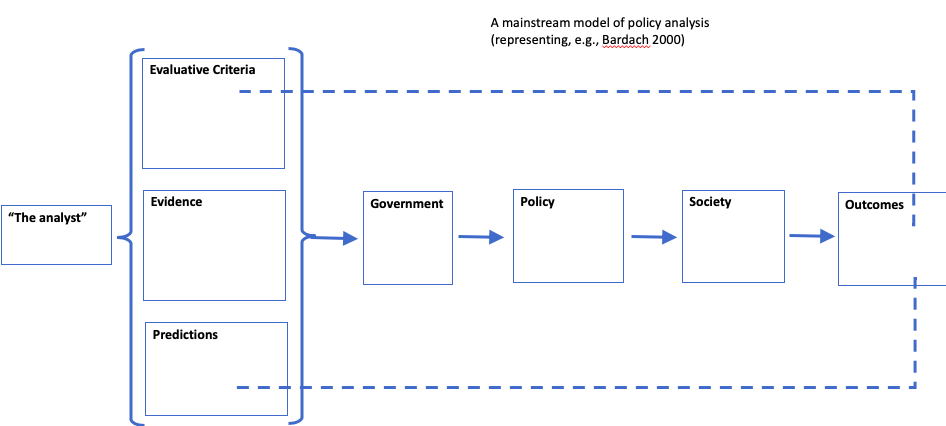
Here is a rather standard model for policy analysis, representing the content of a fairly typical public policy course or a textbook such as Eugene Bardach’s A Practical Guide for Policy Analysis (2000).
The analyst is a professional: a staffer, a consultant, or possibly an elected official. This person assembles evidence, combines it with evaluative criteria (e.g., fairness or efficiency) and makes predictions. The result is advice, probably in the form of a memo or slide deck. Methods for reaching conclusions may include, among others, cost/benefit analysis or sensitivity analysis.
The recipient is an authority: a decision-maker within a government or perhaps someone whose role is like a government’s, e.g., a corporate executive who sets internal policies. Influenced by the analyst, the authority makes policy, which takes the form of taxes or fees, prohibitions and penalties, authorizations, subsidies and rewards, licenses, personnel deployments, etc.
In turn, the policy influences “society.” That is a complex amalgam, but a major component of society is a set of markets that can be affected by governmental policy. As a result of the society’s own dynamics, plus the government’s policy intervention, certain outcomes arise. The analyst had tried both to predict and assess those outcomes (hence the dotted lines), and did a good job if the outcomes turn out to be good.
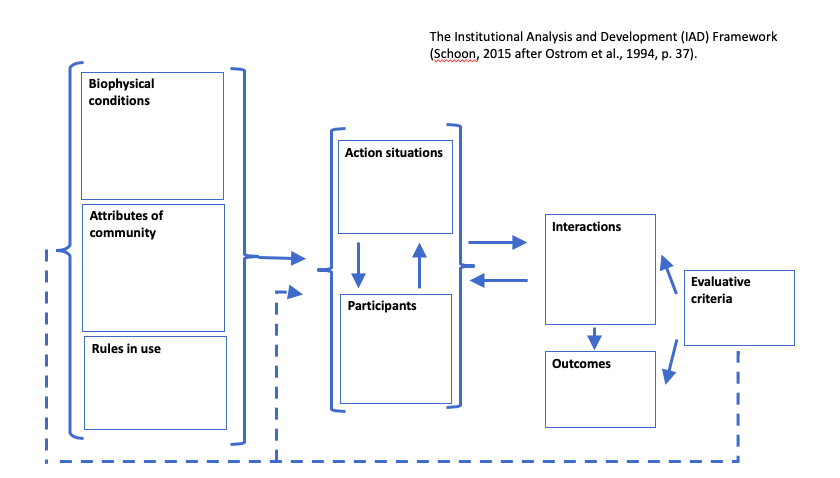
In contrast, here is the model of Institutional Analysis and Development (IAD) developed by Elinor Ostrom and colleagues. I have explained it in more detail before.
To some extent, these two models can be reconciled. For instance, the analyst in the first model collects evidence, some which may be about biophysical conditions (Which medicines work on which diseases?), attributes of community (How equal are people in the population?) and “rules-in-use” (What actual laws and/or norms are people observed to follow?). Evaluative criteria appear in both models.
But the models also differ in some important ways.
Where is the analyst in Ostrom’s model? Perhaps it is anyone who can observe and analyze the institution, including participants in it. In fact, analysts always work within institutions, with their own biophysical conditions, attributes of community, etc.
The first model treats “government” as the major actor, whereas the second sees institutions all over the place. According to Ostrom et al., a government is a set of institutions, but so is the analyst’s agency, the market they’re considering regulating, and even the discussions that generate the evaluative criteria. Whereas the first model is linear–from the analyst to the outcome–the second one is deeply recursive.
Here are some questions to ask about either model, or about any model for analyzing policy:
What is the value of analysis? Specifically, what is the value of relatively professional and trained, yet not hyper-specialized, analysis? What does an analyst know that immersed participants don’t know? What can someone with an MPP contribute?
How should we think about time? In the first model, the whole point is the future. As business school students learn, it’s rational to ignore sunk costs. The only questions are: What will happen if we act in a given way, and is it good? The second model is arguably static, a map of how an institution functions at time-T. But where did it come from? What would change it into an entirely different institution? And for both models: should the past matter?
Whose responsibility is it to decide? Perhaps a “decision-maker” inevitably decides, even if it’s in favor of the status quo. Then perhaps people who are decision-makers should learn to have a mental bias in favor of making decisions and taking responsibility for them. But do you or I have a moral responsibility to be decision-makers?
What is the place of markets in all of this? For Bardach (pp. 4-5) they seem to be the default social form, and governments intervene in them if and when they fail in various ways. Governments, in turn, are not markets: they regulate or affect markets. For Ostrom et al., all institutions involve distinct participants who interact to produce outcomes. Markets involve a certain range of interactions (bargaining, exchange, but also discussion, persuasion, collaboration, and exit). So do other institutions, including governments. There is no sharp difference between a market and a government (or a church, or a scientific discipline, or an online network). The differences are the details in the boxes above.
What is the role of the public, citizens, and public discussions? These are not mentioned in either diagram. For Bardach, citizens emerge as audiences and sometimes as sources of political constraint. The analyst should consider public opinion because it’s too hard to implement advice that is deeply unpopular in a democracy. Those are narrow roles for the public. In Ostrom, everyone is part of a complex, dynamic system. That means there are no sharp distinctions among policy-makers, analysts, and citizens. They all make policy in various ways. But should there be a special role for citizens, as such? And can policy promote that role?
NCDD is thrilled to announce our March Confab Call, which will introduce a new book from John Gastil and Katie Knobloch, Hope for Democracy. This free call takes place Tuesday, March 10th from 2-3 pm Eastern/11 am-12 pm Pacific. Register today to secure your spot.
Concerned citizens across the globe fear that democratic institutions are failing them. Citizens feel shut out of politics and worry that politicians are no longer responsive to their interests. In Hope for Democracy, John Gastil and Katherine R. Knobloch introduce new tools for tamping down hyper-partisanship and placing citizens at the heart of the democratic process. They showcase the Citizens’ Initiative Review, which convenes a demographically-balanced random sample of citizens to study statewide ballot measures. Citizen panelists interrogate advocates, opponents, and experts, then write an analysis that distills their findings for voters. Gastil and Knobloch reveal how this process has helped voters better understand the policy issues placed on their ballots. Placed in the larger context of deliberative democratic reforms, Hope for Democracy shows how citizens and public officials can work together to bring more rationality and empathy into modern politics.
The Confab will give folks a chance to ask questions of Katie and John, and Robin Teater from Healthy Democracy, which convenes the Oregon Citizens’ Initiative Review. Subjects will include the Review itself, American politics and deliberative democracy, research partnerships with nonprofits, and anything else that seems even slightly relevant.
This free call will take place on Tuesday, March 10th from 2-3 pm Eastern, 11 am-12 pm Pacific. Register today so you don’t miss out on this event!
About NCDD’s Confab Calls
NCDD’s Confab Calls are opportunities for members (and potential members) of NCDD to talk with and hear from innovators in our field about the work they’re doing and to connect with fellow members around shared interests. Membership in NCDD is encouraged but not required for participation. Confabs are free and open to all. Register today if you’d like to join us!
Polls usually show that foreign policy is a low-priority issue in US political campaigns. This year is no exception: asked to choose one priority, just 13 percent of prospective voters recently selected foreign policy.
But I think the Iraq and Afghan wars influence Americans in deeper ways. These are not “foreign policy issues,” like how we should address Brexit or North Korea. They represent a wound that hasn’t been treated. The question on people’s minds is not, “What should we do about Iraq?” or even “What should have been done in 2001?” The question underneath people’s explicit thinking is: “What kind of people are in charge of our country?”
After all, the decision to invade Iraq and Afghanistan caused about 60,000 US casualties. (That includes those killed or wounded but not suicides or PTSD cases.)
It is very hard to know how many Iraqis and Afghans have died, because the data are not available and because it’s debatable how much causal responsibility the US holds for the deaths of various combatants and civilians. However, by 2007, 53% of Iraqis were saying that “a close friend or relative” had “been hurt or killed in the current violence.”
The running tab for the two wars is about $6 trillion, which is about 30% of the goods and services that all Americans produce in a year.
And for all this sacrifice and damage, we have lost–failing to attain any of the original objectives of the Bush Administration. Iran has the most power in Iraq; we are negotiating a ceasefire with the Taliban, whom we supposedly defeated in 2002.
For some Americans, none of this may be very salient. But for others, it reflects a deep betrayal by the global elites who sent our men and women into danger overseas. For still others, it is a classic case of American imperialism running amok. Considering the magnitude of the disaster, the debate has been relatively marginal or even submerged. But I think it’s always just below the surface.
Consider the record of these presidential candidates since 2008:
Hillary Clinton: votes for the war, apparently in large part because she, her husband, and other senior members of her own party favored it (not just because of the Bush Administration). She later calls her vote her mistake but still feels qualified to run for president in 2008 and 2016 and to serve as a hawkish Secretary of State in between. Thus she is partly responsible for managing the war after having helped to start it. When she comes before the voters, she loses both times.
Barack Obama: against the war from the outset, not in Washington when it starts, seems to want to wind it down; wins the presidency twice.
Jeb Bush: the presumed front-runner for the Republican nomination in 2016, but his brother launched the wars. Wins 4 delegates in the 2016 primary.
Donald Trump: actually fairly positive about the war when it started, but claims to have been against it, which is consistent with his general attitude that foreign interventions waste American lives and treasure. Beats all the establishment Republican primary candidates and Clinton. In office, battles the national security establishment and generally refrains from deploying US military assets overseas. His record conveys a willingness to spend money on the troops, a reluctance to put them in danger, and a contempt for the top brass. Now he’s in a good position for reelection.
Joe Biden: as chair of the Senate Foreign Relations Committee, he votes to authorize the war. Although he is the former vice president in a popular Democratic administration, he looks likely to lose the current primary.
Pete Buttigieg: he opposes the Iraq War yet serves in Afghanistan–sort of the opposite of the bipartisan elites who started the war without putting themselves in danger. Considering that he’s the 38-year-old mayor of the 4th-largest city in Indiana, he’s done pretty well in a presidential primary campaign.
Bernie Sanders: the only Democratic primary candidate who can provide clear evidence that he was opposed to the war and tried to stop it. This is credible not only because his House vote was recorded but because he has opposed almost all US interventions since the 1970s.
If you believe (as I tend to) that dominant US institutions deserved to be sustained and protected even after the debacle of these wars, then there should have been a much deeper house-cleaning. It’s true that Members of Congress who voted for the war faced a hard choice with limited knowledge and no foreknowledge of the 19 years ahead. Nevertheless, they chose wrong and should have been banished from public life unless they took full responsibility for their own decisions and used their power to prevent anything similar from happening again. You don’t shake off hundreds of thousands of deaths, a $6 trillion bill, and a catastrophic defeat and move on to other topics. National leadership is a privilege, not a right, and if you help cause a disaster, you lose the privilege.
Some Americans never had strong reasons to sustain dominant US institutions. They have now been joined by people for whom the past 19 years provide reasons for distrust–whether they believe that globalist elites have betrayed real Americans or that America is the global bully of the neoliberal era. Although I make no equivalence between Trump and Sanders–they are opposites in character, policy proposals, and commitment to democracy and rule of law–a national campaign between those two is surely a consequence of decisions made by 2003.
It was our pleasure to host our February Confab Call featuring the Hidden Common Ground Initiative! For those who may have missed it, or those who want to refer back, this post has all the important information from the event.
Hidden Common Ground is a joint project of USA TODAY, Public Agenda, the Kettering Foundation, and National Issues Forums. At the heart of the initiative are National Issues Forums in communities and online across the country about compelling public issues: health care, immigration, the economy, and divisiveness. USA TODAY will provide press coverage and commentary, Public Agenda will publish issue-based research, and Kettering Foundation will develop nonpartisan discussion guides. Since there are too few opportunities for Americans to discover their “hidden common ground,” participating in the year-long initiative is vitally important.
The Confab was a wonderful overview of the initiative and opportunities to participate, and it can be found at this link. Our participants asked a whole lot of great questions – if you are curious to see those, you can check them out here. Additionally, the presentation materials can be accessed at this link.
Our sincere thanks to Betty Knighton, Darla Minnich, and Kara Dillard for presenting this session. NCDD hopes we’ll hear about our members participation in this initiative soon!
To learn more about NCDD’s Confab Calls and hear recordings of others, visit www.ncdd.org/events/confabs. We love holding these events and we want to continue to elevate the work of our field with Confab Calls and Tech Tuesdays. It is through your generous contributions to NCDD that we can keep doing this work! That’s why we want to encourage you to support NCDD by making a donation or becoming an NCDD member today (you can also renew your membership by clicking here). Thank you!
I have been teaching two classic examples of civil disobedience or satyagraha—Gandhi’s Salt March and the Montgomery Bus Boycott—to very smart and committed undergraduates. The readings are listed below. As I reflect on our discussions, I’m thinking about two lessons that may not be widely understood today.
First, the objective is not the same as the target. Your objective might be to dismantle white supremacy, but that is not a “target“ because you can’t directly affect it, especially if you are a group of Black citizens of Montgomery, AL in 1955. The bus company is a target because 75% of its riders are African Americans, and you can bankrupt it by boycotting it.
The bus company was not the worst offender against racial equity, even among local institutions. For example, the city’s chief law enforcement officer was a member of the White Citizens Council, which made the police a worse problem than the bus company. But the bus company was a better target because Black people had more leverage over it.
The pitfall is to choose the targets that you can affect even though affecting them doesn’t trouble the worst offenders. I think a lot of left activism in the US since 2000 has targeted city governments and universities, leaving Wall Street unaffected. That is because left activists know how to target cities and colleges, but not how to target Wall Street. On the other hand, you do need targets that you can actually affect. The Montgomery bus boycott and the British colonial police force in India were good examples. They were vulnerable to direct action, and targeting them caused problems for higher authorities.
Second, a social movement is not primarily a protest. In fact, I am not sure that any act of “protest” occurred during the whole Montgomery Bus Boycott, if that means a gathering in a public space to convey a message: a march or demonstration. The Great Salt March was (in fact) a march, but that was not what gave it power. Gandhi got many people arrested for making their own salt and thereby flooded British jails; the Montgomery Improvement Association boycotted a bus company. Both were accomplishments of organization more than expression, although both certainly conveyed meaning to their supporters, their targets, and third parties.
The Montgomery Bus Boycott, in particular, was a matter of getting thousands of Black workers to their jobs every day for many months without using the buses. A protest would have accomplished little. Building an alternative transportation system brought a company to its knees and conveyed a message of power.
Readings
Ramachandra Guha, Gandhi: The Years that Changed the World (2018), chapter 16 (“The March to the Sea”)
Bikhu Parekh, Gandhi, Chapter 4 (“Satyagraha”), pp. 51-62;
Gandhi, Satyagraha (Ahmedabad: Navajivan Publishing Co., 1951), excerpts; and Gandhi, Notes, May 22, 1924 – August 15, 1924, in The Collected Works of Mahatma Gandhi (Electronic Book), New Delhi, Publications Division Government of India, 1999, 98 volumes, vol. 28, pp. 307-310
Karuna Mantena, “Showdown for Nonviolence: The Theory and Practice of Nonviolent Politics,” in Shelby and Terry, pp. 78-110
Martha Nussbaum. “From Anger to Love: Self-Purification and Political Resistance,” in Shelby and Terry, pp. 114-135
Episode 1 of Eyes on the Prize, “Awakenings, 1954-1956”
Charles Payne, “Ella Baker and Models of Social Change“; and Ella Baker, “Developing Community Leadership“
James L. Farmer Jr., Lay Bare the Heart: An Autobiography of the Civil Rights Movement (excerpts)David Garrow, Bearing the Cross: Martin Luther King, Jr., and the Southern Christian Leadership Conference (1986), pp. 105-205.
Taylor Branch, Parting the Waters: America in the King Years, 1954-63 , pp. 11-82
Martin Luther King, Stride Toward Freedom, chapters 3, 4, and 5.Charles Tilly, “Social Movements, 1768-2004“
Marshall Ganz, “Why David Sometimes Wins: Strategic Capacity in Social Movements,” in Jeff Goodwin and James M. Jasper, Rethinking Social Movements: Structure, Meaning, and Emotion (Lanham, MD: Rowman and Littlefield, 2004) pp.177-98.