Apply to the Summer Institute of Civic Studies by Mar. 15

We encourage NCDD members to apply to be part of the 7th annual Summer Institute of Civic Studies this June 15-25, and also to consider attending the 2015 Frontiers of Democracy conference this June 24-25. Both events have institutions in the field that are stewarded by NCDD supporting members Drs. Peter Levine and Nancy Thomas of Tufts University.

I myself am a Summer Institute alumni and have attended multiple Frontiers conferences, and they are both great opportunities to learn and work with many of the nation’s leaders of civic innovation. Find out more below about both  in the announcement below or by clicking here.


Tufts-logo

The 7th Annual Summer Institute of Civic Studies

The seventh annual Summer Institute of Civic Studies will be an intensive, two-week, interdisciplinary seminar bringing together faculty, advanced graduate students, and practitioners from many countries and diverse fields of study.

Organized by Peter Levine of Tufts University’s Tisch College and Karol Sołtan of the University of Maryland, the Summer Institute will engage participants in challenging discussions of such topics as:

  • What kinds of citizens (if any) do good regimes need?
  • What should such citizens know, believe, and do?
  • What practices and institutional structures promote the right kinds of citizenship?
  • What ought to be the relationships among empirical evidence, ethics, and strategy?

The syllabus for the sixth annual seminar (in 2014) is here: Continue reading

Job Opening with the Consensus Building Institute

We want to make sure that our members know about an exciting job opening with the Consensus Building Institute, one of our great NCDD organizational members. We know that some of our NCDDers would be a great fit for the position, so check out the announcement below or find out more here.


The Consensus Building Institute is seeking a talented, experienced and entrepreneurial Senior Associate for our Washington, D.C. office.  CBI is a leading non-profit organization dedicated to empowering leaders around the world to collaborate, negotiate, and resolve conflict. CBI conducts its work in the U.S. and internationally. We have offices and staff in Cambridge, MA, Washington D.C., New York, San Francisco, and Santiago, Chile.

We are seeking a Senior Associate with five to ten years experience in work related to multi-stakeholder problem solving, multi-party negotiations, public policy dispute resolution. Prior employers could include collaborative service firms in mediation, facilitation and multiparty convening, or in related fields such as land use and environmental planning and management, public policy development and analysis, or citizen participation.

If interested, please send a letter of interest and CV to Ronee Penoi at rpenoi@cbuilding.org.
Women and candidates of color strongly encouraged to apply. 

For the full position description visit: www.cbuilding.org/sites/default/files/CBI_SENIOR_ASSOCIATE_JOB%20ANNOUNCEMENT_JAN_2015.pdf.

City of Cambridge Adopts PB, Partners with PBP

We could hardly be more excited to share that yet another city has adopted participatory budgeting and will be partnering with our friends at the Participatory Budgeting Project, an NCDD organizational member. We learned about this great new development from the Challenges to Democracy blog, which is run by the Ash Center for Democratic Governance & Innovation, another NCDD organizational member, and we encourage you to read more about the news below or to find the original article here.


Ash logoIn June, Mayor of Boston Marty Walsh announced the successful allocation of $1 million dollars from Boston’s budget to fund seven capital projects, formulated and proposed by the city’s youth. Boston is one of several cities across the United States to have not only enthusiastically embraced participatory budgeting (PB), but have adapted the concept – for example by extending the opportunity to youth.

Boston has begun to facilitate greater civic engagement and empowerment among its young residents. Its experiment in civic activism is also generating momentum behind PB in another city in the Greater Boston area. The City of Cambridge recently announced that it would initiate its own PB process, in partnership with the nonprofit Participatory Budgeting Project (PBP).

Cambridge City Council member Leland Cheung first introduced PB to Cambridge over two years ago when he learned about its implementation in other cities, but its implementation has been fully embraced by Cambridge Mayor David Maher, City Council, and the City Manager. With the process formally underway, the City Budget Office will continue to handle all matters related to PB.

The city has made available half a million dollars in the FY16 capital budget for city projects.

Whereas Boston’s PB initiative targets residents age 12-25, Cambridge will open its PB process to all residents of Cambridge who are 12 years and older. Jeana Franconi, director of the city’s Budget Office, and her team has scoured the city’s library’s, senior centers, non-profits, schools and youth centers to solicit ideas for proposals. This ideas collection phase – which closed officially on December 31 – will help narrow down city priorities as reflected by resident concerns.

After residents submit ideas, “Budget Delegates” – volunteers at least 14 years old and whom are either a resident or affiliated with Cambridge in some way – will be tasked with transforming the project ideas into concrete proposals to be voted on in March.

Like the Boston PB process, the City of Cambridge envisions PB to be a tool for fostering civic engagement and community spirit. To that end, it has four goals it hopes to achieve through experimenting with PB.

Make Democracy Inclusive. As the Boston case demonstrated, PB brought together stakeholders (e.g., youth) who are not normally invited to participate in the decision making process and emphasized their role in strengthening civil society and enhancing civic engagement. Through expanding and diversifying participation in the decision-making process, the City’s budget is able to better reflect the priorities of stakeholders and preserve their engagement with the city over the long-term.

Have Meaningful Social and Community Impact. Residents are encouraged to submit ideas to the ideas map and other residents are able to “support this project” by clicking on the appropriate link. The city and budget delegates (see above) are able to then collect some data on which projects would generate “meaningful social and community impact.”

Promote Sustainable Public Good. Cambridge has outlined that all project considerations benefit the public, are implemented on public property, and can be completed with funds from one year’s PB process.

Create Easy and Seamless Civic Engagement. The city dedicated several meetings to establishing a steering committee that will lead the PB process (there are 22 current members), articulated themes of inclusion, and sustainable, meaningful impact, and launched its first PB Assembly to encourage community members to brainstorm ideas.

Like Boston’s Youth Lead the Change initiative, Cambridge’s PB project will complement other city programs that seek to encourage civic participation and engagement on the part of all city residents and those who are affiliated with the city. Franconi noted,

PB really ties in to many of the civic engagement efforts the city is involved in. [For example], the Community Development Department recently hosted Community Conversations in several neighborhoods to receive recommendations for the upcoming Citywide Plan.

With regards to young people in particular, Franconi spoke of the city’s Kids’ Council, through which participants travel to the annual National League of Cities conference to represent Cambridge and support youth participation on a national level. Youth involvement in the PB initiative, however, will provide opportunities for direct impact on the city’s most relevant needs.

Cambridge will begin its evaluation phase in April, but has already reflected on a few lessons as outlined by Richa Mishra’s piece on the promises and pitfalls of PB. In particular, Mishra’s emphasis on “process backed by results” should resonate with any local government attempting PB. The temptation to seek quick results over preserving the fidelity to process has, as she asserts, a deleterious effect on participation and ownership. Likewise, if process is emphasized at the expense of meaningful moves towards achieving results, participants could become disillusioned that their voices will not make a difference.

Franconi recognizes this inherent tension in the decision making process, and believes the city has still a lot to learn about the nature of PB. For one, Cambridge will initiate the next year’s PB process in the summer rather than the fall to fully capture citizen participation in every stage—from ideas collection to voting on the proposals—and to give residents more time to digest their responsibilities and sense of civic duty.

As the city designs its evaluation strategy, Hollie Russon Gilman, PhD, an expert on U.S.-based PB initiatives, further recommends that “civic experiments and civic innovations like PB need room to grow, evolve, and engage people. At times privileging initial indicators, over social impact, has the potential to stifle early process creativity.”

In the meantime, the city has achieved some incremental wins. It has opened up multiple avenues for participation (i.e., steering committees, online map tool, volunteering as a budget delegate or facilitator). Additionally, “a strong online and social media presence has helped tremendously,” Franconi asserts. “It has allowed us to do more outreach and canvassing to our underserved populations.”

As of this writing, Cambridge is on target with its proposed timeline. Over 380 ideas have been submitted to the online ideas map. To move forward with the formulation of concrete proposals, Cambridge hosted a Budget Delegate training on January 6 and will host a Volunteer Facilitator Training on January 10. For more information on how to get involved, please click here.

You can find the original version of the is piece on the Challenges to Democracy blog at www.challengestodemocracy.us/home/cambridge-is-next-u-s-city-looking-to-foster-engagement-with-participatory-budgeting/#more-1413.

NCDD Director to Speak at Personal Democracy Forum 2015

We want NCDD members to know about Personal Democracy Forum 2015, a cutting-edge event being hosted by Personal Democracy Media this June 4-5 in NYC. PDF will bring together a diverse group of changemakers, and we’re excited to say it will feature NCDD’s director Sandy Heierbacher as one of the featured speakers. Early bird registration is as low as $350, but it ends Jan. 30th, so register ASAP!

Learn more in the announcement below or by visiting www.personaldemocracy.com/conference.


Personal Democracy Forum is the definitive event in the world of technology and politics. PDF brings together a thousand top opinion makers, political practitioners, technologists, and journalists from across the ideological spectrum for two days to network, exchange ideas, and explore how technology and wired citizens are changing politics, governance, and civil society.

We’ve already confirmed these amazing speakers, global leaders and innovators at the cutting edge of technology, politics and social change:

  • Sunil Abraham – Executive director, Center for Internet & Society, Bangalore
  • Cory Doctorow – Author and blogger, BoingBoing
  • Harold Feld – Senior vice president, Public Knowledge
  • Tristan Harris – Design ethics and product philosopher, Google
  • Nanjira Sambuli – Research manager, iHub Nairobi
  • Sandy Heierbacher – Executive director, National Coalition for Dialogue and Deliberation
  • Astra Taylor – Author, “The People’s Platform”
  • Zephyr Teachout – Professor, Fordham Law School

If past years are any indication, we’ll have a full house, because there’s no other event that gathers the transpartisan community of change­makers and doers that comes to PDF. And our “early ­bird” rate is our absolute best price­­, so act now and save!

Help NCDD Explore a D&D Youth Leadership Initiative

Some of you may have heard already on our Discussion Listserv that, as part of our continued commitment to cultivating “democracy for the next generation,” NCDD’s director Sandy Heierbacher asked me to help conduct a scoping project to explore what possibilities there are to potentially launch a youth leadership /emerging leaders program within the NCDD network.

IMG_7985We are already collecting input from NCDD’s student and young professional members (young folks/students, share your input on our survey for a chance to win $50, and write to me at roshan@ncdd.org to join our youth conference call Jan. 25th at 7pm ET!) , but we are also looking for ideas and suggestions from the broader NCDD community on the big picture questions of:

  1. How you think NCDD might best support students and young people who are interested in or want to be involved in the D&D field? And,
  2. What role would you want to see young people who are part of NCDD playing in the Coalition? What kinds of contributions could you imagine them making and/or see the network supporting them to make?

So we are looking to start a discussion here on what you think NCDD as an organization and as a community could potentially do to cultivate more opportunities for and leadership from young people – who are the next generation – in our field.

We are open to hearing any and all of your thoughts on these bigger questions for our field. And to help get the conversation started, we also want to invite you to think about a few more specific questions:

  • What do you think is THE most important and/or effective thing that NCDD and the D&D community could do to support you getting more involved in the D&D field?
  • What other programs, schools, organizations, etc. do you know of that already are doing a good job getting young people involved in D&D work? What are others doing that we could learn from or build on?
  • Is there anything else that NCDD and the D&D community should do, change, keep in mind, and/or work on to support youth and student involvement and leadership in this field?

We know there are a lot of possibilities for potentially creating more programmatic or organizational supports for young people looking to join the D&D field, and thinking together with our brilliant NCDD members is a great way to unearth some of the best of those potentials.

We hope that you will take a few moments to contribute your input to our ongoing exploration in the comments section below. We hope to harvest the ideas that this discussion generates by the end of the month, so please chime in soon!

Thanks so much for all that you do, and of course, thank you for continuing to support NCDD!

Evaluation & Collective Impact Workshops from Tamarack

We want to make sure NCDDers know about two great workshops on evaluation and collective impact being offered this winter by the good people at Tamarack, an NCDD organizational member. We encourage you to read their announcement below or find out more at www.tamarackcommunity.ca.


As you plan your winter learning schedule, we invite you to two of our signature 3-day workshops that are designed to advance your work in community change.

Both of these workshops were completely oversubscribed in 2014, so we encourage you to register or Hold a Seat for these workshops today.

Evaluating Community Impact: Capturing and Making Sense of Outcomes

Liz Weaver and Mark Cabaj are leading the ever-popular Evaluating Community Impact workshop in Toronto, ON from February 23-25, 2015Each year, they carefully incorporate new tools and trends into the curriculum to ensure you are getting the latest and greatest information about how to capture, evaluate and communicate impacts in your community.

Recent upgrades to the Toronto curriculum will include:

  • How to employ hard and soft data to measure progress
  • New methods for capturing “systems change”
  • How to use narratives to communicate community impact to others

For a closer look at the workshop agenda, please visit our event agenda page.

Click here to Register or Hold a Seat for the workshop

Champions for Change: Leading a Backbone Organization for Collective Impact

Champions for Change is an advanced training offered by the Tamarack Institute in collaboration with FSG Social Impact Consultants and will be held in Calgary, AB from April 15-17, 2015.

Plenary sessions and workshops will be led by John Kania and Fay Hanleybrown of FSG, as well as Liz Weaver and Paul Born from the Tamarack Institute. Topics that will be presented include:

  • Deeply understanding the roles and impact strategies of the backbone organization
  • Developing and learning from shared measurement
  • Community engagement to build the will of your community
  • Making collaborative governance effective
  • Sustaining funding for collective impact over the long term
  • Working in complexity and the importance of adaptive leadership
  • Getting to true impact and systems change

For a closer look at the workshop agenda, please visit our event agenda page.

This dynamic learning experience is an important step for staff of Backbone Organizations and steering committee members of collective impact initiatives to develop their capacity as collaborative leaders.

Click here to Register or Hold a Seat for the workshop

Special rates are available for both workshops for teams registering three or more people. Please feel free to contact Kirsti if you have any questions.

We look forward to hearing from you and we hope that you’ll join us for these workshops for insightful learning and an opportunity to foster meaningful connections.

ALA Midwinter Meeting Includes Engagement Meetup

The American Library Association (ALA) has been focusing increasingly on community engagement and using libraries as spaces for civic dialogue recently. As part of that work, they sent out an invitation to a reception of engagement professionals during their 2015 Midwinter Meeting. We encourage NCDD members to read the invitation below and learn more about ALA at alamw15.ala.org.


An invitation for those of you attending ALA’s 2015 Midwinter Meeting:

Are you an expert in engaging your community? Or do you simply want to be? Join ALA’s Public Programs Office for a Libraries Fostering Community Engagement Reception at the 2015 Midwinter Meeting.

The gathering will be held from 5 to 6 p.m. on Saturday, January 31, at the Hyatt Regency McCormick Hyde Park/CC 11A (on-site at the convention center). Connect with like-minded library professionals at this informal networking reception. Share your ideas, vent your frustrations, and hopefully walk away inspired.

Light refreshment will be served.

Please add the event to your Scheduler at the following link so we can know how many people to expect: http://alamw15.ala.org/node/26873

If you have any questions, please contact Brian Russell at brussell@ala.org. Look forward to seeing you there!

This event is sponsored by the ALA initiative Libraries Transforming Communities (ala.org/LTC).

A Participant’s Reflections on NCDD 2014

We were so appreciative of the reflections on our 2014 National Conference on Dialogue & Deliberation that NCDD supporting member Cynthia Kurtz shared on her blog that we wanted to share them here on ours. There are great lessons she took away that all of us can learn from, so we encourage you to read her piece below or to find the original version here.


What I Learned at the NCDD 2014 Conference

So I’m back from my first real conference in ten years, and I learned a lot. This is the conference I mentioned a few blog posts back, of the National Coalition for Dialogue and Deliberation.

NCDDers-with-signs-borderThe first thing I learned was: I’m ten years older than I was ten years ago. Conferences have always been exhausting, but this one felt like a strange dream in which crowds of faces surged and receded while I surfed on crests of … of … lots of stuff. However, I survived; I have vague memories of the event; and I have some things to tell you.

Natural story workers

One thing that surprised me at the conference was how many people there do story work. Only a few people said they do story work, but a lot of people worked with stories in some way, while they were trying to get people to understand each other.

My initial reaction on pointing this out to myself was, “Sure, but they don’t really do story work. It’s not as intense or authoritative or authentic or deep or….” And in the midst of trying to justify myself to myself, I realized that I may be on my way to becoming pompous.

Do you remember the thing I’m always saying about how the best storytellers are the people who don’t realize they are telling stories? About how, once people begin to be proud of the quality of their storytelling, the quality of their storytelling declines? I’m starting to wonder if there is a parallel process in doing story work. Maybe the best story workers are people who work with stories without knowing it. Maybe, over the years, I have become not only a story performer but a story-work performer as well. I’d like to think I have passed through the story-work-performer state into a state of deep wisdom, where I have become both natural andskilled; but, alas, I find that my skills of denial cannot rise to the challenge of this assertion.

Solutions to pomposity and story-work performing I can come up with include the following.

  1. I could stop doing this work for a while – six months or longer – and see if the pomposity goes away. However, this is not an option, because I still have many promises to keep.
  2. I could keep reminding myself that I am not the owner of anything (except my good name) and that many people have had great ideas about story work. But I’ve been doing that all along, and it doesn’t seem to have saved me. No, humility alone is not enough. I need to take positive action.
  3. I am always encouraging people to share stories. So why don’t I encourage myself to share story work? If I can make a conscious effort to recognize, respect, and connect with the story work other people are doing – even if they don’t call it that, or maybe especially if they don’t call it that – I can regulate myself to open my mind to all forms of story work. I’ve done some of this in the past, but honestly, I’ve done far less than I could have done.

Number three is my new plan. One part of the plan is the “translation dictionary” idea, which I think I mentioned here before. This idea is to develop a set of (relatively brief, don’t worry) writings about how PNI connects to as many fields and approaches and methods as I can possibly find. Before I went to the NCDD conference, I thought I should build a translation dictionary because it would be helpful to you. Now I think I need it even more than you do.

My least-favorite assumption is still alive and well

I am sorry to tell you that the “story work means telling stories” assumption is still going strong. People are still very little aware of natural, everyday story sharing and the functions it provides in society and in communities and organizations. When people talked to me about ideas for using stories in their work, their first impulse was always to talk about how they might use stories to communicate with the public — i.e., to tell stories.

I don’t ever want to minimize the function of storytelling as purposeful communication. It is reasonable and laudable to convey essential messages through stories. However, if this is the only thing people think they can do with stories, or get from stories, that’s a sad thing. Because using stories to communicate is just the tip of the iceberg of what stories can do for a community or organization (or society). Those of us who care about stories have more work to do to get that word out.

It’s getting crowded in here

In More Work with Stories, I connect PNI with nine other fields. But I have been realizing lately that I could probably connect it with ninety, if I broadened the scope to methods and approaches as well. Getting involved with the NCDD has helped me to learn that I have been hiding in a hole in terms of the many ways people have developed to help people make sense of things together. Just because a method doesn’t say anything about stories doesn’t mean it doesn’t have anything to do with stories. If it has to do with people and communication, it has something to do with stories.

For example, as part of my NCDD learning, I recently bought The Change Handbook, which describes 61 methods for helping people create positive change. Can you guess how many of those 61 methods I was familiar with before I found the book? Eleven. Why have I not been building more connections? (Because I’ve been writing a book, that’s why; but still.) Now I want to know: How does PNI connect with the World Café? The Art of Hosting? Dynamic Facilitation? Wisdom Circles? Bohm Dialogue? Open Space? Systems Dynamics? Charrettes? Non-Violent Communication? Future Search? And so on.

This universe of connections is yet another reason to build a translation dictionary. I had been thinking about the dictionary as a way for people to understand PNI, and above I described it as a way I could share story work more completely. But a translation dictionary could also help people move back and forth between PNI and a variety of other methods as they build the suites and composites that best fit their contexts and purposes.

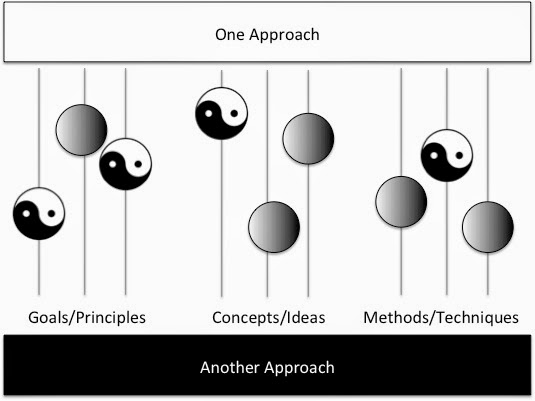
I started thinking through what a template for a translation dictionary might look like. I came up with this process:

  1. Summarize each of the two approaches with a paragraph or two. (One will always be PNI, but I’m trying to be general.)
  2.  Look for pairings in each of three areas: goals or principles; concepts or ideas; and methods or techniques. Come up with at least one and at most three pairings in each category.
  3. For each pairing, decide whether it’s a similarity or a contrast. If it’s a similarity, describe how the two elements are similar, and how they are (subtly) different. If it’s a contrast, describe how the elements differ, and how they are (subtly) similar or at least complementary.
  4. For each pairing, describe how it might be used in practice to combine what is best in the two approaches.

I visualize the whole pattern as something like this:

…where the grey circles indicate similarities, and the yin/yang symbols represent contrasts. Here I have vertical circle placements showing the relative centrality of each element to each approach, but that might be too fussy. I like diagrams, but I know some people would not get much out of the extra visual information.

So as I thought about this template, I realized that I had seen something similar before. What I was creating looked a little like a template for a pattern language. You could even say that my categories of goals, concepts, and methods are like the pattern language elements of context, problem, and solution.

Here’s a question for you: Everybody loves pattern languages, and rightly so, but why do we have to stop there? Could there be more kinds of languages than just of patterns? What about connection languages that, instead of describing patterns, describe connections? Might pattern languages, which are typically used within approaches (or transcending approaches), contribute to a lack of sharing among approaches? Maybe pattern languages could connect to connection languages, so that you could follow links from inside a particular approach, through its connection language, and into the pattern languages of other approaches.

What if lots of people made connection languages? What if, someday, it would be considered uncool to talk about one’s approach without also showing one’s connection language? What if connection languages were printed on cards, and people could use them to brainstorm about ways they could combine different approaches and methods to get results for their communities and organizations? What if, instead of going shopping for isolated approaches, groups could find the best combinations of methods and ideas for their contexts and purposes?

These are just wild speculations, and some might not agree with them. My plan right now is to make a start on my own connection language, using a template like the one above (which will evolve), and fold it into the second book. If you are interested in the idea of connection languages and want to work with me, or do something similar, let me know.

The great benefit of being in the wrong place at the wrong time

I went to the NCDD conference pretty much by accident. A champion of my book told me that he was going to the conference and planned to tell people there about my book. I said, hmm, what’s this, and if people there might like my book, should I think about going too? I had been thinking that I could start going to conferences again, now that my son is old enough that I can (stand to) leave home for a few days. So I joined the NCDD and signed up. (Sadly, my champion was not able to go due to a family emergency.)

Ending up in what seemed to be the wrong place at the wrong time was a revelation. Even though I might never have chosen this conference without someone else planning to go there first, it was just the right conference for me to go to. I have long complained about how there are no good story-listening conferences to go to, how people who do the work I do have to show up as beggars at knowledge management and decision support and management conferences. But I’ve now come to realize that this poverty is a strength in disguise.

I would have learned so much less at a conference where everyone already knew what I had to say, and where I already knew what everyone else had to say. It is so very mind-expanding to go to a conference you feel like you have no reason to go to! In fact, I am now resolved to seek out conferences that have as little as possible in common with what I have done before. If I will not be hopelessly lost and over my head, I should not go. If you know of a conference I should not go to, please let me know about it!

Essential energy

What excited me most about this conference was that I was able to connect with people who shared my passion for helping people get along and create better futures together. I sometimes feel alone in what I do, like nobody cares if we stop telling each other stories, like people are content to see stories used only to manipulate and influence. Our nascent PNI Institute is building a new community in the story space, so that’s changing already. But the people I met at the NCDD conference really cared about participatory democracy; about inclusion; about bringing power to the people; about bridging divides; about finding better ways forward. They didn’t consciously work with stories for the most part, but they cared about the things I cared about. Is this my tribe? I’m not a one-tribe person; I like to flit among several tribes. But this might be one of them.

The rest of the story

I have placed my full conference notes here for those who would like to read about what went on (that I saw) at the conference.

My favorite quotes from my conference notes:

  1. Where do you find the public voice? It’s not a trained voice. We hear it every day in every place. In waiting rooms, in bars, around water coolers, in lines at the grocery stores. It is all around us. So why is it unavailable? Because we don’t recognize it for what it is. It is too ordinary.
  2. There is no them once you know them.
  3. It’s healing for people to experience people with other beliefs just listening to them.
  4. Polarization is the antidote to American ingenuity.
  5. Deliberation by itself is not nearly enough when big systems have strong tendencies, and when a merciless climate clock keeps ticking. It is not just an absence of public voice, but strong structural problems. There needs to be an ongoing critical conversation about what our world needs.
  6. We need real human experiences, and a non-judgmental, non-politicized space to describe experiences.
  7. Instead of coming to agreement, we can take the need to agree away and simply try to understand each other. If you do that, it is easier to understand, and you get to deeper issues.
  8. We need to listen to each other in an open-hearted way. We need to have collaborative solutions that have the possibility of going to the next level of facing big issues.
  9. We learn from breaking things, making mistakes, trying to do things when we don’t know how. A game is like that: a challenge you need to approach via play. People know how to play games. If we want to make it accessible, we have to draw on things they know. Drawing on inherent forms of communication and action works.
  10. Giving people a voice ensures that justice and peace aren’t just about fighting each other. It’s the fact that people can work out their issues on their own. Justice will come about because of a common sense of peace.
  11. We have the world’s greatest renewable resource: creativity.

Hooray for creativity! And for collaboration.

You can find the original version of Cynthia’s post on her Story Colored Glasses blog at www.storycoloredglasses.com/2014/10/learnings-from-ncdd-conference.html.

Officials’ Public Engagement Fears & 3 Reasons to Overcome Them

We want to share a great piece from our partners at Public Agenda – one of our NCDD organizational members that helped sponsor NCDD 2014 – that highlights some of the fears about public engagement that government officials shared during a workshop hosted by the Participatory Budgeting Project, another NCDD organizational member, at this year’s gathering of the National League of Cities. You can read how PA responds to such concerns – and get ideas for how you can, as well -in the post below.

We thank Public Agenda for their continued support of NCDD and for their leadership in the field, and we encourage you to read their piece below or find the original by clicking here.


Three Ways Deeper Engagement Improves the Relationship Between Officials and Residents

PublicAgenda-logoby Allison Rizzolo

Our local public officials are thirsty for better and deeper ways to engage the people they serve. This is a sentiment I heard again and again during last month’s National League of Cities Congress of Cities in Austin.

The sentiment was cast in sharp relief during a workshop on participatory budgeting that I attended as part of the conference. Our partners at the Participatory Budgeting Project (PBP for short) presented to a variety of elected and appointed officials from cities across the country.

Participatory budgeting is a process through which residents are active partners in local budget decisions. We are partnering with PBP on research and evaluation of participatory budgeting processes in communities across the country.

During the workshop in Austin, PBP’s Josh Lerner and Maria Hadden provided participants with practical tools and training to launch participatory budgeting in their communities and better engage their constituents in local budget decisions.

Josh and Maria opened the workshop by asking participants about the barriers to constituent engagement that they face in their communities. Participants also talked about what they were hoping to get out of the conference to address those challenges. This conversation revealed a number of difficulties that local officials share when it comes to engaging their constituents in better and deeper ways, regardless of the size or demographics of their city, town, or county.

The concerns officials at the workshop named included:

  • Civic participation is currently quite low. How can we get more people to show up or weigh in? And how do we get them to do so thoughtfully?
  • City council meetings are boring. We need livelier, more energetic ways to bring the public into decision making.
  • Interaction between officials and the public, at city council meetings for example, can often be resentful, angry, or filled with drama. Media depictions of these events don’t help. How can we keep interaction constructive?
  • Past frustration on the part of constituents stands in the way of current relationship-building and future progress.
  • How do we increase participation while making the best use of our time, energy, and money?

While these concerns may be anecdotal, we heard similar sentiments in a 2012 survey we conducted of local public officials in California. For example, survey respondents told us they saw most residents as not well informed about the issues affecting their communities. In fact, 72 percent said community members do not keep abreast of the issues that affect their community’s well being. Nearly 7 in 10 said that community members have become much angrier and mistrustful of local officials in recent years.

It’s no wonder healthier, deeper engagement with constituents seems a monumental task to officials.

Sure, deep, thoughtful and authentic engagement of constituents may not be easy. But these forms of engagement, through methods embraced by Public Agenda, the Participatory Budgeting Project, and our peers, can contribute to a more informed citizenry and stronger communities.

Better engagement improves the relationship between officials and their constituents in many ways. Here are three:

Constituents become more thoughtful and informed.

Both Public Agenda and the Participatory Budgeting Project embrace deliberative methods for public participation that, by their nature, help foster a more educated and thoughtful body of voters. Let’s take Choicework discussion starters, a resource that Public Agenda has created and used to structure dialogue for decades.

Choiceworks present people with a range of different approaches to solving a problem, from a variety of perspectives. We take care to also illuminate the values, interests, pros and cons inherent in each choice. Choicework dialogues help people acknowledge that there are no simple answers but many valid perspectives. They also foster a more collaborative, open-minded attitude, instead of the adversarial one we too often see in political discourse.

In the participatory budgeting process, residents develop ideas for spending a set amount of the local discretionary budget. Then they vote on proposals based on these ideas, forcing them to reckon with competing priorities and a limited budget. After the votes are tallied, the local government implements the top projects.

By obliging participants to confront limitations and prioritize options, both the Choicework and PB processes help people understand the tough decisions and trade-offs that local officials face when making decisions. Having a personal stake and role in decision making also fosters a sense of stewardship among participants – they end up having a greater concern for and interest in public issues.

Engagement builds trust and promotes equity.

One way to build – or rebuild – trust is to ensure that communities who haven’t had a seat at the table in the past receive one. Broad and diverse participation beyond the “usual suspects” is a key principle of deep engagement.

Public Agenda often works with local governments and community-based organizations to help them undertake a community conversation process. We work with officials and organizations on recruitment so that the demographics of participants resemble the communities they come from. In particular, we strive to bring low-income communities, communities of color, non-English speaking communities and immigrant communities into the process.

In addition to active recruitment, simply making a meeting more interesting and participatory goes a long way in increasing and broadening participation. In participatory budgeting, because residents are invited to directly weigh in on ways to improve their own community – repaving the basketball court on the next block over, buying more tables for the cafeteria at the school their child attends, installing better lighting on their sidewalks – they’re more likely to participate. The process is just more interesting because it’s personal and interactive!

And it draws underrepresented communities in. In New York City, a much higher proportion of low-income residents participated in the Participatory Budgeting process than in the traditional election. Almost 4 in 10 participatory budgeting voters reported household incomes below $35,000 per year, compared with 21 percent of 2013 local election voters.

Engagement saves costs and effort.

Naturally, public officials are concerned about the return on investment for their time, resources and money. Will I actually be able to reach more constituents? How much will it cost me?

Processes that engage constituents in meaningful ways, as partners in decision making rather than as consumers of decisions already made, take a lot of time and effort up front. Over the long run, however, they are well worth it.

During the conference workshop in Austin, Josh of PBP identified two concrete ways in which he has seen the participatory budgeting process pay off for local officials. First, creating more transparency around budgeting can stimulate greater efficiency and cost savings. When they’re helping to make budget decisions, residents may be willing to explore ways to get more bang for the buck and are more likely to collaborate on cost savings rather than complain.

Secondly, bringing residents into the decision making process from the beginning can prevent officials from funding projects that the community doesn’t actually need, or projects that face pushback. Instead, community members decide together their needs and prioritize accordingly.

A lot of times public officials may feel as though the struggles they are facing are unique to their context. My experience at the participatory budgeting workshop demonstrated that, regardless of the characteristics and demographics of their localities, local officials share many similar challenges.

Engaging constituents more deeply may seem daunting, but rest assured you are not alone in facing this challenge – we can help.

You can read the original version of this PA piece by visiting: www.publicagenda.org/blogs/three-ways-deeper-engagement-improves-the-relationship-between-officials-and-residents.

Public Engagement Training from Annette Strauss Insitute Feb. 25-27

We hope that NCDD members will take advantage of a great public engagement training being offered this February 25th-27th by the Annette Strauss Institute for Civic Life – one of the NCDD organizational members who partnered with us to sponsor NCDD 2014. The early bird registration deadline for the trainings is January 30th, so make sure to register ASAP!

NCDD would like to thank the Annette Strauss Institute for their continued support of our work and for their leadership in the field. You can learn more about the training from ASICL’s announcement below or by clicking here.

Facilitating Civic Dialogue and Consensus Seminar

ASI_horiz.spotAre you often in a position where you’re making decisions that affect large populations?  Do you frequently feel political pressure from multiple directions?  Do you feel as if you are often unsure of what the public wants, or perhaps you only hear from the same, small group of citizens?

The Annette Strauss Institute for Civic Life at The University of Texas at Austin is offering a 3-day seminar that will help you develop the knowledge and skills you need to enrich your engagement with the public. Join us to boost your skills on:

  • Creating customized strategies for engaging the public;
  • Facilitating difficult conversations involving competing viewpoints;
  • Bringing an array of stakeholders to consensus; and,
  • Utilizing innovative technology for public engagement.

This seminar will help you develop the knowledge, tools, and skill sets to enrich your engagement with the public.  You’ll learn how to identify stakeholders and create customized strategies for engaging them; how to facilitate difficult conversations involving competing viewpoints; and how to bring an array of stakeholders to consensus.  You will also examine some of the most cutting-edge technology for public engagement.

Register for the 3-day training or just one module!

Module One – Wednesday, February 25, 2015
Powerful, Productive, and Prudent: A New Paradigm for Public Engagement + Technology and Civic Engagement.

Module Two – Thursday, February 26, 2015
Designing Civic Engagement Processes

Module Three – Friday, February 27, 2015
Dealing with Difficult Civic Topics and Stakeholders

For more information on this the training or to register, please visit http://moody.utexas.edu/strauss/public-engagement-training.