Ash Innovations Award for Public Engagement in Government

We recently heard from NCDD supporting member Archon Fung of Harvard’s Kennedy School of Government about an exciting new award for public engagement that we wanted to make sure our members knew about. The award is aimed at helping effective engagement practices grow and develop, and we hope some of you will apply. You can read more about the award below or find more information at www.innovationsaward.harvard.edu


APPLY FOR SPECIAL $100,000 AWARD IN PUBLIC ENGAGEMENT AND PARTICIPATION

Ash logoHarvard Kennedy School invites you to apply for the Roy and Lila Ash Innovations Award for Public Engagement in Government.

Administered by the Ash Center for Democratic Governance and Innovation at Harvard University’s John F. Kennedy School of Government, the Innovations in American Government Awards are given to programs that serve as examples of creative and effective government at its best.

This special Innovations Award will recognize government-led innovations that demonstrate novel and effective approaches to increasing public engagement and participation in the governance of towns, cities, states, and the nation. Applications are welcome from citizen engagement and participation programs, policies, and initiatives that encourage or expand public participation and promote collaborative problem-solving in government.

All units of government—federal, state, local, tribal, and territorial—within the United States, along with their partners, are eligible to apply.

The winner of the Roy and Lila Ash Innovations Award for Public Engagement in Government will receive a $100,000 grant to support replication and dissemination activities.

Applications and additional information for this special award and for the broader Innovations in American Government Awards are available now on the application website:  www.innovationsaward.harvard.edu.

Applications are due by June 20, 2014, so don’t delay!

Important 10-question survey for NCDD volunteers and contractors

To all members of the NCDD community:

With our small staff and modest budget over the years, we’ve always relied on NCDD members to step forward as volunteers to plan the national and regional conferences, organize our online events, host our book clubs, contribute content to the website, create videos, provide each other with advice, and so much more.  We are a Coalition after all, and that’s part of our culture.

I hope you’ve noticed that NCDD has a lot going on these days — now more than ever before, from my vantage point. We have our new member map and directory, regular confab calls and tech tuesdays, lots of rich collaborative projects like Creating Community Solutions (the national dialogue on mental health project) and the CommunityMatters partnership, a news blog that keeps getting better and better.  And we want to keep up this momentum as well as the high quality of our activities and products.

NCDDSeattle-GRs-borderWe’re looking to create a go-to list of NCDD members we can tap into when we need volunteers — and when we have opportunities to contract with NCDD members.

There are many opportunities on the horizon for you to participate more deeply in NCDD.  We’ll need researchers and report writers, people who can theme and summarize the best listserv conversations and blog threads, people who can help us do systems mapping and geo-mapping, people who can interview leaders in the field for the blog, collect mini case stories for the Dialogue Storytelling Tool, share their own stories and cases, do graphic recording, help manage our social media accounts, and so much more.

Some tasks will be volunteer tasks, of course, but some that require a greater time commitment or a specialized skill set will be compensated.

If you’re interested in volunteering or contracting with NCDD in the coming months and years, please take a few minutes and fill out the 10-question survey that’s up at:

www.surveymonkey.com/s/ncdd-rolodex

This survey will help us develop a rolodex of great members who are willing to be contacted about volunteer and paid opportunities that arise, based on your skills, experience and interests.

Request your free copy of David Mathews’ new book The Ecology of Democracy

Our friends at the Kettering Foundation are offering to send complimentary copies of David Mathews’ new book out to anyone in the NCDD community who requests one.

Ecology-coverAs you may know, David Mathews is president of the Kettering Foundation and former Secretary of Health, Education, and Welfare in the Ford administration. I know him personally, and he’s an extremely kind, thoughtful, intelligent, and humble guy.

The Ecology of Democracy: Finding Ways to Have a Stronger Hand in Shaping Our Future is for people who care deeply about their communities and their country but worry about problems that endanger their future and that of their children. Jobs are disappearing, or the jobs people want aren’t available. Health care costs keep going up, and the system seems harder to navigate. Many worry that our schools aren’t as good as they should be. The political system is mired in hyperpolarization. Citizens feel pushed to the sidelines.

Rather than giving in to despair and cynicism, some Americans are determined to have a stronger hand in shaping their future. Suspicious of big reforms and big institutions, they are starting where they are with what they have.

From the introduction:

This book is about people who are trying to help our country realize its dream of democracy with freedom and justice. However, they would never describe themselves that way: it would be far too grandiose. They would just say they are trying to solve a problem or make their community a better place.

This book is also for governmental and nongovernmental organizations, as well as educational institutions that are trying to engage these citizens. Their efforts aren’t stopping the steady erosion of public confidence, so they are looking for a different kind of public participation.

The book is divided into three sections — Democracy Reconsidered (Part I), Citizens and Communities (Part II), and Institutions, Professionals, and the Public (Part III).  It is chock-full of ideas about how the work of democracy can be done in ways that put more control in the hands of citizens and help restore the legitimacy of our institutions.

The 230-page book can be ordered from the Kettering Foundation here for $15.95. A 16-page preview is also available as a free download.

To get a free copy of the book mailed to you, send an email to customerservice@ait.net with your mailing address and a note that you’re affiliated with NCDD.

Introducing our fabulous youth organizers for Text Talk Act

Creating Community Solutions is pleased to announce that we’ve teamed up with Active Minds, Lady Gaga’s Born This Way Foundation, and our other partners (NCDD is one of them) to identify some fantastic young people across the U.S. who will be helping organize Text Talk Act events in their communities.

We asked them to send us selfies, and you can check out their brief bios here.

Young_People_borders

Hopefully you already know all about Text Talk Act from our previous postings and recent confab call on the project, but in case you don’t, Text Talk Act is an innovative event taking place on April 24th (next Thursday). Thousands of people across the country will participate by (1) getting together in small groups of 4 or 5 people and (2) texting into 89800 to get polling questions and discussion questions sent to them by text.

In other words, this is texting-enabled face-to-face dialogue.  We’re experimenting with how the fun and convenience of text messaging can be leveraged to scale up face-to-face dialogue — especially among young people.  And we hope all of you are planning to take part!

Learn more about Text Talk Act here, and sign up today.

NCDD is part of the collaboration running the Creating Community Solutions national dialogue effort aimed at tackling mental health issues in our communities, along with these other NCDDers:  National Institute for Civil Discourse, Everyday Democracy, National Issues Forums Institute, AmericaSpeaks and the Deliberative Democracy Consortium. Check out all of our previous posts on Creating Community Solutions here.

New Medicaid/Medicare Issue Guide from NIFI

In case you missed it, we wanted to make sure to let you know that our partners at the National Issues Forums Institute released a new issue guide last month on Medicaid & Medicare. The health care issues our nation faces require serious deliberation, and we know this new guide will help guide good conversations around real solutions. You can read more from NIFI on the guide below or find their original post on the guide here.


NIF-logoThis issue guide was prepared for the National Issues Forums Institute in collaboration with the Kettering Foundation.

The following is excerpted from the introduction to this 16-page issue guide:

Nearly everybody will, at some point, get sick and need the help of health-care professionals. Finding the resources to cover these public programs is an ever-increasing challenge at a time when our national debt is at an all-time high. Ultimately, all Americans—policymakers as well as citizens—will have to face painful decisions about reducing the cost. This may mean fewer choices in health care for the tens of millions of people enrolled in these programs. The choices are difficult; the stakes, enormous…

The guide presents three options for deliberation:

Option 1: Do What It Takes to Maintain Our Commitment

Keeping the programs solvent may mean higher taxes for workers and companies, or raising the age of eligibility for Medicare. It could mean asking Medicaid patients to share the cost of their coverage. We need to do what is necessary to continue the commitment even if that costs everyone more.

But, raising taxes to pay for both programs may cost them the broad-based support they now enjoy. Making people wait longer to collect Medicare or forcing the poor to pay part of their health care may cause people to delay getting help, resulting in higher costs later on.

Option 2: Reduce Health-Care Costs Throughout the System

It is critical to put Medicare and Medicaid on a better financial footing. We need to pay for fewer lab tests people get and reduce money spent on end-of-life care. The U.S. government should negotiate for lower drug costs as other countries do.

But, fewer tests may mean more people will die from undiagnosed illnesses. Less end-of-life intervention may mean that more people will die sooner than they would otherwise need to. And lowering the profits of drug companies will mean less money for research into better drugs that benefit everyone.

Option 3: Get Serious about Prevention

One reason Medicare and Medicaid are headed for a crisis is because so many Americans have unhealthy lifestyles that cause them to develop preventable illnesses like diabetes and heart disease. We should stop expecting others to pay for the consequences of our bad choices. Government incentives should reward those who weigh less, eat right, and exercise more.

But, an emphasis on prevention and requiring that people adopt healthier lifestyles would invite unfair scrutiny of their behavior and would increase government intrusion into people’s lives.

Click here to order or download these issue materials.

Update from Participatory Budgeting Campaign in CA

We are always happy to hear good news from our partners with the Participatory Budgeting Project, an NCDD organizational member, and we wanted to share an update on their campaign in California from the PBP blog. We encourage you to read about how PB is growing below, or find the original post by clicking here.

PBP-logoLast October 2013, PBP began a year-long partnership with one of California’s foremost foundations to promote participatory budgeting (PB) across the state. Through our work with The California Endowment (TCE), PBP is supporting local advocacy for PB in the foundation’s Building Healthy Communities (BHC) program sites around the state. BHC is a 10-year initiative focused on empowering residents in 14 low-income California communities to eradicate health inequalities through community organizing and policy change. In each of these communities, PB presents a unique opportunity to channel public resources toward services and infrastructure that promote health and foster community economic development.

PB in Schools: Proposition 30 and the Local Control Funding Formula

Since PBP began working with Building Healthy Communities, a major shift in education funding in CA has presented an unexpected but promising opportunity for PB throughout the state. Through a new statewide tax passed by voters in 2012, millions of new education dollars are now flowing to California’s school districts, along with greater control over funds at the local level and new requirements to engage local stakeholders in the budget process.

C4J Workshop_California

In response to interest from advocates around the state, we held a webinar on this new Local Control Funding Formula (LCFF) and international models of PB in schools and school districts for over 60 participants, with representatives from the California Teachers AssociationCalifornians for Justice, and EdTrust West. PBP is now working with BHC groups and other community allies in Oakland, Sacramento, and Los Angeles to explore options for moving PB forward in schools.

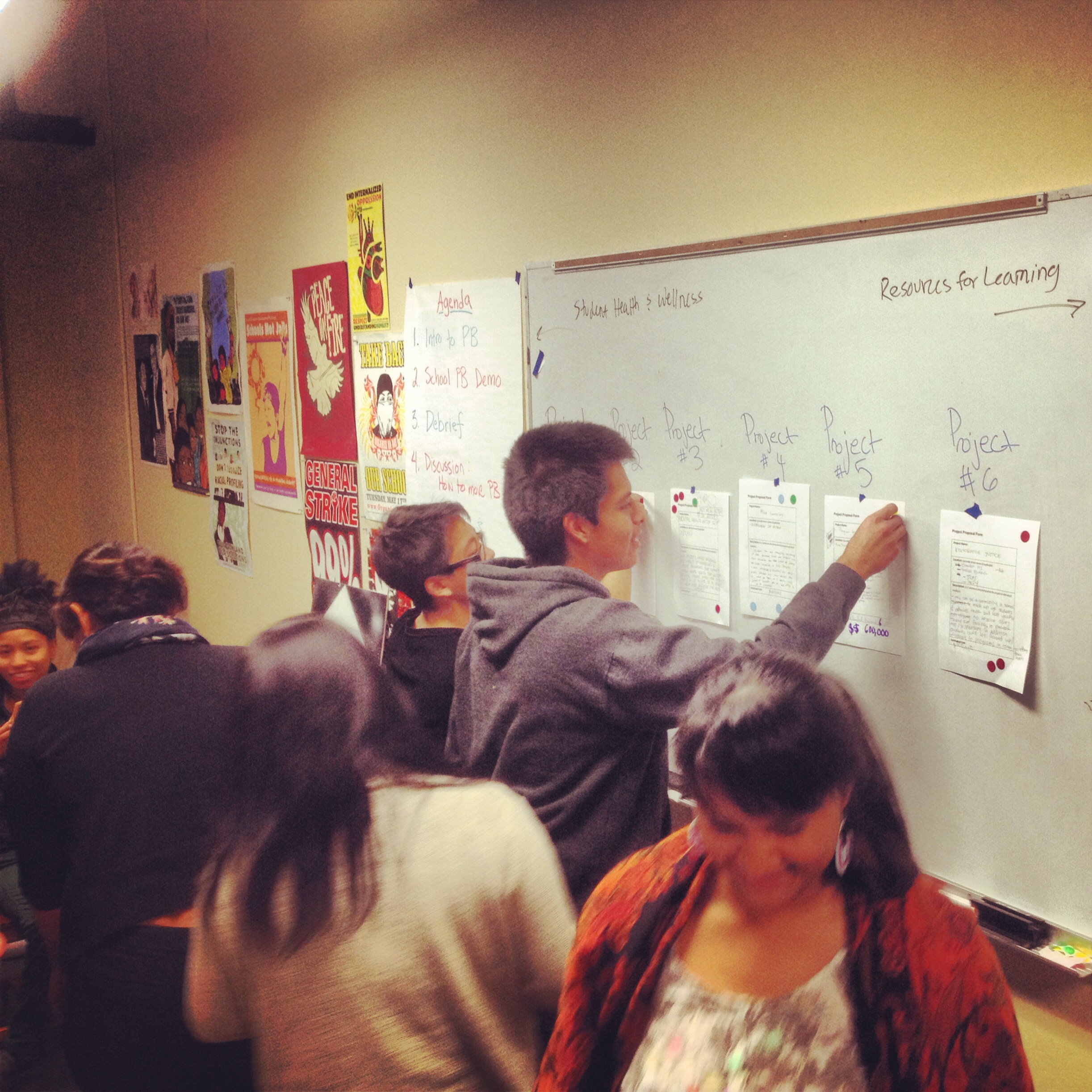
In the picture to the right, youth leaders and staff from Californians for Justice rank project ideas at a PB demo workshop in Oakland. Participants discussed projects to support student health and learning in Oakland and San Jose school districts.

PB in Cities: Long Beach, San Diego, Richmond

In addition to developing new PB models, we’re also supporting BHC groups in Long Beach, Richmond, and San Diego in launching new citywide and district-based processes. In November, PBP staff and Chicago Alderman Joe Moore went to Long Beach for a speaking tour, including a City Council briefing, several strategic meetings and a community form (pictured on the left). Since then, three candidates running for Long Beach City Council have endorsed PB, and a current council member, James Johnson, held a PB workshop with his constituents in February.

Right across the bridge from Vallejo, the City of Richmond is considering a youth PB process in conjunction with the city’s Youth Council. PBP will be leading a workshop at the Richmond Youth Summit on April 19. In San Diego, BHC groups active with the Community Budget Alliance, coordinated by the Center for Policy Initiatives, have also been meeting with their council members and Planning Department staff over the last few months to build support for PB. They’re looking at both district funds and CDBG funds as possible pots of money for PB.

Stay tuned for upcoming PB events in Long Beach, Richmond, and San Diego!

PB Conference

We’re now planning the first PB conference to take place in California, in the Bay Area in September 2014. Our 3rd annual international PB conference will bring together practitioners and advocates from across the state, country, and world. See more info.

Join us in expanding PB in California!

If you live, work or attend school in any of California’s 14 BHC sites and want to see PB in your community, contact Ginny Browne, Project Coordinator, at ginny@participatorybudgeting.org.

Interview on GovLoop Innovation Report

We recently read a great interview over at EngagingCities on an interesting report detailing 20 significant innovations made in government last year, and we thought it would interest our NCDD members. We encourage you to read the interview below or find the original post here.

engaging cities logoIn late December,  GovLoop released a new report, “The GovLoop Guide to 20 Innovations that Mattered in 2013.” EngagingPlans editor Della Rucker recently sat down with Emily Jarvis, lead writer of the report and producer of the GovLoop podcast, the DorobekINSIDER, to talk about how Emily and her colleagues uncovered those innovations, and what they found.

DGR: Thanks for taking the time to talk, Emily.  Where did the idea for the20 Innovations that Matter report come from?

EJ:  2013 was a rough year for government people, especially federal employees.  We felt like most of the media wasn’t telling the whole story about government employees – and we knew that government is one of the most innovative entities out there.  So we wanted to highlight those achievements.  Last year (2012) we did a report on technology in government, so that was kind of a stepping stone.

DGR:  How did you uncover all these trends, and so much information about them?  There are a lot of concrete examples in this report. 

EJ: We had a team of 14 people who were involved.  We went through various resources that GovLoop had generated over the year – guides, trainings, the podcast, etc.  We ended up seeing four categories of stories that were very much about people in governments taking risks, trying something new.  We wanted to call those out.

When we had those four categories identifies, then we went back through the specific stories to find the five strongest examples.  We wanted to choose stories where we could make a strong case for why that innovation matters.   A great example is the I-Center in North Carolina, which allows government agencies to try out technologies before they buy them.  This innovation was powerful because resources are so tight, governments can’t take risks on buying the wrong equipment.  The I-Center was a great way to manage that risk.

We ended up with 150 stories, which was of course way too many.  So we put them all on Google Docs and out staff voted to end up with the 20 we highlighted in the report.  There’s probably another 125 that we could have put on the list!

DGR: What did you see that surprised you?  Did any trends surface that were unexpected?

EJ: We’re very tech-forward at GovLoop, so to see large agencies taking that risk and seeing what they can do with social media was great.  For example, the Department of the Interior’s Instagram feed… I kind of use my dad as a litmus test for things like this!  If it catches his attention, if it demonstrates to him what government can do, then I know it can have an impact.  He was so excited about the Department of Interior Instagram feed – now he has a different relationship with that part of the government!  He can see an agency at work.

What’s really amazing is how social media use like that example changes peoples’ views of government agencies and workers.  It showcases how cool a government worker can be!

In May 2013, when the Open Data Directive first came out from the White House, that was critical to another trend that we identified.  It basically said that all new federal data needs to default to open – it needs to be open to the public unless there is a necessary reason to not release it.  I don’t think that’s something that someone in the general public would necessarily understand or care about, but so many of the apps and projects that are being developed now are based on open data.  There are whole sectors of the economy that are based on government data.  But it’s hard for people who are outside of government to understand that.  It’s not just about opening it up to the public, but it’s also making it so that the data can be shared and used.  That’s transformative.

One of the coolest things I saw was what local governments are doing with libraries.  These institutions needed to find new ways to interact with people, and they are basically reinventing themselves as a tech hub.  For example, Anne Arundel County’s library is across the street from a new Target, and people who wanted to apply for jobs had to do it online.  But if you don’t have a computer or internet access, how do you apply for those jobs?  The library basically set up an employment center, and it helped people do their applications.  We’re seeing a resurgence in libraries that you wouldn’t have bet on a few years ago.  You see government changing.

Another fascinating example of government changing, and changing swiftly and responsively, came from the Boston Police Department.  As a lot of us remember, the first news that they had caught the fugitive from the Boston Marathon bombing came from the Police Department’s Twitter.  That tweet got 3 million retweets in the first three minutes.  Even two years ago, no one would have imagined that news would have been spread like that.  Even more fascinating, that department now has a chance to really do something different.  They have a huge audience, and people have trust in them.

DGR: What kinds of trends are you seeing with regard to Innovation Officers?  That’s been a subject of some debate, at least in the local government world. 

EJ: Governments are at a point where money is tight but the demand for their services is higher than ever.  We’re seeing that some cities have dedicated themselves to trying something new every chance they can.  They realize that it might not work, but that they can try and learn from it and do something better.  They’re becoming more agile.  It’s flipping the script on how people assume that government works.  The Innovation Officer becomes the person who is out on the leading edge, saying “follow me, let’s give it a try and learn from it.”

We talked to one of the White House’s Innovation Fellows – Clay Johnson.  He was working on improving the federal procurement process, and he noted that the biggest challenge was the senior leadership – he said, “they had to change the way they think.”   That’s incredibly hard for government employees.  They’re intensely cognizant of their responsibility as stewards of the taxpayer’s money, and they have to walk a very fine line between being responsible and enabling necessary new ideas.  There’s reasons why governments do things the way they do – there are checks and balances.  The Innovation Officer – or anyone who is supporting government innovation, whatever their title — can’t go crazy.  It’s more about having someone within the government or agency who is willing and able to say “Let’s try this, let’s fail smartly.”

DGR: If someone were flipping through this report casually, what would you want them to take away from it?  What’s the message you most want people to get out of it?

EJ: If someone were to flip through it like a magazine, I’d want them to realize that government isn’t made up of a bunch of bureaucrats.  Governments can be, and a lot of the time they are, on the cusp of innovation.

I’d want them to come away with a different interpretation of government employees, to understand that the media’s portrayal is not what they are.   Innovation is alive in government, and it matters!

Civilizing Online Discourse by Expanding “Like” Button Options?

If you were wondering with us recently about how online comments sections can be made more civil, we encourage you to check out a savvy new tool that our organizational partners at Public Agenda are experimenting with. PA has embedded a “reader reaction button” – an evolutionary leap forward from Facebook’s “like” button – into their site that allows readers to react in multiple, nuanced ways to almost any part of an article or comment.

With reactions such as “respectfully disagree” and “not the whole story” available for users to express how they feel about specific content, this new tool could be a game changer for online dialogue. You can read about the new tool below or try it yourself by visiting PA’s original post here. And you really should try it because, we have to say, it’s really cool!


PublicAgenda-logoWith the arrival of spring, we’re trying a fresh approach to the way you can interact with our online content.

We believe that engaging with fair-minded perspectives that we may not agree with is good for democracy. This practice helps us break out of a simplistic “for or against” framework toward an issue and come to a rounder comprehension of the issue and approaches to resolving it.

Unfortunately, the civil exchange of opposing perspectives is hard to find on the Internet, where interaction feels like the Wild West. Inherent anonymity doesn’t help, and neither does the click-bait game. Conflict, after all, is newsworthy. (This is something we certainly struggle with here!) All of this animosity on the Internet could actually be doing some real damage.

We may view rude Internet behavior as inevitable, but civil Internet discourse that is also click-friendly IS possible. The Engaging News Project, out of the University of Texas, is demonstrating how.

respect button

A screenshot of PA’s new Reader Reaction Button in action

The Project is experimenting with reader reaction buttons on comments for news stories – specifically, the ubiquitous “Like” button. “Like” can sometimes be a limited and limiting response. As the researchers write,

“‘Like’ doesn’t always seem appropriate. A fair, but counter-attitudinal, post in a comment section? It’s challenging to press ‘Like.’” What if news sites used a button that said “Respect” instead?

Word choice, it seems, does matter. When participants saw a “Respect” button instead of a “Like” button in the comments section on a news story, they interacted more frequently with other readers’ comments, including those from a political perspective different from their own. From the report on the research:

Instead of asking people to approach online comments thinking about whether they agree with a comment, or “like” a point of view, the “Respect” button puts people in a different state of mind. Instead of “am I with them or against them?” the “Respect” button directs people to think more about “Is this a decent argument?”

We’ve decided to adapt the “Respect” approach to how you can interact with our blog content.

If you highlight text anywhere in a blog post, or see the ReadrBoard symbol (left) on content (including pictures and video), a box opens up. In that box, you can choose your reaction (including “Respect”), see the reactions of others, or add your own reaction. We hope this new approach encourages you to engage more with our content – and with each other.


NCDD 2014 conference topic: The business of D&D

NCDD organizational member Tim Bonnemann, founder of Intellitics, shared his thoughts via our great Submit-to-Blog Form on our recent effort to get your input on this year’s NCDD conference, and we are happy to share them.


Well, that was fun. Last month, NCDD asked their community and the world to share ideas for this year’s conference. Using an online ideation tool called Codigital, more than one hundred contributors suggested, refined and ranked nearly as many ideas over the course of ten days (see full results here).

Reading through the list of ideas, I couldn’t help but notice that almost half of them deal with what I like to refer to as the business side of D&D. Taken together, they all appear to address the fundamental question of how to make a living doing this work, whether as individual practitioners or the field as a whole.

Here are the five business-related themes that caught my eye:

1. Understanding the client

About ten or so ideas expressed the need to connect in person with city managers, elected officials, policy makers, public agency representatives, etc. to learn about the obstacles and barriers they face and the shortcomings of public engagement processes they have experienced.

2. Proving what works

Another ten or so ideas focused on the need to share, document and celebrate examples where good work is already happening and creating positive impact: success stories, best practices, role models etc. One of the top 25 most popular ideas in particular suggested to “mov[e] the needle on assessment and evaluation, so we can demonstrate D&D’s power and effectiveness.”

3. Marketing and selling D&D

A couple of ideas dealt with the challenges of communicating this work and the value it provides. How do we “write, talk about, and present D&D” in ways that are more accessible and compelling? What’s our elevator pitch?

4. Funding

Another couple or so ideas suggested to connect directly with funders to better understand their interests and needs, particularly in the context of “Collective Impact” initiatives, and to make it easier (and more likely) for practitioners to successfully access these potential resources.

5. Scaling and going mainstream

And finally, a whole host of ideas showed a strong interest in taking this work to scale and better yet, making it part of the common fabric of society. How can we engage at regional, state, national or even global levels, and what role does the use of technology and mass media play? How can this work become a part of our civic infrastructure?

So there you have it. A motto, a theme? Or at least a potential focus area for this year’s conference.


Tim Bonnemann is the founder and CEO of Intellitics, a digital engagement startup based in San José, CA. Intellitics helps organizations and communities make use of technology in meaningful ways to support dialogue, deliberation and other types of participatory processes. Follow him on Twitter at @planspark.

Results of NCDD’s awesome Codigital experiment

We wanted to share the full results of our 10-day engagement project, where we invited members of the NCDD community to share what they would like to see happen when our field comes together at the 2014 National Conference on Dialogue & Deliberation this fall in the DC area.

The level and quality of participation in this activity were amazing! It was exciting for me, and for the whole planning team for NCDD 2014, to see the great ideas that were shared, and to be able to watch as you honed and prioritized each other’s ideas.

Codigital-screenshot

As you can see from the image above, 122 of you participated, 95 ideas were submitted, 174 edits were made, and a whopping 5290 votes (or ratings) were cast.

Props go to James Carr and Codigital for one of the smoothest, most addicting, and most intuitive engagement experiments we’ve conducted for our community.  Codigital was kind enough to donate their services to NCDD for this project, and we are so grateful they did.

Check out the full results of the project here.  The project report contains all the ideas submitted (in the order the group ranked them) and overall engagement statistics. Planning team member Phil Neisser is working on theming the results, and we are open to others’ interpretations and reactions to the results — and to the process.  Please share your thoughts in the comments here.

The results of this project will be extremely useful to the planning team as we move forward in the planning process. Hopefully it is also getting many of you thinking about the most valuable ways YOU can contribute to the conference (our call for workshop proposals will be issued soon).

If you are interested in using Codigital’s co-creation tool, feel free to contact James at james@codigital.com. He can also be reached by phone at 303-884-1260 (Mountain time; he’s based in Colorado). In addition to online activities like the one we just ran, Codigital’s tool is used by groups before and during conferences to improve engagement through participation in interactive projects that gather ideas and perspectives, and co-create solutions reflecting the collective intelligence of the group. They are happy to partner with facilitators and conference organizers.