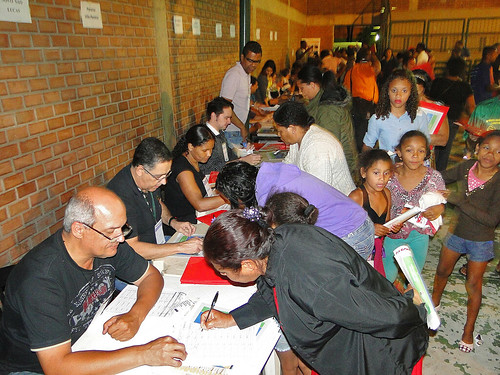
The Journal of Field Actions, together with Civicus, has just published a special issue “Stories of Innovative Democracy at the Local Level: Enhancing Participation, Activism and Social Change Across the World.” When put together, the 13 articles provide a lively illustration of the wealth of democratic innovations taking place around the world.
(Washington, DC) Alana Samuels has a great Atlantic piece about Participatory Budgeting in the California City of Vallejo. Participatory Budgeting is an important democratic innovation with lots of potential, and Samuels movingly describes residents of Vallejo working hard to allocate city funds even on “the second-to-last night of the World Series, when the region’s beloved San Francisco Giants could have clinched the series.” (Compare my narrative of youth working hard on PB in Boston.) But hers is also a cautionary tale about enlisting people in small-scale democratic practices while large-scale systems–such as state budgets–go very much against their wishes. Frustration ensues.
(Los Angeles) At CityLab 2014, I’m on a panel called “Beyond the Buzz: What Citizen Engagement Strategies are Really Working.”
I think mayors and the people who work for them tend to think of engaged citizens as potential suppliers of:
votes
taxes
input/opinion
voluntary work
The first two won’t be strictly relevant to our panel, because taxes are required by law and voting is a “political” concern, officially separate from public administration (except insofar as the voting process itself should be convenient and reliable).
Input and volunteering are valuable, but we need to push them to the next level. Both tend to be individual and disconnected from other aspects of life. For example, a private citizen may contact the city to complain about an immediate problem, like a broken light, or to express an opinion about a community problem, like police bias. She may separately sign up to clean a park or tutor a child.
Individuals give their best input when they discuss their ideas with other people, checking their biases and values, holding themselves and others accountable, and learning from collective experience. They do their best volunteer work when they have decided with others what is needed and how to address those needs, and when they can reflect on the results of their efforts. That means that both input and volunteer labor are best when they are connected to citizens’ discussions.
What’s more, both talk and volunteer work are best when they are connected to paid work (presuming that the individual is employed). We learn a great deal on the job, and we have the potential to improve a city through our paid employment. If our civic engagement is limited to free contributions–input and/or volunteer service–it is not nearly as serious, informed, or potentially effective as it is if it also influences our paid work.
So instead of imagining an individual complaining about her children’s school or volunteering to chaperone students, picture her engaging in a discussion with diverse people about how to improve the school for all kids. That conversation should involve parents, other residents, students themselves, and also professional teachers and administrators. Some of the adults will have jobs that affect the welfare of children, from ministering to a religious congregation to operating a local grocery store. They should bring their experience from work into the discussions and hold themselves accountable to their fellow citizens as they go about their jobs. They may also volunteer and express individual opinions, but those acts will be informed by their discussion and their work.
Text, Talk, Act is a valuable innovation that has come out of the National Dialogue on Mental Health. It uses text messaging to spark small-group discussions in many places at once, and the participants share their ideas back. There are prizes available for organizing a Text, Talk, Act event on Oct 6.
(Orlando, FL) So many of the initiatives that I admire happen to be small: classrooms devoted to reflection and service, deliberative meetings of citizens, one-on-one interviews with community organizers, efforts to restore wetlands and woods. Their leaders do not necessarily favor smallness; they may wish to “go to scale.” Yet the values they prize seem linked to smallness, and I suspect that the “Small is Beautiful” movement of the late 1960s is somehow in their heritage, whether they know it or not.
With that in mind, I’ve looked superficially at E.F. Schumacher’s popular 1973 manifesto, Small is Beautiful: Economics as if People Mattered. Some passages seem to me insightful. For example:
In the affairs of men, there always appears to be a need for at least two things simultaneously, which, on the face of it, seem to be incompatible and to exclude each other. We always need both freedom and order. We need the freedom of lots and lots of small, autonomous units, and, at the same time, the orderliness of large-scale, possibly global, unity and coordination. When it comes to action, we obviously need small units, because action is a highly personal affair, and one cannot be in touch with more than a very limited number of persons at any one time. But when it comes to the world of ideas, to principles or to ethics, to the indivisibility of peace and also of ecology, we need to recognise the unity mankind and base our actions upon this recognition (p. 61).
Forty years later, it is not longer so obvious that “action” requires small scale, on the basis that “one cannot be in touch with more than a very limited number of persons at any one time.” A person can have thousands of Facebook friends and Twitter followers. Moreover, networks of people who associate voluntarily can now quickly become large and powerful. Bennett and Segerberg (2012) cite, for example, los Indignados, a movement composed of 15 million protesters in 60 Spanish cities that arose in 2011. These protesters kept “political parties, unions, and other powerful political organizations out: indeed, they were targeted as part of the political problem. … The most visible organization consisted of the richly layered digital and interpersonal communication networks centering around the media hub of Democracia real YA!”
Thus I would no longer draw the line between small and big. But Schumacher was right that “action is a highly personal affair”; and domains of personal action require relationships among human beings who know and hear each other and cooperate in tangible ways. Thus we can draw a distinction between personalized politics and institutionalized politics that roughly maps onto small versus big. Schumacher would say that we need both.
personalized
institutionalized
main forms of interaction
talk, collaboration, relationships
rules, incentives, directives, measurements
major advantages
ability to take tangible action; responsiveness to individuals’ needs
fairness, efficiency, predictable general rules that permit individuals to live freely, the ability to address big problems
major disadvantages
exclusiveness, petty politics and bullying, failure to address macro issues
individuals have modest or intangible impact
equity and inclusion mean
responding to each member’s needs and interests appropriately; inviting outsiders to join
rules and rights that enhance equality of opportunity and/or outcomes for a population; applying these rules impersonally
democratic decision- making
can sometimes be consensual. Always requires a concern for the feelings of each member
majority vote or a market system for aggregating preferences
how to deal with collective action problems
personalized appeals; sometimes a violator is ostracized
requirements, monitoring, and penalties (e.g., in a system of taxation)
roles are
relatively informal and can be equivalent for all members
formalized and differentiated
One of the most difficult questions is how to connect institutionalized and personalized politics together so that we can get the best of both. We cannot ignore big systems in order to live within our chosen networks, because the big systems govern us and ultimately decide the fate of the small associations. But as we try to move from relational politics to institutionalized politics, we often lose the distinctive virtues of the former, especially deliberate human agency.
The two main methods for expanding the scope of relational politics are: 1) replication and 2) leverage–that is, either finding ways to make relational practices happen over and over and networking them together, or else using instruments like laws or the mass media to achieve the ends that we have selected in personal interactions. Neither is easy to accomplish with integrity, and I think the whole question of how relational politics can influence mass systems is seriously under-explored.
[Sources: E.F. Schumacher (1973), Small is Beautiful: Economics as if People Mattered, Harper & Row; W. Lance Bennett & Alexandra Segerberg (2012) The Logic Of Connective Action: Digital Media and the Personalization Of Contentious Politics. Information, Communication & Society (15)5:739-768. See also Jane Mansbridge's Beyond Adversary Democracy.]
This 4-page publication (2004) describes the “Deliberative Mapping” approach and how it could be used to foster more productive discussions between specialists and members of the public about complex policy issues where there is no obvious way forward.
Though it only appears to have been tried once, Deliberative Mapping was a methodology that could be applied to a problem to judge how well different courses of action perform according to a set of economic, social, ethical and scientific criteria. The aim was to use the approach as the basis for more robust, democratic and accountable decision making which better reflects public values.
The methodology combined assessment by individual specialists and members of the public (or citizens). Participants:
appraise a complex problem for which there is no single obvious way forward
systematically weigh up the pros and cons of each of the potential ‘options’ under consideration, and
integrate their individual assessments to help identify a possible future course of action.
Deliberative Mapping integrated two independent but complementary approaches to informing decision making:
Stakeholder decision analysis (SDA) which is a qualitative group based process
Multi-Criteria Mapping (MCM) which is a quantitative, computer-assisted interview process
This briefing was authored by Science and Technology Policy Research at the University of Sussex and the Environment and Society Research Unit (ESRU) University College.
Rio Grande do Sul Participatory Budgeting Voting System (2014)
Within the open government debate, there is growing interest in the role of technology in citizen engagement. However, as interest in the subject grows, so does the superficiality of the conversations that follow. While the number of citizen engagement and technology events is increasing, the opportunities for in-depth conversations on the subject do not seem to be increasing at the same rate.
This is why, a few weeks ago, I was pleased to visit the University of Westminster for a kick-off talk on “Technology and Participation: Friend or Foe?”, organized by Involve and the Centre for the Study of Democracy (Westminster). It was a pleasure to start a conversation with a group that was willing to engage in a longer and more detailed conversation on the subject.
My talk covered a number of issues that have been keeping me busy recently. On the preliminary quantitative work that I presented, credit should also go to the awesome team that I am working with, which includes Fredrik Sjoberg (NYU), Jonathan Mellon (Oxford) and Paolo Spada (UBC / Harvard). For those who would like to see some of the graphs better, I have also added here [PDF] the slides of my presentation.
I have skipped the video to the beginning of my talk, but the discussion that followed is what made the event interesting. In my opinion, the contributions of Maria Nyberg (Head of Open Policy Making at the Cabinet Office) Catherine Howe (Public-i), as well as those of the participants, were a breath of fresh air in the current citizen engagement conversation. So please bear with me and watch until the end.
I would like to thank Simon Burral (Involve) and Graham Smith (Westminster) for their invitation. Simon leads the great work being done at Involve, one of the best organizations working on citizen engagement nowadays. And to keep it short, Graham is the leading thinker when the issue is democratic innovations.
Below is also an excellent summary by Sonia Bussu (Involve), capturing some of the main points of my talk and the discussion that ensued (originally posted here).
***
“On technology and democracy
The title of yesterday’s event, organised by Involve and Westminster University’s Centre for the Study of Democracy, posed a big question, which inevitably led to several other big questions, as the discussion among a lively audience of practitioners, academics and policymakers unfolded (offline and online).
Tiago Peixoto, from the World Bank, kicked off the debate and immediately put the enthusiasm for new technologies into perspective. Back in 1795, the very first model of the telegraph, the Napoleonic semaphore, raised hopes for – and fears of – greater citizen engagement in government. Similarly the invention of the TV sparked debates on whether technology would strengthen or weaken democracy, increasing citizen awareness or creating more opportunities for market and government manipulation of public opinion.
Throughout history, technological developments have marked societal changes, but has technological innovation translated into better democracy? What makes us excited today about technology and participation is the idea that by lowering the transaction costs we can increase people’s incentives to participate. Tiago argued that this costs-benefits rationale doesn’t explain why people continue to vote, since the odds of their vote making a difference are infinitesimal (to be fair voter turnouts are decreasing across most advanced democracies – although this is more a consequence of people’s increasing cynicism towards political elites rather than their understanding of mathematical probabilities).*
So do new technologies mobilise more people or simply normalise the participation of those that already participate? The findings on the matter are still conflicting. Tiago showed us some data on online voting in Rio Grande do Sul participatory budgeting process in Brazil, whereby e-voting would seem to bring in new voters (supporting the mobilisation hypothesis) but from the same social strata (e.g. higher income and education – as per the normalisation hypothesis).
In short, we’re still pretty much confused about the impact of technology on democracy and participation. Perhaps, as suggested by Tiago and Catherine Howe from Public-i, the problem is that we’re focusing too much on technology, tempted by the illusion it offers to simplify and make democracy easy. But the real issue lies elsewhere, in understanding people and policymakers’ incentives and the articulation (or lack thereof) between technologies and democratic institutions. As emphasised by Catherine, technology without democratic evolution is like “lipstick on a pig”.
The gap between institutions and technology is still a big obstacle. Catherine reminded us how participation often continues to translate into one-way communication in government’s engagement strategies, which constrains the potential of new technologies in facilitating greater interaction between citizens and institutions and coproduction of policies as a response to increasing complexity. As academics and practitioners pitch the benefits of meaningful participation to policy makers, Tiago asked whether a focus on instrumental incentives might help us move forward. Rather than always pointing to the normative argument of deepening democracy, we could start using data from cases of participatory budgeting to show how greater participation reduces tax evasion and corruption as well as infant mortality.
He also made a methodological point: we might need to start using more effectively the vast array of data on existing engagement platforms to understand incentives to participation and people’s motivation. We might get some surprises, as findings demystify old myths. Data from Fix My Street would seem to prove that government response to issues raised doesn’t increase the likelihood of future participation by as much as we would assume (28%).** But this is probably a more complicated story, and as pointed out by some people in the audience the nature and salience of both the issue and the response will make a crucial difference.
Catherine highlighted one key problem: when we talk about technology, we continue to get stuck on the application layer, but we really need to be looking at the architecture layer. A democratic push for government legislation over the architecture layer is crucial for preserving the Internet as a neutral space where deeper democracy can develop. Data is a big part of the architecture and there is little democratic control over it. An understanding of a virtual identity model that can help us protect and control our data is key for a genuinely democratic Internet.
Maria Nyberg, from the Cabinet Office, was very clear that technology is neither friend nor foe: like everything, it really depends on how we use it. Technology is all around us and can’t be peripheral to policy making. It offers great opportunities to civil servants as they can tap into data and resources they didn’t have access to before. There is a recognition from government that it doesn’t have the monopoly on solutions and doesn’t always know best. The call is for more open policy making, engaging in a more creative and collaborative manner. Technology can allow for better and faster engagement with people, but there is no silver bullet.
Some people in the audience felt that the drive for online democracy should be citizen-led, as the internet could become the equivalent of a “bloodless guillotine” for politicians. But without net neutrality and citizen control over our own data there might be little space for genuine participation.
*This point was edited on 12/07/2014 following a conversation with Tiago.
** This point was edited on 12/07/2014 following a conversation with Tiago.”
—————————
I am also thankful to the UK Political Studies Association (PSA), Involve and the University of Westminster for co-sponsoring my travel to the UK. I will write more later on about the Scaling and Innovation Conference organized by the PSA, where I was honored to be one of the keynote speakers along with MP Chi Onwurah (Shadow Cabinet Office Minister) and Professor Stephen Coleman (Leeds).
In lieu of a substantive post here today, I’d like to link to my article in Transformations entitled “You can add us to equations but they never make us equal: participatory budgeting in Boston.” It’s a reported piece; I didn’t conduct formal research, but I attended a key meeting, talked to the kids, and noted my impressions. I believe that asking kids to allocate $1 million of city funds is an excellent idea. It not only involves them in deliberation but also requires them to do collaborative work (analyzing and vetting proposals) and builds relationships. I argue that those are the three essential aspects of hands-on, citizen-centered engagement.
The current issue of the Journal of Public Deliberation (which offers open access) “assess[es] the state of our field, celebrates our successes, and calls for future innovative work. The authors are scholars and practitioners who represent the diversity of our field and provide a wide range of perspectives on deliberation, dialogue, participation, and civic life. The ideas from this issue will be discussed at the upcoming Frontiers of Democracy conference [at Tufts], after which the editors will write an ‘afterword’ reflecting on lessons learned.”
To expand opportunities for discussion and reflection about public issues, we should look beyond the organizations that intentionally convene deliberations and also enlist organizations that preserve common resources, volunteer service groups, civics classes, grassroots public media efforts, and partisan, ideological, and faith-based movements that have some interest in discussion. Many of these groups are not politically neutral; more are adversarial. But they have a common interest in confronting the forces and decisions that have sidelined active citizens in countries like the US. They are all threatened by the rising signs of oligarchy in the United States. Collectively, they have considerable resources with which to fight back. It is time for us to begin to stir and organize–not for deliberation, but for democracy.
A little while ago I mentioned the launch of the Portuguese version of the book organized by Nelson Dias, “Hope for Democracy: 25 Years of Participatory Budgeting Worldwide”.
The good news is that the English version is finally out. Here’s an excerpt from the introduction:
This book represents the effort of more than forty authors and many other direct and indirect contributions that spread across different continents seek to provide an overview on the Participatory Budgeting (PB) in the World. They do so from different backgrounds. Some are researchers, others are consultants, and others are activists connected to several groups and social movements. The texts reflect this diversity of approaches and perspectives well, and we do not try to influence that.
(….)
The pages that follow are an invitation to a fascinating journey on the path of democratic innovation in very diverse cultural, political, social and administrative settings. From North America to Asia, Oceania to Europe, from Latin America to Africa, the reader will find many reasons to closely follow the proposals of the different authors.
While my perception may be biased, I believe this book will be a major contribution for researchers and practitioners in the field of participatory budgeting and citizen engagement in general. Congratulations to Nelson Dias and all the others who contributed their time and energy.