America’s Future: What Should Our Budget Priorities Be? (NIFI Issue Guide)

The National Issues Forums Institute published this Issue Guide (2014), America’s Future: What Should Our Budget Priorities Be?, to provide participants a resource to deliberate national budget issues.

From the guide…

America is slowly coming out of a long recession. Unemployment, after peaking at 10 percent in 2009, has fallen below 8 percent; more new homes are being built, although just gradually. Despite the heavy blow we’ve taken in the last few years, the US economy is very large and still growing…

We have significant resources, but they are finite. What direction should we take?

The Issue Guide presents three options for deliberation:

Option One: Keep Tightening Our BeltNIF-America's-Future
Though painful, the sequester (mandatory across-the-board budget cuts) showed that we can get by with less. We should continue cutting gradually to bring down the deficits, shrink the national debt, and let the private sector drive the recovery.

Option Two: Invest for the Future
We are making progress on the deficit. We need to make some adjustments to entitlements, but now is not the time to slash programs; it may result in hobbling the recovery. Instead, we should make strategic expenditures and grow the economy, which in turn will shrink the deficit.

Option Three: Tame the Monsters
The steady growth of defense, Social Security, and Medicare/Medicaid are the main drivers consuming the federal budget…Social Security and Medicare, in turn, should be need-based and self-sustaining. We should get away from the whole concept of “entitlement,” which is bankrupting those programs. We also should reform and simplify the tax code.

More about the NIFI issue guides
NIFI’s Issue Guides introduce participants to several choices or approaches to consider. Rather than conforming to any single public proposal, each choice reflects widely held concerns and principles. Panels of experts review manuscripts to make sure the choices are presented accurately and fairly. By intention, Issue Guides do not identify individuals or organizations with partisan labels, such as Democratic, Republican, conservative, or liberal. The goal is to present ideas in a fresh way that encourages readers to judge them on their merit.

Issue Guides are generally available in print or PDF download for a small fee ($2 to $4). All NIFI Issue Guides and associated tools can be accessed at www.nifi.org/en/issue-guides

Follow on Twitter: @NIForums.

Resource Link: www.nifi.org/en/issue-guide/americas-future

The Changing World of Work: What Should We Ask of Higher Education? (NIFI Issue Guide)

This 11-page Issue Guide from the National Issues Forums Institute, The Changing World of Work: What Should We Ask of Higher Education?, was published January 2015 to help inform participants in deliberation about the current state and future of higher education.

From the guide…

There is a pervasive anxiety in America about the future of higher education. Spiraling costs combined with seismic changes in the American workplace raise questions about whether a bachelor’s degree is still worth the cost. In a recent cover story, Newsweek magazine asked: “Is College a Lousy Investment?” For a growing number of Americans, the answer appears to be yes.

Today’s students accumulate an average of almost $30,000 in debt by the time they graduate. They will go into a job market that looks especially bleak for young people. Many college graduates are unemployed or working minimum-wage jobs. Still more are working in jobs that don’t require a college credential.

Some of the troubles facing new graduates can be attributed to the post-recession economy. But there are larger forces at work that are transforming the nature of employment in America—forces that colleges and universities have been slow to recognize, much less respond to.

The Issue Guide presents three options for deliberation:

Option One: “Prepare Students for the Job Market”NIF-Changing-World-of-Work
Colleges and universities should tailor their programs to the real needs of employers and direct more of their educational resources toward vocational and pre-professional training.

Option Two: “Educate for Leadership and Change”
Academic institutions should focus on preparing students to become effective citizen leaders—the men and women who will go on to create the jobs of the future, effect change, and build a better society.

Option Three: “Build Strong Communities”
Colleges and universities should harness their power to create jobs, generate business opportunities, provide essential skills, and drive development in their communities and in the region.

More about the NIFI Issue Guides
NIFI’s Issue Guides introduce participants to several choices or approaches to consider. Rather than conforming to any single public proposal, each choice reflects widely held concerns and principles. Panels of experts review manuscripts to make sure the choices are presented accurately and fairly. By intention, Issue Guides do not identify individuals or organizations with partisan labels, such as Democratic, Republican, conservative, or liberal. The goal is to present ideas in a fresh way that encourages readers to judge them on their merit.

Issue Guides are generally available in print or PDF download for a small fee ($2 to $4). All NIFI Issue Guides and associated tools can be accessed at www.nifi.org/en/issue-guides

Follow on Twitter: @NIForums.

Resource Link: www.nifi.org/en/issue-guide/changing-world-work

Over The Edge: What Should We Do When Alcohol and Drug Use Become a Problem to Society? (NIFI Issue Guide)

The National Issues Forums Institute published the 15-page Issue Guide, Over The Edge: What Should We Do When Alcohol and Drug Use Become a Problem to Society?, in February 2015. The Issue Guide discusses an overview of substance abuse in America and the effect it has had on people and their communities. The guide can be downloaded for free here.

From the guide…

NIFI-OverTheEdgeBy all accounts, America is a nation of substance users. More than two-thirds of us are taking at least one prescription drug, and more than half drink alcohol on a regular basis. Marijuana consumption is on the rise as more states relax their laws on its medicinal and recreational use. But even legal substances, when misused, can result in serious problems. Beyond the human suffering, the abuse of legal and illicit substances is costing the nation more than $400 billion dollars each year due to lost productivity, health problems, and crime.

This guide offers three perspectives to help start the conversation about how we should respond to the problem of substance abuse. While not entirely mutually exclusive, each provides a different lens on the nature of the problem, the kinds of actions that would have the greatest impact, and the drawbacks or consequences of each.

The Issue Guide presents three options for deliberation:

Option One: Keep People Safe
Our top priority must be to protect people from the dangers posed by substance abuse, according to this option. Whether the threat comes from sharing the same roads and highways with people under the influence, living in communities under siege by drug trade, or having our families devastated by a child or adult addict, the potential for harm is real. In order to keep people safe, we need to tightly regulate and control the production and use of alcohol and drugs, as well as impose penalties for people who break the rules.

Option Two: Address Conditions that Foster Substance Abuse
This option says we must recognize the critical role society plays regarding how and why people use drugs and alcohol. It is too easy to blame the individual—to say that if a person had just been stronger, smarter, or had more willpower, they would not have become involved in substance use. Instead, we should focus on the broader context and take responsibility for changing the social, cultural, and economic conditions that foster widespread substance use and abuse

Option Three: Uphold Individual Freedom
We must respect people’s freedom while offering them the means to act responsibly, according to this option. Overzealous efforts to control substance use infringe upon our rights, are often ineffective, discourage sick people from seeking treatment, and have led to the incarceration of large numbers of Americans for nonviolent drug offenses. Instead, we must provide the information and treatment options people need to make healthy choices, as well as reform laws that are unduly intrusive or unfair.

NIF-Logo2014More about the NIFI Issue Guides
NIFI’s Issue Guides introduce participants to several choices or approaches to consider. Rather than conforming to any single public proposal, each choice reflects widely held concerns and principles. Panels of experts review manuscripts to make sure the choices are presented accurately and fairly. By intention, Issue Guides do not identify individuals or organizations with partisan labels, such as Democratic, Republican, conservative, or liberal. The goal is to present ideas in a fresh way that encourages readers to judge them on their merit.

Issue Guides are generally available in print or PDF download for a small fee ($2 to $4). All NIFI Issue Guides and associated tools can be accessed at www.nifi.org/en/issue-guides.

Follow on Twitter: @NIForums.


Resource Link: www.nifi.org/en/catalog/product/over-edge-issue-guide-downloadable-pdf

Peter Railton on why meetings are essential

The American Philosophical Association’s John Dewey lectures are autobiographical remarks by senior philosophers who draw lessons from their whole lives as scholars and people–much in the spirit of Dewey. University of Michigan Professor Peter Railton exemplifies the genre with his 2015 lecture, Innocent Abroad: Rupture, Liberation, and Solidarity, which is a wonderful reflection on a life of thought integrated with action.

What I want to quote is his defense of “meetings,” which is strikingly similar to the arguments I offer in We Are the Ones We Have Been Waiting For. Railton writes:

Oscar Wilde is still right—because the cost of building a society where the people have more say in how their lives are run is still many, many meetings. What is a meeting, after all, but people deliberating together with a capacity to act as a group that is more than just a sum of individual actions, and this sort of informed joint action is a precondition for significant social change. Come together, decide together, act together, and bear the consequences together. We must own our institutions or they will surely own us. As Aristotle told us, one becomes a citizen not by belonging to a polity or having a vote, but by shouldering the tasks of joint deliberation and civic governance. And there is no civic or faculty governance, no oversight of discrimination in hiring and promotion, no regulation of pollutants, no organization of faculty or students to initiate curricular reform, no mobilization by professional associations to protect their most vulnerable members or to promote greater diversity, no increased humaneness in the treatment of animals and human subjects, no chance to offset arbitrariness and bullying within offices and departments, no oversight of progress and revision of plans in response to changing circumstances, without actual people who care spending long hours in the work of planning, meeting, and making things happens. The alternative is for all these decisions to be made at the discretion of those on high—or not at all. …

Of course, I am using ‘committees’ and ‘meetings’ as stand-ins for countless forms of joint deliberation and action. It needn’t fill the streets with banners or occupy buildings—sustainable activism is the work of a lifetime, not just of youthful bravado. What most impresses me about the activism of today’s youth is that it persists, indeed, flourishes, in countless ways that are more integrated with the ways of working of the world. As I look around me from the vantage point of Philosophy, I see colleagues and students investing countless hours trying to enhance the inclusion of women and other under-represented groups, or to build collective bargaining for graduate student instructors and term lecturers, or to reach out beyond the university to promote equitable trade, or to support humane and ecological practices in agriculture, or to bring new resources to under-served communities. These efforts involve personal sacrifice, and often made by those within the academy whose positions are the least secure. Moreover, they are making these sacrifices without a movement at their backs, or a Zeitgeist to buoy them from below. So it behooves those of us who are more secure to revive our spirit of activism. To lend a hand, and to use whatever leverage we might have to provide badly-needed support.

I agree with every word above. I’d only add that opportunities to talk, listen, and work with fellow citizens have weakened. The proportions of Americans who said that they attended community meetings, worked with neighbors to address problems, and belonged to organizations fell between 1975 and 2005.

These trends were not accidental but reflected intentional moves to sideline citizens. For instance, jury trials were replaced with plea-bargaining. The proportion of Americans who served on public boards declined by about 75 percent during the second half of the twentieth century, due to consolidation of local governments and the replacement of lay bodies with professional managers. The decline of unions meant many fewer union meetings and collective bargaining sessions; it also meant that labor was no longer a force that could demand public discussion of issues.

It follows that democracy not only takes a lot of evenings. It also requires a fight for the right to use our evenings to govern ourselves–against people who would rather govern us.

The post Peter Railton on why meetings are essential appeared first on Peter Levine.

a method for mapping discussions as networks

Two Quebecois scholars, François P. Robert and Pierre Mongeau, have developed a valuable method for modeling the “socio-semantic network” formed when people discuss an issue.* I can envision this method used to assess deliberations, to give real-time feedback to moderators during conversations, and even to reveal patterns of discussion in fictional texts as a contribution to literary criticism.

The article is in French and it uses a lot of terminology from network analysis, so unless you already know how ideas like “directed degree centrality” are expressed in French, you may find it hard going. Since I worked my way through it, I will provide relatively extensive notes below. But here is the shorter version:

Individuals form a social network if they know one another. Each link is a relationship, such as an experience of having talked one-on-on together. Meanwhile, individuals form a “socio-semantic network” if they use the same or highly similar phrases in a conversation on a common theme. “Each word or phrase that two people use in common is a link.” They need not know each other to have a socio-semantic link.

The social relations among people and their socio-semantic networks are different but not necessarily independent. One could affect the other. For instance, we might find that people who are central in a social network disproportionately affect the ideas that are expressed throughout that network. Their prestige may give them influence. Or we might find that people who express ideas that are frequent in the network become more socially central: holding popular ideas may give them prestige.

Robert and Mongeau involved 95 Montreal residents in discussions of a public policy topic: college tuition. Some of these discussions occurred in a large group using formal procedures. (I imagine Robert’s Rules or some variation thereof.) Other discussions occurred in small groups that were less rule-guided.

Some participants knew each other before the experiment. The authors identified all the social links that existed before the deliberation and also found out who had talked to whom during the event. They could thus chart the changing social network of the participants. Meanwhile, the authors asked participants to write about the issue both before and after the deliberation, collected the writing produced during the discussions, and looked for similarities of phrases between pairs of participants. That allowed them to chart the changing socio-semantic network of the group.

They found: “The conventional method [a large group deliberation using formal rules] favors the emergence of a link between social centrality and socio-semantic centrality, while the alternative method [small group discussions] favors the emergence of a negative relationship between these measures.” Apparently, in large group discussions, people who are socially central—knowing many others or interacting with them one-on-one during the meeting—increasingly dominate the views expressed by all the participants. But “in the alternative deliberative format that uses discussions in small groups, the emergence of differences is promoted by providing a space for expressing views different from those of the socially central people.”

The authors draw a lesson for organizers of events. “In practical terms, these results suggest that it would be advantageous for a democratic organization to first use alternative methods so as to promote the expression of a diversity of views and then to continue the deliberation in a conventional manner (like that prescribed in codes of procedure) to develop consensus positions.”

Maybe–although the design of deliberative formats involves more criteria that these. I am more interested in the methodology, because I believe it could be developed and applied for other purposes. To me, the fact that opposite results emerged from different kinds of deliberation validates the method, especially since the authors have a plausible explanation for the patterns they found.

* François P. Robert and Pierre Mongeau, Caractéristiques sociosémantiques des méthodes conventionnelles et alternatives de deliberation, Revue internationale comminucation sociale et publique, no 12, Dec. 2014, pp. 101-120

A bit more detail on the instruments: Before the deliberation, individuals were asked, “Of the following people, with whom did you have [knowledge or contact] before January 28, 2012? ” They were also asked after the deliberation, “With whom [names listed] have you had an exchange, a confrontation, or a sharing of ideas (whether positive or negative, whether or linked or not to the experiment)?” “An extra open-ended question asked respondents to provide information to identify people whose names they did not remember; for example, ‘During the break, I spoke with the gentleman sitting in front of me’ or ‘I talked a lot with the young lady to my right at the first round of discussions.’”

And the findings: “There is a negative correlation (r = – 244; p <0.05) between socio-semantic centrality during the conventional activity [large group deliberation] and that observed in the alternative activity [small group]. This correlation indicates that the central people in the socio-semantic network when the method of deliberation is conventional do not tend to be central in the alternative method. Furthermore, socio-semantic centrality while using the alternative method is positively correlated with that observed after the experiment (r = 378, p <0.01). Thus, people using more words and similar expressions to all participants during the alternative method also tend to do so after the experiment.”

No correlation was found between socio-semantic centrality and “various social centrality measures …. No link can be established before the experiment between centrality in the social network of a person and centrality in the socio-semantic network.”

“In the conventional method [a large-group deliberation], only directed degree centrality in the pre-existing social network is significantly and weakly correlated with socio-semantic centrality (r = 223, p <0.05) (Table 5). Thus, the number of choices received (prestige) of a person in the pre-existing social network is linked, albeit weakly, with the person’s use of words and phrases used by all those present in the conventional method. When the correlations are based on social centralities observed in the circumstantial network centralities all social measures were significantly correlated with sociossemantic centrality in the conventional method. The link is moderate (see Table 6), because the correlations vary around a mean of 0.41 (p <0.01). These results confirm the presumed relationship between social centrality and socioesemantic centrality by our general assumptions (Hg1, Hg2) and the first specific hypothesis (HSA).

“In the alternative method, the correlations between sociosémantique centrality and three of the five social centraly measures are reversed … The correlations between sociosémantique centrality and betweenness centrality measures and proximity are no longer significant for measures of centrality in the circumstantial social network. Furthermore, the centrality of the close pre-existing social network is also weakly negatively related to socio-semantic centrality for the alternative method (r = – 213; p <0.05). …. The alternative method does not attenuate the relationship between sociosemantic centrality and social centrality; it appears to transform them insofar as the correlations are weaker in the alternative method, but reversed. …”

“Indeed, this correlation suggests that people with greater prestige in the network before the [large group] deliberation begins (that is to say, they arrive at the meeting with more  relational capital) have a slight tendency to use words and expressions similar to those used by all participants.

“Conversely, with the alternative method, the central people tend, but moderately, to use words and expressions different from those used by all participants. In other words, the greater the number of relationships a person has with other participants, the more the person’s vocabulary tends to be different, to a moderate degree. This can be explained either by a change of vocabulary on the part of people whose social centrality was already high even before the deliberation began, or else that new themes have become central. Since it seems unlikely that people have changed their vocabulary in such a short period, this suggests that other people have become central in the socio-semantic network during a deliberation using the alternative method. Indeed, the alternative method gives people more time and opportunity to hear a different perspective by using periods of small group discussion. In this situation, a person who brings a new perspective that is taken up and discussed in the group thus increasing his or her centrality in the socio-semantic network. Moreover, the proliferation of small groups not necessarily discussing the same topics explains the relatively weak correlation (r = – 24 on average; p <0.05).”


The post a method for mapping discussions as networks appeared first on Peter Levine.

Social Security: How Can We Afford It? (NIFI Issue Guide)

The National Issues Forums Institute published Social Security: How Can We Afford It?, a 13-page Issue Guide in December 2014 to offer information for deliberation on the future of social security.

From the guide…

Projections in 2013 showed that the Social Security Trust Fund could run out of money in 2033. Growing federal deficits and a rising national debt have made many wonder whether Social Security will soon become too great a burden on the workers who have to pay for it…

Many Americans are reexamining the principles on which Social Security is based and are thinking anew about the nature of individual responsibility. What does the government owe the elderly? Should saving for retirement be strictly an individual responsibility? Is it fair to require succeeding generations to shoulder the increasing burden of supporting retirees?

The question we must face is this: how can we best provide for Americans’ retirement?

The Issue Guide presents three options for deliberation:

NIF-SocialSecurityOption One: Shore Up and Reaffirm Social Security
Social Security benefits represent a promise made to Americans, symbolizing a shared commitment to one another that is a fundamental value of our country. The program has earned its near-universal support, and the promise should be kept by doing whatever it takes to keep these benefits as they are.

Option Two: End Reliance on Social Security for Retirement
Government has been taking too much responsibility for the well-being of its older citizens, undermining the nation’s traditional emphasis on self-reliance. We should phase-in a privatized system of retirement savings accounts, which could be regulated by the government, but controlled and managed by individuals.

Option Three: Reinvent Retirement and Social Security
It is unrealistic to continue to support a plan that enables people to retire in their early-to-mid-60s when the average life span is now 78. The compact that Social Security represents should be adjusted to take that change into account.

More about the NIFI Issue Guides

NIFI’s Issue Guides introduce participants to several choices or approaches to consider. Rather than conforming to any single public proposal, each choice reflects widely held concerns and principles. Panels of experts review manuscripts to make sure the choices are presented accurately and fairly. By intention, Issue Guides do not identify individuals or organizations with partisan labels, such as Democratic, Republican, conservative, or liberal. The goal is to present ideas in a fresh way that encourages readers to judge them on their merit.

NIF-Logo2014

Issue Guides are generally available in print or PDF download for a small fee ($2 to $4).

All NIFI Issue Guides and associated tools can be accessed at www.nifi.org/en/issue-guides

Resource Link: www.nifi.org/en/issue-guide/social-security-how-can-we-afford-it-updated-edition-2014

Infectious Disease Outbreaks: How Should We Keep Our Communities Safe? (NIFI Issue Advisory)

In January 2015, the National Issues Forums Institute released the four-page Issue Advisory, Infectious Disease Outbreaks: How Should We Keep Our Communities Safe? The Issue Advisory is not a full NIFI issue guide, though provides a basic outline of options for participants to use in deliberation on handling infectious disease. It can be downloaded for free here.

From the introduction…

The outbreak of Ebola has reached the United States and this has raised concerns among many about how to respond to international outbreaks of contagious, potentially deadly diseases for which vaccines are not yet available.

Ebola spread so rapidly in parts of Africa—and its effects are so dramatic—that many Americans are understandably frightened that isolated cases in this country could turn into a more widespread epidemic. While contracting Ebola requires direct contact with body fluids from an infected person who is showing symptoms, health-care workers who had apparently been following precautions have contracted it.

Health experts say it is important to remember that the number of Ebola cases in the U.S. is minuscule, while according to the Centers for Disease Control more than 200,000 Americans are hospitalized for the flu each year. And as we work through how best to respond, many are mindful that the lack of sanitation and health-care resources is largely to blame for Ebola’s deadly toll in impoverished areas of western Africa. Recovery by patients treated in the U.S. has been promising. But at the same time, what many see as obvious gaps in protection by a variety of institutions in the early stages of the U.S. outbreak have people wondering how ready we are as a society for other, similar problems. While Ebola is one example used in this issue advisory, these considerations might apply to many other infectious diseases, as well.

The issue advisory presents three options for deliberation:NIF-IssueAdvisory_Disease

Option One: “Enforce Safety Rules”
We must institute strong measures to contain any incidence of a deadly communicable disease.

Option Two: “Stamp It Out at the Source”
The world must vastly increase its efforts to address public health crises in the location where diseases first occur, such as the African Ebola Zone.

Option Three: “Emphasize Prevention and Preparation in the Community”
We should get serious about prevention and preparation.

More about the NIFI Issue Advisory
This Issue Advisory is meant to support deliberative forums in communities of all types. In productive deliberation, people examine the advantages and disadvantages of different options for addressing a difficult public problem, weighing these against the things they hold deeply valuable. The framework outlined in this issue advisory encompasses several options and provides an alternative means for moving forward in order to avoid polarizing rhetoric. Each option is rooted in a shared concern, proposes a distinct strategy for addressing the problem, and includes roles for citizens to play. Equally important, each option presents the drawbacks inherent in each action.

NIF-Logo2014

All NIFI issue guides and associated tools can be accessed at www.nifi.org/en/issue-guides

Resource Link: www.nifi.org/en/catalog/product/infectious-disease-outbreaks-how-should-we-keep-our-communities-safe

diagramming Sarah Palin’s Iowa speech

Northeastern political scientist Nick Beauchamp has developed a remarkable, free tool (Plot Mapper) that identifies keywords in a stream of text and plots them on a two-dimensional plane. The words are placed automatically but meaningfully (using a form of principal components analysis), and a line traces the order in which the ideas unfolded over time.

Beauchamp’s analysis of the 2015 State of the Union was covered in the Washington Post. He demonstrated the neat arc of the president’s rhetoric:

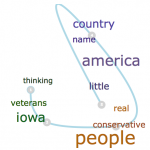
I wanted to try the tool, so I looked around for another recent speech that might contrast with the SOTU. Sarah Palin’s Iowa speech has been widely panned on the right as well as the left, being called a “tragedy”–or at least “an interminable ramble.” I pasted the text into Plot Mapper and this is what I got:

Screen Shot 2015-01-27 at 11.37.14 AM

I actually think the quality gap between these two texts is a little obscured by this form of analysis. “America,” “country,” and “people” seem to play similar roles in both speeches. We also see an actual organizing structure to Palin’s words: she moves from nationalism through right-populism (real people are conservative) to conclude with the local (veterans in Iowa). Finding such an arc may be giving the speaker a bit too much credit. Nevertheless, the tool has enormous potential for comparing discourse. I’d be especially interested in using it to analyze how people affect each others’ ideas when they deliberate.

The post diagramming Sarah Palin’s Iowa speech appeared first on Peter Levine.