Fusion Partnerships Wins Social Activist Award

We hope you’ll join us in congratulating NCDD supporting/founding member Polly Riddims and the wonderful team at Fusion Partnerships on recently being awarded the Social Activist Award from the Justice Studies Association. We are proud to count Polly and her team as part of our NCDD community, and we hope you’ll take a moment to read the Fusion team’s statement on their award below. 

On Friday, May 30, 2014, Fusion Partnerships, Inc. received the Social Activist Award from the Justice Studies Association in recognition for their continuing work for justice and well-being in Baltimore. The award was presented during their 16th Annual Conference “Revisiting to Revisioning: Restorative Justice to Transformative Justice” at Towson University, May 29-31, 2014. Polly Riddims, Managing Partner and Jim Kucher, Board Chair were there to accept the award.

Through collaborative action, including fiscal sponsorship, Fusion Partnerships works to be a catalyst for social justice and peace. Fusion currently provides fiscal sponsorship and incubation support for over 65 community based program in the Baltimore region working for social change. These projects are making a difference in areas of youth development, health and nutrition, gender and LGBT issues, criminal justice reform, racial justice, and the arts.

Fusion was established in 1998 to educate and facilitate community building and collaborative efforts toward social change. Through work in the community, Fusion found many underserved grassroots community leaders with great new ideas, entrepreneurial projects and innovative strategies, struggling to do their best with little financial support and without access to the nonprofit resources. Fiscal sponsorship provides an opportunity for individuals or groups tocarry out their ideas, where they can succeed and grow, and create a space for collaborative work and sharing of resources.

Justice Studies Association (JSA) is an international not-for-profit membership association established in 1998 to:

  • Foster writing and research about, the practice of, and activism for, justice without violence;
  • Provide venues in the form of an annual conference and a journal of progressive thought to tackle pressing issues of criminal, social, restorative, and economic justice;
  • Foster a sense of community among scholars, activists and practioners of justice interested in creating a global community in which the needs of all are met; and
  • Welcome scholars from all disciplines to think and write about issues of justice from an interdisciplinary and global perspective.

New Reports on Civic Dialogue & Business Leaders

Our friends at the Network for Business Sustainability recently released two reports that we think NCDD members should note. The reports focus on the potential for business leaders to be more involved in civic dialogues, and we encourage you to read more about them in the NBS statement below.

Businesses have traditionally played little role in civic dialogue, but their involvement can help advance issues. The Network for Business Sustainability (NBS) has recently published two reports, written by Dr. Thomas Webler, that identify the potential for business involvement in civic dialogue.

The reports are aimed at a business audience, and can serve to introduce businesses to civic dialogue concepts. We hope that they will also be useful for anyone seeking to understand business perspectives or the value of engaging businesses in dialogues.

The reports are:

Both are freely available. We very much appreciate thoughts and feedback, and will evolve the reports accordingly. Comment on the report webpage or by sending a note to Maya Fischhoff at mfischhoff@nbs.net.

About the reports and NBS

NBS is a non-profit based at Western University (Canada) which connects research and practice around sustainable business. Each year, NBS’s Leadership Council of leading Canadian businesses identifies priority issues. For 2013, they asked: How can businesses help citizens become informed, inspired and engaged in a national dialogue about sustainability?

This project represents an innovative collaboration between research and practice. Researcher Dr. Thomas Webler summarized the best academic and practical research available on civic engagement. A working session of leaders from the business, non-profit and academic communities provided extensive feedback, which Dr. Webler incorporated into the final documents.

The Village Square’s Creative Civic Conversations

We recently read a great piece in the Christian Science Monitor that featured one of NCDD’s organizational members, The Village Square, and we hope you’ll take a few moments to read it. Much like the Albany Roundtable that we just recently featured on the blog, The Village Square is creating a civic infrastructure that brings people together for regular conversations on local politics.

The CSM article, titled “Civil Discourse That Doesn’t Taste Like Broccoli”, was penned by NCDD member Liz Joyner, who works for Village Square, and details the history and approach of this innovative organization. In it, Liz details how The Village Square has taken its inspiration from our nation’s early days of politics:

In the early 1800s, things weren’t looking particularly good for the American experiment in self-governance. Coming to Washington with differences of opinion natural to a vast new land, early legislators lived and ate in boarding houses that became entrenched voting blocs. Thomas Jefferson wrote that these men came to work “in a spirit of avowed misunderstanding, without the smallest wish to agree.”

Apparently neither human nature nor legislatures have changed much since.

Jefferson’s solution was to bring lawmakers to the White House in diverse groups for good dinner and conversation. Two hundred years later, The Village Square takes a page from his book when we invite politically diverse citizens to break bread at our “Dinner at the Square” series or “Take-out Tuesday” town meetings.

As Liz notes, the concept of a coming together in a village square is not in any way a new idea. Yet in a time when we have grown disconnected from our communities and polarized into echo chambers of like-minded people, creating a common space to come together with those we disagree with is increasingly a radical idea.

The Village Square project exists to help create and hold that space:

…The Village Square engages people socially around civic issues – bringing neighbors back in relationship with each other across ideological difference. People aren’t built to reexamine the basics of their positions unless they feel some sense of friendship and common purpose with those suggesting they do so.

But as Liz notes, getting folks from our polarized, siloed communities to sit down and talk is some times like pulling teeth. That is why Village Square takes a fun and playful approach to its serious civic work.

To address this challenge, our irreverently named programs are part civic forum, part entertainment. Each event is casual (the stage is set up to feel like the facilitator’s living room) and involves sharing food. As we begin, we give out two “civility bells,” ask that the audience avoid tribal “team clapping,” and share a quote to inspire our better angels. We welcome fluid audience participation and always try to laugh.

From here our formats vary widely – ranging from huge community dinners with a panel and social time, to 20 elected officials moving from table to table in “Speed Date your Local Leader,” to a barbecue competition between a Republican and Democratic commissioner.

It’s creative ideas for bringing people together that The Village Square is bringing to cities in Florida, California, and Missouri – and hopefully more. We encourage you to read Liz’s full article in the Christian Science Monitor, which you can find at www.csmonitor.com/Commentary/Common-Ground/2014/0611/Civil-discourse-that-doesn-t-taste-like-broccoli, and learn more about The Village Square at http://tothevillagesquare.org.

Featured D&D Story: Class Discussion on Gun Violence

Today we’d like to feature a great example of dialogue and deliberation in action, a class discussion on gun violence from University of Missouri. This mini case study was submitted by NCDD supporting member Sarah Read of the Communications Center, Inc. via NCDD’s new Dialogue Storytelling Tool. Do you have a dialogue story that our network could learn from? Add YOUR dialogue story today! 


ShareYourStory-sidebarimageTitle of Project: Class Discussions on Gun Violence

Description

Last summer I was asked to redesign and teach the Public Policy Dispute Resolution class at the University of Missouri School of Law which I then taught in the fall semester. At the outset of the semester, the students were asked to write an essay about why they had enrolled and what they hoped to learn.

The majority of those essays reflected the students’ deep concerns, as citizens, with the partisan nature of our political discourse and their frustration at how quickly discussions on difficult issues, even with friends and family, turned into name-calling and debate. The students expressed a desire to better understand and address such things as “media-fueled divisiveness”, lack of “nuance in everyday politics”, and “polarization”. They also asked to learn about how points of view form, how policies are made, how to help opposing groups communicate, and how to “explore the area between two extreme views.”

These questions were discussed in the first part of the semester when we focused on skills such as conflict mapping, question framing, and use of non-adversarial dialogue patterns, and the use of different processes to navigate conflict. The last third of the semester focused on actually applying this learning to a difficult dialogue, and the topic chosen by the class was issues relating to gun control or violence.

The classes that followed were designed to allow the students to directly experience how the choice and sequencing of dialogue structures (here informal dialogue, through a World Cafe type forum, to a more deliberative issue forum), paired with dialogue-based phrasing, can change the usual scripts used in discussion of a politicized, highly charged issue like gun violence.

To focus the discussion students were given a real-world hypothetical of adopting a policy on who could carry guns in public schools. This hypothetical used the demographics of an identified nearby school district and a law that had been recently adopted in Kansas. Class members came into the discussions with a wide range of viewpoints (which had been reflected in their prior essays) and were loosely assigned roles as community members.

The two students who agreed to serve as (i) a school board member highly supportive of both the law and of allowing more guns in the schools, and (ii) the superintendent responsible for managing budgets, safety, personnel, and overall administration, received more detailed supporting information for their roles. They were instructed to raise or share thoughts and information as seemed natural or appropriate in the discussions.

Although starting from very different places, the students were (to their surprise), over three sessions, able to reach unanimous agreement on an interim policy that could be placed into effect immediately. Much of this progress had to do with how the dialogues were sequenced.

Which dialogue and deliberation approaches did you use or borrow heavily from?

  • National Issues Forums
  • World Cafe
  • Conversation Cafe

What was your role in the project?

Professor / Convener

What issues did the project primarily address?

  • Crime and safety
  • Education
  • Partisan divide

Lessons Learned

The sequencing of different dialogue processes, with time off between sessions, when done thoughtfully, can substantially lessen the overall in-person time needed for groups to come to agreement. Sequencing also allows for better option development, and promotes more productive deliberations at the time deliberative thinking is required. This is because successful resolution of complex issues requires integrative thinking about several different factors – information, interests, values, and rules or standards.

Integrative thinking takes time. Sequencing discussions can provide the necessary time for new ideas and options to emerge. Effective integrative thinking within a group also takes trust in the others that you are making decisions with. Without trust, information is discounted and risk to one’s personal interests is likely to take precedence over the effects on others in the community.

Simply put, building trust requires an effort to build relationships. Building relationships also takes time, and multiple contacts. By sequencing conversations so that deliberation does not occur too soon allows for better relationship development.

Where to learn more about the project:

Read full series of posts here: http://buildingdialogue.wordpress.com/2014/03/15/teaching-the-navigation-of-difficult-dialogues-intro.

Featured D&D Story: Class Discussion on Gun Violence

Today we’d like to feature a great example of dialogue and deliberation in action, a class discussion on gun violence from University of Missouri. This mini case study was submitted by NCDD supporting member Sarah Read of the Communications Center, Inc. via NCDD’s new Dialogue Storytelling Tool. Do you have a dialogue story that our network could learn from? Add YOUR dialogue story today! 


ShareYourStory-sidebarimageTitle of Project: Class Discussions on Gun Violence

Description

Last summer I was asked to redesign and teach the Public Policy Dispute Resolution class at the University of Missouri School of Law which I then taught in the fall semester. At the outset of the semester, the students were asked to write an essay about why they had enrolled and what they hoped to learn.

The majority of those essays reflected the students’ deep concerns, as citizens, with the partisan nature of our political discourse and their frustration at how quickly discussions on difficult issues, even with friends and family, turned into name-calling and debate. The students expressed a desire to better understand and address such things as “media-fueled divisiveness”, lack of “nuance in everyday politics”, and “polarization”. They also asked to learn about how points of view form, how policies are made, how to help opposing groups communicate, and how to “explore the area between two extreme views.”

These questions were discussed in the first part of the semester when we focused on skills such as conflict mapping, question framing, and use of non-adversarial dialogue patterns, and the use of different processes to navigate conflict. The last third of the semester focused on actually applying this learning to a difficult dialogue, and the topic chosen by the class was issues relating to gun control or violence.

The classes that followed were designed to allow the students to directly experience how the choice and sequencing of dialogue structures (here informal dialogue, through a World Cafe type forum, to a more deliberative issue forum), paired with dialogue-based phrasing, can change the usual scripts used in discussion of a politicized, highly charged issue like gun violence.

To focus the discussion students were given a real-world hypothetical of adopting a policy on who could carry guns in public schools. This hypothetical used the demographics of an identified nearby school district and a law that had been recently adopted in Kansas. Class members came into the discussions with a wide range of viewpoints (which had been reflected in their prior essays) and were loosely assigned roles as community members.

The two students who agreed to serve as (i) a school board member highly supportive of both the law and of allowing more guns in the schools, and (ii) the superintendent responsible for managing budgets, safety, personnel, and overall administration, received more detailed supporting information for their roles. They were instructed to raise or share thoughts and information as seemed natural or appropriate in the discussions.

Although starting from very different places, the students were (to their surprise), over three sessions, able to reach unanimous agreement on an interim policy that could be placed into effect immediately. Much of this progress had to do with how the dialogues were sequenced.

Which dialogue and deliberation approaches did you use or borrow heavily from?

  • National Issues Forums
  • World Cafe
  • Conversation Cafe

What was your role in the project?

Professor / Convener

What issues did the project primarily address?

  • Crime and safety
  • Education
  • Partisan divide

Lessons Learned

The sequencing of different dialogue processes, with time off between sessions, when done thoughtfully, can substantially lessen the overall in-person time needed for groups to come to agreement. Sequencing also allows for better option development, and promotes more productive deliberations at the time deliberative thinking is required. This is because successful resolution of complex issues requires integrative thinking about several different factors – information, interests, values, and rules or standards.

Integrative thinking takes time. Sequencing discussions can provide the necessary time for new ideas and options to emerge. Effective integrative thinking within a group also takes trust in the others that you are making decisions with. Without trust, information is discounted and risk to one’s personal interests is likely to take precedence over the effects on others in the community.

Simply put, building trust requires an effort to build relationships. Building relationships also takes time, and multiple contacts. By sequencing conversations so that deliberation does not occur too soon allows for better relationship development.

Where to learn more about the project:

Read full series of posts here: http://buildingdialogue.wordpress.com/2014/03/15/teaching-the-navigation-of-difficult-dialogues-intro.

CM Conference Call on Inclusive Communities, Thurs. 6/12

CM_logo-200pxWe are happy as always to announce that CommunityMatters, a collaborative effort in which NCDD is a partner, is hosting its next capacity building conference call this Thursday, June 12, from 4-5pm EST.  This hour-long conference call will focus on inclusivity and what it means to build inclusive communities.

This month’s call features thoughts from Moki Macias who is the Director of Community Building at the Annie E. Casey Foundation’s Atlanta Civic Site and from Tramunda Hodges who also works at the Foundation’s Atlanta Civic Site as Community Building Coordinator.  Moki and Tramunda will share their experience with promoting equal treatment and opportunity in community decision-making, and we are sure it will be a great opportunity for NCDD members to gain helpful insights around inclusion in our work.

You can find more about the call at www.communitymatters.org/event/inclusive-communities, and we encourage you to register for the call today by clicking here. We hope to have you join us on Thursday!

KF Interviews Imagining America Codirector

We recently read a fascinating interview with Imagining America codirector Timothy Eatman that our organizational partners at the Kettering Foundation published that we want NCDD members to see. IA’s work in bridging academia and public engagement is critical to advancing our field, so we encourage you to read Timothy’s thoughts on how we get there below. You can find the original interview here.

kfIn a recent column in the New York Times, Nicholas Kristof laments that scholars are too often unimportant and “irrelevant,” producing “gobbledygook . . . hidden in obscure journals.” Kristof goes on to say that “over all, there are, I think, fewer public intellectuals on American university campuses today than a generation ago.” Whether real or perceived, the sentiment that scholars are disengaged is shared by many.

However, on a number of fronts, higher education is enjoying a renewed commitment by scholars to community-centered research and teaching. The Kettering Foundation and many others have referred to this as “public scholarship.” The term “public scholarship” may strike you as a little funny: we don’t typically think of scholarship as public or even publicly accessible. So what’s this all about?

Imagining America: Artists and Scholars in Public Life (IA), a national consortium of publicly engaged scholars headquartered at Syracuse University, has for many years drawn attention to these challenges. The program was launched in 1999 at the White House. The founding partners were the University of Michigan, the Woodrow Wilson National Fellowship Foundation, and the White House Millennium Council, led by Hillary Clinton. Today, IA has more than 100 member institutions.

Imagining America LogoTimothy Eatman serves as codirector of IA and holds a faculty appointment at Syracuse University’s School of Education in the department of Higher Education. He also serves as an affiliate faculty member in the Communications and Rhetorical Studies Department. Jack Becker recently sat down with him for a couple of discussions before and after the 2013 Imagining America National Conference, which brought together several hundred participants from across the country and around the world to ask the powerful question, “How do we catalyze artists, designers, and humanists, and tap the power that their fields represent, to open us up to innovative, 21st century ways of demonstrating the relevance of the academy and of impacting our pipeline of young adults?”

Jack Becker: What kind of space does the Imagining America annual conference open up for thinking about democratic engagement?

Tim Eatman: It’s the space being used for over a dozen years to affirm this work. It helps connect graduate students and scholars to a conversation around civic engagement that they might not be able to have at their university or at their disciplinary conference.

We need a space to just be able to air some of these issues, particularly in the academy. Particularly in Research-One institutions. This is a traditional space. We think we are stimulating and catalyzing a community that sees room for scholarly research to thrive, but also feels that in the 21st century we can have a larger continuum of knowledge creation. This supports the idea of academic freedom and agency.

Part of the challenge is encouraging faculty to think of their pedagogy differently, in ways that harness the knowledge and thinking of students as colearners and colleagues; this orientation changes the dynamic of the classroom. We’re pushing for that as well. What does it look like when we position students as colearners? A lot gets left on the floor in terms of possibilities when we don’t engage students more deeply.

Promoting “publicly engaged scholarship” is one of Imagining America’s core activities. What is publicly engaged scholarship, and is it in tension with conventional forms of scholarship?

Publicly engaged scholarship has an emphasis on the reciprocal dynamic of knowledge making. An orientation of the campus that values the knowledge-making capabilities of the community; a posture that values community-located knowledge in ways that we don’t tend to do much of in the Ivory Tower. It also includes larger efforts to transform the culture of higher education.

So, the key question is, what is the impact our scholarship has on our community? It’s good to have ways to champion each other (faculty and scholarship), but what is the impact?

There has to be space for scholars who want to be engaged in clinical esoteric research and advance knowledge, and there has to be space for those that want to work with teachers, not as, to channel Harry Boyte here, not as experts on top but as experts on tap. When I go into a teacher’s classroom, I can’t tell them anything much about that environment; they know that environment. So it’s a different posture when you go into an environment and say, “you know what, I have some things to learn, I have some things to teach, yes, but how can we think together about what the consequence of our work is and can be?”

The challenge from a policy standpoint is, faculty are going to do some of that anyway, but not in a way they could if that work were valued in the rewards system. On that note, the Tenure Team Initiative has been an important program of IA that focuses on improving the rewards system in academe for faculty who practice engaged scholarship in the cultural disciplines and seeks to develop a broad understanding of the university’s public mission and its impact on changing scholarly and creative practices.

Issues of faculty rewards are among the most traditionally treated issues in the academy. Trying to create space to value something other than traditional forms of knowledge making is difficult work—look I don’t have any argument with that—I too was a master’s and doctoral student stationed with an assigned carrel in the stacks immersed in reading and rigorous theoretical and analytic work. But our relevance in the 21st century requires that we have to have more sophisticated options than collecting and discussing things; we have to engage that work, we have to be able to demonstrate the verity and impact of that work for purposes of societal amelioration.

So, we need our bench chemist, but there’s also space within the continuum of knowledge creation and practice for the engaged chemist that takes students into the community to examine homes with lead paint and analyze samples to explore the scientific principles that that analysis affords, but also takes the next step to connect with policymakers and community leaders to bring the kind of energy to bear that will make that situation better.

So much of the democratic engagement on our college campuses seems to pivot out of the liberal arts. Imagining America has broadened this focus to look at the humanities, arts, and design, among other areas. Particularly, how do the arts enter into the realm of democratic engagement?

One of our key questions is, how does art awaken that sense of civic agency? If we are a consortium that pivots on the arts, then we need some kind of expression of that. The D.R.E.A.M. Freedom Revival, led by IA associate director, Kevin Bott, is one avenue for this expression. Periodically, the Freedom Revival comes together to hold engaged musical performances where audience members are asked to join in; they might come on stage to testify to their dreams for their community as well as their struggles. We focus on all kinds of issues: education, healthcare, democracy, among others. In these performances we believe we are contributing to a broader democratic revival that encourages community members to commit to this revival.

Thinking about the idea of a revival of civic agency is powerful. We are trying to harness the notion that the oldest democracy in the world was here in Syracuse, the Onondaga Nation. In these performances, we use a community-engaged model to stimulate participants in an awakening of that history and connecting it to contemporary issues. This is one way IA is operating to connect to our understanding of the power of artistic expression, in addition to our work around tenure and other initiatives.

I think of IA’s work in the arts as creating spaces where hearts and spirits meet minds for deep, sustained, impactful, knowledge creation and healing. And we use words like spirit, heart, and healing because those things are achieved with the arts in a way that other disciplines don’t; art stimulates things that other disciplines don’t and creates spaces that aren’t otherwise there.

Syracuse University has worked very hard to strengthen ties with the broader community. For former chancellor Nancy Cantor, this investment in the community went well beyond the push to extend teaching and learning into the community, but to invest in physical infrastructure—buildings and pathways that connected the university and community, what she referred to as “third spaces of interaction.” How should this fit into our thinking about the spaces our campuses occupy?

This whole Connective Corridor and The Warehouse is developing a district that supports thinking about space—how we occupy space and how that space opens us up to the community. It’s one thing to understand the value of this, it’s another thing to get the resources. One of former Syracuse chancellor Nancy Cantor’s approaches has been to invest in space. Things that are attached to the ground mean something to the community. The Warehouse, in downtown Syracuse, was an eyesore in this community. As I understand it, there was a financial bond that Syracuse owed New York State from a residence hall they had built. So instead of paying the state through the bond, Syracuse University built a space to improve the community. This is leveraging resources and shifting mindsets and discourses. People begin to talk and think about what it means to be a Syracuse citizen and have their space and city expressed through the eyes of artists and citizens.

The Connective Corridor and Near Westside Initiative, [initiatives started by Syracuse University as a means of bolstering the community-university relationship and investing in space] means nothing without important partnerships in the area. They get grants to invest in community, and Syracuse doesn’t have total control of the money. Nancy Cantor understood a deeper commitment was needed. When you empower the community, it makes a difference. It’s a different way of thinking about institutions of higher education and creating third spaces, between the university and the community. Building relationship with strength and a sense of cohesion is difficult.

The point here is that there is something very important about the nexus between higher education institutions and the community that can be leveraged for good or for ill. I want to be part of a nexus of individuals that embolden the disciplines in a way that will expand knowledge creation and helps develop solutions to pressing public problems.

You can find the original version of this interview at http://kettering.org/kfnews/making-scholarship-tangible.

Facilitating & Introversion: Tips for Engaging Quiet People

We recently read a great piece on bringing out the gifts of introverted people over at NCDD supporting member Janice Thomson’s blog, Citizenize-Citizenise. Janice has been working with the Chicago chapter of the International Association of Facilitators on developing resources for effectively engaging quieter folks, and we think they could be quite useful to our members. You can read Janice’s piece below or find the original here.


“Stop the madness for constant group work. Just stop it!” pleads Susan Cain, author of Quiet: The Power of Introverts in a World That Can’t Stop Talking. Group work, she claims, stifles some of the most insightful and creative thinkers and inflates the influence of extroverts. To generate the best ideas, workplaces and schools need to provide more solitude for deep reflection and creative thinking.

As a facilitator, her critiques made me wonder. Do the group processes I use marginalize important voices and perspectives? Is it possible to design meetings and workshops to fully involve introverted participants? I started a conversation around these questions with fellow facilitator Margaret Sullivan and together we designed a workshop to test our ideas and learn from others.

This blog summarizes learning from our “Facilitating Introverts” workshop held May 16, 2014 with the International Association of Facilitators (IAF), Chicago chapter. We warmly invite additional suggestions for how to include introverts in meetings and workshops!

What’s an introvert?

The concept of introversion originated with psychologist Carl Jung who noticed that people tend to be energized either by going inward in quiet reflection (introverts) or outward in interactions with people (extroverts). Later personality theorists added concepts like how one processes information, sensitivity to novelty and stimulation, and attitudes toward privacy and public attention.

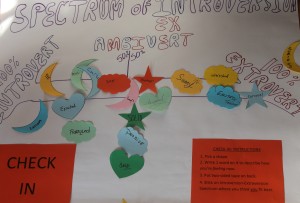
Spectrum of Introversion Photo: Al Rush

Introversion/extroversion is a spectrum (see top photo). The population is roughly equally divided between the two halves and most people fall somewhere toward the middle. Although most people can function in both introverted and extroverted ways, they prefer one or the other. So, traditional group work, which is designed for extroverts, can indeed disadvantage introverts. To rectify this imbalance, it is necessary to first understand the special needs and gifts of introverts.

Importantly, since nobody functions exclusively as an introvert or extrovert, it would in fact be more accurate to discuss facilitating introversion or incorporating introverted processes into group work. This however is linguistically and conceptually cumbersome. So, for clarity, we simply use the term “introverts”.

Needs and gifts of introverts

Reflecting on the ideas of personality theorists and considering group situations that challenge introverts, we created a list of needs and gifts of introverts relevant to group work.

Important themes include:

  • Managing energy. Introverts are drained by social interaction and need alone time to recharge.
  • Processing time. Introverts take in lots of multi-layered information. They may therefore need more time than extroverts to process information, reflect, and decide what to say. They also need to understand expectations so they may prepare in advance.
  • Privacy and caution. Introverts do not like to call attention to themselves and can be reticent to share their ideas — especially if they are not yet fully formed or may provoke conflict.
  • Meaning and focus. Introverts are drawn to meaningful conversations and can go deep into subjects. Conversely, they get overwhelmed when multiple themes are discussed simultaneously.
  • Deep listening. Introverts can be very attentive listeners. They may notice things and make connections that extroverts miss. They also ask great questions.
  • Writing and non-verbal expression. Many introverts prefer to communicate in ways other than talking and may be skilled at writing or drawing.
  • Creativity and imagination. Introverts have rich inner lives which can lead them to uncover valuable insights and generate creative solutions.

Tools and techniques to involve introverts

Using these needs and gifts, we brainstormed tools and techniques to help introverts feel comfortable, meet their needs, and share their gifts in group work. We then added ideas culled from online facilitator forums and workshop discussions. We offer this initial list of tools and techniques for facilitating introverts to facilitators as thought-starters in designing group processes.

An introvert-friendly workshop

To demonstrate what an “introvert-friendly” workshop might look like, the methods we used in our own “Facilitating Introverts” workshop and why we chose them are described below.

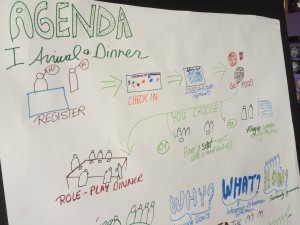
I. Arrival and Dinner

Arriving at a meeting or workshop can be uncomfortable for introverts, especially if they don’t know anyone. So it’s important to consciously design an experience to put them at ease. We provided:

Photo: Al Rush

Visible agenda. Introverts like to know what to expect, including when they may need to contribute. We displayed a large visual agenda at arrival and reviewed it at the start of the workshop.

Greeter and host. While extroverts can just dive into unstructured social situations, introverts welcome some assistance. Participants were met by a greeter at a registration table and a “host” who mingled and made sure everyone was comfortable – e.g., introducing people and suggesting activities.

Nonverbal check-in. Fun, non-verbal activities done at one’s own pace can be an easy warm-up and help facilitate connections. We invited participants to write their mood on a colored shape and place it on an introversion-extroversion spectrum chart. This also introduced a core concept of our workshop, showed who was in the room, and provided a “temperature check”.

Reflection pond. This served as both “graffiti wall” and “parking lot”. Introverts don’t like to draw attention to themselves or provoke conflict so it’s good to offer ways to share anonymously. They can also get overwhelmed when multiple topics are discussed simultaneously. So it’s useful to use methods like “parking lots” to keep conversations focused.

Dinner choices. It’s important to never label a person or activity as “introvert” or “extrovert”, but rather to offer choices that allow participants to manage their own energy. For dinner, we offered three options: mingling informally, sitting in small groups, or participating in a facilitated “role play” game. We also kept novelty and stimulation low by providing familiar food (pizza) and calming music.

Role play dinner. Since introverts may be reticent to draw attention to themselves, role play games can help them speak more freely. We created a scenario where five famous introverts and five famous extroverts worked together on a project team. Participants described how their character (e.g., Eleanor Roosevelt, Marie Antoinette, etc.) would feel and behave in different group situations. This provided both structured group interaction and a playful introduction to workshop themes.

Flexible meeting space. We chose a meeting space, the Thinkubator, that provides many seating options, nooks and crannies, and an outdoor deck for different types of group interaction and solo breaks.

II. Opening

After introducing the topic, we created community agreements that included:

  • Moment of silence. Because introverts take in so much information, they sometimes need extra time to “catch up”. To create opportunities for this, we created “silence” signs anyone could use to request the group to be quiet for a few minutes – no explanation needed.
  • Breaks. Introverts sometimes need alone time to recharge. So we gave participants permission to take a break at any time, for any reason, no questions asked.
  • OK to pass. Introverts sometimes need additional time to formulate their thoughts. So, in structured go-arounds and sharing times, participants can “pass” and talk later.
  • Don’t hold back. “Quieter people” were reminded that they too have contributions valuable to the group and not to “hold back” sharing.

Homework and paired sharing. Introverts like to come prepared to meetings. Assigning homework is one way to achieve this. We asked participants to watch Susan Cain’s TED Talk to prepare. The first social interaction was low-key: sharing one thing learned from this video with one’s neighbor.

III. Needs and Gifts

An individual “scenario reflection” exercise was used to identify introverts’ needs and gifts. Three situations were described that can be challenging to introverts: 1) arriving at a meeting of strangers, 2) being asked to share one’s viewpoint early in a meeting, and 3) a meeting on a contentious issue.

To share ideas, we planned a structured go-around using a talking stick. This gives introverts the floor without them having to ask for it, but also lets them “pass” and speak later if they aren’t ready to talk.

IV. Tools and Techniques

We began with individual brainstorming, followed by a 20 minute discussion in groups of 3-4 people to modify and add to our initial list of tools and techniques. Especially with introverts, it’s important to begin brainstorming individually. A group size of 3-4 people allows sharing, but is comfortable to introverts.

Here’s a 1 minute video of the entire workshop (thanks to Gerald and Steve at the Thinkubator):

V. Post-event

Introverts often get their best ideas after a meeting or workshop – i.e., once they’ve had time to fully process its content and reflect alone on its meaning. So it’s important to provide a method, such as an online forum, to continue sharing and discussion after the event. That is one goal of this blog.

What do you think?

Margaret and I are sharing this blog with both the Chicago IAF workshop participants and the broader facilitation community. We invite suggestions of additional tools and techniques, needs and gifts, and thoughts on “facilitating introverts”. Please leave your comments below in “Leave A Reply”. You may also post a comment on the Chicago IAF Facebook page or Linked In group.

If there is sufficient interest, we might offer this workshop again, perhaps in modified or expanded form. Please use the contact form to let me know of your interest in organizing or assisting with a future workshop.

You can find the original version of this blog piece at www.janicethomson.net/facilitating-introverts-eliciting-the-gifts-of-the-quiet-ones.

Ten Equity & Action Tools from Everyday Democracy

Our organizational partners at Everyday Democracy recently shared a compilation of their top 10 resources for dialogue and deliberation practitioners that we highly encourage you to check out. They provide guidance on issues from incorporating racial equity into our work to training youth facilitators and are valuable tools for deepening our work. You can read more about the resources below or find EvDem’s original post by clicking here.


EvDem LogoOver the past 25 years, our most important source of learning has been from the deep partnerships we have had with formal and informal leaders in communities from every region of the country. People come to us from places of all sizes and demographics, and with a wide variety of histories, assets and concerns. As we have coached them, we have learned with them, and as a result have created and adapted advice and tools that others can learn from and adapt to their particular situations.

Some of the lessons we have learned from our community partners include:

  • How community coalitions can work together to organize large-scale dialogue and action;
  • How to recruit a broad diversity of residents for dialogue, facilitation, and action;
  • How to engage those who are often left out or marginalized;
  • How to frame an issue so that people of all backgrounds and views can find their voice in the conversation;
  • Ways to use an intentional “equity lens” so that organizing, dialogue and action can take into account and address the underlying inequities and power dynamics of the community;
  • How to bridge dialogue and intentional action strategies;
  • How community voice and participation can change the way public instutions such as school systems and police departments work;
  • How to link community voice with policy-making;
  • How to embed dialogue and change processes in the regular culture and practices of the community.

Many of these lessons are captured the tools and advice you will find on our website. The tools that were most frequently clicked on in recent months reflect an interest in applying these lessons in other communities. Here is a sampling of our “readers’ favorites” of the recent past:

1. Facing Racism in a Diverse Nation

This six-session discussion guide helps all kinds of people take part in meaningful dialogue to examine gaps among racial and ethnic groups and create institutional and policy change.

2. Action Road Map Planning Tool

This Action Road Map will help communities walk through the steps we need to take to carry out a plan for action. Using this worksheet, you will think about the people, places, and things in your community that can help you reach your goals. Each action team should create their own Action Road Map.

3. Protecting Communities, Serving the Public

This five-session discussion guide is designed to help communities bring police and residents together to build trust and respect, develop better policies, and make changes for safer communities.

4. Guide to Training Public Dialogue Facilitators

A Guide for Training Public Dialogue Facilitators is a comprehensive training curriculum. This guide includes advice for creating a training program for both youth and adults, with expanded facilitator training, plus suggestions for ongoing support and evaluation of dialogue facilitators.

5. Organizing Community-Wide Dialogue for Action and Change

This comprehensive guide will help you develop a community-wide dialogue to change program from start to finish.

6. Personal Cultural Timeline Exercise

This activity will help the group get to know each other better and understand our histories. The facilitator should post large sheets of paper with the timeline written on it for participants to add their events. Follow the instructions in the handout below to facilitate the discussion.

7. Building Prosperity for All

Building Prosperity for All is for people in rural communities and small towns who are working to move from poverty to prosperity. This resource was designed to benefit communities that participated in dialogue-to-change programs using the guide, Thriving Communities: Working Together to Move From Poverty to Prosperity for All. However, no prior experience with Thriving Communities is necessary to get involved.

8. Strong Starts for Children

This five-session discussion guide helps people get involved in an important issue facing all of us: the well-being of our youngest children. The guide looks at how we are connected to the lives of children in our community and the “invisible” effects of racism and poverty. It also guides people in developing plans for action.

9Focusing on Racial Equity as We Work

Organizing groups should review this list of questions, occasionally, to make sure they are working well together.

10. Facilitators’ Racial Equity Checklist

Following each dialogue session, facilitators should take some time to debrief and make sure they are working well together.

Please let us know what tools and supports you are using in your community, and what you are learning as you apply democratic principles and practices. We look forward to working and learning with you, and to sharing your practical insights with others.

The original version of this post can be found at http://everyday-democracy.org/news/top-10-resources-creating-change#.U37rSPldUlr.

New Gettysburg Project Seeks to Bridge Research & Practice

We wanted to share the post below from the Ash Center for Democratic Governance and Innovation’s Challenges to Democracy blog highlighting an interesting new initiative to watch called the Gettysburg Project. Led in part by NCDD supporting member Dr. Archon Fung, the initiative explores the decline of public engagement and ways that we might improve the scope, diversity, and impact of organizing and mobilization of the public. You can read Xolani Zitha’s piece on the project below or find the original piece here


Ash logoHarvard Kennedy School faculty Archon Fung and Marshall Ganz have shared so many conversations over the years on the problems of American democracy, and specifically on failed efforts to improve the state of public engagement, that they decided together to do something about it.

Some months later, Fung and Ganz — along with co-organizers Anna Burger, Hahrie Hahn, and several others — have launched a unique initiative named The Gettysburg Project. The effort aims to both influence, and to pull inspiration from, the world of research and the world of practice. It will bring together scholars and practitioners with a wide range of interests to develop new understandings of consequential civic engagement in the United States.

At a meeting hosted by the Hauser Institute for Non Profit Organizations in April 2013, Professors Fung and Ganz first shared The Gettysburg Project with students. Below is a recap of that discussion, which progressed from the project’s background through its theoretical framework to its core activities.

Identifying and Acting Upon a Common Purpose

Professor Fung began the conversation explaining that the essence of The Gettysburg Project is a celebration of the 150th anniversary of President Lincoln’s Gettysburg Address, in particular the last line of the address—“government of the people, by the people, and for the people shall not perish from the face of this earth.”

And the Project’s first proposition is that democracy in the United States is in grave danger. Professor Ganz characterized the most salient challenge to democracy in the United States as the lack of opportunity for ‘equality of voice.’ This political inequality manifests itself in many ways, not the least of which is unequal voting participation. Ganz observed that this idea of equality of voice has been articulated by many, including Harvard political scientist Sydney Verba, who noted that liberal democracy is based on the deal that unequal economic resources be balanced by equality of individual political voice and participation.

Watch a presentation on The Gettysburg Project by Marshall Ganz and Archon Fung, hosted by the Hauser Institute.

Yet when we think of the common purposes articulated in the US Constitution, i.e. “forming a more perfect union,” what often comes to mind are establishing justice, ensuring domestic tranquility, and providing for the common defense. Thus Ganz posed the question, how does equality of voice translate into the capacity to achieve the primary functions of democratic government as spelled out in the Constitution?

Ganz went on to say that Alexis de Tocqueville observed that the knowledge of ‘how to combine’ trumps all other forms of knowledge. In his observations on the emerging democracy of the United States, de Tocqueville was concerned with the problem of radical individualism. He saw a solution in multiple stripes of civic associations, the point of which was not about having many competing groups but rather many ways in which individuals could come into relation with other individuals. Through the process of coming together, individuals learn to move beyond their narrow self interest. They move toward an enlightened self interest and a broader understanding of common interests and common purpose.

In addition to a critical role in articulating a common purpose, and thus making real the aspirations articulated in the Constitution, at the same time civic associations also develop our capacity to act on behalf of those interests. Through civic associations, or what de Tocqueville described as combination or coming together, equality of voice can translate into the power or the capacity to achieve common purpose.

Yet according to Ganz the mechanisms through which people come together and discern common purpose, then translate that purpose into collective action in the public domain, are dysfunctional and not working. Civic associations have become seriously crippled.

The Unresponsiveness of Public Institutions

Ganz argued that our public institutions are meanwhile too often opposed to preferences expressed by the public. For example, when Congress will not vote for issues that have overwhelming public support such as background checks for firearms licensing. Similarly, the debate over the cause of radical and growing inequality of wealth asks whether inequality is a manifestation of specific policy choices or the failure of public institutions.

This lack of responsiveness is a symptom of a deeper problem that economist Albert Hirschman has written about. Any political system will ultimately run down, and the challenge becomes correcting the deterioration. Hirschman found that voice mechanisms are one solution, in which those affected by the dysfunction of the system express their dissatisfaction in ways that will result in the system correcting itself. Through the process of competitive elections and public deliberation, democracy becomes a self-correcting mechanism through which ‘voice’ can work.

Archon Fung referred to Martin Gilens’ compelling research on the plutocratic nature of democratic government at present. On issues in which there are class differences in preferences, policymakers are responsive only to the top 10% of the population

If voice turns out not to work, then the alternative for citizens is to exit the system. Where there are competing institutions, individuals can choose to leave. There is a “tipping point” when everyone deserts an institution if no corrective action is taken. In the context of entrepreneurial capitalism in which firms compete, and the most efficient succeed, exit is an available strategy.

But in democracy, is exit an option? The Gettysburg Project is premised on a belief that it is an option with the ‘knowledge of how to combine.’ But a second premise is that the mechanisms for inputting an effective voice and something meaningful coming out the other end of the policy process are broken. Further, there are two strategies to exit in a political system. First, people can stop voting when they realize that voting does not make a difference. In only six states did it make a difference whether or not you voted in the 2012 presidential election.

The other exit is to seek private solutions for public problems such as contracting with private sector firms or non-profits. The result of this is that it weakens our capacity for public action, resting on the belief that privatization brings market mechanisms to solve public problems. There is some evidence to the contrary.

Building Organizational Capacity to Return to Equality of Voice

The focus of The Gettysburg Project is how to bring ‘voice’ back into the system in a meaningful way. But is the problem with individuals? Some would say that people don’t have enough civic virtue and are discouraged from participation, so they resort to an individualistic political culture. Or is the problem is with institutions? The electoral system itself is biased, while the role of money in politics makes the system dysfunctional.

There are a lot of people working on issues at the individual level covering civic education and culture, focusing on getting individuals to exercise more voice. There is a lot of other work on the structural side focusing on campaign finance reform, better voting machines, or getting rid of the Electoral College. In between the individual and the institution is the organizational level, at which people come together to exercise collective action in the de Tocqueville sense.

The Gettysburg Project assumes that none of these things will happen unless associations get together, especially the kinds of organizations that engage and mobilize broad sections of the American population in public life. In the 19th and 20th centuries, the organizations that did the job of integrating people are not able to anymore because the approaches that worked then are not working any more. Identifying the new structures that will replace labor unions and congregations will represent a solid step forward for American democracy.

Fung observed that The Gettysburg Project will also seek to build the capacity and strength of existing organizations that engage and mobilize people in public life. The Project will explore how much of the challenge has to do with internal organizational functioning, with how much organizations do or do not cooperate with each other, with the ways in which organizations try to influence public policy or electoral politics, and even with the effect of the Internet. There is an internal, horizontal, and external dimension to understanding the challenges of voice and public participation.

The Project’s intention is to bring together a group of 20-30 leaders of organizations with a successful track record in mobilizing people and activity. Individual participants are senior enough to have the capacity to change, the willingness and curiosity to figure things out, and many more years still left in their careers. They represent a variety of settings and contexts, allowing for a rich understanding of the nature of this problem from an organizational point of view.

An early meeting at the Roosevelt Institute in Hyde Park, New York brought together leaders from labor unions, community organizations, Dreamers, and others to test the idea. Surprisingly all organizations felt that they were in some way stuck in a rut in this area. And these leaders did not know about each other, even though they worked in the same field. Professors Ganz and Fung next hosted the first formal convening of The Gettysburg Project in March 2014. Check back on the blog for future updates on the key themes and discussion points that come up throughout the project.

You can find the original version of this post at www.challengestodemocracy.us/home/frontiers-of-democracy-research-the-gettysburg-project/#sthash.5fPnS9dZ.dpuf.