Power of Dialogue Training Sept. 18-20 from PCP

We are pleased to announce that the Public Conversations Project is hosting a great dialogue training Sept. 18-20 which features a steep discount for NCDD members. PCP is an NCDD organizational member and we are proud to have them as one of our NCDD 2014 All-Star Sponsors. Find out more about the training below or by clicking here.

Public Conversations ProjectDo you work with groups challenged by deep differences? Do you need new ways to help them engage? Join Public Conversations in Minneapolis on September 18-20 for our signature workshop, The Power of Dialogue.

This Public Conversation Project signature workshop offers a deep exploration of Reflective Structured Dialogue, an intentional communication process to reduce threat and foster mutual understanding across lines of deep difference. Through immersion in an intensive case simulation, participants will learn about the dynamics of polarization and conflict, and explore modes of communication that increase understanding, re-humanize opponents and shift relationships. Learn more and register.

Learn:

  • The dynamics of polarization and conflict, including the effects of strong emotion on our capacity for communication
  • The difference between the intent and impact of speaking
  • Ways of speaking, listening, and asking questions that open up conversation and relationships
  • Core components of Reflective Structured Dialogue

Develop:

  • A “dialogic” mindset: the ability to create a space for multiple complex or conflicting views
  • Questions for personal reflection, opening dialogue and shaping conversation

Experience:

  • The process of dialogue – preparing participants, planning, facilitating, and participating – via an extended dialogue simulation
  • The power of connecting with practitioners from different fields who are committed to transforming conflicted conversations

We encourage you to learn more about this great opportunity and to take advantage of the NCDD discount! Find out more and register at http://events.r20.constantcontact.com/register/event?oeidk=a07e9qm0j6f08c7992b&llr=c55866bab

Participate in Conversation Day in NYC, Aug. 30th

We want to make sure that our NCDD members, especially those of you in and around NYC, are aware of a very cool event called Conversation Day coming up this Saturday. We received the announcement below from NCDD Sustaining Member Ronald Gross, and we encourage you to check it our or find our more at www.conversationsnewyork.com.


Join us on Saturday, August 30th, at 3 pm in Bryant Park, located between 40th and 42nd streets between 5th Avenue and the Avenue of the Americas (6th Ave.), at the Fountain on the west edge of the Park. RSVP ASAP to reserve your  place to grossassoc@aol.com.

Conversation Day is a celebration of the joys and benefits of Good Talk, presented by Conversations New York in concert with our friends in Boston, San Francisco,  London, and Paris and as far afield as Kuala Lampur — by talking the talk here in the Big Apple!

Join us at 3 pm in Bryant Park on the 30th. Look for us wearing colored hats (red/yellow/blue/green). Exact location and details will be provided when you RSVP to grossassoc@aol.com.

OR… Do-it-yourself! You can hold your own conversation anytime during that day or evening, anywhere in NYC, indoors or outdoors, with old friends or new ones.

The simplest thing you can do to show your support of the day is to simply have a conversation with someone you don’t know!

To go one step further, just bring together a few people (4-6 is ideal), and choose an enjoyable and meaningful topic or two to talk about (suggestions below or on reverse of flyer).

If you like, partner with a friend to be co-convenors. If you want to enlarge your circle even further, consider using MeetUp to announce your event.

A Few Possible Topics for Your Conversations

Here are a few topics for consideration – or ask for suggestions from your participants, then vote, and talk about the top two or three choices.

  • What is happiness and how can we make ourselves happier?
  • What makes New York City great (for you) – and how might we make it greater (for all of us)?
  • What is health and how can we achieve it?
  • Who in history or nowadays do you most admire as a human being, and why?
  • What’s on your bucket list: the things you’d most like to do in the rest of your life?
  • What lessons does history teach us?
  • What concerns do you have about privacy today, in areas ranging from your health, your employment, your on-line life, your politics, your relationships, or…?
  • Or create some of your own!

For more information, or to let us know what you did, and how it went, please contact us at grossassoc@aol.com. Our website is www.conversationsnewyork.com.

Conversation Day in NYC is inspired by Global Talk-to-Me Day, a project of Talk to Me London.

Introducing Grande Lum and his work at the US Dept of Justice’s Community Relations Service

I want to draw your attention to the important work being done by the Community Relations Service of the Department of Justice in communities like Ferguson that are in crisis. The director of the Community Relations Service, Grande Lum, is one of our featured speakers at the 2014 National Conference on Dialogue & Deliberation coming up in October, and we’re honored to be following his work and to be able to hear from him at the conference.

Grande-LumThe Community Relations Service (CRS) is often called “America’s Peacemaker.” Over the years, CRS has worked with thousands of communities, many of whom came together in crisis and emerged stronger and more unified. CRS delivers four services: mediation of disputes, facilitation of dialogue, training, and consulting.

Their must-see resource page provides tips and best practices for police, schools, community leaders, and others who find themselves at the center of crises revolving around division and inequity.

In an August 18th press release from the Department of Justice on the federal civil rights investigation into the death of Michael Brown, Attorney General Eric Holder highlighted the work of the Community Relations Service in Ferguson, Missouri:

In order to truly begin the process of healing, we must also see an end to the acts of violence in the streets of Ferguson. Those who have been peacefully demonstrating should join with law enforcement in condemning the actions of looters and others seeking to enflame tensions.

To assist on this front, the Department will be dispatching additional representatives from the Community Relations Service, including Director Grande Lum, to Ferguson. These officials will continue to convene stakeholders whose cooperation is critical to keeping the peace.

And an August 20th post on BuzzFeed covers how the mayor of Sanford, Florida (the town where Trayvon Martin was shot not long ago) has urged Feruson to welcome the help of the Justice Department and especially its Community Relations Service, saying it “saved the day” in Sanford.

trayvonprotestTriplett, who is white, was the man in charge a year-and-a-half ago when the killing of Trayvon Martin spiked racial tensions in the area and far beyond. A situation that many expected to explode into violence, didn’t. Peaceful protestors were met with respectful police and public officials.

Triplett credits the the Department of Justice for the calm and in an interview Tuesday he urged Ferguson leaders to embrace the help the feds have to offer. In his town, Triplett said federal officials arrived with experience on how to handle large crowds and engage with protest movements.

They had tips on police tactics, too. “The best thing that you can do is use your mind and your mouth versus an nightstick and a gun. You know, ‘violence breeds violence’ type thing. These guys [Justice Department advisers] have been there, done it, they’re very astute,” Triplett said.

“We on the city side, we fix roads. We make sure your lights turn off and on. We make sure your toilets flush. We cut ribbons for new businesses. So you’ve got to rely on those that know.” Justice Department officials are engaged in Ferguson in full force, with six agencies on the ground in the Missouri town coordinating a federal investigation into the death, monitoring police behavior and trying to build a bridge between authorities and protesters through a previously little-known department branch called the Community Relations Service.

The agency, which has ten regional offices across the country, is specifically designed to diffuse tension after discrimination-charged events and was established as part of the 1964 Civil Rights act. On Wednesday, the head of CRS, Grande Lum, will be in the Justice Department party accompanying Attorney General Eric Holder on his trip to Ferguson.

Holder has been very critical of the police response to protests in Ferguson, and Justice Department officials have pointed to the early involvement of CRS as proof the feds have a better handle on how to deal with the Ferguson protests than local authorities do.

Read the full BuzzFeed article at http://www.buzzfeed.com/evanmcsan/doj-in-ferguson#1gu9nsk for LOTS more interesting content.

CRS-officesCRS has 10 Regional Directors who supervise conflict resolution specialists (also called conciliation specialists) in regional offices and 4 smaller field offices. These offices are strategically located throughout the country to meet the unique needs of the states and communities they serve.

The Regional Directors are highly trained professional mediators, facilitators, trainers, and consultants who are experienced in bringing together communities in conflict to help them enhance their ability to independently prevent and resolve existing and future concerns.

Regional Directors oversee the regional conflict resolution teams in the development of customized and proactive local solutions. The 10 regional offices are located in Boston, New York, Philadelphia, Atlanta, Chicago, Dallas, Kansas City, Denver, Los Angeles, and Seattle. The field offices are located in Miami, Detroit, Houston, and San Francisco. The regional and field offices increase the availability of CRS services to rural communities and aid in rapid deployment during crises.

Grande Lum will be speaking during the closing plenary at the 2014 NCDD conference. Learn more about Grande here, and register today to join us at the conference!

Grande is also a Supporting Member of NCDD, and you can learn more about him on his member page. Also see NCDD’s previous blog post about Top #NCDD Resources for Addressing Racial Conflict & Inequality.

Pastors, Scientists to Continue “Perceptions Project” Dialogues

The team at Public Agenda, an NCDD organizational member and Partner of our upcoming national conference, has been reflecting on their experiences facilitating the Perceptions Project – a series of dialogues between scientists and evangelical Christian pastors – in a fascinating series on their blog. We encourage you to read the second reflection on their bridge-building work below, or find the original version here.

PublicAgenda-logoAs we make the final preparations for the next set of Perceptions Project dialogues, I can’t help but think back to our first dialogues in Pasadena.

We spent considerable time preparing for those conversations, between evangelical pastors and scientists. We worked with our partners on the project, AAAS (the American Association for the Advancement of Science), thinking about who should participate and how the dialogues might unfold. We anticipated the tensions that might emerge – tensions that could stall conversation between the two communities. And we thoughtfully planned ways to surface areas of common ground and shared understanding.

Yet despite the many hours of planning that led up to the dialogues, I was unable to foresee what it would feel like to be in them. What I hadn’t, and perhaps couldn’t, anticipate was how eager participants would be to talk to one another and ask questions about each others’ experiences. While there was some tension between the groups, the overarching theme was curiosity.

One interaction in particular has stayed with me since that first dialogue. We were discussing the manner in which scientific data is presented in popular media. A few pastors expressed frustration with the seemingly constant stream of new evidence that is presented as fact yet often appears to be contradictory.

In response, several scientists described the scientific method. They also noted that they are limited in the claims they can make based on a single study and expressed their own frustration at the way their findings are often presented—and inflated—in the media without sufficient context or qualification.

This was an “a-ha” moment for one pastor who, prior to the dialogues, assumed that scientists were responsible for how their findings were presented in different media outlets.

That “a-ha” moment reminded me of the critical role that dialogue can have in connecting us in spite of our differences. For the Pasadena participants, dialogue provided an opportunity to break down misconceptions and provide each group insight into how the other community operates.

As the next dialogues approach, I eagerly anticipate the “a-ha” moments that lie ahead and wonder what questions participants will ask of one another that will deepen their understanding of each others’ experiences.

You can find the original version of this Public Agenda post at www.publicagenda.org/blogs/when-curiosity-reigns.

New Grant Initiative Seeks to Address Polarization

NCDD members may want to look into the Madison Initiative, an exciting exploratory grant initiative from the Hewlett Foundation. Hewlett is hoping the initiative can address the problem of polarization in the US, especially in Congress. You can learn more from Hewlett’s press release below or by visiting www.hewlett.org.


Exploratory Project Seeks to Strengthen Representative Democracy in U.S.

HewlettFdn-logoMenlo Park, Calif. — It is hard to look at events of the past few years without concluding that democracy in America is in trouble. Surveys routinely find that most Americans think poorly of the federal government and, in particular, of Congress. Such frustration and mistrust do not bode well for our system of government.

Against this backdrop, The William and Flora Hewlett Foundation announced today that it is launching a new initiative to help alleviate the problem of polarization, with a special focus on the problem in Congress. The foundation will invest $50 million over the next three years in what it is calling the Madison Initiative. It will use this initial phase of grantmaking to assess whether and how it can help strengthen the nation’s representative institutions so that they are better able to address the major issues facing the country—and do so in ways that work for the American people.

The Initiative takes its name from James Madison, who warned against “the mischiefs of faction.” He and the other Founders designed a system of government built on representative institutions meant to foster negotiation and compromise. They understood that governing a nation as extensive and diverse as the United States would require leaders capable of reaching agreement among, and on behalf of, people and groups with different and often conflicting interests, beliefs, and agendas.

Reflecting its Madisonian roots, the Initiative will have the foundation joining forces with other funders, civic groups, and leaders—in and outside of government—working to restore pragmatism and the spirit of compromise in Congress; to reform campaign and election processes so they set the stage for problem solving; and to promote a more informed and active citizenry.

Hewlett’s approach is unequivocally agnostic on particular policy outcomes outside of democracy-enhancing reforms. The Initiative is based on the premise that the health of a representative democracy is measured not by whether any particular policy is adopted, but by whether its institutions are working in ways that most people find acceptable.

“Strengthening the ability of democratic institutions to find solutions is better for everybody in the long run, no matter which political party is seen to benefit in the short term,” said Larry Kramer, president of the Hewlett Foundation and former dean of Stanford Law School. “We want to see better and more productive debate and deliberation on the most challenging problems facing society, which are simply not being addressed at the moment.”

The Madison Initiative will be explicitly bipartisan, engaging with and supporting nonprofit grantees from the right, left, and center who share the goal of improving representative democracy in the United States.

The Hewlett Foundation is not the first grant maker seeking to shore up the country’s flailing democracy. There are many other donors in the field. Ellen Alberding, president of the Joyce Foundation, a longstanding funder in this area, observed, “We are delighted to have the Hewlett Foundation joining this effort. They are bringing a powerful vantage point and a collaborative spirit to their work, and we look forward to working with them to advance the goals we have in common.”

The Initiative has been structured as an exploratory effort in which the foundation will invest $50 million over the next three years; if the preliminary grantmaking is seen as promising, the Foundation will return to its Board of Directors for additional funding in 2017.

About The William and Flora Hewlett Foundation
The William and Flora Hewlett Foundation helps people build measurably better lives. The Foundation concentrates its resources on activities in education, the environment, global development and population, performing arts, and philanthropy, and makes grants to support disadvantaged communities in the San Francisco Bay Area. A full list of all the Hewlett Foundation’s grants can be found here.

Contact:
Jon Jeter
Communications Officer
communications@hewlett.org

Parker Palmer’s book “Healing the Heart of Democracy” now out in paperback

One of NCDD’s most well-known and well-loved members, Parker Palmer, alerted me today that one of his newest books, Healing the Heart of Democracy, is soon to be available in paperback.

Here’s what U.S. Congressman John Lewis, had to say about the book: “We have been trying to bridge the great divides in this great country for a long time. In this book, Parker J. Palmer urges us to ‘keep on walking, keep on talking’—just as we did in the civil rights movement—until we cross those bridges together.”

The paperback edition includes a detailed discussion guide with links to 40 brief online videos where the author talks about key issues in the book. You can download the discussion guide, the videos, tips for organizing a discussion group, and more at www.couragerenewal.org/democracyguide.

HealingHeartDemo-coverThe Guide makes it easier and more attractive for people to gather in families, neighborhoods, classrooms, congregations, etc., and learn to talk with each other across lines of political difference. That’s what “We the People” need to do to reclaim the power of civic community in an era of divide and conquer politics.

In his email this morning, Parker wrote, “I know you’re as concerned as I am about the sad state of American democracy. ‘We the People’ are the only answer. But there can be no ‘We’ until more of us learn to value our differences, hold them creatively, talk across our divides and seek the common good so we can hold our leaders accountable. That’s what this book is about and that’s why I’m eager to get the word out, especially as we approach mid-term elections.

Among the many positive reviews, “Democracy & Education” called the book “one of the most important…of the early 21st Century.” In a Starred Review, “Publishers Weekly” said, “This beautifully written book deserves a wide audience that will benefit from discussing it.”

You can pre-order the paperback version at Amazon here, and you can visit the book’s website at http://lp.wileypub.com/healingtheheartofdemocracy/ where you can watch a video, read the Prelude, and find purchasing options.

Have you already read Healing the Heart of Democracy? Let others know what you thought of it in the comments!

New Study Finds Surprising Lack of Red-Blue Divide

We want to share the announcement on an insightful new study that we know will interest NCDD members that comes from NCDD supporting member Steven Kull of Voice of the People. VOP teamed up with the Program for Public Consultation to conduct a study on public policy opinions that has some pretty surprising results. You can learn more about the study in Steven’s announcement below or find the study by clicking here.


vop logoA new study conducted by NCDD members at Voice of the People and the Program for Public Consultation finds remarkably little difference between the views of people who live in red (Republican) districts or states, and those who live in blue (Democratic) districts or states on questions about what policies the government should pursue. The study analyzed 388 questions asking what the government should do in regard to a wide range of policy issues and found that that most people living in red districts/states disagreed with most people in blue districts/states on only four percent of the questions.

The study titled, “A Not So Divided America,” contradicts the conventional wisdom that the political gridlock between Democrats and Republicans in Congress arises from deep disagreements over policy among the general public.

The study analyzed questions from dozens of surveys from numerous sources including the National Election Studies, Pew, major media outlets, the Chicago Council on Global Affairs as well as the Program for Public Consultation. Responses were analyzed based on whether the respondents lived in red or blue districts or states.

  • On only four percent of the questions (14 out of 388) did a majority or plurality of those living in red congressional districts/states disagree with the majority or plurality in the blue districts/states.
  • For a large majority of questions – 69 percent – (266 of 388), there were no statistically significant differences between the views in the red districts/states and the blue districts/states.
  • For 23 percent, or 90 questions, there were statistically significant differences in the size of the majority or plurality, but the dominant position in both the red and blue districts/states was on the same side of the issue.
  • Thus for 92 percent of questions people in red and blue districts and states basically agreed.

The full study can be found at http://vop.org/wp-content/uploads/2014/07/Red-Blue-Report.pdf.

The report’s appendix with the survey questions analyzed can be found at http://vop.org/wp-content/uploads/2014/07/Red-Blue-Appendix.pdf.

Public Agenda Convenes Scientists, Evangelical Pastors for Dialogue

Public Agenda, an NCDD organization member, recently shared the piece below on their blog that we wanted to share with you. It is part of a series of pieces from the PA team reflecting on the experience of facilitating dialogue sessions between scientists and evangelical Christian pastors, and it’s fascinating. You can read the piece below or find the original here.

PublicAgenda-logoWhen I told people that I was headed to LA to facilitate a conversation between evangelical pastors and scientists, most reactions fell somewhere between surprise and cynicism. “Why bother,” asked a friend, “when they’re never going to agree on anything anyway?”

But a strange thing happens when you get a small group of people together in a room for a facilitated dialogue: they listen to one another. And instead of trying to persuade the group to support their worldviews, the pastors and scientists each respectfully introduced themselves and explained why they do what they do for a living. Similarities emerged right off the bat: curiosity, compassion and an unyielding search for truth.

It wasn’t long before the conversation took on a lighter tone. One participant, a reproductive biologist, acknowledged the tension in the room as he explained his research: “We already covered religion and politics,” he said, “so I figured I’d throw sex in there too.”

And there were profound moments as well, like when a scientist explained that he wasn’t 100 percent certain of anything, and that all scientific theories exist only until proven false. “What you just said makes me feel safe,” a pastor replied, “because many of the scientists I know seem so definite in their beliefs, so I don’t feel comfortable expressing my faith.”

Three hours later the group had hammered out areas of common ground and ideas for next steps to foster collaboration between the two communities. But more importantly, the conversations continued well past the end of the formal discussion. Most participants lingered in the room and talked, exchanging contact information and discussing how to keep the conversation going.

As a facilitator, it was humbling to witness a group of people overcome significant differences to explore how to work together to improve their community. Let’s hope that they can continue to defy expectations and set an example for the rest of us.

The original version of this piece is available at www.publicagenda.org/blogs/defying-expectations.

Community-Building Arts Project from Tamarack

We wanted to share a write up from Axiom News that featured a great initiative in Canada led by NCDD organizational member Tamarack. The lessons learned from this arts-based project to support community building are valuable for all of us, so we hope you’ll take a moment to read the Axiom piece below or find the original version here.


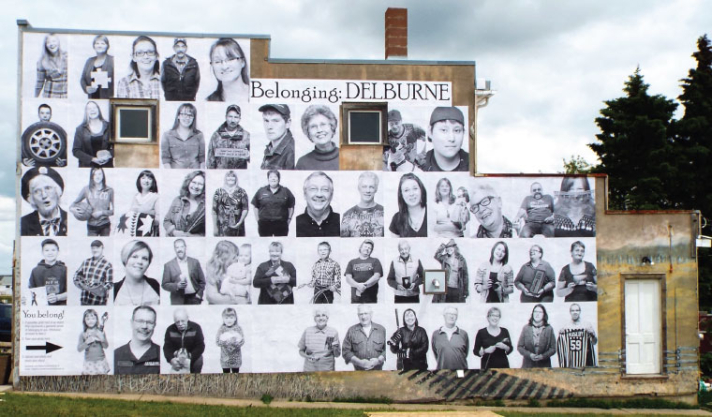
Massive, Main Street Photo Exhibit ‘Shifts Feelings’ in Alberta Community

The Village of Delburne, located halfway between Calgary and Edmonton, Alberta provides a model for communities looking to engage residents in setting priorities and making decisions on what matters.

Earlier this year the village engaged in the “1,000 Conversations Across Canada” initiative championed by Tamarack, the Institute for Community Engagement.

The intent of the 1,000 Conversations campaign is to help shape communities by promoting the idea that citizens can collaborate and communicate with one another to create positive change.

Close to half the village population of about 830 representing a broad cross-section of the community participated in the conversations, a related survey, and an art project geared to strengthening the community’s sense of connection.

For the art project, internationally renowned portrait artist John Beebe collaborated with the village to create gigantic photos of local residents. These were then wheat-pasted on multiple exterior building surfaces throughout the village. The village school featured a collection of about 140 portraits.

Delburne Family and Community Support Services (FCSS) community worker Nora Smith has been a key champion of all of these efforts, but has been especially struck by the possibilities in art as a community-building tool.

“There’s something incredibly powerful in tying the art element into the community development piece,” says Nora. “I can’t really put my finger on it, but I know it’s there just by the way I watched the community members stop and appreciate each other.”

The art project is “shifting the feeling” in the community, which testifies to the foundational level of change that Nora and others are investigating through this community engagement process. The work is largely about the biases and prejudices that shape one’s thinking and therefore one’s way of being in society. “If we can start shifting people at that level, that would be fantastic,” Nora says.

Delburne residents have now identified and voted on the following four priorities for their community:

  • Main Street revitalization
  • Health and Wellness
  • A Belonging Delburne project (which includes the art project)
  • A communication project
  • Plans are underway to re-engage in the Fall to flesh out tangible action plans within each of these four priorities. These plans will be revisited on a yearly basis to gauge accomplishments and reevaluate priorities.

Delburne represents a growing shift amongst communities and neighbourhoods in Canada to focus on stronger resident engagement, reducing the “role” of the local government in deciding what gets done and what doesn’t.

What other communities can learn from Delburne:

  • Be strategic about engaging people. Paul Born’s book, Community Conversations, offers valuable insights on how to ensure everyone who should be at the table is there.
  • People inviting those they have a relationship with to participate in the community engagement process is critical to ensuring strong engagement.
  • Trust the process. “It’s so easy as someone working in community development to want to give the answers,” Nora says. “Have faith that the answers are eventually going to come out of the community itself.” It’s important that the answers do emerge this way, to ensure sustainability as residents “own” the actualization of these answers.
  • Strengthening community engagement is a process: it takes time and work.
  • Strongly consider integrating the art element into community development efforts.

This story is part eight of a series focused on placemaking and other citizen led initiatives. To read the other entries in this series, visit the original post here.

You can find the original version of this Axiom News piece at www.axiomnews.com/massive-main-street-photo-exhibit-%E2%80%98shifts-feelings%E2%80%99-alberta-community.

CM’s 4 Tips for More Inclusive Communities

Our partners at CommunityMatters recently put together a useful list of tips for creating more inclusive communities to go along with their recent conference call on the same topic. We wanted to make sure to our members see these pointers, so we encourage you to read CM staffer Caitlyn Horose’s write up below or find the original CM blog post by clicking here

CM_logo-200pxWhat do you do to make people in your community feel welcome? How do you create opportunities for people from all backgrounds to participate fully in building and improving your community?

Creating an inclusive community isn’t easy, but many places are finding ways to start building a more inclusive and welcoming culture.

Here are four strategies from cities and towns committed to inclusivity—share your own stories and ideas in the comments!

1. Make a statement. Riverside, California developed a, set of principles for building a more inclusive community. Their Inclusive Community Statement identifies the responsibilities of individuals, groups and institutions for achieving this common goal. Through maintaining an openness to dialogue, building intergroup partnerships and providing education about diversity the principles set a path toward fair treatment and equal opportunity for all residents of Riverside.

2. Spread the word. Signs line the streets in Newark, California signifying the city’s ongoing efforts to foster acceptance and inclusion.

3. Welcome newcomers. How do newcomers in your city learn about local people and places? Communities in the West Kootenay and Boundary regions of British Columbia developed welcomemap.ca, The website welcomes new immigrants to the area, and provides easier access to local information and services. Similarly, British Columbia’s North Shore developed a short video that illustrates the power of individual action in welcoming newcomers. Both efforts are part of British Columbia’s Welcoming and Inclusive Communities Initiative.

4. Adopt a resolution. Greenacres, Florida, Fort Worth, Texas and many other cities and towns have demonstrated a commitment to inclusion through the adoption of a public resolution. The National League of Cities offers a sample resolution that communities can use and build from.

On June 12th, Moki Macias and Tramunda Hodges of the Annie E. Casey Foundation will join CommunityMatters to share their experience promoting equal treatment and opportunity in community decision-making at the Foundation’s Atlanta Civic Site. Join this call to hear more ideas and strategies for building inclusive communities. You can see the notes and listen to the call here.