Help NCDD Explore a D&D Youth Leadership Initiative

Some of you may have heard already on our Discussion Listserv that, as part of our continued commitment to cultivating “democracy for the next generation,” NCDD’s director Sandy Heierbacher asked me to help conduct a scoping project to explore what possibilities there are to potentially launch a youth leadership /emerging leaders program within the NCDD network.

IMG_7985We are already collecting input from NCDD’s student and young professional members (young folks/students, share your input on our survey for a chance to win $50, and write to me at roshan@ncdd.org to join our youth conference call Jan. 25th at 7pm ET!) , but we are also looking for ideas and suggestions from the broader NCDD community on the big picture questions of:

  1. How you think NCDD might best support students and young people who are interested in or want to be involved in the D&D field? And,
  2. What role would you want to see young people who are part of NCDD playing in the Coalition? What kinds of contributions could you imagine them making and/or see the network supporting them to make?

So we are looking to start a discussion here on what you think NCDD as an organization and as a community could potentially do to cultivate more opportunities for and leadership from young people – who are the next generation – in our field.

We are open to hearing any and all of your thoughts on these bigger questions for our field. And to help get the conversation started, we also want to invite you to think about a few more specific questions:

  • What do you think is THE most important and/or effective thing that NCDD and the D&D community could do to support you getting more involved in the D&D field?
  • What other programs, schools, organizations, etc. do you know of that already are doing a good job getting young people involved in D&D work? What are others doing that we could learn from or build on?
  • Is there anything else that NCDD and the D&D community should do, change, keep in mind, and/or work on to support youth and student involvement and leadership in this field?

We know there are a lot of possibilities for potentially creating more programmatic or organizational supports for young people looking to join the D&D field, and thinking together with our brilliant NCDD members is a great way to unearth some of the best of those potentials.

We hope that you will take a few moments to contribute your input to our ongoing exploration in the comments section below. We hope to harvest the ideas that this discussion generates by the end of the month, so please chime in soon!

Thanks so much for all that you do, and of course, thank you for continuing to support NCDD!

Register for the Facilitate ’15 Online Conference, Feb. 20

We want to encourage NCDD members to attend Facilitate ’15, an online conference being organized by former NCDD Board member Lucas Cioffi of Qiqo Chat where attendees can host their own sessions, in addition to those being offered. Regular registration is $50, but NCDD supporting members are eligible for a 30% registration discount! Today is the last day for the early bird rate of just $30, so make sure to learn more in the announcement below and register today.


The Facilitate ’15 Conference

Facilitate ’15 is an interactive conference is all about the cutting edge of facilitation. Meet innovators working in dozens of fields. Experiment with new technologies, and co-create new solutions to challenges you’re facing.

Active & Experiential Learning

Not only will we talk about the cutting edge, we will actively explore it with all the technologies that you and your fellow participants bring to the table for testing.

You can schedule a session on any topic and use any facilitation technique and any online tool that you have access to! If you do not have a preferred tool, an easy-to-use group video chat tool will be available as the default.

Who Will Attend

This event is for facilitators who want to

  • share leading practices,
  • run experiments with new techniques and technologies,
  • and participate in others’ experiments.

Agenda

Feb 1: Online Collaboration Begins. We will open an online collaboration space for sharing leading practices, brainstorming, and deeper conversations.

Feb 13: Pre-Conference Networking

  • 12-1pm EST: You can expand your professional network through speed networking using your webcam and/or phone (your choice).

Feb 20: Conference

  • 11am-12pm EST: Opening Plenary Session (phone + website)
  • 12-3pm EST: Participant-Led Discussions & Experiments (webcam)
  • 3-4pm EST: Closing Plenary Session (phone + website)

Participation

Some folks are concerned that they don’t want to pay if there aren’t going to be many people there.  Well, there’s a guaranteed minimum of 35 participants by Feb 1st or the event will be free.

So you’ll either find a fantastic critical mass of peers willing to push the edge of the field and experiment with new facilitation techniques that they’ve brought to the table or everyone gets their money back and the event happens anyway, but just for the people who signed up by Feb. 1st.

You can learn more about Facilitate ’15 and register by visiting www.eventbrite.com/e/facilitate-15-tickets-15007043471.

Evaluation & Collective Impact Workshops from Tamarack

We want to make sure NCDDers know about two great workshops on evaluation and collective impact being offered this winter by the good people at Tamarack, an NCDD organizational member. We encourage you to read their announcement below or find out more at www.tamarackcommunity.ca.


As you plan your winter learning schedule, we invite you to two of our signature 3-day workshops that are designed to advance your work in community change.

Both of these workshops were completely oversubscribed in 2014, so we encourage you to register or Hold a Seat for these workshops today.

Evaluating Community Impact: Capturing and Making Sense of Outcomes

Liz Weaver and Mark Cabaj are leading the ever-popular Evaluating Community Impact workshop in Toronto, ON from February 23-25, 2015Each year, they carefully incorporate new tools and trends into the curriculum to ensure you are getting the latest and greatest information about how to capture, evaluate and communicate impacts in your community.

Recent upgrades to the Toronto curriculum will include:

  • How to employ hard and soft data to measure progress
  • New methods for capturing “systems change”
  • How to use narratives to communicate community impact to others

For a closer look at the workshop agenda, please visit our event agenda page.

Click here to Register or Hold a Seat for the workshop

Champions for Change: Leading a Backbone Organization for Collective Impact

Champions for Change is an advanced training offered by the Tamarack Institute in collaboration with FSG Social Impact Consultants and will be held in Calgary, AB from April 15-17, 2015.

Plenary sessions and workshops will be led by John Kania and Fay Hanleybrown of FSG, as well as Liz Weaver and Paul Born from the Tamarack Institute. Topics that will be presented include:

  • Deeply understanding the roles and impact strategies of the backbone organization
  • Developing and learning from shared measurement
  • Community engagement to build the will of your community
  • Making collaborative governance effective
  • Sustaining funding for collective impact over the long term
  • Working in complexity and the importance of adaptive leadership
  • Getting to true impact and systems change

For a closer look at the workshop agenda, please visit our event agenda page.

This dynamic learning experience is an important step for staff of Backbone Organizations and steering committee members of collective impact initiatives to develop their capacity as collaborative leaders.

Click here to Register or Hold a Seat for the workshop

Special rates are available for both workshops for teams registering three or more people. Please feel free to contact Kirsti if you have any questions.

We look forward to hearing from you and we hope that you’ll join us for these workshops for insightful learning and an opportunity to foster meaningful connections.

ALA Midwinter Meeting Includes Engagement Meetup

The American Library Association (ALA) has been focusing increasingly on community engagement and using libraries as spaces for civic dialogue recently. As part of that work, they sent out an invitation to a reception of engagement professionals during their 2015 Midwinter Meeting. We encourage NCDD members to read the invitation below and learn more about ALA at alamw15.ala.org.


An invitation for those of you attending ALA’s 2015 Midwinter Meeting:

Are you an expert in engaging your community? Or do you simply want to be? Join ALA’s Public Programs Office for a Libraries Fostering Community Engagement Reception at the 2015 Midwinter Meeting.

The gathering will be held from 5 to 6 p.m. on Saturday, January 31, at the Hyatt Regency McCormick Hyde Park/CC 11A (on-site at the convention center). Connect with like-minded library professionals at this informal networking reception. Share your ideas, vent your frustrations, and hopefully walk away inspired.

Light refreshment will be served.

Please add the event to your Scheduler at the following link so we can know how many people to expect: http://alamw15.ala.org/node/26873

If you have any questions, please contact Brian Russell at brussell@ala.org. Look forward to seeing you there!

This event is sponsored by the ALA initiative Libraries Transforming Communities (ala.org/LTC).

A Participant’s Reflections on NCDD 2014

We were so appreciative of the reflections on our 2014 National Conference on Dialogue & Deliberation that NCDD supporting member Cynthia Kurtz shared on her blog that we wanted to share them here on ours. There are great lessons she took away that all of us can learn from, so we encourage you to read her piece below or to find the original version here.


What I Learned at the NCDD 2014 Conference

So I’m back from my first real conference in ten years, and I learned a lot. This is the conference I mentioned a few blog posts back, of the National Coalition for Dialogue and Deliberation.

NCDDers-with-signs-borderThe first thing I learned was: I’m ten years older than I was ten years ago. Conferences have always been exhausting, but this one felt like a strange dream in which crowds of faces surged and receded while I surfed on crests of … of … lots of stuff. However, I survived; I have vague memories of the event; and I have some things to tell you.

Natural story workers

One thing that surprised me at the conference was how many people there do story work. Only a few people said they do story work, but a lot of people worked with stories in some way, while they were trying to get people to understand each other.

My initial reaction on pointing this out to myself was, “Sure, but they don’t really do story work. It’s not as intense or authoritative or authentic or deep or….” And in the midst of trying to justify myself to myself, I realized that I may be on my way to becoming pompous.

Do you remember the thing I’m always saying about how the best storytellers are the people who don’t realize they are telling stories? About how, once people begin to be proud of the quality of their storytelling, the quality of their storytelling declines? I’m starting to wonder if there is a parallel process in doing story work. Maybe the best story workers are people who work with stories without knowing it. Maybe, over the years, I have become not only a story performer but a story-work performer as well. I’d like to think I have passed through the story-work-performer state into a state of deep wisdom, where I have become both natural andskilled; but, alas, I find that my skills of denial cannot rise to the challenge of this assertion.

Solutions to pomposity and story-work performing I can come up with include the following.

  1. I could stop doing this work for a while – six months or longer – and see if the pomposity goes away. However, this is not an option, because I still have many promises to keep.
  2. I could keep reminding myself that I am not the owner of anything (except my good name) and that many people have had great ideas about story work. But I’ve been doing that all along, and it doesn’t seem to have saved me. No, humility alone is not enough. I need to take positive action.
  3. I am always encouraging people to share stories. So why don’t I encourage myself to share story work? If I can make a conscious effort to recognize, respect, and connect with the story work other people are doing – even if they don’t call it that, or maybe especially if they don’t call it that – I can regulate myself to open my mind to all forms of story work. I’ve done some of this in the past, but honestly, I’ve done far less than I could have done.

Number three is my new plan. One part of the plan is the “translation dictionary” idea, which I think I mentioned here before. This idea is to develop a set of (relatively brief, don’t worry) writings about how PNI connects to as many fields and approaches and methods as I can possibly find. Before I went to the NCDD conference, I thought I should build a translation dictionary because it would be helpful to you. Now I think I need it even more than you do.

My least-favorite assumption is still alive and well

I am sorry to tell you that the “story work means telling stories” assumption is still going strong. People are still very little aware of natural, everyday story sharing and the functions it provides in society and in communities and organizations. When people talked to me about ideas for using stories in their work, their first impulse was always to talk about how they might use stories to communicate with the public — i.e., to tell stories.

I don’t ever want to minimize the function of storytelling as purposeful communication. It is reasonable and laudable to convey essential messages through stories. However, if this is the only thing people think they can do with stories, or get from stories, that’s a sad thing. Because using stories to communicate is just the tip of the iceberg of what stories can do for a community or organization (or society). Those of us who care about stories have more work to do to get that word out.

It’s getting crowded in here

In More Work with Stories, I connect PNI with nine other fields. But I have been realizing lately that I could probably connect it with ninety, if I broadened the scope to methods and approaches as well. Getting involved with the NCDD has helped me to learn that I have been hiding in a hole in terms of the many ways people have developed to help people make sense of things together. Just because a method doesn’t say anything about stories doesn’t mean it doesn’t have anything to do with stories. If it has to do with people and communication, it has something to do with stories.

For example, as part of my NCDD learning, I recently bought The Change Handbook, which describes 61 methods for helping people create positive change. Can you guess how many of those 61 methods I was familiar with before I found the book? Eleven. Why have I not been building more connections? (Because I’ve been writing a book, that’s why; but still.) Now I want to know: How does PNI connect with the World Café? The Art of Hosting? Dynamic Facilitation? Wisdom Circles? Bohm Dialogue? Open Space? Systems Dynamics? Charrettes? Non-Violent Communication? Future Search? And so on.

This universe of connections is yet another reason to build a translation dictionary. I had been thinking about the dictionary as a way for people to understand PNI, and above I described it as a way I could share story work more completely. But a translation dictionary could also help people move back and forth between PNI and a variety of other methods as they build the suites and composites that best fit their contexts and purposes.

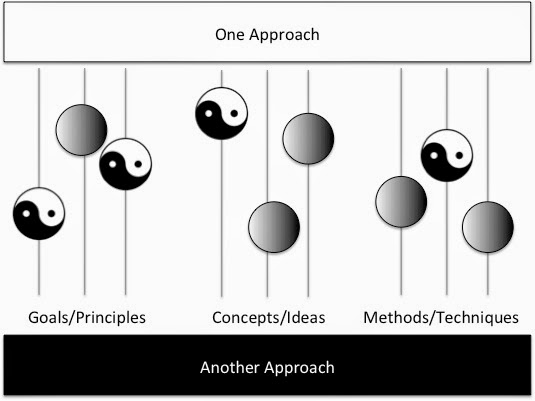
I started thinking through what a template for a translation dictionary might look like. I came up with this process:

  1. Summarize each of the two approaches with a paragraph or two. (One will always be PNI, but I’m trying to be general.)
  2.  Look for pairings in each of three areas: goals or principles; concepts or ideas; and methods or techniques. Come up with at least one and at most three pairings in each category.
  3. For each pairing, decide whether it’s a similarity or a contrast. If it’s a similarity, describe how the two elements are similar, and how they are (subtly) different. If it’s a contrast, describe how the elements differ, and how they are (subtly) similar or at least complementary.
  4. For each pairing, describe how it might be used in practice to combine what is best in the two approaches.

I visualize the whole pattern as something like this:

…where the grey circles indicate similarities, and the yin/yang symbols represent contrasts. Here I have vertical circle placements showing the relative centrality of each element to each approach, but that might be too fussy. I like diagrams, but I know some people would not get much out of the extra visual information.

So as I thought about this template, I realized that I had seen something similar before. What I was creating looked a little like a template for a pattern language. You could even say that my categories of goals, concepts, and methods are like the pattern language elements of context, problem, and solution.

Here’s a question for you: Everybody loves pattern languages, and rightly so, but why do we have to stop there? Could there be more kinds of languages than just of patterns? What about connection languages that, instead of describing patterns, describe connections? Might pattern languages, which are typically used within approaches (or transcending approaches), contribute to a lack of sharing among approaches? Maybe pattern languages could connect to connection languages, so that you could follow links from inside a particular approach, through its connection language, and into the pattern languages of other approaches.

What if lots of people made connection languages? What if, someday, it would be considered uncool to talk about one’s approach without also showing one’s connection language? What if connection languages were printed on cards, and people could use them to brainstorm about ways they could combine different approaches and methods to get results for their communities and organizations? What if, instead of going shopping for isolated approaches, groups could find the best combinations of methods and ideas for their contexts and purposes?

These are just wild speculations, and some might not agree with them. My plan right now is to make a start on my own connection language, using a template like the one above (which will evolve), and fold it into the second book. If you are interested in the idea of connection languages and want to work with me, or do something similar, let me know.

The great benefit of being in the wrong place at the wrong time

I went to the NCDD conference pretty much by accident. A champion of my book told me that he was going to the conference and planned to tell people there about my book. I said, hmm, what’s this, and if people there might like my book, should I think about going too? I had been thinking that I could start going to conferences again, now that my son is old enough that I can (stand to) leave home for a few days. So I joined the NCDD and signed up. (Sadly, my champion was not able to go due to a family emergency.)

Ending up in what seemed to be the wrong place at the wrong time was a revelation. Even though I might never have chosen this conference without someone else planning to go there first, it was just the right conference for me to go to. I have long complained about how there are no good story-listening conferences to go to, how people who do the work I do have to show up as beggars at knowledge management and decision support and management conferences. But I’ve now come to realize that this poverty is a strength in disguise.

I would have learned so much less at a conference where everyone already knew what I had to say, and where I already knew what everyone else had to say. It is so very mind-expanding to go to a conference you feel like you have no reason to go to! In fact, I am now resolved to seek out conferences that have as little as possible in common with what I have done before. If I will not be hopelessly lost and over my head, I should not go. If you know of a conference I should not go to, please let me know about it!

Essential energy

What excited me most about this conference was that I was able to connect with people who shared my passion for helping people get along and create better futures together. I sometimes feel alone in what I do, like nobody cares if we stop telling each other stories, like people are content to see stories used only to manipulate and influence. Our nascent PNI Institute is building a new community in the story space, so that’s changing already. But the people I met at the NCDD conference really cared about participatory democracy; about inclusion; about bringing power to the people; about bridging divides; about finding better ways forward. They didn’t consciously work with stories for the most part, but they cared about the things I cared about. Is this my tribe? I’m not a one-tribe person; I like to flit among several tribes. But this might be one of them.

The rest of the story

I have placed my full conference notes here for those who would like to read about what went on (that I saw) at the conference.

My favorite quotes from my conference notes:

  1. Where do you find the public voice? It’s not a trained voice. We hear it every day in every place. In waiting rooms, in bars, around water coolers, in lines at the grocery stores. It is all around us. So why is it unavailable? Because we don’t recognize it for what it is. It is too ordinary.
  2. There is no them once you know them.
  3. It’s healing for people to experience people with other beliefs just listening to them.
  4. Polarization is the antidote to American ingenuity.
  5. Deliberation by itself is not nearly enough when big systems have strong tendencies, and when a merciless climate clock keeps ticking. It is not just an absence of public voice, but strong structural problems. There needs to be an ongoing critical conversation about what our world needs.
  6. We need real human experiences, and a non-judgmental, non-politicized space to describe experiences.
  7. Instead of coming to agreement, we can take the need to agree away and simply try to understand each other. If you do that, it is easier to understand, and you get to deeper issues.
  8. We need to listen to each other in an open-hearted way. We need to have collaborative solutions that have the possibility of going to the next level of facing big issues.
  9. We learn from breaking things, making mistakes, trying to do things when we don’t know how. A game is like that: a challenge you need to approach via play. People know how to play games. If we want to make it accessible, we have to draw on things they know. Drawing on inherent forms of communication and action works.
  10. Giving people a voice ensures that justice and peace aren’t just about fighting each other. It’s the fact that people can work out their issues on their own. Justice will come about because of a common sense of peace.
  11. We have the world’s greatest renewable resource: creativity.

Hooray for creativity! And for collaboration.

You can find the original version of Cynthia’s post on her Story Colored Glasses blog at www.storycoloredglasses.com/2014/10/learnings-from-ncdd-conference.html.

IAF N. American Conference Content Proposals due Jan. 24

We want to make sure that NCDD members are aware of a great opportunity to participate in – and maybe present at – the International Association of Facilitators‘s 2015 North American Conference (IAFNA 2015), which will be taking place this May 14th – 16th in Alberta, Canada. The conference has recently released a call for proposals, and NCDD members are encouraged to submit conference proposals before the January 24th deadline.

Iiaf logoAF was one of the wonderful co-sponsors of our NCDD 2014 conference, and we know that IAFNA 2015 will be a great event that NCDD members will find useful. We want to thank them for supporting NCDD, and we hope you will support them as well!

The theme of IAFNA 2015 is Innovating, Promoting and Applying. This is a bit more on how IAF Canada, who is hosting the event, describes the conference:

The IAFNA 2015 Conference will weave the three learning streams Face-To-Face, Graphic (Visual), and Virtual through the Conference themes of Innovating, Promoting and Applying facilitation expertise. Additionally, the Saturday morning sessions will focus exclusively on how these three streams may be applied in Indigenous/Multi-Cultural situations within any nations. Coupled with the less structured other three half-days, we‘re inviting a wide variety of educational opportunities for our Delegates.

If you are interested in submitting a workshop proposal, you can get started by downloading the detailed call for proposals PDF file, which can be found by clicking here, and downloading the submission form, which you can find by clicking here.

The IAFNA 2015 conference organizers have this to say about content proposals:

All proposals should provide new concepts of high-quality content, solid training, and interactive learning experiences with a focus on application. The extensive range of facilitation experience and diversity of facilitators at all levels should be taken into consideration. Each workshop must be aligned to at least one of IAF‟s Core Facilitator Competencies:

  • Create Collaborative Client Relationships
  • Plan Appropriate Group Processes
  • Create and Sustain a Participatory Environment
  • Guide Group to Appropriate and Useful Outcomes
  • Build and Maintain Professional Knowledge
  • Model Positive Professional Attitude

We know that there are plenty of NCDD members who have valuable lessons and experiences to share with the IAF community, so we strongly encourage you to apply if you have an idea for a workshop! But content proposals are due Thursday, January 24th, so don’t put it off!

Good luck to all of those who submit content, and we can’t wait to see a successful IAFNA 2015! For more info on the IAFNA conference, visit www.iafna2015.com.

NIF Hosts Live Conversation on Higher Ed & Work, Jan. 21

We want to encourage you to watch the live broadcast of a key conversation event that the National Issues Forums Institute & the Kettering Foundation – both NCDD organizational members – are hosting on Jan. 21st on the role of higher education in our country and in the economy. You can learn more below or read the original NIF announcement here.


Join us for a national conversation on The Changing World of Work: What Should We Ask of Higher Education?

NIF logoOn Wednesday, January 21, 2015, from 9 am-noon, the National Issues Forums Institute will stream the event live from the National Press Club on the all-new nifi.org.

Speakers and panelists include:

  • Jamie Studley, Deputy Under Secretary of Education
  • Nancy Cantor, Chancellor, Rutgers University-Newark
  • David Mathews, President, Kettering Foundation
  • Harry Boyte, Senior Scholar in Public Philosophy, Augsburg College
  • William Muse, President, National Issues Forums Institute
  • Other distinguished leaders from policymaking institutions, business, and civic and community groups

Organized by the National Issues Forums Institute, the American Commonwealth Partnership at Augsburg College, and the Kettering Foundation, this conversation responds to concerns voiced by thousands of citizens in more than 160 local forums in which participants deliberated on the future of higher education. Cosponsoring organizations include the American Association of State Colleges and Universities, the American Democracy Project, Campus Compact, Imagining America, and others.

What kind of economy do we want? Given momentous changes in the economy and the workplace, what should we expect of American higher education? Do our colleges and universities bear some responsibility for the challenges facing young graduates today? Do they owe it to society to train a new generation of entrepreneurs, innovators, job creators, and citizen leaders? And do we still look to them to be the engines of social progress and economic development they have been in the past? During this event, new resources will be released meant to spark local conversations on these and other questions.

Check back here for updates and on the day of the event to view the stream.

You can see the original version of this NIF post at www.nifi.org/en/groups/stream-changing-world-work.

“Resilient Communities” Conference Call from CM, Jan. 22

We are pleased to invite NCDD members once again to join CommunityMatters – a joint partnership that NCDD is proud to be a member of – for the next installation in their capacity-building call series. This month’s call on “Resilient Communities”, CM_logo-200pxand it will be taking place on Thursday, January 22nd, from 2-3pm Eastern Time.

The folks at CM describe the upcoming call like this:

Our communities are constantly changing. Most changes are gradual and predictable – a new store opens on Main Street, newcomers come to town and priorities shift. But, sometimes change is abrupt, unexpected – a major natural disaster or an epidemic.

How can your city or town best prepare for unanticipated change? What will help your community respond to challenges not only to bounce back, but to become stronger than ever?

Michael Crowley, senior program officer, Institute for Sustainable Communities, and Christine Morris, chief resilience officer with the City of Norfolk, Virginia, join CommunityMatters for an hour-long conference call on January 22. They’ll share ideas about and lessons learned from building resilient communities.

We highly encourage you to save the date and register for the call today by clicking here.

Before you join the call, we also suggest that you check out the blog piece on boosting community resilience that Caitlyn Davison recently posted on the CM blog to accompany the call. You can read her piece below, or find the original here.

We hope to hear you on the call next week!


7 Ways to Boost Your Community’s Resilience

Do you know what’s around the corner for your community?

Community resilience is about making our cities and towns less vulnerable to major and unexpected change, and establishing positive ways to face change together.

Resilient communities build on local strengths to anticipate change, reduce the impact of major events, and come back from a blow stronger than ever.

What steps can your community take toward resilience? Here are seven ideas from cities and towns working to boost local resilience.

1. Stop, collaborate, and listen. Focus on how people in your area collaborate. In trying times, people in resilient communities mobilize quickly, working together to solve problems and help each other. Promote neighbor-to-neighbor cooperation through collaborative efforts like a community garden, seed library, tool sharing, or solar co-op.

2. Put a dot on it. The Carse of Gowrie area of Scotland is engaging residents in identifying local strengths through community resilience mapping. Residents used online software to map assets in light of potential climate change risks and opportunities. The maps help locals visualize their community and provide valuable data for decision-making.

3. Set an agenda for resilience. To kick-start community conversations about resilience in Norfolk, Virginia – one of the Rockefeller Foundation’s 100 Resilient Cities – the city hosted an Agenda-Setting Resilience Workshop. The workshop brought together community leaders and residents to discuss the interconnected impacts of local stresses and shocks, including rising sea level and recurrent tidal flooding. Feedback from the workshop will inform the city’s resilience plan.

4. Create a local resilience task force. In New York’s Hudson Valley, non-profit Scenic Hudson formed a task force to plan for sea level rise and flood-resistant waterfronts. The task force’s final report outlines general and site-specific recommendations that promote resilient and thriving waterfront communities.

5. Practice your plan. You might have the slickest emergency plan ever written, but it isn’t going to do your town much good if no one else knows about it. Still recovering from Superstorm Sandy, the community of Red Hook, New York isn’t messing around. After developing an emergency response plan based on community members’ experience during Sandy, the Red Hook Coalition organized Ready Red Hook Day, a fun practice event to walk through the plan and visit local response stations.

6. Talk about communication during crisis. When a disaster strikes, will people in your community know about it? How will they let others know they are okay, or that they need assistance? In San Francisco, grassroots resilience planning helped develop a simple system for the elderly to communicate – a green door hanger indicates everyone got out safely; red means help is needed.

7. Plan big. Communities in Vermont know that planning for resilience at the local level might not be enough – they experienced crisis first-hand after Hurricane Irene devastated large parts of the state in 2011. Resilient Vermont, led by the Institute for Sustainable Communities, is working to develop an integrated, long-term strategy for resilience that weaves together state, regional, and local initiatives.

On January 22, Michael Crowley, senior program officer, Institute for Sustainable Communities, and Christine Morris, chief resilience officer with the city of Norfolk, Virginia, join CommunityMatters® for an hour-long talk on community resilience. You’ll find tools and lessons learned for boosting resilience in your area. Register now.

You can find the original version of this CM blog piece at www.communitymatters.org/blog/7-ways-boost-your-community%E2%80%99s-resilience. You can find more information on the “Resilient Communities” conference call at www.communitymatters.org/event/resilient-communities.

Officials’ Public Engagement Fears & 3 Reasons to Overcome Them

We want to share a great piece from our partners at Public Agenda – one of our NCDD organizational members that helped sponsor NCDD 2014 – that highlights some of the fears about public engagement that government officials shared during a workshop hosted by the Participatory Budgeting Project, another NCDD organizational member, at this year’s gathering of the National League of Cities. You can read how PA responds to such concerns – and get ideas for how you can, as well -in the post below.

We thank Public Agenda for their continued support of NCDD and for their leadership in the field, and we encourage you to read their piece below or find the original by clicking here.


Three Ways Deeper Engagement Improves the Relationship Between Officials and Residents

PublicAgenda-logoby Allison Rizzolo

Our local public officials are thirsty for better and deeper ways to engage the people they serve. This is a sentiment I heard again and again during last month’s National League of Cities Congress of Cities in Austin.

The sentiment was cast in sharp relief during a workshop on participatory budgeting that I attended as part of the conference. Our partners at the Participatory Budgeting Project (PBP for short) presented to a variety of elected and appointed officials from cities across the country.

Participatory budgeting is a process through which residents are active partners in local budget decisions. We are partnering with PBP on research and evaluation of participatory budgeting processes in communities across the country.

During the workshop in Austin, PBP’s Josh Lerner and Maria Hadden provided participants with practical tools and training to launch participatory budgeting in their communities and better engage their constituents in local budget decisions.

Josh and Maria opened the workshop by asking participants about the barriers to constituent engagement that they face in their communities. Participants also talked about what they were hoping to get out of the conference to address those challenges. This conversation revealed a number of difficulties that local officials share when it comes to engaging their constituents in better and deeper ways, regardless of the size or demographics of their city, town, or county.

The concerns officials at the workshop named included:

  • Civic participation is currently quite low. How can we get more people to show up or weigh in? And how do we get them to do so thoughtfully?
  • City council meetings are boring. We need livelier, more energetic ways to bring the public into decision making.
  • Interaction between officials and the public, at city council meetings for example, can often be resentful, angry, or filled with drama. Media depictions of these events don’t help. How can we keep interaction constructive?
  • Past frustration on the part of constituents stands in the way of current relationship-building and future progress.
  • How do we increase participation while making the best use of our time, energy, and money?

While these concerns may be anecdotal, we heard similar sentiments in a 2012 survey we conducted of local public officials in California. For example, survey respondents told us they saw most residents as not well informed about the issues affecting their communities. In fact, 72 percent said community members do not keep abreast of the issues that affect their community’s well being. Nearly 7 in 10 said that community members have become much angrier and mistrustful of local officials in recent years.

It’s no wonder healthier, deeper engagement with constituents seems a monumental task to officials.

Sure, deep, thoughtful and authentic engagement of constituents may not be easy. But these forms of engagement, through methods embraced by Public Agenda, the Participatory Budgeting Project, and our peers, can contribute to a more informed citizenry and stronger communities.

Better engagement improves the relationship between officials and their constituents in many ways. Here are three:

Constituents become more thoughtful and informed.

Both Public Agenda and the Participatory Budgeting Project embrace deliberative methods for public participation that, by their nature, help foster a more educated and thoughtful body of voters. Let’s take Choicework discussion starters, a resource that Public Agenda has created and used to structure dialogue for decades.

Choiceworks present people with a range of different approaches to solving a problem, from a variety of perspectives. We take care to also illuminate the values, interests, pros and cons inherent in each choice. Choicework dialogues help people acknowledge that there are no simple answers but many valid perspectives. They also foster a more collaborative, open-minded attitude, instead of the adversarial one we too often see in political discourse.

In the participatory budgeting process, residents develop ideas for spending a set amount of the local discretionary budget. Then they vote on proposals based on these ideas, forcing them to reckon with competing priorities and a limited budget. After the votes are tallied, the local government implements the top projects.

By obliging participants to confront limitations and prioritize options, both the Choicework and PB processes help people understand the tough decisions and trade-offs that local officials face when making decisions. Having a personal stake and role in decision making also fosters a sense of stewardship among participants – they end up having a greater concern for and interest in public issues.

Engagement builds trust and promotes equity.

One way to build – or rebuild – trust is to ensure that communities who haven’t had a seat at the table in the past receive one. Broad and diverse participation beyond the “usual suspects” is a key principle of deep engagement.

Public Agenda often works with local governments and community-based organizations to help them undertake a community conversation process. We work with officials and organizations on recruitment so that the demographics of participants resemble the communities they come from. In particular, we strive to bring low-income communities, communities of color, non-English speaking communities and immigrant communities into the process.

In addition to active recruitment, simply making a meeting more interesting and participatory goes a long way in increasing and broadening participation. In participatory budgeting, because residents are invited to directly weigh in on ways to improve their own community – repaving the basketball court on the next block over, buying more tables for the cafeteria at the school their child attends, installing better lighting on their sidewalks – they’re more likely to participate. The process is just more interesting because it’s personal and interactive!

And it draws underrepresented communities in. In New York City, a much higher proportion of low-income residents participated in the Participatory Budgeting process than in the traditional election. Almost 4 in 10 participatory budgeting voters reported household incomes below $35,000 per year, compared with 21 percent of 2013 local election voters.

Engagement saves costs and effort.

Naturally, public officials are concerned about the return on investment for their time, resources and money. Will I actually be able to reach more constituents? How much will it cost me?

Processes that engage constituents in meaningful ways, as partners in decision making rather than as consumers of decisions already made, take a lot of time and effort up front. Over the long run, however, they are well worth it.

During the conference workshop in Austin, Josh of PBP identified two concrete ways in which he has seen the participatory budgeting process pay off for local officials. First, creating more transparency around budgeting can stimulate greater efficiency and cost savings. When they’re helping to make budget decisions, residents may be willing to explore ways to get more bang for the buck and are more likely to collaborate on cost savings rather than complain.

Secondly, bringing residents into the decision making process from the beginning can prevent officials from funding projects that the community doesn’t actually need, or projects that face pushback. Instead, community members decide together their needs and prioritize accordingly.

A lot of times public officials may feel as though the struggles they are facing are unique to their context. My experience at the participatory budgeting workshop demonstrated that, regardless of the characteristics and demographics of their localities, local officials share many similar challenges.

Engaging constituents more deeply may seem daunting, but rest assured you are not alone in facing this challenge – we can help.

You can read the original version of this PA piece by visiting: www.publicagenda.org/blogs/three-ways-deeper-engagement-improves-the-relationship-between-officials-and-residents.

Public Engagement Training from Annette Strauss Insitute Feb. 25-27

We hope that NCDD members will take advantage of a great public engagement training being offered this February 25th-27th by the Annette Strauss Institute for Civic Life – one of the NCDD organizational members who partnered with us to sponsor NCDD 2014. The early bird registration deadline for the trainings is January 30th, so make sure to register ASAP!

NCDD would like to thank the Annette Strauss Institute for their continued support of our work and for their leadership in the field. You can learn more about the training from ASICL’s announcement below or by clicking here.

Facilitating Civic Dialogue and Consensus Seminar

ASI_horiz.spotAre you often in a position where you’re making decisions that affect large populations?  Do you frequently feel political pressure from multiple directions?  Do you feel as if you are often unsure of what the public wants, or perhaps you only hear from the same, small group of citizens?

The Annette Strauss Institute for Civic Life at The University of Texas at Austin is offering a 3-day seminar that will help you develop the knowledge and skills you need to enrich your engagement with the public. Join us to boost your skills on:

  • Creating customized strategies for engaging the public;
  • Facilitating difficult conversations involving competing viewpoints;
  • Bringing an array of stakeholders to consensus; and,
  • Utilizing innovative technology for public engagement.

This seminar will help you develop the knowledge, tools, and skill sets to enrich your engagement with the public.  You’ll learn how to identify stakeholders and create customized strategies for engaging them; how to facilitate difficult conversations involving competing viewpoints; and how to bring an array of stakeholders to consensus.  You will also examine some of the most cutting-edge technology for public engagement.

Register for the 3-day training or just one module!

Module One – Wednesday, February 25, 2015
Powerful, Productive, and Prudent: A New Paradigm for Public Engagement + Technology and Civic Engagement.

Module Two – Thursday, February 26, 2015
Designing Civic Engagement Processes

Module Three – Friday, February 27, 2015
Dealing with Difficult Civic Topics and Stakeholders

For more information on this the training or to register, please visit http://moody.utexas.edu/strauss/public-engagement-training.