forecasting the UK parliamentary elections

The celestial bodies have aligned to put British politics in that rare situation: a first-past-the-post electoral system with multiple viable parties.

Usually, when a legislature consists of the top vote-getters in all the districts, it evolves (or degenerates?) into a two-party system, because supporters of any other party worry that their votes would be “wasted.” However, due to the turmoil of Brexit, plus the strength of regional parties, several parties will be competitive in the next UK election if it happens soon.

That makes the result extraordinarily difficult to predict. In theory, a party with well under 50% support could come in first in more than half the constituencies and dominate the Commons. You can’t tell how any party will perform just by examining national polls, because it depends on where its votes are concentrated. Britain could have the most socialist government since 1979, the most Thatcherite government since 1990, the first English-nationalist party in its history, or the first Liberal-led parliament since 1922, all depending on the quasi-random question of where the votes lie.

I cannot assess Max Baxter’s Electoral Calculus site, but I don’t see an alternative, and it seems sophisticated. The change that he finds over recent months certainly seems plausible.

In May, many divergent outcomes had fairly similar probabilities. The most likely outcome was a Brexit Party majority, but that was less than a 4-1 bet. The combined odds of either a Labour government or a Labour/Liberal coalition were a bit higher, at 23%.

(“Nat” refers to the Scottish Nationalists plus Plaid Cymru from Wales)

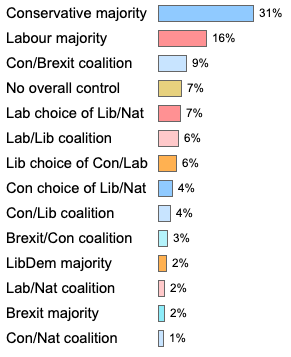
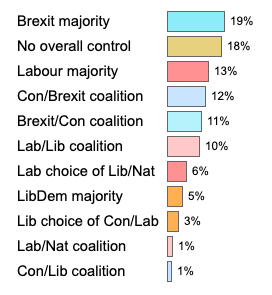
Since then, Brexit voters have shifted to the Tories because Boris Johnson is now the PM. That makes a Conservative government considerably more likely and almost wipes out the chance of a Brexit Party government. (Why vote for them when you can have Boris?) Since the Brexit Party was the most likely to form a government in May, the Tory leadership contest has been very consequential. Here are the current odds, again per Max Baxter:

In national polls, the Tories lead Labour by only about 4-5 percentage points and don’t reach 30% support. But they could still capture a majority of seats in a four-way contest.

I think Boris Johnson faces a bit of a dilemma. If he calls a snap election, he has a 31% chance of being able to govern without any coalition partners, an attractive option considering that 60% of voters are against him. He also has a 52% chance of being able to form some kind of government, with or without partners. To maximize his odds, he must continue to take all the votes away from the Brexit Party, which means a hard-line stance on Europe.

On the other hand, he already leads a government, and if he calls a snap election, he faces about a 48% chance of losing control to the opposition. That makes an election a pretty big risk, a coin-toss. But if he steams ahead with the current parliament, I can only see things getting much, much worse as Brexit hits. A 51% chance of forming a new government now is better than his likely odds any time after October.

On that basis, I think he will call an election and not budge an inch on Brexit until it’s over.

the oscillation between dictatorship and parliamentary institutions (a game theory model)

Abstract: Sometimes despots have incentives to convene representative bodies that govern with them. And sometimes the leaders of republics have incentives to rule unilaterally. Changes in the incentives explain the oscillation between authoritarianism and republicanism. Today’s incentives are pushing in the wrong direction.

Imagine that a leader (a king, tyrant, dictator, general) possesses the only effective, loyal, well equipped military force in an area. That person—Mancur Olson called him a “stationary bandit”—can use the threat of violence to extract money from the population to pay for and motivate the army plus a bureaucracy that identifies, counts, and organizes the society’s wealth.

It may help if the ruler has some perceived legitimacy (an anointed monarch instead of a usurper or dictator, for example) and offers benefits to the people, such as safety from foreign enemies. Those factors may reduce dissatisfaction that can breed resistance. But the main pattern is a monopoly of power that serves to extract resources to fund the power itself. This situation can be self-reinforcing.

But how to get to that situation if you don’t start with a loyal and effective army and bureaucracy? And how to get back to that situation if you lose it due to defections or diffuse resistance?

One way is to convene many of the leaders of the society who already have the capacity to collect resources: nobles or other great landlords who are succeeding at extracting rents, senior clergy who collect tithes or control endowments, and municipal leaders who represent commercial interests. These people can agree to generate the resources to pay for the state if they see advantages for themselves. Someone with a claim to leadership (say, a king) can convene them, negotiate with them, and end up as a ruler who shares power.

This is a way for parliamentary institutions to emerge from despotism, as they did across Europe in the middle ages. A medieval parliament almost always represented the nobility, the church, and the towns in separate houses or estates.

Now let’s say that the system is rolling along, and the monarch actually has a well-equipped, loyal military force and a bureaucracy funded by taxes. It becomes possible for that monarch to dismiss the parliament and use the state to extract taxes, rents, military service, and labor by force, perhaps legitimized by some theory of divine right.

This is a way for parliamentary government to shift into monarchical absolutism, as occurred in many European countries around the 17th century (plus or minus).

But let’s say the king gets into debt, or faces insubordination, or is attacked by a powerful foreign threat, or simply sees low levels of compliance. He may need to call a parliament again so that key stakeholders can voluntarily agree to coordinate their efforts to raise money. And if the parliament can organize itself effectively, it can threaten the monarch’s power and even his safety.

This is how the English parliament gained the authority, after 1688, to make all laws. The monarch still embodied the executive branch and could make many discretionary decisions of a broadly managerial type. Since that was too big a job for any individual to do alone, monarchs governed through ministers, often holders of offices that dated back to the middle ages.

Technically, the monarch could place anyone in these offices and could intervene in any issue directly by proclamation. However, since the power of the purse had shifted to parliament (and money can buy an army), the monarch was vulnerable. Charles I has lost his head; James II, his throne. Many subsequent British monarchs preferred to govern through ministers supported by parliament. And once parliament had divided into parties, this meant selecting ministers acceptable to the majority party. George I even discovered that it was convenient to make the leader of the majority–the Whig MP Robert Walpole—an effective chief minister who would chair a cabinet that he (Walpole) chose. Walpole served in this role for 20 years, resigning only when he no longer led a majority in the House of Commons.

In this way, parliamentary cabinet government and the office that we now know as the Prime Minister evolved from the underlying situation. The premiership was not created, like the US presidency, when a person or group conceived the idea and wrote it down in a constitution or law. It emerged from Walpole’s experience serving the King with the Commons’ support. But one could explain both the British premiership and the US presidency as a result of the same underlying needs.

Some subsequent monarchs pushed back by naming ministers of their own choice who lacked parliamentary support. There was not always a prime minister all. In 1783, the politician Charles James Fox reacted to the prospect that George III might name a prime minister without the confidence of parliament:

[If] a change must take place, and a new ministry is to be formed and supported, not by the confidence of this House or the public, but the sole authority of the Crown, I, for one, should not envy that hon. gentleman his situation. From that moment I put in my claim for a monopoly of Whig principles.

The last sentence simply means that Fox would seek to legislate a requirement that the cabinet receive parliamentary support. But the first sentence is more interesting. A prime minister who couldn’t win a majority in the House would stand in an unenviable situation even if he continued to serve, because he could not govern effectively without the parliament behind him.

Meanwhile, the governments of the Netherlands and England (at least) had learned that they did not have to rely solely on taxes, rents, and loans from bankers. They could also borrow from their own people, who would voluntarily buy state securities as long as they trusted the government to spend the money in what they considered the public interest. The middle class gained that confidence because they dominated the parliaments of these countries (versus the weakened nobility and the disenfranchised poor). As a result, these countries could raise huge sums and field substantial navies and armies, which, in turn, created economic benefits for the middle classes.

As a result, governments with parliaments became far more powerful on the international stage than absolute monarchies. Republican France could field an army of 1.5 million based on taxation, conscription, and bond sales. Although Napoleon overstepped, France threatened to dominate all of Europe. Absolutism recurred after 1815 and held on in places like Russia a lot longer, but it was the long-term loser in the Darwinian struggle for fitness among nations.

In this way, republican forms of government tended to prevail, except that the vast systems of state power that republics underwrote could also break free of parliamentary oversight. I don’t think that Germany could have built a massive state apparatus between 1871 and 1932 without a Reichstag to represent the public and make taxation and conscription reasonably popular. But once that apparatus existed and Hitler controlled it, he could dismiss the parliament and rule by fear. The story was perhaps a bit different in the USSR and China, both of which had long traditions of monarchical despotism and only brief parliamentary rule before their communist dictatorships. But all twentieth-century authoritarianism echoed baroque-era absolutism (with a larger dose of terror).

Then, around 1989, most of the authoritarian regimes crumbled in the face of republican popular movements. I think this was simply a recurrence of the despot’s traditional vulnerability, his need for widespread compliance. Authoritarian regimes sagged under the weight of corruption, stagnation, and obsolescence and couldn’t draw on their publics for resources—money, talent, or enthusiasm–to fix their problems. The reasons for the original rise of parliamentary government recurred.

The problem now is that the cost of dominating a population and extracting resources from the people has fallen. You don’t need a vast conscript army if you have drones and cruise missiles. You don’t need an army of bureaucrats if you can scrape data from electronic records. If you have a monopoly on the legitimate use of force within your territory, you can rule with just a few supporters.

William the Conqueror destroyed the Anglo-Saxon elite and governed England (with a population of at least 1.1 million) with about 8,000 men. Thanks to his victory on the battlefield and the dread power of knights, he was not forced to share authority but could keep 8,000 people behind them by distributing plunder. That is an example of a single leader possessing the resources to dominate, much as modern authoritarian states do. William’s descendants saw that advantage slip away and were forced to convene parliaments–but the road to democracy was long and slow.

Dewey was wrong that “the current has set steadily in one direction: toward democratic forms.” Instead democracy and despotism have oscillated, depending, in part, on how easy and affordable it is for a small number of people to dominate the population. Unfortunately, domination has lately grown cheaper and more effective.

See also: Dewey and the current toward democracy; why post-modern nation states do not need mass support; why autocrats are winning (right now); Dubai, Uganda, and today’s global political economy; and what does it mean to say democracy is in retreat?
less than a penny a year for grassroots civic organizing

(DC) The Foundation Center’s database and analytic website entitled Foundation Funding for US Democracy is full of interesting information and worth detailed exploration.

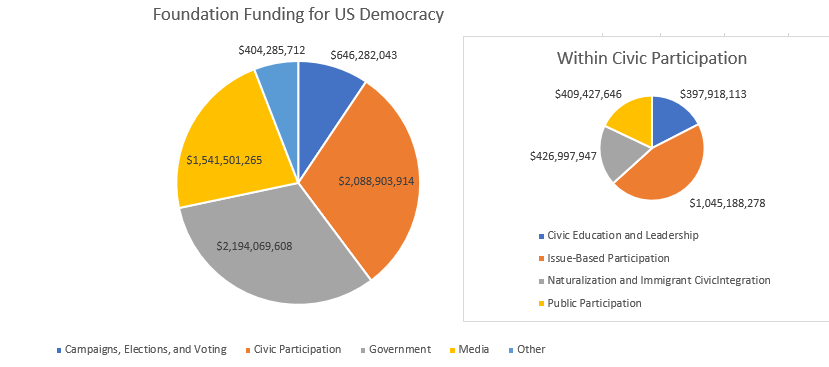
Drawing on tax forms, the site categorizes $5.5 billion in grants made to strengthen democracy in the USA since 2011.

The ideological range is wide: the DeVos and Mercer foundations are in the database, along with Open Society and many more.

This is the distribution of grants by very broad categories, with a somewhat more detailed look at the pie slice devoted to “civic participation” (which interests me most).

My graphs based on Foundation Center data

I estimate that $1.73 billion of the $5.5 billion (31%) has gone to nonprofits headquartered in DC or the surrounding counties in Maryland and Virginia. With some exceptions, these are professional organizations without a grassroots membership base.

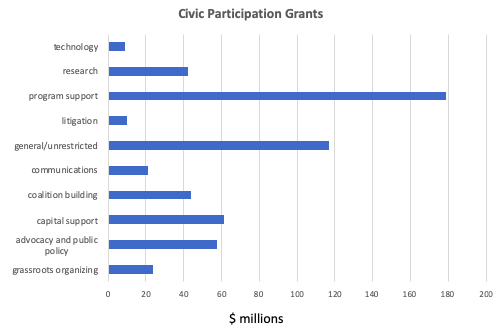
Within the category of “civic participation,” $2.1 billion has been distributed for the following purposes. These categories are non-exclusive; a grant can serve more than one purpose.

A total of $23 million–.0.43% of all democracy funding and a little less than one cent per American per year–has been spent on grassroots organizing for civic participation. I think that marks a major deficit.

new opening: Service Year Program Administrator at Tisch College

This is a one-year limited-term position.

There are currently about 67,000 annual positions for young Americans who choose to conduct service for a whole year. These positions are supported by national programs like AmeriCorps (such as Teach for America, Habitat for Humanity, YouthBuild, and City Year), Peace Corps, and the Commonwealth Corps in Massachusetts, and by many other organizations, including Tufts University’s 1+4 Bridge Year program, which offers credit and financial aid for a year of service before Tufts. Americans serve at many ages (from pre-college to retirement) and in many settings, from their own communities to countries around the world. 

The Jonathan M. Tisch College of Civic Life seeks to hire an administrator to expand the prevalence and visibility of service years in Massachusetts. Service Year Alliance and Tisch College are partnering to support this role. The Administrator will also be expected to collaborate with stakeholders in Massachusetts, particularly the Massachusetts Service Alliance. The Administrator will be expected to consult closely with Service Year Alliance and the Massachusetts Service Alliance and to engage other stakeholders across the Commonwealth. Sectors that the organizer may engage include k-12 education, higher education, local and state governments, nonprofits, and private sector employers. The administrator will assess opportunities to sustain and build in based work in East Boston and/or other geographical communities in Massachusetts. Provides specialized, subject matter knowledge to develop, implement, review and evaluate a university Program or Project in collaboration with Manager or Director. May participate in development of goals and strategies; creates data management and filing systems; develops, analyzes and monitors budgets, grants and contracts; and participates in development and implements marketing and advertising efforts including writing content for website and social media material. May design and represent program externally at conferences, meetings and events. 

Basic Requirements:

  • 1-3 years of service experience.
  • Experience with organizing and network-building.
  • Knowledge, skills and experience typically acquired through the attainment of a bachelor’s degree and 3 years of experience.
  • Skills for conducting reliable and independent research.
  • Excellent communications skills.
  • Ability to work independently and to collaborate well with diverse stakeholders.

Preferred Qualifications:

  • Knowledge of or experience in subject matter preferred.
  • Personal experience with a service year.
  • Understanding of the service sector nationally.
  • Understanding the nonprofit sector in Massachusetts Master’s degree in related discipline and 3+ years of experience in related field of study.
  • Experience ensuring compliance of web page content with W3C and Section 508 (ADA) accessibility standards preferred. Ongoing training will be provided to help keep up with current trends and requirements. 

An employee in this position must complete all appropriate background checks at the time of hire, promotion, or transfer.

Equal Opportunity Employer – minority/females/veterans/disability/sexual orientation/gender identity.

Apply here.

opportunities in Civic Science

At Tisch College, we are working with many colleagues and peers to help build a field that we call Civic Science. Key players here are our senior fellow for Civic Science, Jonathan Garlick, and our postdoctoral fellow in Civic Science (whom we share with the Kettering Foundation), Samantha Fried.

One of our collaborators in the work is the Rita Allen Foundation, which sends this exciting announcement:

We are excited to announce a new Civic Science Fellowship opening. This Fellow will work for 12 months to advance emerging collaborative work among a group of funders with shared interest in advancing meaningful, inclusive engagement between science and society—including the Burroughs Wellcome Fund, the Chan Zuckerberg Initiative, the David and Lucile Packard Foundation, the Gordon & Betty Moore Foundation, the Kavli Foundation, and the Rita Allen Foundation. The Fellow will work with each partner foundation, with multidisciplinary fields of research and engagement practice, and with communities underserved by existing science communication efforts to ensure that their goals, objectives, and efforts inform the path forward for the funders’ collaborative efforts. The Fellow will be part of the pilot cohort of Civic Science Fellows—promising leaders from diverse backgrounds who will be embedded in key supportive networks and will work on multidisciplinary projects that connect civic science research, effective engagement practice, scientists, and communities.

The full position description can be found here: http://ritaallen.org/stories/funder-civic-science-fellow/

memory politics

I’ve been in Madrid, Munich, and Berlin for a few days of vacation with family, plus the meetings with scholars from Spanish-speaking countries and scholars and activists from the former Soviet bloc that are described in “Civic Studies Goes Global” (July 17). In all, I had conversations with roughly one hundred people, if you include the high school students whom I taught in their school outside of Madrid, a firm of Spanish anarchist architects, grad students from countries like Belarus and Georgia, and even the well-informed guide who led our walking tour of Berlin’s Mitte. We also learned a lot from museum displays in places like the German Historical Museum, and I’m deep into David Blackbourn’s History of Germany 1780-1918: The Long Nineteenth Century.

Memory politics (how political actors influence what nations or other groups remember) is important everywhere and often generates current divisions. That is true in the United States, where questions of American exceptionalism versus the original sin of white supremacy are at the forefront right now. A leading question is how we should remember our past–not just what we should do next. Similar questions arise in the former Soviet bloc, in Latin America, and practically everywhere I can think of.

Germany does a good job with its memory politics today. The Federal Republic has made an acknowledgement of its Nazi past central to its civic culture–but you can see how that stance evolved, sometimes painfully, in the post-War era. In the library of an agricultural institution, I read a proclamation issued in 1945 on behalf of Bavarian farmers. It denounces the tyranny and war they have just experienced. The farmers express sympathy for the murdered, including an explicit mention of the death camps. But they add that it is “particularly” cruel that the tyranny conscripted Bavarian agricultural workers, since a farmer has Christian love for the land and other people. I admit that my first reaction was that these farmers were probably part of Hitler’s electoral base in 1932. That turns out not to be true–he did much better with Protestant rural voters and lost Bavaria (narrowly) to the Catholic Centre Party in the last free election of Weimar. Still, this document seems like only the first halting step toward an appropriate view of the past.

A fine example of current memory politics–German, but one could imagine similar efforts in other countries–is the exhibition “Beyond Compare: Art from Africa in the Bode-Museum.” Bronzes and other sculptural works from Africa are paired with European sculptures selected from this extraordinary collection. The labels invite us to ask why some things have been categorized as ethnographic objects and others as works of art; how to think about artists whose names are famous or who are anonymous; how aesthetics, faith, and functionality interrelate; how various cultures represent power, gender, and otherness; how these objects found their way to a museum on the Spree; and how sculptures from Europe and Africa have been cleaned and displayed (in this case, the parallels are more evident than the differences), among other questions.

As a whole, the Bode-Museum displays primarily Christian religious objects in a building that recalls a grand renaissance basilica, but its religion is High Culture or Geistesgeschichte, not Catholicism. Its contents are not of local provenance, nor looted from other countries, but purchased on the international market–albeit often as a result of someone else’s looting. And many of the objects are themselves efforts at memory politics, like this 19th-century figure of an ancestor from Hemba in the DRC.

See also: thoughts after a similar trip last year; the politics of The Sound of Music; the state of the classics in 2050; marginalizing odious views: a strategy; and civic education in the year of Trump: neutrality vs. civil courage.

trying to keep myself honest

(Madrid) This summer–which is not over yet–has already been full of rich and challenging discussions for which I am grateful.

In June, I spent several days discussing some lesser-known works of Friedrich Hayek with a group of mostly classical liberals/libertarians.

In late June and early July, more than 160 experienced scholars, practitioners, and activists from many countries visited Tisch College for a series of linked events: the American Political Science Association’s Institute for Civically Engaged Research, a convening of city staff from 15 Cities of Service, a gathering of Bridge Alliance members, the eleventh annual Summer Institute of Civic Studies, Lead for America’s summer institute, and the Frontiers of Democracy Conference. These people certainly held diverse ideological views, but a strong voice came from participants whom I would associate with intersectional movement politics–people who favor bottom-up, extra-institutional movements to confront white supremacy, patriarchy, and related “-isms.”

And now I am in Madrid for the Ibero-American Meeting on Civic Studies. I am very much enjoying my academic colleagues from Argentina, Colombia, Ecuador, Guatemala, Mexico, Spain and Venezuela who hold diverse views. While here, I have also visited a traditionally “red” working class Madrid neighborhood and met with radical Spanish architects and have heard a senator from the PSOE (socialist) party lecture. They have given me a dose of European social democratic politics. In contrast to intersectional movement politics, this is largely about building mass institutions (unions and parties) for “the people,” understood as singular.

I remain basically an American center-leftist. Barack Obama is my favorite president and have sent a little money to Kamala Harris. But since I fear intellectual complacency and clichés, I am always grateful to have my presumptions challenged. Libertarianism, intersectional movement politics, and social democracy feel like a triangle of ideas that keep me (somewhat) honest from three directions.

I think I hear the classical liberals saying, “Society is too complex to be modeled, let alone regulated or planned, because it is a function of countless individual choices, and the millions of agents can react to any effort to constrain or guide them by changing their behavior. Opportunity costs are ubiquitous and especially difficult to measure. Talk of ‘social justice’ arrogantly replaces what individuals want in their own circumstances with a specific theory of what they should want and implies that someone has the right to enforce that. Instead, policy should be maximally general, durable, and predictable so that individuals can form and implement their own plans in their contexts.”

I think I hear intersectional activists saying, “People are dying as a result of racism and transphobia and sexual violence. That is because other people hold deeply seated world-views that categorize their fellow human beings into hierarchies and create boundaries. These world-views are fundamental causes of injustice and must be challenged. There is no substitute for the people at the top of the hierarchies [people like me] acknowledging their advantages and changing their own lives accordingly.”

And I think I hear the social democrats say, “When large numbers of ordinary people have organized themselves into unions, parties, and social movements, they have countered corporate capital and negotiated mixed economies that have generated equity and security along with prosperity. But such organizations require substantial discipline (constraining individual choice) and broad identities, such as ‘worker’ or ‘citizen.'”

See also: on hedgehogs and foxes; The truth in Hayek; identities, interests, and opinions

reclaiming our kids’ walk to school

(Madrid) In June, I was with an international group, and we were lamenting that no one from any of our respective countries seems very comfortable allowing their children to walk alone to school. We all walked to school when we were kids, even though the crime rate–at least in the US–was much higher then. It seems as if parents raised in the mid-1900s let their late-1900s children walk around dangerous cities, but we are too nervous to let our early-2000s offspring do the same.

Now I am in the very dynamic and impressive MediaLab Prado, a “citizen laboratory that functions as a meeting place for the production of open cultural projects.” And I have just encountered Camino Escola Seguro, A Safe Path to School. In part, it involves knitted safety notices that assure families that local shopkeepers and residents are keeping their eyes on the streets and making them safe for children to walk to school.

I’m not saying this would work everywhere. Maybe it won’t work at all. But I love the spirit of people reclaiming the common resource of a safe walk to school.

What is the appropriate role for higher education at a time of social activism?

(Posted in Madrid) In the current issue (and available free online) is my article entitled, “Another Time for Freedom? Lessons from the Civil Rights Era for Today’s Campuses,” Liberal Education, Winter 2019, Vol. 105, No. 1.

This is the first of several pending articles in which I explore the interactions between social movements and institutions. My motive is to encourage people who sit in institutional settings to pay attention not only to activists who make demands but also to the movements to which these activists belong. In order to relate appropriately to a given movement, it’s important to assess whether it has robust internal discussions, whether it is a space for learning, how it develops leaders, what norms it enforces on its members, and other such characteristics. Interpreting a movement is valuable whether you want to be a good ally, merely treat the movement fairly, or actively counter it because you oppose its influence.

In this piece, I use as a hook a fascinating New York Times op-ed by Dr. Martin Luther King, Jr., in which he described the movement that had engulfed Historically Black Colleges and Universities by 1961. A sample passage from my article:

In the model of civic action that King describes, college students plug into national social movements that have leaders and organizations outside higher education. The students’ involvement is youth-driven: students recruit other students to participate. …

Like most participants in social movements, the students King describes in the Times essay have transformational goals. They do not aim to modify the policies and practices of existing institutions—such as their own colleges—but to rebuild or reconstitute the whole society. Student activists, King writes, are “seeking to save the soul of America. . . . One day historians will record this student movement as one of the most significant epics of our heritage.” Today, movements like Black Lives Matter and climate activism do not merely advocate specific policies but attempt to fundamentally transform society, from white supremacy to racial equity, or from carbon-dependence to global sustainability.

By contrast, colleges and universities—including the HBCUs of 1961—are institutions. As such, they are inevitably led by people who have extensive experience, who must therefore be older. Institutions can encourage youth voice and can change as a result of social movements. For instance, a range of curricular and policy reforms that promote greater racial equity and diversity can be traced back to the civil rights movement. But institutions will predictably resist more radical transformations. They are not movements; they are targets of movements.

The tension between movements and institutions is inevitable, but higher education has a particular commitment to ideological pluralism and debate. Although pure neutrality is impossible and a misleading ideal, colleges and universities must demonstrate a reasonable degree of impartiality about the contested issues of the day. As academic institutions, they value reflection and “organized skepticism.”11

When today’s colleges and universities go beyond classroom teaching to offer experiential civic education, a typical model involves supporting students to choose and define their own issues and to develop and implement plans of action—not signing them up for specific social movements that will demand sacrifice. Often, an institution’s recruitment takes the form of a general invitation to civic engagement, civic learning, or dialogue, not a call to join a movement.

See also: pay attention to movements, not just activists and events; the value of diversity and discussion within social movements; social movements of the sixties, seventies, and today; a sketch of a theory of social movements

how to improve the civil society of a school

Students learn to be citizens by joining, forming, leading, and influencing extracurricular groups in their own schools. A school’s whole array of groups is its “civil society.” The number, diversity, reach, purpose, vitality, and interconnection of these groups is important for youth development, generally, and for civic education, in particular.

Discussing this topic with teachers this morning, I received an excellent question. How should we encourage all students to participate? What should we do about the fact that 9th-graders sign up for many groups but membership trails off fast? How about the students who are too busy because they work? And what about the kid who wears headphones all day and just doesn’t want to connect?

I think I began my reply with two caveats. First, I don’t know how to motivate teenagers nearly as well as teachers do. And second, some kids really may face serious barriers to membership, no matter how hard you try to include them.

That said, the challenges of a school’s civil society are like those of any civil society. Like teenagers, adults exhibit different degrees of commitment. They drop out when they lose interest or as a response to disagreements. Many free-ride, staying in a group to get its benefits without doing a fair share of the work. Some work extra hard and well but aren’t noticed.

Addressing these problems constitutes Alexis de Tocqueville’s “art and science of association.” It’s never easy but there are good practices. Impose regular penalties for non-contribution but make initial penalties very light so that they are actually enforced and violators can recover easily from being penalized. Keep a clear and public list of who belongs and who doesn’t and clarify what constitutes membership versus exit. Rotate responsibilities. Incorporate low-cost methods of monitoring compliance, such as sign-in sheets. Implement efficient mechanisms for conflict-resolution. (For these principles, see, among other sources: Ostrom, Elinor. “Design principles and threats to sustainable organizations that manage commons.” Santiago, Chile, March. 1999.)

Learning these practices is a core task of civic education. We traditionally learn them only from experience, but it is possible to learn some of them from texts and discussion. Students who learn to lead groups are better placed than any adults to actually generate viable groups in their own schools. Thus I would recommend teaching strategies for recruitment and group-management explicitly, and then encouraging student leaders to be primarily responsible for the vitality of their own civil society.

See also a portrait of American teenagers’ out-of-school life; and class disparities in extracurricular activities.