call for papers: Civic Politics and Global Order

“Civic Politics and Global Order”: A Special Issue of The Good Society: A Journal Of Civic Studies

More than a century ago, US President Woodrow Wilson asked Congress to declare a state of war with Germany—a radical step in pursuit of a radical objective. Seeking “no conquest” and expecting “no indemnities” for any life or treasure lost, Americans, Wilson declared, would fight “for democracy, for the right of those who submit to authority to have a voice in their own governments, for the rights and liberties of small nations, for a universal dominion of right by such a concert of free peoples as shall bring peace and safety to all nations and make the world itself at last free.”

The “concert of free peoples” that emerged from the Great War’s ashes—the League of Nations— never gave adequate international expression to such democratic civic ideals, nor could it prevent a second global conflict. Yet it laid grounds for a complex of institutions—among them the World Bank, United Nations, NATO, and European Union—that for decades after World War II embodied for millions of people the possibility of an increasingly stable and just world order. Now the prestige of that order has reached a historic low, and its continued existence has come into doubt.

Simultaneously, however, citizens and societies worldwide continue to seek ways of achieving Wilson’s essential vision: a vision of self-governing communities collaborating, despite conflicting interests, on the otherwise impossible task of creating a safe and just world.

Aware of such strivings and persuaded of their importance, the editorial board of The Good Society invites submissions from scholars and practitioners exploring the relationship between civic politics and global order. What interests do self-governing communities at the national, subnational, or transnational level have in maintaining international or global order? What normative commitments are required, and what independent and collaborative actions are advisable, to advance such interests while maintaining due regard for divergent local, cultural, and historical contexts?
What strategies and tactics—proven, novel, or forgotten—are ripe for implementation, experimentation, or rehabilitation? Above all hangs the question: Is there a regulative ideal of global order that self-governing aspirants and civic agents should adopt? If so, how can it be formulated, disseminated, theorized, and realized in a manner that respects the plural as well as universal interests and experience of humanity?

The editorial board invites papers of 6,000 to 8,000 words that address the questions above, as well as other relevant questions emerging from serious inquiry into the character of a good society and the conditions for achieving and maintaining it. Please submit papers by May 1, 2019 to: http://www.editorialmanager.com/gs/default.aspx

For more information regarding this call, write Trygve Throntveit, editor, tthrontv@umn.edu

The Good Society is the flagship journal for the interdisciplinary (between disciplines) and transdisciplinary (beyond disciplines) field of Civic Studies. For more information on Civic Studies, please visit http://civicstudies.org/about/ .

Empathy and Justice

My remarks at a conference entitled “Empathy …. or Ways of Caring,” Harvard Department of Romance Languages and Literatures, March 15, 2019. (Apologies for some cutting and pasting from previous posts.)

Doris Sommer mentioned that Barack Obama popularized the notion of an “empathy deficit.” In a 2004 interview with Oprah Winfrey, while he was still a State Senator, Obama said:

I often say we’ve got a budget deficit that’s important, we’ve got a trade deficit that’s critical, but what I worry about most is our empathy deficit. When I speak to students, I tell them that one of the most important things we can do is to look through somebody else’s eyes. People like bin Laden are missing that sense of empathy. That’s why they can think of the people in the World Trade Center as abstractions. They can just crash a plane into them and not even consider, “How would I feel if my child were in there?”

Here Obama links empathy to moral judgment. In a 2006 commencement address, he also implies that the level of empathy in a society as a whole is a precondition of social justice. Our “empathy deficit” explains why we accept that “Americans … sleep in the streets and beg for food,” that “inner-city children …. are trapped in dilapidated schools,” and that “innocent people [are] being slaughtered and expelled from their homes half a world away .”[2]

To suggest that this argument is problematic, I would quote then-President Obama in Jerusalem on March 21, 2013:

I — I’m going off script here for a second, but before I — before I came here, I — I met with a — a group of young Palestinians from the age of 15 to 22. And talking to them, they weren’t that different from my daughters. They weren’t that different from your daughters or sons.

I honestly believe that if — if any Israeli parent sat down with those kids, they’d say, I want these kids to succeed. (Applause.) I want them to prosper. I want them to have opportunities just like my kids do. (Applause.) I believe that’s what Israeli parents would want for these kids if they had a chance to listen to them and talk to them. (Cheers, applause.) I believe that. (Cheers, applause.)

It is not so much the speech as the applause that I find problematic, because I believe that the Israeli electorate supports policies that are unjust, and their political behavior is compatible with a fair amount of actual empathy.

The word “empathy” is a modern coinage. It is not attested before 1895, and it gained its current meaning only in 1946. Many wise people have thought about moral psychology and justice without using this word at all, so we should consider whether it does us any good.*

I’d posit the following definitions:

  • Empathy: Feeling a similar emotion in response to someone else’s emotional state. Your friend is mad at her boss because he treated her unfairly. That makes you mad at her boss. Your anger is probably different in texture and intensity from hers, but it’s the same in kind, an imperfect reproduction of her mental state.
  • Sympathy: Feeling a supportive emotion in response to someone else’s emotional state that is not the same as that person’s original emotion. She is mad at her boss, so you become sorry for her, or committed to fairness, or sad about the state of the world, or nostalgic for better times–but not angry at her boss. Then you are sympathetic. (NB You can be both sympathetic and empathetic if you feel several emotions.)
  • Compassion: A species of the genus sympathy. Another person’s negative emotion causes you to have a specific supportive feeling that is not the same as her emotion: you sincerely wish that her distress would end without blaming her for it.
  • Justice: A situation or decision characterized by fairness, goodness, rightness, etc. (These are contestable ideas and may be in tension with each other.) The English word “just”–like dikaios in classical Greek–can be applied either to a situation or to a person who cares and aims for justice.

There is an old and rich debate about which character traits and subjective states are best suited to pursuing justice. One answer is that you should be a just person, one who tries to decide what is fair or best for all (all things considered), who desires that outcome, and who works to pursue it.

A different response is that we are not well suited to defining and pursuing justice itself. We lack the cognitive and motivational qualities that would allow us to grasp justice and reliably act on it.

Justice is an abstract idea that takes the form of words: it is discursive. According to a mainstream view in contemporary moral psychology, we first form emotional opinions about concrete situations and then we select the ideas that will justify those opinions, post-hoc. Justice doesn’t guide us; it justifies and excuses us.**

In that case, it might be better to cultivate emotions, such as empathy, sympathy, compassion–or loyalty, aversion to harm, or commitment to specific rules–in order to deliver more just outcomes, all things considered.

In her remarks, Marina Amelina noted that developed countries built social welfare systems between ca. 1880 and 1970. That could because their publics became more empathetic. But it also be because less-wealthy people gained power and used it to protect themselves. Equal power plus self-interest might generate justice more reliably than empathy. John Rawls famously modeled justice as the decisions that self-interested parties would make if they were rendered perfectly equal by a Veil of Ignorance that blocked them from knowing their own situations. In the real world, we can approximate the Veil of Ignorance by assuring that everyone has equal rights and powers. This is a clear alternative to the view that justice should be built on empathy.

Paul Bloom and others argue that empathy is particularly unreliable guide to justice, more likely to mislead than to inform. For instance, Donald Trump can make people feel empathy for a small number of individuals whose families were allegedly victimized by undocumented aliens, and then use that emotion to build support for deporting millions of people who have harmed no one. A famous example is Edmund Burke’s outrage at the mistreatment of Marie Antoinette, which obscured any concern for the countless people tortured, executed, or “disappeared” by the ancien regime that she represented. (By the way, I respect Burke–and I don’t think it was fair or smart to execute the Queen–but this passage is still a good example of misplaced empathy.)

Empathy can also substitute for justice, as the transcript from Jerusalem that I quoted earlier suggests. You congratulate yourself for feeling some version of a suffering person’s emotion and excuse yourself from fixing the problem.

Compassion may be better than empathy. Instead of feeling the same emotion as the other person, you feel a combination of beneficence and equanimity that may be a more reliable guide to acting well. But it’s possible that compassion only clears the deck for reasoning about what you should actually do.

Other candidates for emotional states that might be more reliable than empathy include solidarity, responsiveness, openness, and intellectual humility.

For its part, justice can be emotional. You can feel a powerful urge to make the world more just. That is helpful insofar as the feeling motivates you and insofar as people obtain genuine insights from our emotions; but it is dangerous because the emotion of desiring justice can be misplaced. You can feel great about improving the world when you are actually harming it.

In the end, I think we must wrestle with these questions:

  1. Can we human beings reason explicitly about justice in ways that improve upon our strictly affective reactions to particular situations? Can we put into words what is good or fair, and why, and make ourselves accountable for that position? Or is this always special-pleading, mere rhetorical justification for what we have already decided based on our emotions?
  2. Does an improvement in social justice indicate an improvement in empathy?
  3. If we should cultivate an emotional stance toward others as a buttress of—or an alternative to—justice, should that stance be empathy, or rather compassion, responsiveness, solidarity, humility, or something else?

*Buddhism is perhaps most widely associated with the virtue that Obama calls “empathy”—in his terms, “the ability to put ourselves in someone else’s shoes; to see the world through those who are different from us” (Northwestern Commencement speech). But Emily McRae notes that “empathy” has no direct translation in Sanskrit or other languages that have been used to express the Indo-Tibetan Buddhist tradition. Key words from that tradition are better translated as “compassion” and “sympathetic joy.” McRae derives a theory of empathy from Buddhist texts, but she focuses on phrases like “exchanging self and other” rather than any single word that corresponds to “empathy.” McRae, “Empathy, Compassion, and ‘Exchanging Self and Other’ in Indo-Tibetan Buddhist Ethics” in Heidi Maibom , ed., The Handbook of Philosophy of Empathy (Routledge, 2017).

**Jonathan Haidt, The Righteous Mind: Why Good People Are Divided by Politics and Religion(New York: Vintage, 2012), pp. 27-51; Ann Swidler, Talk of Love: How Culture Matters (Chicago: University of Chicago Press. 2001); pp. 147-8; Leslie Paul Thiele, The Heart of Judgment: Practical Wisdom, Neuroscience, and Narrative Cambridge University Press, 2006) and Jesse Graham, Brian A. Nosek, Brian A., Jonathan Haidt, Ravi Iyer, Spassena Koleva, & Peter H. Ditto, “Mapping the Moral Domain. Journal of Personality and Social Psychology, vol. 101, no. 2  (2011)., p. 368)

See also: empathy, sympathy, compassion, justice; empathy: good or bad?; “Empathy” is a new word. Do we need it?; how to think about other people’s interests: Rawls, Buddhism, and empathy

what sustains free speech?

My remarks last week at a small conference on “Tolerance, Citizenship, and the Open Society” at the Tisch College of Civic Life …

We human beings did not evolve to take a broad view of justice, to collect information from diverse sources, to reason impartially, and to be responsive to other people who differ from us. These acts do not come naturally to us.

But we are capable of building prosthetics. For instance, we did not evolve with the skill to tell time precisely, which is now useful for coordinating behavior in mass societies. So we wear wristwatches, hang clocks on our walls, and display the current time on most of our electronic devices. A clock or a watch is a prosthetic device that extends our natural capacities.

An invention (in this case, a clock) will not suffice on its own. Many people must use it. That requires some kind of system that creates incentives or requirements for producing the devices and using them widely. A market with supply and demand can work; so can a state mandate. Either one is an institution.

We have created institutions that extend our ability to deliberate about justice. An example was the metropolitan daily newspaper from ca. 1910 to ca. 1990. Always very far from perfect, it nevertheless delivered important, mind-broadening information to about 80% of Americans every day in the year 1970. They (and advertisers) paid for the local press because it also provided sports, classified ads, comics, and whole package of goods–but with the most important news on the front cover, where it could not be missed.

A university is another institution that supports inquiry and discussion about important matters. It is more complex than a newspaper. Its revenues may include tuition, government aid, grants, gifts, intellectual property transfers, and clinical fees, among other sources. The goods it produces include skills and knowledge of value to each learner; virtues and skills that have public value; the pure public goods of basic knowledge and culture; monetizable forms of knowledge, such as patents; services, such as meals, art exhibitions, and clinical care; and credentials and entry to the middle class.

The skeptical view of such institutions is that their underlying economic motivations determine the ideas and discussions that they support. For example, newspapers are owned by tycoons or faceless corporations that just want to maximize profits. Universities sell social stratification and individual advancement. This analysis always merits attention and explains some of the phenomena. But it is one-sided, because these institutions are also the result of human artisanship–of people creating the means to sustain better thinking at a large scale.

For instance, the metropolitan daily newspaper can be interpreted as the product of the media industry, but it should also be seen as the product of the press. Traditional newspapers tried to distinguish the two by separating the newsroom from the publisher’s suite, but those subsystems were connected. For instance, plenty of publishers were former shoe-leather reporters. Their motives were mixed. That is good because mixed motives produce scalable public goods.

Too simple a theory would yield two predictions about newspapers that both proved incorrect. In 1900, you might predict that millions of people would never spend their own money voluntarily to purchase relatively impartial and challenging daily news. But they did–in part because they were also buying comics and box scores. In 1970, you might predict that we would always have a press, because it meets a social need. But the press has collapsed (half as many people work as reporters today compared to ten years ago) because the Internet has killed its business model.

As with other forms of artisanship, nothing is for certain. Ingenuity, commitment, and perseverance are required. The institutional structures that support broadened understanding depend on intentional work.

The results are always flawed. The recent scandals with college admissions just bring home the flaws of universities, for instance. We should have a free, open, informed, and consequential discussion about how to improve them. But no discussion can occur outside of a viable forum that depends on an institution. We don’t spontaneously gather to discuss; the discussion always happens in a university or a school, an op-ed page of a privately-owned newspaper, Facebook, a union hall, a church basement, a party convention, the state legislature–somewhere that draws resources and assembles users.

These institutions then structure and limit the discussion. There is no view from nowhere, only a permanent struggle to discuss as wisely as we can in various forums. We don’t create these forums deliberatively; most of them arise as the result of accident, power, or leadership. Because they are all flawed and limited, it is essential to have many of them, with diverse forms, competing and checking one another.

This is a “civic” perspective because it emphasizes our ability to shape the world of discourse through artisanship. And it broadens our attention so that we consider not only the rules for speech within an institution (e.g., campus speech codes) but also–and usually more importantly–the underpinnings of the institution itself.

See also a civic approach to free speech; Sinclair and Bezos: media ownership and media bias; don’t let the behavioral revolution make you fatalistic; prospects for civic media after 2016; China teaches the value of political pluralism; polycentricity: the case for a (very) mixed economy.

Trump and Putin: the ideological angle

I think my working theory of Trump and the Russians (from June 2017) remains pretty consistent with what we now know. But the part of the story that has been mostly submerged concerns the ideological affinities between Trump and Putin and whether certain shared values have influenced their behavior.

Ideological affinities should not be legally investigated, litigated, or prosecuted. If Bernie Sanders wanted some assistance (other than cash) from European Social Democrats, he would be welcome to it. To view endorsements, exchanges of information, introductions, etc. as illegal campaign contributions would violate free speech rights. In reality, Sanders would be unlikely to seek European help, because American voters wouldn’t like that. But George W. Bush calculated that American voters would appreciate Tony Blair’s support for him. In all such cases, voters should observe, debate, and judge.

Regarding Trump and Putin, voters face two questions. One is whether these men have a real affinity and any kind of significant political alliance–not because that would be prosecutable, but because it would be important to understand and assess. The second question is the nature of their affinity. What values (if any) does it reflect, and what should we make of those values? (I leave aside financial ties, which might still be under investigation in the Southern District of New York and elsewhere. We should leave those matters to investigators with subpoena powers.)

One view would be that Trump and Putin share a white nationalist agenda. Casey Michel reports that “Richard Spencer, the current face (and haircut) of US’s alt-right, believes Russia is the ‘sole white power in the world.’ David Duke, meanwhile, believes Russia holds the ‘key to white survival.’ And as Matthew Heimbach, head of the white nationalist Traditionalist Worker Party, recently said, Russian president Vladimir Putin is the ‘leader of the free world’—one who has helped morph Russia into an ‘axis for nationalists.'”

This belief may not track reality. Stephen F. Cohen emphasizes that Putin “endlessly appeals for harmony in ‘our entire multi-ethnic nation’ with its ‘multi-ethnic culture.'” Those statements are arguably better than anything Trump has uttered about America. Russian nationalism of the Putin variety is probably better explained as a reaction to understandable grievances rather than a form of white supremacy. But the question is not whether Putin is a racist. The question is whether an American white supremacist would see him as an ally. The actual alt-right does, and Trump may have similar instincts. Both of Trump’s wives have been Slavic women, and I strongly suspect that he sees ethnic Russians as part of his own in-group, defined in contrast to Muslims and peoples of color.

Another view (mine, for what it’s worth) would be that Putin exemplifies a global tendency to concentrate power in charismatic macho male leaders who work closely with their security services and local billionaires, and who maintain popularity by demonstrating “strength” versus enemies, foreign and domestic. Then Putin is an example of a category that now covers more than half of the world’s population, starting with India’s Narendra Modi and China’s Xi Jinping. In this context, Trump is a wannabe. He has all the same instincts for crony capitalism, militant policing, resentment of outsiders, etc., but he’s not as smart, and he faces more domestic opposition.

A third view is that the real problem is global capitalism, undergirded by US hegemony. In that view, Putin is not high on the list of villains. In fact, he is a bit of a thorn in the side of US/NATO/EU power. The international partnerships that should evoke the most resistance are those within the G8 or Davos. Instead of being angry when Trump meets Putin privately, we should have objected to the bromance of Barack Obama and James Cameron.

These positions are separated by wide and deep gaps in values and worldviews. Ideally, the American people would consider them all and form a majority view. But I don’t expect this to happen, because it is in no one’s political interest to focus on the ideological questions concerning Trump and Russia. Democrats know that this is not a winning political issue for 2020, even if more people happen to agree than disagree with them about Putin. The issue also threatens inter-party harmony a bit. Republicans have principled reasons to oppose Putin but would then find themselves battling a Republican president on difficult terrain.

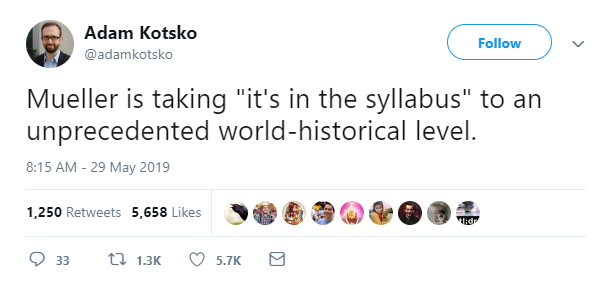
Lots of liberals have been hoping that the Trump/Putin relationship was felonious, which would shift the issue from politics to law. I suppose I was hoping that, but with some misgivings. For the record, I also opposed prosecuting Bush Administration figures like Scooter Libby, because I thought that was a way of criminalizing what should have been a political question. In a true democracy, we address even the most serious questions–matters of life and death at a mass scale–through open debate and elections, not by turning them over to lawyers. The end of the Mueller investigation is an opportunity for us to perform our civic responsibilities. Even if political leaders don’t especially want to discuss whether Trump and Putin share a worldview, that is the topic that deserves our attention.

scholarship on engaged scholarship

We are accepting application for the APSA Institute for Civically Engaged Research (ICER) at Tisch College until March 31. In preparation for the Institute, I am looking for good writing about civically engaged research that is relevant for political scientists, although not necessarily about political science per se.

Incidentally, ICER will not be mainly devoted to reading and discussing papers; it will be more like a workshop. But readings are useful for the organizers at least, and a few texts may be assigned.

A diversity of perspectives and agendas, methodologies, topic areas, and authors’ backgrounds and social identities is important.

I’ve got these but would welcome additional suggestions. (This post is a bleg.)

  • Ackerly, Brooke, and Jacqui True. “Reflexivity in practice: Power and ethics in feminist research on international relations.” International Studies Review 10.4 (2008): 693-707.
  • Burawoy, Michael. “For public sociology.” American sociological review 70.1 (2005): 4-28. (His ASA Presidential Address)
  • Flyvbjerg, Bent. “Social science that matters.” Foresight Europe 2 (2005): 38-42.
  • O’Meara, K., Timothy Eatman, and Saul Petersen. “Advancing engaged scholarship in promotion and tenure: A roadmap and call for reform.” Liberal Education 101.3 (2015): 52-57.
  • Ostrom, Elinor. “Beyond markets and states: polycentric governance of complex economic systems.” American economic review 100.3 (2010): 641-72. (Her Nobel Lecture)
  • Struminska-Kutra, Marta. “Engaged scholarship: Steering between the risks of paternalism, opportunism, and paralysis.” Organization 23.6 (2016): 864-883.
  • Tickner, J. Ann. “On the frontlines or sidelines of knowledge and power? Feminist practices of responsible scholarship.” International Studies Review 8.3 (2006): 383-395.
  • Wallerstein, Nina B., and Bonnie Duran. “Using community-based participatory research to address health disparities.” Health promotion practice 7.3 (2006): 312-323.

School and Society in the Age of Trump

John Rogers and the research team of Michael Ishimoto, Alexander Kwako, Anthony Berryman, and Claudia Diera have produced a landmark study entitled “School and Society in the Age of Trump,” based on their survey of 505 high school principals and follow-up interviews of 40 principals.

The principals offered evidence about five challenges that confront schools at this moment: 1. “Political division and hostility,” 2. “Disputes over truth, facts, and the reliability of sources,” 3. “The crises posed by opioid addiction,” 4. “Vulnerabilities associated with threats of immigration enforcement” and 5. “The perils and frequency of gun violence.”

The report explores the frequency of these issues in various types of school: those with predominantly students of color, racially-mixed schools, and schools with mostly white students; schools in Trump, anti-Trump, and politically mixed communities; and schools in different regions of the country. Principals were also also asked how their schools respond. For instance, do they communicate the importance of respecting new immigrants? Do they discipline students for uncivil or demeaning behavior?

All the results make sense, but they are not always immediately intuitive. For instance, derogatory remarks about other racial/ethnic groups are more common than derogatory remarks about immigrants, and both are most common in predominantly white schools, but far from absent in the other schools. (See below.)

Principals are also most likely to report disciplining students for insensitive remarks in mostly-white schools, but they are much less likely to talk with their students about the importance of respecting immigrants in the mostly-white schools.

Many principals report proactive responses, such as meeting with student groups to ask for their help in promoting civility and respect or meeting with parents for similar purposes. But those responses vary greatly. Sixty-two percent of principals serving mostly youth of color met with parents for this reason, versus 37% of principals in mostly white schools.

It’s common today for parents to challenge the information or news sources that teachers assign or for students to reject assigned sources. The frequency of those events doesn’t differ dramatically depending on the schools’ demographics (although I imagine that the sources that are distrusted differ).

According to the report, “A little more than a quarter of principals report they have restricted topics or information sources in order to diminish the flow of unreliable or contentious information.”

A different kind of stress comes from the opioid crisis. It is worst in predominantly white schools but definitely present in racially-mixed schools and those that serve mostly youth of color.

Rogers and colleague write that “Sixty-eight percent of the principals we surveyed report that federal immigration enforcement policies and the political rhetoric around the issue have harmed student well-being and learning, and undermined the work of their schools in general.”

Students across the board are fearful of gun violence, but more so to the degree that their students are people of color.

These challenges vary by demographics and region, but I’ll show a final graph about politics. The opioid crisis is most widely reported in Trump country. Political division is also more often reported there than elsewhere, but by small margins. In Trump country, far fewer principals report immigration enforcement as a challenge for their students. (That is either because of where most immigrants live or because of problems of under-reporting in Trump districts, as Rogers notes.) Untrustworthy information is seen as a challenge everywhere, to about the same degree, but I am sure that what counts as untrustworthy varies.

These are just some snapshots from a rich and compelling report.

how to think about other people’s interests: Rawls, Buddhism, and empathy

Last week, my colleague Erin Kelly and I taught excerpts from John Rawls’ Theory of Justice along with Emily McRae’s chapter, “Empathy, Compassion, and ‘Exchanging Self and Other’ in Indo-Tibetan Buddhism,” from the Routledge Handbook of Philosophy of Empathy. I then attended a conference on empathy. As a result, I’ve been thinking about Rawls’ famous thought-experiment, Buddhist exercises for moral improvement–and how empathy relates to both.

Rawls argues that to know what justice demands, you should collect all the relevant available information about how the society in general works, but you should then imagine that you don’t know your own position in the society and ask what rules and institutions you would favor–in your own interest–under this “veil of ignorance.”

To make that method seem intuitive, imagine that I am considering (in the light of last week’s scandalous news about college admissions) whether it is desirable for such institutions as Yale University to exist. I should try to understand how Yale functions, today and in the past, in the broader society. But I should try not to be influenced by the fact that I was admitted to Yale and graduated from there. I should ask whether the existence of Yale would be a good thing if I did not know whether I would ever get anywhere near it. Thus general knowledge plus self-interest plus ignorance about my own circumstance equals justice.

We could think of this thought-experiment as a way of modeling justice. Just as we test a model of a new airplane in a wind tunnel, so we test a theory of justice by using Rawls’ veil of ignorance, because that will yield the same results as justice itself would yield if we could know directly what justice says.

Now compare Rawls’ method to those developed in Indo-Tibetan Buddhism. McRae begins her chapter: “Imagine yourself as an old yak … your back weighed down with a load far too heavy, a rope pulling you by the nostrils, your flanks whipped, your ribs bruised by the stirrups.” She is quoting the nineteenth-century Tibetan master Parrul Rinpoche, who offers it as an exercise in empathy.

McRae defines bodhicitta as a “radically altruistic moral orientation that centrally involves cultivating oneself in order to be the kind of person who can reliably, effectively, and wisely benefit others… . The cultivation involved in becoming a person with bodhicitta–a bodhisattva — … includes developing virtues such as patience, generosity, and wisdom, and moral skills such as mindfulness, moral reasoning, responsiveness, and, arguably, empathy. … .Empathy practices [such as imagining that you are a yak] are traditionally presented in the context of cultivating bodhicitta, since empathy triggers both virtuous emotionality (through the Four Immeasurable Qualities practices) and the realization of no-self (through exchanging self and other practices), both of which are necessary for bodhicitta.”

Here are some differences:

  • Rawls tries to make moral reasoning as impersonal as possible, whereas the Indo-Tibetan Buddhist tradition strives for maximum concrete identification with other sentient beings.
  • In the Buddhist tradition, you cultivate empathy. Rawls provides a way of determining justice that does not require empathy–in part because empathy can be biased, manipulated, and otherwise untrustworthy.
  • Rawls treats every person as equal, whereas a stance of “radical altruism” implies that the thinker should count everyone else as more important than herself.
  • Rawls’ theory is limited to “persons” (probably human beings), whereas Buddhism extends to all sentient life.
  • Rawls offers a technique for deciding what justice is, whereas for the Buddhist theorists, the problem is not deciding what is right–they presume that we should be as altruistic as possible–but rather motivating people to act right. “Exchanging self and other is not simply a heuristic for determining the limiting condition on action (“how would you like it if someone did that to you?”) or a mental exercise in perspective taking. It is a transformative practice that uses empathic imaginative projection to chip away at self-clinging by softening the boundaries of self and other.”

And here are some similarities:

  • Both methods are conducted by the thinker alone. Neither is dialogic, involving an actual exchange of opinions. You imagine you’re a yak, but you don’t ask the yak if you got that right.
  • Like the Buddhist teachers, Rawls also softens “the boundaries of self and other,” but he does so by asking you what you’d want if you did not know who you were.

If you happen to find both arguments persuasive, you’re left with an odd proof:

1. Self-interest plus [a specific form of ] ignorance = justice (Rawls)

2. Compassion plus radical altruism = justice [Buddhism]

So

3. Self-interest plus ignorance = Compassion plus radical altruism

True?

See also: empathy, sympathy, compassion, justice; empathy: good or bad?; “Empathy” is a new word. Do we need it?; Owen Flanagan, The Bodhisattva’s Brain: Buddhism Naturalized; the grammar of the four Noble Truths; avoiding the labels of East and West; Philosophy as a Way of Life (on Pierre Hadot)

Civic Education: Is There Common Ground?

[The video just plays the introduction. Here is a link to all the separate talks.]

This is the video from a panel at the American Federation of Teachers’ Albert Shanker Institute on Wednesday. The panelists are: Leo Casey, Executive Director, Albert Shanker Institute, Jessica Marshall, co-author, “Let’s Go There: Making A Case for Race, Ethnicity and a Lived Civics Approach to Civic Education;” doctoral candidate, Northwestern University; former Director of Social Science and Civic Engagement for the Chicago Public Schools, Robert Pondiscio, Senior Fellow and Vice President for External Affairs, Thomas B. Fordham Institute, Joe Rogers, Director of Public Engagement and Government Affairs, Center for Educational Equity, Teachers College, Columbia University, and me. The moderator is Marla Ucelli-Kashyap, Assistant to the President for Educational Issues, American Federation of Teachers.

I thought the panel reflected some real diversity of perspectives, backgrounds, and opinions, yet we managed to stay focused on a common question: Is there common ground for civic education? My colleagues offered many important insights. My own view, for what it’s worth, is that common ground is available so long as we focus on the vessel into which the content of civics is poured: the need for courses, prepared teachers, funding for materials, etc. Once we begin to discuss how America should be presented to students, disagreements inevitably–and appropriately–arise. Content is the question that excites the most popular interest and concern, from a range of perspectives, and it must be addressed. But we don’t really know to what extent the content of robust civics programs would differ if they developed in more conservative and progressive communities.

conservatism as gratitude or humility?

(DCA) Yuval Levin offers this definition (h/t Robert Pondiscio):

To my mind, conservatism is gratitude. Conservatives tend to begin from gratitude for what is good and what works in our society and then strive to build on it, while liberals tend to begin from outrage at what is bad and broken and seek to uproot it.

You need both, because some of what is good about our world is irreplaceable and has to be guarded, while some of what is bad is unacceptable and has to be changed. 

This is a thoughtful effort to describe left and right evenhandedly, but I don’t think it is the best way to define or defend conservatism.

The problem is that people differ greatly in the degree to which they can reasonably be grateful to any particular polity. Consider, as one of several extreme examples, Native Americans. They can adopt any view of the USA that they want, but they have much less objective reason to be grateful to this republic than I have. They may well feel deep gratitude to their own communities. That gratitude is particularistic. Conservatism would then imply a particularistic ideal: a commitment to the specific communities that deserve each person’s gratitude. Some versions of conservatism have in fact been particularistic–but not Levin’s. He wants Americans (all Americans, I presume) to feel grateful to the nation-state:

But we can also never forget what moves us to gratitude, and so what we stand for and defend: the extraordinary cultural inheritance we have; the amazing country built for us by others and defended by our best and bravest; America’s unmatched potential for lifting the poor and the weak; the legacy of freedom—of ordered liberty—built up over centuries of hard work.

In the same essay, Levin suggests a more secure and persuasive core principle for conservatism—humility:

Conservatives often begin from gratitude because we start from modest expectations of human affairs—we know that people are imperfect, and fallen, and weak; that human knowledge and power are not all they’re cracked up to be; and we’re enormously impressed by the institutions that have managed to make something great of this imperfect raw material. So we want to build on them because we don’t imagine we could do better starting from scratch.

This reminder of “modest expectations” is what conservatism valuably contributes to public debates. Because people are “imperfect, and fallen, and weak”–or, we could say, cognitively and motivationally limited and biased–we should always be somewhat skeptical of ambitious reform proposals, of original designs for complex things (cities, welfare programs, markets), and of the likelihood that any person can dramatically improve things for any other person.

Humility, in this sense, is the common thread that unites libertarians (skeptical of central planning), religious conservatives (skeptical of human reason and motivation), and communitarians (skeptical of formal institutions). It also encourages all three types of conservatives to admire complex phenomena that have emerged and that seem to function well enough–“that have managed to make something great of this imperfect raw material.”

Levin argues that humility implies gratitude, but that connection is contingent. It depends on whether what has emerged so far is good enough for you and the people you care most about. Answers to that question will reasonably differ. Humility is the premise; gratitude is a consequent that depends on the circumstances. Humility is something that everyone has a reason to endorse, although everyone should also be open to the possibility of change.

See also: what defines conservatism?; a plea to conservatives; and from classical liberalism to a civic perspective

“Empathy” is a new word. Do we need it?

According to the OED, “empathy” entered the English language in 1895 to mean “a physiological brain-function”–specifically, “a form of psychophysical energy” in the nervous system–that correlated with a feeling.

This meaning is now obsolete, because the underlying theory is. A somewhat more familiar meaning appeared in 1909: “Not only do I see gravity and modesty and pride … but I feel or act them in the mind’s muscles. This is, I suppose, a simple case of empathy, if we may coin that term as a rendering of Einfühlung.” E. B. Titchener Lect. Exper. Psychol. Thought-processes i. 21  (1909).

But this meaning is now also “rare,” says the OED. The word “empathy” gained its mainstream current meaning only in 1946 (in a professional psychology journal):

[Meaning 2b] orig. Psychology. The ability to understand and appreciate another person’s feelings, experience, etc.

1946 Jrnl. Clin. Psychol.2 61/1   A ‘man-to-man’ regard for the client, characterized (ideally) by the understanding of empathy without the erratic quality of identification or the supportiveness of sympathy.

You might think it’s a Greek word, and it parses in Greek: en- (“of the state or condition of”) plus pathos (“an incident, accident; suffering”) = “the state of someone’s [else’s] suffering.” But no such word is listed in my Liddell & Scott Greek-English Lexicon. It is a modern English word built of ancient Greek components. If anything, the origin is the German word Einfühlung (coined in 1873), which needed an English equivalent.

While noting the recent origins of the English word, Emily McRae also argues that it has no direct translation in Sanskrit or other languages that have been used to express the Indo-Tibetan Buddhist tradition. Key words from that tradition are better translated as “compassion” and “sympathetic joy.” McRae derives a theory of empathy from Buddhist texts, but she interprets phrases like “exchanging self and other” rather than any single word that corresponds to “empathy.”*

Since the word “empathy” is recent, and many wise thinkers have done without it, we might ask whether adding it to our vocabulary has done us good. It would be possible to carve up the conceptual space so that “empathy” vanished and we used only “compassion,” “beneficence,” “good will,” “forgiveness,” “responsiveness,” “mirroring,” and other related words.

I am a little worried that “empathy” confuses matters by combining an empirical concept–empathy exists when person A feels an emotion, which causes person B to feel some of that same emotion–with a positive moral valence (it is good to be empathetic). Yet it is not always good to feel the same emotion as someone else in response to that person.

*“Empathy, Compassion, and ‘Exchanging Self and Other’ in Indo-Tibetan Buddhist Ethics” for Handbook of Philosophy of Empathy (Routledge), edited by Heidi Maibom, 2017. See also: empathy, sympathy, compassion, justice; empathy: good or bad?; and my self, your self, ourselves