Frontiers of Democracy Conference 2019 Draft Agenda

This is a working draft (as of May 8, 2019), likely to change in detail. Tickets are still available but are running out.

Thursday, June 20

4:00-5:30 registration
Heavy hors d’oeuvres served

5:30 opening plenary

Welcoming comments by organizers.

“Short-takes” talks (10 minutes each, no Q&A)

  • Maya Pace, Lead for America, “Start Where You Live”
  • Jamila Michener, Cornell University, author of Fragmented Democracy: Medicaid, Federalism and Unequal Politics, on “Health Equity and Democracy”
  • Wendy Willis, Deliberative Democracy Consortium and author of These Are Strange Times, My Dear: Field Notes from the Republic
  • Andi Crawford, the Director of Empowerment and Citizen Engagement for the City of Lansing, MI, “Love Your Block in #LOVELansing”

Discussions at curated tables of eight

Friday, June 21

8:00-9:00 breakfast served

900-10:30 am: Plenary Session: “Working at the Frontiers of Democracy”

Questions:
1. What sense of duty, purpose or mission guides your life?
2. What issues at the “frontiers of democracy” interest and concern you most right now?
3. What do you not know enough about and hope to learn more about?
4. What issues and questions are you hoping that this conference will address?
5. What do you imagine that you will do after this conference if it goes well for you?

These questions will be discussed first by a panel at the head of the room and then by all participants, seated at assigned tables of eight. The panel:

  • Hajer al-Faham, a PhD candidate in political science at the University of Pennsylvania
  • Veronica del Carril, a youth program leader/arts educator from Argentina
  • Manuela Uribe Henao, Colombian working on public health interventions in El Salvador
  • Marianne Kwakwa, a PhD candidate in political science at Notre Dame
  • Jennet Kirkpatrick, political theorist at the University of Arizona, author of the books Uncivil Disobedience and The Virtue of Exit
  • Jamie Lee, Communication and Information Specialist, UNESCO/Cambodia, working on genocide memorials
  • Debilyn Molineaux, co-founder, The Bridge Alliance

10:30-10:45 break

10:45-12:15 concurrent sessions. Choose among:

  1. “Spectacle, Movement, Deliberation: Theoretical Perspectives on Democracy,” Samuel Schmitt, Aidan Kestigian, Vasiliki Rapti
  2. “Maintaining Meaningful Classroom Dialogue Even on Controversial Subjects,” Michael Fischer and Katina Fontes
  3. “BetaBlocks: Democratizing Manifestation of Technology in the Public Realm,” John Harlow and Eric Gordon
  4. “Renewing Democracy Through Renewal of Infrastructure,” Tom Flanagan, Craig Lindell, Wendi Goldsmith, Douglas Bruce, Carmen Sirianni
  5. “Love your Block,” Michael Hammett, Mary Bogle, Mauricio Garcia, and Andi Crawford
  6. “Fixing American Democracy from the Outside In – Storming the Hill,” with Represent.Us, American Promise, and Small Planet Institute, the Consensus Building Institute.

12:15-1:15 lunch
1:15-2:30 plenary activity: “How to be Helpful: Building Relationships for Social Impact” Led by Adam Seth Levine of research4impact. “How do you build successful working relationships with people who have diverse forms of expertise?”

2:30:2:45 break

2:45-4:15 Concurrent sessions. Choose among

1. “Amplify Impact, Build Bridges, and Connect Communities through Civil Discourse,” Cheryl Graeve, Robert Boatright, and Timothy J. Shaffer
2. “Democratizing Research for Environmental Justice and Health,” Chad Raphael, Doug Brugge, Amy Laura Cahn, Neenah Estella-Luna, Kenneth Geiser, and Charlotte Ryann
3. “How Interactive Simulations and Film Presentations Enhance Classroom Dialogue on Controversial Issues,” Joshua Littenberg-Tobias, GR. Marvez, and Jonathan Goodman Levitt
4. “Gaming and Civic Tech,” Libby Falck and Dmytro Potekhin
5. “Fixing American Democracy From the Inside Out – What’s Hot on the Hill!,” Jeff Edelstein and others
6. “Governance and Restorative Justice: The Role of Civic Groups in Problem-Solving in Schools and Drug Policy,” Nicole Kaufman, Sharyn Lowenstein, Dani O’Brien

4:15-4:30 break

4:30-6:00 Plenary Session led by Sam Novey and Clarissa Unger, “Recognizing Local Leadership to Build Better Strategies for Civic Renewal.”

(Time at tables for introductions and discussions)

Saturday, June 22

8-9 Breakfast

9 am-10:15: A choice between two sessions:

1. Panel: “Political Participation in the City and the Ballot Box.” with Tanya Gibbs, Benjamin Hernandez, Jonathan Collins, Tammy Esteves

Or

2. “The Social Contract of America” (Interactive workshop) planned by Debilyn Molineaux

10:15-11:30

Plenary Discussion

Questions:
1. What do you plan to do as a result of the conference?
2. Did your understanding of the frontiers of democracy shift?
3. What did you learn from someone in a different domain?
4. What are we committed to doing together?

These will be addressed first by a panel seated at the front of the room, and then by participants at assigned tables of eight. The panel is

  • Nakeefa Garay, urban studies PhD Student, Rutgers Newark
  •  Elizabeth Jabar, artist, Colby College
  • Liza Kostanyan, NGO leader, Armenia
  • Sterling Speirn, CEO, National Conference on Citizenship
  • Amber Wichowsky, political scientist, Marquette

11:30 What are we committed to doing together?

Report outs from tables, discussion.
Discussion of a follow up report

Rewiring Democracy

Matt Leighninger and Quixada Moore-Vissing have published “Rewiring Democracy: Subconscious Technologies, Conscious Engagement, and the Future of Politics” (Public Agenda 2018).

I would pick out this major contrast from the complex document of 68 pages.

  • On one hand, technologies are being used ubiquitously to influence individuals and the political world without our conscious awareness. Examples include tools that allow organizations to predict what individuals want without having to ask them, techniques for microtargeting messages, and methods of surveillance.
  • On the other hand, people are deliberately inventing and using new tools for civic purposes, i.e., for free and intentional self-governance. Examples include tools for collecting contributions of money or time and techniques for circulating information in geographical communities.

Much depends on which force prevails, and that depends on us.

The report ends with 3-page case studies of civic innovations. Public Agenda is also publishing those examples separately, starting with a nice piece on the changing role of tech on social movements. It explores how contemporary social movements share photos and collaboratively produce maps, among other developments.

See also: democracy in the digital age; the new manipulative politics: behavioral economics, microtargeting, and the choice confronting Organizing for Action; qualms about Behavioral Economics; when society becomes fully transparent to the state

college and mobility

Xiang Zhou has published “Equalization or Selection? Reassessing the ‘Meritocratic Power’ of a College Degree in Intergenerational Income Mobility” in the American Sociological Review–also available here. Like all multivariate statistical models, it’s subject to criticism and should be replicated using other datasets and specifications. But it’s certainly interesting and very well presented.

For background, here is Raj Chetty’s graph from a different source, showing the relationship between Americans’ family incomes when they were growing up and their incomes as adults, both expressed as percentiles.

If it showed a straight line from 0,0 to 100,100 with a slope of one, that would imply a perfect correlation between generations. It would imply zero mobility, although it would be consistent with some random movement up and down the income ladder that would be concealed by displaying averages. Instead, we see a basically straight line from 0,30 to 100,70 with a slope of about .4. People at the very bottom do tend to rise a bunch of ranks (if they survive to adulthood), and people at the very top do average below where their parents were. In short, there is a strong correlation across generations with some reversion to the mean.

The graphs in Zhou’s article use a similar format but they show the data for young US adults depending on whether they graduated from college or not. Graduates are shown in blue, non-graduates in red.

In this first pair, the graphs show the raw data and then the same data reweighted for a bunch of variables that were measured while the subjects were still in high school: their “gender, race, Hispanic status, mother’s years of schooling, father’s presence, number of siblings, urban residence, educational expectation, the Armed Forces Qualification Test (AFQT) percentile score.”

It’s clear that you should go to college. A person whose parents were at the 25th income percentile ends up at the 30th percentile if she doesn’t graduate from college, and above the 60th if she does. But the slope is flatter for college students than non-college students without reweighting; and the lines are closer together and parallel when reweighted.

Zhou interprets this pattern to mean that people who are able to attend college (due to financial resources, a high school diploma, motivation, etc.) end up better off than those who are not able to attend, but college itself adds no noticeable benefit. To put it another way, if we used public policy to move everyone to the blue line by making them all college graduates, the slope of the blue line would remain fairly flat and it would cross the y-axis at a lower point, because it’s impossible that everyone in a society should rise to a higher income percentile than their parents.

Here are the same patterns when Zhou distinguishes between selective and non-selective colleges. The slope for the non-selective colleges is steeper (which could imply that they are better at mobility), but the difference between the selective and non-selective colleges is not statistically significant after reweighting.

If Zhou is right, universal college would not improve economic mobility at all. The line would be fairly flat and lower than the current line for college grads. The economic advantages of college are due to stratification, not the experience of being in college.

See also: to what extent can colleges promote upward mobility?; sorting out human welfare, equity and mobility; social capital and economic mobility

the Green New Deal and civic renewal

Here’s a short case for a Green New Deal:

  1. We face a climate emergency.
  2. Government spending must be part of the solution. Even if we passed a robust carbon tax, we still need coordinated action that can’t be accomplished by individuals and firms that are trying to minimize their taxes. For example, building a new power grid, shifting some traffic from a national network of highways and gas stations to a more sustainable transportation system, and subsidizing basic research are goals that need coordinated solutions. Note that most actual work will still be done by companies (that’s true in Europe as well as the USA); the question is who should plan and pay for it. I suspect the payer must be the government, borrowing at currently low rates and using tax revenues to finance the debt.
  3. If we are going to spend trillions, we must spend it equitably. That means not just distributing the resources fairly but using them to combat accumulated injustices. Jobs and profits must go to the people who deserve and need them most. Deciding who those people are requires a theory of justice; and in my view, such a theory requires attention to racial injustice as well as class differences.
  4. Politically, the way to pass a major economic reform is to ensure it serves many interests. Although it may offend purist notions of good government and detract from the cost-effectiveness of our response to climate change, we’re probably going to have to make a big spending package a bit of a “Christmas tree,” with some additions that address legitimate concerns apart from the climate and some that just help get the bill through Congress.

Meanwhile, we also face a sustained decline in certain aspects of our civil society, with fewer Americans associating, organizing, and exercising power. This is one reason that our political system fails to address issues like climate change and racial injustice.

The original New Deal supported civic life in at least three ways.

First, the Civilian Conservation Corps added an explicit civic education curriculum to its public works projects, striving to teach the participants to be responsible and effective citizens.

Second, programs like the WPA not only employed Americans to do important work but also empowered them to make creative decisions about what work to do. The WPA’s artists, architects, engineers, craftspeople, and laborers contributed their talents and ideas, thus gaining a sense that they (not the government) were rebuilding America.

Third, Roosevelt explicitly supported unions, which not only increased workers’ take-home pay but also recruited them into powerful, autonomous, durable groups.

Could we do this again? One component would be big employment programs that provide civic and workforce education for the people who insulate houses or build public transit. That was already the proposal of Van Jones’ 2008 book The Green Collar Economy: How One Solution Can Fix Our Two Biggest Problems. His chapter four is entitled “The Green New Deal.” It almost goes without saying that most federally supported jobs should be unionized jobs.

Another component would be support for civil society groups. Rural electric cooperatives own 42 percent of the distribution lines in the US and serve 12 percent of the population. They have already shifted somewhat more to renewables than the energy industry as a whole (even though they are disproportionately based in conservative states). At the same time, they provide opportunities for Americans to participate in governing significant assets–for instance, at their required annual public meetings. They should be favored along with urban analogues.

A third component would be lots of support for innovative solutions by smallish groups– for-profit startups as well as nonprofits. If you invent a company that has a positive impact on the climate, you are doing public work.

Fourth, people should have more and better ways to influence and even create policy, at all scales. The traditional means include formats like public meetings, which devolve into lines of angry citizens who each get 30 seconds to yell at the decision-makers. Check out Tina Nabatchi and Matt Leighninger’s book Public Participation for 21st Century Democracy (2015) for better ideas.

Finally, as I mentioned earlier, to address social justice, we need an account of what justice requires. That is a contested matter, appropriately so. It involves conflicting goods, from the intrinsic value of nature to the principle of liberty to concerns about past injustices. We won’t reach consensus, because these issues are complex and we differ in our values, identities, beliefs, and interests. But we can have a better or worse conversation about justice at all scales, from neighborhoods to the US Congress. Better conversations require better institutions, from neighborhood centers and listserves to broadcast news.

It would be important not to detract from the ranked priorities of (1) combating climate change and (2) remedying injustice, but a thoughtful approach could use civic means to accomplish these goals. In fact, civic engagement can strengthen the environmental benefits. For example, although it takes time to involve the public in designing a new transportation system, the chances are then greater that people will use the system. And unless they use it, it does no good for the climate.

I would not go so far as to argue that civic engagement always makes programs work better. Engagement can be done well or badly. There can also be tradeoffs between good engagement processes and efficiency. The most difficult challenge for environmentalists may be that active citizens resist directing resources efficiently to climate issues, because their agendas are broader. But I do think it’s worth investing in civic engagement to maximize the advantages for (1) climate, (2) justice, and (3) civic life.

See also national service in the stimulus; empowering citizens to make sure the stimulus is well spent; public engagement in the stimulus: Virginia’s example; an overlooked win for civic renewal: federally qualified health centers; work, not service. And see Harry C Boyte, “Populism or socialism? The divided heart of the Green New Deal.”

youth, midlife & old-age as states of mind

This post is inspired and informed by Kieran Setiya’s Midlife (Princeton, 2017), but I didn’t review it recently because I wanted space to develop my own views.

Here are three definitions that are not tied to chronological age. They could–in principle–describe a person who has lived for any number of years:

  • Youth: You believe that you have important choices to make, or that you will face such choices in the future. You see your current situation mostly as the result of others’ decisions. You’ve been formed by your parents, your community, or the whole society, but you expect to make a mark through your own agency and choice.
  • Old age: You think that all the important choices involving you have already been made. You made choices in the past, or perhaps you never had much choice, but now the die is cast. If you expect to confront any decisions in the future, you assume that they will be mere Hobson’s choices: what to give up, which medical risks to take.
  • Midlife: You think that your current situation is partly the result of your own past choices, which you may either regret or recall proudly. You expect to make additional decisions in the future. You’re not starting from scratch–and not, perhaps, from where you would want to start–but you still have more moves to make.

Teenagers and young adults who enter YouthBuild USA estimate that they will live to an average age of 40 (Hanh et al 2004). They think that their lives are about half over. If Cathy J. Cohen’s analysis of African American youth applies to these teenagers (Cohen 2010), they will explain their own situations as a result of their own agency (they made mistakes, such as dropping out of high school) and structural injustices (their high schools were bad). Their mentalities are middle-aged or even old. YouthBuild, however, causes them to raise their own life-expectancies by almost 30 years. It makes them appropriately youthful by teaching them that structural factors explain their current situations but that they will have good decisions to make in the future, including decisions that can prolong their lives.

Something similar happens when a certain kind of hyper-serious 7-year old feels that she has made momentous decisions. Her “life is ruined” because of what she did. Adults should persuade her that her situation is adults’ responsibility and that her life is just beginning.

Now consider a person in his 40s who decides to start over and live his own life, because so far everything has been determined by others: parents, authority figures, then a disappointing spouse and demanding kids. For him, the past is others’ responsibility; the future will shaped by his agency. This is either a commendable move to reclaim his youth or a sign of immaturity, a failure to accept that he actually shaped who he is. In either case, it is tinged with sadness because he should have been youthful when he was chronologically young instead of now.

Or consider a person who is chronologically old and whose doctor tells her she is close to death. Yet she gains satisfaction in the way that the Stoics recommended, by planning how to spend her last weeks and how to die with dignity. She has put herself in midlife even though she is old.

For those of us who are actually in our middle years, this framework affords some satisfaction. Young people should be youthful. But midlife is maturity. It combines a recognition of limits–we have made choices that we cannot undo–with a sense of agency. We are what we have made ourselves, but we aren’t done.

Sources: Cathy J. Cohen, Democracy Remixed: Black Youth and the Future of American Politics (Oxford 2010); Hahn, A., Leavitt, T. D., Horvat, E. M., & Davis, J. E. (2004). Life after YouthBuild: 900 YouthBuild graduates react on their lives, dreams, and experiences. Somerville, MA: YouthBuild USA. See also Kieran Setiya on midlife: reviving philosophy as a way of life; and to what extent do you already know the story of your life?

More Temperate

Most trees have leafed out for two or three days.
Each leaf unfolding in place to fill its space, green;
But the trees that flowered are wilting now,
Bold blooms shrinking to leave more space between,
Dwindling to stipples along each bough.
Superimposed: a lacy screen, damascened,
Patches on a slate background--the dripping sky--
Grey except at some hidden place where a break
Must let the sun flood up to certain high
Shingles, a wire, a spire that's a streak
Of brilliant white. All silent, a still sheen,
Sheer, stretched thin to fade or end in a blaze.

considering censure

The question of the moment should not be what decision to reach in re Donald Trump. Justice is always best served by a process that generates evidence and permits a defense before any decision is reached. A process conducted by Congress cannot avoid being political, but it can be structured so that all sides get heard and the conclusions are open rather than foreordained. This is important for fairness and legitimacy.

Not to hold any kind of process at all would itself be a decision. It would be a clear statement that presidents enjoy impunity when their party controls at least one house of Congress. That would be another step in the degeneration of our system. I think this degeneration reflects fairly deep flaws built into the Constitution. But that is no excuse for non-action.

An impeachment process would require public hearings and debates, which would be valuable for the American people to see and to assess. It would count as a “judicial proceeding,” thus justifying the release of key documents, including those involved in grand jury proceedings. It would also justify sending the president written questions, and if he refused to answer, that refusal would be material to the decision. It would force all members of the House to take a position; all Senators, too, if the House voted to impeach.

On the other hand, impeachment is not much of a sanction if it doesn’t lead to conviction in the Senate. A split result might further cheapen the constitutional remedy of impeachment.

Although Jeffrey Isaac is right that members of the House and presidential candidates can address other issues while an impeachment process unfolds, their attention and the public’s focus are finite resources. Impeachment would dominate politics. If that helped Trump by keeping him in the spotlight or by obscuring a truly substantive debate about policy and philosophy within the Democratic primary, it would not serve the public interest.

Senators should be forced to take positions on Trump’s alleged obstruction, but an impeachment vote could be more politically costly for Democratic incumbents than for Republicans. The Post is reporting that the public is currently against impeachment, 56%-37%. Opinions certainly could shift as a result of the process, but you have to assume that attitudes toward Donald Trump are now pretty durable. It doesn’t make sense to punish a president by subjecting his opposition to a tough political battle.

The considerations against impeachment make me wonder about censure. Like impeachment, censure would not be a foreordained decision but a choice for each house of Congress to consider after due investigation and public debate. The practical consequences of censure are the same as those of impeachment if we assume that the Senate would fail to convict. The civic advantages of the debate and public vote are the same. I suppose nobody knows whether censure counts as a “judicial process,” but the House would certainly argue so when demanding sealed grand jury documents. The public might be more receptive to censure than impeachment, and it could be done quicker.

The main disadvantage is that a process to determine whether to censure the president forecloses the possibility of removing him from office. It says that Trump will finish his term unless something else arises that necessitates impeachment. That implication is hard to swallow but might make the best sense overall.

Volodymyr Zelensky, servant of the people?

I’m very curious what my politically diverse but well-informed Ukrainian friends think about their presidential election. It’s mostly framed in the West as: “comedian with no political experience is elected president.” That is a little misleading: it suggests a stand-up comic winning on the basis of one-liners. Volodymyr Zelensky is actually the founder and creative leader of a company that produces successful movies and TV series in which he stars.

His most recent show is Servant of the People, which is available on Netflix with English subtitles, and which my wife and I have been watching. Zelensky plays a high school teacher who goes on a profane rant against corrupt politicians that his students film and post on YouTube. They also crowd-source his campaign funds and get him on the ballot, and he’s elected president.

Ukrainians have now voted to make the writer/actor of this role their actual president. It is roughly as if Americans chose Amy Poehler for president because of her role as Leslie Knope on Parks & Rec–either selecting Leslie to lead our real country (a naive reaction) or choosing the creator of Parks and Rec because of the show’s values and its portrayal of America. Or it might be a little like electing Ronald Reagan as governor of California because of his fictional personas plus his political speeches (which made a seamless whole in the 1960s).

Servant of the People is well-made, well-acted, funny. I can totally understand why people would be interested in voting for its creator, who is utterly appealing on screen.

Of course, the show is also a powerful device for persuasion. In the controlled environment of a fictional world, Zelensky can construct events to make his character the good guy and to sideline difficult questions. Plato’s warnings about the power of theater come to mind. Instead of describing Zelensky as a “comedian,” I would call this entrepreneur/actor with a law degree a highly skillful rhetorician. On screen, he is without guile. But to create that persona took artistry.

Questions:

What is the political thesis of the show? The targets are corruption, hypocrisy, arrogant elites, and social unfairness. Those are very real problems in Ukraine and many other countries. It can, however, be misguided to treat integrity as the only goal while neglecting contested policy questions. Zelensky’s fictional character dodges policy questions from the press because they are ridiculously wonky and because he’s a a draftee into politics who doesn’t know the answers. The real Zelensky has avoided interviews and press conferences even though he seriously ran for president. This strikes me as problematic.

What does Zelensky stand for? Reading scattered quotes available in English, I would guess he’s basically a Europhile liberal, in the Ukrainian context: in favor of civil liberties, some market reforms, and tilting West. But not a hardcore nationalist–for example, Servant of the People is performed in Russian rather than Ukrainian. He’s ethnically Jewish, which should give no one a free pass but which rarely accompanies xenophobia in that part of the world. On the other hand, it’s not great to have to guess the president’s positions from scattered quotes.

Is he qualified? I don’t believe that political leaders must be, or even should be, policy wonks. They should learn from experts (and from others) while setting the tone and direction. Zelensky is a very capable person–again, not just a stand-up comic but the author of complex (if problematic) political fiction and the founder and leader of an enterprise. He did study law. I would think his resume is fine if he demonstrates an ability to share power, delegate, and learn.

Ukrainians have rolled the dice. Given the alternative, I fully understand why they took this risk. It’s not the textbook version of how a democracy should work, but the status quo has been intolerable, and at least the explicit values of Servant of the People are benign. Nor does the textbook account ever fully apply. My fingers are crossed.

civility, humility, tolerance, empathy, or what?

It sounds like a parody of a professor’s life, but I have actually attended conferences since 2016 on the themes of: 1) empathy and compassion, 2) civility, 3) responsiveness, and 4) tolerance. I missed an excellent-looking meeting on 5) humility and conviction, but I teach those concepts in classes on Gandhi’s political thought. Nobody has invited me to a meeting about 6) openness or 7) fallibalism, but I would consider attending.

In case you’re wondering, the participants in these meetings have been delightfully humble, empathetic, civil, and so on. It doesn’t mean we were right.

The question is: which intellectual virtues should we develop in ourselves and in others in various settings? This is not a matter of rules or controls. In many settings, people have–and should have–rights to talk and respond to others as they wish. It’s more a matter of what we should strive for, ourselves, and sometimes how we should assess others. For example, if I’m a high school teacher who assigns students to discuss a contentious issue, on what basis should I assess their interactions?

The full list of criteria would also include 8) truth and 9) justice. For instance, you can make a claim that is admirably civil, empathetic, and responsive, yet demonstrably false. That is not generally desirable. Or perhaps you could engage in an admirable way with other people while making claims that are simply unjust. You could be an avuncular and gracious Nazi. Unless we adopt a completely procedural understanding of justice (it just is what people decide that it is, by discussing), there can be a gap between a good discussion and a just outcome.

But the first seven criteria seem important even if we leave truth and justice aside for the moment. First, it matters how our discussions go because it’s one way that we explore truth and justice. Second, we should simply relate to each other well. By conversing, we form or sustain a community and share a social space. So the quality of discourse affects the quality of the commons.

So which of the first seven are virtues, for whom, and in which combinations?

  1. Empathy is an affective reaction that can distort our judgment (for instance, by focusing us too much on a concrete case) and that can be unwelcome or unhelpful. If you’re a victim of racial injustice, you don’t want me, a white guy, to say that I feel your pain–or even to try to feel it. You want me to keep a clear head and do something about it.
  2. Civility is sometimes defined in terms of rules and norms of politeness. For instance, to use an offensive word or to yell at another person is uncivil. Politeness actually has value in many circumstances, but civility-as-politeness doesn’t seem to be the core issue. You can say horrible things with polite words, or valuable things laced with profanity. As Tony Laden notes in his contribution to A Crisis of Civility?: Political Discourse and Its Discontent, there is a different scholarly literature in which civility means not politeness but “a form of engagement in a shared political activity characterized by a certain kind of openness and a disposition to cooperate.” That seems the right direction but not easy to assess in practice. It takes us to …
  3. Responsiveness. We all have a valid interest in others’ being responsive to us. It seems to be a virtue. But … should you respond positively to a heinous new idea? Does being genuinely responsive entail shifting your views closer to the speaker’s? Or can you be responsive without changing your mind? If so, what does that entail?
  4. Tolerance is much better than intolerance, as a general rule. But it doesn’t seem sufficient. We don’t merely want to be tolerated, but also welcomed and listened to. At the same time, some ideas are intolerable. Tolerance doesn’t seem necessary or sufficient for good interactions.
  5. “Humility and conviction” is the name of a great program at UConn. This combination of words has the advantage of balance. We should be humble, because we can easily be wrong; but we should also take a stand. Humility alone is compatible with being wishy-washy. But conviction without humility is zealotry. This is (in the broadest sense) an Aristotelian way to think about virtues–as the mean between extremes. It raises the standard problem for Aristotelian accounts: What is the mean in each circumstance? Who should be more humble, and should should be less so?
  6. Openness is one of the Big Five personality traits. It seems desirable but needs some balance and moral direction. Otherwise, it shades into prurient curiosity or thrill-seeking. For example, openness correlates with use of illegal drugs. Although I am not an alarmist about drugs, a psychological trait that could either cause you to listen well to new ideas or experiment with ecstasy doesn’t seem to be reliably a virtue.
  7. Fallabilism means knowing that you could be wrong. “The spirit of liberty is the spirit which is not too sure that it is right; the spirit of liberty is the spirit which seeks to understand the minds of other men and women” (Learned Hand). We should all be fallibalists, but again the question is what this means in practice. For example, I know colleagues involved in Science and Technology Studies who are primarily concerned about the excessive authority of science and want to preserve skepticism about climate change. My own view is that we should declare anthropogenic global warming a settled issue and decide what to do about it. But that would be less fallibalist.

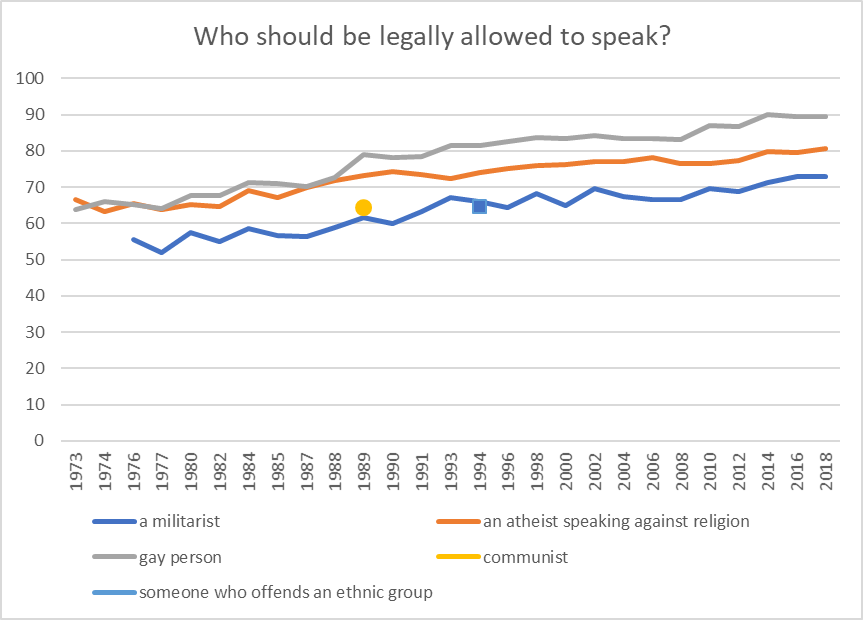
See also: Empathy and Justice; civility: not too much, not too little; what sustains free speech?; responsiveness as a virtue.

what constitutes coordination?

[W]e addressed the factual question whether members of the Trump Campaign “coordinat[ed]”-a term that appears in the appointment order-with Russian election interference activities. Like collusion, “coordination” does not have a settled definition in federal criminal law. We understood coordination to require an agreement–tacit or express–between the Trump Campaign and the Russian government on election interference. That requires more than the two parties taking actions that were informed by or responsive to the other’s actions or interests. We applied the term coordination in that sense when stating in the report that the investigation did not establish that the Trump Campaign coordinated with the Russian government in its election interference activities.

— from the Mueller Report

That faint sound you hear is hundreds of philosophers paging through their thumb-worn copies of seminal books and articles about shared agency and collective intentionality and revving up their word processors to write lecture notes and articles.* I have not investigated this literature sufficiently to have useful views, but it is a rich topic of current investigation that bridges ethics, metaphysics, and philosophy of language and mind.

What does it mean to say, “We are doing something?” Is the “we” a real thing or just a shorthand for several “I’s”? If a bunch of people all run for shelter at the sound of thunder, are they coordinating? What if they take exactly the same actions as part of a dance? Does the “we” mean something different in the sentences “We all ran for shelter” and “We all performed a dance”? (This is from Searle.)

What if I say to you, “Let’s go for a walk”? Do I then have an ethical obligation to coordinate my itinerary and pace with you? (From Gilbert). Is the obligation just the usual one to honor a promise, or does it stem from my new relationship to you?

Let’s say that all the members of the Supreme Court believe that something is unconstitutional and issue a unanimous ruling to that effect. Later, the same nine people all think that dinner was awful. In one case, did the Supreme Court make a judgment, whereas in the other case, nine people made separate judgments? What if the nine issued a ruling and then found out that it was invalid because they weren’t properly in session at the time? Did they incorrectly believe that they were acting as a group? (Inspired by Epstein).

Robert Mueller says that whether the Trump campaign and Russia coordinated is a “factual question.” But it requires a definition of coordination. Apparently, the legal definition of that word (from statutes and/or precedents) is unsettled. But in any case, the deeper issues are philosophical–and not simple to resolve.

*e.g., Brian Epstein, The Ant Trap: Rebuilding the Foundations of the Social Sciences (Oxford Studies in Philosophy, 2015); Margaret Gilbert, “Walking Together: A Paradigmatic Social Phenomenon” in her 1996 book Living Together: Rationality, Sociality, and Obligation, pp. 177–94; Larry May, Sharing Responsibility (Chicago: University of Chicago Press, 1992); Philip Pettit and David P. Schweikard, “Joint Actions and Group Agents,” Philosophy of the Social Sciences, vol. 36, no 1, 2006, 18–39; John Searle, “Collective Intentions and Actions,” in P. Cohen, J. Morgan, and M.E. Pollack (eds.), Intentions in Communication (Cambridge, Mass. MIT Press, 1990); Raimo Tuomela, “We Will Do It: An Analysis of Group Intentions;” Philosophy and Phenomenological Research, vol. 51, no. 2 (1991), pp. 249–77; David J. Velleman, “How to Share an Intention,” Philosophy and Phenomenological Research, vol 57 (1997), pp. 29–51; and other such papers.