I’ll be overseas, mostly in Uganda, and mostly offline until Feb. 25. I’ll resume posting after then.
overseas until Feb. 25
Reply

I’ll be overseas, mostly in Uganda, and mostly offline until Feb. 25. I’ll resume posting after then.
In the year 1596, Anna is about to be burned at the stake. As the constable prepares to light the fire below her, she can do nothing but seek a solution in her own memory and imagination.
The Anachronist is a game in which you make choices that determine the outcome. By increasing Anna’s knowledge, you can create opportunities for her to act. By decreasing the entropy or disorder of the whole situation, you can raise the odds that the ending will be a happy one for all of the characters. If you try to conclude the story while knowledge is too low or entropy is too high, Anna will burn.
At the same time, The Anachronist is literary fiction. With as many words as a novel, it’s indebted to authors like Joyce, Borges, Calvino, and Pamuk. It uses modernist and post-modernist literary techniques–as well as an interactive format–to explore questions of perspective, historical change, and truth.
Emily Short writes:
The Anachronist is a Twine piece by Peter Levine. It’s long, and paced like a novel rather than like a short story or a poem; it very much belongs to the category of readerly IF [Interactive Fiction]. …
As for what it’s about, that is a little more difficult to describe. The protagonist is being burned at the stake in 1598 (perhaps), but in the moment that she stands in the flame, her mind wanders. She imagines her surroundings in Oxford, or possibly a painting of her surroundings; she thinks about alchemy, the art of memory, the intellectual commitments of a former teacher.
Your task is an abstract one, to do things that globally increase knowledge or decrease entropy. Part of the gameplay involves recognizing and selecting anachronistic references; those links aren’t highlighted for you, but if you succeed in finding something, that counts against entropy.
The knowledge aspect is a little trickier. Most of the choices at least in the early stages of the story are choices either to look more closely at some aspect of the world or else to move onward. My impression was that looking more closely would often increase knowledge, but I’m not certain how consistently that was applied. Some choices overtly claim to have changed your knowledge/entropy status, but I’m not sure that there aren’t other, covert alterations.
I have not yet had the time to read the whole thing. One of the themes so far is a meditation on cultural contact, on how people portray and understand those from other cultures. But that is definitely not the only thing going on, and I’d need to finish the piece in order to say much more.
It’s been online for about three weeks. Some other early readers’ responses are here. Or click to enter the world of The Anachronist.
I opposed Betsy DeVos’s nomination, I’m grateful to the people who protested it, and I’m sorry she won confirmation. But I’m not sure it’s a good sign that she attracted more effective opposition than the other nominees have. (That is, unless the grassroots opposition to Jeff Sessions has been relatively underreported.) The purpose of this post is not to check the momentum of the anti-DeVos efforts but to ponder today’s ideological spectrum and how we should identify and counter the worst threats to democracy.
Why did DeVos get more effective criticism than the other nominees? It can’t be because she poses a graver danger. The Every Child Succeeds Act of 2015, which had bipartisan support, determines federal k-12 education policy. Congress won’t reopen that legislative compromise. Moreover, education is predominantly a state responsibility, and the 2015 Act gave the states more discretion. The Higher Education Act is due for renewal, but I doubt Congress will muster a majority for a major change. DeVos will have to operate within the parameters of two demanding statutes. In contrast, the cabinet secretaries in charge of foreign policy, justice, financial regulation, and environmental issues have much more freedom of action.
Nor do DeVos’ radical views explain why she attracted more effective opposition than Trump’s other nominees. She is a very strong proponent of school choice, to such an extent that some mainstream proponents consider her support a liability. But the idea of introducing market mechanisms into education has been dominant for 25 years, and both the Clinton and Obama administrations endorsed versions of that theory. Democratic Sen. Cory Booker has worked with DeVos on school choice initiatives. To be sure, she acknowledges that she favors school choice so that religious schools can expand, whereas some other pro-market reformers just expect better performance to result from competition. But that difference of motivation may not make much difference for actual policy.
It’s true that DeVos performed poorly in her hearings, but was she really less qualified than Rick Perry or Ben Carson? If the Senate has been assessing competence and qualifications, then you’d have to consider sexism to explain why Senators seem to prefer those two men to DeVos. After all, DeVos has worked on education issues, albeit narrowly defined.
It’s not hard to find other explanations for DeVos’ harder path to confirmation. More people care about education than about other issues. Vouchers are unpopular or irrelevant in suburban and rural communities. Also, there is just one cabinet secretary for education, so she attracted all the attention, whereas the nominees concerned with other topics split up the opposition. Here, for example, is a rally against the environmental nominees, but it targets three of them, it’s not very big compared to the anti-DeVos events, and it’s in Democratic controlled Newark, NJ.

Above all, the teachers unions are organized nationally and still have the capacity to prompt grassroots action.
I’m all for that, since I think democracy requires organization. But is it good that mobilization has been most effective against DeVos? We’re used to a linear ideological spectrum, with pro-market/anti-state views on the right and New Deal/Great Society government activism on the left. In that framework, DeVos stands far to the right. Trump is also some kind of right-wing radical. Therefore, DeVos must be like Trump, and blocking her would mean blocking Trumpism. Unions are organized for that purpose, since they exist to counter market rule.
I think this framework is obsolete. We should array political leaders on two continua, from pro- to anti-state and from liberal to authoritarian on social issues. Donald Trump does not stand to the right on the spectrum from pro- to anti-state. He is all for using the massive power of the federal government. He just wants to use it for an ethnonationalist, reactionary program.
This is the taxonomy I have in mind for the issue of education:

I code Ted Kennedy as pro-state and socially-liberal, although he was a major architect of No Child Left Behind, which introduced market mechanisms. I still think he was more pro- than anti-state, because NCLB also dramatically increased federal spending on education and introduced some new command-and-control regulations. I code Cory Booker as socially liberal and pro-market on education, because he (and not he alone among Democrats) has strongly advocated school choice. I put DeVos just a touch to Booker’s right on the pro/anti-state axis, but also well to his south on the authoritarian scale, because she clearly wants to use education policy to change the whole culture in conservative directions. Still, she chooses to do that by reducing the power of the state, not by expanding it, which makes her not very authoritarian. Finally, Donald Trump stands down there in the bottom-left quadrant, eager to use the state to enforce reactionary norms.
I’m left-of-center on this diagram, but I’m willing to have an ongoing debate with market advocates in which the size of government rises and falls and voters make judgments based on results. It’s the bottom-left that frightens me.
If pro-state authoritarianism is the greatest threat to democracy today, then we must rally all its opponents. They will include pro-government liberals who detest the content of Trump’s policies along with anti-government libertarians who fear the expansion of the state. I would not advocate trying to enlist Betsy DeVos herself in the movement against Trump, although she did oppose him explicitly on ideological grounds in March, saying, “I don’t think Donald Trump represents the Republican Party. I continue to be very optimistic that as we get further along into the process, the more voters know about him, and the more informed they are, the more they’re going to continue to break away.” But even if you don’t want to share a movement with DeVos herself, we need people from her general camp.
As Jon Valant writes, Donald Trump is driving Democrats away from school choice. They used to be divided on that issue, and some, like Sen. Booker, saw choice as means to improve poor systems. Now Trump has endorsed school choice on the stump and has chosen a market zealot for his education secretary, and Democrats are rightly against Trump. Therefore, Democrats are turning against school choice. Valant says, “Trump and DeVos, divisive figures enormously unpopular among Democrats, could become the public faces of charter schools and school choice.”
If you oppose market mechanisms in education (and I’m moderately skeptical of them), then this is a Good Thing. It disrupts the bipartisan support for school choice and turns it into yet another policy proposal that will require single-party control to enact. Down go the odds that we will expand school choice. But if you’re hoping for a leftist plus liberal plus libertarian coalition against Trump, then the shift against school choice could make things harder.
None of that implies that DeVos will be a good Secretary of Education or that it was a mistake to oppose her. I just think we need a coalition against authoritarianism that is equally effective against the true Trumpists and that makes common cause with libertarians until the present danger passes.
Bertolt Brecht, An die Nachgeborenen (1939), in my translation from the very simple and direct German.
I
Truly I live in dark times!
A sincere word is folly. A smooth forehead
Indicates insensitivity. If you’re laughing,
You haven’t heard
The bad news yet.
What are these times, when
A conversation about trees is almost a crime
Because it implies silence about so many misdeeds,
When, if you’re calmly crossing the street,
It means your friends can’t reach you
Who are in need?
It’s true: I earn a living.
But believe me, that’s just a coincidence. Nothing
of what I do entitles me to eat my fill.
It’s a coincidence that I am spared. (If my luck stops, I’m lost.)
They tell me: eat and drink! Be glad that you did!
But how can I eat and drink if
What I eat is snatched from the hungry,
My glass of water from someone dying of thirst?
And yet I eat and drink.
I would like to be wise.
The old books say what wisdom is:
To shun the strife of the world and spend the short time
You’ve got without fear.
Do without violence.
Return good for evil.
Not fulfilling desires but forgetting
Counts as wisdom.
I can’t do any of that:
Truly I live in dark times!
II
I came to the cities in a time of disorder.
When famine ruled.
I came among the people in a time of turmoil
And I rebelled with them.
So the time passed
That was given me on earth.
I ate my food between slaughters.
Murder lay over my sleep.
I loved carelessly
And I looked upon nature with impatience.
So the time passed
That was given me on earth.
In my time, roads led into the swamp.
Speech betrayed me to the slaughterer.
I could do very little. But without me,
Rulers would have sat more securely, or so I hoped.
So the time passed
That was given me on earth.
Energies were low. The goal
Was far in the distance,
Clearly visible, though for me
Hard to reach.
So the time passed
That was given me on earth.
III
You who you will emerge from the flood
In which we have sunk,
Think
When you speak of our weaknesses
And of the dark time
That you have escaped.
For we went, changing countries more often than shoes,
In class wars, desperate
When there was only injustice and no outrage.
This we knew:
Even hatred of humiliation
Distorts the features.
Even anger against injustice
Makes the voice hoarse. Oh, we
Who wanted to prepare the ground for friendliness
Could not ourselves be kind.
But you, when
one can help another,
Think of us
Forgivingly.
(Originally posted in 2014.)
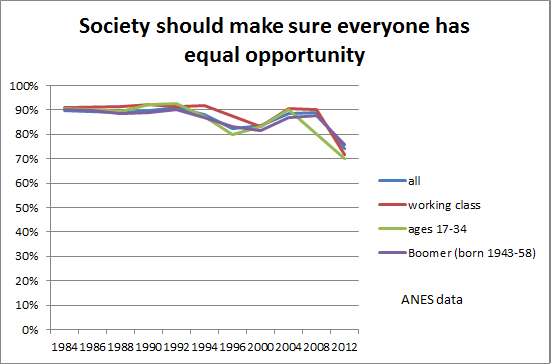
Here are some graphs that show Americans’ changing views of equality. You can click them to expand them. In each case, I’ve graphed the opinion of the whole population, of people who identify as working class (a measure more of self-image than objective resources), of younger people, and of one pivotal generation, the Boomers, as they’ve moved through time. Each point represents at least 100 respondents, usually many more.
Some observations:
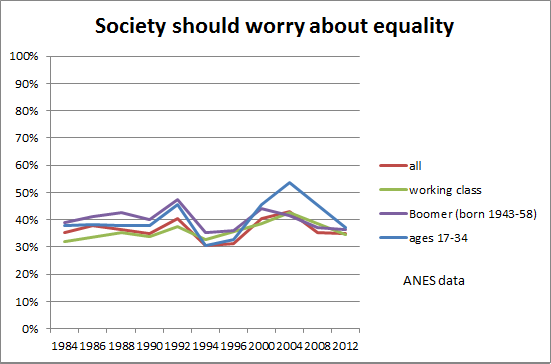
Most Americans believe in equal opportunity. Not nearly as many believe that we should worry about equality or that a lack of opportunity is a big problem. (The former question asks whether “We should care less about equality,” and I show the percentage who disagree.) One interpretation is that Americans believe in equality of opportunity but not in equal 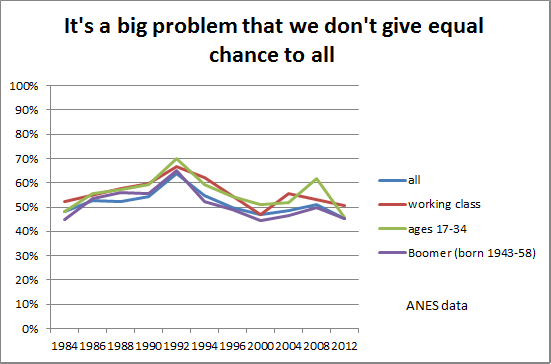 outcomes, and many perceive that opportunities are pretty equal.
 Differences by class, age, and generation are not striking. Younger people have been somewhat more likely to think that we should worry about equality, but they’ve actually been a bit less likely to see unequal life chances as a big problem. Boomers have tracked the national mean during this period, as have working-class people.
The consensus in favor of equality of opportunity fell off substantially during the Obama years. That is not entirely an effect of partisanship, since even in 2012, 83.5% of Republicans favored equality of opportunity, just five points below Democrats.
The other equality measures rose during the Reagan and Bush I administrations, fell under Clinton, rose during Bush II, and fell under Obama. Any of these explanations might hold: people react negatively to the perceived priorities of incumbent politicians; or Americans view equality as taken care of under Democrats and unaddressed under Republicans; or Democrats win elections when the economy is bad, and that’s when Americans grow concerned about equality.
Finally, I really don’t see a secular trend here–i.e., a trend that would reflect long-term changes in the economy or the demographics of the country. Two of the measures stand roughly where they did in 1984, and the shifts appear to be short-term reactions to presidential administrations or the business cycle. There’s possibly a long-term trend in the general belief that “society” should ensure everyone equal opportunity. One could perceive a decline in that measure since 1992, although if 2016 or 2018 registers a rise, that decline will look illusory.
See also: the most educated Americans are liberal but not egalitarian; the most educated Americans are liberal but not egalitarian (2); a new chapter on generational trends in US politics; and how public opinion on social spending has changed: a generational approach.
CIRCLE has created new visual guides on how to engage the 50% of young people who don’t vote, five policy steps for better youth engagement, and–displayed below–a path to stronger democracy. Please share!


Elizabeth Eckford attempting to enter Little Rock School on 4th September, 1957
(Atlanta, en route to Starkville, MS) Sacrifice can be a political act; often politics requires it. Sacrifice would be unnecessary in an ideal society and pointless in a completely static one; but in an unjust society that is subject to change, it is both necessary and powerful. Social movements are fueled by sacrifice. However, sacrifice also presents risks that we must learn to contain.
I’ll consider two cases in this post. Gandhi pledged in 1932 to starve himself to death over an issue related to untouchability. Black parents sent their children to segregated Little Rock schools in 1957 in the face of mob violence. These were acts of sacrifice in the sense that people voluntarily risked something of great value to achieve a political end.
The Gandhi example is fraught. He originally swore to starve in order to prevent Dalits from receiving separate representatives in an all-India legislature. The most charitable interpretation of this rather perplexing stance is nationalist: he wanted everyone to vote simply as an Indian. The great Dalit leader Bhimrao Ramji Ambedkar insisted on separate representation for the so-called Untouchables to prevent them from being dominated by caste Hindus. When he visited the literally starving Gandhi in prison, they negotiated a compromise involving a temporary set-aside of seats for Dalilt. Ambedkar wanted that provision to last for ten years “to stabilise opinion” Gandhi countered:
Five years or my life. Tell your followers that is what Gandhi says and plead my case before them, and if they do not accept this from you surely they do not deserve to be called your followers. My life is in your pocket. I may be a despicable creature, but when the truth speaks through me I am invincible. You have a perfect right to demand cent percent security by statutory safeguards, but from my fiery bed, I beg of you not to insist upon that right. I am here today to ask for a reprieve for my caste Hindu brethren.
Gandhi used a threat to end his own life (and thereby produce an enormous emotional upheaval in the subcontinent) in order to limit a provision intended to help the least advantaged Indians. Soon, the Mahatma converted his fast into an attack on the very principle of Untouchability, but he still used a threat to sacrifice himself to defeat Ambedkar, who was never persuaded on the merits yet found Gandhi politically “invincible.”
The Little Rock school desegregation campaign is far more attractive, yet Hannah Arendt famously disapproved of it. Partly, that was because she interpreted US racial conflict from the perspective of a formerly assimilated German Jew who had concluded that Jews would never be accepted in Europe; thus she leaned toward separatism rather than integration. She also misunderstood race and racism in the US. But most importantly, her republican political ideals caused her to overlook the value of sacrifice.
In a republic, citizens are both rulers and ruled (to use Aristotle’s definition). They make joint, binding decisions about life-and-death matters after airing their differences in public fora. Sometimes, a citizen must pay a high price—for instance, being drafted and then killed in a battle for the republic. But that is not a “sacrifice” in the sense of an individual, voluntary act. It’s the outcome of a joint decision made through law.
A core republican idea is “non-domination.” No citizen may just tell any other citizen what to do. Citizens are governed by general laws that must be defended with general arguments. Therefore, the paradigmatic examples of sacrifice for Christians—God telling Abraham to sacrifice Isaac; God sacrificing His only-begotten son for love of the world—are not models for republican politics.
People are either citizens of a given republic or not. Arendt strongly opposed statelessness because it made refugees into citizens of nowhere. She thought that children and adolescents were not citizens because they couldn’t rule. In “Reflections on Little Rock,” she describes schooling as preparation for “future citizenship.” Because children are not current but future citizens, to ask them to act politically is to expect them to be ruled without ruling.
However, the most startling part of the whole business was the Federal decision to start integration in, of all places, the public schools. It certainly did not require too much imagination to see that this was to burden children, black and white, with the working out of a problem which adults for generations have confessed themselves unable to solve. I think no one will find it easy to forget the photograph reproduced in newspapers and magazines throughout the country, showing a Negro girl, accompanied by a white friend of her father, walking away from school, persecuted and followed into bodily proximity by a jeering and grimacing mob of youngsters. The girl, obviously was asked to be a hero–that is, something neither her absent father nor the equally absent representatives of the NAACP felt called upon to be. It will be hard for the white youngsters, or at least those among them who outgrow their present brutality, to live down this photograph which exposes so mercilessly their juvenile delinquency. The picture looked to me like a fantastic caricature of progressive education which, by abolishing the authority of adults, implicitly denies their responsibility for the world into which they have borne their children and refuses the duty of guiding them into it. Have we now come to the point where it is the children who are being asked to change or improve the world?” And do we intend to have our political battles fought out in the schoolyards?
Arendt didn’t use the word “sacrifice” in this passage because it was not yet part of her vocabulary. Ralph Ellison took her to task on that point in an interview with Robert Penn Warren:
That’s right – you’re forgetting sacrifice, and the idea of sacrifice is very deeply inbred in Negroes. This is the thing – my mother always said I don’t know what’s going to happen to us if you young Negroes don’t do so-and-so-and-so. The command went out and it still goes out. You’re supposed to be somebody, and it’s in relationship to the group. This is part of the American Negro experience, and this also means that the idea of sacrifice is always right there. This is where Hannah Arendt is way off in left base in her reflections on Little Rock. She has no conception of what goes on in the parents who send their kids through these lines. The kid is supposed to be able to go through the line – he’s a Negro, and he’s supposed to have mastered those tensions, and if he gets hurt then this is one more sacrifice.
To her credit, Arendt wrote to Ellison, “It is precisely the ideal of sacrifice that I didn’t understand.”
Danielle Allen, in Talking to Strangers: Anxieties of Citizenship since Brown v. Board of Education, rightly makes the dispute between Arendt and Ellison a central issue for democratic theory. Allen argues that sacrifice is a characteristic political act, because even belonging to a community requires giving things up, and changing it usually carries a higher price. Although formally we all sacrifice by belonging to a community, the actual level of sacrifice always differs very unfairly. Unequal sacrifice is thus a fundamental reality; it calls for specific responses, such as acknowledgement and recompense.
I agree; political theory must address and encompass sacrifice. Acts of sacrifice also have specific cultural and religious resonances, different in each tradition, and these are resources for the world’s oppressed people. The trouble is that sacrifice is also coercive and can overwhelm deliberation. As with many aspects of politics, what we need is balance.
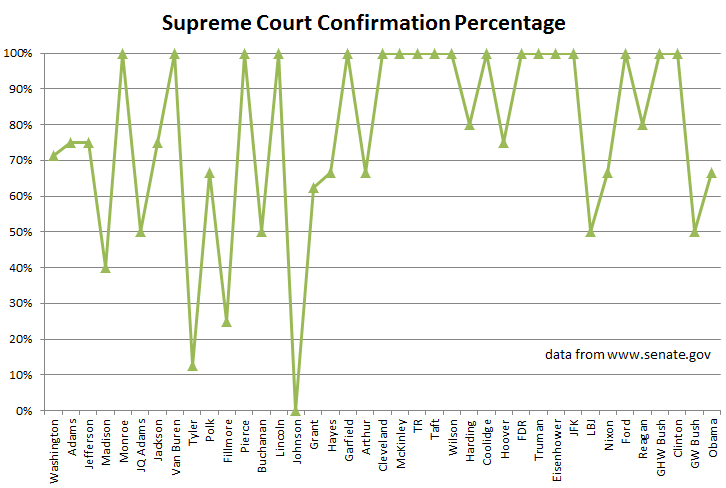
This graph shows the proportion of each president’s Supreme Court nominations who were confirmed as opposed to rejected, withdrawn, or postponed. I draw attention to the rocky record of the antebellum presidents, the very high confirmation percentage between 1900 and 1967, and the mixed story since then.
It’s often said that Robert Bork was the first nominee of modern times rejected on ideological grounds, not because of a scandal. Conservatives (rightly or wrongly) view that episode as the moment when a norm was broken, since 20th century presidents had been allowed to name candidates who met basic qualifications. Liberals now feel equally strongly about Merrick Garland, the first modern nominee not to receive a vote at all, even though he was clearly a moderate. If Democrats filibuster Neil Gorsuch and Republicans end the filibuster, that will be seen as a new stage. The new implicit rule will be: presidents can name Supreme Court nominees when a majority of the Senate chooses to concur, but otherwise the seat stays vacant. In general, we will expect vacancies to be filled when the Senate and White House belong to the same party, but otherwise to remain empty unless the two sides happen to be able to work out a win/win deal.
This trend could be taken as an example of the decline of norms and comity in Washington. I believe in the general truth of that story. However, I would interpret the changing norms for confirmation in a different way. From 1900 until around 1970, both national parties had conservative and liberal wings. Conservative Southern Democrats stood to the right of Republicans on social issues. Some Northern Republican Senators were genuine liberals. This meant that most presidents could assemble majority coalitions on important votes–not only nominations, but also landmark bills and budgets–regardless of which party controlled the majority. A Democrat would use party loyalty and intraparty horsetrading to line up most of his own caucus, adding liberal Republicans to reach a majority. A Republican would do just the reverse to win. As a result, the norm was not only that presidents got their way with Supreme Court nominations (absent scandals) but also that they drove national policy.
Once the parties polarized into left and right, that situation no longer applied. Since then, presidents have really only been able to govern domestically when their party has controlled Congress, although they have increasingly resorted to unilateral executive actions at other times. The only moments of effective governance, as envisioned by the Constitution, have occurred in 1980-82, 1992-4, 2003-6, and 2009-11. The rest of the time has seen stalemate or executive unilateralism.
For Supreme Court nominations, only the Senate matters. Since 1980, 11 justices have been confirmed while the Senate and presidency have been aligned, three (Kennedy, Souter, and Thomas) slipped through despite a hostile Senate, one (Miers) was withdrawn despite unified party control, and two (Bork and Garland) were blocked.
Going forward, I think it’s pretty much inevitable that presidents will get their Supreme Court nominees through when they have majorities in the Senate, and otherwise, they will be blocked. Merrick Garland deserved a vote but would have been defeated under this new norm. Trump gets Gorsuch and can fill other vacancies until he loses the Senate or his own reelection. Democrats should use the filibuster now, so that Republicans have to end it and the underlying rules are clarified. If Democrats win the Senate and White House in 2020, they should use majority votes to appoint strong liberals to the court.
I am not saying the new normal is acceptable, but I fail to see an alternative, and we might as well understand the stakes.
Data from the Senate. See also: is our constitutional order doomed?, are we seeing the fatal flaw of a presidential constitution?, and two perspectives on our political paralysis.
I enjoyed a conversation with Dr. Matt Townsend yesterday on the topic of civic education. Here is the audio. Dr. Matt’s show has a national audience and is devoted to “talking about good.” We discussed the importance of learning to deliberate controversial current issues with people who disagree.
Sorrow everywhere. Slaughter everywhere. If babies
are not starving someplace, they are starving
somewhere else. With flies in their nostrils.
But we enjoy our lives because that’s what God wants.
Otherwise the mornings before summer dawn would not
be made so fine. The Bengal tiger would not
be fashioned so miraculously well. The poor women
at the fountain are laughing together between
the suffering they have known and the awfulness
in their future, smiling and laughing while somebody
in the village is very sick.— From Jack Gilbert, “A Brief for the Defense.”
On Saturday, I ate my 50th birthday dinner with my beloved wife and younger daughter in a restaurant in Cambridge, MA. While we waited for the check, we heard about the protest at Logan Airport and decided to go. I then watched two of my favorite people stand against injustice in the company of a large and passionate band of our fellow citizens.
To say that I enjoyed my birthday evening seems wrong. It sounds a bit like saying, “The US Coast Guard turned the refugee-laden ship St Louis away from Miami in May 1939, and 254 of the passengers were soon murdered in the Holocaust, but I enjoyed standing on the dock with a ‘Let them in!’ sign.”
But there is another way of looking at these situations. Politics is often about cruelty and injustice. Sometimes the people who respond with optional political actions–like carrying signs in Logan’s Terminal E–are not directly at risk. We may nevertheless take satisfaction from our political action if we contribute, in some ultimate way, to a better world.
For one thing, we should draw satisfaction because that motivates more activity. If politics is mere sacrifice, everyone except the most direct victims (the ones with their backs to the wall) will drop out sooner or later. I think it’s wise for activists to advertise the emotional benefits of action.
More than that, we should take satisfaction from politics, even if others are suffering while we are safe, because consequential public action is part of a dignified life–an aspect of dignity too often denied to us by bureaucracies and markets. Hannah Arendt thought that the American Framers originally revolted in defense of their own private liberties, but they discovered, as they made the new republic together, that “no one could be called happy without his share in public happiness, that no one could be called free without his experience in public freedom, and that no one could be called either happy or free without participating, and having a share, in public business” (On Revolution, p. 247). Lin-Manuel Miranda captures that feeling at the very end of Hamilton, when his hero sings, “I wrote some notes at the beginning of a song someone will sing for me. America, you great unfinished symphony, you sent for me. You let me make a difference.”
We shouldn’t wish for injustices so that we can make a difference. (Young-man Hamilton does–singing “God, I wish there was a war! / Then we could prove that we’re worth more /
Than anyone bargained for…”–but he outgrows that sentiment.) When, however, we are confronted with injustices that we did not choose, we may take some joy from rising up together with those we love:
For mighty were the auxiliars which then stood
Upon our side, we who were strong in love!
Bliss was it in that dawn to be alive.
[…]
Now was it that both found, the meek and lofty
Did both find, helpers to their heart’s desire,
And stuff at hand, plastic as they could wish;
Were called upon to exercise their skill,
Not in Utopia, subterranean fields,
Or some secreted island, Heaven knows where!
But in the very world, which is the world
Of all of us,–the place where in the end
We find our happiness, or not at all!– Wordsworth, “The French Revolution“
See also: unhappiness and injustice are different problems ; you have a right and a responsibility to attend to your own happiness; notes on Hannah Arendt’s On Revolution; and Mill’s question: If you achieved justice, would you be happy?

