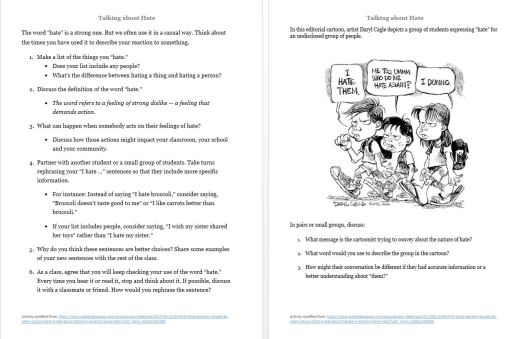
A Short Lesson on Hate

Talking About hate

Click on the link here, Talking about Hate, to access the lesson.

Friends, today’s post is brought to you by our program coordinator and all-around excellent teacher, Ms. Peggy Renihan.

During back to school, many teachers facilitate activities designed to create a safe learning environment. Recent current events may have students discussing sensitive issues. The activity provided in this post may, we hope, help facilitate conversations.

It is based on the an article from the Washington Post about teaching the issues related to the sometimes acrimonious public debates we face today . 
(A special Thank You to our own Val McVey for finding and sharing interesting and useful resources.)

There are some thought-provoking resources in the article that may be helpful. We reviewed most of the links and suggest that you view the videos and read the articles before sharing with students to ensure age-appropriateness.

Knowing that most people appreciate a readymade activity, we (Editor’s Note: we meaning Peggy!) modified the resources and information from the article to be ready for classroom use.Click on the link here, Talking about Hate, to access the lesson.


Social Mobilisation Campaign Model

The Social Mobilisation Campaign (SMC) model is an approach used by the Creative Centre for Community Mobilisation (CRECCOM) to mobilise and empower rural communities to fully own their development. The model uses a combination of participatory methodologies, rights based approaches, results based management, collective action, and policy advocacy tools to...

On Hate and Love

It has been a difficult few days. Following the violent white supremacist rally which took place this weekend, I am angry, heartbroken, ashamed, unsurprised, and resolutely full of an overwhelming sense of love.

There is too much hate in this world; I choose love.

To be clear, love is not a passive emotion. It is not a empty gesture intended to claim allyship. As Dr. King teaches us, love is not “emotional bosh.” Rather “a strong, demanding love…is ultimately the only answer to mankind’s problems.”

In the face of a world that knows such terrible hate, love is a defiant act. It is a way of living, being, and interacting. Love is a way of fighting. Love, as Dr. King says, is how we “implementing the demands of justice.”

I choose love.

Elie Wiesel, too, spoke to the transformative power of love when, nearly 20 years after Dr. King, he noted that “the opposite of love is not hate, it’s indifference.”

Indifference is a passive act. It is the quiet comfort of moderates who enable the deep injustices of the status quo with their silence and complicity while patting themselves on the back for staying beyond the messy fray. Indifference is to cede your power, to abdicate your responsibly, to accept things as they are with a half-hearted shrug, but what could I do?

Indifference is to give up on love.

If we’re being honest with ourselves, the hateful acts our country saw this weekend could have happened in any American city. Our problems are not restricted to a single party, a single region, or a single demographic. The blistering hate we saw on display was merely the articulation of a wound we have collectively let fester far too long.

All of us who benefit in some way under the current status quo bear responsibility for these atrocities. We may hate the perpetrators and everything they stand for, but we haven’t done enough to respond. We’ve chosen for too long the smooth path of indifference.

It is time to choose love.

It is not an easy road. A passionate dedication to the type of love Dr. King espoused requires strength, courage, and heartbreak. There’s a reason civil rights educator and activist Myles Horton titled his autobiography The Long Haul.

There is so much work to be done, and on dark days like to today, the entire task can feel hopeless. Love may be right, but it is far easier to settle in to indifference.

When confronted with hopeless tasks, I like to remember Camus’ inspired description of Sisyphus, the Greek man mythically condemned to “ceaselessly rolling a rock to the top of a mountain” for all eternity.

It is the quintessential futile task. His work will never be accomplished. Yet despite the dreadfulness of his fate, Camus describes Sisyphus as proud and unbroken; despite it all, he is impuissant et révolté (powerless and rebellious).

That is how I feel on days like today. There is so much to do, and so little I can hope to accomplish. I am utterly powerless, an insignificant piece in the larger social machine. There is nothing for me but the thankless strain of rolling a boulder, or the foolish optimism of tilting at windmills. The task we face is just too great.

Yet, despite this powerlessness, despite my own petty insignificance, I remain steadfastly rebellious. I remain committed to love.

And I will send that love into the world with everything I’ve got. I will speak out against hate, and I will love passionately, radically, and unapologetically. I will not be broken by the enormity of the task. Hate is too great a burden to bear; indifference too superficial a comfort. Amidst the pain, the hate, and the fear, the greatest thing I can do is this:

I choose love.

facebooktwittergoogle_plusredditlinkedintumblrmail

Now We Are All Sons of —

On July 16, 1945, 35 miles southeast of Socorro, New Mexico, the world’s first nuclear weapon was detonated at 5:29 am.

The test was code-named Trinity by J. Robert Oppenheimer. There is no definitive explanation for why Oppenheimer chose the name, but it is widely believed to be a reference to John Donne’s Holy Sonnets: Batter my heart, three-person’d God.

Oppenheimer had previously been introduced to Donne’s work by his mistress, Jean Tatlock, before she committed suicide the year before Trinity.

Donne’s poem reads:

Batter my heart, three-person’d God, for you 
As yet but knock, breathe, shine, and seek to mend; 
That I may rise and stand, o’erthrow me, and bend 
Your force to break, blow, burn, and make me new. 
I, like an usurp’d town to another due, 
Labor to admit you, but oh, to no end; 
Reason, your viceroy in me, me should defend, 
But is captiv’d, and proves weak or untrue. 
Yet dearly I love you, and would be lov’d fain, 
But am betroth’d unto your enemy; 
Divorce me, untie or break that knot again, 
Take me to you, imprison me, for I, 
Except you enthrall me, never shall be free, 
Nor ever chaste, except you ravish me.

Upon witnessing the detonation, Oppenheimer recalled being inspired by a line from the Bhagavad-Gita: “Now I am become Death, the destroyer of worlds.”

It is unclear whether Oppenheimer actually uttered those words in the early morning hours of July 16, so perhaps the most memorial line from that day goes to another scientist on the project, director Kenneth Bainbridge:

Now we are all sons of bitches.

In a letter to Oppenheimer, Bainbridge later tried to clarify his words:

The reasons for my statement were complex but two predominated. I was saying in effect that we had all worked hard to complete a weapon which would shorten the war but posterity would not consider that phase of it and would judge the effort as the creation of an unspeakable weapon by unfeeling people. I was also saying that the weapon was terrible and those who contributed to its development must share in any condemnation of it. Those who object to the language certainly could not have lived at Trinity for any length of time.

In the May 1975 issue of Bulletin of the Atomic Scientists, Bainbridge shares Oppenheimer’s reply:

Years later [Oppenheimer] recalled my words and wrote me, “We do not have to explain them to anyone.” I think I will always respect his statement, although there have been some imaginative people who somehow can’t or won’t put the statement in context and get the whole interpretation. Oppenheimer told my younger daughter in 1966 that it was the best thing anyone said after the test.

In the same article, Bainbridge describes the detonation in careful detail:

The bomb detonated at T = 0 = 5:29:45 a.m. I felt the heat on the back of my neck, disturbingly warm. Much more light was emitted by the bomb than predicted, the only important prediction which was off by a good factor. When the reflected flare died down, I looked at Oscuro Peak which was nearer Zero. When the reflected light diminished there I looked directly at the ball of fire through the googles. Finally I could remove the goggles and watch the ball of fire rise rapidly. It was surrounded by a huge cloud of transparent purplish air produced in part by the radiations from the bomb and its fission products. No one who saw it could forget it, a foul and awesome display.

A few weeks later, the United States dropped atomic weapons on Hiroshima and then Nagasaki; shaking the world with their devastation.

The U.S. won the war, but the horrors unleashed by humanity that day can never be put back in the box. We made something great and terrible; a remarkable tribute to the accomplishments of science and tragic testament to the destructive power of mankind.

Now we are all sons of bitches indeed.

facebooktwittergoogle_plusredditlinkedintumblrmail

There Are Plenty of Alternatives

Below is the opening paragraphs from an article of mine that originally appeared on TheNation.com on August 9, 2017. The full article can be found here: https://www.thenation.com/article/to-find-alternatives-to-capitalism-think-small.  Update, Sept. 28: An Italian translation of the article can be found here.

In the aftermath of Donald Trump’s shocking election victory, a shattered Democratic Party and dazed progressives agree on at least one thing: Democrats must replace Republicans in Congress as quickly as possible. As usual, however, the quest to recapture power is focused on tactical concerns and political optics, and not on the need for the deeper conversation that the 2016 election should have provoked us to have: How can we overcome the structural pathologies of our rigged economy and toxic political culture, and galvanize new movements capable of building functional alternatives?

Since at least the 1980s, Democrats have accepted, with varying degrees of enthusiasm, the free-market “progress” narrative—the idea that constant economic growth with minimal government involvement is the only reliable way to advance freedom and improve well-being. Dependent on contributions from Wall Street, Silicon Valley, Hollywood, and Big Pharma, the Democratic Party remains incapable of recognizing our current political economy as fundamentally extractive and predatory. The party’s commitment to serious change is halfhearted, at best.

While the mainstream resistance to Trump is angry, spirited, and widespread, its implicit agenda, at least on economic matters, is more to restore a bygone liberal normalcy than to forge a new vision for the future. The impressive grassroots resistance to Trump may prove to be an ambiguous gift. While inspiring fierce mobilizations, the politicization of ordinary people, and unity among an otherwise fractious left, it has thus far failed to produce a much-needed paradigm shift in progressive thought.

This search for a new paradigm is crucial as the world grapples with some profound existential questions: Is continued economic growth compatible with efforts to address the urgent dangers of climate change? If not, what does this mean for restructuring capitalism and reorienting our lives? How can we reap the benefits of digital technologies and artificial intelligence without exacerbating unemployment, inequality, and social marginalization? And how shall we deal with the threats posed by global capital and right-wing nationalism to liberal democracy itself?

In the face of such daunting questions, most progressive political conversations still revolve around the detritus churned up by the latest news cycle. Even the most outraged opponents of the Trump administration seem to presume that the existing structures of government, law, and policy are up to the job of delivering much-needed answers. But they aren’t, they haven’t, and they won’t.

Instead of trying to reassemble the broken pieces of the old order, progressives would be better off developing a new vision more suited to our times. There are already a number of projects that dare to imagine what a fairer, eco-friendly, post-growth economy might look like. But these valuable inquiries often remain confined within progressive and intellectual circles. Perhaps more to the point, they are too often treated as thought experiments for someone else to implement. “Action causes more trouble than thought,” the artist Jenny Holzer has noted. What is needed now are bold projects that attempt to demonstrate, rather than merely conceptualize, effective solutions.

The challenges before us are not modest. But it’s now clear that the answers won’t come from Washington. Policy leadership and support at the federal level could certainly help, but bureaucracies are risk-averse, the Democratic Party has little to offer, and the president, needless to say, is clueless. It falls to the rest of us, then, to figure out a way to move forward.

The energy for serious, durable change will originate, as always, on the periphery, far from the guarded sanctums of official power and respectable opinion. Resources may be scarce at the local level, but the potential for innovation is enormous: Here one finds fewer big institutional reputations at stake, a greater openness to risk-taking, and an abundance of grassroots imagination and enthusiasm.

For the rest of this article, go to https://www.thenation.com/article/to-find-alternatives-to-capitalism-think-small

come work with us: new senior research position at CIRCLE

Senior Researcher: The Center for Information and Research on Civic Learning & Engagement (CIRCLE), Tisch College. Apply here.

Description

The Jonathan M. Tisch College of Civic Life prepares students in all fields of study for lifetimes of active citizenship, promotes new knowledge in the field, educates Tufts students and beyond for a life of active citizenship, and applies our research to evidence-based practice in our programs, community partnerships, and advocacy efforts. Tisch College’s work is central to Tufts University’s mission. Tisch College offers several opportunities to engage Tufts students in meaningful community building and and other civic and political experiences, explore personal commitments to civic participation, and take on active and effective roles in public life and to engage faculty in expanded active citizenship research and teaching. Tisch College also seeks to influence higher education in the US and abroad to embrace active citizenship maintly through its work via Institute for Democracy in Higher Education. CIRCLE (The Center for Information and Research on Civic Learning and Engagement) is a research-base think tank that studies how young peole in the United States learn to become active participants in our democracy, and studies a broad range of topics, from K-12 civic education, youth organizing, youth and civic media, to community characteristics that promote civic development. Although CIRCLE studies civic development and engagement of all youth, the central focus of its work is on expanding access to civic learning and engaement opportunities especially for marginalized youth from various backgrounds. CIRCLE is an influential force and a premier source of information —facts, trends, assessments, and practices—related to youth civic engagement. CIRCLE reaches both academic and practitioners audiences through both academic and popular media, including a large number of features in major news outlets. Founded in 2001, CIRCLE has been part of Tisch College since 2008 and CIRCLE staff are fully integrated into the organizational life of Tisch College and Tufts University, offering CIRCLE staff a number of opportunities to develop skills in and outside of research.

CIRCLE (The Center for Information and Research on Civic Learning and Engagement) is a research center that studies young Americans’ civic development. CIRCLE is seeking a Senior Researcher with deep backgrounds in quantitative research methodologies, and varied experience in planning and executing research projects of various scales, independently and as part of a professional team. The Senior Researcher will be a Tufts University employee and will work in the main CIRCLE office on the Tufts campus in Medford/Somerville, Massachusetts. Responsibilities include serving as the lead quantitative researcher on a range of research projects that may include secondary data-analysis, large dataset creation/analysis, literature reviews, field experiments, and original surveys. The Senior Researcher’s tasks include producing analytic plans, methodology documentations, datasets, reports, fact sheets, formal and informal research briefs and press releases on timely and relevant topics, often in close collaboration with CIRCLE colleagues. The Senior Researcher will assist research grant proposals writing especially with the methodology sections, and occasionally represent CIRCLE at a wide range of events including research conferences, practitioner forums, press events and other public events. The Senior Researcher will work alongside colleagues, including a current Senior Researcher, Director of Impact, and Researcher, and provide inputs and peer training to other CIRCLE staff who produce research (quantitative and qualitative). All CIRCLE staff report directly to Director of CIRCLE, who reports to Associate Dean of Research at Tisch College.

Qualifications

Basic Requirements:

  • Minimum 5 years’ experience.
  • Master’s degree in a discipline related to social science.
  • Knowledge of statistical package, such as SPSS and STAT.
  • Because of CIRCLE’s explicit focus on improving civic education and engagement for young people of color and other underserved youth, and because of Tisch College and Tufts University’s foundational commitments to diversity and inclusion, candidates with diverse backgrounds and experiences, broadly defined, are especially encouraged to apply.

Preferred Qualifications:

  • Research experience in a professional setting in which quick deadlines and collaborative team work were common.
  • Comfort with multiple projects and delegating and receiving tasks, and making decisions about research and analytic design choices with minimal guidance.
  • Experience with multivariate statistical techniques, evaluation methods, and psychometric analysis.
  • Experience with developing and executing surveys.
  • Ability to communicate effectively with practitioners, reporters, scholars, and young people through writing, speech, and graphs.
  • Ability to produce reliable, accurate, and readable research products on short deadlines.
  • Ability to work collaboratively with CIRCLE colleagues from varied backgrounds and to interact with practitioners of diverse backgrounds, views, and positions.
  • Ability to teach research methods to colleagues and student/workers.
  • Concern for youth civic engagement is necessary; however, prior research in this specific area is not required.
  • An employee in this position must complete all appropriate background checks at the time of hire, promotion, or transfer.

Equal Opportunity Employer – minority/females/veterans/disability/sexual orientation/gender identity.

Primary Location: United States-Massachusetts-Medford/Somerville

A New School Year with FJCC

Well, it is another school year, and we here at the Florida Joint Center for Citizenship at the Lou Frey Institute wish teachers everywhere a great start to the year. In this post, you will find a compilation of the resources that we have to offer as you start the new year. If you have any questions about these resources, please feel free to shoot me an email! 

Civics360

Civics360 is our newest resource, and we continue to add to it. Some of you may be familiar with the Escambia Civics Review Site; Civics360 replaces that site. So what does Civics360 bring to the table?

Student Friendly Readings in English, Spanish, and Haitian Creole and Reading Guides in English
We now have the Student Friendly Readings in three languages, and a reading guide in English that can help students with their understanding, crafted with the help of literacy experts from UCF. 
readings

New Student Friendly Videos
We have a collection of new videos, ranging between 5 and 10 minutes long or so, that break down the content into easy to understand visuals and text. We have also included video guides to aid in understanding. Please note that currently half of the benchmarks have videos; we are working hard to complete the remaining benchmarks!

videos1

Additional New Features
Additional new features include new vocabulary tools, digital quizzes, a brand new practice assessment that provides you with student reports, and more.

Civics360 does require registration, but it is 100% free. Be sure to check it out!

Florida Citizen

Our main website at Florida Citizen has a number of resources that you could find useful. Of course we have our traditional lesson plans for the middle school civics course. These lesson plans are all aligned to the benchmarks and benchmark clarifications, and include content elaboration for the teacher, relevant vocabulary, and a step by step walk through of instruction.
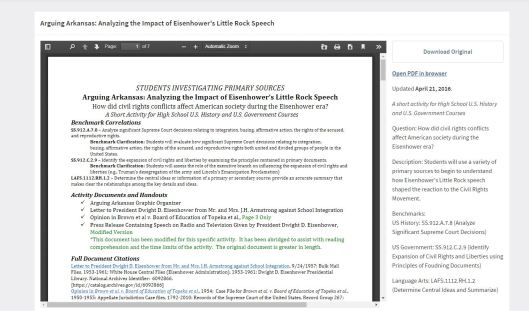
We also have Students Investigating Primary Sources. This series of lessons for grades 2-12, developed in collaboration with the National Archives, provide students an opportunity to ‘play’ with primary sources around relevant topics aligned with Florida history, civics, and government benchmarks. You can learn more about the SIPS lessons here. 

sips page 2

We have not forgotten elementary teachers. Our Civics in a Snap lessons cover each of the K-5 elementary benchmarks, and take 15-20 minutes to work through. They are also aligned with relevant LAFS benchmarks. You can learn more about the Civics in a Snap lessons here. 

3.c.2.1

We have a number of additional resources available on Florida Citizen, including the first three parts of our ongoing webinar series. Be sure to visit Florida Citizen and register for access to the free resources today!

Questions about any of our websites or resources can be directed to Dr. Steve Masyada at FJCC! Hope to hear from you soon!


Transpartisan Review Issue #2 Now Available

I’m excited to announce the latest issue of a project produced by a handful of members and friends of NCDD – The Transpartisan Review #2. Originally introduced to the NCDD community last fall at our NCDD 2016 conferenceThe Transpartisan Review is a new digital journal dedicated to sharing thoughts and insights from the growing transpartisan community.

In our second issue, The Transpartisan Review takes an introspective look at the state of politics in the US and examines the potential transpartisan engagement has in finding solutions for this troubled time. Executive editors Lawrence Chickering and James Turner explore the effect the transpartisan impulse has on political engagement, taking a comprehensive look at the current political climate in the United States through the lens of their “Transpartisan Matrix”.

This issue of The Transpartisan Review also includes several articles on a variety of topics, including contributions from distinguished NCDD members Pete Peterson & Michael Briand (who also served as managing editor), and shares an account of a Living Room Conversation focused on transpartisan issues. Not only are they effective conversation starters, but these features represent the continuation of a dialogue the editors of the journal are encouraging with and between its readership.

You can read the entire issue online or download it for free at the journal’s website, www.transpartisanreview.com, and while you’re there, we invite you to read Chickering and Turner’s Transpartisan Notes, a series of short-form articles on current issues written with a transpartisan perspective.

You can look forward to more critical contributions to the work of bridging our nation’s divides in future issues of The Transpartisan Review and from this great team of NCDDers and transpartisan leaders in the coming months.