Author: Isadora Borges Monroy. Few discussions about democratic innovations neglect to include the promise of technological gimmicks and the possibility of new information networks having a snowballing effect on political participation. In Democratic Innovations: Designing institutions for citizen participation Graham Smith takes a critical look at how processes like town...
Los Angeles Public Radio station 89.33 KPCC interviewed to me last Thursday on the topic, “Are young people’s views on race really that different from their parents?” I emphasized that young people are demographically more diverse than their predecessors; about 40% of 18-29s are now people of color, and rising fast. I also think that some issues that were once contested (e.g., de jure segregation, interracial marriage) have been settled for the younger generation. However, de facto segregation is actually worse than it was when I was a kid. To be precise, there are more racially diverse schools–ones that enroll people from many racial/ethnic groups–yet a larger proportion of Whites attend overwhelmingly White schools. Meanwhile, in some polls, an outright majority of young Whites believe that discrimination is worse against Whites than against African Americans.
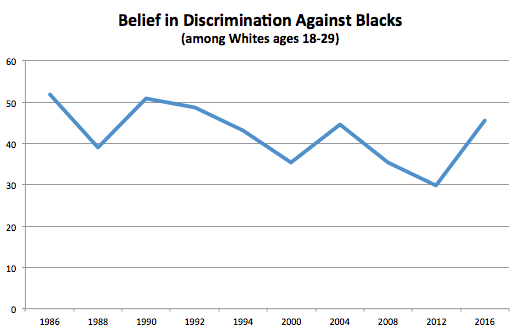
I now offer a Free Graph of the Day. The American National Election Studies have asked people to agree or disagree that “Generations of slavery and discrimination have created conditions that make it difficult for blacks to work their way out of the lower class.” (I wouldn’t phrase the question that way, for several reasons, but it provides a trend over time.) Below I show results for Whites between the ages of 18 and 29. The pattern seems to be a general decline from 1986, when the question was first asked, until 2012, followed by some recovery in 2016–possibly in response to Black Lives Matter and related activism? About the same proportion–just under half–of White Xers in the 1980s and Millennials in the 2000s have agreed with this statement.
American National Election Studies, analyzed by Peter Levine
My takeaway is that it’s a mistake to depend on generational change to improve racial equity in the US, although the increasing number of people of color helps, and Millennials certainly have an opportunity to promote justice if they work at it.
Author: Terhemba Ambe-Uva. In Nigeria, urban slums face what Fung refers to as a “wicked problem”, which to tackle, requires a holistic and multifaceted approach. The country has in recent years witnessed the highest level of urbanization in Africa. However, this rapid urbanization, coupled with endemic corruption, and low levels...
Join the Center for Legislative Archives to discover how to use political cartoons to teach about the United States Constitution. This webinar will draw from the collection of Clifford K. Berryman cartoons from the U.S. Senate Collection. Berryman’s career as a political cartoonist in Washington, DC, spanned five decades and his cartoons are a rich resource for history and civics lessons.
During this interactive webinar, you will practice techniques for helping students evaluate visual content and explore ideas for how to use political cartoons to illustrate the “Big Ideas” of the Constitution, such as separation of powers and representative democracy. You will also explore additional resources from the National Archives for integrating political cartoons in the classroom, such as DocsTeach.org. This webinar is designed for middle school and high school educators. Register for the webinar here.
We are excited to announce that NCDD is working with New York’s 92nd Street Y to support, The Ben Franklin Circles (BFC), a project in collaboration with Citizen University and the Hoover Institution. BFC – an NCDD member org, could use some facilitation support and that’s where NCDD comes in – we have an exciting opportunity for you!
The Circles are inspired by Benjamin Franklin’s junto or “mutual improvement club,” – a sort of civic engagement support group the founding father started and ran for over 40 years. In this 21st Century reboot, small groups of people get together once a month to reflect on big themes that Franklin identified as key to living a good life and creating a good society – topics like Industry/Work; Justice; Moderation; Thrift/Frugality and more. There are 13 total. Participants are encouraged to think about how these principles impact their own lives and how they shape our society, using the conversations as a way to create empathy and strengthen community bonds. Read more about the Circles in our Resource Center.
Here is the opportunity: 92Y has created a platform and toolkit and is offering limited stipends for facilitators to help lead these conversations in their communities. Circles meet once a month for 13 months for about 90 minutes each session. Meetings can be scheduled based on the facilitator’s schedule.
This is a great opportunity for you to utilize this model, connect with groups in your community, and get paid for your time as well! NCDD would love to see a whole bunch of you get involved with Circles across the country. It’s another great way we can work to strengthen community connections and help people bridge divides, at this particularly divisive time in our nation. And many of you have the networks with interest in these kinds of conversations!
If you are interested in this opportunity and would like to connect with organizers to learn more, please fill out this quick form here and they will contact you to discuss this opportunity further!
“La Regione Puglia ha deciso di avviare un percorso di partecipazione con lo scopo di promuovere un’attività di ascolto e confronto, a tutti i livelli, sulla proposta di gasdotto Tap (Trans-Adriatic Pipeline) avanzata sulle coste salentine, in particolare quelle della marina di Melendugno (area San Foca)” [..] “Il Tap è...
As i get this difficulty instead typical meant for the younger newlyweds, very likely middle of the and also later part of the 30s together with ten years younger. Generally a information, “falling from love” and is particularly certainly troubled just by this approach move. He/she (and this isn't merely...
Were suitable are living a life involving enjoy. However, in spite of the simplest way good some are usually in other facets of ones own lifestyles, people don’t truly feel it’s likely to have the exact same success within adore. People explain to on their own to help “be natural...
Nonetheless, there are times when worry may be difficult, and not just the only thing that realistic. There are perhaps times when it can get out of hand out of control, leaving you to definitely think that these people that are the loss of their particular heads. When this occurs,...

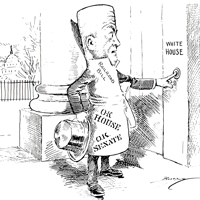 Anyone Home? Cartoon by Clifford Berryman, 2/24/1920


