Feminism and the Transgender Community

I’ve been deeply struck recently by the narratives I’ve heard from some feminists about transgender people. There is a disconnect, or a tension, it seems, between certain conceptions of feminism and a full embrace of transgender people.

Among many older feminists, for example, there seems to be a general confusion about transgender identities and, perhaps, a too-eager willingness to dismiss those identities.

I mention age here not to imply that older people’s idea are inherently out of date or old-fashioned – this isn’t like when everybody rolls their eyes at the kind-of-racist thing your grandparent just said.

Rather – the women I’m thinking of are deep, liberal, radical feminists. Their age is important because they fought on the front lines of sexual liberation. They’ve personally felt that glass ceiling pushing them down. They know what it’s like to be sexually harassed and discriminated against as part of institutions that didn’t even put up the appearance of condemning such behavior.

They knew the first women in their families who were allowed to vote.

These women have been leaders in the battle not only only for women’s rights and equality, but for women’s freedom of self-expression.

Being a woman, they’ve rightly argued, is no single thing. There is no perfect body type. No thing you must enjoy or activities you must hate. It’s not clothes or hair, attitude or aptitude that define femininity.

In this way, the women’s movement isn’t just about the right to be treated equally, it’s about the right to be ourselves.

This concept runs into challenges with the transgender movement which – correctly or not – is often interpreted as arguing that, for example, a transgender woman is someone who feels like a woman.

A radical feminist doesn’t know what that means.

How can someone “feel like a woman” when womanhood itself is something that eludes definition?

This approach interprets transgender men and women as people who are simply conforming to the gender binary: transgender men were assigned female at birth but were too macho to be stereotypical women. Transgender women liked princesses too much to live by their assigned gender of male.

And while I am not at all convinced that the above interpretation of transgender people is accurate, it does create tension between the two communities as feminists bemoan the reinforcement of gender norms and see people of privilege – those assigned male at birth – claim the title of womanhood.I don’t know the way out of this tension. I have no idea what it feels like to be a gender other than the one I was assigned to at birth, but I have to trust people when they tell me that’s who they are. For me, that is enough. But as a society I think we need something more.

This conflict is particularly tragic because there should be no greater allies to the transgender community than feminists. There should be no one better able to appreciate the struggle of being unable to genuinely be yourself.

In many ways, that is, we are all in the same fight – all struggling to find and be our true selves.


facebooktwittergoogle_plusredditlinkedintumblrmail

Commoners Descend on Chieri, Italy, for Major Festival

Italians once again took the vanguard in advancing the commons paradigm by hosting a three-day festival in Chieri, a town of 60,000 people on the outskirts of Torino, Italy.  The International Festival of the Commons featured films, musical performances, video exhibits, lectures, panel discussions, food and drink, and lots of enjoyable conversation.

I think festivals are a fantastic way to bring together both deeply committed commoners and ordinary citizens who are just looking for a fun time with a dash of politics and education. The festival attracted hundreds of townspeople who strolled through city parking lots converted into concert spaces, and listened intently to public talks and debates about the commons. 

Jurist and politician Stefano Rodota, a prominent Italian politician who has pioneered the idea of a human right to “common assets” (things needed by everybody), spoke one evening to a packed crowd about “the commons as between solidarity and fraternity.” 

A performance at the International Festival of the Commons, Chieri, Italy.On another evening, seed activist Vandana Shiva – fresh from a series of protests against GMOs at a major food expo in Milan – spoke about the commons as living systems that should not be commodified and sold. To the great satisfaction of an audience of about 600 people, she noted that Italy is one of the few places that still produces juicy, tasty tomatoes; the rest have been so modified by agribusiness to suit global commerce that they amount to biological cardboard. Shiva did a great job of showing how the commons is not an academic abstraction, but a language for explaining why so many aspects of daily life are being degraded and how enclosures dispossess us.

read more

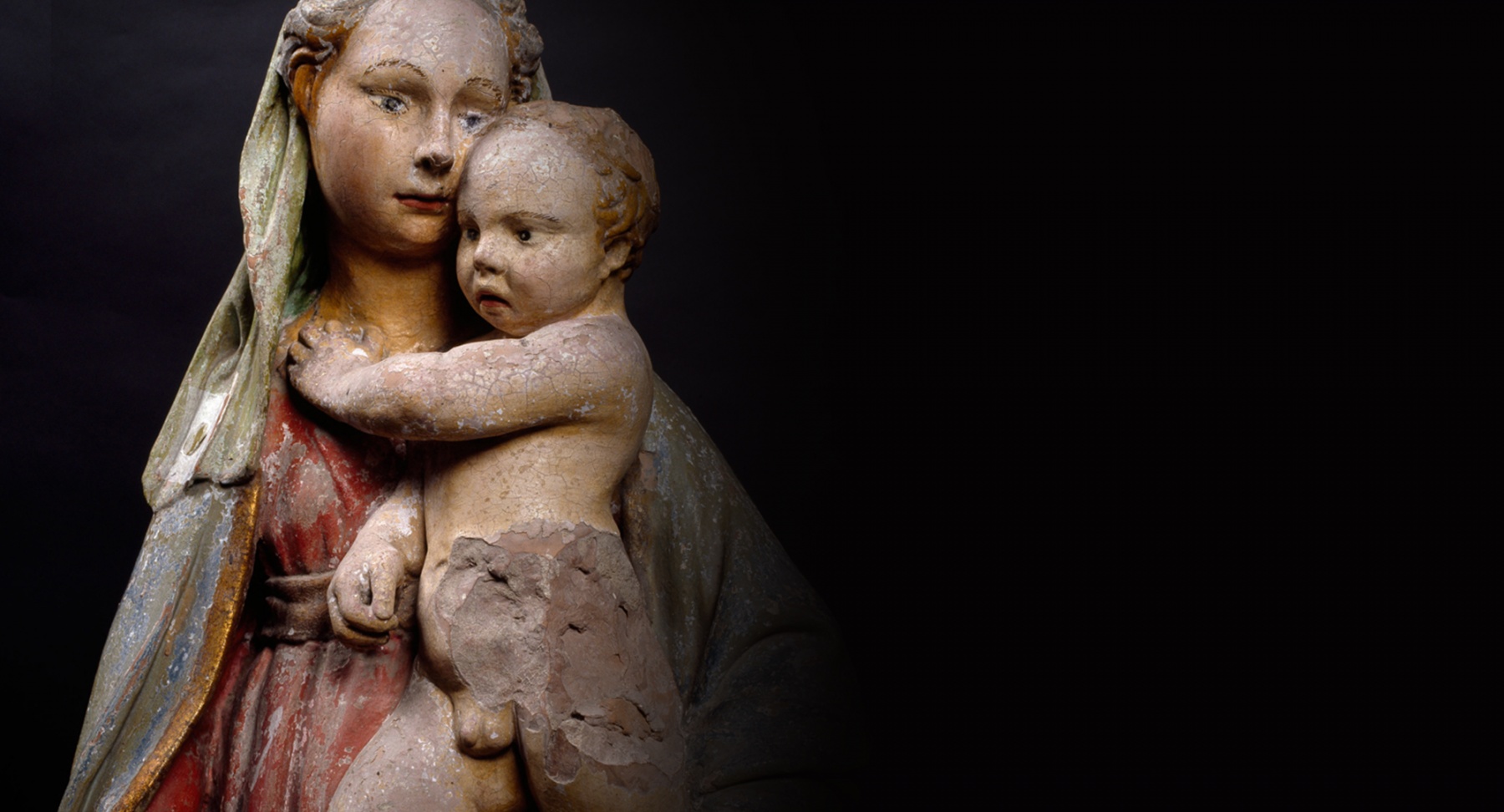
Donatello’s Madonna in Citerna

This is highlight #1 from our recent Italian vacation. In the little Umbrian hill town of Citerna, in the church of San Francesco, a small, badly damaged, and heavily painted terracotta Madonna and Child stood on a shelf above the choir for many centuries, unnoticed by art historians. To the extent that its existence was recorded at all, it was assumed to be a folk work from the 15th-16th centuries.

In 2001, Laura Ciferri–then a graduate student–paid it a visit and realized that it was not the kind of Umbrian folk piece that she was studying for a paper. She proposed instead that it had been made by the great Donatello himself.

Experts in Florence removed numerous layers of thick paint, chemically tested the materials, and rebuilt portions of the sculpture, working on the little object for seven years. Although I have found peer-reviewed scholarly articles from ca. 2002 that doubt its attribution, now that the restoration is complete, the consensus seems to be that it is a work of Donatello. He probably made it in Florence between 1415 and 1420–not using a mold but working directly with clay. He personally painted the baked terracotta, and his polychrome surface is now visible again.

To support the attribution, specialists point to similarities with more famous works, such as the hands of Donatello’s “David.” I would add that this most idiosyncratic artist always visualized scenes in his own unprecedented way. Here the baby senses an unknown danger in the distance. His face is disturbed; his body tenses even as one hand reaches for his mother. He curls the big toe of his left foot. Most of his wrap has fallen away to reveal his vulnerability and humanity. Mary, who knows what lies ahead for him, reflects soberly as she touches her cheek to his forehead and very gently supports his foot.

The post Donatello’s Madonna in Citerna appeared first on Peter Levine.

ILG Seeks Input on California Public Engagement Survey

We want to make sure that our NCDD members, especially those of you based in California, have a chance to hear about a key public engagement survey being conducted by the folks with the Institute for Local Government, one of NCDD’s member organizations.

ILG logoILG is looking for input from public officials and staff to help them and we encourage you to share the survey with folks in your network who they need to hear from.

Here’s how ILG describes the survey:

Does your community experience public engagement challenges? The Institute for Local Government (ILG) Public Engagement program provides information and resources to help local officials with the design, delivery and assessment of their public engagement processes. ILG has launched a survey and is seeking input from local officials and staff at all levels. The results of the survey will help ILG understand the community engagement experiences and needs of California communities.

This survey is part of a reflection, evaluation, and planning project funded by the James Irvine Foundation. ILG is seeking feedback from local elected officials and staff to better understand the impact of ILG resources and assistance, to help plan for the future.

Participants can enter to win one of ten $25 Visa gift cards. This survey will be open until July 31st. Please take the survey now!

We hope you’ll help ILG continue improving local public engagement by taking the survey yourself if you’re in the target audience or sharing it with those who are!

You can find the survey directly by visiting http://cacities.az1.qualtrics.com/jfe1/form/SV_bqI6PmKvsj7VBB3.

You Can’t Take the Sky From Me

I don’t know what to write today. I’ve been looking for inspiration. I’ve been hoping for the mundane.

But every time my mind starts to wander, all I can think is: My father would have been 73 today. 73 if it hadn’t been for that cancerous mass in his esophagus that metastasized throughout his throat and lungs before it was even discovered. My father would have been 73.

He passed away over three years ago, and you would think that would make such an ominous anniversary less troublesome. But each year it’s merely – different.

I’ve been writing every day for over two years,  meaning that two of my father’s birthdays and two of his deathdays have passed in that time. And every time such a date rolls around I think to myself: I should write about my father.

And then I think: I’m not ready yet.

Not that I haven’t written about my father at all – he and his sayings have made a few cameos on this blog. But I haven’t paid him homage, as I have for my grandmother or for others whom I’ve lost since I began blogging.

I haven’t praised his strengths or made light of his failings. I haven’t shared his stories or described his many personas. I haven’t found those moments of joy and sorrow which perfectly capture what I want to say. I haven’t written that post, though I want to someday.

But, I think, not today.

These things take time.

People are too complicated, relationships too complex. A series of black and white shapes hardly does a whole person justice. Words hardly seem enough.

I’ll not reduce him to a two-dimensional representation. I’ll not pretend there was nothing but good times. Life is hard and complicated and messy and beautiful, and it seems a disservice to remember any life as less than that.

So I don’t know what to write. No, not today.

Maybe next year.

facebooktwittergoogle_plusredditlinkedintumblrmail

The Pope’s Unsettling Message

As if Republicans did not have enough to worry about with Donald Trump, the visit of Pope Francis to the United States in September, which includes an unprecedented address to a joint session of congress, may portend even more trouble.

In the long run, Pope Francis' message could also be as unsettling to liberals as it is to conservatives.

For Republicans, the pope's visit in September is likely to cause acute discomfort. As Suzanne Goldenberg wrote in the British Guardian last month, "Leading figures on the American right are launching a series of pre-emptive attacks on the pope... hoping to prevent a mass conversion of the climate change deniers who have powered the corps of the conservative movement for more than a decade."

The pope's approach to other issues will likely be equally disturbing. "The pope will come humbly but will talk clearly," said Honduran Cardinal Oscar Rodriguez Maradiaga, a leading adviser to Francis. On immigration and social and economic justice as well as climate, Pope Francis will be outspoken. "The desert cannot be a tomb or a cemetery," Maradiaga said, referring to the hazardous journey of many immigrants and the need for policies that are generous and welcoming.

Maradiaga also said the pope is sure to raise questions of inequality and justice. "Capitalism is not a God. The system is fostering tremendous inequalities," he explained.

If Pope Francis challenges pieties of the right, his message also challenges the left.

In 1902 in Democracy and Social Ethics the settlement house leader Jane Addams warned that a class of progressive "experts" was emerging who saw themselves outside the life of the people. In her view, detached expertise reinforced existing hierarchies based on wealth and power and created new forms of hierarchical power that threatened the capacities of communities to determine their destinies.

Over time, outside expert claims to unique authority based on positivist views of science and technology reshaped fields from education and health to race relations and economics, as well as professional practices in general which claim the imprimatur of science.

Andrew Jewett describes the dynamic of outsider knowledge based on positivist theories of science in Science, Democracy, and the American University. "The scientists who powerfully shaped the national discourse on science in the middle years of the twentieth century drew a sharp line between science and society," he says. "They sought to insulate the research process [as]... a space untouchable by both the state and the horizontal communication between citizens."

Leaders in today's progressive politics embody this stance of outside fixer often with the best of professed intentions. Thus Donna Shalala, former Chancellor of the University of Wisconsin, later the most progressive member of the Clinton cabinet, and recently appointed head of the Clinton Foundation, illustrated this dynamic in a famous speech calling for renewal of the Wisconsin Idea in 1989, "Mandate for a New Century." Shalala called for universities to be at the forefront of action on problems such as racism, sexism, homophobia, environmental degradation, hunger and war.

She also redefined the older Wisconsin Idea into an unabashedly elite perspective. As she put it, "The ideal [is] a disinterested technocratic elite... society's best and brightest in service to its most needy [dedicated to] delivering the miracles of social science [on society's problems] just as doctors cured juvenile rickets in the past" (1989). In this framework the general population, no longer productive citizens, are reconceived as clients and consumers serviced by experts, while citizenship itself is narrowed to practices like voting, volunteering, or petitioning government for redress.

Her perspective is far from unique. It is embodied in one-way approaches to change in fields such as "translational science," in which experts usually claim the mantle of science to design and implement policies with little role for the lay citizenry except compliance. With exceptions, such as the research partnerships of the Kettering Foundation, the power patterns of such approaches have remained invisible in public discussion.

Pope Francis' Laudato Si' dramatically changes the game by putting the hierarchical power of technocracy front and center. Francis describes the shift that prioritizes informational approaches for dealing with human problems over relational and cultural approaches. "The basic problem," he argues in the section, the Globalization of the Technocratic Paradigm, "is the way that humanity has taken up... an undifferentiated and one-dimensional paradigm [that] exalts the concept of a subject, who, using logical and rational procedures, progressively approaches and gains control over an external object." This is positivism. "Many problems of today's world stem from the tendency, at times unconscious, to make the method and aims of science and technology an epistemological paradigm which shaped the lives of individuals and the workings of society."

The result is a huge concentration in power. Technological transformations "have given those with the knowledge, and especially the economic resources to use them...dominance over the whole of humanity and the entire world."

If the analysis is unsettling, the implications of this critique hold some measure of hope -- if the people act. As Pope Francis said in a speech to popular movements gathered in Bolivia, on July 9, "I would like to repeat: the future of humanity does not lie solely in the hands of great leaders, the great powers and the elites. It is fundamentally in the hands of peoples and in their ability to organize."

In this spirit, we need to take the opportunity of Francis' visit in September to begin to organize in new ways and on a new scale to address our mounting problems. In the process we could well revitalize the democratic way of life.

--

Harry Boyte edits Democracy's Education: Public Work, Citizenship, and the Future of Colleges and Universities (Vanderbilt, 2015), with many contributions on the democratization of technocratic power and the recovery of the democratic purposes of education.

Feedback

People tend to be really bad with feedback. Both giving feedback and receiving feedback. And on really a wide range of topics.

Psychologist Roy F. Baumeister has written that “Bad emotions, bad parents and bad feedback have more impact than good ones. Bad impressions and bad stereotypes are quicker to form and more resistant to disconfirmation than good ones.”

This may be in part because of neurochemistry, as Judith E. Glaser and Richard D. Glaser explain in the Harvard Business Review: “When we face criticism, rejection or fear, when we feel marginalized or minimized, our bodies produce higher levels of cortisol, a hormone that shuts down the thinking center of our brains and activates conflict aversion and protection behaviors. We become more reactive and sensitive. We often perceive even greater judgment and negativity than actually exists. And these effects can last for 26 hours or more, imprinting the interaction on our memories and magnifying the impact it has on our future behavior. Cortisol functions like a sustained-release tablet – the more we ruminate about our fear, the longer the impact.”

In addition to the severe implications for those who experienced trauma, this chemical reaction has an important role in our daily lives as well.

Coupled with the challenges many of us face in accepting compliments, it can seem nearly impossible to process critical feedback in a productive way. It’s easier to deny or discredit your accuser.

This is one of the challenges at the root of white fragility – that is, when white people shut down rather than acknowledge that something they did or said was experienced as racist by a person of color.

But the experience is more universal – it is a subtle, persistent reality of every day life.

Our smallest actions can have a profound impact – both positive and negative – on those around us. But too often, we are unaware of the experiences we are leaving in our wake. How could we unless someone told us?

Feedback is one of the most cherished gifts a person can give you. They may be thanking for your words, or explaining why your actions were harmful. It may be a compliment or it may be criticism. But either way, we should appreciate what a remarkable gift it is.

When someone gives you feedback, they share a moment of their world with you. A moment you could not have seen by yourself. That is amazing. It is beautiful.

I want more of that, not less.

I want everyone to share little moments of their world with me.

facebooktwittergoogle_plusredditlinkedintumblrmail