Educational Change, Cultural Organizing and Citizen Politics

Deborah Meier, a great democracy educator and a mentor of mine, and I have been discussing the meaning of "citizen politics" in our Bridging Differences blog conversation at Education Week. In the last blog she responds both to me and to Mike Miller, long time community organizer who commented on our exchange (his comments are on the Sabo Center for Democracy and Citizenship blog).

"I'm struggling to picture the alternative form of organizing you are suggesting," says Meier, remarking that she can better understand Miller's description of large coalitions of community groups and trade unions. She adds that Miller has no examples of large-scale successful educational transformation. She also observes that an example which does purport to be about large scale change, the school choice movement, "creates communities separate from the ones we actually live in and vote in."

Then she asks "what's our alternative?"

I agree choice does not equate with "democracy." Citizen politics is the wellspring of democracy as a way of life in American history is citizen politics. Let me elaborate.

Mike Miller's involvement in the conversation illustrates one example, which is fairly widely known these days. In 1983 I wrote about the San Francisco Organizing Project (SFOP), a broad-based community organization which he was organizing, and attended its founding convention. The chapter, "God's Laboratory," from my book, Community Is Possible, is up on academia.edu

SFOP was wonderfully diverse. It reminded me of a vivid description of San Francisco in a black newspaper at the turn of the century, "Like a Fairway of an enormous circus [with] thousands of every race...Hindoos, Japanese, Black men with wide shoulders, slim hips, loose relaxed gait, Jews, Swedes, Spaniards, Chinese, lean Englishmen..."

SFOP brought together religious groups, trade unions, community organizations, with people from different racial, cultural, and partisan backgrounds to work on issues like affordable housing and jobs,. These days some such broad based community organizations also include schools.

Building the conference involved intentional work to create public relationships across huge differences, using methods like one on one meetings. It was full of conflict but very productive, growing the "public persona" which Alyssa Blood observed among special education kids in Public Achievement - capacities to work in public settings full of diversity. It also embodied key democratic values such as equality, cooperation, and respect -- faith in the public potential of people from all sorts of backgrounds. Overall it was about civic agency, or developing collective empowerment.

That's what I mean by "citizen politics."

Mike and I discussed how citizen politics can spread. We both agreed that more is needed than community organizing to change America. We had some differences on what will spread it.

We discussed two models. The Chinese model, the countryside encircling the cities, builds coalitions to overcome the powerful. Mike advocates variations on this model - as do most community organizers.

I also argued another model is necessary, "cultural organizing," and we discussed the astonishing spread of Christianity in its early centuries especially among the poor and marginalized. It involved conversion to a different way of seeing themselves and reality, which accorded people a new dignity and worth. This was a molecular process of cultural transformation. In American history something similar has taken place again and again around democracy, in which religious values and of practices are one strand but they form part of a larger public whole.

We're seeing signs of this democratic ferment again, especially around education. Lani Guinier's The Tyranny of the Meritocracy has many examples of bringing a more cooperative ethos into the hypercompetitive individualist culture of education. For instance, Guinier describes the "quiet revolutionary" Shirley Collado, who develops ways for minority students from low income backgrounds to work together cooperatively. Guinier calls such examples "democratic merit," challenging the "testocracy."

The subtitle of her book, "Democratizing higher education," is revealing. In colleges and in schools, there are signs of a fledgling democratic movement.
It needs the idea of public life as an arena of diversity and tension which can be constructive - if people grow "public personas." Public Achievement illustrates. At Maxfield Elementary School in St. Paul a PA team of fifth grade African Americans are working on an anti-bullying campaign. I asked them why kids bully. They had many insights about the hypercompetitive culture.

They are learning strategies for working together - cooperating - and with a broader public, kids not their buddies.

PA is one seedbed of a movement.

Harry Boyte's most recent book is the edited collection, Democracy's Education (Vanderbilt University Press, 2015).

the Democrats’ problem is social capital

Notwithstanding the fiasco that is the GOP presidential primary so far, Matthew Yglesias warns, “The Democratic Party is in much greater peril than its leaders or supporters recognize, and it has no plan to save itself. … The vast majority — 70 percent of state legislatures, more than 60 percent of governors, 55 percent of attorneys general and secretaries of state — are in Republicans hands. And, of course, Republicans control both chambers of Congress.”

A major factor is the turnout gap. That is worse for Democrats in local and off-year elections but will persist in 2016. Today, the pollsters Greenberg/Quinlan/Rosner report that “unmarried women, minorities, and particularly millennials are less interested in next year’s voting than seniors, conservatives, and white non-college men are.”

Why do we see these gaps? On the whole, we engage in politics when we are brought into networks where political issues are regularly discussed and where people encourage each other to participate. This is a consistent finding of our own research on youth as well as much research on adults. Yglesias uses that theory to explain why unionized teachers vote in local elections:

Teachers talk to one another (they work together, after all) about questions of public policy (everyone talks at work about work, but public school teachers’ work ispublic policy), and they also have hierarchical channels of information dissemination (the union itself) through which this work talk can connect to practical politics.

(Yglesias is expanding on Eitan Hersh’s argument that “scheduling local elections at odd times appears to be a deliberate strategy aimed at keeping turnout low, which gives more influence to groups like teachers unions that have a direct stake in the election’s outcome.” Yglesias is contributing an explanation of why the union members vote.)

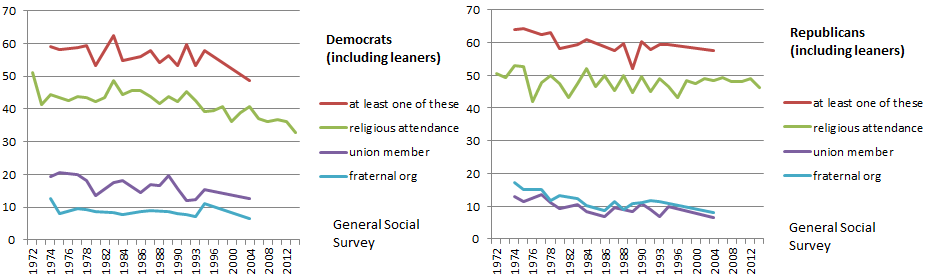
Let’s call participation in networks “social capital.” Since the 1970s, Democrats have lost social capital (of a politically relevant kind) and Republicans have not. The parties used to be on par, but the Republicans now have a meaningful advantage.

To illustrate, I show rates of regular religious attendance, membership in unions, membership in fraternal organizations, and a composite (defined as belonging to at least one of the three). The data come from the General Social Survey, which hasn’t asked about unions or fraternal associations since 2004. But in some ways, that’s OK, because I think the trend from 1970-2004 is the significant one, and the subsequent period has been unsettled because of social media and two high-profile presidential elections.

politics and social capital

Observations:

  • Democrats have become less likely to attend religious services regularly; Republicans have not.
  • Democrats have always been more likely than Republicans to belong to unions, but their membership rate was considerably higher in the 2000’s than in the 1970s. (Of course, union membership for Americans as a whole has fallen more steeply.)
  • Republicans have lost some ground with fraternal associations, but those never provided a huge component of their social capital.
  • The Democrats show an overall decline; the Republicans do not.

Caveats: 1) These are only three measures of social capital, plus a composite of the three. There are certainly other varieties of engagement–but I selected the ones I thought were most important. 2) Democrats and Republicans are not fixed demographic groups with persistent members. It is not the case that people have remained Democrats but have become less likely to join unions or attend church. Rather, the American people have changed in various ways, and the subset that consists of Democrats who have social capital has shrunk. The trends shown above only tell part of the story, but I think an important part.

It’s No Longer Our Policy to Put Out Fires

There’s a great scene in West Wing about a fire in Yellowstone. “When something catches on fire, it’s no longer out policy to put it out?”

The scene was based off a real incident of fire management strategy. In 1988, Yellowstone suffered the largest wildfire recorded in it’s history, burning 30% of the total acreage of the park. The fires called into question the National Park Service’s “let it burn” strategy.

Implemented in 1972, this policy let natural fires run their course and remains policy today. As per a 2008 order from the director of the National Park Service, “Wildland fire will be used to protect, maintain, and enhance natural and cultural resources and, as nearly as possible, be allowed to function in its natural ecological role.”

The let it burn strategy may have had impact on the Yellowstone fires, but as a 1998 article in Science argued, the problem may have been that they hadn’t implemented the policy soon enough.

Using network analysis to model the spread of forest fires, the researchers conclude, “the best way to prevent the largest forest fires is to allow the small and medium fires to burn.”

This is because forest fires follow a power law distribution: small fires are more frequent and large fires are rare. Most fires won’t reach 1988 magnitude and will burn themselves out before doing much damage. Allowing these fires to burn mitigates the risk of larger fires – because large fires are more likely in a dense forest.

This logic can be generalizable to other systems.

A 2008 paper by Adilson E. Motter argued that cascade failures can be mitigated by intentionally removing select nodes and edges after an initial failure.

Cascade failures are typically caused when “the removal of an even small fraction of highly loaded nodes (due to attack or failure)…trigger global cascades of overload failures.” The classic example is a 2003 blackout of the northeast which was triggered by one seemingly unimportant failure. But that one failure lead to other failures which lead to other failures, and soon a large swath of the U.S. had lost power.

Motter argues that such cascades can be mitigated by acting immediately after the initial failure – intentionally removing those nodes which put more of a strain on they system in order to protect those nodes that can handle greater loads.

This strategy is not entirely unlike the “let it burn” policy of the park service. Cutting off weak nodes protects the whole and mitigates the risk of larger, catastrophic events.


facebooktwittergoogle_plusredditlinkedintumblrmail

against methodological individualism

According to the Stanford Encyclopedia of Philosophy entry (by Joseph Heath) methodological individualism “amounts to the claim that social phenomena must be explained by showing how they result from individual actions, which in turn must be explained through reference to the intentional states that motivate the individual actors.” I find that I have written three blog posts that are critiques of methodological individualism from different angles. That makes me–I guess–an opponent of it.

In against methodological individualism, or why neighborhoods are not like broccoli, I proposed six reasons why not to treat the neighborhood in which a person lives as a variable that we can assign to the individual person as a causal factor. The neighborhood in which a person lives is neither straightforwardly the result of any individuals’ choices nor a factor that helps explain their actions. Rather, neighborhoods should be thought of as having their own place in causal models. The theorist who inspired these thoughts was Robert Sampson.

In more to life than individual attributes, I argued that we should study mechanisms, processes, and episodes as phenomena that we can generalize about and model, both as causes and consequences. If we always only try to understand rioters as individuals, we will miss what we could learn by studying riots as episodes. The theorists who inspired those thoughts were Doug McAdam, Sidney Tarrow, and Charles Tilly.

And in is social science too anthropocentric? I offered a short review of Brian Epstein’s  The Ant Trap: Rebuilding the Foundations of the Social Sciences. One of the conclusions of this book is: “facts about a group are not determined just by facts about its members.” For instance, it is a fact about the Supreme Court that it upheld the Affordable Care Act, but that fact was not determined by the opinions and votes of 9 members. Many other factors came into play, including the actions of the individuals who had created, constituted, limited, and chosen the court.

Many would agree with these points, none of which are original to me. But still a lot of social science is methodologically individualistic, especially the research that is meant to influence policy. In quantitative studies, often the data is a matrix with an individual in each row and a variable in each column. Instead of individuals, the rows may be cities, zip codes, years, or events like crimes or purchases. Still, those are really means or counts that describe groups understood as aggregates of individuals. (For instance, the poverty rate in a zip code is the proportion of the resident individuals who are poor.) And qualitative research is very heavily about what person A, who has descriptive characteristics X and Y, says about topic P in context C.

I think we are missing much that we could learn if we treated not only groups, but places, episodes, and other phenomena as causal.

Just Read, Florida! Civics Literacy Project

jrfimage

Just Read, Florida! has decided to focus on civics this year, and are sponsoring a wonderful opportunity for schools and districts. In addition to a contest and in partnership with the Florida Lottery, Just Read, Florida! is taking the show on the road with the TOSS-UP Quiz Show tour. Just Read, Florida! will conduct a fun and exciting quiz show contest at schools around the state targeting middle school students and testing their mastery of the civics standards. Be sure to check out the Just Read, Florida! website for more information on the TOSS UP Quiz Show. The Florida Joint Center for Citizenship was involved in the crafting of the questions for the quiz show.

The Florida Department of Education’s Just Read, Florida! Office along with various educational partners are seeking project submissions created by elementary (grades K‐5), middle (grades 6‐8) and high schools (grades 9‐12) designed to promote good citizenship and enhance literacy in the state of Florida. The contest is being held in conjunction with “Celebrate Literacy Week, Florida! 2016” which will be January 25‐29, 2016.
The theme for the Celebrate Literacy Week, Florida! 2016 Literacy‐Civics School Service Project Contest is “Literacy Changes Our World”.

  • WHAT A COMMUNITY LITERACY‐CIVICS SERVICE PROJECT MAY CONTAIN:
    -An organized literacy‐based service project involving students, teachers and
    surrounding community partners.
    -A goal of enhancing citizenship in students, reaching others and expanding their
    literacy skills.
    -Evidence of the project’s successful impact on the targeted audience which may
    include those in the school, neighborhood, community and beyond.
    -Evidence of creativity and/or innovation in the selection and implementation of
    the project.
  • SUBMISSION REQUIREMENTS:
    -Documentation and written summary of the focus, goals, challenges and
    successes of the project. This may be done through, but is not limited to,
    narratives, photos, video, recordings and data collection.
    -Project Mission Statement (500 words or less)
    -Release forms should be included for any participant involved in video, photos,
    recordings and data collection.
    -By submitting your works, you are releasing publication and talent presentation
    rights to the Florida Department of Education and are certifying that the work is
    free of copyright violations.
    -Only one submission per school per level served (elementary, middle, high
    school levels) is permitted.
    -Student participation is required.
    -Submissions should be faithful to the topic, “Celebrate Literacy Week, Florida!
    2016 – Literacy Changes Our World.”
  • Be sure to review the rubric for this project! 

rubric

  • Submissions may be emailed to CLW2015@fldoe.org or mailed to
    Florida Department of Education
    Just Read, Florida!
    325 West Gaines Street, Suite 1432
    Tallahassee, Fl. 32399
  •  Submissions must include the following and be submitted by December 11,
    2015.
    o Documentation and written summary
    o Project mission statement
    o Release forms (Required for each student involved in video, photos,
    recordings and data collection
    o Completed application form
  • PRIZES:
    -The first place winning school from the elementary, middle and high school
    levels will be awarded a $1,000 cash prize or gift card.
    -The second place winning school from the elementary, middle and high school
    levels will be awarded a $500 cash prize or gift card.
    -The third place winning school from the elementary, middle and high school
    levels will be awarded a $250 cash prize or gift card.
  • The Just Read, Florida! Office reserves the right to limit awards when the total number of submissions received for one category is below ten or if the quality of submissions does not meet the standard of excellence as stated in the requirements.
  • Please visit http://www.justreadflorida.com/ and select Celebrate Literacy Week,
    Florida! for more information on this contest and the exciting events and activities
    scheduled for the week. For questions or additional information, email CLW@fldoe.org or follow us on Twitter @EducationFL or by using #CLW2016.