Tax Credits for Business Working with Community Colleges: An Idea Worth Spreading
Reply

In the age of ubiquitous Internet connections, smartphones and data, the future vitality of cities is increasingly based on their ability to use digital networks in intelligent, strategic ways. While we are accustomed to thinking of cities as geophysical places governed by mayors, conventional political structures and bureaucracies, this template of city governance is under great pressure to evolve. Urban dwellers now live their lives in all sorts of hyper-connected virtual spaces, pulsating with real-time information, intelligent devices, remote-access databases and participatory crowdsourcing. Expertise is distributed, not centralized. Governance is not just a matter of winning elections and assigning tasks to bureaucracies; it is about the skillful collection and curation of information as a way to create new affordances for commerce and social life.
That's the opening paragraph from my new report for the Aspen Institute, “The City as Platform: How Digital Networks Are Changing Urban Life and Governance.” (pdf file download here). The report synthesizes discussion at an Aspen Institute Communications and Society conference last July. About thirty technologists, urban planners, policy experts, economic analysts, entrepreneurs, and social justice advocates shared insights into how networking technologies are transforming urban life, commerce and government.
I wrote the report as a rapporteur, not a commons advocate, but it’s abundantly clear that the sharing and collaboration facilitated by digital networks are spawning all sorts of new commons and hybrids (e.g., government/commons and government/corporate collaborations). The focus of the conference was mostly on US cities, but these things are happening worldwide, especially in cooperation-minded global cities such as Amsterdam, Barcelona and Seoul. In the US, San Francisco and Los Angeles are in the vanguard, in part because of San Francisco’s proximity to Silicon Valley tech firms and in LA, because everyone there lives on their smartphones.
The New America Foundation is hosting a talk called “Rebuilding the Public’s Trust Starts with Trusting the Public,” this Thursday, February 25th from 10-11am Eastern, and we want to encourage our NCDD members to  consider participating.
The event will focus on democratic innovations that changing the way citizens participate in government, featuring a presentation on the Citizens’ Initiative Review (CIR) process from long-time NCDD member John Gastil who will be on a panel with Carolyn Lukensmeyer, another long-time NCDD member, and author Hollie Russon-Gilman.
Here’s how New America describes the event:
Rebuilding the Public’s Trust Begins with Trusting the Public
From the ascent of Trump to armed protest and the tragedy of Flint, we have reason to worry about the future of our democracy. On Thursday, February 25, from 10-11am New America will host a talk that brings more encouraging news about real democratic reforms happening in the United States.
Penn State political communication professor John Gastil will share his insights on a reform that helps voters make smarter decisions in initiative elections. This innovation, called the Citizens’ Initiative Review, began in Oregon in 2009 and is appearing this year in Massachusetts. New America fellow Hollie Russon-Gilman will also share reflections from her brand new book, Democracy Reinvented: Participatory Budgeting and Civic Innovation in America.
This talk will be taking place in downtown Washington, DC and we hope lots of our DC-based members can make it. For the rest of us, the talk will be streamed live via webcast. Either way, we encourage you to RSVP here today to make sure to save your spot!
You can learn more about this event and New America by visiting www.newamerica.org/political-reform/rebuilding-the-publics-trust-begins-with-trusting-the-public.
The Middle School Civics EOCA is just around the corner, and we have been asked about resources that might be useful in reviewing for the exam. So without further ado, here are some possibilities that could serve you well! I have personally reviewed each of these resources, and am comfortable recommending them to you. And if you have any additions to this compilation, please feel free to share! Click on the link in the heading or in the text to access the resource.
FLDOE 2015 Civics Content Focus Reports
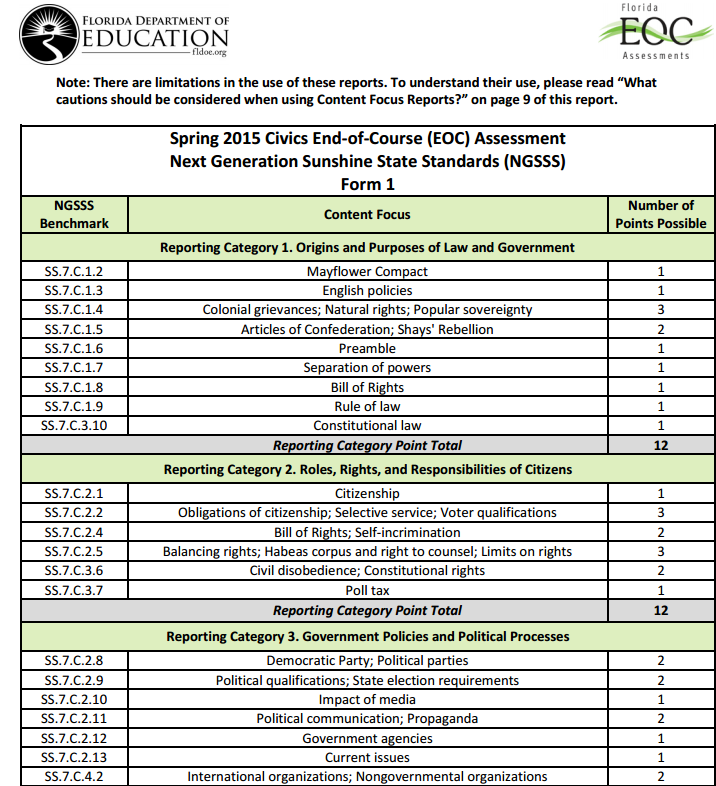
The 2015 Civics Content Focus Reports give you at least some idea of what the test might look like. Be sure to note the cautions on page 9. You will also want to review the Civics EOC Test Item Specifications, which you hopefully have been using throughout the year!
Florida Students Civics Tutorials

We have written about these tutorials before, and they are the first resource I recommend for both instruction and review. They are excellent for a flipped classroom model as well. If you are planning on using them as a review resource, I recommend assigning students only the parts of the tutorials they need, and it would be more effective to perhaps set these up in learning stations across the classroom. You could require that students screen-capture or write down responses to the assessment elements in order to ensure completion and comprehension.
Escambia County Civics EOC Review Site

The Escambia site is one that we helped develop, so we do have some attachment to it, but we also believe that the Student Friendly Readings for each benchmark clarification, as well as the assessment items (with answers) and Quizlet vocabulary review tool can serve you well in a review effort. Students can use each of the one page readings to refresh key content that they need, and it lends itself well to a learning center or small group model of review.
Florida Virtual School Resources
 The recorded review sessions, available for free at the bottom of the FLVS page, do a good job covering elements of each of the four reporting categories that will be assessed on the EOC. Because they are about 2 hours long, you will want to preview each one and determine where you might want students to focus their attention. They may also provide you with a model for your own approach to classroom-based reviews. I especially appreciate how an effort is made to integrate assessment elements. Please be aware that you will need to download Blackboard Collaborate to run the videos.
You will also want to check out the FLVS Civics EOC Practice test, which may be of use to you. Again, however, this shouldn’t be the first time that students are being exposed to these types and styles of items. Answers to the practice test items are available here. Note that answers are actually explained as well, which is an excellent element of review. I would suggest actually having students explain WRONG answers. If they can tell you why an answer is wrong, they should have a much easier time of figuring out why an answer might be right!
We wrote about this review model last year, and it may be one that you find useful as well. It worked well for Randall Middle School, and it is a positive way to mix things up a little for both you and your students. We explored this model in great detail in this post, and I encourage you to take a look and see if it is something you might like to do.
District Review Sheets and Practice Tests
Many districts have done a good job developing practice tests and review sheets for the EOC. Based on what I have had a chance to see, I can recommend a couple at the least.

Marion County, which has fantastic leadership in the social studies department, has provided teachers and students with an EOC study guide, made up of a mix of short answer questions, EOC style questions, and vocabulary, all of which draw on the test item specifications. All or part of this is something that I encourage you to adapt and adopt for your own review. Even having the students collaborate on the completion of the study guide could be a huge help for them in preparing for the EOC. Note that the guide is developed in conjunction with their own particular pacing guide and text; you can adapt the chapter and unit headings where necessary.

Pasco County has provided a quality practice test as well, though I prefer the FLVS version because of the answer explanations. Still, it is another way to measure student understanding and get a sense of areas of need while also ensuring ongoing exposure to EOC type questions.
TEACHER WEBSITES

Mr. Kula, social studies teacher at Westpine Middle School in Broward County, has compiled a number of quality content rich and illustrated study guides for the Civics EOC that could be useful for you. While they don’t cover every benchmark, what IS there is effective, and broken down by topic. These would be appropriate for students to use in conjunction with a written review or in small groups using an ‘expert group’ teaching model.

Mrs. Hirsch, a teacher at Fruit Cove Middle School in St. John’s County, has gathered a number of excellent tools for EOC review. The EOC Content Review sheets that she has provided are well done and engaging, and definitely worth sharing with your own students:
Q1 Civics What You Need to Know
Q2 Civics What You Need to Know
Legislative Branch Content Review
Executive Branch Content Review
Judicial Branch Content Review
Civics Assessment Strategy Guide

Here is an EXCELLENT and short powerpoint covering strategies for the EOC. I cannot recommend it enough!
Ruckel Middle School Civics Flashcards

Ruckel Middle School, in Okaloosa County, has developed a tool using Quizlet that provides students with flashcards for review. These might be useful as a bellringer or exit slip activity as you wrap up content this year and start to transition to in depth review.
Ms. Sirmopoulos’ Civics Review Materials

Jackie Sirmopoulos, an excellent and wonderfully effective teacher at PK Yonge Lab School in Gainesville, has been teaching Civics, with some of the highest scores in the state, for awhile. She has provided a plethora of useful review materials that I encourage you to explore. I have looked at almost all of them in each folder, and are all well aligned to the benchmarks and useful in helping you start to address possible student deficiencies while ensuring understanding among all of your students.
These are just a few of the quality review resources that you might find beneficial. If you have any additional resources to share, please shoot me an email or leave it in the comments!


I learned a great new term today.
I had the opportunity this morning to hear from Northeastern postdoctoral fellow Moya Bailey, who brought up the concept of Palimpsestic Time.
Used largely in the seventh to fifteenth centuries, a palimpsest is a manuscript page “from which the text has been either scraped or washed off so that the page can be reused, for another document.”
In her prose work Palimpsest, early 20th century poet H.D. adopt the term to apply to history.
As scholar Margaret M. Dunn explains in her excellent article on the “Altered Patterns and New Endings” of the works of H.D. and Gertrude Stein:
H.D. had long been fascinated with the idea of the palimpsest, literally a parchment on which earlier writing is partially visible underneath present writing. As a symbol for recurring patterns of human experience, the palimpsest is an image that occurs frequently throughout her work.
Recurring patterns of human experience.
History isn’t as neatly linear as we might be inclined to make it. We build on the past, but never fully erase it. It’s truth and legacy are always there, bleeding through and affecting the present.
We wipe clean the palimpsest, attempting to reset past norms of gender, race, class, sexuality, identity…
But the palimpsest is a rough tool; the marks of the past always linger. The slate is not so easy to wipe clean.


