Moving Forward with NCDD’s Emerging Leaders Initiative

During our NCDD 2016 conference, we were proud to officially announce that NCDD would be launching our new Emerging Leaders Initiative – a new effort to support and engage the next generation of D&D leaders and practitioners that NCDD has been developing since our 2014 conference on Democracy for the Next Generation. Today, we’re happy to share more details el_badge_web_01on the next steps in developing the initiative’s offerings!

What is the Emerging Leaders Initiative?

The Emerging Leaders Initiative (ELI) emerged from the NCDD members’ recognition of our need to foster long-term resilience for the field of dialogue & deliberation and that we can do that best by intentionally cultivating D&D’s next generation of leadership – that is, the younger folks in our ranks as well as those who are newer to the field.

To that end, the ELI will seek to provide extra resources and support to rising leaders in our field and to create more “on ramps” into the dialogue, deliberation, and public engagement field, especially for young people 35 and under, but also for newcomers to the field of any age. We want to offer these emerging leaders a means to become more involved in the world of D&D, connecting them with opportunities to build their capacity as practitioners, scholars, and professionals while lifting up the contributions, innovation, and leadership of young and new people in our field.

To accomplish these goals, NCDD has already created several tools that will be cornerstones of the Emerging Leaders Initiative – including the Emerging Leaders Discussion Listserv, social media forums, and a compilation of introductory D&D resources – and we are currently working on building a robust mentorship program, youth-focused webinars, and other capacity-building efforts for emerging leaders. We encourage our NCDD members, especially our younger and newer ones, to learn more about what the ELI by visiting its the brand new web page at www.ncdd.org/youth – the hub for all things related to the initiative.

Have Your Say in How the ELI Develops!

In addition to the new page, we are also launching the Emerging Leaders Survey – a short questionnaire that we’re using to better understand how we can support and collaborate with our emerging leaders. We are asking anyone in NCDD’s network or the broader field who is 35 and under, relatively new to D&D, and/or a current student to fill out the survey by Friday, February 10th.

Our field is already full of promising young folks and newcomers, and we want to hear from you! This survey is your chance to directly inform what you want the Emerging Leaders Initiative to look like and how you want to be involved. And to sweeten the deal, two survey participants will be randomly selected after Feb. 10th to win a $25 gift card! Don’t miss your chance – please fill the survey out today or encourage any of the younger or newer D&D folks who you are connected with to do so!

We’re Just Getting Started

The ELI will continue to develop and evolve over time, and collaboration with our NCDD members will play a key role in how that happens. So if you want to connect with this important work and help support and cultivate the next generation of D&D leaders, please don’t hesitate to get in touch me, Roshan Bliss, NCDD’s Youth Engagement Coordinator, at roshan@ncdd.org.

On a personal note, I am incredibly honored and humbled to be spearheading the Emerging Leaders Initiative for NCDD, and I can’t wait to connect with others who understand the importance of cross-generational collaboration in dialogue, deliberation, and public engagement. The D&D field’s future is bright and full of potential, and we hope that you will support the Emerging Leaders Initiative in unlocking even more of that potential in the coming years!

Want to support the Emerging Leaders Initiative and all of the great young people in the field? Make a donation in support of the next generation of D&D!


“Teaching the Presidency in the Digital Age” Webinar!!!

I am happy to pass this along, as the Teaching for Democracy Alliance is simply fantastic.

tfda
WEBINAR: Teaching the Presidency in the Digital Age
Wednesday, January 11th
4pm ET/1pm PT

The Teaching for Democracy Alliance is pleased to announce its first webinar of 2017 on the timely and important topic of “Teaching the Presidency in the Digital Age.” The webinar will feature Professor Joseph Kahne of UC-Riverside, whose most recent work examines the connection between media literacy education and students’ ability to spot fake news, as well as commentary by media literacy experts Dr. Katherine Fry of Brooklyn College and Dr. Paul Mihailidis from Emerson College. The webinar will also highlight free and innovative instructional resources to support teachers as they help their students make sense of the executive branch in today’s digital climate. Register HERE.

This looks to be another excellent webinar from them. I encourage you to check it out.


review article: Public-Spirited Citizenship: Leadership and Good Government in the United States by Ralph Ketcham

[From Political Science Quarterly, vol. 131, no. 4, winter 2016-17, pp. 896-7. Text as submitted. The definitive version is available at www.wileyonlinelibrary.com/journal/polq. ]

Ralph Ketcham is a distinguished American political historian and biographer, a renowned educator, and an avid student of political thought from classical to current times. In Public-Spirited Citizenship, the most recent of more than a dozen books, he offers a sweeping narrative about both political science and American politics from the founding era to the present, with a valuable excursion into 20th century East Asia.

His story begins with the civic republican tradition that defined the public good as the purpose of politics, civic virtue as the foundation both of a good society and a worthy life, statecraft as leadership and institutional design to encourage civic virtue and promote the public good, and education as the development of good character along with the skills and knowledge needed for civic life. Ketcham emphasizes that the founders of the American republic were steeped in this tradition.

Civic republicanism never vanished, according to Ketcham’s account, but it suffered a series of blows in the 19th and 20th centuries. The idea of a public good began to seem unscientific and naïve as theories of human nature emerged that emphasized self-interest and irrationality. Education was increasingly defined as the imparting of information and scientific insights about the way things really worked, not moral development or reflection on the public good. Public institutions, too, shifted from deliberative forums to sites of negotiation among organized interests.

The American Political Science Association played a role in that story. Starting in the early 1900s, leading American political scientists decried education that took the form of “sermonizing and patriotic expostulation” (p. 105). The only alternative they recognized was a rigorous, detached, disenchanted study of politics as it was. In keeping with that goal, they advocated specialization and expertise. Political science meant training for professors and technocrats in basically the current system.

Good citizens, Ketcham argues, will not be “’experts’ in the details of government; rather, they must have a disinterested perspective and must ask the proper public question, ‘What is good for the polity as a whole?’ and not [a] corrupt private one” (pp. 33-34). That stance is best cultivated, Ketcham argues, by a broad liberal education that is “profound,” “integrated,” and “radical.” But all those ideals seem naïve to positivist social scientists, who doubt there is anything good for the polity (apart from the aggregation of private interests) and who favor education that is specialized empirical training for the status quo.

The broad outlines of this narrative are not unique to Ketcham, but he has a sharp eye for overlooked aphorisms, incidents, and characters. This book is a treasury of quotations from proponents of civic republicanism and positivism alike. It is also a pageant of character sketches—from Benjamin Franklin in dialogue with Mohawk King Hendricks about good government in 1754, to Fukuzawa Yukichi reflecting on how republican norms might merge with Confucian ideals in Meiji Japan, to Ketcham’s own colleagues at Syracuse University’s Maxwell School of Citizenship and Public Affairs, who are giving renewed attention to the ideal of “citizenship” that is in their institution’s name.

I concur with the whole story, but I would add that an 18th century account of the public good and civic virtue can’t directly apply today, not only because we must draw from more diverse sources, but also because we have learned hard truths from history, the natural and social sciences, the terrible experiences of the past century—in a word, from modernity. The decline of civic education and civic culture reflects not only a loss of moral commitment but also a profound intellectual challenge that confronts public-spirited citizens today.

Participatory Budgeting Madagascar

Problems and Purpose Modern governments are constantly trying to improve their own governance practices as well as citizen's views of these practices. To do this, one initiative which has been implemented by many governments has been Participatory Budgeting (PB). In Madagascar, the idea was introduced by the World Bank in...

Crowdfunding

Method: Crowdfunding

Crowdfunding is an alternative finance model whereby funds are sourced from a large number of individuals (a ‘crowd’). Crowdfunding has gained new popularity with online cites such as Kickstarter and GoFundMe which connect project creators directly to potential backers.

2017 Frontiers of Democracy Conference Call for Proposals

We are happy to announce that once again, the Frontiers of Democracy conference organizers at Tufts University are accepting session proposals for their annual gathering. The 2017 conference will take place, as always, at the Tufts University downtown campus in Boston, this time from June 22nd – 24th.

The annual Frontiers of Democracy conference is a key gathering for our field that brings together leading deliberative democracy thinkers, public participation practitioners, and civic educators to explore ideas at the forefront of advancing democracy. NCDD’s leadership attends almost every year, and many of our members are staples of the conference, so mark you calendars to join us!

This year, the Frontiers gathering’s framing statement highlights the global rise in authoritarianism and the challenge it poses for continuing to expand democracy:

In 2017, the frontiers of democracy are threatened around the world. Leaders and movements that have popular support – yet are charged with being undemocratic, xenophobic, and illiberal – are influential or dominant in the Philippines, Russia, Turkey, Hungary, South Africa, France, Britain, and the United States, among other countries. Meanwhile, many peoples continue to face deep and sustained repression. Social movements and networks are confronting this global turn to authoritarianism. Please join us for a discussion of what we must do to defend and expand the frontiers of democracy.

If this theme speaks to work you do or conversations you are eager to have, consider applying to host  workshops or learning exchanges of your own! You can find the form to submit proposals by clicking here.

More details about the 2017 gathering are forthcoming, so make sure to check back frequently to the Frontiers of Democracy conference website at http://activecitizen.tufts.edu/civic-studies/frontiers for news and updates. We look forward to seeing many of you there!

Citrus Ridge Civics Academy Grand Opening Celebration

I apologize for the delay in posting. Here at the Florida Joint Center for Citizenship, we have been swamped with work, and finding the time to write a few words has been tough, but I hope to get back on track! Let’s start with some excellent news.

As you are likely aware, Polk County has opened a new public K-8 school with a civics focus, called Citrus Ridge: A Civics Academy. The FJCC is excited to be playing a small part in the school, offering support to teachers, students, and administration. To some degree, the school was sponsored by Congressman Dennis Ross (R-FL 15th). In early December, the school had its official ‘Grand Opening’, and we were happy to be there.

cr-go

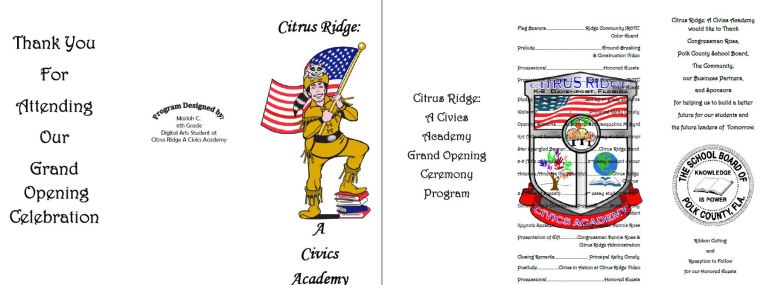
Citrus Ridge Grand Opening Program

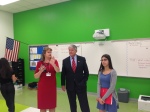
My own favorite part of the program involved student leaders across the grade levels reading their essays on good citizenship, such as the young elementary student below, who will, I think, go on to big things one day!

Congressman Ross himself arrived just in time to speak to the audience of students, staff, parents, and community members. He spoke highly of the importance of civic education and of civility, and how important it is that we understand each other as citizens. He also officially presented to the school principal, Kathy Conely, a wonderful gift. It features the flag flown over the U.S. Capitol in honor of Citrus Ridge, as well as Congressional documents and records announcing the creation of the school and its goals.

We also got a wonderful tour of the new school, led by students and the school administration, prior to a ribbon-cutting.

We are looking forward to continuing to work with Citrus Ridge and the great people there. You can see some much better pictures of the event at the Ledger!