my fall philosophy class on the question: How should I live?

This introductory course will emphasize one of the great philosophical questions: “How should I live?” The readings will specifically consider whether truthfulness, happiness, and justice are important aspects of a good life, and how each should be defined. …

Moral Mapping Exercise: With colleagues, I have been developing a method for moral introspection that involves making and revising a network diagram (or map) of your moral ideas and the connections among them. I will ask you to make a private map early on and to revise it regularly. I will ask you to bring a copy to class that you are comfortable sharing: it should omit any ideas that you prefer to keep private. At the end, I will collect your final map and a 2-page reflection on it. Instructions are here.

Syllabus: Subject to Change

Sept. 6: Overview and introduction

I. Truthfulness

Is there an obligation to seek the truth? To say or teach the truth to others? How does truthfulness relate to happiness and justice? Can we know truths about ethics?

Sept. 11: Plato, Apologysections §17-35Also Justin P. McBrayer, “ Why Our Children Don’t Think There are Moral Facts ,” The New York Times, March 2, 2015. Or in this PDF if you have trouble reading it on the NY Times site.

Sept. 13: Plato, Apology §35-42. Also read the “introduction to moral mapping” section of this Google doc.

Before Sept. 18: Do the first two tasks of the moral network mapping exercise (1. “Generate a set of moral beliefs” and 2. “From a list to a network”). Bring a copy of your map that you are comfortable sharing with a partner during class.

Sept. 18: Friedrich Nietzsche, Beyond Good and Evil, aphorisms §1-12

Sept. 20: Nietzsche, Beyond Good and Evil, aphorisms §13-32

Sept. 25: Bernard Williams, Truth, Politics, and Self-Deception, Social Research, Vol. 63, No. 3, (FALL 1996), pp. 603-617.

Sept 29, midnight. First paper due. Describe a situation in which it’s problematic whether to be truthful or not. Argue in favor of being truthful or not being truthful in this situation. Define what you mean by the term “truthful.” Give reasons for your position and explain and counter good reasons against it. Cite at least one relevant passage from Plato or Nietzsche.

I. Happiness

What is happiness? What are the best paths to happiness? Do we have a right to pursue our own happiness? Can we make others happy?

Sept. 27: Epicurus, “Letter to Menoeceus” (We will also discuss Socrates’ remarks about happiness in the “Apology,” already assigned.)

Oct 2: “Buddha” in the Internet Encyclopedia of Philosophy. (You can also optionally consult “Buddha” from the Stanford Encyclopedia of Philosophy.)

Before Oct. 4. Do the third task of the moral network mapping exercise: “Investigate the shape of the network.” Make changes to the map if you have had any new ideas or changed your mind. Bring a copy to class to discuss.

Oct. 4: “Buddha” (continued)

Oct 9: No class (Columbus Day)

Oct. 11. Emerson, “Self-Reliance”

Oct. 11: More discussion of the “happiness” readings.

Oct 13. (midnight) Second paper due. Essay prompts (pick one):

  1. Many words seem related to the word “happiness”: for instance, “pleasure,” “satisfaction,” “equanimity,” “acceptance,” “joy.” Choose one such word and explain why it is a good goal and how one should pursue it.
  2. Socrates, Nietzsche, and Emerson recommend independence or self-reliance. Is this the best path to happiness? Why or why not?
  3. What is one belief about life or the world that would bring happiness if people accepted it as true? Is this belief true? Should people embrace it?

Regardless of which prompt you choose, summarize and respond to objections to your position.

III. Justice Toward Others

What are principles of justice? Which principles of justice are binding on whom? How do they relate to each other?

A. Welfare

We discussed happiness in the previous section. Could maximizing the happiness of all human beings–or something similar to that–be the main principle of justice?

Oct. 16: Mill, Utilitarianism, chapter 2 (“What Utilitarianism Is”) and chapter 5 (“On the Connection Between Justice and Utility”)

Oct. 18: Rawls, A Theory of Justice, Part I, chapter 1, §5 (versus utilitarianism)

Before Oct. 23: Do the fourth task of the moral network mapping exercise: “Consider the Location of the Nodes.” Make changes to the map if you have had new ideas. Bring a copy to class to discuss.

Oct. 23: More discussion of welfare.

B. Liberty

Oct 25: Isaiah Berlin, “Two Concepts of Liberty” (1958), in Isaiah Berlin, Four Essays on Liberty (1969).

Oct 30: Friedrich Hayek, The Constitution of Liberty, Chapters 1, 4 and Postscript (pp. 11-21, 54-70, 397-411.)

Nov. 1: John Rawls, A Theory of Justice, Part I, 1 §1-4, 2 §11-17, and 3 §24

Nov. 6: Discussion of Rawls continues.

Nov. 8: Robert Nozick, Anarchy, State and Utopia, pp. 149-177

Nov. 10 (midnight) paper due. Suggested essay prompt: Individual liberty and public happiness (or welfare) can conflict. Give a real or imaginary example of such a conflict, say whether you favor liberty or welfare/happiness in that case, and explain why, considering objections to your position. Cite at least one assigned author.

B. Equality

Nov. 13: [possible cancellation due to professor’s travel]

Nov. 15: Tim Scanlon, “When Does Equality Matter?

Nov. 20: Bayard Rustin, “From Protest to Politics: Future of the Civil Rights Movement,” Commentary (February, 1965)

Nov. 22, midnight: Fourth paper due. Suggested topics: (1) Describe an example of an inequality that you consider unjust. Explain why some might reasonably consider it to be just. Argue that it is actually unjust and explain why. Cite at least one assigned text. (2) Give an example of an unequal situation that you consider justifiable. Explain why some might consider that situation to be unjust or unfair. Explain why it is actually just. Cite at least one assigned text. (3) What should we consider when we reason about what a just society is like? Is Rawls right that we should ignore our own situation and beliefs? Is Nozick right that we should pay attention to past actions that have created the current situation? What forms of information do you consider relevant to justice, and why?

D. Democracy

Nov. 27: Robert A. Dahl, Democracy and its Critics, pp. 106-52

Nov. 29: Kwasi Wiredu, “Democracy and Consensus in Traditional African Politics” (http://them.polylog.org/2/fwk-en.htm) and Emmanuel Chukwudi Eze, “Democracy or Consensus?” ( http://them.polylog.org/2/fee-en.htm)

E. Identity

Dec 4: Audre Lorde, “ The Master’s Tools Will Never Dismantle the Master’s House ” and Steve Biko, “Black Consciousness and the Quest for True Humanity

Dec. 6: Todd Gitlin, “The Left, Lost in the Politics of Identity,” Harper’s Magazine, 1993; and Susan Bickford, “Anti-Anti-Identity Politics: Feminism, Democracy, and the Complexities of Citizenship,” Hypatia Vol. 12, No. 4.

Before Dec. 11: Revise your moral network map again. Prepare a copy to hand in (omitting anything that you consider private and don’t want to share. Also write a note of up to 2 pages reflecting on the map.

Dec. 11: More discussion of the readings on democracy, diversity and inclusion.

Dec. 15: Fifth Paper due. Topic TBA.

The Uses of Anger

“Every woman has a well-stocked arsenal of anger,” says Audre Lorde in The Uses of Anger, her 1981 keynote talk at the National Women’s Studies Association Conference.

I have been thinking a lot about this piece recently. It feels sharply relevant today, 36 years after it was written.

Every woman has a well-stocked arsenal of anger. An arsenal built from fear; from the constant slights and dismissals; from living and functioning in a world which takes us for granted, insists we are not enough, and half-heartidly feigns distress over the violence used against us. Every woman has a well-stocked arsenal of anger.

I know I do.

Lorde argues this anger is a strength, that it has powerful, transformative uses. Anger, she argues, leads to change.

Importantly, in conflicts between the oppressed and their oppressors, there are not “two sides.” The anger of the oppressed leads to growth while the hatred of the oppressors seeks destruction. As Lorde writes:

Hatred is the fury of those who do not share our goals, and its object is death and destruction. Anger is the grief of distortions between peers, and its object is change.

Anger is the grief of distortions between peers. Anger arises when you and I fail to understand each other, when we fail to listen genuinely and to acknowledge each other’s experience. Anger arises when the world insists that your perceptions and experiences aren’t real.

It’s gaslighting on a societal scale.

But anger has it’s uses, Lorde says. “Anger is loaded with information and energy.”

Anger, articulated with precision and “translated into action in the service of our vision and out future is a liberating and strengthening act of clarification.”

Anger at the distortions between peers creates space for us to clarify and remove those distortions; to genuinely accept the experiences of others.

This is particularly important in the context of gender because the experiences of women vary radically across numerous dimensions of race, class, and identity.

In order to successful use our anger, we must “examine the contradictions of self, woman, as oppressor.”

Lorde is diplomatic on the topic, recognizing that she, too – a lesbian woman of color – has at times taken on the role of oppressing other women. But drawing on my own identity, I’m inclined to be more direct here: white women, and particularly white cis women have played a long and important role in building and maintaining systems of white supremacy and cisnormativity.

We have suffered our slings and arrows, no doubt, and with good reason our personal arsenals are well-stocked with anger. Yet we, too, are oppressors. We have oppressed our sisters directly and indirectly, intentionally and unintentionally. Recognizing this is, as Lorde describes, a painful process of translation. But is a process we must undertake; a process we must engage in order to radically change the systems of power, privilege, and oppression we are embedded in; the systems which oppress us and our neighbors.

Furthermore, Lorde argues that anger can bring out this change – guilt at our own complicity does nothing:

I have no creative use for guilt, yours or my own. Guilt is only another way of avoiding informed action, of buying time out of the pressing need to make clear choices, out of the approaching storm that can feed the earth as well as bend the trees.

Guilt is a proxy for impotence; for inaction. But anger is transformative. As Lorde writes:

…The strength of women lies in recognizing differences between us as creative, and in standing to those distortions which we inherited without blame but which are now ours to alter. The angers of women can transform differences through insight into power. For anger between peers births change, not destruction, and the discomfort and sense of loss it often causes is not fatal, but a sign of growth.

facebooktwittergoogle_plusredditlinkedintumblrmail

the Obama Foundation Fellowship

The Obama Foundation is recruiting their first cohort of Fellows. This inaugural class will have a special opportunity to shape the program for the future. The fellowship takes the form of four face-to-face gatherings over two years, plus a lot of opportunities for professional development. The Foundation is looking for a “diverse set of community-minded rising stars – organizers, inventors, artists, entrepreneurs, journalists, and more – who are altering the civic engagement landscape. By engaging their fellow citizens to work together in new and meaningful ways, Obama Foundation Fellows will model how any individual can become an active citizen in their community.” More here.

Upcoming Opportunities with Common Ground for Action

We wanted to let everyone know about several updates this month from NCDD member org, Kettering Foundation on their Common Ground for Action online forum. Coming up quick is the  CGA forum on climate choices being held tomorrow (September 8th – Register ASAP!) and another CGA forum on healthcare on September 21st. Later on in the month, Kara Dillard will be hosting a two-part training on how to use CGA forums in your communities or places of work. Register to join these online forums and trainings by clicking on the links in the announcement below. This announcement was from the September Kettering newsletter – sign up here to start receiving their newsletter.


Common Ground for Action: Updates, Upcoming Forums, and Moderator Training

The largest public university in the country, the Ohio State University, is using Common Ground for Action online forums as part of its first-year experience programming again this year, offering students the chance to participate in deliberative forums on climate choices and other issues. CGA is also being used by many other teachers in colleges around the country, including Lone Star College in Texas, Florida International University, and the University of Washington.

If you haven’t had a chance to participate in an online deliberative forum using KF and NIFI’s Common Ground for Action platform yet, or if you want to participate in a forum on Climate Choices or Health Care, there are two open forums in the next couple of weeks.

Friday, September 8, 1 p.m. EST/10 a.m. PST | Climate Choices | REGISTER

Thursday, September 21, 12 p.m. EST/9 a.m. PST | Health Care | REGISTER

If you’re unable to participate in either of those forums, click on the button below to sign up to receive e-mail invitations to other upcoming CGA forums.

Would you like to learn to use CGA in your work or community? Kara Dillard, an experienced moderator of CGA forums, is leading an online training session soon. The session consists of two parts, Thursday, September 21, at 12 p.m. ET and Friday, September 22, at 4 p.m. ET. The first session consists of participating in a CGA forum; the second session walks participants through moderating an online forum and using the support materials. REGISTER.

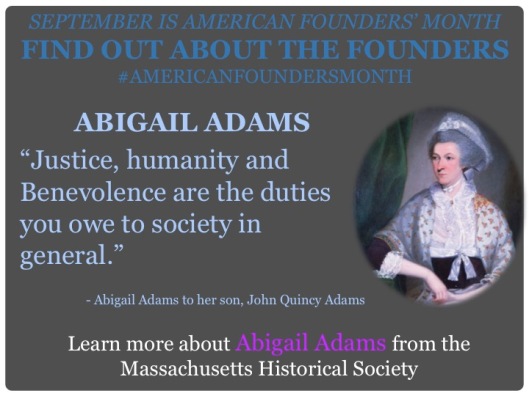
American Founders’ Month in Florida: Abigail Adams

Sept 6 A Adams

Abigail Adams is perhaps one of the most well known of what we might call the Founding Mothers, the women who participated, in one form or another, in the establishment of the United States of America. Indeed, she was more than simply the wife of of one president (John Adams) and the mother of another (John Quincy Adams). But what was she, really, and what do we owe to her memory and her contributions to our country? Check out the overview and really cool primary sources in this lesson provided by the Massachusetts Historical Society to learn more about this incredible woman.

You can download the PowerPoint slide to share with your students here: Abigail Adams AFM

Additional American Founders’ Month Posts:
Introduction to the Founding Fathers
Who Was George Washington?


anxieties about American exceptionalism

In our century, a major fault line in US politics has been the question of “American exceptionalism,” meaning the unique excellence or mission of the USA–“the notion that America is freer and more democratic than any other nation, and for that reason, a model, vindicator, and at times the chief defender of ordered liberty and self-government in the world” (Stanley Kurtz).

As I observed in 2010, “Newt Gingrich, Sarah Palin, Mike Huckabee, Mitt Romney, and Rick Santorum agree: the president and his allies in Washington deny ‘American exceptionalism’ in a way that is unprecedented (Huckabee), ‘truly alarming’ (Gingrich), or ‘misguided and bankrupt’ (Romney).”

This was ironic, since Barack Obama had come to national attention with a riveting speech at the 2004 Democratic convention in defense of nothing other than … American exceptionalism. “Tonight,” Senator Obama had said, “we gather to affirm the greatness of our nation.” Throughout his presidency, he often spoke on the same theme. In 2014, he said, “I believe in American exceptionalism with every fiber of my being.” And yet accusing him of failing to understand–or of actively undermining–America’s unique excellence became a competitive sport on the right.

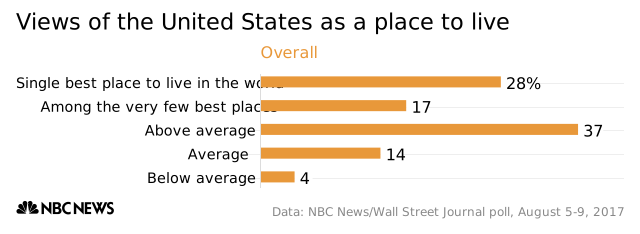
But there is an important group that doesn’t really believe in American exceptionalism: the American public. Here is a result from this week’s Wall Street Journal/NBC poll:

It looks as if most Americans think the US is above average as a place to live (I agree, by the way), but that just over a quarter think it’s the single best place in the world. Asked to rate the “national character,” the median respondent gives us a score of 5 out of 10, down from 6 out of 10 in 1998. This survey question makes no explicit mention of other countries, and it’s possible that people would rate every other nation’s character lower than ours–but that seems unlikely for the people who rate us 5 or lower.

The claim that America is “is freer and more democratic than any other nation” is empirical. It begs for comparative statistics. Freedom House rates the US 89 on freedom, a good score but 11 points below Sweden’s perfect 100. Maybe they’re wrong, but ranking the US number one in the world certainly requires evidence. It’s not a test of patriotism but a hypothesis about the world.

One might focus instead on prosperity and economic dynamism. But the enormous comparative advantages that we held as result of the Second World War have faded away, and we now represent just 4% of the population of a competitive world in which lots of nations, small and large, inevitably score economic successes.

This gap between a rhetoric of unique superiority and the facts seems to cause profound anxiety. In 2016, Trump positioned himself as the candidate who believed that the US should be better than every other nation but had lost that status due to feckless politicians. He often asserts that we are worse off today than anyone else–for example, that our tax rates are uniquely high, as if we were the socialist exception in a neoliberal world. Clinton took the view that we were “already great.”

Both positions could be seen as responses to anxiety. Valid criticisms of the American past (slavery and segregation, especially) have perhaps fueled this anxiety by suggesting that we were never exceptionally great to start with. That’s a raw point for people who think that our exceptionalism is threatened.

Three issues to think about:

  • To what extent is the US actually “exceptional”–not in the sense of better, but different? We are unusual (but not actually unique) in our degree of racial diversity. We have the oldest constitution in the world. We have no way to call an early election to end a failing administration. We have never had a socialist government, but our left has a robust alternative tradition of pluralist populism. We are the birthplace of the Civil Rights Movement and its philosophy of politics. We fought a civil war over the question of slavery in which 750,000 died. We tend to think of ourselves as a commercial republic instead of, for example, a social democracy, a social market economy, or a consensus model. We may once have had a high degree of economic mobility, but now we do not. We once had a very strong voluntary sector, but it, too, is now probably weaker than those in other nations. We are a Petri dish for new religions, some messianic in nature; and we are more religious than other advanced economies. These are just examples of ways that we are, or once were, unusual.
  • Underlying most claims of exceptionalism are normative positions: assertions that some aspects of our society are not just unusual, but valuable. What values that are plausibly associated with the US are worthy of praise? Should we be proud because we have a tradition of laissez-faire economic policies? Or because of the New Deal and its legacies?
  • What attitude should an American citizen hold toward the US Republic? Favoritism over other countries? An even-handed and detached stance toward the US as just one of many countries? For myself, I would say: a special, focused responsibility for awakening the better angels of our nature.

See also: the new history warsAmerican exceptionalismBritish exceptionalism: how the UK is different from Europeshould we teach patriotism?; and a palindrome (a poem on America).

Labor and Civics

Earlier this week, we celebrated Labor Day in the United States – a day which only became a national holiday in the wake of the Pullman Strike; a dark ordeal in which 30 American workers were killed by U.S. Federal Troops.

Of course, most of the world celebrates the contributions of labor on May 1 – International Worker’s Day. But that was a bit too radical for the American palate, so sensible moderates – such as President Grover Cleveland, who authorized the use of force against American civilians during the Pullman Strike – consolidated on the September date.

And now, as Americans celebrate the unofficial end of summer and try to remember rules about when it is appropriate to wear white, they are encouraged to also remember the contributions of the American worker and the progress made by labor unions. The 8-hour work day, the 5-day work week, safety in the work place; these are just a few of the things which labor unions have given us.

But the contributions of unions run deeper than that; indeed they are at the very core of our democracy.

In classical Greek thought, laborers could not be citizens. While there was surely an elitist air to this view, it was driven more directly by a practical belief: citizenship is work.

To be a citizen in the classic sense was not merely to be the recipient of certain guarantees and protections – e.g., rights of safety, security, and redress – it was to contribute wholly to the improvement and wellbeing of your society.

In a practical sense, a citizen could not engage in physical labor because he (yes, “he”) must devote his time and energy to the real work of citizenship. Any other vocation would reduce and ultimately remove his ability to work as a citizen.

Of course, such a view was also elitist and absurd – a society cannot function without laborers and a system in which laborers are excluded from citizenship automatically creates an irreparable class system.

But, on the other hand, the Greeks had a point: citizenship is work, and one cannot engage in that work if they are wholly consumed with other responsibilities.

Neither a person who has to work 3 jobs just to make ends meet nor a high-powered executive who responds to emails in the middle of the night will be in a position to contribute to the work of citizenship.

Labor unions provide protections for workers. They serve as collective bargaining units which give the collective of workers more power than a single worker alone. They provide a vital role in ensuring safe, just, and productive workplaces.

But more deeply, they provide the foundation for democratic engagement – both as a venue where every day people are empowered to share their voice, and as a tool for ensuring that people who work – most of us, quite frankly – have the space to engage in the hard work of citizenship.

In short, our democracy would not function without labor unions, and when we weaken them, we weaken our democracy.

facebooktwittergoogle_plusredditlinkedintumblrmail

Labor and Civics

Earlier this week, we celebrated Labor Day in the United States – a day which only became a national holiday in the wake of the Pullman Strike; a dark ordeal in which 30 American workers were killed by U.S. Federal Troops.

Of course, most of the world celebrates the contributions of labor on May 1 – International Worker’s Day. But that was a bit too radical for the American palate, so sensible moderates – such as President Grover Cleveland, who authorized the use of force against American civilians during the Pullman Strike – consolidated on the September date.

And now, as Americans celebrate the unofficial end of summer and try to remember rules about when it is appropriate to wear white, they are encouraged to also remember the contributions of the American worker and the progress made by labor unions. The 8-hour work day, the 5-day work week, safety in the work place; these are just a few of the things which labor unions have given us.

But the contributions of unions run deeper than that; indeed they are at the very core of our democracy.

In classical Greek thought, laborers could not be citizens. While there was surely an elitist air to this view, it was driven more directly by a practical belief: citizenship is work.

To be a citizen in the classic sense was not merely to be the recipient of certain guarantees and protections – e.g., rights of safety, security, and redress – it was to contribute wholly to the improvement and wellbeing of your society.

In a practical sense, a citizen could not engage in physical labor because he (yes, “he”) must devote his time and energy to the real work of citizenship. Any other vocation would reduce and ultimately remove his ability to work as a citizen.

Of course, such a view was also elitist and absurd – a society cannot function without laborers and a system in which laborers are excluded from citizenship automatically creates an irreparable class system.

But, on the other hand, the Greeks had a point: citizenship is work, and one cannot engage in that work if they are wholly consumed with other responsibilities.

Neither a person who has to work 3 jobs just to make ends meet nor a high-powered executive who responds to emails in the middle of the night will be in a position to contribute to the work of citizenship.

Labor unions provide protections for workers. They serve as collective bargaining units which give the collective of workers more power than a single worker alone. They provide a vital role in ensuring safe, just, and productive workplaces.

But more deeply, they provide the foundation for democratic engagement – both as a venue where every day people are empowered to share their voice, and as a tool for ensuring that people who work – most of us, quite frankly – have the space to engage in the hard work of citizenship.

In short, our democracy would not function without labor unions, and when we weaken them, we weaken our democracy.

facebooktwittergoogle_plusredditlinkedintumblrmail

In Defense of DACA

“On June 15, 2012, the Secretary of Homeland Security announced that certain people who came to the United States as children and meet several guidelines may request consideration of deferred action for a period of two years, subject to renewal,” reads the website for United States Citizenship and Immigration Services.

Consideration of deferred action for childhood arrivals, or DACA, has narrow guidelines as to whom is eligible: to qualify, you must have arrived in the US before the age of 16; you must have continually resided in the US for the past 10 years (since June 15, 2007); must be a student, high school graduate, or an honorably discharged veteran of the US armed services, and must not “pose a threat to national security or public safety.”

In short, DACA applies to people who have gone to American schools, contributed to American society, and who came to this country before they were even old enough to have a choice in the matter. They are students virtually indistinguishable from their classmates.

Many don’t even remember a time when they weren’t living in the U.S.

This is their home country.

There are many reasonable debates to have around immigration policy. We could talk about the Chinese Exclusion Act of 1882, which opens with the shockingly straightforward line:

Whereas, in the opinion of the Government of the United States the coming of Chinese laborers to this country endangers the good order of certain localities within the territory thereof…

The Act, passed by Congress and signed by President Chester A. Arthur, represents the first time ethnic exclusion was explicitly stated in U.S. immigration law; justified merely by the flimsy fear of colonizing Europeans that Chinese residents endangered “the good order of certain localities.”

The Chinese Exclusion Act was renewed as the Geary Act in 1892 and made permanent another decade later. Incidentally, the Geary Act also expanded the language used; targeting any “Chinese person or person of Chinese descent.”

In 1943, in the midsts of World War II and after 60 years of virtually banning Chinese immigration, the Magnuson Act allowed for limited Chinese immigration and provided a path to citizenship for persons of Chinese descent living in the U.S. It did nothing, however, to address issues such as California’s Alien Land Law, which barred non-citizens from owning property. The full repercussions of the Chinese Exclusion Act weren’t legally addressed until the Magnuson Act itself was repealed in 1965; after eighty-three years of explicit discrimination.

In relaxing restrictions on Chinese immigration, the Magnuson Act brought Chinese immigration guides inline with another U.S. immigration bill, the U.S. Immigration Act of 1924, or the Johnson-Reed Act.

This act, which introduced national-origin quotas, was designed to “preserve the ideal of U.S. homogeneity,” according the U.S. State Department’s Office of Historian. This act greatly restricted immigration of Italians, Eastern European Jews, and people from other Asian countries, most notably Japanese. Quotas were calculated in such a way as to have little effect on immigration from Western Europe.

The point of this history lesson is simple: the United States has a long history of racist, exclusionary immigration policies designed to favor that amorphous group of “people like us.” For all our talk of a melting pot and the American dream, where any child – any child – can grow up to succeed – we have long merely shrugged while endorsing policies with the clear message, we conquered here first.

There is so much I would change about U.S. immigration policy if I could. I find myself generally inclined to agree with Peter Singer’s argument that it is time to abandon the constructed narrative of a national community in favor of conceptualizing ourselves as members of a global community.

But the plan to end DACA, to end legal protections for over 800,000 people who have grown up in this country, goes beyond philosophical debates about what immigration is or ought to mean. It is straight up unconscionable. These are our friends and neighbors. They are members of our community.

Quite simply, in the most robust sense possible: this is their country, too.

facebooktwittergoogle_plusredditlinkedintumblrmail