American Founders’ Month continues in Florida, and it coincides with Freedom Week. There may be no quote more famous in our nation’s history than Patrick Henry’s “…give me liberty or give me death!” It is perhaps an appropriate way to start off our celebration of Freedom Week as we wrap up American Founders’ Month.
Patrick Henry, like many of his peers, was a man of many talents, beliefs, and contradictions. He was a brilliant orator, fiery and powerful, but few of his speeches survived him, as he rarely wrote anything down. Unlike his contemporaries, he did not write many letters, so we have few primary sources to consider him with. A passionate advocate for liberty, he was, like many of his elite contemporaries from the South, a slave holder. Like many of them (though not all!) he recognized the evils of slavery without necessarily choosing a path towards his own complicity. A believer in strong bonds across the states, he was embittered by what he saw as New England’s reluctance to contribute fairly to the national project under the Articles of Confederation.
His passion for liberty led Henry initiallt to the Anti-Federalist camp; he did not trust those working in Philadelphia at the constitutional convention, and he did not trust the new Constitution.
This Constitution is said to have beautiful features; but when I come to examine these features, Sir, they appear to me horribly frightful: Among other deformities, it has an awful squinting; it squints towards monarchy: And does not this raise indignation in the breast of every American? Your President may easily become King: Your Senate is so imperfectly constructed that your dearest rights may be sacrificed by what may be a small minority; and a very small minority may continue forever unchangeably this Government, although horridly defective: Where are your checks in this Government? Your strong holds will be in the hands of your enemies: It is on a supposition that our American Governors shall be honest, that all the good qualities of this Government are founded: But its defective, and imperfect construction, puts it in their power to perpetrate the worst of mischiefs, should they be bad men
TLDR; Hannah Arendt never wrote a "moral philosophy." It is not hidden away in the archives or any of the recent collections of her work, nor in her unpublished lectures, letters, or journals. She was a political theorist who thought that moral philosophy requires a set of social relations that are inaccessible in the modern world. Yet as she has become more popular and is taught more and more often by moral philosophers, she is developing an unearned reputation as a moralist that perverts both what we should mean by moral philosophy and what she hoped to show us about the world we now inhabit.
Starting in the mid-nineties and then accelerating in mid-2000s, the publishing house Schocken Books has been publishing impressive thematic collections of mostly unpublished or inaccessible papers by Hannah Arendt. Edited by Jerome Kohn, the collections take up themes like Arendt’s approach to her Jewish identity, or the themes of understanding, politics, or judgment. The first “Essays in Understanding” collection was originally published in 1994, but seemed not to find an audience, and so was not completed: after the successful publication of a new version of Origins of Totalitarianism in 2004, the series was rekindled in 2005 by the publication of The Promise of Politics.Promise was a hit, as were the followups, and a new volume of essays on understanding is due at the beginning of next year.
This has been a great service to Arendt scholars, but it has also had a peculiar impact on the uptake of Arendt in the contemporary era. As I will argue here, these four volumes have completely transformed the disciplinary identification of her work and, perhaps, undermined her own account of how she ought to be read and understood.
Some background: I wrote my dissertation on Arendt. Though I attended Bard College where Hannah Arendt is buried, I first encountered her work in graduate school under the tutelage of Holloway Sparks, a political theorist, when I took a seminar on her work. We read Arendt–as I think was then the fashion–in chronological order, after a brief introduction by way of this interview (transcribed in the Penguin Portable Arendt as this was pre-Youtube):
At the very beginning of the interview, Arendt claims that, “I neither feel like a philosopher nor do I believe I’ve been accepted by the circle of philosophers as you so kindly suppose.”
The interviewer, Günter Gaus, protests: “I consider you to be a philosopher.”
Arendt responds: “I can’t help that, but in my opinion, I am not a philosopher. I’ve said good-bye to philosophy once and for all.”
Later, she explains: “I want to look at politics with an eye unclouded by philosophy.”
That was enough to situate Arendt as, in some sense, anti-philosophical, and to highlight the important distinction that motivated much of her work: an antagonism between politics and philosophy. Philosophers, Arendt argued, were too obsessed with objectivity in their assessment of nature and metaphysics to be able to take up the situated thinking of a political theory. Where political theory essays to understand what has happened, which is just what we expect from philosophy of science or metaphysics, when it tries to be political, philosophy retreats to a kind of impotent moralizing. Contrast Marx and Rawls and you’ll see the difference immediately.
It was, at the time, also quite au courant to cite Elizabeth Young-Bruehl’s biography of Arendt on the question of Arendt as an ethical thinker:
The myriad currents of political opinion represented by Arendt’s critics flowed over or around the larger issues Arendt had raised–and not answers. These issues loomed larger in American political life as the war in Vietnam escalated. Rosalie Colie, Arendt’s Wesleyan friend, ended a letter about the war with a plea: “Please write your morals. We need it, I do anyway.” For a “morals” there was–and still is–a great need, but Eichmann in Jerusalem would not satisfy it.
Thus, Young-Bruehl too assumed that Arendt had left philosophy and its effort to separate normative issues from political ones behind.
Now, of course, we have since that time received the Schocken Books collections with great pleasure. Much there is collected around themes, and perhaps because of this great interest in Arendt’s morals the papers I hear most often cited are the papers on personal and collective responsibility. In other words, the desire for Arendt’s “morals” is so great, produced so much secondary scholarship and archival research, that Jerome Kohn decided to publish the primary source material that might best represent this theme.
The impact of this decision has been, I think, far ranging. I wrote my dissertation just as these collections were being published, so I feel that my own experience of Arendt bridges the pre- and post-Schocken worlds. An ethical reading of Arendt that at the time felt fresh and only available to those who had spent time in the archives at the Library of Congress has begun to feel fairly well accepted. Yet I sometimes wonder whether we have lost the political theoretical version of Arendt in the shuffle.
Consider five ways to read Arendt for the first time: (1) the exhaustive chronological reading of a graduate seminar, (2) in order of impact and importance, (3) a thematic tour through works relevant to your interests, (4) an exhaustive reading focusing on lines of argument and thematic connections, and (5) brief dips into relevant essays, ignoring the larger project.
While I still think (1) is the proper way for upper-level students to imbibe Arendt’s oeuvre, I can acknowledge that completeness is not always a friendly initial goal. Most of my colleagues and readers are pursuing some version of (3) or (5), although a few may get seduced by the exhaustive thematic approach. When my friends James Stanescu and Joseph Trullinger asked me to rank Arendt’s works by importance, I discovered that as much as I hate to admit that some of her books and essays are more important than others, I do have strong feelings about how they ought to be read if (2) is at stake. The ideal read order by impact and quality would be:
The Human Condition
Between Past and Future
On Revolution
Origins of Totalitarianism
Eichmann in Jerusalem
Life of the Mind
Love and Saint Augustine
Crises of the Republic
Men in Dark Times
This is in many ways a conventional order: though many students will start with Eichmann, I believe one can’t appreciate it as an Arendtian text without having a grounding in her other work, both on politics in general and on totalitarianism in specific. I also happen to think that two works which are not as often read today deserve to be more carefully studied: her work On Revolution comparing the French revolution to the American one, and her collection of linked essays, Between Past and Future, which is both deeply philosophical and shows–as she protested in the interview–how political theory is truly a different method than political philosophy.
The publication of the four Schocken volumes (with a fifth coming in January) have radically changed this ordering, however. First, it made available her unpublished piece, “Introduction into Politics” which she intended as a followup to Between Past and Future. (Recall my lengthy treatment of one of its themes here.) Second, it made easily available a triptych of pieces: “Personal Responsibility under Dictatorship,” “Some Questions of Moral Philosophy,” and “Thinking and Moral Considerations” which together are often read as supplying the necessary “morals” from Arendt.
Let me say a few things about this triptych: written as lectures and addresses, they are clear and easy to read and teach. They also address some of the questions that most bedeviled critics of her account of Jewish leaders’ collaboration with Nazi authorities, and her strange half-indictment of Adolf Eichmann less for what he did out of hate than for what he did out of stupidity. These essays are certainly in conversation with the startling results coming out of social psychology (Asch, Milgram, Zimbardo) regarding the terrible things people will do out of compliant respect for authority or subsumption into a role or job. How can seemingly ordinary men and women–who love their families, attend church regularly, and might never scruple to steal or cheat–engage in horribly violent acts?
Yet is this, this moral psychology, really all we want from moral philosophy? In some sense, the horrors of the Shoah are plain to all who care to look, and “speechless horror” is a perfectly adequate response. After that, Arendt’s moral philosophy constantly returns to a conception of self-consistency, regular reflection, and seems to conclude that most evil-doing is a kind of superficial self-deception. The totality of her moral philosophy might be boiled down to: a) “No one has the right to obey,” and b) “Morality is being able to live with yourself and what you’ve done.”
Arendt says as much in “Some Questions of Moral Philosophy,” which largely summarizes the argument of Between Past and Future and is primarily about confronting the collapse of morality into manners, the loss of abstract principles or autonomy in the pursuit of social conformity, and the ease with which mores and customs can be turned towards wickedness.
As such, I’ve begun to worry that these new collections may cause us to ignore Arendt’s political theory. It’s as if a new edition of Kant’s Dreams of a Spirit-Seer became all the rage and we began to ignore the Critiques. Reading Arendt through the lens of her disgust with moral philosophy–which, like religion and theology was utterly unable to prevent or even explain the Nazis–means that we ignore what, to my mind, she was able to help us see about the world. It also means that we too readily accept that moral philosophy can never be anything other than a kind of degraded political theory. I think there are many more interesting lines of inquiry to be had from moral philosophers than how to avoid committing genocide!
But I won’t defend moral philosophy from Arendt here. Too many of her critics read her looking for flaws or weaknesses to attack. Instead, here’s an act of appreciative theory:
Joshua Miller’s Top Ten Things that Arendt Got Right About Political Theory
Race-thinking precedes racism. Arendt’s analysis of the rise of totalitarianism is a mammoth book, but the basic argument is simple: you can’t hate Jews for their race until you think of the fundamental flaw with Judaism in racial terms. Thus, race-thinking comes before racism. Before race-thinking, Europeans hated Jews for completely different reasons: religion! You don’t exterminate other religions, you convert them. But once you have race-thinking, you can create justifications not just for anti-Semitism but for colonialism, imperialism, and chattel slavery of Africans.
The Holocaust happened because Europeans started treating each other the way they treated indigenous peoples in the rest of the world. Europeans learned to think racially in the colonization of Africa, and the European model for dealing with resistance involved murderous concentration camps. Thus, when race-thinking eventually returned as a form of governance in the European continent, so too did the concentration camps.
Totalitarianism is largely caused by the growth of a class of “superfluous” people who no longer have a role in their economy. In an industrializing society, much traditional work can now be done with fewer workers. One possible solution to this oversupply of workers is to put some of that surplus labor force to work monitoring, policing, and murdering the rest.
Ideologues ignore counter-evidence. A very good way to understand ideology is as a logical system for avoiding falsification. There are alternatives theories of ideology that aren’t immune to counter-evidence but instead merely exert constant pressure: for instance, there’s a difference between what Fox News does and what Vox does, and Arendt’s account is more useful for criticizing Fox’s constant spinning than Vox’s technocratic neoliberalism. But Arendt supplied us a useful account of ideology that is closest to our standard use and our current need.
The language of human rights is noble and aspirationally powerful. However, statelessness renders most rights claims worthless in practical terms and in most judicial institutions. Someone who must depend on her rights as a “man” or a human is usually worse off in legal terms than an ordinary criminal.
You don’t discover yourself through introspection. You discover yourself through action. The main set of claims she made in The Human Condition about the role of public and political life strikes me as pretty important, especially insofar as it denigrates economic and racial identity politics. Think of the cocktail party version of this: on meeting a new person, some people will ask, “Where do you work?” in order to get to know them, identifying them through their profession, their economic role. Others will ask: “What are you into?” as if to say that our recreation and consumption is what defines us. But for Arendt, the appropriate question is: “What have you done? What do you stand for?”
If you take that seriously, “identity” politics is frustratingly restrictive. A person is not defined merely by the class or race they come from: they are defined by the principles upon which they act. While it is often necessary to step into the political sphere as a representative of Jews or women–and Arendt acknowledged that this becomes unavoidable when one is attacked as a woman or a Jew–the best kind of politics allows us to enter the political sphere as ourselves, not knowing what we will discover about those selves until we have acted. So the need for identity politics is an indication of larger injustices: we respond as members of our groups when systematic and institutional forces oppress us as members of these groups.
Revolutions that aim for political goals are more likely to succeed than revolutions that aim for economic goals. Misery is infinite and thus insatiable; political equality is comparatively easy to achieve. Thus it’s important to connect economic complaints to a deprivation of political equality: the important problem with white supremacy, for instance, is not that whites “have” more than Blacks, but that we count for more, that it is uncontroversial that “White Lives Matter.” (Though an important indication of that “counting for more” is that white people have more than Blacks because we continually plunder Black people and are able to get away with it systematically.)
Philosophy as a discipline is fundamentally at odds with politics. This is a problem for political philosophy, and it helps to explain why so much of political philosophy is hostile to politics and tries to subsume the agonistic nitty-gritty of the public sphere under rules of coherence and expert knowledge. This is because thinking as an activity is a withdrawal from active life, and especially politics: the fundamental conflict between the eternal and the ephemeral is not one that can be usefully bridged, and most often those encounters are pernicious for both thinkers and doers.
Work and labor are different. Some activities are repetitive and exhausting, and only biological necessity forces us to continue them. Some activities make the world and our lives within it meaningful and fruitful. Many people have economic roles that mix the two activities, but still and all they are distinct. What’s more, there’s not shame in wishing and working for a world without labor, perhaps a world of automation. But a world without work would be fundamentally meaningless.
One last thing: the Schocken collections are admirable and beautiful texts, but Jerome Kohn sometimes turns to salesmanship in his introductions. Perhaps one reason they play such an outsized role in recent readings of Arendt is that he argues in the introduction (and many readers seem to accept) that “her unwritten volume on Judging… may have crossed some of the t’s and dotted some of the i’s of ‘Some Questions of Moral Philosophy.'” In short, Kohn bills these lectures as filling in the unwritten volume. (While he disavows this interpretation in the next line, he also writes assertively if schematically about what Judging must be given these essays.)
Lectures given in 1965 and 1966–which only set up questions and ostentatiously end in uncertainty rather than answer them!–are supposed prefigural accounts of Arendt’s thoughts a decade later. It’s really a shame: a Heideggerian anxiety over mortality and the unfinished projects it portends that is deeply un-Arendtian. As with Beiner’s transcription and interpolation of the Kant lectures and indeed as with my own dissertation on her work, we are so focused on what we lost with her death that we ignore what she gave us.
Participatory urban planning directly engages neighbourhood residents in the process of land use planning. Residents provide local knowledge and information to compliment the technical know-how of experts and officials. Solutions are collectively developed to meet the needs of the community.
Participatory urban planning directly engages neighbourhood residents in the process of land use planning. Residents provide local knowledge and information to compliment the technical know-how of experts and officials. Solutions are collectively developed to meet the needs of the community.
Neighbourhood management has been used primarily in low-income neighbourhoods as a way to reform service delivery, improve living conditions and build community capacity. The process is fundamentally participatory in that it involves community members directly in the planning, implementation, and maintenance of services and infrastructure.
Neighbourhood management has been used primarily in low-income neighbourhoods as a way to reform service delivery, improve living conditions and build community capacity. The process is fundamentally participatory in that it involves community members directly in the planning, implementation, and maintenance of services and infrastructure.
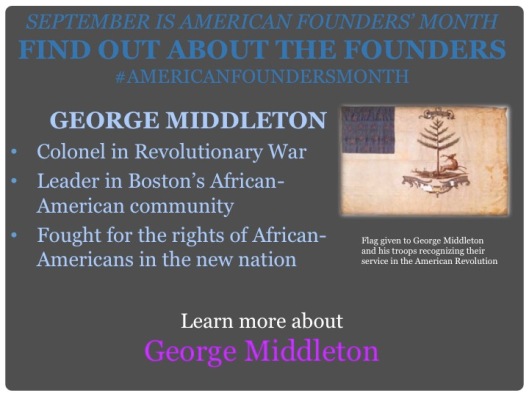
American Founders’ Month in Florida continues! Today, we will meet George Middleton. Colonel Middleton was one of the leaders of the African-American community in Revolutionary-era Boston, and helped established a predominately African-American militia during the war. This militia, known as ‘The Protectors’, helped defend property and people in Massachusetts throughout the war.
Colonel Middleton was also a strong advocate for the rights of African-Americans in the new United States. Whether fighting against slavery and for civil and political rights or equal opportunities for education for African-American children, Middleton is a role a model for citizens in the nation, then and now.
“Freedom is desirable, if not, would men sacrifice their time, their property and finally their lives in the pursuit of this?”
Middleton’s words ring true today. As we enter Freedom Week, it is important that we remember and recognize all of those that have lived those words throughout our history.
September 28th and 29th at Fung House. 48 Professors Row, Tufts Campus, Medford MA
Thursday Sept. 28
5 pm “(Un)equal Respect and Agents of Justice”
Benedetta Giovanola, Associate Professor of Moral Philosophy
Department of Political Science, Communication, and International Relations, University of Mascerata, Italy Commentator: Dennis Rasmussen, Associate Professor of Political Science
6:15 pm “The Nature and Design of Robust Institutions”
Speaker: Brian Epstein, Associate Professor of Philosophy
Commentator: Peter Levine, Lincoln-Filene Professor of Citizenship and Public Affairs Jonathan M. Tisch College of Civic Life
7:30 pm Dinner for all participants
Friday, Sept. 29th
9:00 am “Justice, Self-Sufficiency, and Commodious Living: Hobbes’ s Commercial Republic”
Speaker: loannis Evrigenis, Professor of Political Science Commentator: Vickie Sullivan, Professor of Political Science
10:15 am “Grounds for Coverage: Considering the Basis for Entitlements of Immigrants to Health Care”
Speaker: Keren Ladin, Assistant Professor of Public Health and Community Medicine and Occupational Therapy
Commentator: Alecia McGregor, Assistant Professor of Community Health
11:30 am “We, the Mediated People: Unconventional Adaptation in post-Cold War South America”
Speaker: Joshua Braver, Jonathan M. Tisch Post-doctoral Fellow in Political Science Commentator: Abiodun Williams, Director, The Institute for Global Leadership
12:30 pm . Lunch
Sponsored by the Tufts Department of Philosophy, the Department of Political Science, and the Jonathan M. Tisch College of Civic Life
Both gender and language are social constructs, and sociological research indicates a link between the two.
In Lakoff’s classic 1973 paper, Language and woman’s place, she argues that “the marginality and powerlessness of women is reflected in both the ways women are expected to speak, and the ways in which women are spoken of.” This socialization process achieves its end in two ways: teaching women the ‘proper’ way to speak while simultaneously marginalizing the voices of women who refuse to follow the linguistic norms dictated by society. As Lakoff writes:
So a girl is damned if she does, damned if she doesn’t. If she refuses to talk like a lady, she is ridiculed and subjected to criticism as unfeminine; if she does learn, she is ridiculed as unable to think clearly, unable to take part in a serious discussion: in some sense, as less than fully human. These two choices which a woman has – to be less than a woman or less than person – are highly painful.
Lakoff finds numerous lexical and syntactic differences between the speech of men and women. Women tend to use softer, more ‘polite’ language and are more like to hedge or otherwise express uncertainty with in their comments. While she acknowledges that – as of the early 70s – these distinctions have begun to blur, Lakoff also notes that the blurring comes almost entirely in the direction of “women speaking more like men.” Eg, language is still gendered, but has acceptable language grown in breadth for women, while ‘male’ language remains narrow and continues to be taken as the norm.
A more recent study by Sarawgi et al looks more closely at algorithmic approaches to identifying gender. They present a comparative study using both blog posts and scientific papers, examining techniques which learn syntactic structure (using a context-free grammar), lexis-syntatic patterns (using n-grams), and morphological patterns using character-level n-grams.
Sarawgi et al further argue that previous studies made the gender-identification task easier by neglecting to account for possible topic bias, and they therefore carefully curate a dataset of topic-balanced corpora. Additionally, their model allows for any gamma number of genders, but the authors reasonably restrict this initial analysis to the simpler binary classification task, selecting only authors who fit a woman/man gender dichotomy.
Lakoff’s work suggests that there will be lexical and syntactic differences by gender, but surprisingly, Sarawgi et al find that the character-level n-gram model outperformed the other approaches.
This, along with the fact that the finding holds in both formal and informal writing, seems to suggest that gender-socialized language may be more subtle and profound than previously thought. It is not just about word choice or sentence structure, it is more deeply about the very sounds and rhythm of speech.
The character n-gram approach used by Sarawgi is taken from an earlier paper by Peng et al which uses character n-grams for the more specific task of author attribution. They test their model on English, Greek, and Chinese corpora, achieving impressive accuracy on each. For the English corpus, they are able to correctly identify the author of text 98% of the time, using a 6-gram character model.
Peng et al make an interesting case for the value of character n-grams over word n-grams, writing:
The benefits of the character-level model in the context of author attribution are that it avoids the need for explicit word segmentation in the case of Asian languages, it captures important morphological properties of an author’s writing, it can still discover useful inter-word and inter-phrase features, and it greatly reduces the sparse data problems associated with large vocabulary models.
While I initially found it surprising that a character level n-gram approach would perform best at the task of gender classification, the Peng et al paper seems to shed computation light on this question – though the area is still under theorized. If character n-grams are able to so accurately identify the single author of a document, and that author has a gender, it seems reasonable that this approach would be able to infer the gender of an author.
Still, the effectiveness of character n-grams in identifying an author’s gender indicates an interesting depth to the gendered patterns of language. Even as acceptable language for women converges to the acceptable language of men, the subtleties of style and usage remain almost subconsciously gendered – even in formal writing.
Where did things go wrong on the way to modern life, and what should we do instead? This question always seems to lurk in the background of our fascination with many indigenous cultures. The modern world of global commerce, technologies and countless things has not delivered on the leisure and personal satisfaction once promised. Which may be why we moderns continue to look with fascination at those cultures that have persisted over millennia, who thrive on a different sense of time, connection with the Earth, and social relatedness.
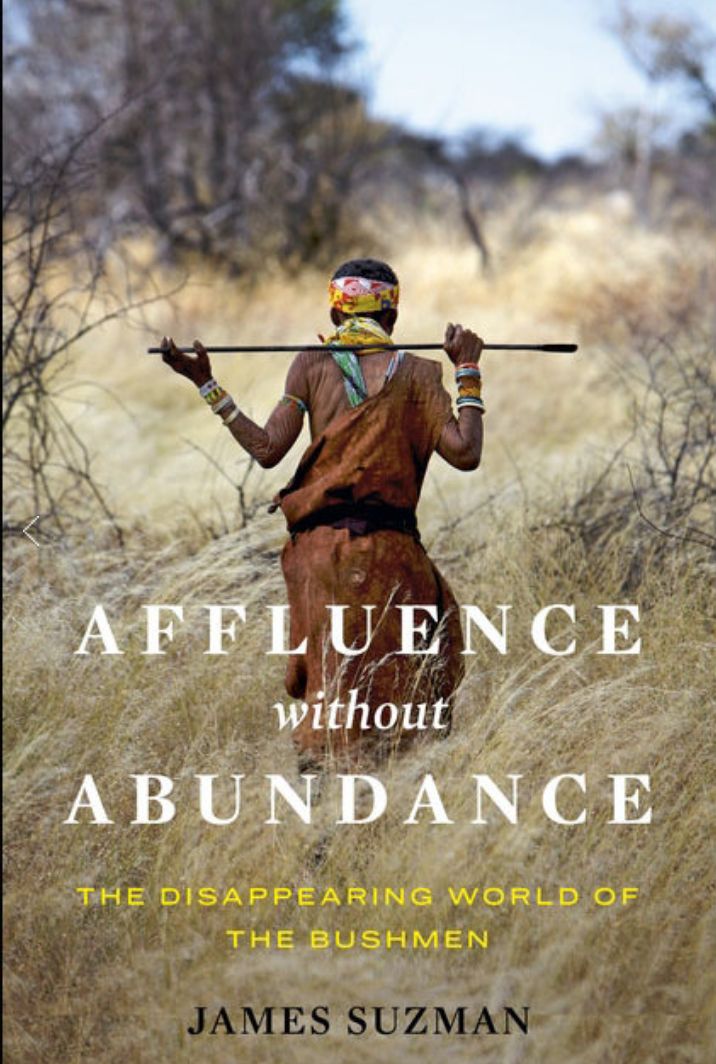
Such curiosity led me to a wonderful new book by anthropologist James Suzman, Affluence without Abundance: The Disappearing World of the Bushmen. The title speaks to a timely concern: Can the history of Bushmen culture offer insights into how we of the Anthropocene might build a more sustainable, satisfying life in harmony with nature?
Writing with the emotional insight and subtlety of a novelist, Suzman indirectly explores this theme by telling the history and contemporary lives of the San – the Bushmen – of the Kalahari Desert in Africa. The history is not told as a didactic lesson, but merely as a fascinating account of how humans have organized their lives in different, more stable, and arguably happier, ways. The book is serious anthropology blended with memoir, political history, and storytelling.
After spending 25 years studying every major Bushman group, Suzman has plenty of firsthand experiences and friendships among the San to draw upon. In the process, he also makes many astute observations about anthropology’s fraught relationship to the San. Anthropologists have often imported their colonial prejudices and modern alienation in writing about the San, sometimes projecting romanticized visions of “primitive affluence.”
Even with these caveats, it seems important to study the San and learn from them because, as Suzman puts it, “The story of southern Africa’s Bushmen encapsulates the history of modern Homo sapiens from our species’ first emergence in sub-Saharan Africa through to the agricultural revolution and beyond.” Reconstructing the San’s 200,000-year history, Suzman explains the logic and social dynamics of the hunter-gatherer way of life -- and the complications that ensued when agriculture was discovered, and more recently, from the massive disruptions that modern imperialists and market culture have inflicted.
The fate of one band of San, the Ju/’hoansi, is remarkable, writes Suzman, because the speed of their transformation “from an isolated group of closely related hunting and gathering bands to a marginalized minority struggling to survive in a rapidly changing polyglot modern state is almost without parallel in modern history.” As European settlers seized their land, forced them to give up hunting, forced them to become wage-laborers on farms, and introduced them to electricity, cars and cell phones, the Ju/’hoansi acquired “a special, if ephemeral, double perspective on the modern world – one that comes from being in one world but of another; from being part of a modern nation-state yet simultaneously excluded from full participation in it; and fro having to engage with modernity with the hands and hearts of hunter-gatherers.”
In learning more about the San, then, one can learn more about the strange, unexamined norms of modern, technological society that most of us live in. It is fascinating to see the social protocols of sharing meat and food; the conspicuous modesty of successful hunters (because in the end their success is part of a collaboration); and the “demand sharing” initiated by kin and friends to ensure a more equal distribution of meat and satisfaction of basic needs.
The inner lives of the Ju/’hoansi suggests their very different view of the world. “For them,” writes Suzman, “empathy with animals was not a question of focusing on an animal’s humanlike characteristics but on assuming the whole perspective of the animal." The performance of the hunt engenders a kind of empathy for the prey, as well as a broader understanding that the cosmos ordains certain sacred roles for all of us – as prey, hunters, and food. Hunting and eating in the Kalahari connects a person with the cosmos in quite visceral ways – something that no supermarket can begin to approach.
I’m not ready to hunt my own food, but is there some way that I can see my bodily nourishment reconnected with the Earth and my peers, and not just to packaged commodities? For now, my CSA is a good start.
The most poignant part of Affluence without Abundance is the final chapter, which describes how many San – deprived of their lands, ancestral traditions, and cultural identities – now live out dislocated lives in apartheid-founded townships that Suzman characterizes as having a “curious mix of authoritarian order and dystopian energy.” There is deep resentment among the San about the plentitude of food even as people go hungry, and anger about the inequality of wealth and concentration of political power. Most frightening of all may be the pervasive feelings of impermance and insecurity. History barely matters, and the future is defined by market-based aspirations -- a job, a car, a home. The modern world has few places to carry on meaningful traditions and sacred relationships.
I was pleased to see that James Suzman has founded a group, Anthropos, https://www.anthropos.org.uk/about to “apply anthropological methods to solving contemporary social economic and development problems.” A timely and important mission.