pseudoscience and the No True Scotsman fallacy

I’m sure the point has been made before, but it occurs to me that to describe shameful episodes like racial eugenics as “pseudoscience” risks the “No True Scotsman” fallacy.

This is an early (possibly the first) telling of the No True Scotsman story, by Anthony Flew:

Imagine Hamish McDonald, a Scotsman, sitting down with his Glasgow Morning Herald and seeing an article about how the “Brighton Sex Maniac Strikes Again”. Hamish is shocked and declares that “No Scotsman would do such a thing.” The next day he sits down to read his Glasgow Morning Herald again; and, this time, finds an article about an Aberdeen man whose brutal actions make the Brighton sex maniac seem almost gentlemanly. This fact shows that Hamish was wrong in his opinion, but is he going to admit this? Not likely. This time he says: “No true Scotsman would do such a thing.”

It would similarly be fallacious to say, “No scientist would claim to assemble evidence for white supremacy. Ah, I see that a whole raft of highly distinguished scientists argued for white supremacy, and a few still do. Well, they are not true scientists.”

If “Racism is pseudoscience” is just a way of saying “racism is false,” then I agree with it. But if it’s meant to imply that the actual practice of science–science as a real human activity–would never support racism, then it’s false. Science did support racism, and that tendency lingers in some quarters. Racist scientists are truly scientists in the sense that they practice that occupation and participate in that social institution. They’re wrong, but that shows that science is susceptible to error–both empirical and moral. It’s not helpful to try to evade the problem by definitional fiat.

See also: is science republican (with a little r)? and is all truth scientific truth?

Talking Leadership with Grad Students

Logo for the Graduate Student Congress at the University of Kentucky.Today I had the honor of having been invited to speak at the University of Kentucky’s Graduate Student Leadership Conference. My talk was called “Democracy and Leadership in Higher Education: A Talk for Graduate Students.” I seconded some of the prior speaker’s remarks, which concerned the value of networking, including online and via social media. One student had expressed her aversion to social media. I explained that at least one wants to have a good Web site, as people do want to look you up some when getting to know you. One avenue that can help are social media profiles, but a good Web site can do wonders too. I would encourage some of the same things. He had said that Facebook isn’t a great medium, but that’s because he was thinking of one’s personal Facebook profile. And obviously he hasn’t read my post about why scholars need Facebook author pages (and since I wrote that piece, my author page following has grown from ~2k to ~141k).

Eric Weber delivering a different talk years earlier, not the one mentioned in this post.

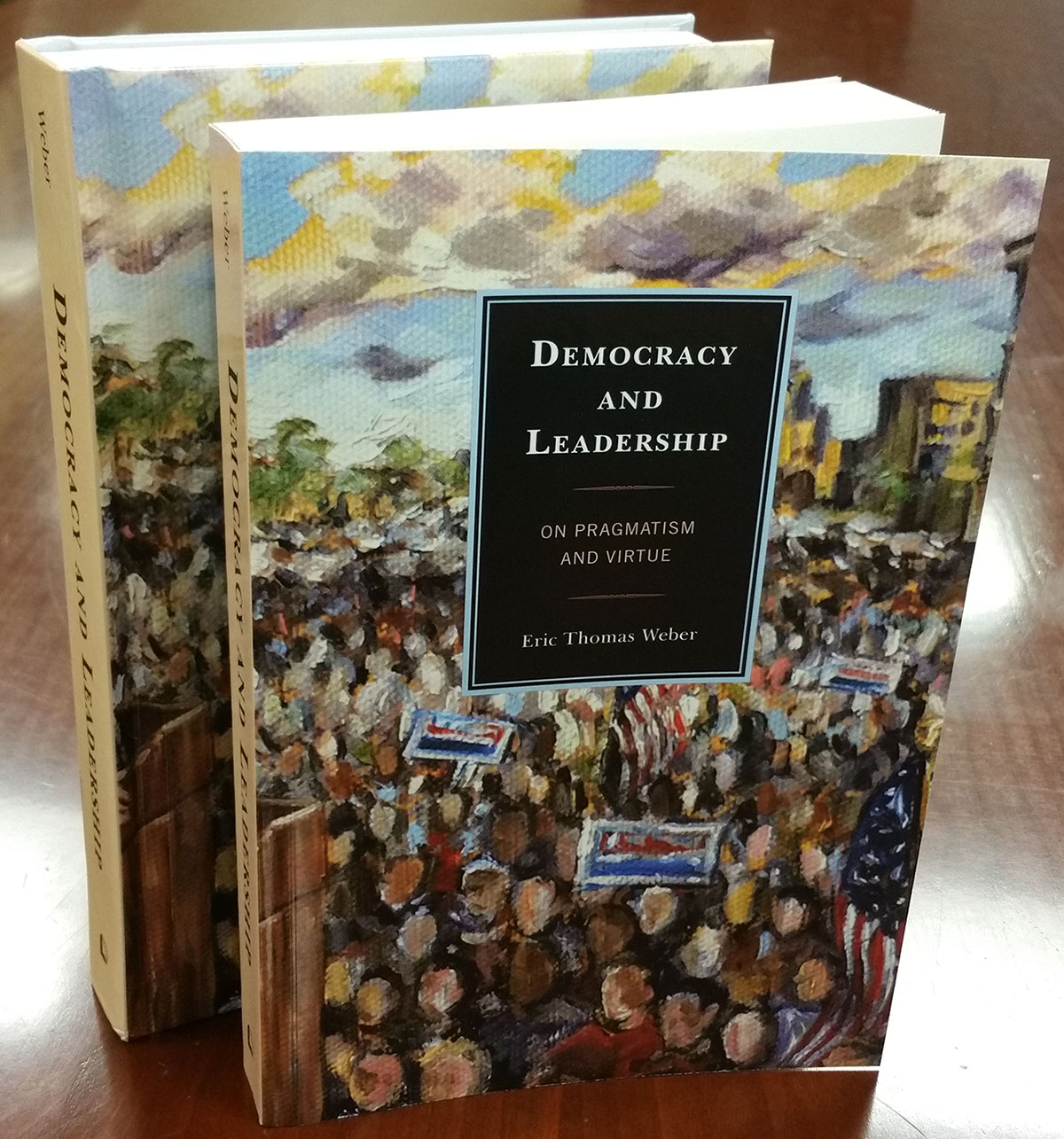
Photo of the paperback and hardback editions of 'Democracy and Leadership.'I wasn’t there today to talk about social media, though. Instead, I spoke mainly about my 2013 book, Democracy and Leadership, and showed what I think we still have to learn from Plato, even if it needs updating for the modern and democratic era. I find a lot of value in reminding myself of what Plato’s Socrates says in the first book of the Republic. There, Socrates says that good people won’t be willing to lead. They’d rather others do it. But, some compulsion weighs on good people, inspiring them to be leaders against their inclinations. That compulsion is the fact, in his way of thinking, that worse people will lead. In the democratic era, the language of good people and bad people generally rings as unpleasant at best. My translation for democracy is to say that the compulsion could be instead that good people care about problems, injustices, that could be ameliorated with effort. Good people don’t want to be at the top for its own sake, but accept positions of responsibility because of what would happen if other people would not stand up to address key problems.

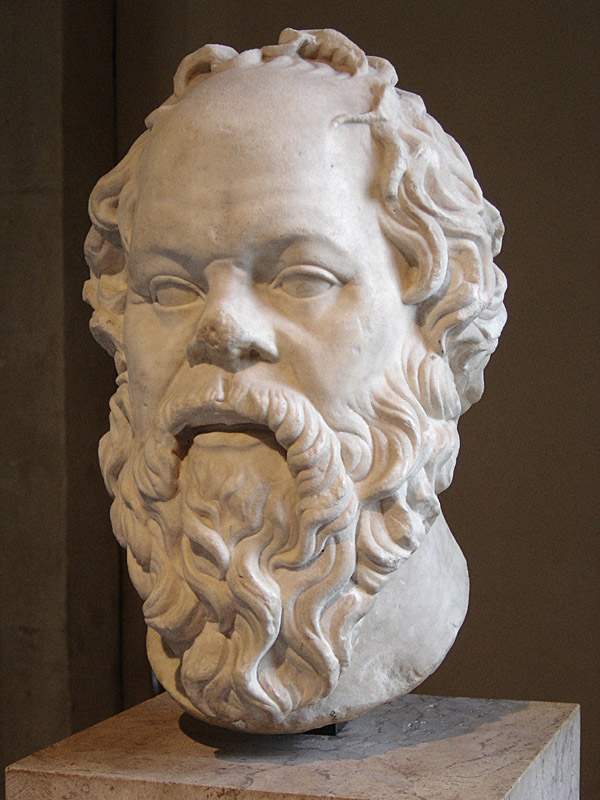
Bust of Socrates.

Socrates.

After that, I explained how and why I think it’s important that we continue to learn about leadership from Plato, even while we disagree with and let go of his authoritarian outlook. In other words, how he characterizes the virtues of leadership is problematic, but there’s no doubt that wisdom is important for leadership, for example, including in the democratic era. It just needs to be understood, pursued, and embodied democratically. So, I talked about what I take that to mean in many contexts of leadership today, but focusing on prime challenges for grad students. After all, good people will need compulsion in grad school too. Leadership is generally thankless, or worse. Plus, it takes a great deal of time and effort, which generally means a distraction from one’s other work. As such, engaging in leadership efforts as a grad student may well mean taking longer to finish one’s program. That’s something serious to accept. To want to lead despite that may well take some compulsion. Even if it does, however, grad student leaders would be wisest if they engage in democratic practices, acknowledging the dangers, challenges, and harms that can come from leading. They should also beware not to carry the world on their shoulders, as time is short, even at its longest, in graduate school (or we generally want it to be), and colleges and universities are slow-moving, relatively conservative institutions. So, at best one can make incremental change and pass on to the next group of leaders their chance to make a further difference.

As such, leadership in the grad school context should stay humble and stoic about what’s possible, want to lead for the right reasons, and be award of the costs, challenges, and reasons not to lead, all while going after it anyway in those cases that truly call for such a sacrifice.

————–

P.S. Of course there was more detail in the talk, but this is the gist of what I had to say this morning, and the people in attendance seemed to appreciate thinking through these matters with me, raising some very thoughtful and valuable questions. My thanks go out to James William Lincoln and the Graduate Student Congress for the invitation.

The post Talking Leadership with Grad Students first appeared on Eric Thomas Weber.

Kenya Youth Manifesto

The majority of Kenyan youth is traditionally excluded from meaningful participation in civic processes; therefore, the Coalition for Kenya Youth Manifesto felt it was important that their perspectives, needs and aspirations should be brought together in one united philosophy. This was accomplished through a collaborative writing process covering the six...

Kettering Releases New Higher Education Exchange

We want to encourage our members in higher education to check out the newest version of the Higher Education Exchange, a free annual publication from NCDD member organization the Kettering Foundation. The Exchange explores important and timely themes around the public mission of colleges and universities and offers reflections from both domestic and international scholar-practitioners on how higher education can and must shift toward teaching deliberation and civic engagement. We highly recommend it. You can learn more about the 2017 edition in the Kettering announcement below or find the full downloadable version here.


Higher Education Exchange 2017: Deliberation as Public Judgment

The 2017 issue of the Higher Education Exchange (HEX) takes on the divisive political moment we find ourselves in and argues that civic work that tries to be apolitical, or stays within the comfort zone of higher education, will not help us to bridge the divides that threaten our democracy

What makes this moment so critical? Polarization is now more intractable than it has ever been before. While elected officials have always had their disagreements, research has confirmed partisanship in Washington has grown to new levels. Media polarization is also on the rise. Not only are we confronted with ongoing socioeconomic and geographical divides, but also social media further enables segmentation into bubbles of like-minded groups. While information has never been more accessible, the citizenry cannot even agree on what constitutes factual information, much less how to interpret its implications.

In addition to the usual gridlock, the discourse of “winners” and “losers” raises the stakes of politics. Each side fears that the other seeks power to impose its will, further increasing the sense of tension and mistrust. As politics comes to be seen exclusively as a competition for power, the outcomes have less claim to be regarded as the expression of a deliberative process that represents the common good.

As a public institution, higher education would seem to be ideally placed to build bridges across these political divides. However, higher education has construed its neutrality narrowly, attempting to steer clear of politics rather than actively bridge political divides. At least since the advent of the modern research university, higher education has focused largely on the production and transmission of expert knowledge, conceiving its democratic role as informing the public. Higher education institutions are thus built around an epistemology that separates “facts” from “values” and, understandably, the historical focus has been on the former rather than the latter. However, if our current dysfunctions have more to do with political divisions than informational deficits, the question becomes: what more expansive civic role is higher education capable of playing?

In recent years, higher education has begun to talk more actively about its civic role. As part of this civic renewal, the word deliberation has enjoyed a resurgence, and higher education has played a key role in nurturing a field of practice across professional domains now ostensibly devoted to deliberative democracy. But what deliberation means may be more varied and obscure than ever. Depending on their purposes and contexts, practices referred to under the rubric of deliberation may have various and even contradictory effects. Deliberation is used for strikingly different purposes, including civic education, conflict resolution, input into government policy and administration, and social justice, and sponsoring organizations make a variety of design choices to suit their purposes. Despite such differences, deliberation is also used to describe the varied practices and examples taking place.

As a research foundation committed to a particular understanding of deliberation, Kettering’s challenge is to be clear about what we mean when we use the term. This volume of HEX attempts to distill Kettering’s understanding of deliberation.

At least two important themes define Kettering’s approach. First, this approach to deliberation is political. It aims to address dysfunctions of our political system, particularly the polarization of our public discourse and resulting loss of confidence in institutions.

Second, at the center of our approach to deliberation is the exercise of the human faculty of judgment. That is, rather than technical or instrumental problems, we seek to apply deliberation primarily to the complex value questions that most divide our country. Because such questions cannot be answered objectively, no amount of technical knowledge can resolve them. While judgment lacks the certainty of scientific knowledge as well as the romantic appeal of a unanimous consensus, we think it is precisely the virtue that is needed to address the communicative dysfunctions of our current political climate.

As our public discourse becomes increasingly adversarial, higher education and other expert professions may be tempted to double down on “informing” the public with expert knowledge. Kettering’s research suggests that we are in need of something different, an ethos—a set of skills, norms, and habits for civic discourse. While higher education is in a position to help bridge our differences, its overwhelming tendency has been to prioritize technical knowledge at the expense of civic ethos. Proponents of deliberation may unwittingly compound the problem by confusing the two. For those who wish to bridge our divides, we hope this collection will help them return their focus to the human faculty of judgment and recover the political roots of deliberation.

We hope this edition of HEX sparks a lively conversation on these themes.

You can find the original announcement of this on Kettering’s site at www.kettering.org/blogs/hex-2017-deliberation-public-judgment.

Palmaria nel cuore [Palmaria at heart]

Per la redazione degli scenari di intervento e il programma di valorizzazione complessiva dell’Isola dell’Isola Palmaria (Comune di Porto Venere, La Spezia) l'11/9/2017 è stato affidato l'incarico per la progettazione e la realizzazione di un percorso partecipativo: “Palmaria nel Cuore”. Al momento il percorso è ancora in svolgimento; sono state...

Seeking the Meaningful Inclusion of People with Disabilities: the PATH Process at L’Arche Antigonish (Nova Scotia)

L’Arche Antigonish, a community of people living with and without intellectual disabilities, engaged in a visioning session using a tool called Planning Alternative Tomorrows with Hope (PATH) to rethink their arts program and to move to more accessible community discussions that intentionally engage people living with disabilities in decisions that...

The C3 Framework, Elementary Education, and ELL Students

optimizing-elementary-education-for-english-language-learners

Many of the folks that read this blog and work in secondary civic and social studies education have considered ways in which they might incorporate the C3 Framework into the work that they do. This is no doubt just as true for elementary social studies educators (they, like Santa, DO exist you know!), and English Language Learners (ELLs) could benefit from the College, Career, and Civic Life (C3) approach to inquiry and learning. Recently, our own Florida Joint Center for Citizenship director Dr. Steve Masyada coauthored, with ELL education expert Dr. Katherine Barko-Alva of William and Mary, a chapter in Optimizing Elementary Education for English Language Learners. In this chapter, they walk teachers through an extended second grade lesson around civic life, modified for ELL students and integrating all 4 Dimensions of the C3 Framework. It might be of interest to folks thinking about ways in which we can get the C3 Framework into elementary classrooms and help our ELL students, and really, all students, in embracing civic life. Check out Dimensions of Success if you are so inclined!

Advertisements