Encouraging Civic Literacy in Florida

Civic literacy has long been a concern nationally, and here in Florida, we have worked hard to give our middle school students a strong foundation in civic education. Indeed, 71% of all middle school students scored a 3 or better on the state civic assessment last year. 

state 2019 assessment

That being said, we know that we can always do more. Recently, Florida Governor DeSantis stated that the state would begin assessing the civic literacy of high school students to determine where we stand with that cohort of future citizens. Are there areas of weakness that need to be addressed? This is what the governor’s effort is intended to address.

At this point, implementation of the governor’s desire is being worked out by the experts in Tallahassee. It is likely that students that pass this now-required measure in high school will meet the state’s recently-established college civic literacy assessment, however.

Please be aware that as of now, passage of this yet-to-be-implemented exam will NOT be required for high school graduation or used in teacher evaluations or school grades. It is simply to see where we stand. 

Be sure to watch this space for more information on this new expectation. The Lou Frey Institute will be providing news, information, and resources concerning this new assessment as it is rolled out across the state. We look forward to supporting the governor, and FLDOE, in its efforts and working with teachers across the state in ensuring that Florida continues to lead the nation in civic education and learning!

You can read more about the governor’s civics effort in the Tampa Bay Times and in the Orlando Sentinel.

job openings in youth civic engagement

This is the latest in an occasional series …

CIRCLE (The Center for Information & Research on Civic Learning & engagement here at Tisch College) is searching for a Project Manager. They are looking for someone with advanced project management skills (and ideally a project management certificate) and a commitment to equality, but no prior knowledge of civic engagement is required.

The nascent Center for Equity on Health, Wealth, and Civic Engagement at Tufts University (whose Principal Investigators are Jennifer Allen, Thomas Stopka and I), seeks a part-time Program Coordinator. Our long-term goal is to build a durable center for the study of equity that integrates research from across Tufts, attracts external funds for ambitious projects, generates groundbreaking research, affects the national and global understanding of equity, and offers educational opportunities for Tufts students and others. This work is distinctive in its interdisciplinary breadth, its focus on equity as an ideal rather than inequality as a narrowly defined problem, and its connection to policy, practice and public discussion. We seek a part-time Program Coordinator to oversee implementation of study plans and who will be a key liaison between faculty members, students, and community stakeholders. Under the supervision of the Principal Investigators, the Program Coordinator will coordinate all center activities. Contact me for more information.

Tisch College seeks a VISTA Campus Recruiter— a part-time position recruiting for national service opportunities in partnership with the Corporation for National and Community Service (CNCS). The Recruiter will primarily focus on AmeriCorps VISTA. The Recruiter will create and enact a comprehensive work plan that presents VISTA service opportunities to students at Tufts University. To apply or for more information please contact Sherri Sklarwitz (sherri.sklarwitz@tufts.edu) by December 20th. Please include the job title (VISTA Campus Recruiter) in the subject line.

Discovering Justice seeks a new Executive Director. Each year, Discovering Justice works with K-8 students and teachers in more than 19 districts across Massachusetts. Discovering Justice provides teachers with civics curriculum, training, and professional development, and also offers experiential field trips and after school programs all designed to provide young people with the knowledge, tools, and resources they need to participate in democracy and extend civic learning into their own neighborhoods and communities.

The  American Academy of Arts & Sciences program on Society and the Public Good seeks a program officer.

political reform in Massachusetts

This is the video of me presenting our study entitled MassForward: Advancing Democratic Innovation and Electoral Reform in Massachusetts at the Boston Foundation in November, with discussion by Jay Kaufman, a former state representative and Founder and President of the Beacon Leadership Collaborative; Beth Lindstrom, former Executive Director of the Massachusetts Republican Party; Laurie Nsiah-Jefferson, Interim Director of the Center for Women in Politics & Public Policy at UMass Boston; and Pavel Payano, an at-large city councilor in Lawrence.

The report was covered in MassLive WGBH , WBUR CommonWealth NEPR WPRI SouthCoast Today, and The Salem News (an editorial) 

Setting Our Sights on 2020

As 2019 draws to a close, the NCDD staff and board are setting our sights on the year ahead and making plans for what we would like to do together in 2020. Suffice it to say 2020 will be an important year for our country and our world. It will be a year where dialogue & deliberation are even more essential to helping people and communities build connections, increase understanding, and reach decisions together. This may feel like a real challenge for the public in the year ahead, but we all know the benefits of quality dialogue and NCDD will work hard to help share this message.

Keiva &Courtney believe what you do matters!

We will help spread the word about the work you all do every day, the impact that work has, and how more people can bring these tools to their communities. We will work with our network to teach more people to convene conversations. We will support our collective work through opportunities for shared learning and collaboration. And we will continue to look for the next steps we can take to advance our field together.

We, of course, can’t do this without all of you. NCDD is a coalition, and we are only as strong as our network. Our staff is made up of only three – myself, Joy, and Keiva, and we all work part-time. We continue to do this work because we are passionate about the potential that dialogue & deliberation offers our world, and know that this network harnesses the knowledge and skills to help see that potential achieved. With your help, we will get there.

Therefore, today we are launching our annual end-of-year fund drive. Our hope is to raise $10,000 before January 1 in order to support NCDD’s goals for 2020. On Giving Tuesday we were able to raise $1,400 to start this drive off, and we would love to raise double this amount in the next few days. Can you help us? If you believe in NCDD’s mission and find value in the resources, connections, and opportunities we provide, we urge you to show your support by making a donation. All contributions are welcome, whether they are $5 or $500. And your contributions are tax deductible! Please share the fund drive with your networks and consider asking your favorite angel donor to contribute as well. Help us reach our $10,000 goal, and thank you so much, in advance, for supporting NCDD!

education and political party support in the UK

A common pattern in the 21st century involves much of the working class shifting from a broad center-left political party toward the right.

One way to measure class is by educational attainment. In Germany, the Social Democrats have lost much of the working class to the right, and the highly educated professions have migrated to the Greens. In the US, where third parties have a much harder time, highly educated people are unlikely to exit the two big parties. Instead, they use their effective voices to dominate at least one party. Recently, the most educated groups have voted Democratic. At one point during the 2016 election, Hillary Clinton led college-educated whites by 5 points, but she trailed Trump among whites who don’t have college degrees by 39 points: 62% to 23%. Democrats would be in big trouble except that race is at least as important as class in the USA, and people of color of all educational backgrounds also tend to vote for Democrats.

What about the UK? Much has been written about the demographics of voters in the recent British elections, but I also like a time-series from the European Social Survey that asks which party people feel “closest” to. This question is asked regularly in even years. It gives you a trend that’s less tied to candidates and specific campaigns.

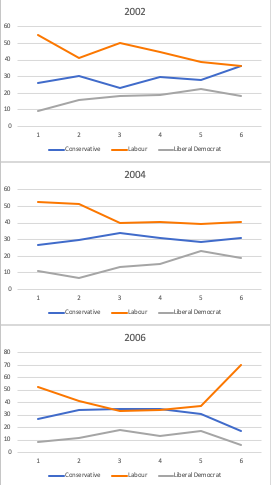
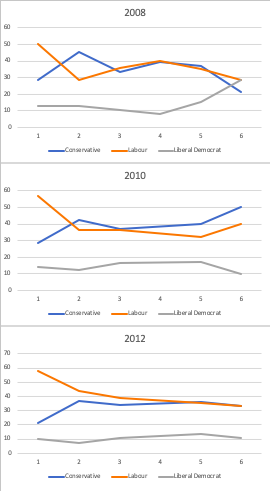
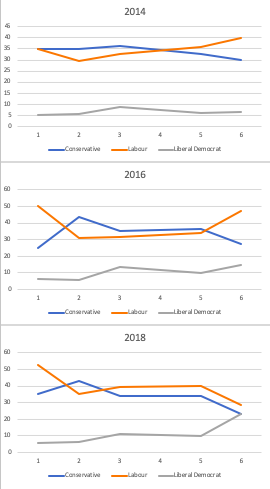
Above, I show support for Labour, the Conservatives, and the Liberal Democrats for six educational strata, from less than secondary education to doctoral degrees or the equivalent. The education question changed in 2010, so I have done my best to keep the categories consistent.

In 2002, Labour’s support correlated negatively with education; the Tories did better with people with more education. The Liberals were far behind but drew best from people with university degrees (teachers and other “knowledge workers,” I would guess).

Fr0m 2004-2008, that pattern continued, with the very important change that the Liberals battled Labour for the support of the most educated, who oscillated between those two parties.

In 2012, the classic pattern recurred, with Labour receiving smoothly declining support with educational levels. In 2014 and 2016, Labour did much better with the best educated. In 2018, the most educated voters essentially shifted to the Liberals.

Based on what we know from constituencies’ demographics, it seems that since 2018, many working class English voters switched from Labour to the Tories or stayed home.

Brexit: a personal reflection

(Fremont, CA) I’m saddened by Brexit for personal reasons that I’ll relate below. But first I should offer three caveats.

First, Brexit is not about me. It will affect the residents of the UK and EU; my feelings don’t really matter.

Second, the “remain” side is not self-evidently right, either ethically or practically. There are democratic arguments in favor of withdrawing from the EU. “Leavers” are not simply bigoted or victimized by propaganda. Both of the biggest parties have been divided by the issue. The EU has served some Britons better than others.

And third, the UK election is about much more than Brexit. Austerity is the main policy that has won.

Having said all that, I’ve had a deep, lifelong commitment to European integration–and to a Europe that has Britain in it. My family spent almost half of my first 15 years in London. My primary school, Prior Weston, was situated immediately next to a weedy lot that was still empty because of the bombs of 1940. That was a powerful reminder of the cost of European division.

Britain had entered the European Economic Community by then, and my Christian-Socialist-oriented state primary school embraced the ideal of the EEC. We studied the culture of each EEC member country in turn. I recall the teachers making some prejudiced remarks. Germans ostensibly had no sense of humor, for example. (This is false.) But the overall message was one of interconnection and shared fate.

London was a global city, anyway–a great entrepot. We knew many, many immigrants. The largest share had come from former colonies in the Global South, but many were Europeans. What made London great was its cosmopolitanism, and that has been true since the medieval days of Lombard bankers and Flemish weavers.

When I was a young teenager, now attending a much more conservative independent secondary school, most of my English friends would have denied that they were European. The continent was a foreign place to them, and basically inferior, in their eyes. My English friends would have identified more with the global Anglophone sphere created by British imperialism, and especially with the white-majority countries of Canada, Australia, and New Zealand.

But I wasn’t British, or European–I was an American in London. And from my perspective, the UK clearly belonged to Europe. Although the little islands had been spared from invasion since 1066 because of a narrow strait, they had participated in all the cultural, economic, diplomatic, technological, sociological and even biophysical developments of the continent as a whole. Even then, I thought it was basically ignorant to distinguish between Britain and Europe.

Years later, sitting by a summer ice cream stand outside of Oslo and watching school children on a field trip, I felt palpably how much the whole scene resembled my childhood in London: the ice cream novelties, the buildings and the park’s layout, the way the kids interacted. If you travel from London to, say, Tuscany, you have changed your milieu. But from London to Oslo or Rotterdam is no distance, culturally.

To build one Europe has always seemed to me a humane and creative project (even though we should acknowledge the barriers around the EU’s perimeter and the often technocratic tendencies in Brussels). Britain–and specifically, England–belongs in the project. It has been more open, more sophisticated, and more humane because it’s been part of “Europe.” And it has shared its own worthy ideals with its European partners.

After today, the EU will go on, but it will be somewhat worse without Britain in it. It’s also hard to imagine the United Kingdom staying united for long. I find this very sad.

what does the word civic mean?

I use the word “civic” every day. It is in the title of my college (The Tisch College of Civic Life) and the major that I direct (Civic Studies) and in the names of many topics and fields that I work on, from civic education to civic media.

But what does it mean? In my own mind, “civic” has certain associations and resonances, although I rarely articulate them. During a recent conversation with colleagues, I realized that most don’t hear the same meanings I do. I don’t blame them; there is no agreement about the definition, and the word has been used in many ways. I’ll turn to its history below.

Today, some people hear in the word “civic” a disciplinary intention, an effort to draw a boundary around respectable and approved behaviors (the “civic” ones). Sometimes it is almost synonymous with “civil.” In turn, “civility” sometimes means almost the same as “politeness.” People may use “civic” to identify approved behaviors, or else they may oppose the word as too restrictive and controlling.

Others want to make the word strictly empirical, rather than a value-laden adjective. Then “civic” may refer to a list of activities, from voting to marching in a protest–regardless of the participants’ values and goals. For example, a march would be civic whether the marchers were members of the Southern Christian Leadership Conference or Mussolini’s Brown Shirts. (But if we take this approach, why are certain activities on the list, and others not?)

I’d like to make space for a more inspiring use of the word that has deep historical roots. My dictionary-style definition would go something like this:

Civ’-ic. adj. 1. Of or pertaining to a group of relatively equal self-governing people. Hence, 2. virtues, values, or skills for self-government, e.g., civic courage, civic knowledge. 3. Assets belonging to or created by self-governing people, e.g., a civic forum. 4. Activities or other phenomena related to self-government, e.g., civic engagement, civic dialogue, civic education.

By a “self-governing people,” I mean to include all the citizens of any republican country, but not only such groups. A town or city within a larger country can have self-governing power. So can a voluntary association or even some kinds of firms; and they may be self-governing even if the states in which they operate are authoritarian. Thus, institutions of various types and scales can be civic.

The history of a word helps explain how it has accrued its diverse definitions and resonances.

The English word “civic” derives from Latin civicus, which primarily refers to relations among fellow members of the same city. In turn, the classical city (the polis or urbs) was self-governing: not usually egalitarian, but quasi-autonomous and governed by a deliberative assembly. So civicus always had echoes of a deliberative forum.

“Civic” enters the Romance languages to translate Latin texts. According to the Oxford English Dictionary (OED), the very first use in English (1542) refers specifically to the ancient Roman oak-leaf-and-acorn garland awarded to men who had saved fellow citizens in war.

A kind of garland was its only meaning in English until the time of the Commonwealth, when Parliament overthrew the monarch and declared a republic. During this period, the Company of Mercers of the free city of London put on a pageant entitled “Charity Triumphant,” parading a female allegorical figure through the streets of the city. Edmund Gayton (“considered a hack writer” and then imprisoned for debt), published a long descriptive and celebratory poem about this pageant, including the sentence, “I cannot here set forth the reason of the late extinguishing these Civick Lights, and suppressing the Genius of our Metropolis, which for these Planetary Pageants and Pretorian Pomps was as famous and renouned in forraign Nations, as for their faith, wealth, and valour.”

Gayton probably deserves his obscurity, but he does seem to coined the word “Civick” in one of its important senses: “of, belonging to, or relating to a citizen or citizens; of or relating to citizenship or to the rights, duties, etc., of the citizen; befitting a citizen” (OED).

In his time, the English were enthusiastic about self-governance and the ideal of a commonwealth, itself a translation for “republic,” meaning the good that a people makes and owns together. Of course, this was also the period of Puritan self-governance in New England and the invention of important activities that we now naturally call “civic”: town meetings, local elections, and civic education, which Massachusetts had required in 1642.

Just one year later, in 1656, Blount’s dictionary defines “Civick” as “pertaining to the city.” Since then, one of its meanings has always been akin to “urban,” as in “Civic Center” for the name of a city’s convention hall. But I think that “the city” had a different original meaning. Now we think of large, dense municipalities. Originally, an urbs or polis was any autonomous community. For instance, the whole Massachusetts Bay Colony was meant to be a City on the Hill.

By 1747, “civic” was used to modify “virtue.” By the end of that century, the word “civique” (with similar associations) had become influential in France. According to the Constitution of 1791: “The Civic Oath (le serment civique) is: ‘I swear to be faithful to the Nation to the law and to the king and to preserve with all my power the Royal Constitution, decreed by the National Constituent Assembly for the Years 1789, 1790 and 1791.‘”

Across the Channel, Edmund Burke denounced the French revolutionaries who would overthrow traditional values and institutions, including religion. He added:

These enthusiasts do not scruple to avow their opinion, that a state can subsist without any religion better than with one; and that they are able to supply the place of any good which may be in it, by a project of their own—namely, by a sort of education they have imagined, founded in a knowledge of the physical wants of men; progressively carried to an enlightened self-interest, which, when well understood, they tell us will identify with an interest more enlarged and public. The scheme of this education has been long known. Of late they distinguish it (as they have got an entire new nomenclature of technical terms) by the name of a Civic Education.

Burke, Reflections on the Revolution in France

According to the OED, this was first use of the word “civic education” in English. It referred to a radically republican, secular, and patriotic project to which the author, Burke, was hostile. To bring civic education to England would be “the most dangerous shock that the state ever received.”

Thus the first English use of the phrase “civic education” was a denunciation. Yet the ideals that animated the French Revolution–self-governance, commitment to the common good–have deep resonances in England and the USA.

By the way, the word “civics” is a noun, in my opinion: short for “civic education.” It is often used adjectively in the phrase “civics education,” but I think that’s a grammatical mistake. In any case, “civics” is strictly American, and its first attested use is in the Boston Daily Advertiser in 1885: “Henry Randall Waite, Ph.D., president of the American Institute of Civics, was the next speaker… The use of the word civics for political science was explained.”

In short, “civic” has many meanings, but some of the oldest and most recurrent ones refer to a republican ideal: concrete communities of people should decide and act together and develop the rules, values, resources, and habits necessary to succeed.

December Confab on Guns & Violence Now Available!

We hosted our December Confab last week with presenters from National Issues Forums, Living Room Conversations, and Essential Partners. Each shared their resources for talking about one of the toughest topics in our communities today: guns and violence. This post contains links to the resources as well as a link to the recording of this event.

Betty Knighton and Darla Minnich from the National Issues Forums Institute shared their Issue Advisory, How Should We Prevent Mass Shootings in Our Communities?   The issue advisory outlines three potential options for addressing this issue and encourages the public to deliberate on these and potentially other options.

Joan Blades of Living Room Conversations shared the Conversation Guide on Guns and Responsibility which seeks to help people come together across political or ideological differences to discuss this challenging topic. The guide offers a format for talking about guns in a way that helps community members hear one another’s experiences and how those impact their views about guns.

Katie Hyten from Essential Partners, the global leader in building trust and understanding across divisive differences, shared the story of how the organization convened participants in 2018 from across the United States for a two-day training in dialogue design and community building, followed by an experiment in digital peer dialogue facilitation. Watch the TIME Magazine video, read the media coverage, ​view resources, ​and find out more about Essential Partners’ approach to this issue on their website.

The Confab was a informative and full of resources and tips. It can be found at this link.

Our sincere thanks to Betty, Darla, Joan and Katie for sharing their resources with us and inspiring us to get our communities talking about this important topic.

Confab bubble imageTo learn more about NCDD’s Confab Calls and hear recordings of others, visit www.ncdd.org/events/confabs. We love holding these events and we want to continue to elevate the work of our field with Confab Calls and Tech Tuesdays. It is through your generous contributions to NCDD that we can keep doing this work! That’s why we want to encourage you to support NCDD by making a donation or becoming an NCDD member today (you can also renew your membership by clicking here). Thank you!

On the Road with ‘Free, Fair and Alive’

Book tours are known for being grueling odysseys. While it wasn’t a breeze to speak at two dozen events in ten weeks of travel in Europe, UK and the US, it was a joy for me to connect with so many different commoners. I found my visits often amounted to field research filled with unexpected discoveries and chance insights. At events I invariably wound up meeting several fascinating commoners and learning about some amazing research initiative. 

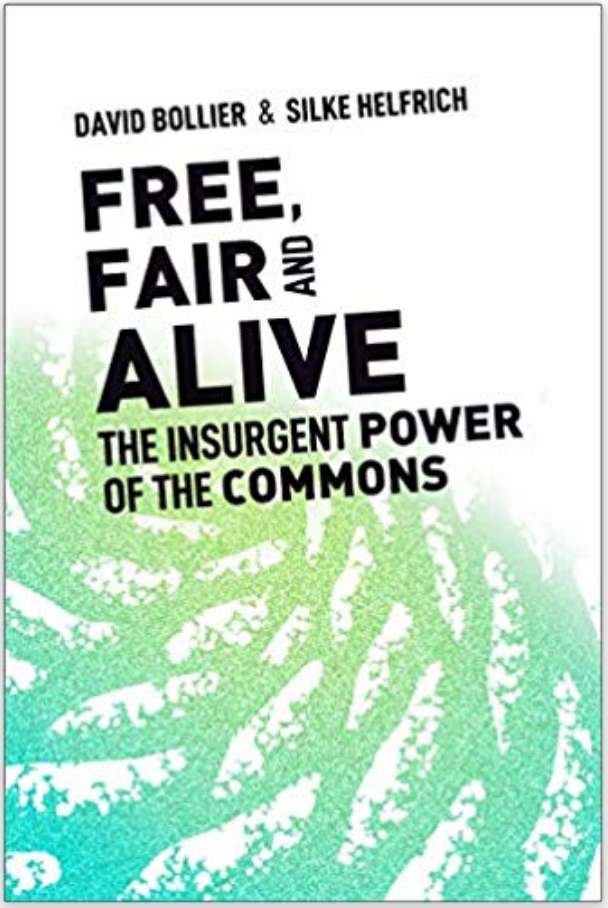
My general conclusion:  The commons world is quite robust -- but it’s not terribly visible to mainstream culture. So the book tour confirmed the aspirations that my coauthor Silke Helfrich and I had for the book, Free, Fair and Alive. We wanted to generate some new concepts, vocabulary, and analyses to bring commoning into sharper focus. That forced us to dig more deeply into the inner dimensions of commoning and into its political implications, especially as it bumps up against property rights and state power.

I'm happy to say that all of our efforts paid off in the end. I kept meeting people who are all too ready to move beyond conventional politics and explore the rich possibilities of the commons. 

To recap for newcomers: Free, Fair and Alive is one of the most comprehensive, in-depth looks at what the commons means in contemporary life. Silke and I spent almost three years trying to make sense of the countless commons we had observed over the preceding 15 years. From her village in Germany and on trains criss-crossing Europe, and from my office in Amherst, Massachusetts -- with occasional in-person work sessions -- we plunged into a serious mutual debriefing about what we had each learned. We wanted to see if we could conceptualize the commons in ways that truly reflect what we had witnessed in Mexico and Greece, India and Germany, the US and UK, and many other places.

Halfway through our research, we realized with a shock that much of the language we were using was seriously wrong and misleading. When using words like “individual,” “rationality” and “resources,” for example – the standard vocabulary of modern economics – we found ourselves locked into a deeply troubling worldview. Do we really wish to regard human beings -- as economists ostensibly do -- as isolated individuals striving to maximize their material self-interests and “externalizing” costs on to “nature.” Is this what "rationality" is?  

Once we realized the ways that we had to escape the gravitational pull of many existing terms and concepts, we set about inventing a new language that could express the realities of cooperating and sharing. In short, a relational framework for the commons. Video producer Nils Agilar captured a glimpse of our process in a wonderful promotional video that he produced. It shows a brainstorming session in which Silke and I came up with a new term to describe what really goes on in a knowledge commons.

For half of my book tour, I traveled with Silke -- to London and a number of other cities in England, and to Amsterdam and Brussels. We encountered Ph.D. students in Amsterdam who hope to build a new international network of graduate students who study the commons. In a separate workshop, I learned how many civic groups in Amsterdam are keen to develop new forms of commons-based finance.

At a Brussels event hosted by Oikos think tank and the Heinrich Boell Foundation, we learned how the commons perspective is gradually working its way into politics. Lotte Stoops, a politician in the Brussels Parliament, is attempting to bring the commons into political and policy discussions there.

In Bristol, England, I met up with some activists with the Transition movement and permaculture world who find great inspiration in the commons. Some Marxist-minded respondents to my talk at The Cube Theater argued that commoners need to pay more attention to class struggle. (Here is a video of my talk and the Q&A in Bristol.)

I had a great evening in London hosted by the Gaia Foundation, which brought together a sizeable contingent of area commoners. Another event, hosted by the Institute for Global Prosperity at University College London, dove into some conversations about art and commoning with the help of the Furtherfield Collective.

Returning to the US, HowlRound Theatre Commons at Emerson College in Boston hosted my presentation and an evening’s dialogue about the role of the commons in the work of artists and cultural workers. By happenstance, I also met up with an Italian student who is an expert on water commons – which gave me a quick tutorial on some latest developments in European and US water commons.

My visit to Boston also brought me into conversation with members of the Leland Street Co-operative Garden in Jamaica Plain ("Tended by All, Harvested by All"), for a potluck dinner in the waning light of a chilly autumn evening. That was an inspiring visit!  People in the neighborhood had personally reclaimed a space that had been used for years as an illegal dumping ground. With some loving care and hard work, the neighborhood turned it into a lovely oasis in the noisy city. 

I participated in other memorable events, including the spirited “Race, Grace, and the Renewal of the Commons” literary festival in Virginia; an activists' luncheon at Ralph Nader’s headquarters hosted by several progressive advocacy groups; conversations with students at Middlebury College and Hampshire College; and an evening with the good folks of Vermont Family Forests in Bristol, Vermont.

I wish to thank the many generous hosts of my talks over the course of my book tour. I also want to salute a number of publications and media outlets that gave some wonderful exposure to Free, Fair and Alive. Shareable magazine named the book as the first of “eleven books we’re reading this fall.” It also did a later Q&A with me about the commons

The group blog Boing Boing published a nice essay by Silke and me, “Learning to See the Commons,” which served as a nice bookend to another Boing Boing piece about Garrett Hardin and the rise of ecofascism

Francesca Rheannon, the velvet-voiced radio show host, interviewed me on “Writer’s Voice," And the new "Commonscast” podcast featured an interview with Silke and me. 

As if all this were not enough, you can learn more about the book itself on its website, where we will soon be posting a new, complete chapter every few weeks. This is possible only because Free, Fair and Alive is licensed under a Creative Commons Attribution-ShareAlike license. A big thanks to New Society Publishers for having the calm confidence in moving forward with a CC license for a commercial book.

A German version of the book was published by transcript Verlag in April, and is expected to go into a second printing in January 2020. A Spanish translation is underway with the help of Guerrilla Media Collective, which also gave us a big boost in outreach and marketing. We have also entered into long planning conversations for possible editions in several other languages.  

Long planning sessions are needed because, while there are no foreign rights to buy (because of the CC license), a simple translation is not enough. There are too many novel terms in our book that will require native commoners to come up with creative equivalents. Any translation will also require the insertion of country-specific examples and cultural references so that the text will really resonate with readers. In a sense, each edition in another language will be an adaptation as well as a translation: a “transladaptation.”

It was a long time on the road, but it was a fantastic set of conversations! My hope now is that the book will take on a life of its own.

participatory action research in the City of God

Equipe Construindo Juntos (The Building Together Research Center) is based in Rio de Janeiro’s City of God neighborhood, made world-famous by the 2002 film. One of the key team members is my Tufts colleague Anjuli Fahlberg, a sociologist. She works as a close colleague with Ricardo Fernandes, Mirian Andrade, Jacob Portela, and about 20 Research Assistants, all from the neighborhood.

Among their projects is an elaborate survey of residents from 989 City of God households. Characteristically, the study began with open-ended discussion groups that chose the questions. The data was collected by fifteen trained and paid residents. To summarize the findings for neighbors, the research team produced “3,000 colorful pamphlets,” made presentations at local nonprofits, and earned press coverage in the major Rio newspapers.

This is an exemplary case of Participatory Action Research. Tisch College is proud to support it.

See also Participatory Action Research as Civic Studies; and nonviolent civic work under conditions of extreme violence (also on Anjuli Fahlberg’s research).