Today, the National Assessment Governing Board released new results for social studies subjects from the National Assessment of Educational Progress (NAEP). EdWeek says, “8th Graders Don’t Know Much About History, National Exam Shows.” Betsy DeVos calls the findings “stark and inexcusable.”
History and geography scores fell, although I don’t know if I’d agree with EdWeek’s Stephen SawchukandSarah D. Sparks that “Eighth graders’ grasp of key topics in history have plummeted.” Here are the median history scores over time:
I would probably say that history scores “declined to a significantly significant degree compared to 2014, meaning that the change from 2014-18 is unlikely to reflect sampling bias.” The differences between 2018 and all other years are within the margin of error and therefore may not be improvements or declines at all.
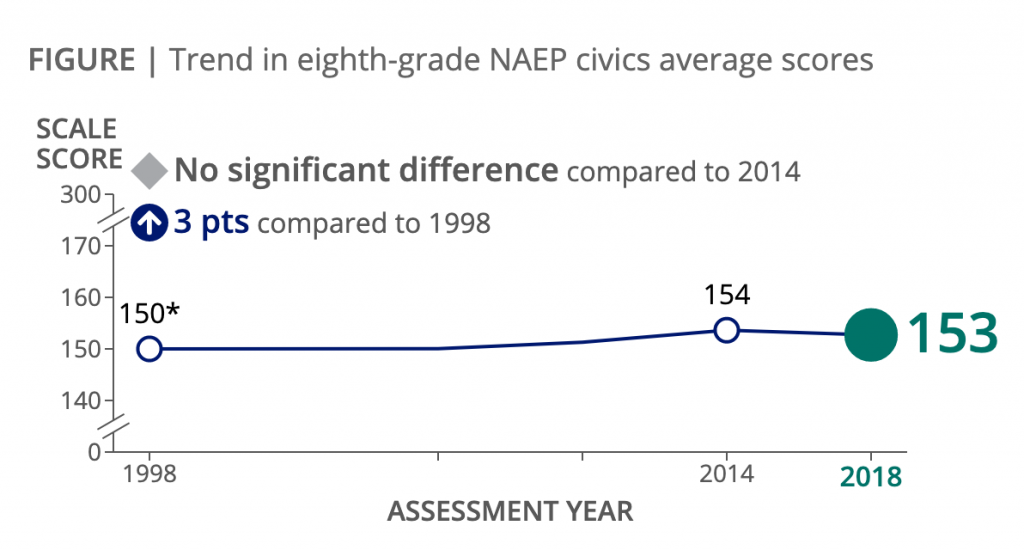
Civics is my own field of interest, and I was one of the designers of the NAEP Civics Assessment instrument. The results for Civics were flat. (Unless you want to say that they “plummeted” by one point.)
The NAEP is extraordinarily useful for analyzing differences in scores by demographic group and for understanding how educational experiences (e.g., taking an 8th grade civics course) relate to outcomes. Unless you have worked with the dedicated folks at the Educational Testing Service and the National Assessment Governing Board, you cannot imagine how careful they are about test-design and implementation or how complex the whole process is.
However, as in the past, I would like to offer these caveats about the NAEP results and the surrounding commentary.
First, as noted above, the changes are subtle, and some are within the margin of error. There is no evidence here of dramatic decline.
Second, the definitions of “proficient” and “advanced” are basically arbitrary. The 1998 designers chose scores that would count as “proficient,” based on their own judgment. Based on the data from that year, they said that just 22% of American 8th graders were proficient. They must have been aware that they would communicate a message of crisis.
The subsequent Assessments have been normed to the 1998 instrument. Roughly speaking, if we drafted an instrument that indicated a major improvement, it would probably not be fielded as such, because the high scores in the pilot phase would suggest that it was an invalid measure–the questions must be too easy.
Therefore, it isn’t really news that the proficiency level is in the neighborhood of 25%. That is how the test is designed. This is not to say that we can’t gradually boost it to 30% or higher if we make a lot of progress in classrooms. But you should understand why the numbers could not be much higher.
The judgment that most kids are not proficient is subject to debate. If you look at the actual questions and how many 8th graders got each one right, you may conclude that most students are below proficient. Or you may think that the questions are surprisingly hard and that we are expecting a lot from 13-year-olds.
For instance, 50% answered this item right:
The United States Congress can pass a bill even if the President disagrees with the bill because
Congress must make sure that the needs of all citizens are met
Congress can make laws more quickly when it does not have to involve the President
Congress usually knows more about what the laws mean than the President does
Congress is the primary legislative power of the government
Is 50% a terrible result, or not too bad? That is a matter of judgment and expectations, not statistics.
Third, the NAEP measures some things but not others. The Civics assessment includes many items about the structure of the US government–which branch or level has what authority. It excludes current events, value-commitments (such as patriotism or commitment to equality), items about social issues, detailed questions about civic institutions outside of government (e.g., What does a PTA do?), items about specific state and local governments, and measures of students’ civic activity outside of school.
Finally, it is difficult to separate reading from civics, particularly at the 4th and 8th grade levels. I don’t think anyone does that better than the NAEP does, but it’s an intrinsic challenge.
A kid who hasn’t actually learned anything specific about the US government but is used to reading advanced texts–The Lord of the Rings, for example–could glean a lot of correct answers based on the meaning of words like “primary” and “legislative” in the example above. A different kid who has dutifully learned some specific civics content might be thrown by the language of the Assessment, especially when the prompts contain longer passages.
It is true that literacy is a civic asset and that people who can do a lot with words are better prepared for civic life. However, if we think there is a separate domain of civic learning–as I do–then measuring it with a written instrument that isn’t confounded with literacy is a challenge.
Overall, I believe there is valuable information in the NAEP (and it’s important for Congress to fund it regularly). But the headlines are hyped. The data show evidence of stability in the relatively narrow set of outcomes that the Assessment measures, with the caveat that the test is designed to be stable over time. If we want to improve civics, we should focus mainly on what helps various kinds of kids to learn the various domains of content that are on the test–plus the important outcomes that the NAEP does not measure at all.
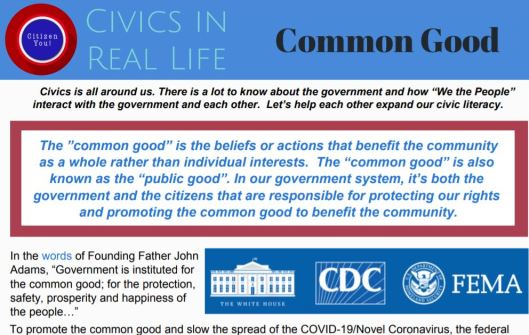
The new Civics in Real Life is now available! Your students may have seen reports of the National Guard deployed in their or neighboring states for a variety of support purposes in the battle against the pandemic. What IS the National Guard, and how does it connect to the purposes of government?
The situation is fluid and unpredictable, but it’s worth tracking these developments.
Lots of philanthropy for COVID-responses. The Foundation Center and GuideStar are tracking $7.9 billion in philanthropic commitments (so far) that specifically address COVID-19. You can find extensive detail here.
Lots of creative new forms of collective action and dissent under pandemic conditions, including protests in which participants stand far apart or ride in cars, refusals to go to work, etc. This crowdsourced list* is admirably broad, encompassing everything from pure service efforts (e.g. sewing masks) to adversarial politics, and ranging from evangelical pastors holding services in defiance of meeting bans to pro-ban parishioners protesting such pastors.
I continue to think that the problem for civil society will not be the pandemic; it will be the depression. If you can resume pre-COVID values, priorities, methods, and habits once the pandemic eases, you will. But many people will not be able to do so because they will have lost their jobs in civil society or their ability to afford civic activity. Still, some of the creative ideas that we’re seeing under the current extreme conditions may prove durable.
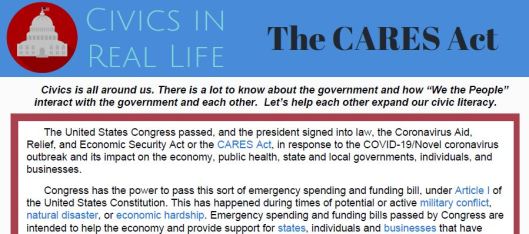
Our Civics in Real Life series continues this week with our newest one on The Cares Act. This resource is intended to inform students about Congressional spending power while also asking them to think about how the exercise of this power during a crisis impacts their life today.
Upcoming resources will include States Rights and Responsibilities, Symbolism, and Non-Governmental Organizations, among others. The second one this week will post on Thursday.
Since the beginning of the coronavirus outbreak, legislative bodies around the world have struggled to function. Meanwhile, from Europe, all the way to Australia and Pakistan, calls to ensure that national legislatures continue to operate abound. In the UK, over 100 MPs signed an open letter asking for the creation of a digital parliament to “maintain democratic traditions in accordance with social distancing.” In the US, amidst media concerns of a “sidelined” Congress, dozens of House Democrats sent a letter to their leadership calling for a change in the rules to enable remote voting.
The disruption in legislative work caused by the pandemic has visibly impacted crisis response efforts. For instance, in Canada, the House of Commons delayed for weeks the vote on a critical wage bill, aimed at covering a percentage of employees’ wages so that employers can keep them on the payroll. The key point of contention? Liberals wanted to vote via virtual parliament, while Conservatives asked for in-person participation.
The functioning of parliaments becomes all the more important as fears of executive overreach are revealed to be founded). Indeed, previous evidence suggests that a pandemic crisis is fertile ground for authoritarian drifts; and chronic abuses are unlikely to stop as the outbreak expands and a growing number of parliaments are unable to work.
Freedom of information for example – particularly relevant during such crises – is under assault. The Global Right to Information Rating shows that since the beginning of the coronavirus outbreak, countries on multiple continents have altered or lifted their “right to know” legislation. At the same time, a growing number of governments restrict journalistic coverage of the outbreak through threats and detentions.
In a context where traditional forms of collective action and resistance – such as social movements and protests – are constrained by physical distancing, parliaments should be the first line of defense in flattening the authoritarian curve. While innovative models of social activism are certainly emerging, they may not be sufficient to contain authoritarian drifts. To avoid rule of law giving way to rule by decree, parliaments must continue working, even if virtually.
The Brazilian Virtual House of Representatives
On March 11th, the Director General of the World Health Organization (WHO) declared the coronavirus outbreak a pandemic. Six days later, in one of the swiftest parliamentary responses, the Brazilian House of Representatives approved a normative resolution authorizing MPs to vote online and provided guidelines for the launch of a “virtual parliament”.
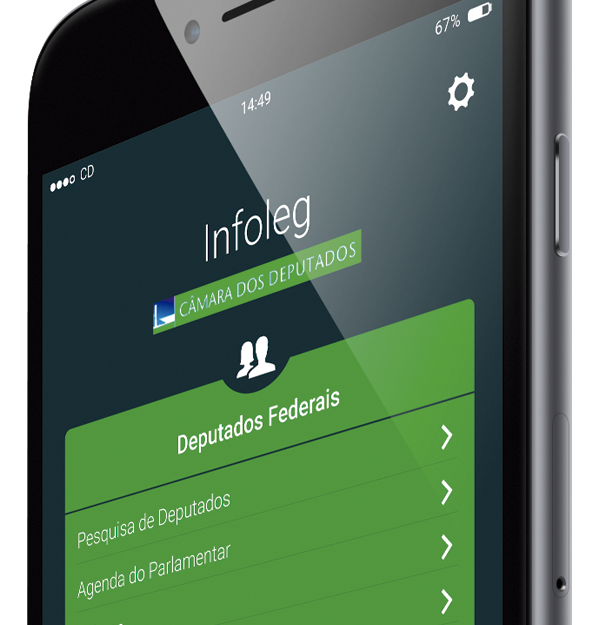
The Office of the Clerk and the House’s digital services (Department for Information Technology and Innovation, DITEC) immediately got to work on the technical solutions required by this rule change. The mobile application Infoleg, originally developed to follow up on the work of the House of Representatives, was repurposed to enable MPs’ mobile phones, following authentication protocols, to function as remote devices for registering presence and casting votes. But Infoleg is more than an e-voting app: it integrates most of the information required by an MP to properly navigate parliamentary sessions, including the list of representatives that will discuss a bill, or the pending procedural motions involved in the deliberation of a matter. While MPs use an external videoconferencing system for their interventions during sittings, the critical systems for registering presence and votes are entirely developed and managed by the House’s internal digital services.
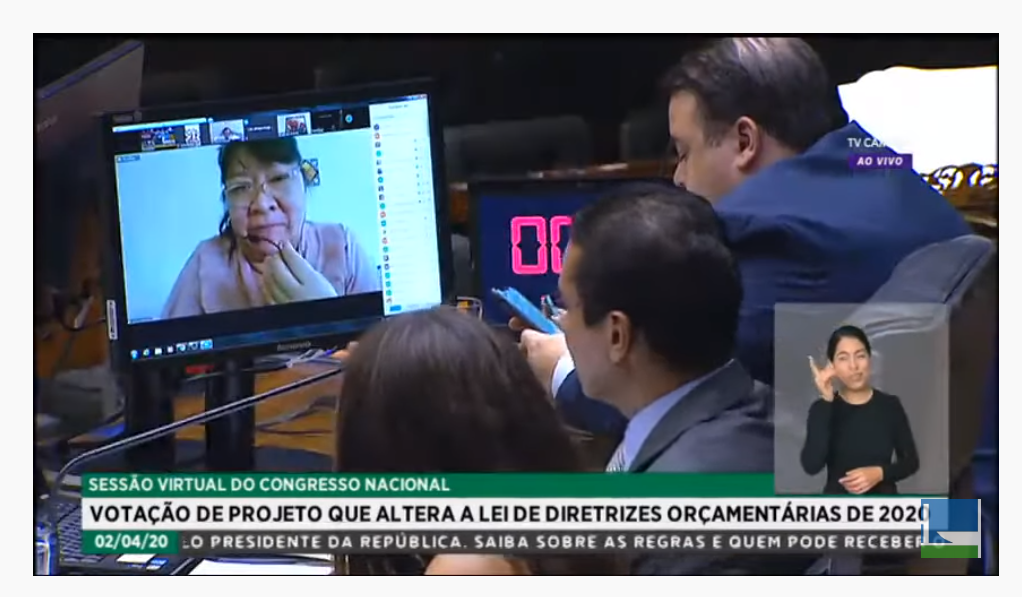
On March 25th, eight days after enacting the new Rules of Procedure, the House of Representatives conducted the first online voting in its history. By April 9th ten virtual sessions had been held, with 15 pieces of legislation, six urgency motions and one constitutional amendment passed. Average attendance for these ten virtual sessions was 98.6% (503 out of 513 representatives), far above the in-person average (87.1%). The constitutional amendment, it seems, was the first ever to be approved by a legislative body through online voting. It was also one of the fastest legislative responses to the financial challenges generated by the pandemic – especially important given the delicate fiscal situation of the country.
Explaining the rapid transition
There is no single explanation of why some parliaments are struggling to function, while others are being more reactive. Yet in the case of Brazil, three enabling factors are worth highlighting.
Political response
Strong digital capacity does not guarantee a smooth transition to a virtual modus operandi. Take for instance Estonia, which has one of the most technologically savvy governments in the world and where online voting for elections is old news: as noted by Andy Williamson, Senior Researcher for the Inter Parliamentary Union, existing regulation prohibits remote sitting of the Estonian parliament. In other words, along with digital capacity, the shift to a virtual parliament may in many cases require political leadership to eliminate analog obstacles. In the Brazilian case, this included swift action by the Speaker of the House, who expedited a normative resolution that was rapidly approved by MPs across the political spectrum. This process, however, must be understood in its broader political context. The current relationship between the national Executive and Legislative is notoriously conflictual. It is therefore possible that the rapid response was also a preemptive move by the House to avoid executive overreach and to maintain political relevance during the crisis. Parliaments in similar situations may want to take note.
Administrative capacity
The importance of the administrative capacity of the Office of the Clerk (the Office) should not be understated. Amassing some of the most qualified civil servants in Brazil, it is the Office that makes political responses technically viable – examining constraints and opportunities and advising the House leadership on the most effective approaches. It should be noted that the adoption of the virtual parliament resolution was facilitated by existing legislation. Passed in October 2019 as a result of a shared vision between the House leadership and the Office of the Clerk, this legislation includes guidelines for a paperless legislative process.
Digital capacity
Finally, a key enabler of the rapid response by the Brazilian House was the existence of a highly qualified, in-house digital team (DITEC), with the mandate and resources to quickly redesign systems that were already developed , maintained and updated internally (e.g. Infoleg, remote voting for committees). The full implementation of the virtual parliament was by no means a small task, and involved DITEC’s core teams on user experience, cybersecurity, application development, legislative informatics, voting and attendance systems, plenary operation (e.g. video streaming), help desk, and emergency response.
It is worth noting that DITEC’s response builds on a tradition of excellence. The House of Representatives has for over a decade been a trailblazer in digital democracy, illustrated for instance by the 2009 launch of e-Democracia, a collaborative platform to engage citizens and civil society organisations in the lawmaking process.
In short, digital transformation does not happen overnight, and the House’s timely response to pandemic-related challenges was in part due to in-house capacity built and honed over the years. (Full disclosure, I was an adviser to the e-Democracia program in its early days, when working on my research ondigital parliaments).
(MP connects to virtual session)
Potential effects of virtual parliaments
It is too early to assess the effects of the pandemic on democratic institutions. The same is true for the medium- and long-term effects of legislatures’ transitions to digital environments. But for the Brazilian case, we can hypothesize:
Effects on party politics
The virtualization of parliamentary procedures may lead to further strengthening of party leaders. First, given that MPs are no longer traveling to the capital, the number of in-person meetings, both formal and informal, is drastically reduced. This reinforces the coordination role of party leaders, already an important position in Brazil. Second, with sittings taking place virtually, for practical reasons the ‘floor time’ allocated to MPs is reduced, increasing the visibility of party leaders who also control the floor time allowed for their MPs.
The impact of this increased influence and visibility of party leaders is uncertain. On the one hand, in a multi-party system with 24 parties represented in the House, a strengthening of leaders’ coordination roles may facilitate the management of legislative politics and even enhance House efficiency. On the other hand, it may weaken the position of a considerable contingent of representatives who work somewhat independently, across party lines. This could be particularly problematic for newly elected MPs who benefited from the support of political renewal movements, whose allegiances to party lines are weaker. This effect could be offset, however, by the stronger online presence of these new, often younger MPs who are used to engaging remotely with their constituents.
Effects on media coverage and third party oversight
As in most countries, the media coverage of politics in Brazil is centered in the capital city, with most journalists, offices and support staff based in Brasília. A good part of that infrastructure depends on in-person and informal exchanges between journalists and their sources, through hallway conversations, over coffee, or at social events. Civil society organisations follow a similar pattern, focusing their advocacy and oversight activities where most MPs are found. With a transition to virtual operation, economies of scale in terms of geographic location and in-person interactions are lost.
A potential secondary effect is that the House becomes less subject to scrutiny from the press and organized groups. Some CSO leaders have indeed expressed such concerns over the shift. José Antonio Moroni, leader of a coalition of social movements for political reform lamented to a local media outlet: “[…] before the MPs circulated in the corridors, and we managed, to a certain extent, to have a dialogue. Now, with this process, we get nothing.” But organisations are reacting quickly, as described by a member of the Education Workers’ Confederation: “We, for instance, already have a list of all the MPs, with e-mail, WhatsApp details, and now we are incentivizing our member organizations not only to maintain their communication with MPs, but actually to intensify the online pressure.”
More digital politics (and fake news)
As the Brazilian parliament moves to an online environment and physical distancing measures continue to be implemented (with varying degrees of success), we should also expect that more political conversations will take place online. This is not necessarily good news, particularly given that somestudies suggest that Brazil is particularly fertile ground for fake news. Add to this a combination of a growing polarization between the branches of government, and the infodemic generated by the current crisis, and you have all the ingredients for accelerating the fake news arms race in the country. As we argued in a recent report, a possible consequence of this arms race is a further and unhealthy shift of the focus of public debates: towards disputes over the authenticity of statements and evidence, reducing the time and energy left to discuss possible actions and solutions to problems.
Whether these hypotheses are validated or not remains an empirical question. These effects become more probable the longer that parliament is obliged to work remotely – a function of the length of the crisis.
So what?
For national legislatures like Brazil’s, the hypothetical adverse effects of a virtual parliament are dwarfed by the possibility of undermining the structure of checks and balances. In other words, these potential effects should be weighed against the possibility of a closed parliament.
The temporary transition to an online environment should also be regarded as an opportunity to explore options for a more open parliament going forward. For example, virtual citizen panels, consisting of randomly selected citizens representing a microcosm of the population, could be convened online to advise on divisive issues including crisis response measures (after all, if parliament can function in a decentralized manner, why not consider the same for a more participatory model of politics?) Such an effort – which would, again, require a political decision by the House leadership – would put the parliament at the forefront of democratic innovations.
In this respect, from a digital democracy perspective, the Brazilian case is one more example of the prospects and limitations of technology for achieving democratic aspirations. The fact that the House adopted a virtual model is critical at this moment. Yet it does not render the legislative any more transparent, representative or participatory than before. Without reforms, digital practices will always mirror their analog origins, whether good and bad. International organizations, donors and tech enthusiasts should not therefore delude themselves: establishing virtual parliaments will do nothing for national legislatures that suffer from pre-existing conditions or that are already on life support. As some recent events attest, national parliaments themselves can be accomplices in the crossing of democratic lines during the coronavirus response.
From a more technical perspective, democracy scholars and practitioners (myself included), have long been aware of the importance of face-to-face interactions for democratic processes. The limitations of existing solutions for digital replication of these interactions was no secret. What few of us expected, however, was how fast democratic praxis would have to transition to a virtual space in order to maintain basic functioning. This applies not only to legislative procedures but also to democratic innovations such as participatory budgeting and citizens assemblies. Unless one believes this pandemic is a one-off with short-term consequences only, the current context reveals the need to invest time and resources in reducing, at least partially, the dependency of democratic processes on face-to-face interaction. If the question of how to best achieve online participation and deliberation at scale was once a niche area, this is no longer the case.
On a more futuristic note: could virtual parliaments be an additional source of resilience in the case of unilateral action by any given executive? Consider the case of Estonia’s Digital Embassies program. Based on cloud technology and off-site servers based in Luxembourg, the program aims to ensure the functioning of critical government functions regardless of Estonia’s territorial integrity. Historically, parliaments have been shut down through coercion of parliamentarians and the closure of legislatives’ physical spaces. But what happens if a parliament can work virtually, with MPs geographically dispersed within and outside their territory? Again, it is an empirical question that – one hopes – won’t need to be answered anytime soon.
Finally, and back to the Brazilian case: as previously mentioned, several countries have altered or lifted their “right to know” legislation during the crisis. The Brazilian President recently enacted a provisional measure temporarily suspending deadlines for answering certain information requests from the public. The Speaker of the House has already announced his intention to reverse the measure in parliament. While the final result is hard to anticipate, one thing is certain: the next battle for the right to information in Brazil will take place online.
We reflect on–and we argue about–the point at which human beings become persons with rights, how (if at all) gender relates to biological differences, the degree to which people are interdependent versus free, the rights of disabled persons, and the roles of mothers and other parents.
Meanwhile, we are surrounded and supported by tools and technologies that obtain data and information to guide decisions and judgments. Methods for obtaining and analyzing data have high prestige. But methods for reflecting on moral and metaphysical issues attract widespread skepticism, except among people who are deeply committed to particular moral/metaphysical views (often, religions).
In this context, we have a tool–fetal ultrasound imagining–that purports to peer into the womb and provide data about the developing organism, including its viability and its genitalia, as well as the prospective mother’s health. People may suspect that this scientific tool will shed light on personhood, sex, disability, and motherhood, not to mention such specifically contested questions as abortion and gender attribution.
The tool is used in specific, culturally resonant ways. Often prospective parents go into the medical facility together. The prospective mother is prepared and treated as a patient–in a blue gown, and so on. The room where the procedure is conducted is private, separated by a closed door from the waiting room. A large, precise, moving image appears on a screen. The parent or parents are asked whether they want to know whether the child is/will be a boy or a girl, which determines whether they are shown the genital area. At least some pregnant women report that the image compels everyone’s attention to the fetus and negates the woman, since she is literally made invisible (Barad 1998). Prospective parents of “normal” or “healthy” children are congratulated and offered good wishes. They can take still photos or even videos home with them.
If we ask “What is a fetal ultrasound session?” (as Clifford Geertz asked, “What is a Balinese cockfight?“) we might consider several answers:
“A fetal ultrasound (sonogram) is an imaging technique that uses sound waves to produce images of a fetus in the uterus. Fetal ultrasound images can help your health care provider evaluate your baby’s growth and development and monitor your pregnancy. In some cases, fetal ultrasound is used to evaluate possible problems or help confirm a diagnosis” (The Mayo Clinic). Note: “your baby” as a description of the object. Not “the baby,” not “the fetus,” not “you.”
An apparatus that uses a piezoelectric transducer, a crystal that both receives and produces ultrasound waves in complex interactions with the mother, the fetus, the computer, the video screen, and the viewers (Barad 1998).
A “bonding scan” also known as a “recreational” or keepsake” ultrasound, meant to produce pictures or videos to save and share with friends and family or even with the child later on (per LiveScience.com, which does not endorse such uses).
An application of SONAR technology, invented to detect and destroy enemy submarines (Barad 1998)
One of the events to expect when you are expecting. A moment to anticipate, celebrate, and share.
A ritual that encourages prospective parent(s) to: 1. bond as couples and begin bonding with their child, with whom they will form a nuclear family, 2. bring the fetus to term because is already moving and kicking, 3. avoid behaviors, such as alcohol consumption, that might harm the fetus, 4. encourage them to begin to begin thinking and talking about it as a “boy” or a “girl,” who will have an appropriate name, pronouns, etc., 5. allow them to announce the pregnancy to a larger audience, thus enhancing their social capital, 6. reinforce the authority of credentialed medical professionals in white coats, and 7. produce revenue for the clinic.
Karen Barad wrote a brilliant 1998 article* that explored much of this terrain. I would respectfully dissent from part of her analysis, only because I am trying to work out a view that better fits my sense of the problematic power of science.
Inter alia, Barad raises epistemological doubts about the image that we see on the screen. We are not “peer[ing] innocently at the fetus,” but using an elaborate apparatus that produces an image as a result of complex interactions that can be changed by altering the apparatus. It is a mistake to think that the referent, when we talk about this image, is “the fetus.” The referent is a “phenomenon that is constituted by the inter-action of the apparatus and the object.” Barad cites Niels Bohr’s epistemology in opposition to the older, “Newtonian framework” in which observation was the “benign facilitator of discovery, a transparent and undistorting lens passively gazing at the world.”
I completely agree that looking inside the torso of a pregnant woman is not innocent or automatically benign. Whether to do it, how to design the procedure and the larger event, and what conclusions to draw are moral and political choices that should be critically assessed. Fetal ultrasound could be banned, discouraged, publicly funded, or required. The image could be seen only by a professional who would give written results to the pregnant woman alone. Or it could be done only by the pregnant woman, who would decide whether to share any information with anyone, including a physician. It could be re-designed so that the woman was depicted in the image along with the fetus, or in many other ways.
A fetal ultrasound event is a social phenomenon that reflects and reproduces power. There is a risk that it will block critical deliberation about issues like abortion and gender by claiming to present natural facts just as they are. To quote Bruno Latour, science can “render ordinary political life impotent through the threat of an incontestable nature” (Latour, 2004, p. 10).
Yet I do believe that we are looking at the fetus. In fact, it is precisely because the technology allows us to actually peer into the woman’s body that it is invasive.
When you see a car coming down the road, you may not actually look at the object that matters. Your brain interprets a reflection on the back of your retina, which may reflect the image on a convex mirror, which distorts reality by showing objects smaller than they would appear if seen directly. But you’d better not pull out into the road if there’s a car coming. The mirror is an excellent device for looking around corners, which is why we use it.
We are in a world of tools that we use effectively for a variety of reasons. In the Philosophical Investigations, Wittgenstein encourages us to see representations as tools that we can use for many purposes. A blueprint can provide instructions to a builder or ideas for a heist, or it can decorate a wall. There is nothing tricky about its metaphysical status. A picture does nothing mysterious inside us that needs analysis (Philosophical Investigations, 188). Whether the visual experience of an image is authentic is not an interesting question (190). The question is what uses we make of an object, including using it to represent a different object. For instance, to see a painting as a portrait of someone is to use it in a certain way. “Now when I say, ‘We consider a portrait to be human’ – when and for how long do we do this? Whenever we see it at all (and don’t see it as something else)” (199).
Likewise, when we are presented with a moving image from inside a pregnant woman, we can see it as a person, or as a boy, or as a fetus, or as a medical problem. Science has no legitimate right to tell us which way to see it. However, the ritual of a fetal sonogram event–conducted by people in white coats with scientific degrees–probably does determine how we will see it. The ultrasound technology really works; the question is whether and how we should use it.
Sources: Karen Barad, “Getting Real: Technoscientific Practices and the Materialization of Reality,” Differences: A Journal of Feminist Cultural Studies 10, no. 2 (1998): 87-91; Bruno Latour, Politics of Nature: How to Bring the Sciences into Democracy, trans. Catherine Porter (Cambridge, MA: Harvard, 2004); Wittgenstein, Philosophical Investigations, German text (1953), my translations.
Good news, friends in Civics! Happy to bring you some more video civics resources. For the pastfewweeks, we shared with you a collection of video lessons for learning civics from home, put together by the excellent folks in Palm Beach using some resources from Civics360. Five additional videos are now available. Each video runs about ten minutes long, give or take a couple of minutes. I’ve included a link back to Civics360 under each video. These resources cover the impact of the 13th, 14th, 15th, 19th, 24th, and 26th Amendments, Significant Supreme Court Cases, Political Parties, and Evaluating Candidates.
Thank you, Lori Dool, for giving us a chance to support teachers!
Impact of the 13th, 14th, 15th, 19th, 24th, and 26th Amendments
Be sure to check out earlier videos in this resource collection! I’ve compiled them below.
Week 1 (Forms of Government, Systems of Government, International Organizations, International Conflicts) Week 2 (Enlightenment Ideas, Impact of Historical Documents, Pursuit of Independence, Articles of Confederation) Week 3 (The Preamble, Constitutional Limits, Federalists and Anti-Federalists, Rule of Law, Sources and Types of Law) Week 4 (Citizenship, Citizen Responsibilities and Obligations, Bill of Rights and Other Amendments, Constitutional Safeguards and Limitations, Constitutional Rights)
Last week’s webinar, Social Distancing Meets Public Engagement, was our largest to date, with over 325 participants! This webinar, co-hosted with our partners at the National Civic League, featured Wendy Willis, Executive Director of the Deliberative Democracy Consortium, and Larry Schooler, Director of Consensus Building and Community Engagement, CD&P. Wendy and Larry showcased strategies for virtual public engagement in this time of social isolation.
This webinar included information about leveraging government access television to enhance the efforts of local government to connect with their residents and stakeholders. Presenters also talked about differences in various forms of online engagement and when it might make sense to use them, as well as tips for turning your in-person meetings into virtual ones.
This webinar is full of resources! Check out the recording of this session at this link. The PowerPoint slides, which contain loads of information, can be viewed separately here.
Additionally, a whole host of resources and guidance were shared by presenters and participants alike in the chat.
Thanks to our presenters, Wendy and Larry, the National Civic League for hosting with us, and everyone who participated!
If you have benefitted from events like this one, please consider making a contribution to help support the National Coalition for Dialogue & Deliberation: www.ncdd.org/donate. NCDD is a small nonprofit and we have expanded our programming to be responsive to our community during the pandemic. Any and all contributions are greatly appreciated and go directly to helping support our staff.
We’re launching a new minor within the Civic Studies program. It complements the Civic Studies Major and the existing minor, which is called Peace & Justice Studies. I anticipate that these two minors will draw students with different interests, thereby promoting intellectual diversity and debate. We’re thinking about adding even more minors over time. One prospect is a minor in Interfaith Civic Studies, or something along those lines.
The Entrepreneurship for Social Impact minor requires six courses, including Intro to Civic Studies (which I regularly reach) and the Innovative Social Enterprise course offered through the Tufts Entrepreneurship Center. The remaining four courses include two from the approved Civic Studies list and two from the approved Entrepreneurship course list.
Join the National Coalition for Dialogue & Deliberation (NCDD) and NCDD Sponsoring Member Susan Stuart Clark of Common Knowledge for this free event Friday, April 24, from 2-3:15 PM Eastern/11-12:15 PM Pacific. In honor of Arbor Day, this is an invitation to explore how we cultivate our personal and community capacity for deeper wisdom and healthy interconnectedness. Don’t miss this opportunity – register today!
This event is the start of a series of activities and collection of resources at sense-us.org, a new pro bono project for Common Knowledge and allies in the arts, healing and community transformation. Participants will learn more about the four practices identified by cross-cultural pioneer Angeles Arrien, which we can use to help deepen our individual and collective capacity for discovering the deeper wisdom in and between us. The four practices and their importance to us and our work designing and facilitate community engagement during and after this pandemic are outlined in this wonderful piece by Susan Stuart Clark.
The April 24 Zoom session will include different ways of centering ourselves and an overview of the four practices as a stepping off point for group reflection. Participants will have the opportunity to connect more deeply with one another, sharing how the practices resonate for you personally, as well as how they relate to your work in and with communities.
Drawn from ancient and indigenous wisdom, these practices invite us to bring our whole selves – heart, body and mind – to our work as cultivators of community, dialogue stewards and/or peace builders. During this time of physical isolation, let’s embrace the ways we can bring closeness to one another through sharing our truest selves with each other. Let’s see how we can expand our capacity to understand the patterns and structures that brought us to this current moment and choose more inclusive and collaborative ways to co-create our future.
Join us for this opportunity to explore how these practices can transform our work. Register today to reserve your spot!
About Common Knowledge
Common Knowledge specializes in bringing new combinations of people together to listen to and learn from each other. Leading together. We facilitate powerful new connections across sectors, silos, and social divides that generate breakthrough civic participation, employee and community engagement programs. Learn more at www.ckgroup.org.
About Susan Stuart Clark
Susan Stuart Clark is Founder and Executive Director of Common Knowledge. Susan formed Common Knowledge to pioneer “community-driven design”, demonstrating how inclusion of diverse stakeholders stimulates innovative solutions on issues such as housing, health care, the environment, education outcomes, voting and financial literacy. Susan has over two decades of experience designing culturally responsive communications and engagement programs and presents frequently about increasing participation of lesser-heard voices, multi-sector collaboration and how investments in social cohesion enhance a community’s overall well-being.
About NCDD
The National Coalition for Dialogue & Deliberation (NCDD) is a network of innovators who bring people together across divides to discuss, decide, and take action together effectively on today’s toughest issues. NCDD provides opportunities for members of the broadly-defined dialogue and deliberation (“D&D”) community to share knowledge, inspire one another, build collaborative relationships, and have a greater collective impact. Learn more at www.ncdd.org.