Update on LFI/FJCC Staff Transitions

Without a doubt, it is the people that make an organization what it is. And we here at the Florida Joint Center for Citizenship at the Lou Frey Institute would not be what we are today without the hard work of the staff here. It is with that note that we wish our wonderful Professional Development director and all around fantastic civics educator, Peggy Renihan, the best of luck as she transitions to a new position in Bay County.

peggy_headshot
Peggy has worked at the Lou Frey Institute for more than a decade. In many ways, she IS the face of the Institute and FJCC in certain parts of the state. Her approach to both relationship building and working with teachers and districts, especially but not exclusively in the northern part of Florida, is one that will not be duplicated.

We wish we could keep her, and we envy Bay County for getting someone with such incredible talents and expertise. Peggy, thank you so much for all that you have done, for civics, for the Center and the Institute, and for your family here. You are appreciated beyond words, and our community will not be the same without you.


the significance of the progressive primary victories

Representative Eliot L. Engel, chairman of the House Foreign Affairs Committee, appears to have lost a primary to Jamaal Bowman, a middle school principal:

This is part of a significant trend: relatively conservative incumbent Democrats in relatively safe Democratic states and districts are falling to more progressive newcomers, such as Alexandria Ocasio-Cortez (N.Y.-14), Ayanna Pressley (Mass.-07), and Marie Newman (IL-3). These insurgents are more diverse and younger than the incumbents. To be sure, a majority of progressive primary challengers have lost, but the net shift is toward a larger bloc within the Democratic caucus.

We should now see assertive progressive caucuses grow in the US House and in many city councils and state legislatures–mirror-images of the House Freedom Caucus on the right. They should and will help to maintain and expand Democratic Party control of as many legislative chambers as possible, while acting as the sharp, leading edge of Democratic majorities. (Jamelle Bouie made this argument in the New York Times.)

The country is becoming more diverse, and people of color tilt heavily toward the Democratic Party. As a result, the Democrats are about to cease being a white-majority party, although many of their national leaders still are white, especially in the Senate.

In 2016, half of the voting delegates at the Democratic National Convention were people of color. These delegates were not appointed as a gesture to symbolic representation or diversity. They were elected by their own power bases. When a party that elects these delegates wins national elections, white dominance is at risk. That is potentially a shift of global significance, bookending 1492 and 1619.

But the party’s leadership must represent its own electorate better. A 58% white Democratic House caucus is a bit too white for a 54% white party, and the party is getting more diverse. The main opportunities to diversify the caucus are districts with Black or Latino majorities. (The Senate represents a bigger problem.)

If you’re not as far as left some of the progressive insurgents, I still think you should welcome their voices in government. The national deliberation is enriched by their ideas, experiences, and agendas. A legislature that excludes such perspectives lacks legitimacy.

What if you were a Bernie voter in 2020? Do a few primary victories offer a disappointing consolation prize? I think not. Electing progressive Democrats in left-leaning districts was always a more promising strategy.

I’ll acknowledge that if you are a democratic socialist, you should have voted for Bernie Sanders in the Democratic primary. He is, after all, a socialist. I didn’t vote for him because my political philosophy–for whatever that’s worth–does not fully align with his. At the same time, if you are a democratic socialist, you would have fundamental reasons not to expect the Sanders campaign to carry your agenda forward. You should be primarily interested in the path that AOC, Jamaal Bowman, and others represent.

Although socialist thought is vast and varied and mostly beyond my personal knowledge, I have never heard of a socialist theorist or strategist who believed that capitalists would back down in response to an individual politician who won a majority vote in a national election. Just because actual socialism would cost the ruling class trillions of dollars, they would be expected to resist it with all their power. That is why socialist strategists have often emphasized strong unions linked to a broad-based left party with internal democracy and ideological discipline (a hard pair of principles to combine), plus a left version of the mass media. Once you build that combination, you have a chance at a more-than-symbolic political campaign.

Michael Walzer writes:

Socialist politicians usually emerge from powerful social movements like the old labor movement or from political parties like the Labour Party in the United Kingdom or the Social Democrats in Germany. Sanders does not come out of, nor has he done anything to build, a significant social movement. That wouldn’t be an easy task in the United States today; in any case, it hasn’t been his task. He has, moreover, never been a member of a political party—not even of the Democratic Party whose nomination he is now seeking. He has never attempted to create a democratic socialist caucus within the party. For all the enthusiasm he has generated, he has no organized, cohesive social or political force behind his candidacy. If he were elected, it is hard to see how he could enact any part of his announced program.

One response is that Sanders is not a socialist in a significant sense, and therefore socialist theory would accept that he could have won the election. He just needed to play his cards a bit differently and receive more help from people like me (and millions of others) who resisted him.

As I once noted, Sanders’ platform is less radical than Harry Truman’s was in 1948. In that sense, Sanders stands in the mainstream of the 20th century Democratic Party. Richard Wright puts Bernie Sanders in the tradition of Victorian moralizing socialists, like William Dean Howells (who voted Republican) or Frances Willard. This is a highly mainstream American tradition, and Bernie’s only difference is the “socialist” brand. To explain socialism, Sanders sometimes cites Denmark, which the Heritage Foundation ranks very high on measures of business freedom, investment freedom, and property rights. I like Denmark’s social contract but would describe it as liberal.

Sanders has never passed any socialist legislation but is part of Chuck Schumer’s leadership team in the Senate. In the 115th Congress, Sanders and, e.g, Senator Jeff Merkley (D-OR) agreed on 90% of their votes–all their rare divergences relating to Trump’s executive branch appointments, plus H.R. 2430, “a bill to amend the Federal Food, Drug, and Cosmetic Act,” and H.R. 3364; “A bill to … counter aggression by the Governments of Iran, the Russian Federation, and North Korea.” You could argue that if Sanders is a socialist, so is Merkley and most of the Democratic caucus.

Although Sanders made major economic proposals, they had little chance of passage, which made him sort of a notional or symbolic socialist. Yes, if Bernie had won in a landslide–carried to the White House by a wave of grassroots enthusiasm and activism for the substance of his agenda–he could have passed his bills. But the primary campaign showed no evidence of a dramatically new electorate. A capable Democratic administration pressured skillfully from a growing leftwing caucus can do much more.

See also three views of the Democratic Party when democracy is at risk; Bernie Sanders runs on the 1948 Democratic Party Platform; and democracy is coming to the USA

Civic Saturday Fellowship Deadline Extended Until July 3rd

Citizen University announced they are extending the deadline for their Civic Saturday Fellowship application for one more week until Friday, July 3rd.

“The Civic Saturday Fellowship prepares motivated, local leaders (or, as we like to say, civic catalysts!) to start their own Civic Saturday gatherings in their home communities. In this nine-month fellowship, civic catalysts will attend the Civic Seminary, a three-day training in Seattle with Citizen University staff, and return home ready to create lasting impact in the civic life of their communities.” You can read more in the announcement below and find the original information on the CU site here.


Civic Saturday Fellowship Program

All around the country, we are facing a crisis in civic life – people are becoming more socially isolated, disconnected from a sense of common purpose, and cynical about their own ability to affect change. Enter Civic Saturday: a gathering that brings communities together to cultivate a sense of shared civic purpose and moral clarity. At Civic Saturday share a meaningful communal experience, and leave inspired to become more powerful, responsible citizens.

The Civic Saturday Fellowship prepares motivated, local leaders (or, as we like to say, civic catalysts!) to start their own Civic Saturday gatherings in their home communities. In this nine-month fellowship, civic catalysts will attend the Civic Seminary, a three-day training in Seattle with Citizen University staff, and return home ready to create lasting impact in the civic life of their communities.

Applications Open Now!

Applications are now open for the Civic Saturday Fellowship Fall sessions! The Fellowship begins with the Civic Seminary, a three-day training, then continues as you organize your own Civic Saturday gatherings in the following months. Apply now for Fall sessions: September 15-18 or October 20-23, 2020.

2020 Fellowship Informational Packet
Application Submission Form

Deadline extended!

Priority Deadline: June 19, 2020
Regular Deadline: June 26, 2020 – extended to July 3, 2020

Informational Webinar

Watch the pre-recorded Informational Webinar from June 3, 2020.

You can find the original version of this announcement on Citizen University’s site at www.citizenuniversity.us/civicsaturdayfellowship/.

more data on police interactions by race

We reported on June 17:

Sixty-eight percent of African Americans say they know someone who has been unfairly stopped, searched, questioned, physically threatened or abused by the police, and 43 percent say they personally have had this experience—with 22 percent saying the mistreatment occurred within the past year alone, according to survey results from Tufts University’s Research Group on Equity in Health, Wealth and Civic Engagement.

According to the KFF Health Tracking Poll for June, 2020, about 30% of Black adults say they have “experienced unfair treatment in interactions with police” within the past year. Forty-one percent of Black adults “say they have been stopped or detained by police because of their racial or ethnic background,” and “about one in five Black adults (21%)–including 30% of Black men–say they have been a victim of police violence due to their racial background.”

According to the Bureau of Justice Statistics’ most recent (2015) Police-Public Contact Survey, 19.8% of African Americans age 16+ had some contact with the police in the past year. This number is the total of several specific types of contact that are asked in the survey, such as riding in a car that was stopped by the police or reporting a crime, among others. The total rate of contact was down by six percentage points compared to 2011.

In the BJS survey, whites were three percentage points more likely than African Americans to report any contact with the police but were also more likely to initiate the contact. Of those who reported that they had been stopped on the street by police, two thirds of whites (67.8%) but only half of Blacks (50.1%) said that the reason for the stop was legitimate.

Of Blacks who said that they had contacted the police, 90.7% said the police behaved properly and 83.6% said they were satisfied by the outcome–very similar rates to whites. The survey implies that 2.7 million African Americans initiated contact with the police in 2015, of whom about 2.3 million were satisfied. This is a fact with some political significance in discussions of defunding the police. At the same time, 3.3% of Blacks and 1.3% of whites reported that the police had used force against them in 2015.

A significant limitation involves the samples of all these surveys. Our survey excludes people in prisons or jails. So does the BJS survey, which also excludes “homeless persons.” I am not sure about the sample of the KFF survey, but it is conducted predominantly by random-digit dialing, which would miss institutionalized people and homeless people. Rates of discriminatory contact would likely be higher if institutionalized and homeless people were included.

The statistics from these three surveys are not strictly comparable. The populations, samples, dates, and questions vary. Still, careful comparisons are interesting. BJS finds that 19.8% of Blacks reported any contact with the police in 2015, and many of those contacts were perceived as legitimate. We find that 22% of Blacks experienced discriminatory treatment by the police in 2020. There could certainly be measurement errors or biases in either survey. Or the rate of discriminatory treatment could have risen in 2020 as a result of mass protests. I would also suspect that some forms of discriminatory treatment do not occur during events that people identify as “contacts.” If a police officer yells at you while driving by but doesn’t stop, that could be an act of discrimination but not a contact.

See also: Two-thirds of African Americans know someone mistreated by police, and 22% report mistreatment in past year; on the phrase: Abolish the police!; insights on police reform from Elinor Ostrom and social choice theory; and science, law, and microagressions.

Two-thirds of African Americans know someone mistreated by police, and 22% report mistreatment in past year

Survey by Tufts University researchers also finds 42% of Latinos and 27% of Whites know victims of police mistreatment

MEDFORD/SOMERVILLE, Mass. (June 17, 2020)—Sixty-eight percent of African Americans say they know someone who has been unfairly stopped, searched, questioned, physically threatened or abused by the police, and 43 percent say they personally have had this experience—with 22 percent saying the mistreatment occurred within the past year alone, according to survey results from Tufts University’s Research Group on Equity in Health, Wealth and Civic Engagement.

Forty-two percent of Latinos and 27 percent of Whites also say they know someone who was unfairly stopped by police, with 23 percent of Latinos and 13 percent of Whites reporting that they personally have had these experiences.

The nationally representative survey of adults, conducted between May 29 and June 10, also looked at other forms of discrimination, and found that, in all types except one, higher percentages of African Americans report being subjected to discrimination than other groups. The survey was designed and analyzed by Tufts University’s Research Group on Equity in Health, Wealth and Civic Engagement.

“Some people might think that day-to-day discrimination happens primarily during routine interactions, such as shopping. But one of the eye-opening results of our survey is that Black people are about as likely to report being stopped unfairly by police as they are to encounter discrimination in a store or in other interactions,” said Deborah J. Schildkraut, professor and chair of Political Science in Tufts’ School of Arts and Sciences.

Although African Americans are 3.3 times more likely than Whites to report that they personally have been unfairly stopped by police, 34% of all Americans say that someone they know has been unfairly treated by the police, and 18% have had such experiences themselves. “Across all races and ethnicities, many people may either feel a personal stake in reforming the police or they may be primed to believe accusations that the police are racially biased because of their own experiences, or both,” said Peter Levine, associate dean for research in Tufts’ Tisch College of Civic Life.

Other forms of discrimination are also pervasive

The survey shows that a higher percentage of African Americans report being subjected to other forms of discrimination than other groups do. For example, 28 percent of African Americans sometimes or frequently feel that other people are afraid of them. By contrast, nine percent of Latinos and six percent of Whites also have that sense.

The only form of discrimination for which African Americans are not the highest percentage involves being mistaken for someone of the same race despite having dissimilar appearances. This experience is most common for Asian-Americans in this survey, although the sample size for Asian-Americans is small.

*Includes Hispanics, African Americans, Asian Americans, Native Americans, Pacific Islanders, and people reporting more than two races/ethnicities. The sample size does not permit reliable estimates for Asian Americans or Native Americans separately. The discrimination survey items were adapted from those developed by Williams, D. R., Yan Yu, Jackson, J. S., & Anderson, N. B. (1997). Racial Differences in Physical and Mental Health: Socio-economic Status, Stress and Discrimination. Journal of Health Psychology, 2(3), 335–351. The table and figure show the proportions of people who have ever been treated unfairly by the police, denied a service unfairly, or known someone who has faced police discrimination, and the proportions who “sometimes” or “frequently” report the other forms of discrimination. (The response options for these questions were different.)

Most people of all races and ethnicities (76 percent of the whole sample) report experiencing at least one of the forms of discrimination in the survey. However, the proportions of people who say they have never experienced any of these forms of experience varies from 11 percent of African Americans to 27 percent of Whites.

Personal experiences

In addition to answering the survey’s questions, respondents could type comments about their personal experiences with discrimination, and some described pervasive negative experiences based on feelings of racial isolation. For example, a Latina woman wrote, “It’s hard and a bit humiliating when you try to be in a town of only white people.” 

Several African American respondents offered stories of discrimination by the police. One man wrote, “[I was] walking home and got [stopped] by the police for no reason. He said ‘hey boy where are (you) going and start laughing. pull up your shirt’.  … one said this is how you plant drugs on someone” [sic].

An African American woman wrote, “I’ve been [asked] to leave a public parking lot, at an apartment complex by the police, my boyfriend resided there.” And another Black woman wrote, “I had a cop grab me by my bra for no reason other than I was doing what was asked of me.”

Forty-four percent of the people who say they have been treated unfairly by police are White.  One white man, for example, described this personal experience: “Pulled over by a police officer. He asked me to get out of the car, I did. Then he slammed me on the hood of his cruiser.” Another white man offered a more general observation: “The police almost everywhere think that they are better and more privileged than others. They think that the law does not apply to them and they act with utter impunity.”

A smaller number of respondents also provided positive comments about the police, and two respondents who are police officers said they had faced discrimination because of their law enforcement affiliations.

Tufts University’s Research Group on Equity in Health, Wealth and Civic Engagement was established in 2019 as part of a strategic effort to use resources and expertise across the university to address major global issues. It brings together researchers from across the university to discuss and investigate aspects of equity and inequity in the United States and the world. The research has been funded by Tufts University’s Office of the Vice Provost for Research as one of several such initiatives.

The group’s principal investigators are Jennifer Allen, professor of Community Health in the Tufts School of Arts and Sciences;  Peter Levine, associate dean for academic affairs and Lincoln Filene Professor of Citizenship & Public Affairs at the Tisch College of Civic Life at Tufts; and Thomas Stopka, associate professor of Public Health and Community Medicine at Tufts University School of Medicine. Other members of the group can be found here.

By September 2020, the Research Group will launch a website at https://equityresearch.tufts.edu that will allow anyone to explore numerous dimensions of equity and inequity with an interactive data-visualization tool. Tufts’ Jonathan M. Tisch College of Civic Life is funding the data-visualization tool.

The survey was fielded online by Ipsos using its KnowledgePanel. The sample was nationally representative, and the number of complete responses was 1,267. More technical information about the survey is at https://equityresearch.tufts.edu/the-survey/.

###

About Tufts University

Tufts University, located on campuses in Boston, Medford/Somerville and Grafton, Massachusetts, and in Talloires, France, is recognized among the premier research universities in the United States. Tufts enjoys a global reputation for academic excellence and for the preparation of students as leaders in a wide range of professions. A growing number of innovative teaching and research initiatives span all Tufts campuses, and collaboration among the faculty and students in the undergraduate, graduate and professional programs across the university’s schools is widely encouraged.

Navigating the Pandemic: Inclusiveness, Addressing Bias, and Bridging Differences

This is the video from today’s session of a series for the Tufts Community (but open to the public.) The guests were Eboo Patel from Interfaith Youth Corps, Prof. Keith Maddox (Director of the Tufts University Social Cognition Lab, Prof. Sam Sommers (Director of the Tufts University Diversity and Intergroup Relations Lab) and Jessica Somogie with a meditation exercise. Deborah Donahue-Keegan and I moderated.

Announcing THREE New, Free, Online Social Studies PD Courses from FJCC/LFI, in partnership with Bay District Schools and support from NARA’s Center for Legislative Archives!

Good evening, friends. You are likely aware of our recent re-launch of the first three courses in our The Civics Classroom series.

TCC EMBED

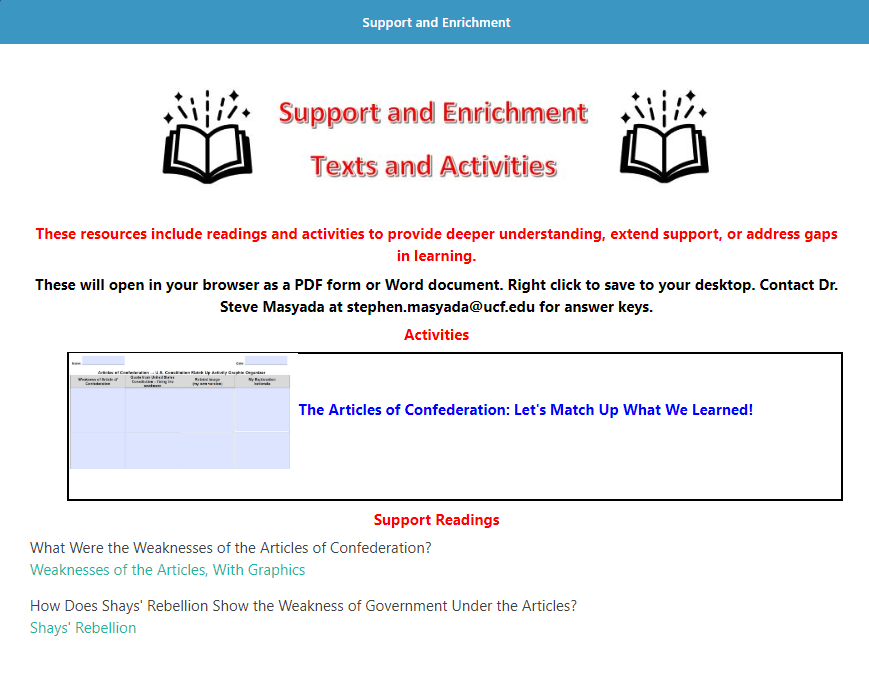
Well, we just couldn’t wait until July 1st, so are excited to announce that A Constitutional Classroom is now open! This fourth course in the series, developed in collaboration with our partners at Bay District Schools, explores the underlying ideas of the US Constitution and is ‘hosted’ by Dr. Charles Flanagan of the National Archives’ Center for Legislative Archives!

constitutional-classroom

A Constitutional Classroom will provide teachers with an understanding of:

  • Major ideas in the U.S. Constitution,
  • How to apply disciplinary literacy skills, and
  • Preparing for instruction to make content accessible for all learners.

You can get info to register for the new course, and download the syllabus, over at Florida Citizen!

As the salesman on TV once said, but wait, that’s not all!

high-school-us-history-classroom

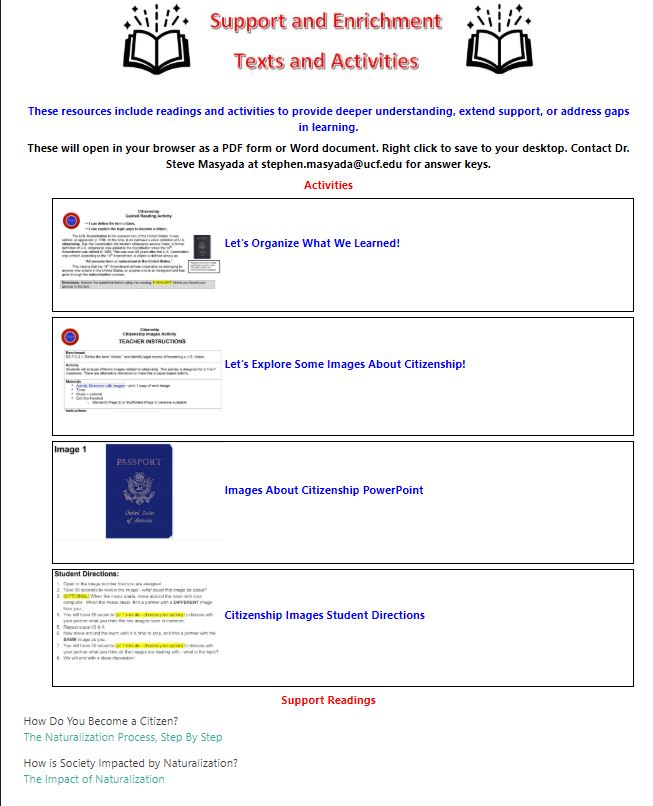
We have also completed and are now launching the first course in what we hope will be a strong and long series for high school US history! The High School US History: The Civil War and Reconstruction Era is, like A Constitutional Classroom, hosted by our friend Dr. Charles Flanagan from the National Archives’ Center for Legislative Archives and was developed in collaboration with our partners at Bay District Schools. 

The High School US History: Civil War and Reconstruction course will provide teachers with pedagogy, content, and resources for:

  • the major ideas of the cause, course, and consequences of the Civil War and Reconstruction Era
  • primary sources and disciplinary literacy
  • strategies and structures for accessible learning

You can get info to register for the new course and download the syllabus at the course page on Florida Citizen.

But what about you folks in high school US Government? We have a new course for you as well!
high-school-government-classroom

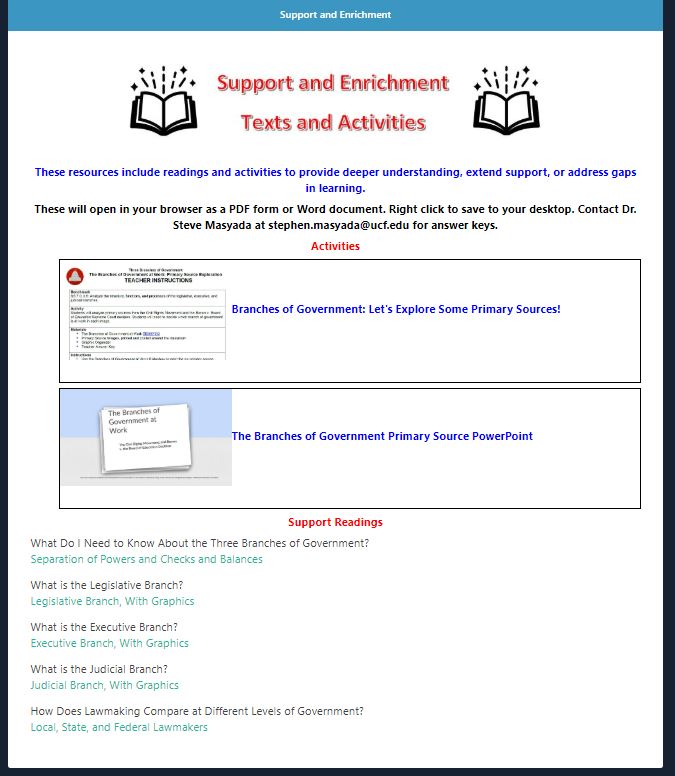
The High School Government Classroom: Building Critical Knowledge course will provide teachers with pedagogy, content, and resources for:

  • lesson planning and preparation in social studies
  • the principles of American democracy
  • the US Constitution
  • Founding Documents
  • Landmark Cases

For Florida teachers, this course is intended to help you prepare students for the new Civic Literacy Assessment. However, it also provides a basic foundation in US government content, pedagogy, and resources and aligns with the newHigh School US Government modules on Civics360! (And there will be a post on the launch of that new resource later!). 

You can get info to register for the course and download the syllabus over at, you guessed it, Florida Citizen.

We hope that you find these new courses beneficial!

Questions? Email Steve!

the political economy of policing

Here is a general theory, drawn from the “Bloomington School” of political economy:

  1. Public safety is a good. Providing this good is at least somewhat costly: people must keep an eye on each other, refrain from violence, teach their children to be respectful of others, maybe punish or at least shun violators. The benefit is shared: everyone gains from the prosperity and peace that result from public safety. But the benefit is fragile: when any individual violates these norms, public safety can be undermined for all.
  2. Costly, fragile, shared goods are difficult to provide. One way to provide such a good is to make and enforce a rule that everyone must pay to provide it, and then use the funds to hire some people to do the work. If public education is a public good, then we can require everyone to pay taxes and use that money to hire professional teachers, and perhaps require every child to attend public schools. If public safety is a public good, then we can collect mandatory taxes to pay for police.
  3. One advantage of a mandate is that it solves the collective-action problem of providing the common good. Another advantage is that it puts the service-provider under the control of a government, which can be an equitable and liberal democracy. A third advantage is that the same rules that create the service can also regulate it in the interest of justice. For example, when establishing public schools, we can require that they serve all children.
  4. One disadvantage of this method is that the service-providers will likely reflect the biases and downright evils of the society. In a racist society, the schools, police, public health systems, and other public services will likely be racist. In a colony, they will probably be imperialist. In a communist state, they will probably be predatory. This means that although policing is not inherently racist in all countries and times, the police will be structurally racist in any racist society. (The generic problem is untrustworthiness.)
  5. Another disadvantage is that the service-providers, although meant to be agents of the community, may develop their own interests. They may lobby, threaten to strike, vote as a bloc, form close relationships with elected leaders, and so on. Then their actual impact will deviate from their assigned mission.
  6. Considering that the basic task of policing is coercion, the generic disadvantages of mandates will likely take the form of harmful coercion in the case of police. Harmful coercion is violence. In contrast, mandatory education or public health systems are more likely to demonstrate bias in how they distribute resources and define goods. Hospitals, for example, are “violent” (if at all) in a looser or more metaphorical sense than police with guns.
  7. One kind of solution to the problems listed in #4-6 is reform: change rules, oversight mechanisms, organizational flowcharts, or budgets to reduce bias and self-interest.
  8. Another kind of solution is to develop a thorough alternative to the mandatory approach described in #2. Mandates are not the only way to provide public goods. People can provide goods voluntarily under favorable circumstances.
  9. One kind of alternative to a mandate is a market. Individuals can purchase their own goods, possibly with a subsidy from the state to equalize their buying power. This is the idea behind school vouchers; it is also very common in policing, where lots of security is actually provided by private firms and technology, such as alarm systems. The drawbacks of markets are hinted at in #3.
  10. A different kind of alternative is a “commons”: a mechanism for collective action that is neither a top-down mandate nor a market. For both education and public safety, we see pervasive elements of commons alongside states and markets. For example, on a city block where adults keep their eyes on everyone’s kids, public safety (and education) are handled as a commons.
  11. Hybrids are not only possible; they are usually wise, because they avoid the risks of systematic failure and domination that come from relying on one social form alone. For instance, it is possible to have police with a limited role, a rent-a-cop at the drug store, and a range of voluntary associations and networks that generate public safety as a commons.

See also on the phrase: Abolish the police!; insights on police reform from Elinor Ostrom and social choice theory; the Chicago police and NY State prison scandals reinforce the need for countervailing power; avoiding a sharp distinction between the state and the private sphere; China teaches the value of political pluralism; polycentricity: the case for a (very) mixed economy; what kind of a good is education?; and the right to strike.

Trump’s Scheme to Sell the Moon

The following opinion piece of mine was published by Al Jazeera English on April 26, 2020, and is re-published here with AJE's permission.

When astronaut Neil Armstrong landed on the moon in 1969, it was seen as an idealistic leap into the cosmos – a “giant leap for mankind.” A few weeks ago, the real estate developer who improbably became US President has legally declared that he sees the Moon in far less elevated terms. He signed an executive order that authorizes private, commercial uses of the Moon and other “off-Earth” “resources” like Mars and meteors. Heavenly bodies are now seen as underleveraged assets meant to generate profits. 

Invoking competitive threats from Russia and China, US Commerce Secretary Wilbur Ross has called on government to support budding space businesses by rolling back regulations and coordinating government aid. He highlighted the gee-whiz possibilities of space tourism (a “Trump Tower Moon,” perhaps?) and the idea of converting solid ice on the dark side of the Moon into hydrogen and oxygen that could be used  as fuel propellant for rockets bound for Mars. It would amount to “turning the moon into a kind of gas station for outer space,” Ross said.

The Trump administration is also exploring the feasibility of “the large-scale economic development of space,” including “private lunar landers staking out de facto ‘property rights’ for Americans on the Moon, by 2020,” as well as the right to mine asteroids for precious metals. If it all sounds like the film 2001: A Space Odyssey, said Ross with evident self-congratulation, well, that vision “is coming closer to reality sooner than you may have ever thought possible.”

Since Donald Trump’s career has been built on claims of “truthful hyperbole,” skeptics might reasonably see this space fantasy as the empty bravado of the Huckster in Chief. Still, we need to ask a fundamental question: Who owns the Moon, anyway?

Economists and politicians are accustomed to referring to space, the oceans, the atmosphere, genetic knowledge and other planetary systems as “global commons.” The ostensible point is to suggest that these things belong to everyone and should be managed for collective benefit. And in fact, nations have crafted a handful of treaties that purport to create cooperative governance to preserve and protect various natural systems.

Believing that Antarctica should remain unowned and nonmilitarized, seven countries with plausible territorial claims to the continent ratified a treaty in 1959 to establish a scientific research commons there. Similarly, as space became a new frontier, more than 100 nations, including the US, ratified the Outer Space Treaty in 1967, to ensure that space exploration would be for the benefit of humanity. A 1979 Moon Agreement (which the US has not signed but is regarded as international law) declared that the surface, subsurface, and resources of the moon shall not be treated as private property. In other words: no ownership, no resource extraction, no militarization, no colonization.          

Imperialistic habits die hard, however. As Trump’s executive order shows, in defiance of treaties, nation-states in practice rarely treat “global commons” as commons – that is, as participatory social systems for stewarding shared wealth in fair, inclusive, long-term ways. More often, at the behest of industry, national governments see “global commons” as free-for-alls for grabbing everything that they can. The needs of ecosystems, other people, and future generations are secondary if not trivial concerns.     

A series of treaties to protect the oceans as the “common heritage of mankind” started out in the 1970s with the ambition of preventing over-exploitation of deepsea minerals, fisheries, and other marine resources. But over time the mindset of nation-states has shifted to “let’s just make sure that our nation can do what it wants and gets its ‘fair share’ of profits.”

In short, the language of “global commons” has been corrupted. Nation-states and industry have no serious aspirations to act as conscientious stewards of our common wealth. Their priorities are return on investment and national aggrandizement.

This habit has taken a dark turn during the Covid-19 pandemic as private pharmaceutical research firms race to produce a vaccine and other treatments. Even though their work is built on our shared inheritance of medical knowledge, often funded by taxpayers – and even though solutions come faster through collaboration and knowledge-sharing – humanity is now held hostage by proprietary, competitive models that pit nation against nation and rich against poor.

Treating medical R&D and treatment discoveries as a genuine commons could produce affordable, widely accessible treatments much more rapidly, as partnerships like the World Health Organization and Drugs for Neglected Diseases Initiative have shown. We should remember the history of eradicating polio. In the 1950s, when a reporter asked medical researcher Jonas Salk who owned the patent on the new polio vaccine, he replied, “Well, the people, I would say. There is no patent. Could you patent the sun?”

Times have changed, and now everything from seeds to groundwater, colors and smells, common words and two-second samples of music, are locked up as private property. The Trump Administration’s goal of mining on the moon is simply the logical extension of this ethic. It stems from neoliberal capitalist beliefs about “value” – that which can be encased in private property rights and exchanged for money in the marketplace has value. Anything used for collective, nonmarket, or conservationist purposes, with no cash changing hands, is by definition worthless. Price = value. Open source sharing may be generative, but it doesn’t contribute to GDP.

The point of talking about the commons is precisely to name those types of value that have no price tag. Things that are essential to our planetary survival, that are sacred and core to our identities, and that are critical to the flourishing of everyone and future generations – these must be regarded inalienable. They are not for sale. We may have drifted a long way from this ethic, but it’s not too late to insist that the Moon – and so many other gifts of the universe – belong to all of us.

beauty worn of promise

Consider these points, made in the last 48 hours by scholars of color:

In the last weeks, there have been unprecedentedly large protests against police violence and systemic racism. The grievances are familiar. … But this time seems different. The costs of protesting are higher, and grievances are more intense, as I’ll explain below. Partly as a result, policymakers appear to be doing more to address protesters’ concerns. …

I find that legislators are 44 percent more likely to vote in favor of black protesters’ demands than white protesters’ demands. They are 39 percent more likely to vote in support of Latino protesters’ demands than white protesters’ demands. Legislators are 32 percent more likely to vote in favor of low-income protesters than more affluent protesters. And they are 10 percent more likely to vote in support of in-person protests, like marches or rallies, versus online protests, like online petitions or social media posts.

[She explains that protest by disadvantaged people is more costly, and costly protests have more political impact.] Legislators’ greater support of costly protest exists even when evaluating protests of equal size, disruptiveness and media attention. …

To be sure, the costliness of the protests is not the only factor in these rapid actions. Black Lives Matter has been shifting public opinion for several years now, and the Floyd protests have dramatically increased that shift, so that a majority of Americans now say they support the protesters’ claims. But given the dangers — the costs — of protesting during a pandemic, massive unemployment, widely circulated stories of brutality, and an election year, officials realize that the grievances are intense — and that black people and their allies are likely to punish officials at the polls if they don’t take action now.

LaGina Gause, “Black people have protested police killings for years. Here’s why officials are finally responding

The change is coming “at a speed that I don’t think we’ve seen before in American politics,” said Dorian Warren, president of Community Change, a nonprofit that works with grassroots groups in low-income communities around the county. …

“You can’t argue with the facts that you’re seeing, or wish them away, or make up an alternative story, because it’s 8 minutes, 46 seconds.”

Moreover, the Floyd video came on the heels of years of organizing by Black Lives Matter activists, as well as movements like the Women’s March and, further back, Occupy Wall Street, Warren said. It also came after the killings of Ahmaud Arbery and Breonna Taylor, young black Americans whose deaths also sparked outrage. Activists have been drawing attention to issues of police violence and race, gender, and class inequality for years, and those issues have only grown more urgent in recent months.

“One way to think about this metaphorically is like an earthquake,” he explained. Organizing by Black Lives Matter and other groups moves slowly, like tectonic plates: “and then all of a sudden they collide.”

Warren is quoted by Anna North in “White Americans are finally talking about racism. Will it translate into action?

The massive, multiracial coalitions that have taken to the streets to raise their voices against police brutality are replenishing springs of solidarity, nourishing the roots of a future social compact that we must now all get on with the business of making. We will do that most effectively with a common purpose in mind.

A common purpose is not some airy-fairy thing. It is a practical tool that allows people to achieve something together. It is a map marked with a destination, a guide that permits collaborative navigation. A common purpose is perhaps the most powerful tool in the democratic tool kit, particularly in a crisis, because it can yield the solidarity that induces people to do hard things voluntarily rather than through authoritarian compulsion. Yet the tool has been disintegrating from disuse.

Our common purpose is liberty and justice for all. We have rediscovered it. It’s time to build on that discovery.

Danielle Allen, “We seek reforms to policing. But something even deeper needs repair

Anger, shame, and fear are appropriate emotions right now, but the emotional palette should be richer than that. And it is richer for many scholars of color (and others) who were already deeply aware of injustice, but for whom the news is the power of the popular response.

History unfolds gradually, painfully, without evident purpose–until suddenly people break it open, allowing a better future to appear like a flash of light. Many such ruptures close again, but some do not. Pessimism (a habit ingrained by ordinary history) blocks the light. An inward turn, even if it is meant to be self-critical, can turn you away from solidarity. To take advantage of an opening, you must be receptive to hope, boldness, and even joy in the opportunity for solidarity and collective purpose.

See also: the kind of sacrifice required in nonviolence; taking satisfaction from politics in the face of injustice; notes on Hannah Arendt’s On Revolution; the prophetic mode in the Civil Rights Movement and in everyday politics; on the phrase: Abolish the police!; Martin Luther King as a philosopher.