New Toolkit Streamlines PB Evaluation in N. America

We were excited to learn recently that Public Agenda and the Participatory Budgeting Project – two of our prominent NCDD member organizations – have released a new participatory budgeting evaluation toolkit in collaboration with the North American PB Research Board. The toolkit will help municipalities across the continent document the impacts and effectiveness of their local PB efforts. We encourage you read more about it in the Public Agenda article below or find the original here.


Evaluation Matters: A New Toolkit for Assessing Participatory Budgeting

PublicAgenda-logoFor those of us exploring ways to deepen and expand public participation in democracy, we know how essential evaluation is to our cause. Both government officials and the public have limited time, energy and resources. And furthermore, many may already be disillusioned by current and past efforts to include the public in decision making.

We need to be able to demonstrate to officials, the public, interested funders, community partners, and others that their investment in new public engagement methods will be worth it. Will more people participate, particularly those who have been historically less civically engaged? Will the new form of engagement lead to better decisions and policies that residents support? Will the public feel like their voices have been heard, and will they come to understand the complexities and trade-offs inherent in many policy decisions? Will the method build trust among officials and the public and open pathways for collaboration among community-based organizations and the government?

At the same time, we as public engagement practitioners are very busy. Evaluation can be time consuming and complicated, especially when we’re attempting to measure something amorphous like deeper public participation. As such, evaluation too often gets lost among everything else we’re doing.

For these and other reasons, we are particularly excited about one of our current projects: an initiative to help make it easier for practitioners to evaluate participatory budgeting efforts.

Communities across the country are experimenting with participatory budgeting (PB for short), which is one potential avenue for deeper public participation and engagement. Through PB, local residents get to decide how their community will spend a set amount of public money. Many of these communities, including some in New York, Chicago, Long Beach, CA and Dieppe, in New Brunswick, Canada, are also trying to track and measure how PB is affecting residents, officials, and neighborhoods.

Community members evaluating PB often have questions that are locally unique and relevant. At the same time, because many PB processes across the U.S. and Canada follow a similar structure, these evaluators are also often looking to answer common questions shared by communities.

To help foster collaboration among evaluators and facilitate shared learning on these questions, we have been working since the start of 2015 to support and coordinate local evaluation work. Ultimately, we hope that this will also lead to a better understanding of the successes and challenges of the PB movement as a whole.

One of our first steps has been to develop a toolkit for those tasked with evaluating PB in their communities. We developed the toolkit in concert with the Participatory Budgeting Project (PBP), the North American PB Research Board and local evaluators from numerous PB sites across the U.S. and Canada.

The toolkit includes key metrics – 15 in all – for capturing important elements of each local PB process specifically and the movement in North America generally. These metrics describe the way PB could impact things like civic life, equity, and governance.

To help ease the evaluation process and data collection, these metrics are paired with survey instruments that address the 15 key metrics. Evaluators can customize these survey instruments and use as needed. We also developed a questionnaire for evaluators that will help us and local evaluators to collect and share comparable data about PB processes across North America and over time.

The toolkit also includes a timeline to help evaluators best determine where and how to undertake PB evaluation at different stages of the PB process.

Download the Toolkit Here

While we developed the metrics and survey instruments for participatory budgeting, the underlying concepts are applicable to evaluating other forms of public engagement, like deliberative meetings, community conversations, and citizen juries.

We hope these tools will help those working on participatory budgeting in their communities by taking some of the guesswork out of measurement and making time for other things like constituent outreach and engagement. If you’re interested in hearing more about evaluation and our work with PB researchers, you can join our listserv for the participatory budgeting community by sending an email here.

Have you voted in a PB process and want to get more involved? Or are you curious about PB and looking to introduce it to your community? The website and people of Participatory Budgeting Project are a great resource for those who are new to PB and want to know more. Introduce yourself to the Participatory Budgeting Project.

You can find the original version of this Public Agenda blog post at
www.publicagenda.org/blogs/evaluation-matters-a-new-toolkit-for-participatory-budgeting#sthash.SQWKGkAR.dpuf.

The Social Justice Phrase Guide

The Social Justice Phrase Guide is two-page guide created by Advancement Project, in collaboration with The Opportunity Agenda. This guide puts forth five guidelines for conscientious communication, that give examples of alternative phrases and metaphors to replace out-dated ones that are offensive and/or discriminatory. View the guide below or download it here.

From Advancement Project…

Advancing a social justice agenda starts with being smart and deliberate in how we frame our discourse. The Social Justice Phrase Guide is your go-to tool to craft inclusive messages. Whether developing language for your organization, communicating through media platforms or engaging in personal discussions, follow these guidelines to successfully communicate across communities. A collaboration of Advancement Project, a multi-racial civil rights organization, and The Opportunity Agenda, a social justice communication lab, download the printable pamphlet here.

The guide…

SJPhraseguide_pg1

SJPhraseguide_pg2

About Advancement Project
Advancement Project is a multi-racial civil rights organization. Founded by a team of veteran civil rights lawyers in 1999, Advancement Project was created to develop and inspire community-based solutions based on the same high quality legal analysis and public education campaigns that produced the landmark civil rights victories of earlier eras. From Advancement Project’s inception, we have worked “on-the-ground,” helping organized communities of color dismantle and reform the unjust and inequitable policies that undermine the promise of democracy. Simultaneously, we have aggressively sought and seized opportunities to promote this approach to racial justice. Follow on Twitter: @adv_project

About The Opportunity Agenda
The Opportunity Agenda is a social justice communication lab. We collaborate with social justice leaders to move hearts and minds, driving lasting policy and culture change. We bring the inspirational voices of opportunity and possibility to social justice issues through communication expertise, and creative engagement. Follow on Twitter: @oppagenda

Resource Link: www.advancementproject.org/resources/entry/the-social-justice-phrase-guide

Recap of Sept. Tech Tuesday Call with QiqoChat

Earlier this week, we hosted another installment of NCDD’s Tech Tuesday series, and if you weren’t there, you missed a great call! This Tech Tuesday event featured former NCDD board member Lucas Cioffi, the founder and creator of the versatile online engagement platform, QiqoChat, along with open space facilitator Michael Herman.

Lucas and Michael gave about 25 participants a virtual tour and demonstration of some of the varied and thoughtfully curated functions of the QiqoChat platform, which impressed quite a few of us. We also shared an insightful conversation on hosting online dialogues, the lessons learned from Lucas and Michael’s “online open space on open space” event, and what it takes to build these kinds of online tools. It was a great discussion!

If you want to listen in on what you missed, then we encourage you to check out the recording of this Tech Tuesday call by clicking here.  Lucas was also kind enough to write up some answers to the questions from the call along with a few links for more info, which you can find here.

If you want to know more about QiqoChat and online dialogue, we encourage you to register for their online event this Wednesday, Oct. 7th at 12pm ET called All You Ever Wanted to Know about Online Dialogue. You can also participate every Friday at 1pm ET to participate in QiqoChat’s experimental 30 minute “dialogue cafes” to get an in-person taste of the platform.

Thanks again to Lucas, Michael, and the folks who participated in the call! To learn more about NCDD’s Tech Tuesday series and hear recordings of past calls, please visit www.ncdd.org/events/tech-tuesdays.

Searching for Wise Questions

The article, Searching for Wise Questions, by Laura Chasin was published September 2011 and discusses how the way questions are framed can dramatically shape the answer. Written with the September 11, 2001 attacks in mind, the article offers opportunities to frame questions in a way that heal rather than divide.

Below is an excerpt from the article and the full piece can be found on Public Conversations Project’s website here.

From the article…

My experience conducting dialogues among those who have fierce differences about issues such as abortion and homosexuality has made me aware that questions have impact even before they are answered. They can close a door or turn on a light. They can intensify conflict or deepen mutual understanding. Asking the right questions now could build bridges across old divides and prevent the digging of new trenches at a time when we can ill afford further damage to our national landscape.

Questions have unsung power. They focus our attention: “What was your first reaction?” They call upon one dimension of us rather than another: “How are you trying to reassure your children?” They can point us toward a path of understanding and action: “Are there legitimate reasons for people to hate this country?”

Every question harbors an assumption that is often hidden. “How can we get even?” states more than it asks. By answering a question, most of us unwittingly support its hidden assumptions.

Since the terrible destruction of September 11, we have been barraged by questions of all kinds. Questions that seek facts or reassurance. Dread-filled questions that shuffle, half formed, through the dark hallways of our minds: “Why?” and “What will become of us now?”

What are the right questions for these harrowing times? To me, they are questions that promote recovery, minimize risks, and strengthen us for the marathon that lies ahead. They are questions that can galvanize our loyalty to our precious, if flawed, nation — without accelerating a worldwide spiral of violence that becomes even more catastrophic than the events of September 11.

We can notice the impact on ourselves and others of the questions we hear or read. We can be thoughtful about the purposes of the questions we ask. We can avoid using rhetorical questions. We can decline to answer questions likely to steer talk in destructive directions.

About Public Conversations Project
PCP_logoPCP fosters constructive conversation where there is conflict driven by differences in identity, beliefs, and values. We work locally, nationally, and globally to provide dialogue facilitation, training, consultation, and coaching. We help groups reduce stereotyping and polarization while deepening trust and collaboration and strengthening communities. At the core of many of today’s most complex social problems is a breakdown in relationships that leads to mistrust, gridlock, and fractured communities. Public Conversations’ method addresses the heart of this breakdown: we work to shift relationships, building the communication skills and trust needed to make action possible and collaboration sustainable. Since our founding in 1989, Public Conversations’ practitioners have worked on a broad range of issues, including same-sex marriage, immigration, abortion, diversity, guns, and the Israeli-Palestinian conflict. We have also contributed to peace-building efforts in several conflict-torn regions overseas. In situations where a breakdown in trust, relationships, and constructive communication is part of the problem, PCP offers a solution. Follow on Twitter: @pconversations.

Resource Link: www.publicconversations.org/resource/searching-wise-questions

10 Tips for Better Attendance at Engagement Events

Getting people to show up for public engagement events is a struggle many of us face in this field. But the great team of folks at NCDD member organization Everyday Democracy has years of experience hosting engagement events, and they recently published a list of tips for generating more turnout. We encourage you to read their strategies below or find their original piece here.


Where Did All the People Go? One Reason You’re Getting Low Turnout at Community Engagement Events and 10 Things You Can Do About It
EvDem Logo

If you’ve ever organized or attended a community event like a town hall meeting, a meet and greet with your lawmaker or a public forum and were surprised that not many people showed up, you’re not alone.

It sometimes seems like people are too busy or don’t care enough to take action. That’s probably true for some people. But for others, they’re tired of spending their time in programs or at events where people don’t value their opinion. They don’t want to participate in something that has a low chance of making any difference. No one does.

Unfortunately, traditional methods of engagement have gotten a bad reputation. Once people have participated in a poorly run event or community engagement program, they’re not likely to come back.

When you’re trying to mobilize people to become more engaged in their community, you have to overcome the negative connotation associated with public participation. It sounds like an impossible task to overcome this kind of barrier, but it can be done.

The good news is, when people get a taste of another form of engagement, they’ll want more. That means more people will want to participate again, tell their friends about it, and even volunteer to help coordinate the next program or event. It means you’ll be able to host a program or event that engages the community and see the room filled with people wanting to take part in creating change.

Here 10 ideas for how you can get started:

1. Acknowledge that some people may not have had a positive experience with public participation.

Whether your program or event builds on an existing form of engagement or you’re trying something new, preconceptions may affect your outcome. Now that you’ve recognized this reality, you’ll be able to take steps to build a good reputation for this kind of work.

2. Think like a skeptic when you are creating your messages and marketing materials.

What would you say to someone who has participated in the past and had a bad experience? How is your program or event different? People need to know that your way of engaging the community will be different, so let them know!

3. Invite people who haven’t been invited before or who don’t often attend community events.

The demographics of our communities are changing, and unfortunately the leadership doesn’t always reflect the diversity of our communities. Be intentional about reaching out to different groups in your community, especially ones who are underrepresented. Having those diverse voices, opinions, and ideas will make your event and your community stronger.

4. Start small.

Changing people’s perceptions won’t happen overnight.  Start with small events or activities and work up to a larger event if that’s your goal. Try things like incorporating engagement activities into your workplace or hosting sample dialogues at various existing community programs to start building a positive reputation.

5. Try different ways of engaging the community.

There is no one size fits all for any community or situation. Try different engagement processes or programs and adapt them to fit your unique needs.

6. Focus on quality.

When people participate in a well-run event or program, you’ll start to build a positive reputation for your organization, for the events you host, and for community engagement in general. Participants will recommend your event to their friends the next time around – that’s the best kind of outreach you can have.

7. Show participants that you value their opinion.

The best way to do this is to truly listen to what they have to say and to take action as a result of their participation. For example, if you’re inviting the community to talk about the city budget, perhaps the community can decide how to allocate a certain amount of funds. Even if the community is only able to influence a small percentage of the total budget, if they have a positive experience with the process then it will increase their respect and trust for the difficult decisions city officials have to make. Another option is to ensure that the city mayor is present in the conversations and will truly listen and take into consideration the community’s concerns. Whether or not people have a direct impact on decision-making, they want to know that their time, experiences and opinions are valued.

8. Get creative and make it fun.

People want to spend their free time doing something they enjoy. Think about how you can make your program or event something that people of all ages will want to attend. Food, entertainment, and activities for children are great additions to a more traditional program.

9. Keep track of what you’re learning about your community.

Test different locations, times of day, types of events, length of commitment, online and offline options, etc. Keep note of what works and what doesn’t so you can improve each time you ask the public to participate.

10. Share what you’ve learned with others.

We’ll be able to create stronger communities if we share what we’ve learned with each other.  Write an email, blog post or report with your findings to distribute with your network.

You can find the original version of this Everyday Democracy piece at www.everyday-democracy.org/news/where-did-all-people-go-one-reason-you%E2%80%99re-getting-low-turnout-community-engagement-events-and.

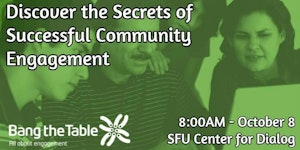
Discover the Secrets of Successful Community Engagement

We are pleased to share the announcement below about a great workshop coming up this October 8 in Vancouver. NCDD Supporting Member Mark Pivon of Bang the Table shared this announcement via our great Submit-to-Blog Form. Do you have news you want to share with the NCDD network? Just click here to submit your news post for the NCDD Blog!


On October 8th, direct from Australia, Bang The Table’s CEO Matt Crozier, will deliver a free, fun and interactive workshop where he will reveal the Top Ten Best Practices of Community Engagement, distilled from thousands of events held by communities across Canada, and around the world.

Register here

Did you know, every week over 50 new consultations are launched using EngagementHQ? Over 140 organizations are currently engaging communities and stakeholders in important consultations this very moment. Organizations like The Canadian Department of the Environment, Alberta Energy Regulator, The City of Mississauga, The Regional Municipality of Halifax, The Vancouver Port Authority, The Vancouver Airport Authority, The Richmond School Board, The City of Richmond and dozens of others have chosen EngagementHQ and Budget Allocator from Bang The Table. What are they doing to ensure success? How are citizens responding?

These questions and more will be explored in our Vancouver EngagementHQ Roundtable.

Date: Thursday October 8th, 2015
Time: 7:30AM – 10:00AM
Location: SFU Morris J. Wosk Center for Dialog, 580 West Hastings Street, Salon B – ICBC Concourse

The registration desk will open at 7:30AM, and we will begin at 8:00AM sharp, so please be sure to arrive early.

Register here

What you can expect from attending this event:

  • Learn how to gather an unlimited number of ideas and enable your community to prioritize them in a democratic and transparent manner
  • Implement multi-channel communications strategies both offline and online to deliver consistency in messaging while securing the widest audience reach
  • Energize communities, build awareness, and secure consensus around important initiatives that eventually point to a record of accomplishment
  • Discover how to use social media in an effective and cross-collaborative manner
  • Mitigate risk and ensure compliance is upheld to all privacy standards while securing feedback from stakeholders, safely and securely
  • Gain insights from other practitioners in community and stakeholder engagement

Our demonstration and roundtable event is free and will provide the opportunity to review a variety of case studies, meet with fellow practitioners, and have your questions answered on online community and stakeholder engagement.

Hope to see you there. This event is free, but seating is limited. Please also note that attire is business casual.

Register here:
www.eventbrite.ca/e/discover-the-secrets-of-successful-community-engagement-tickets-18613955843

@Stake: A Role-Playing Card Game

The Engagement Lab at Emerson College created @Stake, a role-playing card game used to foster decision-making, empathy and collaboration. The players take various roles and create questions based on real life issues to deliberate on during the game. All participants pitch their ideas under a time limit and one of the players, “The Decider” will choose who has the best idea and award points.

More about the game@stake

Development of @Stake:

Planning issues often involve conflicting interests coupled with deep resentments and community divides. Building a new highway, for example, is seldom only a question of the highway’s design, but the destiny of the land, the community, and individual residents.

We were amazed at the success of @Stake in driving productive conversation at our UNDP workshop, and took it back to the Lab for further development. Since then, it’s been used at the Frontiers of Democracy Conference, The Jewish Federation, youth ambassador programs for inner city planning institutions in Boston, and the United Nations in New York. Numerous expansions and customization packs have made the game robust enough to aid in processes of all types nationally and across the world.

Since its inception, @Stake has become one of our best tools for proving to others that games can be productive civic tools.

How to play @Stake:

What is it about? Before the game takes place, the play group must brainstorm topics for the game. The topics selected should be important questions for whatever real world process matters most to the players and their organization (ex. “How can we get young people more involved in local issues?”).

The Decider Once the question for each round has been established, one player becomes the first “Decider,” the player who will pick from the other players’ pitches and determine which is best. It’s up to them to keep time, promote fair play, and make prompt decisions in awarding points.

Role Cards All other players are assigned roles such as Mayor, Activist, or Student. Each role card features a short bio and three agenda goals that the players try to include in their pitches for bonus points.

The Pitch Players hear the question for the round, and are then given one minute to devise an idea. Pitching occurs in two phases. Each player has one minute to give their initial pitch to the Decider, and then there is a short discussion period during which players may ask questions of one another and try to achieve compromises to attach their agenda items to others’ plans.

Decider At the end of the round, the Decider must pick a winning pitch. That winning player earns points, then every player earns bonus points based on their agenda items. The new decider is the player that won the previous round.

**When playing @Stake, please tweet or use the hashtag #AtStakeGame to share your gameplay moments.

About The Engagement Lab
The Engagement Lab is an applied research lab at Emerson College focusing on the development and study of games, technology, and new media to enhance civic life. The Lab works directly with its partner communities to design and facilitate civic engagement processes, augment stakeholder deliberation, and broaden the diversity of participants in local decision-making. Along with the Salzburg Academy on Media and Global Change, the Engagement Lab serves as the hub of a global network of engagement and new media organizations.

Follow on Twitter: @EngageLab

Resource Link: http://elab.emerson.edu/games/@stake/

The Creation of Politics Video

The short video, The Creation of Politics (2014), was created by Kettering Foundation, in collaboration with Momentum Inc., Danijel Zezelj, and Main Sail Productions. The video tells the story of villagers who came together to address the dangers they faced as a community and how this led to the creation of politics. Below is the blog post from Kettering describing the video in more detail and find the link to the video here.

From Kettering

KF_Creation of PoliticsThose of you who have participated in Kettering’s annual summer Deliberative Democracy Exchange have probably heard Kettering Foundation president David Mathews tell a story about a small village that faces a recurring flood. It is a fable of sorts. In spite of the villagers’ many efforts to stop the flood, the waters return again and again.

So the people in the story had to make a decision: should they move across the river, where another band of people already live? Should they stay in their homeland? Or, should they move to higher ground? And in coming together and making a collective decision, the people create politics.

The story is designed to be universal – one that belongs to all times, all people, all cultures. People in communities everywhere face difficult problems and must weigh the costs and benefits of potential actions and then decide how to act together. The story counters the idea that public deliberation is some kind of new technique to be used on communities and encourages a notion of democracy that is citizen-centered.

A team at the Kettering Foundation collaborated with Momentum, Inc., artist and illustrator Danijel Zezelj, and MainSail Productions to produce a new animated video, The Creation of Politics, which brings to life this archetypal flood story that imagines how politics was first created – and why.

About Kettering Foundation
The Kettering Foundation is a nonprofit operating foundation rooted in the American tradition of cooperative research. Kettering’s primary research question is, what does it take to make democracy work as it should? Kettering’s research is distinctive because it is conducted from the perspective of citizens and focuses on what people can do collectively to address problems affecting their lives, their communities, and their nation.

Follow on Twitter: @KetteringFdn.

Resource Link: http://kettering.org/blogs/new-video-creation-politics