Innovative Journalism Can Take Public Conversation to Scale

We have barely begun to use major media and journalism – both old and new forms – to scale up the impact of powerful public conversations about public issues beyond the rooms and online forums where those conversations take place. Our societies urgently need innovations and development in the area of public conversation journalism in order to bring collective intelligence and community wisdom into our policy-making and into the everyday activities of ordinary citizens and organizations.

In this post I want to highlight the most remarkable public conversation journalism I’ve ever seen and explore some of the kinds of work public conversation journalists do and could do.

A few weeks ago 122 members of the National Coalition for Dialogue and Deliberation created, edited, and rated 95 ideas about what they’d like to see and do in their national conference in October 2014 (and you can see the results here). To my surprise and delight, an item I contributed ended up in third place:

Explore the best examples we can find where major media have partnered with dialogue and deliberation efforts to actually “scale up” public dialogue and deliberation to the regional, state, and national levels – or which contained lessons and best practices to help us do that in the future.

Thanks to these results I’ve decided it is finally time to share a major research project I’ve been working on over the last 15 years. I posted the last pieces of that work online last month. So now a major new resource is available – a thorough examination of what I believe is the most potent example of media-sponsored public conversation on public issues in North America and possibly the world. This initiative – all but unknown even to specialists in the field – was undertaken in 1991 by Maclean’s magazine, Canada’s leading newsweekly in collaboration with Canadian TV. The resources now available online include the entire 40 pages of Maclean’s coverage, the complete CTV documentary video, detailed interviews with four of the major players, and my own descriptions and analyses (see www.co-intelligence.org/Macleans1991Experiment.html).

What Maclean’s and Canadian TV did

These two major media innovators convened 12 Canadians whose extreme diversity reflected the diversity of their deeply divided country. They then charged these ordinary folks with articulating a shared vision for Canada. They were given two and a half days to do it. Maclean’s provided a team of leading-edge negotiators from the Harvard Negotiation Project – led by Roger Fisher, co-author of the classic negotiation handbook Getting to Yes – to help them.

The intense conversations that resulted were remarkable all by themselves. But the coverage provided by Maclean’s and Canadian TV was unprecedented and, I believe, has never been surpassed in the quarter of a century since. It generated widespread lively conversation around the country for months – and awards for Maclean’s.

Despite the fact that it happened more than two decades ago, I find this remarkable event teeming with potential lessons for all of us who want to “scale up” public dialogue and deliberation. We know that that can’t be achieved by centrally organizing millions of people into high quality conversations; there just aren’t the resources for doing that. We need some kind of catalyst that can trigger hundreds of self-organized, spontaneous conversations, including some with potential for real impact.

Maclean’s and Canadian TV provide important clues. They designed their coverage in ways that closed the gap between the small facilitated conversation and its mass audience. They didn’t provide the usual coverage to be witnessed by passive observers keeping up with the latest news. Their coverage was actively, intensely engaging. Like reality TV today, the Maclean’s/Canadian TV coverage drew millions of readers and viewers into intimate and often dramatic interactions among twelve radically different Canadians who included a few people much like themselves as well as others that they strongly disagreed with. Because of the brilliant design of both the interactions and the coverage, these journalists showed us how to vicariously engage an entire country in a higher form of conversation and a renewed sense of political possibility.

As I noted in my book Empowering Public Wisdom, a major unlearned lesson in this effort was that Maclean’s and Canadian TV didn’t repeat this process every year after that. If such a journalistic engagement of the entire country in high quality conversation were to be done on a regular basis, any country doing it would find itself thinking more clearly and creatively about its affairs than it had ever done before and creating a political force field which would profoundly influence politicians, news media, educators, businesses, and government decision-makers, as well as ordinary citizens.

Once it became part of the political culture, such collective thoughtfulness and due attention to diverse views and information would make all the difference in the world. That was, after all, the dream of democracy in the first place: an informed, conversant citizenry engaged together in crafting their collective lives and future.

The fact that we have today new ways to do that – conversational technologies as well as digital and telecommunications technologies – makes it even more important to understand what pioneers in the field did that we can now build on to succeed beyond their wildest dreams.

Public conversation journalism

The field of journalism – its theory, practice, and business models – is in upheaval.

The primary source of this disruption – the Internet – is widely recognized: Journalists, who were once the gatekeepers of news and current information, have been bypassed by millions of bloggers, citizen journalists, and community and issue activists using the web and modern communications technology to share what’s going on and what they think about it. This explosion of participatory information-sharing has many blessings for democracy. But it also has limitations, as many valuable journalistic standards have been ignored on the way to greater freedom and participation. The field is now rife – or perhaps ripe – with angst and creative conversation and experimentation. Among the most creative efforts to engage with this issue is Journalism That Matters, catalyzed for over a decade by NCDDer Peggy Holman and a handful of colleagues.

To this rich transformational soup of modern journalism I want to add one more ingredient – an innovative manifestation of journalism’s time-honored contribution to informed citizen engagement in a vibrant democracy: I call it “public conversation journalism” – journalism that has a professional commitment to do things like these:

  • Report on public conversations on public issues – before, during, and after – as legitimate community news.
  • Sponsor major public conversations on public issues, like Maclean’s did.
  • Welcome op eds that promote or usefully comment on public conversations about public issues.
  • Profile public conversation participants from various angles including who they are (to entice audience identification with them and thus trigger a vicarious experience of their views, their passions, their transformations) as well as their personal human interest stories and their infectious enthusiasm.
  • Profile the issues being discussed (background and framing) to deepen and contextualize the public conversation.
  • Provide multi-media coverage (print, video, even journalistic drama like Multiple Viewpoint Drama and Playback Theater).
  • Feature conversations that include well chosen, inclusive diversity such as we find in the Maclean’s initiative, Citizens Juries, WIsdom Councils, and Deliberative Polling (which convene cross-sections or random selected members of a population) and/or in “whole system” stakeholder conversations such as Consensus Councils and Future Search Conferences.
  • Provide truly transpartisan coverage – that is, coverage that includes a broad range of perspectives that move the viewer or reader beyond the reductionist, obsolete, and deeply adversarial standard of “both sides”.
  • Cover the very real drama of citizens problem-solving together, that may include but goes way beyond “the debate”.
  • Help the public understand the character and dynamics of different kinds of conversation – productive and unproductive, creative and uncreative, informed and uninformed, vibrant and restrained, diverse citizens and “the usual suspects”, colaborative and adversarial, etc.
  • Cover – and even provide forums and structure for – the social media generated around quality dialogue and deliberation.
  • Cover the actual results of public conversations on public issues – the immediate and longer term impacts on participants, communities, decision-makers, etc. – and publicize when good public conversational work gets taken seriously or ignored.
  • Cover efforts to institutionalize public deliberations, to build a “culture of dialogue”, to promote citizen engagement, etc.

I hope journalists and professionals in the fields of citizen dialogue and deliberation and public engagement engage in thinking together about how to bring about this powerful new kind of collaboration among themselves and their colleagues. I hope to hear from you about earlier and current experiments in such collaboration, including any details we can all learn from and questions and challenges you now face. I have heard of some work in Australia along these lines, and a number of people have noted that South Africa’s Mt. Fleur scenario initiative – which, intriguingly, happened one year after the Maclean’s initiative – included remarkable publicity by major news media.

There is SO much to learn and try out here…

Update from Participatory Budgeting Campaign in CA

We are always happy to hear good news from our partners with the Participatory Budgeting Project, an NCDD organizational member, and we wanted to share an update on their campaign in California from the PBP blog. We encourage you to read about how PB is growing below, or find the original post by clicking here.

PBP-logoLast October 2013, PBP began a year-long partnership with one of California’s foremost foundations to promote participatory budgeting (PB) across the state. Through our work with The California Endowment (TCE), PBP is supporting local advocacy for PB in the foundation’s Building Healthy Communities (BHC) program sites around the state. BHC is a 10-year initiative focused on empowering residents in 14 low-income California communities to eradicate health inequalities through community organizing and policy change. In each of these communities, PB presents a unique opportunity to channel public resources toward services and infrastructure that promote health and foster community economic development.

PB in Schools: Proposition 30 and the Local Control Funding Formula

Since PBP began working with Building Healthy Communities, a major shift in education funding in CA has presented an unexpected but promising opportunity for PB throughout the state. Through a new statewide tax passed by voters in 2012, millions of new education dollars are now flowing to California’s school districts, along with greater control over funds at the local level and new requirements to engage local stakeholders in the budget process.

C4J Workshop_California

In response to interest from advocates around the state, we held a webinar on this new Local Control Funding Formula (LCFF) and international models of PB in schools and school districts for over 60 participants, with representatives from the California Teachers AssociationCalifornians for Justice, and EdTrust West. PBP is now working with BHC groups and other community allies in Oakland, Sacramento, and Los Angeles to explore options for moving PB forward in schools.

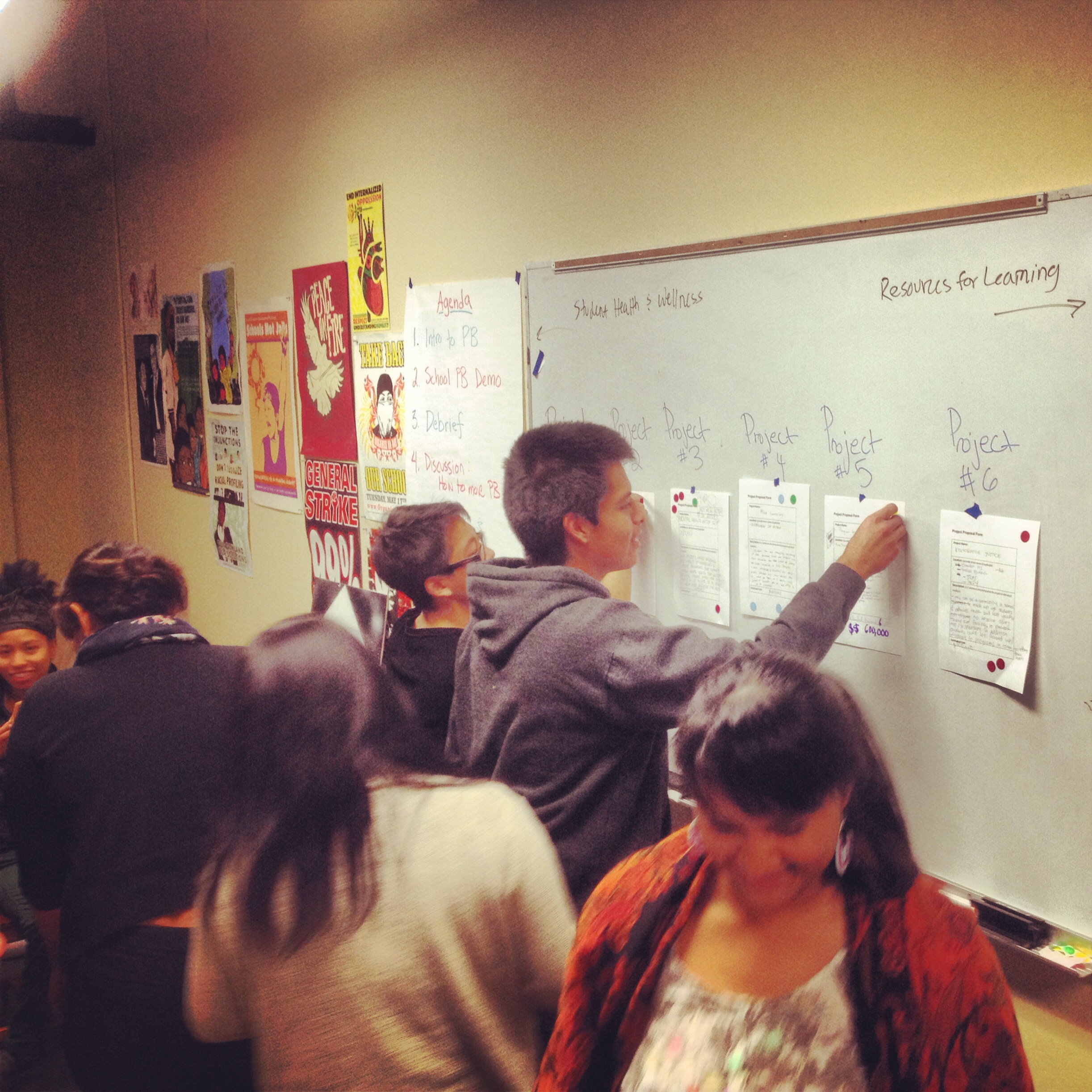
In the picture to the right, youth leaders and staff from Californians for Justice rank project ideas at a PB demo workshop in Oakland. Participants discussed projects to support student health and learning in Oakland and San Jose school districts.

PB in Cities: Long Beach, San Diego, Richmond

In addition to developing new PB models, we’re also supporting BHC groups in Long Beach, Richmond, and San Diego in launching new citywide and district-based processes. In November, PBP staff and Chicago Alderman Joe Moore went to Long Beach for a speaking tour, including a City Council briefing, several strategic meetings and a community form (pictured on the left). Since then, three candidates running for Long Beach City Council have endorsed PB, and a current council member, James Johnson, held a PB workshop with his constituents in February.

Right across the bridge from Vallejo, the City of Richmond is considering a youth PB process in conjunction with the city’s Youth Council. PBP will be leading a workshop at the Richmond Youth Summit on April 19. In San Diego, BHC groups active with the Community Budget Alliance, coordinated by the Center for Policy Initiatives, have also been meeting with their council members and Planning Department staff over the last few months to build support for PB. They’re looking at both district funds and CDBG funds as possible pots of money for PB.

Stay tuned for upcoming PB events in Long Beach, Richmond, and San Diego!

PB Conference

We’re now planning the first PB conference to take place in California, in the Bay Area in September 2014. Our 3rd annual international PB conference will bring together practitioners and advocates from across the state, country, and world. See more info.

Join us in expanding PB in California!

If you live, work or attend school in any of California’s 14 BHC sites and want to see PB in your community, contact Ginny Browne, Project Coordinator, at ginny@participatorybudgeting.org.

Civilizing Online Discourse by Expanding “Like” Button Options?

If you were wondering with us recently about how online comments sections can be made more civil, we encourage you to check out a savvy new tool that our organizational partners at Public Agenda are experimenting with. PA has embedded a “reader reaction button” – an evolutionary leap forward from Facebook’s “like” button – into their site that allows readers to react in multiple, nuanced ways to almost any part of an article or comment.

With reactions such as “respectfully disagree” and “not the whole story” available for users to express how they feel about specific content, this new tool could be a game changer for online dialogue. You can read about the new tool below or try it yourself by visiting PA’s original post here. And you really should try it because, we have to say, it’s really cool!


PublicAgenda-logoWith the arrival of spring, we’re trying a fresh approach to the way you can interact with our online content.

We believe that engaging with fair-minded perspectives that we may not agree with is good for democracy. This practice helps us break out of a simplistic “for or against” framework toward an issue and come to a rounder comprehension of the issue and approaches to resolving it.

Unfortunately, the civil exchange of opposing perspectives is hard to find on the Internet, where interaction feels like the Wild West. Inherent anonymity doesn’t help, and neither does the click-bait game. Conflict, after all, is newsworthy. (This is something we certainly struggle with here!) All of this animosity on the Internet could actually be doing some real damage.

We may view rude Internet behavior as inevitable, but civil Internet discourse that is also click-friendly IS possible. The Engaging News Project, out of the University of Texas, is demonstrating how.

respect button

A screenshot of PA’s new Reader Reaction Button in action

The Project is experimenting with reader reaction buttons on comments for news stories – specifically, the ubiquitous “Like” button. “Like” can sometimes be a limited and limiting response. As the researchers write,

“‘Like’ doesn’t always seem appropriate. A fair, but counter-attitudinal, post in a comment section? It’s challenging to press ‘Like.’” What if news sites used a button that said “Respect” instead?

Word choice, it seems, does matter. When participants saw a “Respect” button instead of a “Like” button in the comments section on a news story, they interacted more frequently with other readers’ comments, including those from a political perspective different from their own. From the report on the research:

Instead of asking people to approach online comments thinking about whether they agree with a comment, or “like” a point of view, the “Respect” button puts people in a different state of mind. Instead of “am I with them or against them?” the “Respect” button directs people to think more about “Is this a decent argument?”

We’ve decided to adapt the “Respect” approach to how you can interact with our blog content.

If you highlight text anywhere in a blog post, or see the ReadrBoard symbol (left) on content (including pictures and video), a box opens up. In that box, you can choose your reaction (including “Respect”), see the reactions of others, or add your own reaction. We hope this new approach encourages you to engage more with our content – and with each other.


2014 Public Participation Interviews: Tyrone Reitman

Earlier this year, we started reading a wonderful interview series from the talented team at Collaborative Services on public participation lessons they have learned in the last year, and we wanted to share their insights with the NCDD community.

The fourth and final interview in the series features the reflections of Tyrone Reitman of Healthy Democracy Oregon (an org member of NCDD), who shares his insights on the award-winning Citizens’ Initiative Review. You can read the interview below, or find the original on Collaborative Services’ blog by clicking here.


collaborative services logoFor the People By the People: Oregon’s Citizens’ Initiative Review

Elections bring a slew of information for and against different initiatives. But how much of what you read, see and hear can be trusted? After all, who is paying for the ballot measures you are voting on? Campaign ads can often cause negative reactions from viewers. They are an expensive way to get you to change the channel. The lack of quality coupled with biased information can be frustrating at minimum and misinform you at worse.

In 2011, recognizing the lack of available quality information, the State of Oregon took a new step forward by including public participation in reviewing citizen initiatives. The non-partisan and non-profit organization Healthy Democracy Oregon came up with a plan to get its state’s citizens more involved in their voting process and provide them with a stronger voice in how their state is run.

The review is the Citizens’ Initiative Review and it provides Oregonians with an unbiased review of ballot measures done by citizens just like you. Groups of 24 randomly selected, demographically representative citizens are selected to be part of a panel for each initiative. Their job is to provide an objective review of the upcoming citizens initiatives and write a statement highlighting their most important findings. The statements are then included in the voter’s pamphlets for citizens to consider when casting their ballot.

hd-logo-03This use of a citizen review is no new idea, but its use with ballot measures is. Cities have used various forms of citizen advisory committees on projects for years. So why not take a page from this book and apply it to the ballot initiative system? After all who better to review and comment on citizens initiatives than the citizens themselves.

This week as we continue our month-long look at public participation successes, we hear from we hear from Tyrone Reitman, co-founder of Healthy Democracy Oregon. He shares with us the challenges Healthy Democracy Oregon faced when creating the Citizens’ Initiative Review, who’s on the Citizens’ Initiative Review panels and how they are selected, and how this model can improve voting in other states. We welcome his insights.

- – -

What inspired the Citizens’ Initiative Review to be established?

Oregon pioneered the ballot initiative system in 1902 to give citizens a stronger voice in their government by bypassing the legislature to create laws directly at the ballot box. After 112 years, the system is going strong but showing some signs of strain. The number of measures on ballots has increased, and so has the amount of money campaigns spend working for and against them. Ballot measure campaigns spent close to a billion dollars in 2012, as voters decided 188 questions on 39 statewide ballots (when local measures are added, the count rises above 5,000). And while legislators have access to public hearings about bills they consider, the initiative process often asks citizens to make even more impactful decisions (for instance, constitutional amendments) with little information other than what campaigns provide.

So while polls show that voters like the initiative system, they’re frustrated by a lack of quality information about measures. A super majority of voters in several states report casting ballots on measures with which they are unfamiliar, and three in four voters say they often find the measures too complicated and confusing to understand.
Oregon_special_election_ballot
As a co-founder of Healthy Democracy, you saw the Citizens Initiative Review come to fruition over the course of five years. What challenges did you face along the way?

A key challenge was to build a trustworthy process that all sides recognize as being fair and free from bias. We talked to legislators on both sides of the aisle to gain their support for this first-in-the-nation program and trained our moderators to put citizen panelists in charge of directing the reviews. We hold a very open process and panelists anonymously report their satisfaction and any perceived bias to researchers each day. Not every campaign has chosen to participate, but we’ve developed a way to bring in other advocates and ensure a fair process whether or not they participate.

How did the process get designed?

As John Gastil, Head of the Communication Arts & Sciences department at Penn State says, “The idea behind the Citizens’ Initiative Review is simple. When we give citizens a chance to deliberate and inform one another, they usually yield well-reasoned and compassionate judgments.” We started with the jury process, which has been used for centuries to bring citizens together to answer factual questions in the legal system. Ned Crosby, founder of the Jefferson Center, developed a model to use citizens’ juries to address questions of policy and governance, and has spent multiple decades refining the process. We were fortunate to have him and talented facilitators as early collaborators to help design the process.

To what extent do you think the Citizens’ Initiative Review impacts Oregon voters’ decision-making process?

We are fortunate that an independent academic research team has studied our results over the past two cycles. In 2012, for the first time, the research team found that over half of Oregon voters were aware of and used the CIR when voting, and two-thirds of them reported that it helped them make voting decisions.

CIR-infographic-largeThe Citizens’ Initiative Review is a randomly selected, demographically balanced panel. How are people selected?

Initial invitations are mailed to 10,000 Oregonians selected at random from the list of registered voters, and those who agree participate are placed in a pool. For each review, 24 panelists are selected to match the demographics of Oregon’s population with regard to party affiliation, voting frequency, age, gender, ethnicity, educational attainment, and geographic location. At the end of the day our goal is to bring together a good faith reflection of the state’s voting population to deliberate, and we’ve had no trouble finding voters to do so.

How many people ultimately serve on the panel? How long do they serve?

24 panelists serve on each review, which lasts five days.

Does the panel select a chair? Is it facilitated in any way by a moderator?

The panelists meet for five days to review a ballot measure (they are compensated for their time and travel expenses). Trained moderators guide the panelists through the process of gathering initial information about the measure, selecting neutral policy experts to interview, and questioning advocates for and against the measure. The panelists deliberate and have the opportunity to ask further questions. As Maggie Koerth-Baker writes in the New York Times Magazine, “The panelists know they’re expected to base their opinions on hard evidence, and this expectation becomes part of their temporary identity. Under those conditions…facts suddenly matter.”

To conclude the Review, panelists draft a Citizens’ Statement that summarizes the most important aspects as well as how many panelists support and oppose the measure. What kind of feedback has this received from Oregon’s voters? What benefits do they express this process has for them?

An independent research team funded by the National Science Foundation and Kettering Foundationstudied the reviews in 2010 and 2012 and found that in 2012, over half of voters read a CIR statement, and two-thirds found it useful when casting their ballots. In the end, voters agreed with both 2012 panels’ assessments. Media have praised the CIR for offering “the most objective analyses of the issues we’ll be voting on” (La Grande Observer). Elected leaders from both parties compliment the process for offering voters a chance to provide quality information to their fellow citizens.

Prior to the 2012 election what outreach efforts and tactics were used to generate interest and familiarity with the Review?

States that allow citizen's initiatives are shown in dark blue.  (Credit: csmonitor.com)

States that allow initiatives are shown in dark blue
(Credit: csmonitor.com)

Oregon is a vote by mail state, and our voters’ pamphlet is widely read (over 80% of voters spend more than a half hour reading it). Since the CIR is a state program, the results are put in the Voters’ Guide, which is where most voters encounter it. We also work with media (newspapers, television, and radio) to spread the results of the reviews.

How do you plan to further let voters know about this process and its analysis?

This year we’ll be enhancing our social media work to increase our reach with younger voters who are less likely to rely on the Voters’ Guide.

coverWe learned that your project is the first formalized voter deliberation resource of its kind. In what other ways, if any, would you like to see Oregon’s initiative process change?

There’s a lot of frustration with the initiative process from groups on both sides of the aisle, but polls show that two-thirds of voters support the initiative system the way it is. Right now we’re focused on the CIR, and more generally, we believe that the best way to help the initiative system achieve its initial purpose of giving the people a stronger voice in their democracy is to improve voters’ access to quality, factual, unbiased information at election time.

Not all states allow citizens’ initiatives – do you see the Citizens Initiative Review as a model for other ballot measures, such as constitutional amendments?

Yes, and in fact access to quality information is especially important for constitutional amendments, which have long-lasting impacts on a state and tend to be difficult to reverse once passed. The Oregon Citizens’ Initiative Review Commission prioritizes constitutional amendments and measures with significant fiscal impacts when choosing which measures will be reviewed.

How can our voters get involved and encourage formalized voter deliberation in their home state?

Sign up for our newsletter or join our Facebook page to stay up to date on the latest in using citizen deliberation and fact-based, quality information to improve governance in America. We’re committed to providing support to groups in other states that are ready to start a Citizens’ Initiative Review, and we’ll connect you to those exciting efforts.

- – -

Healthy Democracy Oregon and  the Citizens’ Initiative Review is changing voting in Oregon for the better and helping set an example for other states to follow. Tell us how you would like to see voting and ballot measures improved in your state or other citizen review processes that you know of.


This interview is part of a blog series from Collaborative Services, Inc. - a public outreach firm in San Diego, California that brings people together from their individual spheres and disciplines to improve communities and help people adapt to an ever-changing world. The firm uses inter-disciplinary efforts to manage and provide services in stakeholder involvement, marketing and communications, and public affairs. The firm’s award-winning services have spanned the western region of the United States from Tacoma, Washington to the Mexico Port of Entry.

We thank Collaborative Services for allowing NCDD to learn along with them, and we encourage our members to visit their blog by clicking here. You can find the original version of the above article at www.collaborativeservicesinc.wordpress.com/2014/02/05/for-the-people-by-the-people-oregons-citizens-initiative-review.

Peace Education Center in MI holds community dialogues on Poverty and Wealth in April

We are pleased to highlight the post below about two great events this week and next week in Michigan, which came from NCDD Sustaining Member and 2012 NCDD Catalyst Award winner John Spady of the National Dialogue Network. Do you have news you want to share with the NCDD network? Just click here to submit your news post for the NCDD Blog!


NDN logoFrom John: Here is an exciting message from Terry Link in Lansing, Michigan, to the National Dialogue Network (NDN) which describes upcoming community events at Michigan State University (on April 4, 2014) and Lansing Community College (on April 9, 2014) that are organized by the Peace Education Center and co-sponsored by big name community supporters.

You can read the message below or visit www.NationalDialogueNetwork.org/?p=851 for the original.

- — -

Hello John,

Just wanted to let you know that we finally have all the pieces aligned to run the NDN program on Poverty and Wealth here in Lansing, MI. We have two sessions organized – the first at MSU for the larger campus community , nearly 60,000 potential participants, although we’ll be happy with any more than 50. The second to be held at the local community college on downtown Lansing. The local Peace Education Center is the organizing force for both (I am a board member) but as you will see from the flyers we’ve solicited co-sponsorship from different entities for each event.

We hope to have the surveys completed and will find volunteers to submit them online back to NDN. We will also be doing an interview in advance of the events on our public radio station’s public affairs show at a date yet to be determined. I will keep you both posted as we move ahead. I will be travelling March 13-27, so you likely won’t hear anything further back from me until I return. Below is the note I sent out to campus sponsors this morning. For more info see the website www.peaceedcenter.org

All good things,
Terry Link

- — -

The problem of an ever expanding disparity between the “have’s” and the “have-not’s” has become the issue of the day.

Please join us in a respectful conversation about a problem that affects us all. We will use a process and materials designed by the National Dialogue Network, funded by a grant from the National Coalition on Dialogue and Deliberation. Seated in small groups, we will listen to each other’s perspectives to further our own understanding of the concerns and possibilities surrounding this important issue.

There will be two sessions, one for the Michigan State University (MSU) community and a second one for the larger Lansing community.

MSU Session, April 4th, 3–5pm, MSU Main Library, North Conference Room, 4th Floor West.

This event co-sponsored College of Communication Arts and Sciences, College of Social Science, Residential College of Arts and Humanities, Peace and Justice Studies program, Philosophy, and the Peace Education Center of Greater Lansing.

Seating is limited, so to reserve a seat please send your name and email to: hesslin2@msu.eduThe event flyer can be downloaded here.

Greater Lansing Community Session, April 9th, 7-9pm, Lansing Community College, Administration Building Board Room. 

This event is hosted by Lansing Community College and sponsored by the Peace Education Center, Michigan League for Public Policy, Capital Area District Library, Power of We Consortium, Justice & Peace Task Force at Edgewood United Church, League of Women Voters – Lansing Area, Red Cedar Friends Meeting, and Common Cause of Michigan. 

Seating is limited, so to reserve a seat please send your name and email to: pec.comments@gmail.com. The event flyer can be downloaded here.

How we tackled “Civic Infrastructure” at NCDD 2012

I’m preparing a little presentation for our partners at CommunityMatters on how NCDD tackled the concept of civic infrastructure at our last national conference, and thought I’d write about it here on the blog to gather my thoughts.

Our convening question (kinda like a theme) for NCDD Seattle was:

How can we build a more robust civic infrastructure in our practice, our communities, and our country?

In our conference guidebook, we described our challenge to attendees this way:

NCDD 2012 Guidebook CoverOur hope is that this theme takes us to a deeper level of discourse and inspires us to begin making real progress together on one of our field’s greatest challenges.

Dialogue and deliberation are powerful communication processes that help people bridge gaps, understand and tackle complex issues, resolve conflicts, influence policy, and make better decisions. We talk a lot about our methodologies, and about how they lead to outcomes like citizen action and policy change. This year, we’re focusing in on the bigger picture of our work – how we all contribute to creating the underlying structure needed to help ensure people can come together to address their challenges effectively (which is what we mean when we use the term “civic infrastructure”). How are we each creating this infrastructure, how are we building on what each other creates, and what can we do together that we just don’t have the capacity to do on our own?

To help inspire you to think about these questions, we’re excited to be running a unique awards program in conjunction with the conference, and invite all of you to participate. The NCDD Catalyst Awards are two $10,000 awards for collaborative projects that launch our field forward in two critical areas: civic infrastructure and political bridge building. Groups will form and hone their ideas at the conference and online at CivicEvolution.org.

Since our conference brought together 400 people with different goals, interests, and levels and types of experience, we designed the conference to allow people to dig into the concept of civic infrastructure at three levels:

  1. Individual level: How might individuals develop their practices with an eye to building civic infrastructure?
  2. Community level: What might a robust civic infrastructure look like in my community?
  3. National and field level: What is happening in this realm at the leading edge of the field? Where are the breakthroughs? What are the challenges? What is the latest research? What are our next steps as a field?

DSCN0588Our opening plenary session on the first day of our three-day conference focused on FRAMING the conference’s theme and goals. I gave a rapid overview of where we’ve come as a community/field over the past 10 years (it was NCDD’s ten year anniversary after all!), and shared why I felt the conference theme was critically important — not only to the future of our field but also to the future of our society.

Attendees did some networking and introductions using the new Group Works Card Deck, and we used keypad polling (thank you, Daniel Clark and Martin Carcasson, for the keypads!) to get a sense of who’s in the room.

One of the polling questions posed by co-Emcee Susanna Haas Lyons was “This conference focuses on civic infrastructure. How comfortable do you feel with this term?” The most popular answer was “I think I know what you mean” (36%), with those who chose the option “I totally get it!” close behind with 30%. 15% were pretty sure they knew what we meant, 17% were not so sure, and 3% indicated they “had no idea” what we meant.

Our featured speaker for Day 1, Eric Liu (Founder of the Guiding Lights Network) helped orient attendees by posing questions about our capacity to help communities address their challenges, and our willingness to meet people where they are. You can watch Eric’s presentation here.

“We’re at a moment right now, where either this democracy is going to live up to its promise or it’s not — and it will to the extent that we, as a network, do our work with purpose and passion,” noted Eric.

“This is a room full of incredible super-carriers. Nodes of networks, catalysts… carriers of an incredible potential” but he cautioned the group to think in not just in terms of “D&D” (dialogue and deliberation), but also in terms of “B&G” (blood and guts). People are primal, tribal, and often motivated more by fear than hope, and suggested that for this movement to be absolutely viral and contagious, we must appeal to what’s going on in people’s guts and channel that energy into our efforts to engage people. According to Eric, concepts like dialogue, deliberation, and civic infrastructure promote a certain kind of civil, logical discourse, and we must also attend to an “infrastructure of the heart.”

After Eric’s speech, planning team members Peggy Holman and Susan Partnow led an Appreciative Inquiry exercise. Attendees were asked to think of a time “when they were part of a group, a team, or a community that was able to constructively engage with each other on a complex challenge. A time when all the critical elements came together and the group was not only able to move forward on the immediate issues, but perhaps also left a legacy in the community that enabled people to more effectively come together to approach challenges in the future (in other words, build civic infrastructure).”

Attendees shared these stories in pairs, focusing on the unique factors that led to success. They were asked to “Consider what the group’s immediate impact was on the issue at hand, AND in what ways it left a long-term legacy in the community.”

Table-group-600px-outlined

Everyone then got back into their table groups and discussed what key themes and patterns seemed to stand out from their stories. Each table jotted down key insights about “what is needed to cultivate strong civic infrastructure” on sticky notes to feed into our graphic recording wall. Our nine-person graphic recording team used that input to get started on a huge conference-wide mural on civic infrastructure.

The next day, after people had experienced a fantastic Showcase session and several workshops, we started off our plenary session on Day 2 with small group dialogue on the following topics:

  • What have we heard that’s promising or working well, and needs to be nurtured?
  • What are some recurring challenges or obstacles to building and sustaining civic infrastructure at various levels (local, regional, national, global)?
  • What could we create together to overcome these obstacles and barriers and move us forward?

NCDDSeattle-2guyssmiling-outlineThe results of this activity were quite expansive, with many dozens of sticky notes being sorted into broad categories like research, communication in the field and with others, online tools and technology for engagement, the importance of storytelling, cultural readiness for dialogue and deliberation, and more. Some common themes included:

  • the need for more funding and resources for this work
  • the appreciation for increased collaboration in the field among people with different approaches
  • the persistent gap between research and practice
  • the need to capture learnings (success stories, learning from failures / “failing forward”, learning from quick projects that react to crises)
  • hopefulness about programs that are being embedded in governance, like Oregon’s citizen initiative reviews and participatory budgeting
  • the need to recognize and utilize community champions for engagement
  • appreciation for the power of storytelling (from the plenary exercise)
  • the need for more physical and online spaces for dialogue and listening to be nurtured in communities
  • the challenge of practitioners being overworked and overwhelmed (no time to create long-term civic infrastructure)
  • inefficiency in the field, including multiple groups doing the same work from scratch rather than building on each other’s work or working together

These sticky notes were themed by a dedicated group of volunteers and then were incorporated into our graphic recording wall. At the end of this plenary, our graphic recording team leader, Timothy Corey, reported on the themes they saw emerging and how they were being interpreted graphically.

Seattle Oct 2012 276Our featured speakers on Day 2 were Pete Peterson, Executive Director of the Davenport Institute for Public Engagement and Civic Leadership at Pepperdine University (now running for Secretary of State in California), and Carolyn Lukensmeyer, founder of AmericaSpeaks and now Executive Director of the National Institute for Civil Discourse at the University of Arizona.

Pete’s presentation focused on innovations and challenges in building civic infrastructure at the state and local level, leading into Carolyn’s presentation, which focused on our field’s challenge to build national infrastructure for engagement, and what might be possible going forward.

Pete outlined what he considers to be a “quiet revolution” in local governance, and provided valuable insight into what works when talking to public officials about public engagement. He made a compelling and concerning argument that, despite the fact that deliberative public engagement is becoming more and more common among legislators, public sector officials approach the task of engaging the public from a place of fear. Without “understanding the fear — that is very well founded based on bad processes — we will not move forward.”  Watch Pete in action here.

If you don’t get that one of the real problems that public sector officials have in engaging the public, is that they’re coming from a place of fear–based very legitimately on past bad experiences with engaging the public–we’re never going to move this field forward.

Carolyn’s speech transitioned us to the national level and focused on what might constitute a national infrastructure for civil discourse. Despite many successes, deliberative public engagement in the United States remains largely episodic and sporadic. We’re a long way from institutionalizing this work so that this is how the public’s business is done, and Carolyn outlined seven infrastructure elements needed to support a healthy democracy:

  • NCDDSeattle-GRs-borderlegislative support for engagement
  • skilled human infrastructure
  • trusted organizational infrastructure
  • accessible physical space
  • technological skills and broadband infrastructure
  • a fact-based media system
  • robust civic education

The “human infrastructure” needed to support a healthy democracy is “the element we’re the furthest ahead on in the United States,” as it includes networks of facilitators and skills in democratic processes and conflict resolution. Watch Carolyn’s speech here.

Carolyn ended her speech with a challenge to our “tribe”:

Every time you do a citizen engagement effort, consciously ask yourself, “how can we add one brick to the foundation of one of these elements of infrastructure that will be there, and capable of being run by the community even if we’re not there?”  Add that to your charge to yourself, because if we don’t build the infrastructure, no matter how good the results are that we produced in that, we haven’t helped the community be capable of self-governing, democratic behavior.

Both of these speeches were top-notch and extremely informative, and are well worth watching if you weren’t able to join us at NCDD Seattle! Visit this link to peruse all the videos created at/about the conference.

Catalyst AwardsThroughout the whole conference, we were also encouraging NCDD members and attendees to hatch and organize around projects they could work on together that would achieve goals they can’t reach alone. Our Catalyst Awards project, which offered two $10,000 awards for team projects in the areas of civic infrastructure and political bridge building, was integrated into the 2012 conference in a variety of ways.

The project, essentially, was a Participatory Budgeting exercise for our community. Our members proposed projects at the conference and also at http://ncdd.civicevolution.org/, organized teams to flesh their ideas out, voted on which qualifying proposals they preferred, and ultimately selected two projects to win the awards:

NCDD2012-CatalystAwardShot

Voting was conducted after the conference so teams would have more time to organize and so all members of the NCDD community could get involved, and numerous projects were launched at the conference and presented during our plenary session on Day 3.

During that final plenary, our speakers John Gastil of Penn State University (also co-Emcee at NCDD Seattle) and Fran Korten, publisher of YES! Magazine, helped us reflect on the progress made and insights gained over the past three days. And as a group, we identified key priorities and strategies for moving forward in our individual practices, our communities, and as a community of practice.

In additional to all of these rich activities, a number of our concurrent workshops focused on issues related to strengthening civic infrastructure, including:

  • When Governments Listen: New Models for Public Engagement, Civic Infrastructure, and Slow Democracy (which covered New Hampshire’s developing statewide infrastructure for engagement)
  • The Art of Engagement: What is Journalism’s Role in a Civic Infrastructure?
  • Building Civic Infrastructure Through Local Government (sharing AmericaSpeaks’ long-term work with DC’s Mayor Williams)
  • The Oregon Citizens Initiative Review and the Institutionalization of Deliberative Democracy
  • Engaging Diverse Communities in Online Neighborhood Forums
  • One Person, One Vote – Bringing Deliberation into the Public Budgeting
  • Statewide Civic Engagement Initiatives
  • Learning from Practice:  Imagine Austin (on the 2.5-year process that engaged thousands of residents in preparing a vision and comprehensive plan for a sustainable future for Austin)
  • Supporting College Students as Key Resources for Civic Infrastructure
  • A Survey of Funders’ Innovative Civic Engagement Activities (with Grassroots Grantmakers’ Janis Foster Richardson)

One of the most insightful summaries on how we took on the theme of “strengthening civic infrastructure” came from one of our attendees, Janice Thomson. In a post on U.K.-based Involve’s blog, she shared some useful insights she gleaned at the conference about how a sustainable civic infrastructure might take shape.

See the full post for her exposition of these themes:

  1. Social capital serves as both the foundation and lubricant for a robust civic infrastructure — i.e., knowing and trusting one’s neighbours, public officials, and others with whom one must cooperate.
  2. Deliberative public engagement seems to be most sustainable when it is a process (not a project) that the community itself owns and which government officials trust.
  3. Engage politicians as politicians to support deliberative public engagement.
  4. Politicians in states with direct democracy (initiatives and referendums) appear to be more supportive of deliberative public engagement than politicians elsewhere.
  5. Citizens must stop behaving like demanding consumers and take responsibility for their decisions.
  6. Courage is needed to engage a divided public on a growing number of contentious issues.

I’ll end this overly long post with one of my favorite quotes from the conference evaluations:

“This was my first NCDD conference and the best conference I have ever attended (and I have attended so very many!). The theme, building a more robust infrastructure in our practice, communities and country, is timely and in need of continual attention and collaboration. I have wanted to attend the bi-annual NCDD conference since the first one, but my schedule didn’t permit. Now, this conference will be a priority in my life and I will do my best to schedule other important activities around it!”

Manju Lyn Bazzell, The Co-Intelligence Institute

See more conference feedback here. We hope to see you this fall at the 2014 National Conference on Dialogue & Deliberation in the DC metro area (October 17-19 in Reston, VA)!

Update to Civic Tech Business & Investment Study

Back in December, we posted about a new study that the Knight Foundation had just released about trends in “civic tech” business, and at the time, they were looking for more feedback from professionals in our field to bolster the analysis. Well they recently released an update to their study including the info from new contributors. We encourage you to read about the update below or find the original announcement here.


Knight-Foundation-logo

You spoke, we responded.

In December 2013, Knight Foundation released an analysis of activity and investment in civic tech which captured 209 companies and more than $430 million in investment between January 2011 and May 2013. To build on that initial analysis, we published all the data and asked people to suggest additional data they believed was missing from the report. Since then, we’ve received dozens of emails from peers in the budding civic tech community proposing additions.

Today, we’re releasing an updated version of the civic tech investment analysis, which includes an additional 32 companies and $265 million of investment. That brings the total to 241 organizations having received more than $695 million in investment from 2011 to 2013. The data crowdsourced by you and your peers in the civic tech field was crucial for incorporating organizations and investment data missing from the original report. We also updated the report to include investments made through the end of 2013, providing an additional seven months of investment data not captured in the original report.

More than anything, we’re excited about all the conversations the report triggered concerning the ongoing development of the civic tech field. Take for example this Twitter civic tech group with Twitter handles of organizations identified in the report created by Scott Phillips of Civic Ninjas. Many more have reached out, especially funders, about convening funders around co-investment opportunities in this space.

By documenting a clearer picture of activity and investment, the report begins to set the stage for a discussion about the impact of civic tech.  Several people have asked us what’s known about the effectiveness of new civic tech tools identified in the report. In the months ahead, Knight will share insights from its own experiences supporting civic tech tools along with assessment resources for practitioners in the field. But we’re also interested in fostering a broader conversation geared around more consistently documenting the impact of civic tech tools and trends on open government, civic engagement and in promoting healthy, vibrant cities.

We also continue to welcome your feedback and suggestions so we can keep updating the analysis over the course of the year. Civic tech is a dynamic sector, and we want to continue to capture what’s happening. It will help the community better understand the opportunities that exist and to develop strategies that increase the effectiveness of new investments.

You can find the original version of this post at www.knightfoundation.org/blogs/knightblog/2014/2/26/civic-tech-analysis-expanded-with-your-feedback.

Montreal Symposium on Professionalizing Our Field

We recently heard about an exciting conference happening in Montreal this July that we want to make sure our NCDD members know about. The conference, hosted by the Canadian Institut du Nouveau Monde, takes place during the IPSA’s annual gathering, and is part of the important conversation about the professional future of our field. Check out the announcement below or find out more at the IPSA’s conference website here.


INM logoThe Institut du Nouveau Monde, a Canadian nongovernmental organization dedicated to public participation, is pleased to invite NCDD members to attend a symposium entitled “Developing expertise in the design of participatory tools: The professionalization and diversification of the public participation field”, that will be held in Montreal July 21-22, 2014 during the annual conference of International Political Science Association (IPSA).

The symposium intends to better understand the conditions involved in the negotiation of the participatory design by looking at the actors that initiate and organize public participation. What are the effects of this professionalization of public participation? Does it compromise or encourage the democratic aims associated with public participation? Is it better to use private consultants, to train public servants to oversee public participation, or to set up an autonomous public organization devoted to public participation? How does the approach that public participation professionals take affect their abilities to design effective public participation mechanisms? The approach chosen to answer these questions is a dialogue between researchers and practitioners for a heuristic confrontation of knowledge and experiences.

About twenty researchers are expected to participate in the scientific segments of the two-day programme (see “Panels” in the preliminary programme). Other segments of the Symposium, the “Round Table” and the “Open Space”, mean to engage with public participation practitioners. Our guest practitioners for the Round Table are:

  • Simon Burral, Executive Director of Involve (London, UK)
  • Carolyn Lukensmeyer, AmericaSpeaks Founding Member and Director and Executive Director of the National Institute for Civil Discourse (Washington D.C., USA)
  • Peter MacLeod, Principal and Co-founder of MASS LBP (Ontario, Canada)
  • Michel Venne, General Director of the Institut du Nouveau Monde (Québec, Canada)

You can view the preliminary program for more information.

Please don’t hesitate to forward this invitation through to anyone you think would be interested to come to Montreal to assist to this symposium. The more practitioners present, the more interesting the discussions will be!

Upon interest, there are two registration options:

  • Participation to this symposium ONLY (July 21-22th) costs $40 per individual (special event rate).
  • Participation to the ENTIRE IPSA Congress (access to all activities July 19-24) is $260 for early registration.

If you choose option 1, send an email to malorie.flon@inm.qc.ca and she will inform the IPSA secretariat to send you a special registration link.

If you choose option 2, you can now register on the IPSA website: www.ipsa.org/events/congress/montreal2014/registration. You will have to pay the association membership fee ($160 for a regular member, $50 for students). We hope to see you there!

You can find the preliminary program for this conference at www.ncdd.org/main/wp-content/uploads/IPSA-Prelim-Program.pdf. More information on the IPSA annual gathering is available at www.ipsa.org/events/congress/montreal2014/theme.

2014 Public Participation Interviews: John Lewis on Outreach

We recently started reading a terrific interview series from the talented team at Collaborative Services on public participation lessons they have learned in the last year, and we wanted to share their insights with the NCDD community. The third interview in the series features the reflections of John Lewis of Intelligent Futures, who shares insights gained from the award-winning ourWascana engagement endeavor in Canada last year. You can read the interview below, or find the original on Collaborative Services’ blog by clicking here.


Multiple Entry Points into the Conversation Create Multiple Opportunities for Successful Public Participation

collaborative services logoThe uncertainty of change coming to a city’s crown jewel can cause an outpouring of different opinions. So how do you capture all of this input and make sure every voice is heard?

That’s the challenge one firm was tasked with in the summer of 2012, when it came to proposed change for Wascana Centre in Regina, Saskatchewan. Just shy of the Centre’s 50th birthday, the ourWascana Visioning Project was launched to collect citizens’ hopes and dreams for the future of Wascana and its beloved Centre. More than 3,300 citizens shared their 8,000 unique ideas during “ourWascana.” Their input is being used to create a sustainable future for this civic gem for the next 50 years.

This week as we continue our look at public participation successes we hear from John Lewis, President and Founder of Intelligent Futures and native Reginan. By providing multiple entry points into the conversation, Intelligent Futures was able to accurately collect public input and foster an open and honest dialogue during the ourWascana Visioning Project. Unique tools for collecting input such as sounding boards set up in Wascana Centre, a social media campaign and creative graphic design all contributed to the project’s success. ourWascana’s success was then reaffirmed on an international scale when it won the 2013 International Association of Public Participation’s Core Values Award for Project of the Year in the Member at Large category.

Today, Lewis shares with us his firm’s experience working on ourWascana, how their approach to outreach is evolving and some of the other exciting projects Intelligent Futures you should know about. We welcome his insights.

- — -

Given your client list, Intelligent Futures is clearly a veteran outreach firm. How has your approach to outreach campaigns changed or developed over the years?

I think we have become more creative in how we give the community an opportunity to provide input. We use the term “multiple entry points into the conversation” a lot. Whether it’s in-person or online, we are trying to create as many ways for people to find out and share their thoughts as possible. I think we’re also getting better at catching people’s attention (in a good way). We know people are really busy and there are millions directions you can take your attention. Through graphic design, plain language and surprising tactics, we try to make our projects interesting, relevant and if possible, fun!

What do you think is the most important act a host can do to foster constructive public dialogue?

Be honest. If you’re honest and clear – about the parameters of the dialogue, about what is being done with the feedback or your experience in a place – you’ll end up with a constructive conversation. I think the projects that get into trouble are the ones that aren’t honest in one way or another. Honesty is the only way to erode the skepticism that many of these projects face from the outset.

What tools, methods, and strategies were used in the ourWascana engagement process and which were the most effective?

We used the “multiple entry points into the conversation” approach extensively with ourWascana, but the three most effective were:

  1. Community “Sounding Boards.” This was a series of feedback boards installed within the park, allowing citizens to share their ideas within the space itself. It didn’t matter if you were attending a festival, having lunch or walking your dog at midnight, you could look around you and provide your ideas.
  2. An extensive social media campaign. ourWascana came out of a celebration of Wascana’s 50th birthday and was looking ahead 50 years. We collected a variety diverse, surprising facts about Wascana Centre and created a #50thingsaboutwascana campaign that generated a lot of interest in the community that translated to interest in the project. Overall, the project campaign was so successful that we ended up with more Twitter followers at that time than Wascana Centre Authority. An interesting, but good, problem to have.
  3. Use of extensive and creative graphic design. In order to generate interest as mentioned before, we took our visual identity and graphic design elements very seriously. We heard from a number of stakeholders that this was an important part of creating the project buzz, which obviously leads to more interest and responses. We especially heard good things about our “Wascana at a Glance” infographic that captured much of the diversity that makes Wascana Centre special.

A sounding board at the Wascana Centre (Credit: ourwascana.ca)

Were there any revisions to your campaign strategy once ourWascana was launched?

To be honest, not really. We took a great deal of time and care to plan the process, including extensive discussion and feedback from the Strategic Planning Committee of Wascana Centre Authority, and it really seemed to pay off.

Of the 8,000 ideas received during the community engagement process, more than 50% were submitted in person via Sounding Boards rather than through workshops or online. Were you expecting this type of response?

It is really difficult to predict the level of response. ourWascana represented our biggest opportunity to take all of our experiences and learn to date and apply them, so we certainly hoped we would receive great levels of feedback. Taking the time to understand the community and plan accordingly certainly helped.

Did any of the feedback surprise you?

Having grown up in Regina (and actually being married in Wascana Centre) I know the place fairly well. The only thing that really surprised me was how strongly the community feels about Wascana Centre. This masterpiece has been 100 years in the making and while any project gets excited about the change that can happen, it was really a validation of all the vision and hard work that created the place that exists today. People really want to ensure that is maintained and built upon in the future.

Credit: ourWascana.ca

Any time you propose a major design change to a civic jewel like the Wascana Centre, people are going to have very strong opinions. How did the ourWascana process ensure that every opinion was heard and considered?

ourWascana fed into the Comprehensive Review Project for Wascana Centre Authority, which will then lead to a review of the master plan for the space. Having said that, I have to give tremendous credit to the Strategic Planning Committee and Bernadette McIntyre, the Executive Director of Wascana Centre Authority. Throughout the process, they never wavered from our approach to have a completely honest, open conversation and to hold judgement and listen to what the community had to say. It was really remarkable to work with a group of people like that.

Do you know of any other communities that have used a model similar to ourWascana? Can you provide some of the best examples?

There are many communities that are shifting towards more creative and authentic community engagement. ourWascana was a hybrid of many approaches. Some of the folks we have drawn particular inspiration from are Candy ChangBuild a Better Block and Rebar Design Studio out of San Francisco. They are doing great things to make conversations about the future of our places more interesting, authentic and exciting.

Is Intelligent Futures still involved in the Wascana Centre Visioning Process today? 

Not formally. We are still in touch with how things are going, but hope to work there again soon!

What are some projects that your company is currently working on that the public should know about?

We are working on a number of interesting projects these days. Two in particular come to mind:

ReImagining: This is a developer-led engagement project to redevelop a former inner-city golf course. Through this project, we are trying to set the new standard for how developers engage with the community. This project is a three-phase process over six months that is all in advance of a formal application even being made to the local government.

Sustainability reporting: We have recently completed our third installment of Pathways to Progress: The Cochrane Sustainability Plan Progress Report. After working with the community to create this award-winning plan, we have been leading the monitoring of progress, which has been really interesting. We’re trying to make the information as user-friendly and graphically appealing as possible, so that the information is actually used.

- — -

Thank you John. It is great to see the community of Regina come together to take ownership of Wascana Centre and create the vision that future generations will enjoy for years to come.


This interview is part of a blog series from Collaborative Services, Inc. - a public outreach firm in San Diego, California that brings people together from their individual spheres and disciplines to improve communities and help people adapt to an ever-changing world. The firm uses inter-disciplinary efforts to manage and provide services in stakeholder involvement, marketing and communications, and public affairs. The firm’s award-winning services have spanned the western region of the United States from Tacoma, Washington to the Mexico Port of Entry.

We thank Collaborative Services for allowing NCDD to learn along with them, and we encourage our members to visit their blog by clicking here. You can find the original version of the above article at www.collaborativeservicesinc.wordpress.com/2014/01/29/multiple-entry-points-into-the-conversation-create-multiple-opportunities-for-successful-public-participation.

Is “Bowling Alone” Still Relevant?

This post is shared from the blog of supporting NCDD supporting member and professor of Citizenship & Public Affairs in Boston, Dr. Peter Levine. Peter recently wrote a reflection on the debate inspired by the now classic Robert Putnam work Bowling Alone, and whether or not it is still relevant after nearly 20 years. We encourage you to read Peter’s thoughts below or find the original post at www.peterlevine.ws/?p=13329.


Bowling Alone after (almost) 20 years

Robert Putnam published “Bowling Alone” in the Journal of Democracy, vol. 6, no. 1, January 1995. By September 25 of the same year, he was in People Magazine (smoking a pipe, standing alone in bowling shoes on a New Hampshire bowling alley). “We’ve become disconnected,” he said in the article, and “I think it’s at the root of all other problems.”

“Bowling Alone” has altered my own trajectory. It led to the National Commission on Civic Renewal, of which I was deputy director. The Commission called for a research center on youth engagement–noting the evidence, cited in Putnam’s original article, that the decline in social connectedness had been generational. That center is CIRCLE; I still direct it nearly 20 years later.

The original article quickly provoked a debate, with empirical and theoretical contributions. At the time, I thought one of the strongest counterarguments was in Jean Cohen’s 1999 chapter “American Civil Society Talk.” I am teaching Cohen this week, along with Putnam’s “Community-Based Social Capital and Educational Performance” (2001), which I take to be a more advanced version of the “Bowling Alone” argument.

In essence, Putnam argued that membership generated trust and reciprocity, which had  good outcomes for individuals and societies. A bowling league was a good example of voluntary membership. Shrinking bowling leagues would be a sign of decline if that exemplified a broader trend.

Drawing on Habermas, Gramsci, and various liberal thinkers, Cohen argued that laws or norms of free speech, free association, and deliberation yield certain kinds of associations that generate politically relevant discourse. That discourse produces better and more legitimate government. Bowling leagues are poor examples of civil society for Cohen because they do not involve political discourse. Unions, social movements, and advocacy groups would be better examples.

Cohen objects to the whole “decline” narrative. For Putnam, Baby Boomers were responsible for decline because their levels of associational membership fell. For Cohen, they were impressive because “they created the first environmental movement since the turn of the century, public health movements, grassroots activism and community organizing, the most important feminist movement since the pre-World War II period, the civil rights movement, and innumerable transnational nongovernmental organizations and civic movements–all of which have led to unprecedented advances in rights and social justice.” She ends: “we must drop the rhetoric of civic and moral decline.”

The debate is partly about method. Putnam finds strong empirical links between composites of membership, trust, turnout, following the news, etc. He tweaks his empirical model until it provides the best prediction of desirable social outcomes. He calls the composite measure “social capital” and offers theoretical reasons for its benefits.

Cohen, however, wants to disaggregate the various components that Putnam combines because she sees some as good and others as bad, from the perspective of left-liberal political theory. She is not interested whether social trust correlates with membership, or whether membership predicts trust in government. She sees membership in discursive associations as desirable, but trust in government as problematic. She also claims that Putnam omits important measures from his explanatory model. He should consider variation in legal rights, for example. (This part of her critique seems a bit unfair considering the methodology of Making Democracy Work.)

I think Cohen scores some valid points, but nearly 20 years later, I find myself increasingly sympathetic to Putnam. The reason is our political situation now. Cohen recognizes that the model of a liberal public sphere is far from perfect, but her argument depends on its potential. We must have reason to hope that free speech and democracy will allow people to form associations that generate reasonable public discourse and hold the government and market to account. Her positive portrayal of the Boomers rests on their success. They achieved “unprecedented advances in rights and social justice.”

But those advances have thoroughly stalled since 1999. We still have the legal framework that permits free association and free speech, but people are not using it very effectively. There are many reasons for that, but I think one is a declining capacity to associate. It now looks  as if the great social upheavals of 1955-1975 rested on a general culture of joining associations and norms of social solidarity. Those have eroded–probably not because of the social movements of the 1960s, but for other reasons, including economic change. The result is a civil society that has great difficulty generating the kinds of political movements that Cohen rightly values. Putnam looks prescient in noting the decline in the groundwork of effective political action.