Society is corrupt? Found a new college!

I have all kinds of (unoriginal) doubts about the new venture called University of Austin. The promise to create a novel financial model sounds empty until they actually describe it. (Since more than 3,500 US colleges and universities compete today, I would guess that great ideas for saving money have already been tried.) At least in Bari Weiss’ version, the case for a new university rests on a damning portrait of the existing ones that doesn’t match what I observe. And, as someone who values freedom of expression and robust debate, I don’t see a serious effort to grapple with the challenges to freedom, such as directives by donors and foundations, state regulations, the decline of tenure, and shrinking liberal arts enrollments. (Liberal arts courses are the most natural homes of vibrant debate.)

On the other hand, there is nothing more traditional than a group of Americans issuing a jeremiad against their doomed and corrupt society and founding a new college as a solution. That describes Calvinist pilgrims, Jeffersonian democrats, Catholic immigrants, Midwestern progressives, formerly enslaved people, Mormons in Utah, boosters of new Western states, sixties idealists, fundamentalist revivalists, and more.

If anything, it is disappointing that the rate of founding new colleges and universities has slowed so much. Many of the new ones appear to be conventional branch-campuses of existing state systems–important for meeting demand but not necessarily innovations.

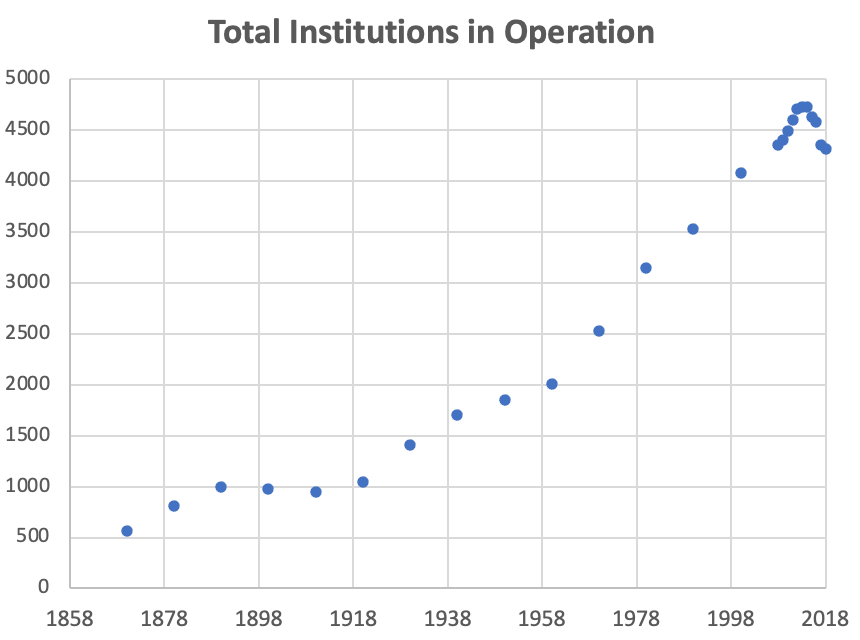
Fig 1, shows that the total number of colleges and universities rose rapidly from 1918 to 1998 but peaked around 2013 and has fallen since.

Data from Thomas D. Snyder, 120 Years of American Education: A Statistical Portrait, U.S. Department of Education, National Center for Education Statistics, 1993 (to 1970) and NCES Digest of Education Statistics, 2019 (NCES 2021-009) after that date

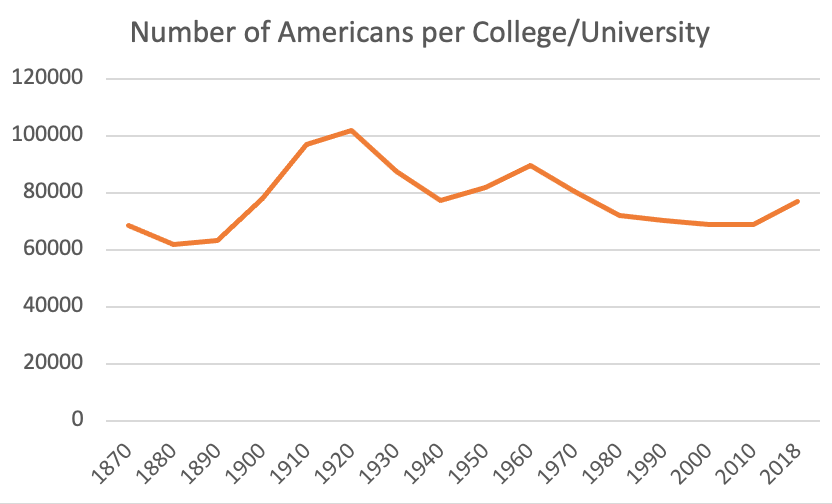
That graph does not adjust for population growth. If we value choice and innovation, we might like to see more colleges and universities per capita, which would mean fewer people per existing colleges (shown in my second graph).

The nineteenth century actually exhibited a worsening of this measure, because population growth outpaced even the rapid formation of new institutions. Much of the 20th century saw improvement, although the number of new institutions could not quite keep up with the Baby Boom in the 1960s. Of late, we have seen more people per college.

Same data as fig. 1, with population adjustments by author

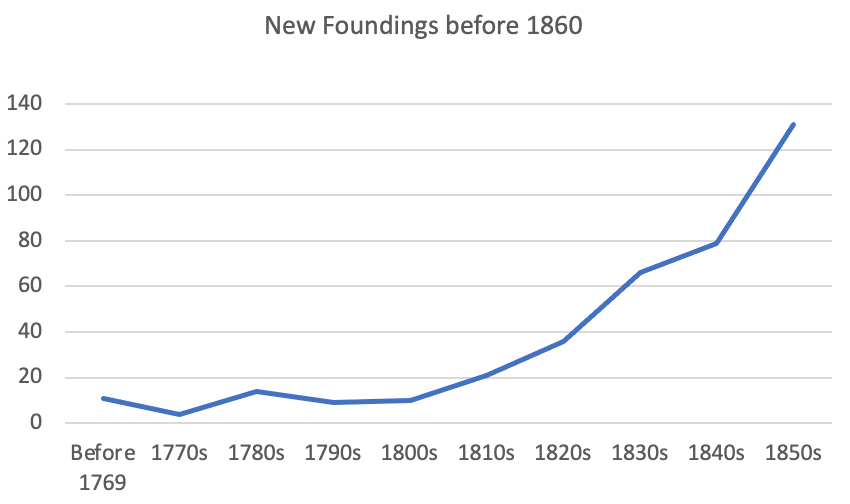
The total number of colleges and universities that are open in a given year doesn’t quite indicate the rate of foundings, because older institutions go out of business. Tewksbury (1932) estimated that four out of five antebellum colleges failed. I can’t find continuous data on new foundings for US history as a whole, but the third graph indicates a rapid increase in that measure from 1820-1860.

Data from Snyder, table 27

I would place University of Austin in that tradition. I am not enthusiastic about their diagnosis or plan, but I think it’s appropriate for disaffected people to start new institutions so that we (and they) can find out what their ideas would really mean in practice. That is how we got the array of colleges and universities that we see today, from Oberlin College to Liberty University, from UCF (with 66k students) to Deep Springs College (with fewer than 30), from Notre Dame to Naropa University in Boulder, CO. I’ve mentioned some outliers, but the overall trend is increasing similarity or “institutional isomorphism.” I’m for innovations that mix things up.

See also: the Harper’s letter is fatally vague; the ROI for philosophy; rationales for private research universitiesthe weirdness of the higher ed marketplacewhat kind of a good is education?; a way forward for high culture etc.

the ROI for philosophy

In Monday’s Washington Post, Jon Marcus writes that “one of the most basic measures of student success” is whether a degree in a particular subject “will provide [graduates] with the gainful employment they need to make it worth the price.” As an example of a bad outcome, he notes that “a philosophy degree from Oberlin costs $142,220 and graduates two years later make $18,154, on average.”

This fact comes from a study by the Foundation for Research on Equal Opportunity (FREO), which “conclude[s] that more than a quarter of programs — including most of those in art, music, philosophy, religion and psychology — leave students financially worse off than if they’d never enrolled.” I’ll raise a few methodological questions later, but first–how should we think about the values at stake here?

Preston Cooper of FREO writes:

This isn’t to say that lower-earning majors are worthless. Society needs artists and musicians. But low incomes for these majors signal a supply-demand mismatch. Universities are producing too many art majors and too few engineering majors relative to the number of jobs available in each of these fields. As a result, employers bid up the wages of engineers while surplus artists flood the labor market. The answer is not to eliminate low-earning majors nationwide, but to reduce their scale.

Many (not all) art majors want to be artists, and if artists’ earnings are very low, that suggests a problem. One solution would be to reduce the number of art majors. Another would be to expand society’s demand for artists (which doesn’t necessarily imply government funding for arts, although that could be one strategy). A third response is to expect artists to tolerate low pay–as we have long done. Which solution we prefer depends on how important we think art is for the society as a whole.

Liberal arts majors are different. Few philosophy majors, for instance, ever enter the job market for philosophy. They end up as lawyers, k-12 educators, business people, founders of LinkedIn–and of course, the proverbial taxi drivers who can quote Kant. The purely economic question is not whether we are producing too many historians, philosophers, and literary critics, but whether a liberal arts education has sufficient value in the general job market.

If philosophy majors get good jobs, that is because employers value clear writing and good reading skills, or because completing a liberal arts degree signals “cultural capital” and membership in an elite.

If, on the other hand, the data show that fields like history and philosophy produce low wages, that suggests two significant problems. First, if majoring in these disciplines is financially costly, they will be luxury goods that only wealthy families can afford–which is bad for the disciplines and unfair to young people of other backgrounds. Second, if we assign most of the society’s work of historical and philosophical inquiry and art criticism (etc.), to professors of those subjects, and if the number of jobs for professors is affected by the number of majors in their disciplines, then these social functions will be limited. We won’t get a very impressive culture under those circumstances.

We need philosophical inquiry, historical depth, cross-cultural understanding, and aesthetic excellence. Those ideals would not, by themselves, justify liberal arts majors that turn out to be costly for individuals. After all, there are other ways for a society to inquire into philosophical questions than to educate a very small number of undergraduates as philosophy majors. I am especially interested in strengthening the liberal arts outside of academia. (See a way forward for high culture.) We could consider organizing undergraduate education in ways that did not depend on majors. However, as long as we are not actually implementing any alternative strategy for producing excellent forms of culture, then poor financial returns to liberal arts majors would be a problem.

But is the empirical finding correct? The lifetime returns for a philosophy degree vary enormously by institution. According to the FREO study, majoring in philosophy at the University of Pennsylvania would net you a handsome $1,250,711 over your lifetime, but a philosophy degree from Loyola University Chicago would cost you $419,352 compared to not having a degree at all. From those two examples, one might hypothesize that philosophy pays at highly prestigious institutions, but if that’s a trend, it admits much variation. Philosophy majors from Illinois State do pretty well (ROI = $197,864), while graduates of the excellent NYU department are $259,265 worse off for having obtained a BA. This looks like noise.

One solution would be to combine the people with a given major from all universities. Apparently, 80% of philosophy & religious studies programs have negative returns if you remove financial aid and assume that students must pay the whole cost. But with a variance among philosophy programs of nearly $1.7 million–from very profitable to very costly–I am somewhat skeptical about the meaning of this aggregate statistic.

Also, the FREO study assumes (with some grounding in previous research) that 80% of the benefit of a graduate degree over a BA is attributable to the graduate degree. But it could be that majors in subjects like philosophy help students to obtain valuable professional degrees next. If that is true, the study underestimates their economic returns.

In any case, the economic question is not the only one to consider. To me, the really important question is how our society as a whole addresses ethical, interpretative, aesthetic, and conceptual matters. Offering liberal arts majors and using the revenue to fund scholarship in those disciplines is only one model. It may be a flawed one. But if it is flawed, we need better ways to accomplish the task.

See also: rationales for private research universities; the weirdness of the higher ed marketplace; David Brooks/Pierre Bourdieu; what kind of a good is education?

rationales for private research universities

The Atlantic’s Emma Green begins her interview with Princeton president Christopher Eisgruber by asking, “Why should Princeton exist?” He answers by talking about “talent.” He says, “the idea of a place like Princeton is that you can identify young people who have extraordinary talent and will benefit from an intensive academic experience. Over the space of years and decades, they will blossom in ways we can’t even predict, and they will be able to address problems that matter.”

In order to accept this rationale, you would have to accept some version of four controversial premises: 1) Princeton attracts talent, as opposed to various forms of capital (financial, social, cultural). 2) Talented people learn more at Princeton than they would at less selective institutions; they do not merely receive credentials with high market value. 3) Graduates of Princeton are trustworthy and accountable to other human beings. And 4) Social change depends on small numbers of talented people.

Persuasive evidence for these claims cannot be anecdotal. Eisgruber cites Justice Sotomayor, who is genuinely talented, probably learned a lot at Princeton (she talked about it when she visited Tufts), serves the public good, and wields influence as a Supreme Court justice. But one example does not make the case. What is the net impact of Princeton on society? (For instance, what is the impact of one Sonia Sotomayor minus one Ted Cruz?)

I would offer a different justification, cautiously because I think it only goes so far. You could call it “one cheer for Princeton.”

Justice is extraordinarily important. It is a contestable concept and it should be complex, encompassing various values that may not fit together comfortably. For instance, it should probably encompass both individual freedom of choice and also equity. Regardless of how you define justice, highly selective and fabulously endowed US universities are not likely to be consistent with it. That is why they should face constant pressure from democratic institutions as well as competition from public higher education and from other entities here and abroad.

But I don’t think that justice is the only good. Here I would also mention truth and beauty. Highly selective and well-funded universities generate a lot of those goods–and not only for their own members. As Eisgruber notes, five of this year’s Nobelists have Princeton connections, and their research is in the public domain. David Card’s work on the minimum wage is research that should promote both truth and justice. He conducted it with Alan Krueger while they were both at Princeton, which is a good example of the benefits of concentrating expertise. Princeton also produces beauty in the form of natural science and scholarship. At Tufts, we add a school of fine arts.

Although highly selective private institutions generate truth and beauty, they don’t–and shouldn’t–monopolize those functions. For one thing, public universities produce a vast amount of the same goods. (But US public universities are often effectively private institutions.) More importantly, truth must come from beyond the academy.

Indeed, universities have weaknesses as producers of knowledge and beauty (apart from their questionable impact on justice). They are not particularly good at valuing the ideas and insights that come from the margins of society. My job is to try to address that problem at Tufts and in some national networks. Whether I succeed is a different question, but I work on it every day. I think my underlying motivation is the belief that by combining the kinds of knowledge that come from places like Tufts and Princeton with very different kinds of knowledge, we might be able to enlighten and empower people beyond our walls.

See also how to keep political science in touch with politics; the weirdness of the higher ed marketplace; a way forward for high culture

Civic Studies at Tufts

In this summer’s issue of Jumbo Magazine (which is sent to prospective Tufts students), I say that Tufts offers “the best mix of experiential [opportunities], like internships and service learning, with academic rigor about civic engagement.”

In this public forum, I should apologize for my competitive claim. If other campuses do more or better than we do, that is good news. But I can elaborate on what I meant.

Virtually every US college or university offers experiential civic education, in the form of student-led groups, service placements and internships, and projects assigned in courses.

Meanwhile, all colleges and universities offer courses relevant to being an effective and responsible citizen, from “Intro to American Government” in political science to courses on specific social issues, to courses that help one to understand cultural identities and differences. Indeed, the liberal arts curriculum as a whole is civic education, if it is done well. (It can be civic mis-education, if it is done very badly.)

However, there is typically a gap between students’ civic experiences and the curriculum. When they are engaged in civic activities, students–like all human beings–usually interact with finite numbers of other individuals within voluntary groups and networks, formal organizations, or enterprises. As individuals and collectively in these groups, they make value-judgments: What counts as a problem? What would be a good outcome? They create and enforce (or undermine and revise) norms that influence their collective behavior. They work together in various ways, producing products and outcomes. And they face characteristic challenges. Some people may slack off, some may misinterpret the purpose of the group, some may mistreat others, and so on.

These issues are addressed in the curriculum, but in a scattered way and not as a major focus. One can learn about ethical judgments in philosophy, about free-rider problems in economics, and about voting procedures in political science. But a student would be hard pressed to identify these relevant aspects of many different courses from various disciplines and put them together.

Hence the Civic Studies Major at Tufts. Our introductory and capstone courses and the electives (including internships) are specifically designed to address the problems of acting together in voluntary groups. These problems have practical significance, and one can learn how to manage them from practical experience. But these problems are also intellectually complex, and one can learn from theory, history, and empirical studies. Our aspiration is put those forms of knowledge together.

See also civic education and the science of association.

how to keep political science in touch with politics

On the last day of the American Political Science Association’s Institute for Civically Engaged Research (ICER), Rogers Smith visited. As APSA president, he had played a major role in launching and inspiring ICER. Rogers offered original and thoughtful remarks to this year’s cohort. Some of what he said reminded me of his APSA Presidential Address, which is available on YouTube.

In that address, Rogers defines civically engaged research as “research done through respectful partnerships with social groups, organizations, and governmental bodies in ways that shape both our research questions and our investigations and answers.” Civically engaged research is not fieldwork or other qualitative or quantitative research about communities.

He justifies civically engaged research as a way of keeping in touch with important trends and movements in the real world:

While there are dangers, we modern political scientists have probably done too little civically engaged research, not too much. The work we have done has also been skewed toward groups with which researchers have strong ideological affinities. Though such rapport can be productive, as a discipline, we must learn from all segments of our societies. If more of us had been attending to the diversity of Black organizers in the 1960s, to anxious fundamentalists as well as assertive LGBTQ advocates in the 1970s, and to angry farm and factory workers in the early 21st century, we might have perceived sooner many major changes in American politics. And if more of us had actively worked with these groups to help them address their concerns and helped them in ethically defensible ways, then Black communities, conservative religious groups, gay activists, and workers and farmers might feel less suspicion and disdain toward academics than many do in the US today. The same may be true in other regions of the world. Intellectual honestly means I can’t guarantee that more civically eengaged research would have helped in these ways, but I know we didn’t do much, and in the light of where we are today, it is worth trying to do more.

I would add two points from my own perspective.

First, there is value in engaged research with (and not only about) right-wing communities and dominant communities. But this does not mean that individual scholars are obliged to conduct such research.

In practice, a disproportionate number of civically engaged social scientists identify with oppressed groups outside the academy, and that is why they feel compelled (as well as motivated) to work with these groups. Often scholars of color, they offer profound insights about the communities that they both study and belong to. No one should expect them to study right-wing whites (unless they want to). Instead, they offer insights from the perspective of the oppressed. For instance, I presume that scholars who are closely engaged with Asian-Pacific Islander groups knew about burgeoning anti-Asian hate well before it made headlines.

Yet we have much to learn from research conducted with conservative and/or demographically dominant groups. Years ago, I visited a prominent land-grant university to meet with the faculty who practiced “community-based” research. This university is located in a largely white and rural part of its state, but the faculty were driving to the nearest big city to do their engaged scholarship in urban neighborhoods that they admired more than their own geographical community. I thought that research about and with neighbors was a gap that should somehow be filled.

Second, the idea that an academic discipline must engage with movements and institutions challenges its self-understanding as a science.

In a simple model of science, facts result from good methods and data. You needn’t engage with planets or atoms in order to understand how they work; you can observe them or otherwise collect data about them. Within pockets, a similar approach to social science works well enough. You needn’t engage in a given election to crunch voting data and generate valid and useful findings about the election. But the human world is different from nature in two relevant ways–it is shot through with values, and it is influenced by intentional human agency.

Social scientists can choose to study many topics. Which questions to focus on is fundamentally a value-judgment, an assessment of what counts as an important issue or problem. Individual scholars are entitled to form their own opinions about priorities, but we are always wiser when we reason about values with other people. If our ears are open, we can learn about new injustices, new opportunities, and even new rights that we did not see before. In that sense, staying in touch–yet always critical–is essential for setting a wise research agenda about the human world.

Society is also unpredictable in a particular way. Human beings are aware of current trends and patterns. They can use their understanding of how things are going to make things look different in the future. They can invent, and no one can foresee a true invention until it arises.

Often, social scientists identify the central tendency in data, but data always come from the past. While we observe society, participants are busy working to disrupt it. History involves ruptures as well as continuities, and statistical social science is relatively badly suited to understanding the breaks. Sometimes, we can see substantial change coming better when we are closer to the action.

On a spectrum from a physicist who studies the eternal laws of the universe to a newspaper reporter who writes what happened yesterday and what it portends for tomorrow, a political scientist stands somewhere in between. History has long arcs but also many contingencies.

As Rogers Smith notes, the behavioral revolution has transformed political science. It presumes that political behavior has regularities that can be understood in a detached way. I believe that behavioral social science has yielded important insights. Yet this research reflects the Zeitgeist; it does not stand outside of history.

Today’s mainstream model of voters and democratic institutions is rather jaundiced. Data show that people lack the motivation and capacity to make well-informed judgements about public issues. But these data come from recent decades, when many organizations and institutions that inform and organize people’s thinking have become old and weak. If it were true that human beings never want reliable information about matters distant to their own private interests, then it would have been impossible to build professional journalism, or civic education in public schools–or even robust political parties that generate social analysis. While those institutions were being built up, the academic discussion of democracy was quite optimistic. (See: Dewey, John.) Now that those same institutions are in decline, the empirical evidence suggests that voters are incapable of forming thoughtful and independent opinions. This whole research paradigm reflects its context, and the context can change. But change requires engagement.

See also: don’t let the behavioral revolution make you fatalistic; why political science dismissed Trump and political theory predicted him, revisited; methods for engaged research; civically engaged research in political science #APSA2019; we should be debating the big social and political paradigms; Participatory Action Research as Civic Studies.

the weirdness of the higher ed marketplace

Princeton has $2.86 million in endowment per student, which would yield about $140k per year in interest for every undergraduate. Princeton could charge no tuition if its goal were to maximize accessibility. On the other hand, Princeton received 32,000 applications last year, so it could easily fill a highly-qualified class with people who could pay its full tuition price–or much more than that–if the university’s goal were to maximize tuition income. Princeton could also double or triple its size or create a new campus in another state or country if it wanted to maximize both accessibility and revenue.

Of course, a university sees itself as doing more than providing education. It also generates research, arts and culture, public service, etc. Every dollar that it collects from a student can go to those other purposes. But any endowment money that it spends on those other purposes could have gone to financial aid.

Meanwhile, prospective students also want a bundle of things, including prestige. Prestige comes with selectivity and sticker-price. Imagine you have a choice between paying the basic in-state tuition at UW-Madison ($10,725) or the same amount to Stanford after receiving financial aid. Stanford might look like a better deal, since its tuition sticker price is $55,473. It seems like you are being given $44k. However, it is unlikely that the marginal cost per student at Stanford is really 5.5 times higher than the cost at UW-Madison. More likely, Stanford knows it can charge a base tuition of $55k because many families will pay that much; and asking for less would be leaving cash on the table. Stanford with financial aid is arguably a better deal than UW-Madison’s full price, not because Stanford offers a better (or more costly) education in the classroom but because attending a college that is extremely selective and expensive looks better.

In short, the demand curve rises with price. The more other people pay for a given college, the more valuable it is to you, holding your own costs and the quality of the education constant.

It sounds as if college is a Veblen good, one that rises in perceived value the more it costs. But that logic does not exactly apply. If a college that regularly turns away 94% of its applicants decided to fill its seats with people who could pay full price, it would look less academically selective (as well as less diverse), and it would become less desirable. Many of the people who could pay to attend would now try to go elsewhere. In other words, if you pay full price, you are better off the more of your fellow students do not. Financial aid demonstrates that the college is selecting on criteria other than wealth. This is not typical of a Veblen good, which looks more desirable if only rich people buy it.

As Frank Bruni amusingly postulated, a college could win the prestige sweepstakes by deciding that no one was qualified for admissions. Bruni imagines the day when Stanford finally admits zero applicants:

At first blush, Stanford’s decision would seem to jeopardize its fund-raising. The thousands of rejected applicants included hundreds of children of alumni who’d donated lavishly over the years. …

But over recent years, Stanford administrators noticed that as the school rejected more and more comers, it received bigger and bigger donations, its endowment rising in tandem with its exclusivity, its luster a magnet for Silicon Valley lucre.

In fact just 12 hours after the university’s rejection of all comers, an alumnus stepped forward with a financial gift prodigious enough for Stanford to begin construction on its long-planned Center for Social Justice, a first-ever collaboration of Renzo Piano and Santiago Calatrava, who also designed the pedestrian bridge that will connect it to the student napping meadows.

One of the anomalies that Bruni is pointing to is that people who attended a college in the past now underwrite it voluntarily with their donations. Usually, you pay in order to obtain a good. Here, you get the good and then you pay for others to get it–in part so that it can be withheld from as many applicants as possible, thus raising its value even more on your own resume.

These are strange incentives ….

46 favorite reads on democracy, civic tech and a few other interesting things

open book lot

I’ve recently been exchanging with some friends on a list of favorite reads from 2020. While I started with a short list, it quickly grew: after all, despite the pandemic, there has been lots of interesting stuff published in the areas that I care about throughout the year. While the final list of reads varies in terms of subjects, breadth, depth and methodological rigor, I picked these 46 for different reasons. These include my personal judgement of their contribution to the field of democracy, or simply a belief that some of these texts deserve more attention than they currently receive. Others are in the list because I find them particularly surprising or amusing.

As the list is long – and probably at this length, unhelpful to my friends – I tried to divide it into three categories: i) participatory and deliberative democracy, ii) civic tech and digital democracy, and iii) and miscellaneous (which is not really a category, let alone a very helpful one, I know). In any case, many of the titles are indicative of what the text is about, which should make it easier to navigate through the list.

These caveats aside, below is the list of some of my favorite books and articles published in 2020:

Participatory and Deliberative Democracy

While I still plan to make a similar list for representative democracy, this section of the list is intentionally focused on democratic innovations, with a certain emphasis on citizens’ assemblies and deliberative modes of democracy. While this reflects my personal interests, it is also in part due to the recent surge of interest in citizens’ assemblies and other modes of deliberative democracy, and the academic production that followed.  

On Civic Tech and Digital Democracy

2020 was the year where the field of civic tech seemed to take a democratic turn, from fixing potholes to fixing democracy.

MISCELANEOUS

Finally, a section as random as 2020.

As mentioned before, the list is already too long. But if there’s anything anyone thinks should absolutely be on this list, please do let me know.

navigating the disciplines

In a year of virtual orientations, I made a video to help inform Tufts undergraduates who may be thinking about what disciplines to explore as they choose courses and–later on–majors. I addressed “civically engaged” students: those who want to improve their communities, nations, and the world and are trying to decide what academic disciplines might help them to do that.

My presentation is not argumentative or judgmental in the sense that I advocate some disciplines over others. But I do impose an organizational scheme with classifications and generalizations that would probably be controversial. For example, I say what I think a “science” is and why the social sciences are scientific. I acknowledge that these definitions are personal and contentious, but they might make the video interesting for some people beyond Tufts.

my thoughts for students as we move online

Like many other universities, Tufts has decided to close physically for the semester and switch to online education. I am sure my colleagues across the country are discussing this shift with their students as they meet for the last time this week–or virtually, if students have already dispersed.

This is what I’m saying. The text is “open source” in case anyone wants to copy some of it, although I’m sure my colleagues will want to say different things or make similar points better.

First, I am disappointed that we will not meet again in person. I thought the conversations were fascinating and compelling. I have been impressed by your commitment and intellectual and emotional investment.

For my part, I was committed to continuously improving the class. We recently made a shift to more small-group discussions, and I would have sought to make more such changes. My goal would have been to end the semester very strong, better than we began it. It frustrates me to have to move into a kind of triage mode.

But we need to do the best we can. The point is to give you the best learning experience possible under the circumstances, which will vary from person to person and over time. Of course, that’s always supposed to be the point. A college class is not a transaction, with you doing what the professor wants in order to get a grade. It’s always supposed to be a joint creation with the objective of learning. Now we’ll really have to accomplish that together.

Usually, students want predictability. A syllabus nowadays looks almost like a contract: you do this, I will do that, and the results are guaranteed. I don’t think we can be predictable this semester. Who knows how many of us (if any) will be directly affected by the disease? Or whether videoconferencing platforms will hold up under the strain? On the bright side, I assume that professors and teachers will invent successful new strategies that will go viral. We don’t know now how we’ll teach and learn in April.

In the absence of predictability, we need communication. It’s your responsibility to share feedback and ideas with me–especially since we will not be meeting face-to-face. I can’t know what you are experiencing or how you assess the course unless you tell me.

I assume that your circumstances and responses will vary. Some may find it hard–for practical and/or emotional reasons–to participate in various ways. But some may be bored and frustrated that they’re not learning enough during one of only eight semesters of a conventional undergraduate education. I need to hear from you, wherever you stand.

I cannot customize perfectly because I have more than 50 students and more than 20 advisees, plus other responsibilities beyond teaching. However, we can differentiate the experience to some extent. We can add optional activities for students who want more and make accommodations for those who are struggling to keep up.

As always, assigning grades is an inevitable task, and I’m not saying that everyone will get an A because of the circumstances. Still, I am hoping that, even more than usual, we can put the assignment of grades somewhat aside and focus on maximizing the learning for everyone. Your responsibility is not only to try to learn but also, to the extent possible, to help others to learn. Those are the two overarching criteria of assessment. We will succeed if we co-produce this class and fail if we give up on it.

With all that being said, my current plan is to form you into groups of 4-5, with changing membership each time. Those groups will hold videoconferences during each of the scheduled class times. I will provide detailed discussion questions with suggested allocations of time for each topic. Each group will write succinct overview notes on a shared document. I will comment substantively on that document when I see places to weigh in. Individual writing assignments will remain the same as on the syllabus.

Now and throughout the semester, suggestions and critiques of this plan are not only welcome, but expected.

how have political science and k-12 civics diverged?

It’s risky to generalize about k-12 civics. In the USA, there are no national standards for civics, state standards tend to be incoherent and not firmly enforced, and textbooks divide the market. Some teachers in some classrooms present highly critical accounts of US politics. Others are committed to American exceptionalism and celebratory narratives. The whole woke-to-MAGA spectrum is represented.

Many k-12 teachers try to avoid adopting positions in the classroom by presenting only hard facts about the constitutional process or by organizing deliberative discussions in which many perspectives are honored. Yet even an ostensibly neutral approach must reflect choices about the most important questions, topics and themes.

It is also risky to generalize about the discipline of political science, which encompasses more heterogeneous subfields than most disciplines. Whole subcultures of political scientists strike me as pro-regime, while others are radical. (See this post for some observations about the balkanized profession.)

But I’d still tentatively hypothesize that the center of gravity in political science stands apart from the center of gravity for k-12 civics, especially if we look at mass-market textbooks and state standards documents for evidence about civics. And I’d suggest that these are the three main gaps:

  1. Political science has haltingly recognized a wider range of perspectives on American political history and institutions, giving more attention to women and people of color as political thinkers and critics. That has meant more attention to critiques of the US system, but also alternative ideals and visions of progress. Again, this generalization ignores woke high school teachers and conservative or traditionalist political science professors, but I’d still venture the generalization.
  2. Political science has widely embraced versions of the New Institutionalism. I have written a primer on that movement, but in essence, it finds that institutions rarely operate as intended because they have their own logics and incentives. This means that it is unlikely that the US government would work as its authors planned. James Madison was an early and brilliant institutionalist who designed constitutional provisions to prevent certain kinds of corruption and failure. But the New Institutionalism has vastly expanded the list of threats, and few political scientists would argue that the US Constitution’s design addresses all these threats in a satisfactory way. Much of the high school curriculum is designed to teach students why the framers designed our system to work as it does. Many political scientists would emphasize that it does not, and could not, work as intended but rather faces serious perils. By the way, here I am not referring to intended “features” of the original Constitution, such as white-male dominance. I am referring to unforeseen “bugs.”
  3. Political science has experienced the behavioral revolution. Human beings evolved to make decisions without full consideration of relevant facts and information, employing heuristics and biases and rationalizing our biases with cherry-picked reasons. It’s common in civics curricula to present a model of the citizen as an independent thinker who decides on the best policy and chooses the candidates who come closest to those views. At least according to political scientists like Achen & Bartels (Democracy for Realists, 2016), this model is a myth. Citizens inevitably join up with large groups and vote to demonstrate loyalty to their groups.

The solution to this gap is not to move k-12 civics all the way to the center of gravity of professional political science. For my taste, the professional discipline is too cynical, not sufficiently normative or interested in problem-solving. Exposing students to cutting-edge political science is unlikely to make them more active and efficacious citizens. A big dose of New Institutionalism plus Behaviorism could kill anyone’s interest in politics unless the insights of those movements can be combined with some creativity and optimism.

At the same time, to ignore the findings of modern political science is increasingly untenable. We need new combinations.

See also: don’t let the behavioral revolution make you fatalistic; the New Institutionalism, deliberative democracy, and the rise of the New Right; on teaching the US Constitution; is our constitutional order doomed?; we should be debating the big social and political paradigms; and constitutional piety.