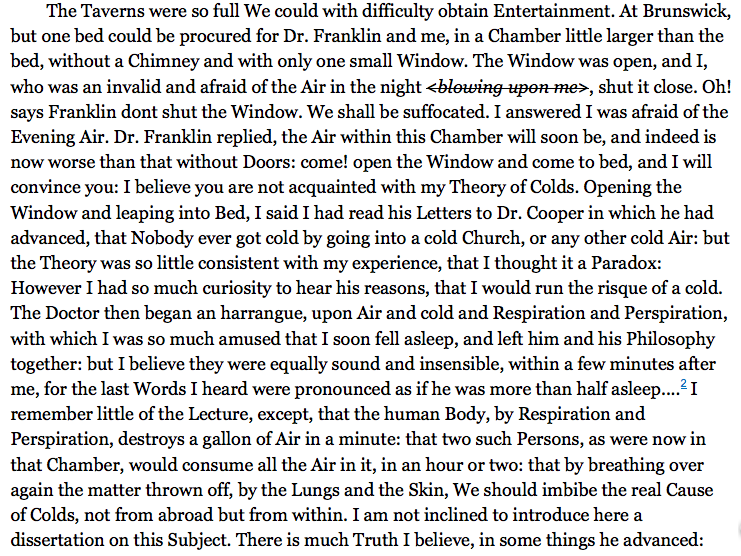
In which Ben Franklin and John Adams sleep together and bicker about whether to keep the widow open. Or, Men of the Enlightenment apply the Faculty of Reason to the Vex’d and Perennial Matter of Bedroom Ventilation:
(etc.)

In which Ben Franklin and John Adams sleep together and bicker about whether to keep the widow open. Or, Men of the Enlightenment apply the Faculty of Reason to the Vex’d and Perennial Matter of Bedroom Ventilation:
(etc.)
National attention has turned to political debates and conflicts at one flagship Land Grant state university and one Ivy League. Mizzou and Yale exemplify the whole higher education system, which is a political flashpoint–for good reasons.
On one hand, universities are designed to stand somewhat aside from the political/economic system, to be independent of the usual power structures, and to supply, teach, and encourage critical analysis. On the other hand, they are absolutely pivotal to maintaining the political/economic system that exists, with all of its flaws as well as its virtues.
Racism is the main topic of the current activism. I fully concur with the importance of racial injustice on campuses. (See Jelani Cobb‘s summary, although Conor Friedersdorf‘s response is also valuable and not diametrically opposed.)
If you want a detailed, sophisticated, critical view of racism in America, higher education is one important place to find it. Many faculty share the critical diagnosis. And the most prestigious universities supply some of the most sophisticated and trenchant criticism.
At the same time, only 4 percent of full professors in America are Black. Young White adults are twice as likely to have a college degree as young African Americans (40% versus 20%), due to an accumulating series of racial gaps in k12 promotion and retention, high school graduation, college admission and retention, and on-time graduation. Their lower college graduation rates are one indication of a generally less supportive and satisfying educational experience for students of color. Given the demographics of faculty and students, the culturally dominant group is almost always White, and they have the whole symbolic heritage of the universities behind them. Finally, these institutions exist in blatantly unjust larger communities. Mizzou is the flagship university of the state that encompasses Ferguson. Yale is in the heart of New Haven, where the NAACP reports that 25% of Black families live below the poverty line, 18.9% of Black children have asthma, and no public school sees more than 28% of its graduates achieve a college degree.
Racial issues are thus unavoidable and supply telling examples of the contradictions built into higher education. But the contradictions extend further. For instance, if you want a trenchant and sophisticated critique of Wall Street, an excellent place to look is in the classrooms and journals of the finest American universities. One stream of critique is economic, but you can also find critical views of the culture, psychology, and even the aesthetics and spirituality of 21st century capitalism. An institution like Mizzou or Yale is designed to be safe from the incentives and pressures that dominate contemporary capitalism so that it can provide an independent view; hence the rules that govern tenure, academic freedom, etc.
Yet these institutions produce the people who actually take over and profit from contemporary global capitalism. The financial services industry employs more members of the Yale class of 2013 (14.8%) than any other other field. Consulting employs another 11.6% of that class. Many more Yalies apply to but don’t get Wall Street jobs right away. And of the 18.2% who go straight to graduate school, many are heading to finance via law school or business school. From a different perspective, we can say that Wall Street is dominated by graduates of institutions like Yale.
So these colleges select the global economic elite, disproportionately choosing the children of the current elite. They expose them to four years of critique of the global economic system–some of it very gentle and subtle, and some fairly blatant. Students see implicit alternatives to contemporary capitalism when they study Dante or Buddha in a seminar room, and they get direct criticisms in social science and philosophy classes. These experiences probably sharpen their minds and skills before they proceed in disproportionate numbers to take over the dominant political/economic institutions of the world and to fund the universities that chose and prepared them so well.
All kinds of odd practices and situations arise. For instance, Yale has $2.4 million of endowment per student, sufficient to generate about $112,000 of annual revenue per student. Given Yale’s faculty/student ratio of 6.1:1, that means the university gets about $683,000 per professor per year from its endowment funds. Yet it charges the students a sticker price of more than $50,000 and constantly solicits its alumni for donations to make enrollment affordable. The institution presents itself as a tax-deductible nonprofit philanthropy devoted to light and truth, yet it is also a corporation with $23.9 billion in the bank. Many of its faculty see themselves as critics of the status quo, yet they work in an institution that replicates it.
I love these places. They have been very good to me–Yale more than any other institution. They have broadened my mind and given me whatever skills and passions I have for analyzing social justice. They create zones of debate and critique that are freer and more vibrant than most other sectors of our society, and they encompass more diversity than most of our neighborhoods and work sites. To the extent that we have any upward mobility, they provide some of the upward paths. They permit and even encourage the criticism that is directed at themselves. At the same time, they are pillars of social injustice. No wonder they stand in the crosshairs today.
Civic engagement is important to measure both as an intrinsic good and as a predictor of various desirable outcomes for the individuals who engage and for their communities and governments. Organizations–from individual schools and nonprofits to the Census Bureau and Corporation for National & Community Service–often ask survey questions that measure it. But there are many available survey measures, and organizations often wonder which ones to use and how to cluster them. Here is a simple table that produces six categories, with sample survey items for each.
| Citizens engage … | with each other | with institutions |
| by communicating |
|
|
| by acting/working |
|
|
| by forming relationships |
|
|
A few observations:
Notwithstanding the fiasco that is the GOP presidential primary so far, Matthew Yglesias warns, “The Democratic Party is in much greater peril than its leaders or supporters recognize, and it has no plan to save itself. … The vast majority — 70 percent of state legislatures, more than 60 percent of governors, 55 percent of attorneys general and secretaries of state — are in Republicans hands. And, of course, Republicans control both chambers of Congress.”
A major factor is the turnout gap. That is worse for Democrats in local and off-year elections but will persist in 2016. Today, the pollsters Greenberg/Quinlan/Rosner report that “unmarried women, minorities, and particularly millennials are less interested in next year’s voting than seniors, conservatives, and white non-college men are.”
Why do we see these gaps? On the whole, we engage in politics when we are brought into networks where political issues are regularly discussed and where people encourage each other to participate. This is a consistent finding of our own research on youth as well as much research on adults. Yglesias uses that theory to explain why unionized teachers vote in local elections:
Teachers talk to one another (they work together, after all) about questions of public policy (everyone talks at work about work, but public school teachers’ work ispublic policy), and they also have hierarchical channels of information dissemination (the union itself) through which this work talk can connect to practical politics.
(Yglesias is expanding on Eitan Hersh’s argument that “scheduling local elections at odd times appears to be a deliberate strategy aimed at keeping turnout low, which gives more influence to groups like teachers unions that have a direct stake in the election’s outcome.” Yglesias is contributing an explanation of why the union members vote.)
Let’s call participation in networks “social capital.” Since the 1970s, Democrats have lost social capital (of a politically relevant kind) and Republicans have not. The parties used to be on par, but the Republicans now have a meaningful advantage.
To illustrate, I show rates of regular religious attendance, membership in unions, membership in fraternal organizations, and a composite (defined as belonging to at least one of the three). The data come from the General Social Survey, which hasn’t asked about unions or fraternal associations since 2004. But in some ways, that’s OK, because I think the trend from 1970-2004 is the significant one, and the subsequent period has been unsettled because of social media and two high-profile presidential elections.
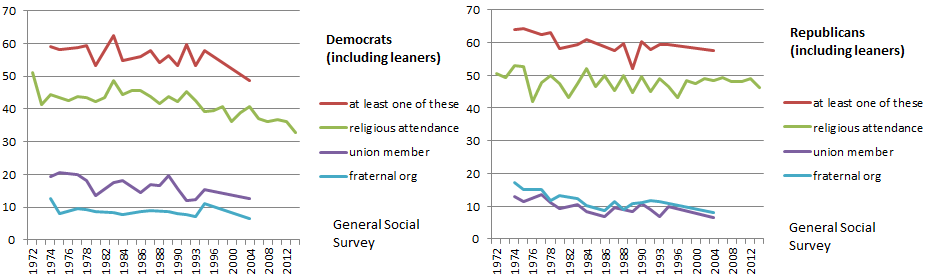
Observations:
Caveats: 1) These are only three measures of social capital, plus a composite of the three. There are certainly other varieties of engagement–but I selected the ones I thought were most important. 2) Democrats and Republicans are not fixed demographic groups with persistent members. It is not the case that people have remained Democrats but have become less likely to join unions or attend church. Rather, the American people have changed in various ways, and the subset that consists of Democrats who have social capital has shrunk. The trends shown above only tell part of the story, but I think an important part.
According to the Stanford Encyclopedia of Philosophy entry (by Joseph Heath) methodological individualism “amounts to the claim that social phenomena must be explained by showing how they result from individual actions, which in turn must be explained through reference to the intentional states that motivate the individual actors.” I find that I have written three blog posts that are critiques of methodological individualism from different angles. That makes me–I guess–an opponent of it.
In against methodological individualism, or why neighborhoods are not like broccoli, I proposed six reasons why not to treat the neighborhood in which a person lives as a variable that we can assign to the individual person as a causal factor. The neighborhood in which a person lives is neither straightforwardly the result of any individuals’ choices nor a factor that helps explain their actions. Rather, neighborhoods should be thought of as having their own place in causal models. The theorist who inspired these thoughts was Robert Sampson.
In more to life than individual attributes, I argued that we should study mechanisms, processes, and episodes as phenomena that we can generalize about and model, both as causes and consequences. If we always only try to understand rioters as individuals, we will miss what we could learn by studying riots as episodes. The theorists who inspired those thoughts were Doug McAdam, Sidney Tarrow, and Charles Tilly.
And in is social science too anthropocentric? I offered a short review of Brian Epstein’s The Ant Trap: Rebuilding the Foundations of the Social Sciences. One of the conclusions of this book is: “facts about a group are not determined just by facts about its members.” For instance, it is a fact about the Supreme Court that it upheld the Affordable Care Act, but that fact was not determined by the opinions and votes of 9 members. Many other factors came into play, including the actions of the individuals who had created, constituted, limited, and chosen the court.
Many would agree with these points, none of which are original to me. But still a lot of social science is methodologically individualistic, especially the research that is meant to influence policy. In quantitative studies, often the data is a matrix with an individual in each row and a variable in each column. Instead of individuals, the rows may be cities, zip codes, years, or events like crimes or purchases. Still, those are really means or counts that describe groups understood as aggregates of individuals. (For instance, the poverty rate in a zip code is the proportion of the resident individuals who are poor.) And qualitative research is very heavily about what person A, who has descriptive characteristics X and Y, says about topic P in context C.
I think we are missing much that we could learn if we treated not only groups, but places, episodes, and other phenomena as causal.
(Los Angeles) We made this announcement today on the CIRCLE homepage:
Much research by CIRCLE and others finds that civic activities have social, physical, and economic benefits for the young people who participate. For instance, volunteer service boosts academic success. Meanwhile, a growing body of research finds that the levels of civic engagement in a community as a whole are related to that community’s economic resilience, quality of education, and security.
This body of research has not so far focused on the specific question of whether engaging young people in civic activities improves social and economic outcomes for communities as a whole over time. We hypothesize that young people’s civic engagement is especially important for the economic vitality of their communities, and we will test that hypothesis using data from Chicago neighborhoods and national data for counties.
See also does service boost employment?, the benefits of service for low-income youth, and against methodological individualism or why neighborhoods are not like broccoli.
(Washington, DC) In a new article, Kei Kawashima-Ginsberg and I argue that discussing current, controversial issues is an effective way to teach civic skills and raise students’ interest in politics. Such discussions are relatively rare in schools that are “racially pluralistic” (having no racial majority), probably in part because diversity makes teachers and students wary of broaching controversy. Yet the benefits of discussion are strongest in just those schools. That may because the students’ diversity is an asset for good conversations, and also because planned discussions fill a gap in diverse schools that pervasively lack political conversation. Our article assembles the quantitative evidence for controversial issue discussions in racially pluralistic schools and offers tips for teachers and links to helpful organizations. See Kei Kawashima-Ginsberg & Peter Levine, “Challenges and Opportunities for Discussion of Controversial Issues in Racially Pluralistic Schools,” Social Education, vol. 79, no. 5 (Oct. 2105), p. 271-7 (or via Academia.edu.)
In The Atlantic, Robinson Meyer explains why Twitter seems not to be as fun or as socially satisfying as some other networks. He thinks it uncomfortably and unsuccessfully “smooshes” together aspects of oral communication (spontaneity, rapidity, and interactivity) with aspects of written communication (permanence, sharability, and the capacity to reach strangers). Meyer thinks that “the more visual social networks have stayed fun and vibrant even as the text-based ones have not. Vine, Pinterest, and Instagram don’t traffic in words, which can be reduced to identity-based magnum opi [that should actually be magna opera], but in images, which are a little harder to smoosh. Visual conversations have stayed chatty, in other words.”
Meyer’s theorists are Walter Ong and Bonnie Stewart, but there are also hints of Habermas in the article: Ong is quoted on the “human lifeworld,” and Meyer notes ways that the public and the private “get smooshed.”
A core Habermasian insight is that there are different norms appropriate to private and public speech.
In public, you must make arguments that can persuade strangers. You must therefore provide adequate reasons and explanations for everything you say. Since you can’t assume that strangers understand your assumptions and experiences, you must make them evident. You are accountable for your remarks and should be responsive to reasonable critiques. You should (generally) take the same positions when talking to different people. When Mitt Romney complained to donors about the 49% of Americans who were “takers,” but he didn’t want the 49% to hear him, he became one of many public figures who have been caught violating the norms of public speech.
In private, the norms are authenticity, spontaneity, and responsiveness to the concrete other people with whom you have relationships. You should (generally) say what you really feel in the moment, although you are also obligated to care about what the individual who hears you thinks and feels. That may require tact. You need not fully explain your thoughts, and your explanations certainly need not convey entire, self-sufficient arguments to strangers. You are not responsible for treating everyone alike. In fact, you are obligated to favor some people, the ones you love and who love you. You have a right to privacy, so if you are videotaped saying something that you wouldn’t want strangers to hear, that is a violation of your rights.
It is dangerous to confuse these domains, to “smoosh” the public with the private. Often, marketing and political propaganda consists of pretending to have an authentic private conversation while actually influencing strangers. Voters mistakenly choose candidates based on their impressions of politicians’ private lives, which are irrelevant at best and fictional at worst. Meanwhile, powerful people privatize the public sphere by making policy decisions on the basis of personal relationships and inventing spurious justifications or avoiding rationales entirely. Prying journalists and governments violate privacy. And sometimes ordinary people retreat from the public sphere and either take no positions at all or develop irresponsible positions on public matters because they can’t or won’t interact with strangers as if they were real decision-makers.
I am not sure, however, whether Twitter exemplifies the smooshing of public and private that worries Habermas. Twitter is a fairly flexible platform. You can use the 140 characters to address the public, although that will often require embedded links. Or you can use the 140 characters to keep your close friends informed about your social plans. You can develop a persona as a public person or as a private one. The two can be confused, and awkwardness can arise. For instance, as Meyer notes, disclaimers that “RTs do not constitute endorsements” are odd ways of distancing a Tweeter from the content. But it could be that Twitter is a useful vehicle for both public and private conversations, and the feeling of tension simply reflects the parlous condition of our public life, more broadly.
See also: Habermas illustrated by Twitter; protecting authentic human interaction; friendship and politics; Ostrom plus Habermas is nearly all we need.
Ohioans vote tomorrow on the Marijuana Legalization Initiative, Issue 3. It is like a stew composed of horrible aspects of our current politics–not legalizing pot, which is fine with me, but allowing rich people to buy public policy, governments to enable rent-seeking and oligopolies, political professionals to manipulate voters, and special interests to extract private benefits in return for enabling popular reforms to pass.
Issue 3 would legalize marijuana but restrict large-scale cultivation to the ten individuals who bankrolled the referendum. The outcomes for the people of Ohio may be better if Issue 3 passes than under the status quo, because ten may be a good number of licensed producers. Zero legal distributors is too few. Prohibiting marijuana creates an illegal industry that causes huge damage. Also, I am enough of a libertarian to believe that if consenting adults want to do something like smoke pot, the presumption should favor their liberty to do so as long as they follow laws protecting others. On the other hand, if anyone can grow and market marijuana, prices will fall and usage will rise, which will have serious consequences for public health. Licensing ten growers may inflate prices and allow the government to regulate the industry effectively–a good balance.
But the voters are not asked to approve ten licenses that go to the highest bidders. They are presented with the opportunity to give state-mandated monopolies to ten wealthy rent-seekers. It’s like the days when kings gave favored courtiers the royal privilege to manufacture specific items in return for gifts and favors. Only it is worse than that, because it enlists the voters in creating these monopolies. In On Revolution, Hannah Arendt noted that corruption was traditionally a sin of rulers, but with democracy, the people can for the first time be corrupted. Issue 3 is blatant yet typical effort to do that.
To their credit, Ohioans have also proposed Issue 2, which specifically prohibits any state amendment that “grants or creates a monopoly, oligopoly, or cartel, specifies or determines a tax rate, or confers a commercial interest, commercial right, or commercial license that is not available to other similarly situated persons.” If both initiatives pass, interesting litigation will ensue. But even if Issue 2 passes, this is really no way to govern.
See also: bottom-up struggles against corruption: a frontier of democracy and the Supreme Court reflects the “degeneracy of the times”.
The Washington Center for Internships selects the annual New York Life Higher Education Civic Engagement Award, and the 2015 award went to us at Tufts University along with Dominican University, John Carroll University (Ohio), Rutgers University-Camden (N.J.), and Weber State University (Utah).
These institutions are all wonderfully different, and the award emphasizes the many ways that colleges and universities can educate their own students for citizenship and strengthen public life in America.
At Tufts, we have two distinctive advantages.
First, we have elevated civic engagement to a high institutional priority. Unlike a typical school of public policy or public affairs, the Tisch College of Citizenship & Public Service at Tufts is charged with reaching all the students and faculty of the whole university, regardless of their majors, degree programs, and disciplines. And unlike a center for public engagement or service, the college has a dean who serves as a peer with the deans of Arts & Sciences, Medicine, and the other Tufts colleges and thereby influences the direction of the whole university. Tisch College is the epicenter of civic engagement at Tufts, collaborating closely with all the other schools.
Second, since we are a research university, we contribute to civic life by studying it and by conducting high-end research in collaboration with civil society. The award application asked for one example of a civic engagement program at each applicant’s campus, and we cited the Community Assessment of Freeway Exposure and Health (CAFEH) project. I’ve written about CAFEH before, but the essential points are that the idea came from community groups; they worked with Tufts on sophisticated, federally-funded science; and the results include not only more than 20 peer-reviewed articles but also local policies meant to address a really serious health problem (fine particulate pollution from highways). This is just an example, but it well illustrates how a research-intensive university can support civic life.
The blurbs on the other four winners are also inspiring and informative.