… because I am taking some time off and also because traffic to the blog is low in mid-August, as in past years.
The post blogging lightly this week … appeared first on Peter Levine.

… because I am taking some time off and also because traffic to the blog is low in mid-August, as in past years.
The post blogging lightly this week … appeared first on Peter Levine.
When we stand to affect another person or animal, at least four moral considerations seem potentially relevant:
The first consideration is relevant to all sentient beings in proportion to their capacity for sensation and experience. Perhaps a clam cannot suffer appreciably. But there is no reason to think that we human beings are the most sensitive of all creatures–or at least, not by much. And since the first consideration applies to most other animals, it is wrong to reduce their happiness or increase their suffering.
A more difficult question is whether a sudden and painless death reduces happiness. On one account, the net of a creature’s happiness accumulates like a running tally over the life-course. In that case, a painless death freezes the score permanently in place, which can make the total higher than it would have been if the future would have been less happy than the past was. A different views is that a creature has no happiness or suffering at all after death, and therefore death has no impact on happiness. In Epicurus’ phrase, “Death is nothing to us.” I am dissatisfied with both views but not sure that I have a better proposal. Certainly, happiness has a temporal aspect, because suffering on one day lingers on the next. But I struggle to say what impact ending a life has on the creature’s happiness.
The second consideration depends on an ability to make meaning or sense of one’s life and to make consequential choices according to one’s sense of purpose: in a word, “agency.” I am not committed to the premise that agency is a capacity of human beings alone, but we certainly have a very advanced version of it. Note that this capacity is temporal: we make meaning by putting our present state and our current choices in a longer narrative that includes a past and a future. One reason that killing a human being is badly wrong is that it ends the narrative that the person is constructing and thereby destroys her agency. I don’t think the same argument applies to the instantaneous and painless termination of the life of a chicken.
The third consideration–naturalness–seems to apply most to creatures that are not human beings. If possible, a bear should be left alone to live as a bear. Our family dog would not be better off if he were left in the woods to fend for himself like coyote, but he should be able to live the life natural to a domesticated dog, with activities like walks and cuddles. And as for a cow–I am inclined to think that its natural state must include time grazing in a field and nursing a calf. I am not sure that suddenly being slaughtered violates its ability to live a natural life. That means that factory farming is unacceptable but family farming may be consistent with respecting the natural states of farm animals.
As for human beings, we are also natural creatures in the sense that we are an evolved species with many innate limitations and tendencies. But we are capable of reflecting on the whole range of our inherited traits and distinguish the better from the worse. We have a natural proclivity to altruism but also to aggression, even to rape and murder. For us to live according to nature is not nearly good enough. We build institutions and norms to change our inherited natures for the better. That forfeits a right to live naturally and makes the third consideration irrelevant to us.
The fourth consideration applies to any animal that cares for another. In the old Disney cartoon, the death of Bambi’s mother deeply hurt Bambi. Although the cartoon anthropomorphized its animal characters, Bambi’s emotional reaction seems plausible enough for a deer. Still, people may be unique in that our relationships with other people are mediated by language and other forms of communication. We can suffer–or have our sense of purpose and agency frustrated–by learning of the death of someone we have never even met. In contrast, if Bambi had not directly experienced his mother’s death, he wouldn’t have suffered from it.
Freedom is certainly a moral consideration as well, but for human beings, it has a lot to do with #2 (purpose and agency), whereas for animals, it is related to #4 (naturalness). For a person, to be free is to be able to live according to her own sense of purpose. But a bear is free if it’s left alone to be a bear.
What all this means: Intentionally causing the suffering of another creature is always wrong, albeit a wrong that should be balanced against other considerations. Reducing the ability of a non-human creature to live naturally is also a wrong, at least ceteris paribus. But that is a complex question when it comes to farm animals. Killing a person is a special evil because it not only causes suffering but it ruins the purpose and agency that came from that person’s ability to plan and foresee the future. Furthermore, the impact on other human beings of killing a given person is particularly deep and widespread. This is one reason that it is badly wrong to kill even a human being who does not have much agency, such as a neonate. Killing an advanced animal painlessly and suddenly (beyond the sight of its kin) does not necessarily violate considerations #3 or #4. It may violate #1, depending on how we understand the temporal dimension of happiness and suffering. And it may violate #2, but only to the degree that other advanced species have capacities for long-term planning.
See also my evolving thoughts on animal rights and welfare.
The post latest thoughts on animal rights and welfare appeared first on Peter Levine.
I like to post every work day (this is post # 2,978 since 2003), but I will be on vacation and trying to be off digital media until August 17.
The post on vacation appeared first on Peter Levine.
(This was written in Lviv,  but posted in Cambridge, MA).
We all receive moral and political inheritances. Although the stories of our ancestors are not equally attractive, we all have exactly the same responsibility: to recognize our whole birthright, to address the shameful parts, and to use the best aspects of our histories to improve the human condition. I observe influential Ukrainians doing that very well right now, while the leaders and dominant voices in Russia do it very badly. And that is why I believe it is essential that Ukraine prevails.
1.
Seamus Heaney’s narrator seeks admission to the “Republic of Conscience.”
At immigration, the clerk was an old man
who produced a wallet from his homespun coat
and showed me a photograph of my grandfather.
Note: the immigration clerk does not show a picture of the would-be entrant, but rather of her or his grandfather. The photo symbolizes the past that we each must carry–both for good and ill. We cannot shed that inheritance without also renouncing all the other ways that our past has shaped us, including even the language with which we think.
The past also gives each of us gifts, and conscience demands that we offer them to humanity:
The woman in customs asked me to declare
the words of our traditional cures and charms
to heal dumbness and avert the evil eye.
It is tempting for an outsider to evaluate the inheritance of a given people and to draw comparative moral judgments about them as a whole group. Canadians born a few miles north of the US border are dealt a hand without the cards for slavery and genocidal settlement that I carry because I was born not far south of that same border. In that sense, at least, the Canadian inheritance is better.
I am not a relativist; I would insist that some political histories and cultures are superior to others. But there are two reasons not to focus on comparative judgments of this kind. If the inheritance of a people is largely evil (which I would not say of the US, by the way), it is too easy to ignore that people’s potential for doing good in the future. And if their inheritance happens to be largely innocent, it is naïve to assume that they will continue to act well once they obtain power.
2.
I have been visiting a country at war. To the east are people who call themselves “Russians.” They carry a thick book of history. One way to make sense of it is to say that the story began in the late 800s in Kiev. That does not imply that Kiev rightly belongs to Moscow today (the reverse would actually be more logical), but some Russian nationalists have drawn that inference. In any case, what followed after Kievan Rus has been–in this version–a long story of patriotism, suffering, military valor, victory under strong rulers, defense of Orthodoxy and other orthodoxies, and resistance to the decadence of the west and south. This is Putin’s way of playing the mixed deck that history handed him.
But it is not the only way. One could tell a story in which the diverse peoples who live within Russia are constantly being oppressed by bloodthirsty rulers from the capital, yet they show a special gift for turning their suffering into witness, resistance, and empathy. Then the best cards in the hand show Decembrists, Turgenev and Pushkin, and Akhmatova and Sakharov, and the worst show Stalin or the Tsars.
Ukrainians have also been dealt a vast and varied deck. One would have to give a different list for any Ukrainian city, but Lviv has been part of at least the Halych-Volyn Principality, the Kingdom of Poland and the Polish-Lithuanian Commonwealth, the Habsburg, Austrian and Austro-Hungarian Empire, the West Ukrainian People’s Republic, the Republic of Poland, the Soviet Union, the Third Reich, the Ukrainian Soviet Socialist Republic, and the Republic of Ukraine. Lviv can count among its famous citizens the Polish saint Józef Bilczewski, the German-Jewish-Israeli philosopher Martin Buber, the Austrian-American economist Ludwig von Mises, the Ukrainian national poet Ivan Franko, and Muhammad Assad, born Leopold Weiss, who translated the Koran into English and played a role in the founding of Pakistan.
A modern Ukrainian can play these and many more inherited cards in many ways—and can even decide whether or not to identify as a Ukrainian in the first place.
One important and influential group of modern Ukrainians views their inheritance thus: They are a pluralistic people, drawing from many roots. All of the residents of Lviv named above are part of the Ukrainian story. Ukrainians of all backgrounds have flourished best under governments that have been explicitly pluralistic, even when the center of gravity has lain far away, in the Polish-Lithuanian commonwealth or in Austria. That is one reason the European Union seems so attractive to Ukrainian protesters that some carried the EU flag into fatal conflicts with the police.
They also have a tradition of republican self-government that began in Kievan Rus, when the people held assemblies called veches to elect their leaders. The tradition reemerged in the Polish-Lithuanian commonwealth, the Cossack states, the late Austrian empire (when there was a Galician parliament in Lviv) and the two Maidan uprisings, when the impromptu meetings were again called veches.
Yes, some Ukrainians were complicit or even aggressively active in pogroms, slave raids, oppressions of serfs, the Shoah, and communist atrocities; but these are inheritances that the modern republic can explicitly acknowledge and mourn.
Meanwhile, I do not currently observe an influential movement of the same type in Russia, one that tries to make the liberal, pluralistic, and humane traditions of that country central while treating militaristic machismo as a threat to the Russian people and peace. A fine article by Karine Clément gives some insight into brave Russian organizers who are creating valuable spaces for democratic engagement; but the date of that article is 2008, and the subsequent seven years have been hard ones.
3.
The reason that liberals are influential in Ukraine and vanishingly marginal in Russia is not that Ukrainians are superior to Russians. No people is superior, and in any case, the differences in their current situations can probably be traced to local and recent contingencies, such as the greater efficiency of the Russian security and media agencies and the flood of petrodollars that fund them. But the fact remains that Ukrainians who are cosmopolitan, liberal, and republican hold considerable power in their country, and there is nothing similar right now in Russia.
It is a deep disappointment that, seven decades after the Second World War, so much of the world is dominated by regimes that are militaristic, authoritarian, and nationalist, devoted to the cult of the strong (male) leader, and content to combine kleptocratic crony capitalism with state repression. One could mention Xi Jinping, Nerendra Modi, Recep Tayyip Erdogan and many more along with Putin–and American voters are not immune to similar attractions. But Ukraine is a place where civil society has confronted the authoritarian wave and now has a chance to prevail.
And that is why I stand with the Ukrainian people and believe that their country is a front line in our era’s struggle for democracy and human rights.
The post why I stand with Ukraine appeared first on Peter Levine.
I am on my way tomorrow to Lviv and Chernovitsi in Ukraine, to co-teach the Summer Institute of Civic Studies and Civic Education there. This will be an immeasurably small contribution to what I think is a great cause: the work of the Ukrainian people in constructing a true civil society as the basis of a true democracy. If they can achieve that task in a portion of the former Soviet Union–after a period of kleptocracy and violent repression–they will be a beacon for the whole region.
I won’t blog while traveling but will report afterwards.
By the way, an AP wire story yesterday used my trip as its opening example of US “scholars drawn to conflict zones.” I must emphasize that Lviv and Chernovitsi are far from any violent conflicts. Many colleagues at Tufts (and elsewhere) actually meet this description: “people who should be getting on a plane to go to a country that’s in crisis.” When I said that phrase, I had in mind professors who fly to Sudan or Iraq and really make a difference there. I wasn’t talking about myself going to Western Ukraine to help lead a political theory seminar for a few days. But I am excited and grateful to be going.
The post heading to Ukraine appeared first on Peter Levine.
Civic Science is an emerging scholarly conversation, and today we held a discussion of it at Tufts. In my group, we agreed that scientists are not value-free but are indeed defined by certain values. We went back to the list of four values that Robert K. Merton identified in 1942. Per Wikipedia, those are:
These “CUDOS” norms emerge from the practices of actual scientists, yet they are aspirational. In fact, they may be rarely honored in a given population of scientists, but they would still reflect the ideals of science. They thus provide tools for the critical assessment of actual science.
We proposed adding:
The post adding democracy to Robert Merton’s CUDOS norms for science appeared first on Peter Levine.
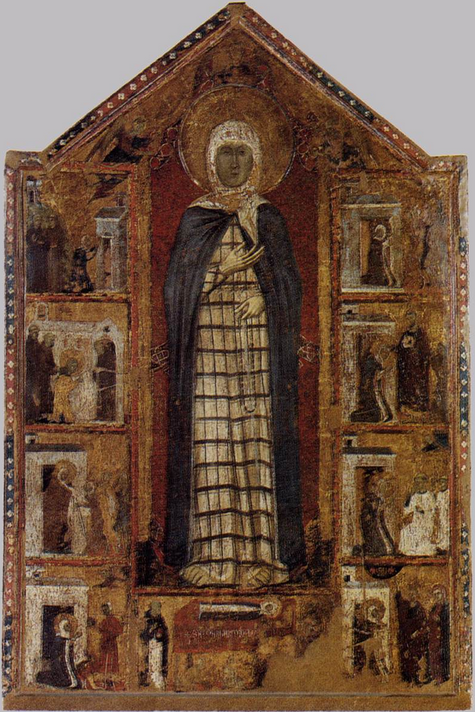
This is highlight #3 from our recent vacation in Italy. St. Margaret of Cortona was a remarkable person–more on her in a moment. The picture is a narrative of her life painted around 1298, or just one year after she died. She wasn’t canonized until 1728. In her own community of southeastern Tuscany, she was treated from the moment of her death (and perhaps even while she was still alive) as a saint to be venerated and depicted on par with St. Clare or St. Agnes. A major local church was immediately renamed in her honor, and her mummified body was placed under its altar. Those actions offer insights into medieval Catholicism, which was much more populist and decentralized than we assume on the basis of recent centuries of Church history and governance.
Margaret’ story would work for a novel (and has inspired an opera and a film). A beautiful peasant girl, she quarreled with her stepmother and ran away to live in sin with a nobleman in his castle. One day, his most loyal hound returned alone from the hunt and led Margaret to the scene of his death at the hands of a murderer. Deeply shaken, Margaret became a Franciscan sister, thus joining the most radical and compelling religious/political movement of the era. She swore personal poverty but may have used her ex-lover’s wealth for philanthropy; we know that she obtained the resources to found a hospital and a convent. No wallflower or passive penitent, she twice challenged the bishop of Arezzo for acting like a warlike lord instead of a man of God. Her example and the force of her thought and personality must have resounded powerfully.
The post St. Margaret of Cortona and medieval populism appeared first on Peter Levine.

This is highlight #2 from our recent time in Italy. Lucignano is a small medieval town in Tuscany, notable for its street plan of concentric ellipses capping a steep hill. During the middle ages, it was contested by larger city-states, but it sometimes enjoyed a degree of independence or civic freedom. It certainly had its own town hall and, within that building, a Sala di Consiglio or council chamber.
At first, this room was decorated by one large fresco of the Madonna in Majesty. If I recall correctly, the inscription under her picture reminded Lucignano’s leaders to listen to both sides of every dispute. Then, between 1438 and 1475, the town’s councilors contribruted personal funds to cover the ceiling with frescoes of exemplary figures from history, each labeled with a name, and most accompanied by an instructive quotation. “Virgil the poet” is shown above.
Christiane L. Joost-Gaugier offers excellent background information on this decorative scheme.* It was not uncommon to depict heroes from the past (often known as “worthies”) in public spaces. And there was a very famous model of a council chamber decorated with frescoes about good (and bad) government in nearby Siena. But the Lucignano frescoes were unique in that the list of exemplary figures came from a specific source, Dante, who also provided many of the quotations painted on the ceiling.
Dante held an elaborate political theory that I will not attempt to summarize comprehensively here. But it seems to me that Lucignano’s civic elders borrowed the following elements of his thought for their council chamber:
People who thought in this way were liable to see themselves as appropriate heirs to the republican citizens of ancient Rome, capable of self-governance, obligated to sacrifice for the common good, and committed to the same law that had prevailed in Rome. This room is a vivid illustration of the idea that civic republicanism flourished in late-medieval Italy and came to the Atlantic world from there.
*Christiane L. Joost-Gaugier, “Dante and the History of Art: The Case of a Tuscan Commune. Part II: The Sala del Consiglio at Lucignano,” Artibus et Historiae, Vol. 11, No. 22 (1990), pp. 23-46.
The post civic republicanism in medieval Italy: the Lucignano council frescoes appeared first on Peter Levine.
Below are my keynote remarks yesterday at …

The video is here:
I departed from the prepared text a fair amount in order to address the audience of civic innovators who had gathered in Austin. By the time I spoke, I knew more about their projects. These are the prepared remarks:
A presidential election cycle is a great civic ritual. Even though only about 60% of adults vote—when we’re lucky—a national campaign still touches most Americans in one way or another. It challenges us to consider fundamental issues. And it connects us to our political heritage, for many of the greatest moments in our political history have been presidential elections.
As the 2016 cycle heats up, what should we expect from this great national civic experience? What do we have a right to expect from the election?
I would say …
The campaign must engage all Americans, without respect to wealth, social status, age, race, gender, disability, and political and religious opinions.
It must give all Americans equal weight and importance, honoring the fundamental principle of one person/one vote. It must make our leaders accountable to the people as equals.
The campaign must provoke a serious conversation about the most fundamental issues facing us as a country.
It must enlist our higher instincts. It is absolutely fine for citizens to retain their diverse political ideologies and their various and conflicting interests. But we must all be reminded of the more generous and idealistic aspects of our own views and interests—or what Lincoln called, after the fateful campaign of 1860, “the better angels of our nature.”
During a national political campaign, Americans must have respectful interactions with fellow citizens who hold different views from their own. The goal is not consensus but mutual understanding and an awareness that we are all legitimate participants in one great political debate.
Some of our interactions must be personal, in the sense that we get to know one another and can actually reply to each others’ ideas—whether online or face-to-face. In other words, it’s not enough to relate to politicians and other celebrities by following what they say. We must also relate to one another.
Citizens must see ways of acting on their political values that go beyond casting a ballot in November, important as that is. If, for instance, you are moved by the problem of climate change or concerned about moral decline, the campaign should inspire you to reduce carbon or to restore traditional values by working with neighbors and peers. The act of voting should be just one of the political efforts that you undertake as a result of the election.
Finally, a diverse set of new actors must see openings to enter political life, whether as campaign volunteers and staffers, independent activists, or reporters, artists, and bloggers. Presidential elections are entry points for new generations of activists and leaders.
I have described a national election in rather glowing terms, but we all know that the reality falls far short.
In fact, many of my friends and colleagues who do civic work at the local level and in nonprofit settings don’t want to have anything to do with national elections. An esteemed colleague who works mostly with adolescents in an urban context recently remarked, “I have never seen anything big that’s good.” I suspect that the programs she admires are ones where human beings voluntarily relate to each other as individuals. They know the other participants’ names and interests. They can act and see the consequences of their actions. The problems that arise in these settings are problems of relationships—individuals being selfish or prejudiced or antagonistic. And so the solutions involve improving the relationships by talking and listening.
In contrast, a national election is impersonal and detached. It’s about millions of people. It’s about casting a secret ballot for a person you will never meet. The consequences of your individual vote are tiny. And the election is not really voluntary because it will yield a new president and a new Congress who will govern us—whether we like it or not.
If you see politics as impersonal—as a matter of mass voting by secret ballot—then I would recommend that you pay some attention to the settings where fellow citizens do come together to talk and work voluntarily. That is the relational bedrock of American democracy, and it is in weak shape. We need more of it. You should help support dialogues and deliberations, community organizing efforts, civic education in schools, community service programs, civic journalism, and new media. The movement to expand these programs is what I call “civic renewal.” It is important.
But if all you do is to create opportunities for voluntary interactions among people who know each other personally (or who can get to know each other), then I would press you to think also about the mass scale. It is not enough for us to build online communities and face-to-face discussions or service opportunities for a small proportion of the population. Decisions of enormous importance are being made every day by national governments and massive corporations. Even if you are not interested in them, they are interested in you. We must work at that level too. Otherwise, our efforts are just cute and nice; they are not real politics.
At the mass scale, politics is no longer relational. It’s not about getting to know people personally and influencing their ideas and values. It’s about leverage—causing other people to act from afar. A vote, for instance, is a small act of leverage. So is a strike or lawsuit.
Some people are busy at the grassroots level engaging with their fellow citizens, discussing issues, developing relationships, and working on important issues and problems. They are quietly rebuilding our civil society. The question is: Where can those good citizens obtain large-scale leverage in a nation of 300 million that has very rigid institutions? One possible answer is: during a national presidential campaign.
In fact, when the 2008 presidential election was first heating up, many of my colleagues saw openings to bring civic renewal into national politics.
First of all, both parties had competitive primary elections that year, so lots of the presidential campaigns were startups. They were eager to incorporate newcomers as volunteers or even as paid staffers and eager to experiment with new tools and methods. There were openings for newcomers to enter politics through the campaigns. Many of today’s younger civic activists cut their teeth working for a 2008 presidential candidate.
Second, because most of the campaigns were long shots to begin with, they were willing to try risky strategies that empowered their grassroots volunteers. They allowed robust discussions on their websites and let their volunteers develop strategies and methods that would work in their own communities.
Third, several of the campaigns offered genuine ideas about civic renewal. John McCain advocated a dramatic expansion of civilian national service, joining Senator Obama in New York on the auspicious and politically precious day of September 11 to call for tripling the size of AmeriCorps. That was a policy to enhance civic participation in America, and it was part of a larger message that also connected to Senator McCain’s service in uniform.
It is widely forgotten now, but John Edwards was committed to a national citizens’ deliberation on important policy ideas that would generate official federal legislation. That was a different kind of policy proposal—and also quite promising.
Finally, Barack Obama spoke about the citizen’s role in politics with more depth and commitment than any presidential candidate since Bobby Kennedy in 1968. That is my judgment, anyway, and I have written about it in some detail. Senator Obama made civic renewal a signature campaign theme. He developed various appropriate policy proposals, from transparency in government to expanded national service.
But perhaps more impressively, his campaign embodied his message of civic engagement in the way it organized itself. Grassroots volunteers were no longer asked to reach certain numbers of voters with scripted messages. Instead, they were trained to form relationships with people in their communities and to develop their fellow citizens’ leadership skills. They were given the power to create their own messages and were held accountable for the number of true relationships they built. This was a great example of a mix of relational politics and mass politics, and it carried Obama all the way to the White House.
Is the 2016 election another source of leverage, another opening for improving American democracy?
On the day after the election, November 9, 2016, some people will be happy. A candidate whom they admire will be the incoming president of the United States. I understand and appreciate their enthusiasm and do not want to rain on their parade. They will have worked for a cause and won it, fair and square.
Still, I think most of us will reflect back on the 2016 election and say: “That was a … [let me think of a word I can use at a polite forum at UT Austin] … that was a …. disaster!” Measured by all of the criteria that I mentioned when I began this talk, the campaign will look like an almost absurd failure, a travesty.
Will all Americans be engaged and will they count equally? Absolutely not, in an election cycle expected to cost $5 billion. A few individuals will personally contribute amounts in the hundreds of millions, and they will certainly count for more than you and me. Candidates are openly boasting of their success in lining up big donors right now, during what is openly called the “money primary.”
Also, the campaign battleground will be small, limited to swing voters in swing states and the very few competitive congressional districts. In vast states like Texas, voters will not be seen to matter much at all.
Will new people bring new ideas and energies into politics? Not, I fear, through the presidential campaigns, because the leading candidates on both sides are the opposite of startups. They are extremely experienced professional operations with little room for newcomers.
And while the innovations of the 2008 campaign involved empowering volunteers to develop their own messages and strategies, the main innovations since then have involved the use of Big Data to hone and test messages sent from campaign HQ to citizens. The whole point of these methods is to affect individuals in reliable and predictable ways—not to hear their views or empower them to act. The value of algorithms and data is rising; the role of volunteers is increasingly trivial.
Will we see a great conversation about the fundamental issues facing the country? I am sorry to say that also seems highly unlikely. In every modern campaign, so many factors direct the conversation into trivialities and distractions, not to mention fear-mongering and outright lies.
And this year, there is an additional reason to be skeptical about the national conversation. Realistically, a Democratic president will not be able to accomplish a domestic policy agenda in her or his first term, because Congress is almost certain to be controlled by Republicans. The most she or he can actually accomplish is to veto Republican legislation and negotiate the annual budget to the status quo. That means that the Democratic candidates must talk about what they would do if elected knowing that they actually cannot do very much at all. All the rhetoric from one side of the campaign will be basically false, which is not good for the discussion.
Republicans can be more genuinely ambitious but it remains to be seen whether any of them will put forward a serious platform.
Incidentally, the same situation applied in the 2012 election, which struck me as one of the least edifying dialogues in modern times. The televised debates between President Obama and Mitt Romney were dominated by each man’s saying: “You propose X,” and his opponent saying, “No I don’t.” They never got to argue about what they did support. The whole conversation was incredibly confusing and misleading.
Will the 2016 campaign touch the better angels of our nature and call us to work together on important problems in our own communities? I hope so, but again I am not terribly optimistic. Much of the $5 billion that will be spent in this cycle will be used to frighten and distract, not to inspire and empower.
Politicians always over-promise what they can deliver and try to persuade us that they will solve our problems for us. That is always a disempowering message. It will be worse than usual this time because few Americans really believe that national leaders can achieve anything significant, given the frozen political situation in DC. So the candidates will relentlessly exaggerate their own potential and thereby minimize the role of ordinary citizens.
I was asked to inspire you; that was my explicit charge for today. So far, I am doing a miserable job. I am painting a very depressing picture of the months ahead.
But I actually do intend an inspirational message. Imagine that it is November 9, 2016, the day after the national election. The official campaign, as waged by professional politicians and covered by the mass media, is just as I have predicted: a civic nightmare. But imagine that Americans do not wake up on the day after the vote and remark, “What a disaster!” Instead, imagine that they say, “This is the year that we the people reclaimed our political system. Yes, the candidates ran multi-billion-dollar campaigns using scripted, misleading messages to influence a few swing voters and demobilize their opponents through fear. But that is not the main story of the 2016 election. Despite the behavior of the candidates and their enablers among the donor class and the mass media, this election actually was a great discussion of fundamental issues. It actually did reach most Americans and it did inspire us not only to vote but to act in other ways to improve the world. We learned about each other and gained a measure of respect for our fellow citizens who disagree. We saw at least the dim outlines of true solutions emerge. We saw a role for ourselves in achieving those solutions. We still expect relatively little from Congress in the next months, but we expect a great deal from ourselves as a people. We are ready to step up to our responsibilities as a great self-governing nation.”
Why would that happen? In all seriousness, it would happen because of your work. It would happen because you have labored and innovated and collaborated. You have built apps and websites where citizens can genuinely discuss important issues with people who disagree. You have covered news in ways that bring out the real issues and engages diverse voices. You have empowered even the most disempowered Americans with tools and ideas and skills that reconnect them to politics and civic life.
None of you can accomplish that alone. The budget of each organization represented in this room is a tiny fraction of the weekly spending of one of the presidential campaigns that will be flooding the airwaves with fear and misinformation. But we can accomplish a great deal together and with the many willing allies who are not here with us today.
We need to find new ways to set common goals and collaborate effectively in our communities, holding ourselves accountable for common outcomes.
In Bolivia this month, Pope Francis reflected on the global impasse among political elites that is putting not just the US but the whole earth in danger. He said, “People and their movements are called to cry out, to mobilize and to demand – peacefully, but firmly – that appropriate and urgently-needed measures be taken.” He concluded his Bolivia speech by saying, “the future of humanity does not lie solely in the hands of great leaders, the great powers and the elites. It is fundamentally in the hands of peoples and in their ability to organize.”
These are great and timely words. We are unlikely to hear them from our most powerful politicians, but we can make them the inspiration for our own efforts. This is the year that we can take back American politics. It is up to us.
The post the year the people took back politics: a vision for 2016 appeared first on Peter Levine.
(Austin, TX) CIRCLE is reporting today that 19.9 percent of 18-to 29-years old cast ballots in the 2014 elections. That was the lowest rate of youth turnout recorded by Census data since the voting age was lowered to 18. The proportion of young people who said that they were registered to vote (46.7%) was also the lowest over the past forty years.
There was, however, a great deal of variation in youth turnout by state (e.g., 31% in Colorado and 15% in Texas). Since the degree to which a state had a competitive senatorial or gubernatorial race was strongly related to its youth turnout, one reason for the record-low may have been the shrinking number of competitive statewide races. Another reason could have been the slew of restrictive voting laws passed by many states between 2010 and 2013.
For more analysis, see the CIRCLE site.
The post 2014 set records for lowest youth registration and turnout appeared first on Peter Levine.