two degrees of Christopher Marlowe

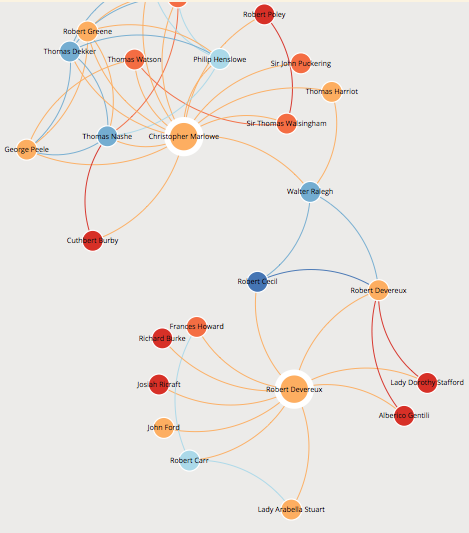
In The Reckoning (1994), Charles Nicholl carefully investigated the 1593 murder of Christopher Marlowe, arguing that it resulted from a struggle between the rival spy networks of Walter Raleigh and Robert Devereux (the 2nd Earl of Essex). It’s a compelling read and a brilliant use of scattered historical records to reveal hidden connections. But The Reckoning predated the current enthusiasm for actually mapping networks and crowd-sourcing the data. Now we have Six Degrees of Francis Bacon, a network map of documented figures from English history, 1500-1700. Using that tool, one can quickly create a map that shows the networks of Christopher Marlowe and Essex, with Raleigh appearing as an intermediary.

Screen Shot 2015-09-16 at 7.57.44 PM

The diagram is by no means complete. For instance, Thomas Kyd is in the database but not linked to his former housemate, Marlowe; and the man who probably stabbed Marlowe, Ingram Frizer, isn’t on the map at all. But that isn’t a criticism, for the organizers ask visitors to add data. How many more stories will come to light as the map grows and historians use it?

(See also the murder of Marlowe and my version of “come with me.”)

Q&A for Constitution Day

It’s Constitution Day. Thanks to an amendment included at the behest of the late Robert Byrd in 2004, every educational institution that receives federal money–from a kindergarten to a graduate school–must offer programs on this day that concern the Constitution. Eight years ago, I posed some gently subversive questions that could be the basis of a discussion on Constitution Day. Here are my questions again, with–for what they’re worth–my answers:

  • How, under our Constitution, can legislation be passed on the sole prerogative of one US Senator?

The Constitution leaves it up to each house of Congress to organize its own procedures. (Article 1, sec. 2: “Each House may determine the rules of its proceedings.”) The Senate can basically construct bills any way it wants.

There is no ideal way to legislate. Any parliamentary body faces a severe challenge in aggregating the opinions of its many members on the many topics that come before it. No legislature can discuss and separately vote on everything. Still, the Senate’s rules give an awful lot of power to individual members to insert provisions. I suspect the reason lies with the Senate’s filibuster rules, which make the passage of legislation extraordinarily difficult. To prevent even more filibusters than we actually have, Senators are allowed to slip in special provisions they especially care about.

Legislating this way is not “unconstitutional” in the sense of violating the text of the document. But we could say that in the broader meaning of the phrase “constitutional system,” our system includes the rules of the US Senate, which are very problematic.

  • How can Congress pass legislation without hearings or debate?

See above. But this second question underlines a particular disadvantage of the Senate’s rules: many decisions get no deliberation whatsoever. No teachers were asked to testify about the pros and cons of a Constitution Day mandate. Again, no process is prefect, but the Senate’s procedures seem to neglect the deliberative value that our constitutional order was meant to uphold: “the mild voice of reason, pleading the cause of an enlarged and permanent interest.”

  • Is it a constructive and appropriate use of federal power to determine the content and timing of educational instruction?

Strong conservative constitutionalists will say that Congress has no business in education at all, because education is not among the enumerated powers of Article 1, Section 8. Students should learn and consider that argument. For my part, I think we long ago rightly settled that the Congress may raise taxes and spend the money on education and may put certain conditions on the funding. I would especially argue for a federal role in supporting education for republican self-government, on the ground that this is “necessary and proper” for the survival of our system.

But that doesn’t mean that micromanagement from Washington is wise. To pick a day–right at the beginning of the conventional academic year–when every school (k-20) must teach the Constitution is a good example of meddling. It’s unlikely to yield positive results. Conservatives make a valid point that needn’t be rooted in an originalist reading of the Constitution: Congress should generally avoid micromanaging, especially in an ad hoc way, because it is too distant from local concerns, too likely to make one size fit all, and too remote from accountability. Characteristically, when the Senate passed a Constitution Day mandate, no one even dreamed of empirically evaluating the impact–whereas a school district that tried such an experiment might have to show that it was cost-effective and a “research-based best practice.” Congressional micromanagement violates the spirit of the Constitution, even when it passes legal muster.

Finally, I do think some good comes from the Constitution Day mandate. It gives an annual boost to the wonderful organizations that provide materials, lesson plans, and professional development for civics, and it yields an annual crop of articles and social media about civic education. Still, if I had to teach a lesson on Constitution Day, it might be about how the legislation that launched it is constitutional yet also problematic–so maybe we need some reform.

See also liberals, conservatives, and love of the Constitutionis our constitutional order doomed? and constitutional piety.

missing the civic empowerment messages of a Pope and a President

Michelle Boorstein compares the enthusiastic responses to Pope Francis in 2015 and Barack Obama in 2008 and collects several explanations for both:

  1. People have “an undeniable, sweeping affinity, a gut reaction to a new leader to whom we attach huge expectations …,  even though most Americans don’t know much about Francis.”
  2. “Does the pope’s all-embracing commentary, which seems to exclude no one, have particular resonance in an increasingly diverse country?”
  3. Does “Francis offer people hope of rescue with his confident proclamations about what needs to be done to fix the world? Cartoonists and graffiti artists have often drawn him as a caped superhero.”
  4. “Francis is an accessible father figure at the helm of one of the world’s largest organizations.”
  5. “People love the blank slate.”

Let me suggest an alternative. Both the president and the Pope talk explicitly about how we, active citizens, can and must address problems. These two men may have been caricatured as caped superheroes, but they are as clear as one can be that they are not the solutions to our problems; we are.

This was the main theme of Obama’s Springfield speech announcing his candidacy in 2007, an important note in his Grant Park speech on Election Night 2008, and a recurrent topic throughout the campaign. When he accepted the Democratic nomination in 2012, he put it concisely: “As citizens,” Obama said, “we understand that America is not about what can be done for us. It’s about what can be done by us, together through the hard and frustrating but necessary work of self-government.” I have collected many more similar quotes here.

As for the Holy Father, he said recently, “the future of humanity does not lie solely in the hands of great leaders, the great powers and the elites. It is fundamentally in the hands of peoples and in their ability to organize.”

I believe that people hear and are moved by these invocations of their power, agency, and responsibility. They do not treat Obama and the Pope as blank slates or as accessible personalities; they feel moved to take action.

Meanwhile, the press completely ignores these leaders’ talk of civic engagement. That theme was never covered in the 2008 presidential campaign, and no one mentions it when they cover the Pope. Obama’s critics especially misunderstand his civic appeal, thinking that it is narcissistic. (“We are the ones we have been waiting for” is literally misheard as “I am the one you have been waiting for”). And we see basically patronizing explanations of why these leaders strike a chord.

See also how to respond to a leader’s call for civic renewal; the encyclical Laudato Si and the power of peoples to organize; and Taking the President Seriously About Citizenship.

thoughts on the College Scorecard

collegecost

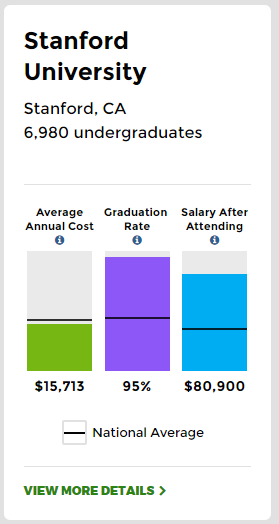
The College Scorecard began as a promise/threat to rate US colleges and universities, but for now, it offers some digestible nuggets of information on more than 3,500 institutions. The results for Stanford are shown to the right, as an example.

I like some things about this. Mainly, it tells a prospective applicant’s family not to be put off by the sticker price. Tuition plus room & board at Stanford costs $64,477, but the average student pays much less than that, graduates quickly, and earns a lot of money. That makes it a good deal (in strictly economic terms) for most people who can get in. In contrast, Cambridge College costs an average of $23,792 and yields an average salary of $36,500 for those who graduate–who represent two percent of those who enroll.

I have three main concerns. First, the average cost overstates the relevant price for a lot of students. Stanford completely waives the parental tuition contribution for families with incomes up to $125,000 a year and waives the whole cost for most families earning below $65,000 (which is about 60% of US households). The average cost is $15k because a lot of Stanford undergrads come from families in the very top tier of the income distribution. If you have a median family income, Stanford will probably be free.

Second, this kind of presentation can mislead about the business model. It can suggest that the real price of a Stanford education is $64k, but thanks to alumni gifts, the university subsidizes attendance for needy students (who, in this case, may be upper-middle-class). I think the following is closer to the truth: there are a lot of highly academically proficient students whose families can easily pay $64k and want to go to Stanford. Their kitchen counters cost more than a year’s tuition. So Stanford charges that much and uses the income to help subsidize all the operations of a research institution. It uses a sliding scale, however, so that all of its students aren’t rich. I don’t necessarily think this is wrong: it depends on how much public good comes from the research. But the numbers give a somewhat misleading impression of the financial model.

Third, the measure of “salary after attending” is very problematic if we see education as a public good. The lowest-paid majors for recent college graduates are “early childhood education ($39,000); human services and community organization ($41,000); studio arts, social work, teacher education, and visual and performing arts ($42,000); theology and religious vocations, and elementary education ($43,000); drama and theater arts and family and community service ($45,000).” A college that produces a lot of preschool teachers, clergypeople, and community organizers is going to score a lot lower on the measure of “salary after attending” than Stanford does. The average salary for recent Hampshire College graduates is $30,800, much less than half as much as Stanford’s figure, but it would be misleading to infer that Stanford offers more value than Hampshire.

“a different Shakespeare from the one I love”

“Kids today don’t appreciate Shakespeare.” That is a tired, perennial complaint. It is not the point that the eminent Shakespearean Stephen Greenblatt makes in “Teaching a Different Shakespeare From the One I Love.” In fact, he admires the way his students approach and use Shakespeare, but he notes two important differences from his own response when he was their age. First, his students are less likely than he was to identify with Shakespeare, to claim his works as part of their inheritance. And second, they are less likely to be moved by the language itself, “touched by the subtle magic of his words.”

Both observations resonate with my own experience. My father was, like Greenblatt, a Jewish-American academic who claimed the English 16th century as his birthright. Dad was perfectly well aware that his ancestors lived in Eastern Europe in Shakespeare’s time and that people like them were banned from–and hated in–England. But if someone had said that Shakespeare wasn’t really my father’s because he belonged to the English (or to gentiles), Dad would have taken those as fighting words. Like Greenblatt, he might have said that the renaissance heritage “was mine as if by birthright, for the simple reason that English was my native tongue. All that I needed to do was to immerse myself in it passionately.” And just as the literature of renaissance England was ours by virtue of our language, so the political heritage of the English revolution (especially its radical wing) was ours because of its influence on the American liberal tradition. In fact, I may have grown up with the shadow of an unspoken idea that Shakespeare and his age belonged most authentically to people like my father, because he had chosen to devote sophisticated critical attention to the texts. Someone with an English name and an English accent who operated an olde tea shoppe in Stratford-on-Avon was, by comparison, an interloper.

Although I recognize huge differences of context and circumstances, I would suggest a rough analogy to the special affection that many African-American Christians feel for the King James’ Version (KJV) of the Bible, which was the other great literary achievement of Shakespeare’s era. As Adelle Banks writes:

The Rev. Cheryl Sanders, an ordained minister and professor of Christian ethics at Howard University School of Divinity, said the KJV’s soaring language can uplift listeners, especially those who have been oppressed.

“It’s a loftiness to the language that I believe appealed to people who are constantly being told, ‘You don’t count. You’re nobody. You’re at the bottom rung of the ladder,'” said Sanders, who has written about black Christians’ use of the KJV. “If I can memorize a verse of Scripture, it gives me a certain sense of dignity.” …

“Although I think young black people are using other translations and finding them useful, we’ll always have a sentimental attachment to King James,” said [Rev. Joseph] Lowery, a retired United Methodist minister who marched with the late Rev. Martin Luther King Jr.

I would add that the KJV echoes throughout the great canon of African American writing, including, of course, the works of Dr. King: “Let justice will roll down like waters and righteousness as a mighty stream.” (Cf. Amos 5:24.)

Rev. Lowery notes a generational shift when he observes that “young black people are using other translations.” Greenblatt suggests two causes for the similar shift that he observes: a growing tendency to treat authors as alien if they are not demographically similar to the reader, and a shrinking sense of direct, affective awe in response to written poetry.

In assessing these changes, I would avoid polemic. Everyone can decide for herself whether to identify with–and claim–long-dead authors and how to respond to written words. Greenblatt’s students are responding to Shakespeare in creative ways that enrich the culture. I am not saying they are wrong. But I would offer two suggestions:

First, you can claim Shakespeare as yours if you speak English, whether it is a mother tongue or a second language. That is an authentic choice, even if your religion, gender, race, and national origin are very different from his. When presented with the Bard as a model, one political response is to say, “Shakespeare was an old white Christian man from the colonial power, and I am not.” A different political response is: “Shakespeare’s words are mine as much as yours, and if you deny my right to them, I will challenge you.” The latter is no less radical or potentially subversive. Which response to choose is a complex and personal matter, and I don’t object to either. I just want to suggest that the second option is available to anyone. And it may be the path less taken today.

Second, I worry that it is becoming increasingly difficult to hear the power and resonances of very fine written language. Culture is increasingly visual and oral, which expands our capacities in some respects but possibly weakens our ability to absorb the special power of the written word.

We are living at a time of incessant communication. By one estimate, more words were recorded in 2002 alone than in all of human history up through 1999. The increase since then has been exponential. Even the older formats are exploding in scale. About half a million new book titles are published every year in English, whereas about 147 books were licensed annually in England in Shakespeare’s day: a 3,400-fold increase. When communications arrive in a ceaseless deluge, it may require crude and explosive language to capture attention.

One source of literary depth and power is allusion. But in order for an allusion to work, the writer and the reader must know the same referents. An excellent reason to study Shakespeare and the KJV is that they have echoed so pervasively through such diverse texts. There are still millions who can hear those echoes, as others can hear Quranic references in classical Arabic or the Shijing reverberating in modern East Asian verse. But when new text is piped around the world by the terabyte, the chances fall that an audience will recognize any given referent. The most widely shared references are from contemporary mass culture, which tends itself to have thin resonances.

I was pretty absorbed and awestruck when I saw live Shakespeare as a child and as a teenager. The words themselves could bedimm the noontide sun and call forth the mutinous winds. I think that response is less likely today, not because the language has evolved so much further from Elizabethan English, nor because there is anything wrong with today’s kids, but because a child is exposed to a much larger quantity of professionally produced, highly emotional drama: constantly streaming videos of all kinds. A play has much more to compete with.

We also live at a time of manic linguistic invention and expansion, when new words and phrases seem to enter the language daily, often duplicating existing choices and overriding traditional grammatical constraints. (Witness the constant turning of nouns into verbs in business English.) Shakespeare’s time offers certain parallels. The volume of public speech and printed communication was expanding rapidly then as well, and English vocabulary was growing. It is often claimed that Shakespeare personally added 1,500 or 2,000 words to English. Those numbers may be exaggerated because older sources have been lost, and scholars search Shakespeare’s works for alleged coinages without always consulting other surviving texts that might use the same words. But there is no doubt that Shakespeare and his contemporaries shared our predilection for inventing words, mixing sources, bending genres, and breaking all putative grammatical rules.

But they had to expand their language. English wasn’t very old, and it needed a much larger store of words, phrases, and tropes to rival Latin. You can often sense a writer of Shakespeare’s day struggling to convey an idea that now seems very straightforward, just because we have more resources. Today we don’t lack words and phrases, but we struggle to hear the resonances of the ones we have. We turn the noun “impact” into a verb without exploring the possibilities of verbs that have histories, like “affect,” “change,” “influence,” “modify,” “transform” (and many more).

I am not committed to linguistic conservatism as a principle; languages change as a result of wonderful human inventiveness. I agree with Greenblatt that multimedia adaptations and mashups of Shakespeare can be fantastic contributions. Yet we can perhaps profit more than usual by slowing down and hearing the depths of our linguistic inheritance.

[See also “signal” (a poem on this theme) and the political advantages of organized religion, in which I note the political power of “Ezekiel connected dem dry bones” and its roots in the KJV.]

“a different Shakespeare from the one I love”

“Kids today don’t appreciate Shakespeare.” That is a tired, perennial complaint. It is not the point that the eminent Shakespearean Stephen Greenblatt makes in “Teaching a Different Shakespeare From the One I Love.” In fact, he admires the way his students approach and use Shakespeare, but he notes two important differences from his own response when he was their age. First, his students are less likely than he was to identify with Shakespeare, to claim his works as part of their inheritance. And second, they are less likely to be moved by the language itself, “touched by the subtle magic of his words.”

Both observations resonate with my own experience. My father was, like Greenblatt, a Jewish-American academic who claimed the English 16th century as his birthright. Dad was perfectly well aware that his ancestors lived in Eastern Europe in Shakespeare’s time and that people like them were banned from–and hated in–England. But if someone had said that Shakespeare wasn’t really my father’s because he belonged to the English (or to gentiles), Dad would have taken those as fighting words. Like Greenblatt, he might have said that the renaissance heritage “was mine as if by birthright, for the simple reason that English was my native tongue. All that I needed to do was to immerse myself in it passionately.” And just as the literature of renaissance England was ours by virtue of our language, so the political heritage of the English revolution (especially its radical wing) was ours because of its influence on the American liberal tradition. In fact, I may have grown up with the shadow of an unspoken idea that Shakespeare and his age belonged most authentically to people like my father, because he had chosen to devote sophisticated critical attention to the texts. Someone with an English name and an English accent who operated an olde tea shoppe in Stratford-on-Avon was, by comparison, an interloper.

Although I recognize huge differences of context and circumstances, I would suggest a rough analogy to the special affection that many African-American Christians feel for the King James’ Version (KJV) of the Bible, which was the other great literary achievement of Shakespeare’s era. As Adelle Banks writes:

The Rev. Cheryl Sanders, an ordained minister and professor of Christian ethics at Howard University School of Divinity, said the KJV’s soaring language can uplift listeners, especially those who have been oppressed.

“It’s a loftiness to the language that I believe appealed to people who are constantly being told, ‘You don’t count. You’re nobody. You’re at the bottom rung of the ladder,'” said Sanders, who has written about black Christians’ use of the KJV. “If I can memorize a verse of Scripture, it gives me a certain sense of dignity.” …

“Although I think young black people are using other translations and finding them useful, we’ll always have a sentimental attachment to King James,” said [Rev. Joseph] Lowery, a retired United Methodist minister who marched with the late Rev. Martin Luther King Jr.

I would add that the KJV echoes throughout the great canon of African American writing, including, of course, the works of Dr. King: “Let justice will roll down like waters and righteousness as a mighty stream.” (Cf. Amos 5:24.)

Rev. Lowery notes a generational shift when he observes that “young black people are using other translations.” Greenblatt suggests two causes for the similar shift that he observes: a growing tendency to treat authors as alien if they are not demographically similar to the reader, and a shrinking sense of direct, affective awe in response to written poetry.

In assessing these changes, I would avoid polemic. Everyone can decide for herself whether to identify with–and claim–long-dead authors and how to respond to written words. Greenblatt’s students are responding to Shakespeare in creative ways that enrich the culture. I am not saying they are wrong. But I would offer two suggestions:

First, you can claim Shakespeare as yours if you speak English, whether it is a mother tongue or a second language. That is an authentic choice, even if your religion, gender, race, and national origin are very different from his. When presented with the Bard as a model, one political response is to say, “Shakespeare was an old white Christian man from the colonial power, and I am not.” A different political response is: “Shakespeare’s words are mine as much as yours, and if you deny my right to them, I will challenge you.” The latter is no less radical or potentially subversive. Which response to choose is a complex and personal matter, and I don’t object to either. I just want to suggest that the second option is available to anyone. And it may be the path less taken today.

Second, I worry that it is becoming increasingly difficult to hear the power and resonances of very fine written language. Culture is increasingly visual and oral, which expands our capacities in some respects but possibly weakens our ability to absorb the special power of the written word.

We are living at a time of incessant communication. By one estimate, more words were recorded in 2002 alone than in all of human history up through 1999. The increase since then has been exponential. Even the older formats are exploding in scale. About half a million new book titles are published every year in English, whereas about 147 books were licensed annually in England in Shakespeare’s day: a 3,400-fold increase. When communications arrive in a ceaseless deluge, it may require crude and explosive language to capture attention.

One source of literary depth and power is allusion. But in order for an allusion to work, the writer and the reader must know the same referents. An excellent reason to study Shakespeare and the KJV is that they have echoed so pervasively through such diverse texts. There are still millions who can hear those echoes, as others can hear Quranic references in classical Arabic or the Shijing reverberating in modern East Asian verse. But when new text is piped around the world by the terabyte, the chances fall that an audience will recognize any given referent. The most widely shared references are from contemporary mass culture, which tends itself to have thin resonances.

I was pretty absorbed and awestruck when I saw live Shakespeare as a child and as a teenager. The words themselves could bedimm the noontide sun and call forth the mutinous winds. I think that response is less likely today, not because the language has evolved so much further from Elizabethan English, nor because there is anything wrong with today’s kids, but because a child is exposed to a much larger quantity of professionally produced, highly emotional drama: constantly streaming videos of all kinds. A play has much more to compete with.

We also live at a time of manic linguistic invention and expansion, when new words and phrases seem to enter the language daily, often duplicating existing choices and overriding traditional grammatical constraints. (Witness the constant turning of nouns into verbs in business English.) Shakespeare’s time offers certain parallels. The volume of public speech and printed communication was expanding rapidly then as well, and English vocabulary was growing. It is often claimed that Shakespeare personally added 1,500 or 2,000 words to English. Those numbers may be exaggerated because older sources have been lost, and scholars search Shakespeare’s works for alleged coinages without always consulting other surviving texts that might use the same words. But there is no doubt that Shakespeare and his contemporaries shared our predilection for inventing words, mixing sources, bending genres, and breaking all putative grammatical rules.

But they had to expand their language. English wasn’t very old, and it needed a much larger store of words, phrases, and tropes to rival Latin. You can often sense a writer of Shakespeare’s day struggling to convey an idea that now seems very straightforward, just because we have more resources. Today we don’t lack words and phrases, but we struggle to hear the resonances of the ones we have. We turn the noun “impact” into a verb without exploring the possibilities of verbs that have histories, like “affect,” “change,” “influence,” “modify,” “transform” (and many more).

I am not committed to linguistic conservatism as a principle; languages change as a result of wonderful human inventiveness. I agree with Greenblatt that multimedia adaptations and mashups of Shakespeare can be fantastic contributions. Yet we can perhaps profit more than usual by slowing down and hearing the depths of our linguistic inheritance.

[See also “signal” (a poem on this theme) and the political advantages of organized religion, in which I note the political power of “Ezekiel connected dem dry bones” and its roots in the KJV.]
unions, communities, and economic mobility

A new paper by Richard Freeman, Eunice Han, David Madland, and Brendan Duke, Bargaining for the American Dream: What Unions do for Mobility is getting a lot of attention. A key finding is that a parent’s union membership boosts the economic prospects of the children as they grow up and form their own households. The effects are large and especially pronounced for working-class union families.

That result deserves headlines, but I will focus on another significant finding, because it relates to civic engagement. Freeman and colleagues find that labor union membership boosts the economic mobility of all children in the community. They control for a range of relevant factors that might explain away this positive effect (for instance, the makeup of local industry and the progressivity of the tax code.) They find that labor unions have positive effects for non-members.

That finding contributes to a larger literature about the positive economic outcomes of various kinds of civic associations:

  • Freeman and colleagues build on the influential research by Chetty, Hendren, Kline, and Saez (2014). Chetty and colleagues found that the odds of moving up the socio-economic ranks are very strongly linked to the community where you grow up, and the main features of the community that matter are: having less residential segregation, less income inequality, better primary schools (measured by income-adjusted test scores and dropout rates), more family stability, and higher social capital. Their main measure of social capital is an index of “voter turnout rates, the fraction of people who return their census forms, and various measures of participation in community organizations.”
  • In our own work, we also found strong economic benefits from what we called “social cohesion” at the community level. We defined that as the degree to which residents socialize, communicate, and collaborate with one another. Separately, we looked at the number of nonprofit organization in a community. Both social cohesion and nonprofit density were strong predictors of economic success for communities, even after we adjusted for many other factors like those considered by Chetty et al and Freeman et al. Just as an example of our findings, “An employed individual in 2008 was twice as likely to become unemployed if he or she lived in a community with few nonprofit organizations (the bottom five percent in nonprofit density) rather than one with in the top five percent for nonprofit density, even if the two communities were otherwise similar.”

A union could be considered an example of social capital. (It is an organization of members.) However, Freeman and colleagues controlled for social capital and still found a strong effect for unions. Their method distinguished union membership from civic participation, and the result was a distinct advantage for unions. That raises two questions: 1) Why would civic participation in general have anything to do with economic outcomes at the community level? And 2) Is the case of unions special? For both questions, I would like to focus on the benefits to non-members, because belonging to a union, a church, or an NAACP chapter can have direct and easily explained value for the individuals who join.

Social cohesion, social capital, and nonprofit density (which are overlapping but not identical constructs) could have economic benefits because: active and organized citizens obtain better governance and better laws; they gain skills and values from participation that they also use to help others in their communities; the associations they form reduce community-level problems, such as crime; these associations spread information and raise knowledge; or these associations build norms of trust and collaboration that enable people to contribute to the economy. There is literature to support each of these mechanisms, but no way to be sure whether they contribute to the patterns we see here.

Unions could fit into any of these stories. For instance, unions seek legislation and they may teach members how to collaborate and trust one another. Unions could also be seen as a special case because they have collective bargaining power. Also, people typically join a union because the workplace is unionized, not because they go out looking for a union to join. A knitting club seems very different: highly voluntary, trust-driven, but lacking in explicit economic power. So there could be an economic explanation applicable to unions alone, e.g., by bargaining for higher wages in their own industry, they send positive ripples through the local job market.

Still, I wouldn’t differentiate too starkly between unions and other associations. It is always a bit misleading to see membership as pure individual choice. People join knitting clubs and soccer leagues because someone else has organized these groups (which is hard and skillful work) and has recruited members. So organizing and outreach are always fundamental.

In short, I would posit that all associations–including but not limited to unions–use a set of similar means to improve economic welfare and mobility in their communities. Some of their means run through the state–they obtain better governance–and some of them result from voluntary action apart from the state. Unions do have some special features that allow them to grow to large scale when conditions are favorable and that give them bargaining power. Although their special features are important, unions are also part of a larger story about organized civic life in the US.

See also The Legitimacy of Labor Unions (2001), and my posts on Why the Garden Club Couldn’t Save Youngstown; civic engagement and jobs; and unemployment and civic engagement: the video.

the Latinos Civic Health Index

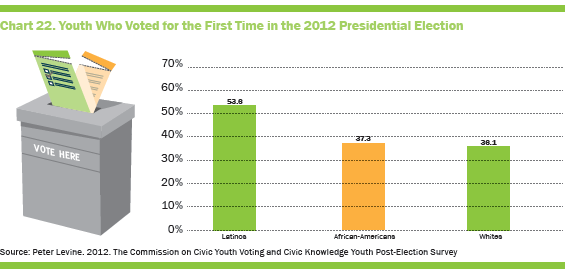
The National Conference on Citizenship (NCoC) released the Latinos Civic Health Index today. My colleague Kei Kawashima-Ginsberg is a co-author and the Tisch College of Citizenship and Public Service at Tufts collaborated with NCoC. Overall, the report points to challenges: Latinos are less engaged than non-Latinos in a wide range of civic and political activities. But there are signs everywhere that rates of engagement are rising. For instance, Latinos’ voter turnout is lower, but their turnout rates are improving. As a result, of all young Latinos who voted in 2012, an outright majority were voting for the first time. Meanwhile, their population share is growing. It seems apt, then, to describe the Latino population as a waking giant. The report provides much more detail, including information on non-political forms of engagement and data on differences among the major subgroups of Latinos.

latinos

when a university is committed to democracy

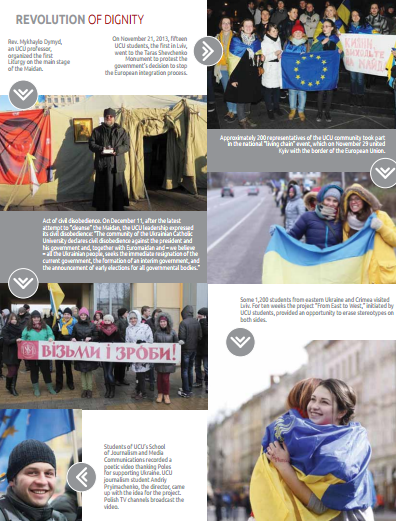
This is a page from the 2013-14 Rector’s Report of the Ukrainian Catholic University in Lviv, an institution that I visited this summer. (Click the image to open the PDF.) The page is headed “A Revolution of Dignity,” and it describes various political–even revolutionary–activities by the university or its members. The next page shows profiles of activists from the university, including a lecturer who was shot to death. It is an interesting combination of American-style glossy PR and strongly worded political commitment.

UkrainianCatholic

I would not hope for a comparable stance from an American university. For one thing, this brochure comes from a country with a war on its own territory and ongoing political crises. We shouldn’t wish for that level of strife here, even if it elicited more political commitment from higher education.

Besides, one can critically assess the position that the university has taken. I’m on the same side, but this position is debatable. Universities contribute to the public discussion by being fair and open to a range of perspectives and by demanding standards of evidence and reason from all participants. When a university commits itself strongly to a cause, it can undermine its ability to be an open forum for debate. It also acquires strange bedfellows–people on the same general side of the political issue who may be quite unsavory.

On the other hand, neutrality is impossible and is the wrong objective. Universities exist to promote free thought and substantive dialog and inquiry, which are incompatible with censorship, oppression, violence, and rampant corruption. Scholars also need intellectual freedom and public support in order to do their work. So universities are closely tied to social justice. They must leave space for a debate about what defines social justice, but they should not pretend that it is other people’s business.

US universities tend to respond to political threats and crises by staying clear of them, at least as official institutions. The Ukrainian Catholic University demonstrates what it looks like when an institution leaps into the fray. The Rector writes in his introductory message “we declared civil disobedience against the government and the president,” which is not what you’d expect in an annual report from a US college or university. He adds:

It’s difficult to summarize the last year, for most of the processes have only begun and are now continuing. We are still experiencing the ‘Revolution of Dignity.’ We are still fighting an external aggressor and internal problems. … From the first days of the revolution we clearly understood what we were fighting for. We were not distracted from running the university for a second. But we also supported our students. …  On December 11 we declared civil disobedience against the government and the president, who used violence against his own people. ….

We should work for victory and for reconciliation. Our weapons are truth and peace. We should already be thinking about what will happen after the war, how to heal physical and spiritual wounds, how to strengthen the country. In addition to the external enemy, Ukrainians need to conquer internal enemies: corruption, anger, hatred. I expect that the spiritual and educational life of the university will help our students handle these challenges.

upcoming talks

These are public talks I am giving in the next two months. All welcome!

Sept. 23: Philanthropy for Active Civic Engagement (PACE) Webinar, “America’s Civic Renewal Movement,” with me and Eric Liu (Citizen University), Kelly Born (Hewlett Foundation) and Joan Blades (Living Room Conversations project). (Register here.)

Sept. 24, Hamline University (St. Paul, MN), Commitment to Community Keynote Address

October 5, University of Texas San Antonio’s Center for Civic Engagement. At its first Civic Engagement Summit, I will talk about “The Promise of Civic Renewal in America.”

Oct. 14, University of Connecticut: the Myles Martel Lecture in Leadership and Public Opinion

Nov. 4, Educational Testing Service office in Washington, DC, “R&D Forum” on civic learning