
The President concluded his final State of the Union address with a rousing statement about citizenship. That was appropriate, because he has done the same thing in almost all of his most important speeches, including the 2004 Democratic Convention speech that launched his national career, his kickoff address announcing his candidacy for president in 2007, and both inaugural addresses. For the record, I past below the fold an anthology of Barack Obama’s strongest statements on the theme of citizenship (1988-2016), culminating with last night’s SOTU. I will be especially interested to hear what he says on this topic once he is out of the Oval Office and beginning the career of nongovernmental citizenship that he hinted at last night.
Writing about community organizing in 1988
Community organizing reveals the “internal productive capacities, both in terms of money and people, that already exist in communities.” It “enables people to break their crippling isolation from each other, to reshape their mutual values and expectations and rediscover the possibilities of acting collaboratively—the prerequisites of any successful self-help initiative.” For organizers, the process “teaches as nothing else does the beauty and strength of everyday people.”
Launching his candidacy in Springfield, IL on February 10, 2007
“And after a time, I came to understand that our cherished rights of liberty and equality depend on the active participation of an awakened electorate. (Cheers.)” …
That’s why this campaign can’t only be about me. It must be about us. It must be about what we can do together. This campaign must be the occasion, the vehicle of your hopes and your dreams. It will take your time, your energy and your advice to push us forward when we’re doing right and let us know when we’re not.
This campaign has to be about reclaiming the meaning of citizenship, restoring our sense of common purpose, and realizing that few obstacles can withstand the power of millions of voices calling for change. (Cheers.) …
That is our purpose here today. That is why I’m in this race, not just to hold an office but to gather with you to transform a nation. (Cheers.) …
I want us to take up the unfinished business of perfecting our Union and building a better America. (Cheers.) And if you will join with me in this improbable quest, if you feel destiny calling and see, as I see, the future of endless possibilities stretching out before us, if you sense, as I sense, that the time is now to shake off our slumber and slough off our fears and make good on the debt we owe past and future generations, then I am ready to take up the cause and march with you and work with you. (Cheers.) Today, together, we can finish the work that needs to be done and usher in a new birth of freedom on this earth. …
3/19/2007 CNN, Larry King Live, answering a question about Michelle Obama:
“She’s very interested in getting young people involved civically. She ran one of these AmeriCorps programs, called “Public Allies” in Chicago that helped young people connect with public service work and get leadership training. And so, she’s really big on encouraging people to get involved in their communities. And I think that’s something that she would be likely to continue if she were in the White House.
12/05/2007, Mt. Vernon, IA “Obama Issues Call to Serve, Vows to Make National Service Important Cause of His Presidency”
[as a community organizer] I found that you could do your part to see that – in the words of Dr. King – it “bends toward justice.” In church basements and around kitchen tables, block by block, we brought the community together, registered new voters, fought for new jobs, and helped people live lives with some measure of dignity.
Eventually, I realized I wasn’t just helping other people. Through service, I found a community that embraced me; a church to belong to; citizenship that was meaningful; the direction I’d been seeking. Through service, I found that my own improbable story fit into a larger American story.”
From a transcript: “I have no doubt that in the face of impossible odds people who love their country can change it. But I hold no illusions that one man or woman can do this alone. That’s why my campaign has called nearly 400,000 Americans to a common purpose. That’s why I’m reaching out to Democrats, and also to Independents and Republicans. And that is why I won’t just ask for your vote as a candidate; I will ask for your service and your active citizenship when I am President of the United States. This will not be a call issued in one speech or program; this will be a cause of my presidency.”
06/30/2008, Independence, MO, Remarks of Senator Barack Obama:
“In spite of this absence of leadership from Washington, I have seen a new generation of Americans begin to take up the call. I meet them everywhere I go, young people involved in the project of American renewal; not only those who have signed up to fight for our country in distant lands, but those who are fighting for a better America here at home, by teaching in underserved schools, or caring for the sick in understaffed hospitals, or promoting more sustainable energy policies in their local communities.
I believe one of the tasks of the next Administration is to ensure that this movement towards service grows and sustains itself in the years to come. We should expand AmeriCorps and grow the Peace Corps. We should encourage national service by making it part of the requirement for a new college assistance program, even as we strengthen the benefits for those whose sense of duty has already led them to serve in our military.
We must remember, though, that true patriotism cannot be forced or legislated with a mere set of government programs. Instead, it must reside in the hearts of our people, and cultivated in the heart of our culture, and nurtured in the hearts of our children.
As we begin our fourth century as a nation, it is easy to take the extraordinary nature of America for granted. But it is our responsibility as Americans and as parents to instill that history in our children, both at home and at school. The loss of quality civic education from so many of our classrooms has left too many young Americans without the most basic knowledge of who our forefathers are, or what they did, or the significance of the founding documents that bear their names. Too many children are ignorant of the sheer effort, the risks and sacrifices made by previous generations, to ensure that this country survived war and depression; through the great struggles for civil, and social, and worker’s rights.
…
And it is up to us to teach our children a lesson that those of us in politics too often forget: that patriotism involves not only defending this country against external threat, but also working constantly to make America a better place for future generations.”
09/12/2008 New York, NY:
Every American can give back to their communities and help their fellow citizens through service,” said Senator Obama. “Many Americans serve their nation through military service. Others serve by volunteering in schools, shelters, churches, hospitals, and disaster relief efforts. Still more are firefighters, teachers, or police officers. As a young man, I served as a community organizer on the South Side of Chicago, where I learned ways to create opportunities for other people to achieve their dreams. Our nation faces serious challenges in its neighborhoods and schools, and we must empower Americans with the resources they need to give back and improve their communities. I am proud to support this legislation and I commend Chairman Kennedy for his continued leadership in opening doors for public service opportunities.
04/29/2009 Town Hall Meeting, Arnold, MO:
We’re living through extraordinary times. We didn’t ask for all the challenges that we face, but we’re determined to answer the call to meet them. That’s the spirit I see everywhere I go. That’s the spirit we need to sustain, because the answer to our problems will ultimately be found in the character of the American people. We need soldiers and diplomats, scientists, teachers, workers, entrepreneurs. We need your service. We need your active citizenship.
01/21/2009 Remarks by the President in Welcoming Senior Staff and Cabinet Secretaries to the White House:
Our commitment to openness means more than simply informing the American people about how decisions are made. It means recognizing that government does not have all the answers, and that public officials need to draw on what citizens know. And that’s why, as of today, I’m directing members of my administration to find new ways of tapping the knowledge and experience of ordinary Americans — scientists and civic leaders, educators and entrepreneurs — because the way to solve the problem of our time is — the way to solve the problems of our time, as one nation, is by involving the American people in shaping the policies that affect their lives.
Memorandum issued the first day in office (2009) “Transparency and Open Government.”
Government should be participatory. Public engagement enhances the Government’s effectiveness and improves the quality of its decisions. … Executive departments and agencies should offer Americans increased opportunities to participate in policymaking and to provide their Government with the benefits of their collective expertise and information. …Government should be collaborative. Collaboration actively engages Americans in the work of their Government. Executive departments and agencies should use innovative tools, methods, and systems to cooperate among themselves, across all levels of Government, and with nonprofit organizations, businesses, and individuals in the private sector.
Accepting the Democratic nomination in 2012
But we also believe in something called citizenship — (cheers, applause) — citizenship, a word at the very heart of our founding, a word at the very essence of our democracy, the idea that this country only works when we accept certain obligations to one another and to future generations.
….
We don’t think the government can solve all of our problems, but we don’t think the government is the source of all of our problems — (cheers, applause) — any more than our welfare recipients or corporations or unions or immigrants or gays or any other group we’re told to blame for our troubles — (cheers, applause) — because — because America, we understand that this democracy is ours.
We, the people — (cheers) — recognize that we have responsibilities as well as rights; that our destinies are bound together; that a freedom which asks only, what’s in it for me, a freedom without a commitment to others, a freedom without love or charity or duty or patriotism, is unworthy of our founding ideals, and those who died in their defense. (Cheers, applause.)
As citizens, we understand that America is not about what can be done for us. It’s about what can be done by us, together — (cheers, applause) — through the hard and frustrating but necessary work of self-government. That’s what we believe.
So you see, the election four years ago wasn’t about me. It was about you. (Cheers, applause.) My fellow citizens — you were the change. (Cheers, applause.)
State of the Union Address, 2014
Tonight, this chamber speaks with one voice to the people we represent: it is you, our citizens, who make the state of our union strong. …
After all, that’s the spirit that has always moved this nation forward. It’s the spirit of citizenship – the recognition that through hard work and responsibility, we can pursue our individual dreams, but still come together as one American family to make sure the next generation can pursue its dreams as well.
Citizenship means standing up for everyone’s right to vote. Last year, part of the Voting Rights Act was weakened. But conservative Republicans and liberal Democrats are working together to strengthen it; and the bipartisan commission I appointed last year has offered reforms so that no one has to wait more than a half hour to vote. Let’s support these efforts. It should be the power of our vote, not the size of our bank account, that drives our democracy.
Citizenship means standing up for the lives that gun violence steals from us each day. I have seen the courage of parents, students, pastors, and police officers all over this country who say “we are not afraid,” and I intend to keep trying, with or without Congress, to help stop more tragedies from visiting innocent Americans in our movie theaters, shopping malls, or schools like Sandy Hook.
Citizenship demands a sense of common cause; participation in the hard work of self-government; an obligation to serve to our communities. And I know this chamber agrees that few Americans give more to their country than our diplomats and the men and women of the United States Armed Forces.
State of the Union Address, 2016
But democracy does require basic bonds of trust between its citizens. It doesn’t work if we think the people who disagree with us are all motivated by malice, or that our political opponents are unpatriotic. Democracy grinds to a halt without a willingness to compromise; or when even basic facts are contested, and we listen only to those who agree with us. Our public life withers when only the most extreme voices get attention. Most of all, democracy breaks down when the average person feels their voice doesn’t matter; that the system is rigged in favor of the rich or the powerful or some narrow interest.
…
So, my fellow Americans, whatever you may believe, whether you prefer one party or no party, our collective future depends on your willingness to uphold your obligations as a citizen. To vote. To speak out. To stand up for others, especially the weak, especially the vulnerable, knowing that each of us is only here because somebody, somewhere, stood up for us. To stay active in our public life so it reflects the goodness and decency and optimism that I see in the American people every single day. …
I see them everywhere I travel in this incredible country of ours. I see you. I know you’re there. You’re the reason why I have such incredible confidence in our future. Because I see your quiet, sturdy citizenship all the time.
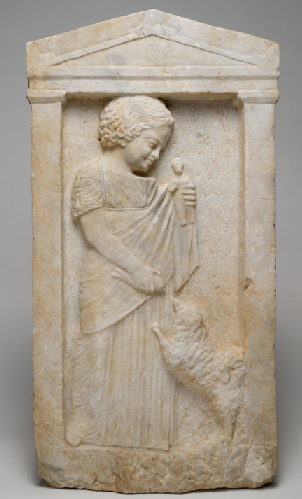 This is Melisto, a daughter of Ktesikrates from