Selim Berker on moral coherence

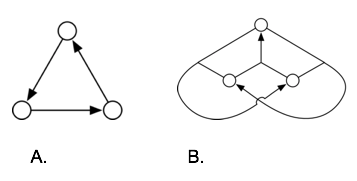
In “Coherentism via Graphs,”[i] Selim Berker begins to work out a theory of the coherence of a person’s beliefs in terms of its network properties. Consider these two diagrams (A and B) borrowed from his article, both of which depict the beliefs that an individual holds at a given time. If one beliefs supports another, they are linked with an arrow.

Screen Shot 2016-02-07 at 12.47.04 PM

Both diagrams show an individual holding three connected and mutually consistent beliefs. Thus traditional methods of measuring coherence can’t differentiate between these two structures. However, Graph A is pretty obviously problematic. It involves an infinite regress—or what has been called, since ancient times, “circular reasoning.” Graph B is far more persuasive. If someone holds beliefs that are connected as in B, the result looks like a meaningfully coherent view. If you find coherence relevant to justification, then you will have a reason to think that the beliefs in B are justified—a reason that is absent in A.

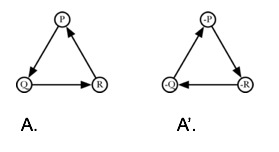
Berker also proposes a subtler but more decisive reason that B is better than A. Below I show A again, now with the component beliefs labeled as P, Q, and R. If the law of contraposition holds, than A implies another graph, A’, that is its exact opposite. A’  includes beliefs -P, -Q, and -R, and the arrows point in the reverse direction.

Screen Shot 2016-02-07 at 12.48.37 PM

But that means that if belief P is justified because it is part of a coherent system of beliefs, then the same must be true of -P, which is absurd.[ii]

The overall point is that coherence is a property of the network structure of beliefs. That should be interesting to coherentists, who argue that what justifies any given belief just is its place in a coherent system. But it should also be interesting to foundationalists, who believe that some beliefs are justified independently of their relations to other ideas. Foundationalists still recognize that many, if not most, of our beliefs are justified by how they are connected to other beliefs. Thus, even though they believe in foundations, they still need an account of what makes a worldview coherent.

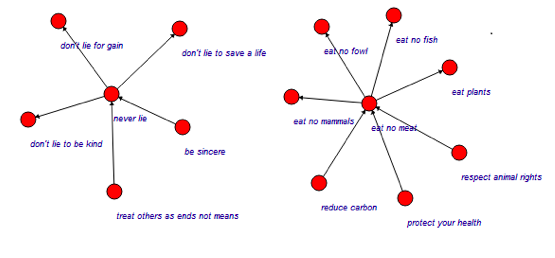
I have been developing a similar view, with a narrower application to moral thought (and without Berker’s deep grasp of current epistemology). I am motivated, first, by the sense that what makes a moral worldview impressively coherent cannot be seen without diagramming its whole structure. Imagine, for instance, a person who holds two major moral beliefs: “Never lie” and “Do not eat meat.” Assume that this person has not found or seen any particular connection between these two main ideas.

Screen Shot 2016-02-07 at 12.50.10 PM

His or her set of maxims is perfectly consistent: there is no contradiction between any two nodes. And every idea has a connection to another. But if we wanted to judge the coherence of this worldview, we would not be satisfied with knowing the proportion of the components that were consistent and directly connected. It would matter that the person holds two separate clusters of ideas—two hubs with spokes. This person’s network is fairly coherent insofar as it is organized into clusters rather than being completely scattered; but it would be more coherent if the two clusters interconnected via large integrating ideas. You can’t see the problem without diagramming the structure.

I also have another motivation for wanting to explore moral worldviews and political ideologies as networks of beliefs. In moral philosophy and political theory, constructed systems are very prominent. Although diverse in many respects, such systems share the feature that they could be diagrammed neatly and parsimoniously. In utilitarianism, the principle of utility is the hub, and every valid moral judgment is a spoke. That theory is so simple that to diagram it would be trivial. Kantianism centers on several connected principles, and Aristotelian, Thomist, and Marxist views are perhaps more complicated still. But in every case, a network diagram of the theory would be organized and regular enough that the whole could be conveyed concisely in words.

In contrast, my own moral worldview has accumulated over nearly half century as I have taken aboard various moral ideas that I’ve found intuitive (or even compelling) and have noticed connections among them. My network is now very large and not terribly well organized. A narrative description of it would have to be lengthy and rambling. Many of my moral beliefs are nowhere near each other in a network that sprawls widely and clusters around many centers.

I suspect this condition is fairly typical. No doubt, individuals differ in how large, how complex, and how organized their moral worldviews have become, but a truly organized structure is rare. (I have asked a total of about 60 students and colleagues to diagram their own views, and only one of the 60 gave me a network that could be concisely summarized.) That means that such constructed systems as Kantianism and utilitarianism are remote from most people’s moral psychology.

Further, I think that having a loosely organized but large and connected network is a sign of moral maturity. It is a Good Thing. That is obviously a substantive moral judgment, not a self-evident proposition. It arises from a certain view of liberalism that would take me more than a blog post to elucidate. But the essential principle is that we ought to be responsive to other people’s moral experiences.

Berker includes experiences as well as beliefs in his network-diagrams of people’s worldviews.[iii] In science, it should not matter who has the experience. An experience of a natural phenomenon is supposed to be replicable; you, too, can climb the Leaning Tower and repeat Galileo’s experiment. But in the moral domain, experience is not replicable or subject-neutral in the same way. Since I am a man, I cannot experience having been a woman my whole life so far. Thus vicarious experiences are essential to moral development.

If we are responsive, we will accumulate sprawling and random-looking networks of moral beliefs as we interact with diverse other people. These networks can be usefully analyzed with the techniques developed for analyzing large biological and social networks. It will be illuminating to look for clusters and gaps and for nodes that are more central than average in the structure as a whole. The coherence of such a network is not a matter of the proportion of the beliefs that are consistent with each other. Its coherence can better be evaluated with the kinds of metrics we use to assess the size, connectedness, density, centralization, and clustering of the complex networks that accumulate in nature.

On the other hand, if someone adopts a moral view that could be diagrammed as a simple, organized structure, he has not been responsive to others so far and he will be hard pressed to incorporate their experiences in the future. At the extreme, his simple graph is a sign of fanaticism.

See also: envisioning morality as a network; it’s not just what you think, but how your thoughts are organized; Stanley Cavell: morality as one way of living well; and ethical reasoning as a scale-free network (my first thoughts along these lines, from 2009).

Notes

[i] Berker, S. (2015), Coherentism via Graphs. Philosophical Issues, 25: 322–352. doi: 10.1111/phis.12052

[ii] “Coherence, we have been assuming, is a matter of the structure of support among a subject’s beliefs, experiences, and other justificatorily-relevant mental states at a given time.” But we can use directed hypergraphs (in mathematics, networks in which any of the nodes can be connected to any number of the other nodes by means of arrows) to represent all of those support relations. That is, we use directed hypergraphs to represent all of the relations that have a bearing on coherence. It follows that coherence is itself expressible as a graph-theoretic property of our directed hypergraphs (p. 339).

[iii] “Many theorists hold that a subject’s perceptual experiences are justificatorily relevant (in these sense that they either partially or entirely make it the case that the subject is justified in believing something).”

you have a right and a responsibility to attend to your own happiness

Two theses for today: 1) You have a right (and even an obligation) to be concerned about your own inner wellbeing–call it happiness, peace, lack of suffering, equanimity, satisfaction, or mental health. And 2) Inner wellbeing is a complex issue, not just a matter of maximizing a simple mental state, such as pleasure.

Why it is right to be concerned about your inner wellbeing

The first premise is far from obvious. More than three million children die every year from undernutrition alone. Their deaths are stark evidence of grave deprivation that affects many more who do not happen to die. Almost half a million human beings are murdered annually around the world, again just a fraction of those who suffer from intentional violence. And even within the United States, more than two million of our fellow citizens are incarcerated, reflecting both severe hardship for the prisoners as well as a trail of harms that many of them have done to others. Under circumstances like these, why may a person like me (who is healthy, safe, and affluent) pay any attention to improving my own inner wellbeing?

No doubt, I ought to be concerned about others. Yet anyone’s inner welfare is also a valid and important concern for that person. This is because it seems to be necessary for human beings to be involved in making themselves happy or satisfied; no one can simply do that for us. So even if the goal were to maximize everyone’s happiness, that couldn’t be accomplished by a world of individuals who were concerned only with other people. They would also have to be responsible for themselves. Pure altruism or other-regardingness is not the ideal, because there would then be no one in a position to make each individual happier.

To be sure, we can ruin other people’s wellbeing, for instance by putting them in fear or anguish. And we can fail to remedy objective circumstances, such as poverty or political oppression, that prevent others from achieving wellbeing. In other words, outer circumstances and inner wellbeing are related. But the links are fairly loose. Some people who know no physical pain and have plenty of money are nevertheless miserable to the point of suicide. Poor villagers who live under a repressive government can be happier than wealthy suburbanites who are well treated by the state. We could make the distribution of rights and goods perfectly just in a whole society and yet everyone could be miserable because they failed to understand how to achieve inner welfare.

Maybe if we organized societies better, everyone would be happier. That is certainly worth trying, but we must also remember the value of freedom. Aldous Huxley’s 1931 novel Brave New World presents as a dystopia a future in which pharmaceuticals, sexual promiscuity, and efficient production have maximized happiness but thereby robbed people of the value and satisfaction that comes from having to struggle as independent and free actors. Free people choose diverse paths and set diverse priorities, some of which lead them to unhappiness. If we honor freedom, then we will be hesitant to make people happy at the cost of their freedom. This is why, in liberal democracies, happiness is not usually seen as a political objective. A government probably cannot make people happy and may threaten their liberty if it tries. The same is true of a parent within a family unit and a boss in a workplace. Each of these have real but limited responsibility for others’ happiness.

Some authors have argued that the only thing to worry about is our own inner wellbeing. A strong example is Epictetus. This major Stoic was born around 55 CE as a slave: his name means “purchased.” He was disabled, perhaps because of a master’s violence. Later in life, he was sent into exile. Yet he became a byword for virtue among both pagan philosophers and early Christians. His core insight was that accidents like disease, enslavement, and exile need not affect your happiness. You can divide all matters into those over which you have control (your own desires, emotions, and private thoughts) and those that are beyond your control (not only disease, suffering, and death but also worldly riches and success). You can learn to care only about the things that you control and can put them in perfectly good order. For instance, you can come to care only about having virtuous intentions, and you can learn to accept whatever happens outside your mind. “Don’t seek for things to turn out as you wish, but wish for them to turn out as they do, and then you will get on well.” [Enchiridion 8] Similar ideas have been worked out in Buddhist and Hindu traditions.

I think his view has two severe drawbacks. First, it reflects an unrealistic psychology. We are evolved, natural creatures. We evolved to be psychologically vulnerable to other people’s treatment. We cannot control our desires and responses to the degree that Epictetus suggests. For instance, it is beyond most people’s capacity to be happy when subjected to abuse or when abandoned and neglected. In fact, we could say that human beings are so constituted that we need other people to take care of us and that we must take care of ourselves. That is why living a good life requires having (and acting upon) the best possible ideas about your inner life and your relations to others.

Second, even when other people are able to make themselves fully happy, we must still be concerned about justice. For instance, if I were to encounter an advanced Buddhist sage who genuinely did not suffer even slightly when I stole his rice bowl, I would still be wrong to take it from him. Epictetus would agree so far; he is against mistreating our fellow human beings. But justice is more than refraining from harming people. I am also obliged to worry about whether other people are stealing food–and whether they have enough to eat in the first place. In other words, a good life includes concern for social justice: for the design, improvement, and maintenance of whole systems. That requires forming desires about the way society is organized and acting to realize those desires–in a word, it requires “politics.” But politics belongs to the category of things that we cannot control, things that are governed by other people’s wills and by fate. Just like making plans to be rich or popular, forming plans to improve a society exposes us to failure and disappointment.

Epictetus advises against political engagement.

You can become invincible if you enter no competition that is not in your power to win. When you see someone honored above others or able to do many things or otherwise admired, do not be carried away by the appearances and consider him blessed/happy. For if the essence of the good lies in what we can achieve, then there is no space for ill-will or jealousy. Rather, for yourself, don’t strive to be a general or an office-holder or a leader/consul, but to be free. The only road to that is contempt for things not in your power [XIX].

But the world needs the modern equivalents of generals, senators, and consuls, plus managers and committee chairs and active members of all kinds of groups. To be an active citizen is part of a good life–if not for all human beings, then at least for many. And that requires being concerned about justice to others as well as your own inner wellbeing.

The sorrows of Pandora’s Box fall into three categories. Some forms of suffering happen to human beings because of the kinds of creatures we are. We can postpone death, aging, disease, pain, and fear, but they are inevitable. Our very existence requires the death of other people, or else the earth would be too crowded for the living. Modern science asserts that we can mitigate these sources of suffering. For instance, we may not be able to cure mortality but we can medicate to reduce pain, anxiety, and other adverse mental states. Stoics and some Buddhists would counsel that we can take the sting out of the same adversities by disciplining our emotional reactions. I am not sure that either strategy can fully succeed.

A different set of injustices are miseries for which we rightly blame our fellow human beings. For instance, we oppress each other politically, exploit each other economically, and exclude each other socially. And even if we are not guilty at a given moment of any of those sins of commission, we may be guilty of grievous sins of omission. I am failing right now to help people even though I own superfluous resources.

The third category is a failure to flourish, thrive, enjoy, and achieve equanimity or satisfaction. Addressing this third category requires focusing inward, on our own moral commitments and beliefs, and seeing if we can improve them to make ourselves happier. Insofar as we can help other people with that task, one of the best ways may be to set a good example.

In short, your happiness should not be your only concern, but it should be one of your concerns.

Happiness is complicated

Much valuable research is being conducted today on the causes and conditions of happiness. Traditionally focused almost entirely on distress and pathology, the discipline of psychology is now turning to positive states and trying to learn what causes them. Meanwhile, economics is moving away from the simplistic premise that the purpose of an economy is to generate wealth and is beginning to conceive of a successful economy as one that makes people happy. The findings of happiness psychology and related research in economics tend to confirm what ancient Stoics, Skeptics, Epicureans and Buddhists advised.

For instance, people seem to gain happiness by being deeply immersed in a purposeful current activity, instead of thinking about the past or the future and instead of doing things that might seem pleasurable but that lack purpose. Acknowledging precedents in Eastern philosophy, the psychologist Mihály Csíkszentmihályi recommends “flow,” or single-minded immersion in an activity over which we have control. Note that flow comes from activity, not from passive experience.

Another source of happiness is caring relationships with fellow human beings. Most people are happier when they feel they contribute to worthwhile communities. That doesn’t mean that highly social people necessarily avoid being depressed. The psychologist Corey Keyes disputes the assumption that people fall on one continuum from depression to happiness (where the latter is defined as a lack of depression). Keyes’ survey research finds that the depression/happiness spectrum exists, but there is a second spectrum as well. This second continuum ranges from “languishing” to “flourishing,” where flourishing encompasses positive emotions, positive psychological functioning (such as believing that your life has purpose, or having warm and trusting relations), and positive social functioning (which includes positive beliefs about other people, confidence that one’s own daily activities are useful for others, and belonging to a community). “Languishing” is basically the absence of flourishing.

Since the flourishing/languishing scale is distinct from happiness/depression, it is possible to be depressed and flourishing. In fact, Keyes movingly discloses in public talks that he fits in that quadrant, being clinically depressed and also flourishing. His findings are important because flourishing brings powerful benefits. For example, it reduces the risk of cardiovascular disease to roughly the same degree as not smoking does. Although languishing is different from mental illness, languishing is bad for your mental health in the long run. In fact, your odds of suffering a diagnosed mental illness later on are just as bad if you are languishing now as if you have a mental illness now. If you would like to be free of mental illness in a few years, it’s just as important to start doing purposeful good work for others as it is to treat your depression or anxiety.

Another finding is that anger and resentment are very bad for happiness, and the best remedy is genuinely to forgive and feel empathy for the person who is the source of anger.

These and other findings from empirical psychology are worth knowing. However, I would not literally commit myself to them as maxims, for four large reasons.

First, they are based on statistical research into large numbers of human beings. Individuals differ. Although there is a general tendency for people to have better inner lives when they care for others, that may not be true for all. There may be genuine introverts who are happiest alone, and also psychopaths who are happiest when they harm others. Even if you are neither an introvert nor a psychopath, you are still unique, not a statistical mean, and so it requires introspection and experience to determine what makes you happy.

Second, these findings are very vague and general. “Immerse yourself in a meaningful current activity” is a succinct statement of a valid general principle. But at least for me, it would have little force because I know that I can only immerse myself in some kinds of activity, at some times, for some purposes. Moreover, each of these activities has limitations, costs, tradeoffs, and risks. The kinds of principles that seem worthy of endorsement are much more specific and qualified than the general maxim to “pursue flow.”

Third, other people are intrinsically involved. You can’t, for instance, feel confident that your own daily activities are useful for others (one of Keyes’ components of flourishing) unless you are actually responsive to other people’s needs and interests. What they need and want varies and should influence you. There can also be genuine sources of happiness that should be tempered or even avoided because they are not fair to other people. For instance, when I am thoroughly absorbed in a creative activity, I experience “flow,” but I am not being a very good parent, spouse, colleague, or citizen. Although life provides sufficient time for a bit of both, I don’t want to commit to “flow” without acknowledging the tradeoffs for other people.

Finally, these psychological findings are about inputs (experiences, activities, or commitments) and the positive mental states that result. For instance, if you forgive other people, you will be less angry and less subject to stress. If you immerse yourself in the present, you will be happier. Those are causal hypotheses. They beg the question of what outcomes we should want. It is not self-evident that we should want to be happy. At best, that vague term needs to be spelled out in more detail. Are we after calmness and acceptance? Excitement and intense positive experience? Satisfaction? Passion? These are complex and controversial topics, and the science of psychology cannot answer them. It can advise about how to get the various outcomes but not which ones to pursue. In short, inner wellbeing requires analysis as well as explanation. We cannot just decide to attend to our own happiness. We must reason about what our inner life should be like.

Imagine that the only thing that mattered was how we scored on one simple scale from intense pleasure to intense pain. Then attending to our inner welfare would be a matter of moving ourselves up the scale as far as we could go at any point. But, as Robert Nozick noted in Anarchy State and Utopia, we would not choose to be hooked to an “experience machine” that kept us permanently at the top end of the pleasure scale. Why not? Presumably because happiness–so defined–is not what we want, or to put it another way, the maximization of pleasure is not true happiness. The word that is usually translated as “happiness” from ancient Greek–eudaimonia–has complex meanings and associations, but it is closer to actively and intentionally flourishing than to feeling pleasure.

If we do not want to have as much pleasure as possible all the time, then what do we want for our inner lives? The answer may include some combination of pleasure, satisfaction, enjoyment, peace, equanimity, acceptance, hope, purpose, and passion, to name just some desirable mental states. Some of them go neatly and comfortably together. For instance, it could be that equanimity requires acceptance; then those two nodes are linked with an arrow. But some of these concepts are at least potentially at odds. To have purpose and passion may be incompatible with acceptance. Hope is a virtue in Christianity but not in classical Greek or Buddhist thought, which view hope as naive and inconsistent with equanimity.

Modern academic philosophy in the countries strongly influenced by the West is not especially focused on getting these ideas in good order. It attends more to ethics (in the sense of treating other creatures right) and social justice (organizing a social system fairly) than to inner wellbeing. In 1958, Elizabeth Anscombe noted and lamented that omission. “It can be seen” she wrote, “that there a huge gap, at present unfillable as far as we are concerned, which needs to be filled by an account of human nature, human action, the type of characteristic a virtue is, and above all of human ‘flourishing.’” To the extent that matters have improved since 1958, that is because academic philosophers in countries like the US and Britain have revisited authors from earlier traditions, notably the pre-Christian Greeks, the classical Asian thinkers, and subsequent works under their influence. Owen Flanagan argues that Buddhism and “Western” philosophy have compensating weaknesses and advantages. Buddhism gives rich and detailed accounts of the inner life but fails (as yet) to provide satisfactory accounts of social justice, especially in complex modern societies composed of states and markets. Western philosophy offers much weaker and more cursory accounts of the good inner life. We must put the pieces back together.

See also: Mill’s question: If you achieved justice, would you be happy?on philosophy as a way of lifeEmerson’s mistake.

the library of Edward R. Murrow

MurrowLast week I reported from the AFT building in Washington, where I’d attended a meeting in a room lined with the personal library of Albert Shanker, the late and very controversial leader of the teachers’ union. Earlier this week, I got to hear my excellent Tufts colleague Kelly Greenhill present on “The Security-Related Effects of Rumors” in a Tufts room that is furnished with the books of the late broadcast journalist Edward R. Murrow (1908–1965).

The arrangement of the two rooms is similar: the books fully surround a long wooden table, leaving just enough space for chairs.

Murrow was best known for his courageous WWII broadcasting and then his postwar opposition to Sen. McCarthy. He was perhaps a more consistently admirable person than Shanker, although opinions on that would vary. His books, however, were much more middle-brow. Shanker owned ponderous tomes of 20th century Continental philosophy. Murrow had more volumes like The Lady and the Vote (1956) by Marion K. Sanders. Then again, Sanders turns out to have been a crusading feminist journalist, a psychological warfare operative in WWII, an interviewer of Saul Alinksy, and a one-time congressional candidate. I’d guess that Murrow knew her professionally, which is reason enough to display her book and many like it.

Sanders got about as many youth votes in Iowa as everyone else combined

My colleagues at CIRCLE are producing a stream of detailed and almost instantaneous analysis of the caucuses and primaries. Keep checking the CIRCLE homepage for the latest.

Here I use CIRCLE’s evidence to illustrate how Sen. Sanders’ dominated the youth vote in the Iowa caucuses. Consider the Democratic and Republican caucuses as one event: the voter first chooses which party to caucus with, and then selects a candidate. By that reasoning, about 50,000 young Iowans (ages 17-29) caucused, and about 58% of them chose the Democratic side. Sanders drew 84% of the Democratic youth, while the Republican youth split their support. As a result, Sanders drew about 49% of all the young caucus-goers put together. Cruz came in second with about 11% of all the youth, followed very closely by Rubio, then Clinton, and then Trump.

Iowa 2016

Sanders got about eight times as many votes as his main opponent on the Democratic side, and about eight times as many as Trump, with whom he is sometimes paired as a supposed enemy of “the establishment.”

That raises such questions as: Can Sen. Sanders do better among older people in other states? Can he perform as well among youth in states where young Democratic voters are far more diverse than they are in Iowa? Can Sec. Clinton narrow the generation gap, and can she get out the youth vote if she wins the nomination? (She only drew about 4,000-5,000 young Iowans on Monday and came in fourth in that age bracket, which ought to ring some alarms.) Finally, where will young Republicans land as their field narrows?

Sanders dominates the Iowa youth vote

Below is CIRCLE’s press release from this morning. Additional data can be found on the website.

Young Democrats Propel Sanders to Virtual Tie in Iowa; Record-breaking Participation Among Young Republicans, who Choose Cruz, Rubio Over Trump

Medford/Somerville, MA – Youth turnout in last night’s Iowa caucuses is estimated to be 11 percent, according to youth vote experts from the Center for Information and Research on Civic Learning & Engagement (CIRCLE) – the preeminent, non-partisan research center on youth engagement at Tufts University’s Jonathan M. Tisch College of Citizenship and Public Service.

Highlights of the youth vote in Iowa include:

  • An estimated 11.2% of eligible Iowan youth aged 17 to 29 participated in last night’s Republican and Democratic caucuses.
  • On the Democratic side, the youth choice was decisive. Of the estimated 31,000 young people who participated in the Democratic caucus, 84% supported Senator Bernie Sanders, contributing to a virtual tie between Secretary Hillary Clinton and Senator Sanders.
  • Young Republicans selected Senator Ted Cruz as their top candidate (with 26%), closely followed by Senator Marco Rubio (23%). Youth support for Donald Trump, which came in at approximately 20%, trailed the support he received among older Republicans.
  • Since 1996, youth turnout in Iowa has exceeded 4% only twice: in 2008 (14%) and yesterday (11.2%).
  • A record-breaking 22,000 young people voted in the Republican caucus.
  • About 31,000 young people participated in the Democratic caucus, the second highest level since 1996 (behind 2008).

“Last night’s Iowa caucuses demonstrated the potential power of young people to shape elections,” said Kei Kawashima-Ginsberg, Director of CIRCLE. “In the Democratic caucus, young voters helped to propel Senator Sanders to a virtual tie, and Republican youth broke their own record of caucus participation. One message is clear: when candidates and campaigns ask young people to participate and inspire them to get involved, they respond.”

For CIRCLE’s full Iowa caucus analysis, please see here. Throughout this election season, CIRCLE’s 2016 Election Center will offer new data products and analyses – such as a preview of youth participation in the NH primary – providing a comprehensive picture of the youth vote, both nationally and in targeted states and congressional districts across the country. You can view trend data on youth turnout via CIRCLE’s interactive maps.

we are for social justice, but what is it?

Schools and colleges, daily newspapers and broadcast television channels, and certain civic associations are prone to present themselves as neutral about politics. They say that they provide information, spaces for discussion, and opportunities to learn skills. Their students, readers, or citizen-members are free to form their own opinions.

Activists in social movements observe that these organizations are not truly neutral (but rather full of implicit values) and argue that grave current injustices require all organizations to take explicit stands.

In response, at least some of the ostensibly neutral organizations declare that they are actually against specific injustices and committed to a better society. Nowadays, they often name their positive objective as “social justice” (a phrase whose deepest historical roots are in Catholic thought). In past decades, they might have talked instead about democracy or freedom.

But although some things are obviously unjust, reasonable people disagree profoundly about what constitutes a positive vision of social justice, and why. Thus–I contend–virtually all of the valuable debate that occurred under the aegis of self-described neutral organizations recurs within organizations that declare themselves for “social justice” without providing a detailed definition of that phrase.

The return of debate is not in itself a bad thing; politics is about persistent disagreement, which responsible citizens can embrace and even enjoy. But it is somewhat naive to expect that a commitment to a vague ideal of social justice will bring consensus. And it is a shame if that expectation leads to disillusionment.

In our current time, this is the main pattern I observe: educational, journalistic, and civic associations strongly proclaim neutrality in response to what appears an uncivil and polarized political debate, and then activists demand that they take a stand in response (mainly) to climate change or domestic US racism. Those are matters of grave concern and they have generated social movements that are particularly effective at influencing schools and colleges, the media, and local associations (much more so than governments or corporations). In decades past, opposition to US foreign policy and war played similar roles in challenges to neutrality.

But if there is any doubt that people can be committed to something called “social justice,” abhor the same specific injustices, and yet disagree about the very definition of “justice,” consider the current debates between #BlackLivesMatter and Sen. Sanders, #BlackLivesMatter and Secretary Clinton, or Clinton and Sanders.

Those three people/movements place themselves on the left, but the debate about social justice is certainly broader than that, even if the phrase currently has leftish resonances. In an interview with Eric Liu for a project that Eric and I conducted together, Mark Meckler, who had founded Tea Party Patriots, called the police presence in Ferguson “outrageous.” He acknowledged the salience of racism but mainly viewed police violence as an example of a government depriving individuals of liberty. “The state has a lot of power and only recently it is outwardly manifesting that power in costumes and equipment that demonstrate military might. … That is not of society, by and for society; that is against society.” A democratic socialist might agree with much of that and yet read Ferguson more as a story of disinvestment in industrial cities and the failure of our economy to value workers. I’ve quoted Julius Jones of #BlackLivesMatter as a proponent of a third view: that anti-Black racism is a fundamental chord in American history. Note that all of these positions could simultaneously be true, yet the proponents must disagree about solutions. More government? Less government? Remedies targeted at race? At class? Any of those could constitute “social justice.”

To have a theory of justice, you need principles and a way of ranking or adjudicating among them. Maybe equality is one of your principles, but equality of what? (Opportunity, status, power, welfare?) Equality for whom? (All the students who are already in your classroom or at your college? All major demographic groups within America? All American individuals? All human beings?)

And even if equality–defined in a particular way–is a very high principle for you, what about freedom (which comes in at least six different and incompatible forms), sustainability, security, creativity, innovation, community, rule of law, tradition, diversity, prosperity, and efficiency? A reasonable view of social justice is surely an amalgam of many of these principles, reflecting tradeoffs and rankings. We develop such views in part by reflecting on what is bad about the status quo and what we have learned about practical solutions that work. (For instance, we wouldn’t advocate equality of education if we thought that schools were a waste of time.) Thus a theory of justice typically rests on a narrative about the failures and the successes of our society so far. All of that–the narrative, the assessment of actual institutions, the abstract principles, and their ranking–is contestable.

An organization can claim that it is thoroughly neutral, just a platform for its members to debate what is right. Or it can assert that it is for social justice, and then its members will debate what is right. The difference matters–a bit. A claim of perfect neutrality is inevitably false and distracting. A commitment to social justice can usefully raise the question, “What is justice?”

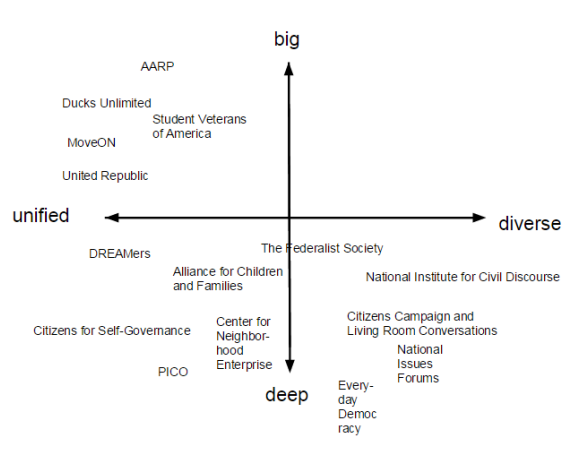
The choice remains how specifically to define the content of social justice. Organizations face choices between ideological diversity and unity and between scale (attracting lots of people) and depth (intensively relating to their members). The more precisely an organization defines its objective, the less hospitable it is to diversity but the more it can achieve unity and advance an agenda. The smaller it is, the better it can work through disagreements, but the bigger it is, the more influence it can have.

I think that organizations that strive to be ideologically diverse and also relatively big are relatively weak and scarce today. Universities and schools and large civic associations can fill that quadrant. It won’t hurt for them to declare themselves for “social justice,” but they would be wise to invite a genuinely diverse debate about what social justice is.

the library of Albert Shanker

IMG_0193This is part of the library of Albert Shanker (1928-77), which lines the walls of the conference room of the Albert Shanker Institute, which is inside the American Federation of Teachers’ Building in Washington. I was there earlier today. It seems fitting that such a library should rest in the heart of the AFT, exemplifying the long, rich, and living tradition of intellectual life within the labor movement (and—importantly—outside of universities).

The collection itself reflects a mid-20th century canon. There are books on Freud and idealist philosophers like Collingwood and Croce, as well as pragmatists like John Dewey, who was a founder of the AFT. There are many books about schooling and education, from a variety of perspectives. Several thousand volumes line the shelves.

Shanker was a highly controversial figure. In “Sleeper” (1977), Woody Allen’s character awakens 200 years after being cryogenically frozen and asks what happened to civilization. He’s told that a man called Al Shanker got hold of nuclear weapons. On issues of unionism, race, school choice, and foreign policy, Shanker made many enemies as well as friends, and probably deserved some of both. I don’t really know the whole story well enough to praise or bury him. I take the library more as a monument to the intellectual life of our unions, which is something to prize when they are under such threat.

Cf. Harry Boyte’s recent blog post on agrarian intellectuals during the New Deal and the powerful popular education movement they led.

the Journal of Universal Rejection

(Washington, DC) On a week when I got an article rejected almost instantly and then participated in an editorial committee for a different journal that celebrated our rising rejection rate, I just have to plug the Journal of Universal Rejection. Arguably the best journal in the entire universe, it rejects all submissions as not up to snuff.

From the instructions for authors:

The JofUR solicits any and all types of manuscript: poetry, prose, visual art, and research articles. You name it, we take it, and reject it. Your manuscript may be formatted however you wish. Frankly, we don’t care.

After submitting your work, the decision process varies. Often the Editor-in-Chief will reject your work out-of-hand, without even reading it! However, he might read it. Probably he’ll skim. At other times your manuscript may be sent to anonymous referees. Unless they are the Editor-in-Chief’s wife or graduate school buddies, it is unlikely that the referees will even understand what is going on. Rejection will follow as swiftly as a bird dropping from a great height after being struck by a stone. At other times, rejection may languish like your email buried in the Editor-in-Chief’s inbox. But it will come, swift or slow, as surely as death.

on voting by mail

Washington Monthly has a cover story by Phil Kiesling arguing that voting by mail would raise turnout substantially and also produce a more representative electorate, especially in primaries, thus reducing partisan polarization. Kiesling makes many good points, and his argument is definitely worth reading. Among other things, he is right to be frustrated by the research on voting-by-mail, although I wouldn’t characterize the problem as he does–as “the tyranny of dated, superficial, and/or irrelevant, academic research.” In fact, my colleagues and I are responsible for some of that research, and there are reasons that we analyze the data as we do. It is genuinely hard to measure the effects of a policy that has been adopted in only one or a few states. But that methodological challenge can limit our imaginations as reformers. Even though I don’t think he characterizes the research fairly, Kiesling helpfully challenges our imaginations.

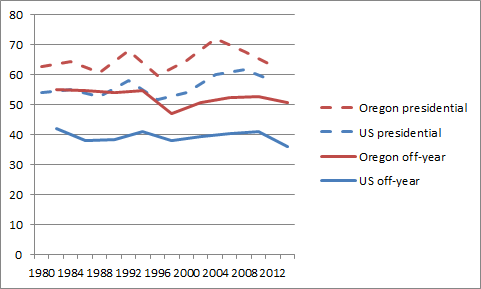
Before getting into the methodological weeds, let me explain why I am not yet convinced that vote-by-mail would increase turnout. Below is Oregon’s turnout trend compared to the national trend. I show the presidential years and off-years as separate lines, because otherwise you get a confusing zigzag pattern. Oregon abolished polling places in 2000 and has run its elections entirely by mail since then. Turnout in the 2004 presidential election was strong, but not so great in 2008 and 2012. Turnout in the off-year elections since 2000 has been lower than it was in the 1980s and 1990s. I don’t see evidence of positive impact here.

Oregon

Kiesling calls it a “problematic assumption” to measure turnout as I do above: as the percentage of all eligible citizens who voted. (My data come from Michael McDonald.) Kiesling would rather define turnout as the percentage of registered citizens who vote. But if votes-per-registered rises, and yet votes-per-eligible-citizens does not, then there is only one mathematical possibility: the percentage of the population that registered must have fallen. That’s not a good thing. So the only way to assess the net impact of a reform on our democracy is by measuring turnout as votes per eligible population. We always do this, not in a “selective manner … to overlook (or even disparage)” vote-by-mail.

My graph simply allows you to see whether turnout has risen or fallen in Oregon before and after the vote-by-mail reform. That is not really a satisfactory method because many other factors are obviously at work. Nor can we conduct randomized experiments with new voting laws. Thus the way almost all academics study state policy reforms is by building large datasets that include statistics from all 50 states over many years. Then we try to isolate the apparent impact of a given change, controlling for everything else that we have measured, including the baseline turnout rates for states prior to the reform.* That method has yielded a rough consensus in favor of Election Day Registration–mentioned by Kiesling and exemplified in our own research.

This method cannot, however, assess the impact of a reform that has only been implemented in one or a handful of states. The math just doesn’t allow estimates of impact when there are very few cases in the category of interest. Thus, frustratingly, we omit Oregon’s vote-by-mail system from most of our models. Kiesling is right to complain about that gap, but I know of no satisfactory solution. One potential option would be to lump universal vote-by-mail together with other reforms, to increase the number of cases, but that would hide any special advantages of universal vote-by-mail.

Kiesling says that the research “lazily tries to extrapolate absentee ballot-based data, inappropriately uses VEP-based yardsticks, and/or focuses on presidential contests only—ignoring midterm and primary elections, where the approach is best suited to show dramatic results.” Those are not fair complaints about our models.

I’d still vote for and recommend universal vote-by-mail, as an experiment. The graph shown above makes me a little pessimistic about its impact (particularly in midterm elections). And I do lament the loss of a secret ballot when elections move to mail. The secret ballot was a hard-won reform designed to prevent voters from being coerced by employers and relatives or from selling their votes. (If you promise to pay me for voting for A, but my ballot is secret, I can take your money and vote for B, which ruins the market. In an election-by-mail, however, your boss, your spouse, or a bribe-giver can check your ballot.) Kiesling says the Oregon Secretary of State is aware of “just a dozen documented cases,” and I guess we could live with that–although each case of coercion is a human rights violation.

More broadly, I resonate with Kiesling’s frustration. If a state does something bold and different, the standard methods of social science really struggle to assess its impact. When a bunch of states implement the same rather modest change, we can measure impact, but often it’s disappointing. For instance, we have found that the variation in states’ education laws does not seem to matter for students’ media literacy or electoral participation. I don’t conclude that reforming education is a waste of time, but rather that the prevailing reform strategies are too weak. A few states have done more interesting things with civic education policy, but we can’t assess their impact using multivariate models.

As citizens, we must keep our imaginations vivid and hopeful. Statistics are always about the past, and the future can be different. I welcome the Washington Monthly’s cover article as a spur to creativity. A 21st-century election system should look very different from the clunky mechanisms we have in place today. Universal vote-by-mail could be the answer. I just don’t read the existing research evidence as Kiesling does.

*Kiesling writes: “But point out that in 2014, the nation’s three UVBM [universal vote-by-mail] states’ voter turnout—based on the identical VEP denominator—was 16 percent higher than non-UVBM states, and the response is often something along the lines of, ‘Yes, but that’s irrelevant because Oregon (and presumably now Washington and Colorado) have always been high-turnout states.’ As if Minnesota, Maine, and Wisconsin are any different?” This is overlooking the power of a multivariate model, which takes into account the historical turnout rate as well as many other variables. We favor Same Day Registration not because turnout is simply higher in states that have it, but because it is higher controlling for other factors.