popular theories of political psychology, challenged by data

(Washington, DC) I’ve raised doubts about Moral Foundations Theory, which offers valuable insights but classifies individuals too crudely, overlooks the importance of deliberation and narrative in the construction of our moral ideas, and fails to explain historical change in moral opinions. I’ve also complained about research that classifies conservatives as having negative character traits. And I’ve argued that Amy Chua and Jed Rubenfeld’s bestseller that purports to explain economic success is unscientific.

Research reported in the press during this week has reinforced my skepticism:

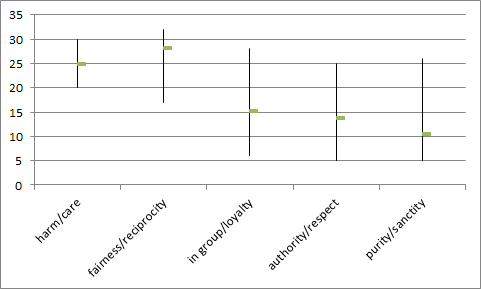
First, Kevin B. Smith and colleagues, writing in the American Journal of Political Science, cast doubts on three strong claims of the Moral Foundations Theory: that the dispositions labeled “foundations” are stable for individuals over time, that these foundations predict and explain political ideology (and hence explain ideological differences), and that the foundations are inherited–as they must be if they result from Darwinian selection. Surveying twins along with other family members, Smith et al. find that “moral foundations are not particularly stable within individuals across time, at least compared to ideology.” At a given point, individuals’ answers to Moral Foundations questions do relate to their ideologies, but their views change over time. The causal arrow seems to point from ideology to moral foundations, as much as the reverse. Presumably, people are influenced by events, experiences, and discussions to revise their political views, thereby changing their Moral Foundations (which are not actually foundational). Thus the stream of research exemplified in Moral Foundations Theory has been “overly dismissive of the role of conscious deliberation.”

Second, Steven G. Ludeke & Stig Hebbelstrup Rye Rasmussen use a large survey to dispute previous work that had associated conservative ideology with “psychoticism,” which means being “cold, impersonal, lacking in sympathy, unfriendly, untrustful, odd, unemotional, unhelpful, antisocial, lacking in insight, strange, with paranoid ideas that people were against him.” Quite to the contrary, they find a negative association between psychoticism and conservatism.

These authors still find that conservatives tend to be more authoritarian than liberals are. My complaint about that kind of finding is that it’s ahistorical. At various historical moments, the right or left may be more favorable to authority or to disruption and change. The current association between conservatism and authoritarianism in the US tells us more about the political situation today than it does about fundamental political psychology. But in any case, we can drop the association between psychoticism and conservatism, since it’s false.

Third (in the same journal), Joshua Hart and Christopher F. Chabris tested whether the Chua & Rubenfeld “Triple Package” of “impulse control, personal insecurity, and a belief in the superiority of one’s cultural or ethnic group” predict economic achievement in modern America. It does not. Parental education (a proxy for social class) does, as does the individual’s own cognitive ability and self-control. As one might expect, having rich parents, doing well on tests, and behaving yourself lead to prosperity in the USA. Believing in the superiority of your cultural or ethnic group is no help at all. (This is political psychology only in the sense that a view about ethnic groups has political implications.)

Sources: Smith, K. B., Alford, J. R., Hibbing, J. R., Martin, N. G. and Hatemi, P. K. (2016), Intuitive Ethics and Political Orientations: Testing Moral Foundations as a Theory of Political Ideology, American Journal of Political Science (doi: 10.1111/ajps.12255);  Steven G. Ludeke & Stig Hebbelstrup Rye Rasmussen, “Personality correlates of sociopolitical attitudes in the Big Five and Eysenckian models,” Personality and Individual Differences, vol. 98, August 2016, pp. 30–36; Joshua Hart & Christopher F. Chabris, “Does a ‘Triple Package’ of traits predict success?,” Personality and Individual Differences, vol 94, May 2016, pp. 216–222.

the last qualified president was Zachary Taylor

There has been lots of debate this week about whether various people are qualified to be president. Peter Shane once observed that the US Constitution, Art. II, § 1, ¶ 5, renders all the current candidates ineligible:

No person except a natural born citizen, or a citizen of the United States, at the time of the adoption of this Constitution, shall be eligible to the office of President; neither shall any person be eligible to that office who shall not have attained to the age of thirty five years, and been fourteen Years a resident within the United States.

It seems that to be president, you have to have been either a natural-born citizen or a citizen of the US on June 21, 1788, the date when the Constitution was ratified. Zachary Taylor was three-and-a-half years old at the time, so eligible. Millard Fillmore was born in 1800, so unqualified–along with all of his successors. It’s that second comma that makes it so. And we know that every jot and tittle of the Constitution is perfect.

(Those wacky Framers.)

the advantages and drawbacks of precision in ethics

subject3I like to ask people to state their own beliefs that are relevant to ethics and then draw connections among those ideas to create networks that represent their moral worldviews. I put people (students and others) in dialogue with each other, invite them to explain their networks to peers, and watch connections form.

Usually the ideas that people propose are not precise. In explaining what we believe, we don’t employ many terms that we could define with necessary and sufficient conditions, nor do we often use quantifiers like “all” or “exactly one.” The connections we detect among our ideas are rarely logical inferences. They are looser links: resemblances, rough implications, empirical generalizations.

One impulse is to strive for as much precision as possible. That is a fundamental goal of analytic moral philosophy and it has significant merit. If someone proposed, “We should strive to improve everyone’s lives,” I would join mainstream analytic philosophers in requesting more clarity. Does that mean maximizing net human welfare? Does “welfare” mean happiness, satisfaction, or objective well-being? Does it trade off against freedom and autonomy? Does “everyone” mean all currently living human beings? (What about future generations?) Does “strive” mean actually maximize net welfare, or have a generally beneficent attitude toward others? These are valid and hard questions.

On the other hand, if the goal is descriptive moral psychology, it is a mistake to ask for that level of precision. We all hold–and are motivated by–rougher moral ideas and looser connections than could pass muster with an analytical philosopher. If you want to know what people believe, you must model those ideas and relationships as well as the clear ones. If you encourage people to map out many of their ideas and relationships, they will produce complex and elaborate networks that are useful for representing their mentalities and for provoking reflection.

That still leaves the normative question: how much precision should each of us strive for? I would say some but not too much. One of my favorite quotes is from Bernard Williams, in Ethics and the Limits of Philosophy (1985, p. 117):Theory typically uses the assumption that we probably have too many ethical ideas, some of which may well turn out to be mere prejudices. Our major problem now is actually that we have not too many but too few, and we need to cherish as many as we can.”

I’d expand that remark as follows: Through direct and vicarious experience, we build up collections of moral ideas that give our lives meaning and restrain our basest instincts. We also connect our ideas; we say that we believe A because it seems somehow related to B. If we must pass all these ideas and connections through a screen for clarity, precision, and inferential rigor, most will have to go. That will leave us with less meaning and less constraint against mere inclination and will.

Seeking clarity can illuminate. It can, for instance, force us to disaggregate a vague idea into a set of related ideas that are worth seeing on their own. Or it can reveal gaps and tradeoffs that deserve consideration. Formal philosophy is also useful for developing specific ideas that are clear and precise and that relate to one another logically.

However, it is a false dream that we can convert our entire networks of moral ideas into structures of clearly defined concepts and implications. Even the best moral arguments carry just a short distance–from a premise to a conclusion, or maybe as far as another conclusion or two, but not all the way across the domain of the moral. It is good to have a dense, complex, and expansive network of ideas that draws on experience and demands constant reflection and reevaluation, even if its components are a bit vague and the links are hard to articulate. Better that than a crystalline chain of reasons that connects just a few ideas and leaves us otherwise free to be selfish or fanatical.

Clinton must not patronize Sanders voters

Hillary Clinton told Glenn Thrush last Friday: “There is a persistent, organized effort to misrepresent my record, and I don’t appreciate that, and I feel sorry for a lot of the young people who are fed this list of misrepresentations. … I know that Senator Sanders spends a lot of time attacking my husband, attacking President Obama. I rarely hear him say anything negative about George W. Bush, who I think wrecked our economy.’”

It is very strongly in Clinton’s interest to stop talking this way. Indeed, she should adopt almost exactly the opposite position. There is room to her left on the ideological spectrum. Sanders voters are in that space. Many of them happen to be young, but it’s their beliefs that line them up with the Sanders campaign. Clinton will need their votes in November. They will be weighing whether to vote for her–or stay home. She must communicate very clearly that she respects their positions, that they are the future of her party, that she has a different “theory of change” from theirs but is open to learning from them, and that the Democratic primary debate has been dignified, substantive, and valuable.

Instead, she is implies that they are naive and callow youth who would vote for her if they hadn’t been misled about her personal contributions by a cynical pol. It would be difficult to devise a message with more power to alienate a pivotal group of potential supporters.

cultural mixing and power

 Screen Shot 2016-04-04 at 9.20.51 PM

These two objects were juxtaposed during a wonderful Tisch Talk in the Humanities yesterday, with Maria Magdalena Campos-Pons from the School of the Museum of Fine Arts and Lisa Lowe from Tufts’ Department of English.

On the left, an 18th century desk made in colonial Mexico that’s now in the Boston Museum of Fine Arts. Lowe noted that the shape derives from the Northern European Renaissance. The geometric patterns on the outside are reminiscent of Moorish Spain. But, as Lee Lawrence writes, “With the desk flap lowered and the bookcase doors open, … the gold-on-red interior screams China—until, that is, you take a closer look. The artist has depicted a hacienda with palm trees and deer, not a landscape with willows and oxen, and the figures wear sombreros, not conical hats.” Some of the figures appear to be Africans, slaves or freemen.

On the right is a photo of Campos-Pons in the Piazza San Marco, Venice. She is an Afro-Cuban artist with some Chinese-Cuban ancestry. She was responsible for the Cuban Pavilion at the 2013 Venice Biennale, a remarkable installation built partly of bird cages. Here she is dressed in an elaborate costume that has Cuban, Chinese, and Yoruba elements, claiming the piazza as a kind of town crier.

Both objects mix Chinese, New World, European, and African content. Both are made by Hispanic artists of color.

It might seem that power and agency is different in these two cases. Campos-Pons is an internationally recognized and successful artist. She makes images that mix specific cultural elements of her choice, and she is honored for the results. The anonymous (to us) artisans who made the desk combined a specific set of cultural elements because Spain had occupied Mexico and turned its indigenous people into subjects. The Empire also forcibly combined the decorative art of the conquered Mudéjars, Chinese porcelain (via the Manila-Acapulco galleon route), and the cultures of Africans who’d been transported as slaves.

But that contrast negates the creativity and agency behind the beautiful desk. Some person or group chose to make it look as it does. If a Spanish-descended patrón had a lot of say in the matter, he or she had vision and talent. And if a native artisan conceived the object, that person was highly creative and–for all I know–well rewarded. As for Campos-Pons, her ethnic and cultural heritage is due to the same Empire. And now she produces goods prized by powerful patrons: museums, collectors, and foundations. Her clients seek a cultural mix or synthesis, as did the original owner of the desk.

One can push the analogy too far, until it seems to make no difference whether an artist has political and economic rights. Campos-Pons faces different objective circumstances from the maker(s) of the desk, and it’s important to improve all people’s circumstances. Still, we can find agency and artistry everywhere, and often it’s by mixing disparate inheritances that we create the objects that represent us best.

See also: when is cultural appropriation good or bad? and upside-down Foucault

two theories of American political parties

Bernie Sanders and Donald Trump have almost nothing in common, except that each campaign is now struggling with its respective party over the rules for selecting and binding delegates. Google News finds these recent headlines: “Trump backers: ‘There will be war’ over disputed delegates,” “Superdelegate system favors Hillary Clinton, say Bernie Sanders voters”–and more than 100,000 more.

Many people will take a side in this argument depending on who they want to win the nomination. They don’t necessarily have an opinion about parties in general. But some Sanders and Trump voters may believe–as a general principle–that the major parties should play very limited roles. That stance is consistent with other aspects of their candidates’ general worldviews. In that case, they will have principled (not merely tactical) reasons to want to strip the parties of discretion.

There are at least two general and current theories of political parties in the US.

On the older view, a party is an association in civil society. It is entitled to organize itself according to its own rules, and people will join if they agree or can stay away if they don’t. Like all associations, a party should consider rules that empower its leaders and core members over casual participants. For one thing, associations want to reward dedicated service. One reason that Democrats have Superdelegates is to make sure that their most devoted members–the ones who have given lots of time to the party itself–can attend and vote at the Convention. Second, like other associations, a party can select individuals to be trustees of its long-term interests. In acting as trustees, the leaders are empowered to check majorities to protect what they consider the best interests of the association. So Republican Rules Committee members who block Trump can argue that they are protecting the GOP.

On the newer view, the parties simply manage the first stage of a two-stage electoral process. In the US, we could use nonpartisan general elections in which all qualified candidates appeared together on the ballot. But then, in most elections, no one would get a majority, and we’d either have to organize a run-off election for the two top vote-getters or allow a person with well under 50% of the vote to take office. Instead, we structure elections so that people first have to compete within one party, and then the parties’ nominees square off in November, producing (usually) a clear winner. Insofar as this is simply a mechanism for organizing a two-stage election, the parties are responsible to the whole public for managing an open, equitable process. The candidate with the most primary votes should always win each party’s primary, and probably the primary should be open to anyone regardless of party registration. That allows any citizen to exercise an equal right to vote in a two-stage election.

Note that the second theory would be appealing to anyone who holds the view of the American Framers or French republican revolutionaries–that parties are odious factions that shouldn’t really exist at all. If parties evolve into highly regulated means for managing two-stage elections, they will cease to be factions, in the bad sense. But then it would be odd that in addition to managing one stage of our election system, they are also expected to campaign for candidates and issues.

The theory of parties as voluntary associations sustained a heavy–and well-deserved–blow when the Supreme Court made a series of rulings against discriminatory practices within the Democratic Party. The Texas party, for instance, had restricted primary voting to whites on the basis that it was a private association devoted to white supremacy. Thurgood Marshall argued successfully against that rule in Smith v Allwright (1944), in which the Court found:

The United States is a constitutional democracy. Its organic law grants to all citizens a right to participate in the choice of elected officials without restriction by any state because of race.  This grant to the people of the opportunity for choice is not to be nullified by a state through casting its electoral process in a form which permits a private organization to practice racial discrimination in the election.

That was only one of a long series of cases, and I am not well informed about all the constitutional issues. However, I think that Smith v Allright is consistent with both theories of parties that I outlined above. One reading of the case is that parties are private associations that can make their own rules; they just cannot discriminate on the basis of race (or other constitutionally relevant characteristics that may arise in other cases). An alternative reading is that the parties now fulfill a state function in our “constitutional democracy,” and they must fully honor the equal rights of all voters. Then any rule or practice that stands in the way of open primaries and majority rule would be unconstitutional.

The courts have not gone so far as reach that second conclusion. What we have in practice is a hybrid. Parties are voluntary associations in civil society that are allowed to protect their own interests and favor their core members. Yet they are seen as performing an essential function for the democracy as a whole and must honor democratic principles. That means there is room for constant debate about party rules, and the disagreement is not just about who should be nominated but also about what kind of thing a party should be.

See also my article from last week, “The waning influence of American political parties,” in The Conversation and in US News.

an article in The Conversation

(Albany, NY) In lieu of blog post here, I have an article in The Conversation today entitled “The Waning Influence of American Political Parties.” An excerpt:

According to the General Social Survey, fewer than one in 10 young adults actively participated in a party in 2004, and that proportion fell to one in 40 by 2014.

We can debate whether it would be desirable, constitutional or even possible to restore the parties’ importance, but as long as they don’t do much for young people, young people will naturally learn to ignore them.

This is a moment to express my enthusiasm for The Conversation. It’s a rapidly growing news site that has established portals in several countries. The tagline “academic rigor, journalistic flair” summarizes its ambition: to publish scholarly articles that are edited and curated by professional journalists so that they are accessible, brief, and timely. The Conversation responds to two huge problems. On one hand, a third fewer people are employed as reporters compared to ten years ago. With traditional reporting in crisis, there is much less careful, fact-based journalism, and fewer professionals are involved in identifying interesting research and bringing it to public attention. On the other hand, academia produces a vast amount of valuable information and insight, but academics are not trained, supported, or rewarded for bringing their work to the public. The Conversation fills the gap.

See also: reform the university to meet the public’s knowledge needs in an age of information overload (a video); Five Strategies to Revive Civic Communication; and how a university “covers” the world.

does focusing philosophy on how to live broaden or narrow it?

Pierre Hadot (1922-2010) built a quietly devoted following and influenced many others indirectly, via Michel Foucault. A classicist, Hadot interpreted the Hellenistic philosophical schools (Stoicism, Epicureanism, Skepticism, and Neoplatonism) as communities of people devoted to improving themselves by employing a range of mental techniques. Argumentation was just one of their exercises, along with meditation, introspection, confession, renunciation and so on. These schools were similar to classical Indian and Chinese movements, but unlike (say) Kantianism or British empiricism, which are mainly structures of arguments.

Hadot thought that the Hellenistic tradition of “philosophy as a way of life” still echoed in the work of certain post-medieval thinkers: Montaigne, Spinoza, Goethe, Nietzsche, and Wittgenstein, among others. But it had become marginal by the 20th century, because philosophy had turned into an academic discipline, dispassionate and purely intellectual.

Hadot blamed that situation on Christianity, which–he argued–had divided the heritage of Hellenistic thought into two distinct parts. The arts of the self (meditation, confession, and the like) had been assigned to the monasteries, while abstract argumentation went to the universities. Hadot had first trained as a priest and was a learned student of early Christianity, but perhaps he had the critical bias of an ex-believer. None of Hadot’s major positive examples were Christian thinkers.

In any case, Hadot suggested a choice. “Philosophy” can mean argumentation united with mental discipline to produce communities devoted to moral improvement; or it can mean the dispassionate and often individual pursuit of truth. One can see these alternatives oscillate over time. The grand theoretical edifices of Plato and Aristotle give way to the Hellenistic Schools and their focus on self-improvement. Medieval scholasticism yields to humanistic writers like Montaigne and Erasmus, who are more concerned with particular inner lives. German idealism fades in favor of Nietzsche, Emerson, and other practitioners of philosophy as a way of life.

That is a provocative framework, but not the only available one. In The Rise of Western Christendom, Peter Brown describes how a generation of great converts to Christianity–Jerome, Augustine, and their contemporaries–debated the relevance of classical thought and “often took up extreme poses against the pagan classics.” But

such a narrowing down of culture (drastic as it was) [was not] an altogether unique event in the long history of the ancient world. It did not necessarily betray a moment of irreparable breakdown. Rather, the history of Greek and Roman civilization had always been marked by a characteristic pendulum swing. Moments of exuberant creativity were repeatedly followed by long periods of retrenchment. And this pendulum swing was marked by constant alternation between periods of creativity in literature and in speculative philosophy followed by long periods of single-minded preoccupation with ethical problems. How educated persons should groom themselves; how they should conquer their weaknesses; how they should overcome pain and console themselves in moments of grief; how they should stand in relation to their fellows and to the gods: these were issues pursued  by ancient philosophers, for centuries on end, with remarkable singlemindedness. [A footnote to Hadot follows a paragraph later.]

In Brown’s framework, moments when abstract thinkers predominate–like 5th century Athens and perhaps Vedic India, 12th century Paris, or 18th century Germany–are exuberantly creative and expansive, but they are followed “by long periods of retrenchment” in which the focus narrows to how to live, including such trivial matters as “how educated persons should groom themselves.” In Hadot’s framework, periods of disconnected, abstract, “academic” thought alternate with times when rigorous argument unites with spiritual practices to produce people who can live “in the service of the human community.”

They could both the right, because intellectual history is vast and complicated. I am left with a sense that there are two risks for any kind of thinking that we call “philosophy.” It can degenerate into mental hygiene, focused on how to live everyday life to the exclusion of challenging questions about nature and reality. Or it can turn strictly theoretical, disconnected from questions about how to live (or–worse–influenced by unexamined assumptions about the good life).

See also on philosophy as a way of lifemy notes on Pierre Hadot; and Hannah Arendt and philosophy as a way of life

the limits of civic life

(Phoenix, AZ), While I am here today as a guest of Arizona State, I will give a version of the following talk:

The video summarizes my view of civic life in about 10 minutes. By “civic life,” I mean applying our minds, voices, and bodies to improving the world. We can do that alone, but inevitably civic life is collaborative, because individuals rarely achieve much alone and because we need other people’s opinions and perspectives to inform our goals and values.

Civic life is important, but it is by no means the only important thing. It represents one circle in this Venn diagram, which also includes circles for politics–meaning all the ways that human beings govern ourselves and create a common world–and the good life.

Screen Shot 2016-03-27 at 11.51.21 AM

In civic life, certain ways of interacting are possible and desirable. We can and should be highly interactive while we are in smallish groups dedicated to improving the world. We can be responsive to one another’s needs and opinions and strive act in concert.

But a good life should sometimes be solitary and inward-looking, or directed to nature or God instead of fellow citizens. And politics should sometimes involve competition instead of deliberation and cooperation. For instance, we want incumbent politicians to be regularly challenged by outsiders who criticize them and strive to unseat them. We don’t want incumbents to get too cozy with their challengers. The same is true of business competitors and contending attorneys.

In the video, I argue—and I strongly believe—that civic engagement can enrich our inner lives and offer us psychological and spiritual benefits. But so can non-civic activities, such as observing and appreciating nature, understanding and making art, or loving and caring for other people intimately. Although I think that the spiritual benefits of civic life are often overlooked—and improving our civic culture would strengthen those benefits—I still resist the argument that the good life equals civic engagement.

Here is a typically subtle case: I love to walk in the woods with my family and dog. Enjoying those loved ones in a natural setting is not a form of civic engagement. However, it is only thanks to the Massachusetts Audubon Society and our state government—and the individuals who work in or with those organizations—that the woods have been preserved and opened for us to use. The worthy activity (a family walk) is not civic, yet it depends upon other people’s civic engagement. Still, it’s far too narrow a view of nature and of intimate personal relations to reduce them to products of civic life.

By the same token, civic life doesn’t exhaust politics or offer adequate means to improve politics. Large, impersonal institutions—such as markets and companies, governments and armies, and scientific and technical disciplines—play leading roles in 21st century politics. You and I have limited leverage over these institutions. We can form opinions about what they should do, but those opinions do not always imply meaningful actions for us to take.

If the institution in question is the United States government, I have a tiny but greater-than-zero form of leverage in the form of my vote. If the institution is Coca-Cola, I can decide whether to purchase its products or not. Allocating votes and money are worthwhile acts but hardly constitute a robust civic life. And if the institution in question is the Chinese Government or the market for oil rigs, my leverage approaches zero. In the video, I say that citizens ask, “What should we do?” rather than “What should be done?” But sometimes reasonable people realize that something should be done and yet cannot find anything to do about it themselves. That is the zone of politics that lies outside of civic life in the Venn diagram above.

In the video and almost all my work, I emphasize that “small groups of thoughtful and committed citizens” have the capacity and responsibility to change large systems. I began my professional career helping to advocate for political reform as a research associate at Common Cause, and while I worked there, Common Cause was losing its membership base due to the shrinkage of American civil society that Robert Putnam would soon diagnose in “Bowling Alone” (1995). I came to think that American politics was corrupt because citizens were not adequately organized and active, and I have spent the subsequent two decades working on civic engagement as a precondition for better government. Still, political reform eludes us in the face of hostile Supreme Court decisions, technological developments, and tenacious political opposition. When reform does come, it may be because of a massive scandal or a well-placed leader, not directly because of active citizens. In some other countries and in global markets, the scope for civic life is even narrower than it is in the US.

To discount the importance of citizens in politics is cynical, but to imagine that intentional civic action is all of politics is naive. To the extent we can, we should work to expand the overlap, so that civic life is more politically influential as well as more spiritually rewarding. But I think we will always be left with two hard questions (among others):

  1. How should we think and act and feel when bad systems are genuinely beyond our control? The Stoic and classical Indian answer was: seek equanimity and acceptance. Epictetus advised: “For if the essence of the good lies in what we can achieve, then there is no space for ill-will or jealousy. Rather, for yourself, don’t strive to be a general or an office-holder or a leader/consul, but to be free. The only road to that is contempt for things not in your power [XIX].” I am unsatisfied with that answer, because I think we have responsibilities to the world even when we cannot see a direct way to address its problems. But what are those responsibilities, exactly? And …
  2. When an aspect of the good life conflicts with civic responsibilities, how should we choose between them?

why don’t social movements have great leaders any more?

In a discussion with undergraduates a week ago, the familiar question arose: Why don’t social movements have great leaders any more? One could dispute the premise, arguing that we do have social movement leaders today and that we romanticize the past when we forget how divisive–even within their own movements–most leaders have always been. Still, I think the students were onto something when they posed this question. Here are the leaders whom young people around the world admired the most in 2015:

leaders

The two people who could clearly be classified as leaders of social movements are dead. Of the rest, five are business leaders and two are elected officials in very large and influential democracies. Only Pope Francis and Muhammad Yunus could be described as leaders in civil society, and neither is a classic example of a social movement participant. Meanwhile, some highly prominent current movements–the Arab Spring, #Occupy, Black Lives Matter–are known for their reluctance to anoint leaders.

I’d propose three theses:

1. “Apex” leaders are assets to social movements, even today. 

Leaders who become famous for their participation in social movements are useful. They symbolize the movement’s objectives and its spirit in human form. They can use their prestige to mediate disagreements within the movement. And they are available to negotiate with outside powers. It’s hard to imagine the victory of Solidarity in Poland or the Freedom Movement in South Africa if Lech Walesa and Nelson Mandela hadn’t ultimately been able to sit down across a table from the regime and work out a deal.

2. Social movements make leaders, more than leaders make social movements.

There is a widespread view that very charismatic and visionary leaders call social movements into being. Perhaps that has happened a few times, but the reverse seems much more typical. Social movements identify individuals who have potential to lead. They offer them opportunities to develop leadership skills and expand their reputations. Often, movement members must cajole the prospective leader into playing that role. They then deliberately construct a reputation for their leader, for the consumption of outsiders.

A classic example is Martin Luther King’s ascent to leadership in Montgomery ca. 1954. As Taylor Branch tells the story in Parting the Waters, King moved to Montgomery with ambitions to participate in civil right activism. Although still a young man, he had been groomed for leadership in his father’s Atlanta congregation and at Morehouse College, where President Benjamin E. Mays was a prophetic leader who had gone to India to meet Gandhi. These institutions, already pillars of the nascent Civil Rights Movement, had developed King’s skills and imparted an overwhelming sense of obligation. In his new city of Montgomery, he took deliberate steps to enter the black leadership, giving a “stirring speech” at the NAACP and joining its executive committee (which, needless to say, already existed). The Montgomery Bus Boycott was started by other people, mainly women, who used finely honed techniques to implement a carefully designed plan. King was recruited to join the effort after it had begun and was then nominated to be the president of the leadership team.

Idealists would say afterward that King’s gifts would made him the obvious choice. Realists would scoff at this, saying that King was not very well known, and that his chief asset was a lack of debts or enemies. Cynics would say that the establishment preachers stepped back for King only because they saw more blame and danger ahead than glory (Branch, p. 137). 

And–I would add–everyone assumed that a male reverend doctor would make a more palatable leader than Rosa Parks, a woman without a college degree who had been “focused for almost two decades on white men’s sexual aggression and violence against black women” and who had challenged the Montgomery bus system because of systematic sexual harassment against black female riders. Hers was not an agenda that would appeal to socially conservative African Americans or white liberals.

So King was chosen. This is not to detract from his personal gifts, but even those came in part from his training within the movement. The other church leaders in Montgomery identified King’s extraordinary talents, gave him an opportunity to use them, and helped develop his national persona. It’s in that sense that the Civil Rights Movement made Dr. King, more than the reverse.

3. Good social movements hold their leaders accountable and limit their powers.

We live in a time of “strong” leaders. China’s Xi Jinping, India’s Narendra Modi, Russia’s Vladimir Putin, and Turkey’s Recep Tayyip Erdogan’s alone preside over a contiguous bloc of countries whose populations approach three billion. Each of these men has consolidated power and projects a macho image. None is particularly accountable. Meanwhile, as I mentioned earlier, we see social movements develop without leaders at all.

The best cases surely lie in between. They are movements with “apex” leaders whose powers are circumscribed and who are held constantly accountable. Again, King is a great example. His main formal role was president of the Southern Christian Leadership Conference, which “differed from organizations such as the Student Nonviolent Coordinating Committee (SNCC) and the National Association for the Advancement of Colored People (NAACP), in that it operated as an umbrella organization of affiliates.” So King was not only accountable to a board, but the organization he led depended on churches’ voluntary and revocable decisions to join. He had no formal power over SNCC or NAACP, let alone the Nation of Islam. Indeed, these groups fairly often competed. To the extent that he was the leader of the whole Civil Rights Movement, he had to earn that standing by constantly serving the grassroots base. It’s that specific kind of leadership that seems especially lacking today.

See also the real Rosa Parksis the Sanders campaign a movement?; and how to respond to a leader’s call for civic renewal.