two theories of American political parties

Bernie Sanders and Donald Trump have almost nothing in common, except that each campaign is now struggling with its respective party over the rules for selecting and binding delegates. Google News finds these recent headlines: “Trump backers: ‘There will be war’ over disputed delegates,” “Superdelegate system favors Hillary Clinton, say Bernie Sanders voters”–and more than 100,000 more.

Many people will take a side in this argument depending on who they want to win the nomination. They don’t necessarily have an opinion about parties in general. But some Sanders and Trump voters may believe–as a general principle–that the major parties should play very limited roles. That stance is consistent with other aspects of their candidates’ general worldviews. In that case, they will have principled (not merely tactical) reasons to want to strip the parties of discretion.

There are at least two general and current theories of political parties in the US.

On the older view, a party is an association in civil society. It is entitled to organize itself according to its own rules, and people will join if they agree or can stay away if they don’t. Like all associations, a party should consider rules that empower its leaders and core members over casual participants. For one thing, associations want to reward dedicated service. One reason that Democrats have Superdelegates is to make sure that their most devoted members–the ones who have given lots of time to the party itself–can attend and vote at the Convention. Second, like other associations, a party can select individuals to be trustees of its long-term interests. In acting as trustees, the leaders are empowered to check majorities to protect what they consider the best interests of the association. So Republican Rules Committee members who block Trump can argue that they are protecting the GOP.

On the newer view, the parties simply manage the first stage of a two-stage electoral process. In the US, we could use nonpartisan general elections in which all qualified candidates appeared together on the ballot. But then, in most elections, no one would get a majority, and we’d either have to organize a run-off election for the two top vote-getters or allow a person with well under 50% of the vote to take office. Instead, we structure elections so that people first have to compete within one party, and then the parties’ nominees square off in November, producing (usually) a clear winner. Insofar as this is simply a mechanism for organizing a two-stage election, the parties are responsible to the whole public for managing an open, equitable process. The candidate with the most primary votes should always win each party’s primary, and probably the primary should be open to anyone regardless of party registration. That allows any citizen to exercise an equal right to vote in a two-stage election.

Note that the second theory would be appealing to anyone who holds the view of the American Framers or French republican revolutionaries–that parties are odious factions that shouldn’t really exist at all. If parties evolve into highly regulated means for managing two-stage elections, they will cease to be factions, in the bad sense. But then it would be odd that in addition to managing one stage of our election system, they are also expected to campaign for candidates and issues.

The theory of parties as voluntary associations sustained a heavy–and well-deserved–blow when the Supreme Court made a series of rulings against discriminatory practices within the Democratic Party. The Texas party, for instance, had restricted primary voting to whites on the basis that it was a private association devoted to white supremacy. Thurgood Marshall argued successfully against that rule in Smith v Allwright (1944), in which the Court found:

The United States is a constitutional democracy. Its organic law grants to all citizens a right to participate in the choice of elected officials without restriction by any state because of race.  This grant to the people of the opportunity for choice is not to be nullified by a state through casting its electoral process in a form which permits a private organization to practice racial discrimination in the election.

That was only one of a long series of cases, and I am not well informed about all the constitutional issues. However, I think that Smith v Allright is consistent with both theories of parties that I outlined above. One reading of the case is that parties are private associations that can make their own rules; they just cannot discriminate on the basis of race (or other constitutionally relevant characteristics that may arise in other cases). An alternative reading is that the parties now fulfill a state function in our “constitutional democracy,” and they must fully honor the equal rights of all voters. Then any rule or practice that stands in the way of open primaries and majority rule would be unconstitutional.

The courts have not gone so far as reach that second conclusion. What we have in practice is a hybrid. Parties are voluntary associations in civil society that are allowed to protect their own interests and favor their core members. Yet they are seen as performing an essential function for the democracy as a whole and must honor democratic principles. That means there is room for constant debate about party rules, and the disagreement is not just about who should be nominated but also about what kind of thing a party should be.

See also my article from last week, “The waning influence of American political parties,” in The Conversation and in US News.
an article in The Conversation

(Albany, NY) In lieu of blog post here, I have an article in The Conversation today entitled “The Waning Influence of American Political Parties.” An excerpt:

According to the General Social Survey, fewer than one in 10 young adults actively participated in a party in 2004, and that proportion fell to one in 40 by 2014.

We can debate whether it would be desirable, constitutional or even possible to restore the parties’ importance, but as long as they don’t do much for young people, young people will naturally learn to ignore them.

This is a moment to express my enthusiasm for The Conversation. It’s a rapidly growing news site that has established portals in several countries. The tagline “academic rigor, journalistic flair” summarizes its ambition: to publish scholarly articles that are edited and curated by professional journalists so that they are accessible, brief, and timely. The Conversation responds to two huge problems. On one hand, a third fewer people are employed as reporters compared to ten years ago. With traditional reporting in crisis, there is much less careful, fact-based journalism, and fewer professionals are involved in identifying interesting research and bringing it to public attention. On the other hand, academia produces a vast amount of valuable information and insight, but academics are not trained, supported, or rewarded for bringing their work to the public. The Conversation fills the gap.

See also: reform the university to meet the public’s knowledge needs in an age of information overload (a video); Five Strategies to Revive Civic Communication; and how a university “covers” the world.

does focusing philosophy on how to live broaden or narrow it?

Pierre Hadot (1922-2010) built a quietly devoted following and influenced many others indirectly, via Michel Foucault. A classicist, Hadot interpreted the Hellenistic philosophical schools (Stoicism, Epicureanism, Skepticism, and Neoplatonism) as communities of people devoted to improving themselves by employing a range of mental techniques. Argumentation was just one of their exercises, along with meditation, introspection, confession, renunciation and so on. These schools were similar to classical Indian and Chinese movements, but unlike (say) Kantianism or British empiricism, which are mainly structures of arguments.

Hadot thought that the Hellenistic tradition of “philosophy as a way of life” still echoed in the work of certain post-medieval thinkers: Montaigne, Spinoza, Goethe, Nietzsche, and Wittgenstein, among others. But it had become marginal by the 20th century, because philosophy had turned into an academic discipline, dispassionate and purely intellectual.

Hadot blamed that situation on Christianity, which–he argued–had divided the heritage of Hellenistic thought into two distinct parts. The arts of the self (meditation, confession, and the like) had been assigned to the monasteries, while abstract argumentation went to the universities. Hadot had first trained as a priest and was a learned student of early Christianity, but perhaps he had the critical bias of an ex-believer. None of Hadot’s major positive examples were Christian thinkers.

In any case, Hadot suggested a choice. “Philosophy” can mean argumentation united with mental discipline to produce communities devoted to moral improvement; or it can mean the dispassionate and often individual pursuit of truth. One can see these alternatives oscillate over time. The grand theoretical edifices of Plato and Aristotle give way to the Hellenistic Schools and their focus on self-improvement. Medieval scholasticism yields to humanistic writers like Montaigne and Erasmus, who are more concerned with particular inner lives. German idealism fades in favor of Nietzsche, Emerson, and other practitioners of philosophy as a way of life.

That is a provocative framework, but not the only available one. In The Rise of Western Christendom, Peter Brown describes how a generation of great converts to Christianity–Jerome, Augustine, and their contemporaries–debated the relevance of classical thought and “often took up extreme poses against the pagan classics.” But

such a narrowing down of culture (drastic as it was) [was not] an altogether unique event in the long history of the ancient world. It did not necessarily betray a moment of irreparable breakdown. Rather, the history of Greek and Roman civilization had always been marked by a characteristic pendulum swing. Moments of exuberant creativity were repeatedly followed by long periods of retrenchment. And this pendulum swing was marked by constant alternation between periods of creativity in literature and in speculative philosophy followed by long periods of single-minded preoccupation with ethical problems. How educated persons should groom themselves; how they should conquer their weaknesses; how they should overcome pain and console themselves in moments of grief; how they should stand in relation to their fellows and to the gods: these were issues pursued  by ancient philosophers, for centuries on end, with remarkable singlemindedness. [A footnote to Hadot follows a paragraph later.]

In Brown’s framework, moments when abstract thinkers predominate–like 5th century Athens and perhaps Vedic India, 12th century Paris, or 18th century Germany–are exuberantly creative and expansive, but they are followed “by long periods of retrenchment” in which the focus narrows to how to live, including such trivial matters as “how educated persons should groom themselves.” In Hadot’s framework, periods of disconnected, abstract, “academic” thought alternate with times when rigorous argument unites with spiritual practices to produce people who can live “in the service of the human community.”

They could both the right, because intellectual history is vast and complicated. I am left with a sense that there are two risks for any kind of thinking that we call “philosophy.” It can degenerate into mental hygiene, focused on how to live everyday life to the exclusion of challenging questions about nature and reality. Or it can turn strictly theoretical, disconnected from questions about how to live (or–worse–influenced by unexamined assumptions about the good life).

See also on philosophy as a way of lifemy notes on Pierre Hadot; and Hannah Arendt and philosophy as a way of life

the limits of civic life

(Phoenix, AZ), While I am here today as a guest of Arizona State, I will give a version of the following talk:

The video summarizes my view of civic life in about 10 minutes. By “civic life,” I mean applying our minds, voices, and bodies to improving the world. We can do that alone, but inevitably civic life is collaborative, because individuals rarely achieve much alone and because we need other people’s opinions and perspectives to inform our goals and values.

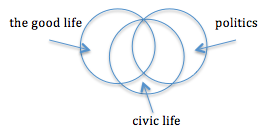
Civic life is important, but it is by no means the only important thing. It represents one circle in this Venn diagram, which also includes circles for politics–meaning all the ways that human beings govern ourselves and create a common world–and the good life.

Screen Shot 2016-03-27 at 11.51.21 AM

In civic life, certain ways of interacting are possible and desirable. We can and should be highly interactive while we are in smallish groups dedicated to improving the world. We can be responsive to one another’s needs and opinions and strive act in concert.

But a good life should sometimes be solitary and inward-looking, or directed to nature or God instead of fellow citizens. And politics should sometimes involve competition instead of deliberation and cooperation. For instance, we want incumbent politicians to be regularly challenged by outsiders who criticize them and strive to unseat them. We don’t want incumbents to get too cozy with their challengers. The same is true of business competitors and contending attorneys.

In the video, I argue—and I strongly believe—that civic engagement can enrich our inner lives and offer us psychological and spiritual benefits. But so can non-civic activities, such as observing and appreciating nature, understanding and making art, or loving and caring for other people intimately. Although I think that the spiritual benefits of civic life are often overlooked—and improving our civic culture would strengthen those benefits—I still resist the argument that the good life equals civic engagement.

Here is a typically subtle case: I love to walk in the woods with my family and dog. Enjoying those loved ones in a natural setting is not a form of civic engagement. However, it is only thanks to the Massachusetts Audubon Society and our state government—and the individuals who work in or with those organizations—that the woods have been preserved and opened for us to use. The worthy activity (a family walk) is not civic, yet it depends upon other people’s civic engagement. Still, it’s far too narrow a view of nature and of intimate personal relations to reduce them to products of civic life.

By the same token, civic life doesn’t exhaust politics or offer adequate means to improve politics. Large, impersonal institutions—such as markets and companies, governments and armies, and scientific and technical disciplines—play leading roles in 21st century politics. You and I have limited leverage over these institutions. We can form opinions about what they should do, but those opinions do not always imply meaningful actions for us to take.

If the institution in question is the United States government, I have a tiny but greater-than-zero form of leverage in the form of my vote. If the institution is Coca-Cola, I can decide whether to purchase its products or not. Allocating votes and money are worthwhile acts but hardly constitute a robust civic life. And if the institution in question is the Chinese Government or the market for oil rigs, my leverage approaches zero. In the video, I say that citizens ask, “What should we do?” rather than “What should be done?” But sometimes reasonable people realize that something should be done and yet cannot find anything to do about it themselves. That is the zone of politics that lies outside of civic life in the Venn diagram above.

In the video and almost all my work, I emphasize that “small groups of thoughtful and committed citizens” have the capacity and responsibility to change large systems. I began my professional career helping to advocate for political reform as a research associate at Common Cause, and while I worked there, Common Cause was losing its membership base due to the shrinkage of American civil society that Robert Putnam would soon diagnose in “Bowling Alone” (1995). I came to think that American politics was corrupt because citizens were not adequately organized and active, and I have spent the subsequent two decades working on civic engagement as a precondition for better government. Still, political reform eludes us in the face of hostile Supreme Court decisions, technological developments, and tenacious political opposition. When reform does come, it may be because of a massive scandal or a well-placed leader, not directly because of active citizens. In some other countries and in global markets, the scope for civic life is even narrower than it is in the US.

To discount the importance of citizens in politics is cynical, but to imagine that intentional civic action is all of politics is naive. To the extent we can, we should work to expand the overlap, so that civic life is more politically influential as well as more spiritually rewarding. But I think we will always be left with two hard questions (among others):

  1. How should we think and act and feel when bad systems are genuinely beyond our control? The Stoic and classical Indian answer was: seek equanimity and acceptance. Epictetus advised: “For if the essence of the good lies in what we can achieve, then there is no space for ill-will or jealousy. Rather, for yourself, don’t strive to be a general or an office-holder or a leader/consul, but to be free. The only road to that is contempt for things not in your power [XIX].” I am unsatisfied with that answer, because I think we have responsibilities to the world even when we cannot see a direct way to address its problems. But what are those responsibilities, exactly? And …
  2. When an aspect of the good life conflicts with civic responsibilities, how should we choose between them?

why don’t social movements have great leaders any more?

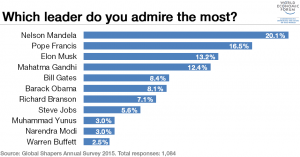
In a discussion with undergraduates a week ago, the familiar question arose: Why don’t social movements have great leaders any more? One could dispute the premise, arguing that we do have social movement leaders today and that we romanticize the past when we forget how divisive–even within their own movements–most leaders have always been. Still, I think the students were onto something when they posed this question. Here are the leaders whom young people around the world admired the most in 2015:

leaders

The two people who could clearly be classified as leaders of social movements are dead. Of the rest, five are business leaders and two are elected officials in very large and influential democracies. Only Pope Francis and Muhammad Yunus could be described as leaders in civil society, and neither is a classic example of a social movement participant. Meanwhile, some highly prominent current movements–the Arab Spring, #Occupy, Black Lives Matter–are known for their reluctance to anoint leaders.

I’d propose three theses:

1. “Apex” leaders are assets to social movements, even today. 

Leaders who become famous for their participation in social movements are useful. They symbolize the movement’s objectives and its spirit in human form. They can use their prestige to mediate disagreements within the movement. And they are available to negotiate with outside powers. It’s hard to imagine the victory of Solidarity in Poland or the Freedom Movement in South Africa if Lech Walesa and Nelson Mandela hadn’t ultimately been able to sit down across a table from the regime and work out a deal.

2. Social movements make leaders, more than leaders make social movements.

There is a widespread view that very charismatic and visionary leaders call social movements into being. Perhaps that has happened a few times, but the reverse seems much more typical. Social movements identify individuals who have potential to lead. They offer them opportunities to develop leadership skills and expand their reputations. Often, movement members must cajole the prospective leader into playing that role. They then deliberately construct a reputation for their leader, for the consumption of outsiders.

A classic example is Martin Luther King’s ascent to leadership in Montgomery ca. 1954. As Taylor Branch tells the story in Parting the Waters, King moved to Montgomery with ambitions to participate in civil right activism. Although still a young man, he had been groomed for leadership in his father’s Atlanta congregation and at Morehouse College, where President Benjamin E. Mays was a prophetic leader who had gone to India to meet Gandhi. These institutions, already pillars of the nascent Civil Rights Movement, had developed King’s skills and imparted an overwhelming sense of obligation. In his new city of Montgomery, he took deliberate steps to enter the black leadership, giving a “stirring speech” at the NAACP and joining its executive committee (which, needless to say, already existed). The Montgomery Bus Boycott was started by other people, mainly women, who used finely honed techniques to implement a carefully designed plan. King was recruited to join the effort after it had begun and was then nominated to be the president of the leadership team.

Idealists would say afterward that King’s gifts would made him the obvious choice. Realists would scoff at this, saying that King was not very well known, and that his chief asset was a lack of debts or enemies. Cynics would say that the establishment preachers stepped back for King only because they saw more blame and danger ahead than glory (Branch, p. 137). 

And–I would add–everyone assumed that a male reverend doctor would make a more palatable leader than Rosa Parks, a woman without a college degree who had been “focused for almost two decades on white men’s sexual aggression and violence against black women” and who had challenged the Montgomery bus system because of systematic sexual harassment against black female riders. Hers was not an agenda that would appeal to socially conservative African Americans or white liberals.

So King was chosen. This is not to detract from his personal gifts, but even those came in part from his training within the movement. The other church leaders in Montgomery identified King’s extraordinary talents, gave him an opportunity to use them, and helped develop his national persona. It’s in that sense that the Civil Rights Movement made Dr. King, more than the reverse.

3. Good social movements hold their leaders accountable and limit their powers.

We live in a time of “strong” leaders. China’s Xi Jinping, India’s Narendra Modi, Russia’s Vladimir Putin, and Turkey’s Recep Tayyip Erdogan’s alone preside over a contiguous bloc of countries whose populations approach three billion. Each of these men has consolidated power and projects a macho image. None is particularly accountable. Meanwhile, as I mentioned earlier, we see social movements develop without leaders at all.

The best cases surely lie in between. They are movements with “apex” leaders whose powers are circumscribed and who are held constantly accountable. Again, King is a great example. His main formal role was president of the Southern Christian Leadership Conference, which “differed from organizations such as the Student Nonviolent Coordinating Committee (SNCC) and the National Association for the Advancement of Colored People (NAACP), in that it operated as an umbrella organization of affiliates.” So King was not only accountable to a board, but the organization he led depended on churches’ voluntary and revocable decisions to join. He had no formal power over SNCC or NAACP, let alone the Nation of Islam. Indeed, these groups fairly often competed. To the extent that he was the leader of the whole Civil Rights Movement, he had to earn that standing by constantly serving the grassroots base. It’s that specific kind of leadership that seems especially lacking today.

See also the real Rosa Parksis the Sanders campaign a movement?; and how to respond to a leader’s call for civic renewal.

Maoist chic as Orientalism

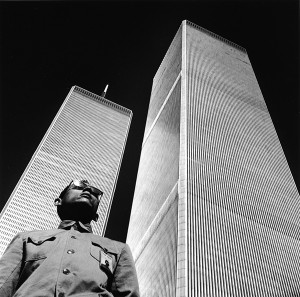
tseng kwong chiWhile visiting the excellent Tufts University Art Gallery exhibition, “Tseng Kwong-Chi: Performing for the Camera,” my colleagues and I heard the following story. Tseng was the child of Chinese anticommunist refugees. He moved to the East Village in the 1970s, where he worked and played with people like Keith Haring and Andy Warhol. When his parents visited from their home in Vancouver, they wanted to take him to Windows on the World, the fancy restaurant that used to be at the top of the World Trade Center. It required a jacket, and the only jacket Tseng owned was a Chinese Communist uniform that he had bought in a second-hand store in Montreal. The restaurant not only let him in but fawned over him, assuming that he was a Chinese dignitary. This reception gave Tseng the idea of posing in front of iconic monuments all over the North America and Western Europe, dressed in his Mao jacket, Ray-Bans, and an ID badge that reminds me of the X-Files. He always donned the serious, distant look of the Chairman inspecting the Red Army’s triumphs.

Tseng had studied art in Paris, so Richard Wolin’s book, The Wind from the East: French Intellectuals, the Cultural Revolution, and the Legacy of the 1960s provides some helpful background. Wolin writes that Communist China was all the rage in Paris in 1967. That year,

Mao-collared suits–“les cols de Mao“–had become immensely fashionable. Try as they might, the clothing boutiques in Paris’ tony sixteenth arrondissement could not keep them in stock. … Lui, the French equivalent of Playboy, decided to jump on the pro-Chinese bandwagon by featuring an eight-page spread of scantily clad models in straw hats, red stars, and Red Guard attire. The accompanying captions were culled from The Little Red Book. One striking image portrayed a young woman, unclad and equipped with an automatic rifle, emerging from an enormous white cake. “The revolution is not a dinner party,” read the legend.

Tseng might not have seen this Lui issue, but he lived in Paris soon after Chinese communism had inspired everything from softcore porn to an insurrection. Meanwhile, in the actual China, during the year 1967 alone, some 237,000 citizens were killed and 730,ooo permanently disabled as a result of the Cultural Revolution.

Tseng was a Canadian citizen, a gay man, an East Village artist, and an Asian immigrant to North America. In these pictures, he is role-playing the most powerful Asian man of the time, one whose victims–almost all Asians–may number 65 million. By passing as a Communist official instead of an East Village immigrant artist, he was able to experience social recognition in his adopted land. He also parodied the appropriation of serious matters for profitable pop culture and made serious art out of the parody.

See also:  French post-War intellectuals: some generalizations and when is cultural appropriation good or bad?

do we actually want higher youth voter turnout?

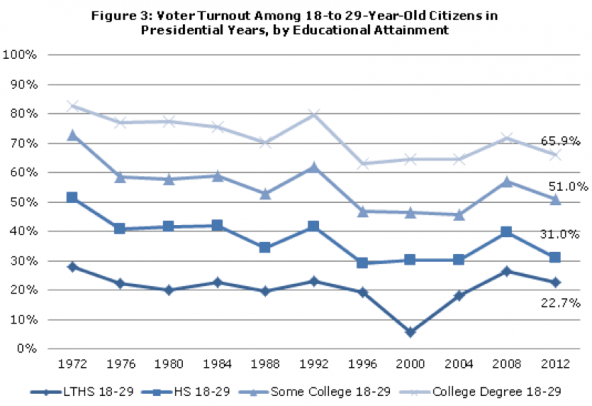
Abby Kiesa and I have a new piece in the Stanford Social Innovation Review (online), entitled “Do We Actually Want Higher Youth Voter Turnout?” We dispute the premise that youth turnout has declined–or risen. Instead, we note the “the relentless replication of political inequality by class,” as illustrated (for instance) by this graph:

We observe that the traditional solution to political inequality has deteriorated. “The civil society built in the 20th century tended to recruit young members for non-political reasons and then make them political. Large institutions—such as unions, churches, Urban League, and Elks—had the means and motivations to recruit widely, and they had incentives to interest at least some of their young members in politics. Belonging to these groups (or subscribing to a newspaper) was correlated with voting. But … all these organizations have lost youth members since the 1970s.”

We argue that no single reform or strategy will work in the 21st century, but that sustained investment by major organizations would pay dividends.

Some Twitter replies to the article have said that we overlook new platforms and modes of engagement that have arisen in this century. This is what we said, though:

To be sure, there are now alternatives to these organizations that serve to empower at least some young people. No one could join a social media campaign in 1974, for example. Still, the new array of civic networks and groups have not yet shown that they are capable of boosting youth voter turnout significantly or reducing gaps by social class.

how talking about Millennials obscures injustice

(Washington, DC) Generational analysis often conceals power and inequality and justifies the status quo. A great example is The New York Times‘ article yesterday about Mic.com, entitled, “What Happens When Millennials Run the Workplace?” Mic’s staff of 106 employees is described as “trim 20-somethings, with beards on the men and cute outfits on the women, who end every sentence with an exclamation point and use the word ‘literally’ a lot.” These folks like to “ride hoverboards into the kitchen for the free snacks. ” The challenges for the managers (who are also under 30) include handling “a sense of entitlement, a tendency to overshare on social media, and frankness verging on insubordination.”

All of this is presented as if it were typical of “millennials.” But the Bureau of Labor Statistics estimates that only 10,000 Americans between the ages of 20 and 24 (and another 28,000 between 25 and 34) are employed as “news analysts, reporters and correspondents.” Very few of those work for hip web startups. Meanwhile, 529,000 Americans between the ages of 20 and 24 work in “healthcare support occupations,” such as nurse’s aides, dental assistants, and vet techs. The fastest growing occupation of all in the US today is personal care aides, who help elderly and disabled clients with bodily (as well as social) needs. These aides earn about $20,000/year and need no preparation other than “short-term on-the-job training.” I guarantee that they never ride hoverboards into the kitchen or talk back to their employers, or else their highly contin[g]ent positions will cease within the hour.

Nearly two million people between 20 and 24 work in food service, of whom just 2.3% are chefs or head cooks. If you’re one of the 101,000 fast food counter-service workers in that age range, you are scrutinized closely to make sure that you are always perfectly deferential to customers, regardless of the situation. Talking back to anyone on the other side of the counter can get you immediately terminated.

So what does the Mic.com workplace represent? I would say: nothing distinctive about Millennials. I bet the Village Voice newsroom had a similar vibe in 1975. These are situations in which the workers have very high market value and lots of options, the management is not very distant from them in terms of market value, social status, or financial stake, and the culture of the occupation is informal.

If you own a piece of a startup whose value lies entirely in its skilled workforce, you’d better to be nice to those workers. If you sit in the headquarters of a multinational fast food empire, your only concern about your line workers is how to weed out the least efficient and deferential 50 percent of them and control labor costs. Since for each employee of Mic, there are about 20,000 food service workers of the same age, this is not an article about Millennials. It’s a timeless tale of how people act when they are worth a whole lot in a labor market.

Sanders’ youth votes > Clinton + Trump

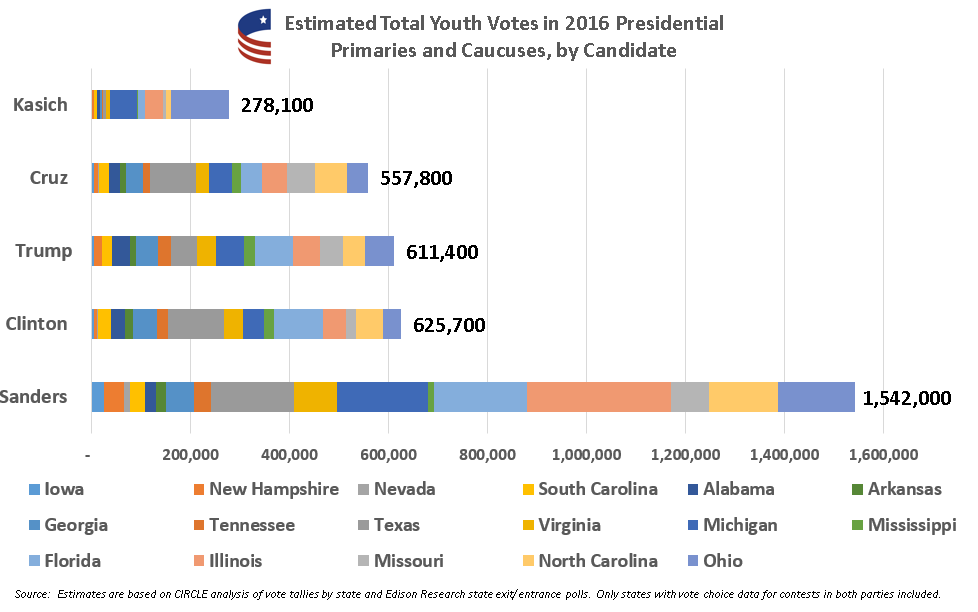
This graphic is the focus of Aaron Blake’s Washington Post article entitled “74-year-old Bernie Sanders’s remarkable dominance among young voters, in 1 chart.” As Blake writes, “Hillary Clinton and Donald Trump are well on their way to becoming their parties’ 2016 nominees for president. Among young voters, though, Bernie Sanders has more votes than both of them — combined.” The source is CIRCLE’s analysis released today.

Cumulative-Graph-March15

is the Sanders campaign a movement?

My friend Micah Sifry has a must-read article in The Nation entitled “How the Sanders Campaign Is Reinventing the Use of Tech in Politics.” He interviews two key staffers, Zack Exley and Becky Bond, who reveal a lot about the way their campaign has engaged its supporters.

I’ve written before about an oscillation: campaigns go back and forth between using technology to empower volunteers and accumulating Big Data to make their centralized outreach efforts more precise. Bond is explicit about which direction the Sanders campaign wants to move:

We’re shifting the focus away from a small number of sophisticated data and technologists engaged in a kind of Election Day arbitrage that ekes out incremental advantages by using micro-targeting algorithms to identify and turn out voters based on a model. Instead, we’re putting hundreds of thousands of volunteers to work, and in some states have literally called every single voter who will pick up the phone to identify everyone who supports Bernie or is undecided. Then we have other volunteers persuade the undecideds and turn out those who indicated support.

The article repeatedly describes the campaign as a “movement.” For instance, Exley says, “When Claire and I first arrived at the campaign, we knew that a movement was already way out ahead of the campaign. We believed it was our job to set up structures and tools to … help grow the movement.” A campaign fueled by volunteer hours and small donations that encourages its activists to recruit and lead certainly has a movement “feel.” But what would qualify the Sanders campaign as an actual movement–or as part of one?

Some would say that it’s already a movement because it has engaged a lot of fired-up people in unpaid political activity. Exley describes “a massive volunteer organization that’s making more than 1 million calls every day right now, knocking on countless doors and doing so much more.” Those accomplishments are typical of big, grassroots-based campaigns–not only partisan electoral campaigns but also bursts of grassroots energy in civil society. According to the late Charles Tilly and his colleagues, such campaigns are components or activities of social movements. But one campaign–even a large one–does not itself constitute a social movement.

Others would say that Sanders is part of a movement because he belongs to a loose, evolving, open network of academics, cultural figures, union leaders, organizers, and a few politicians that originated in the New Left and that supports democratic socialism in the United States. Not only is that network called a movement, but it is sometimes called The Movement–as in, “I grew up in the movement, you know,” or “I got to know Bernie through the movement back in the ’70s.”

I personally do not identify with this network, in part because I haven’t done anything worthy of admission to it and in part because my actual political beliefs are too eclectic. (I am not sure you can love Hayek and be in The Movement.) But I’ve known and admired bono fide participants all my adult life. The questions are … Does this strain of political thought and activism really qualify as a movement, even as it has spanned multiple decades? Has it shown enough signs of motion to be a movement? And how much of a movement activist is Senator Sanders? My sense is that he has been a solo voice on important issues, but not much of a movement-builder. He is not known for training organizers or leading organizations. As a voice and a vote in the Senate, he may be an asset to the movement–much like a noted author or musician who supports the cause–but I’m not sure he’s a movement person.

His campaign could nevertheless be an important episode in a movement that spans a longer time horizon and that has many more leaders than Bernie Sanders. It’s too early to say whether that’s the case, because everything depends on what happens after the 2016 election.

Another question is what movement his campaign is part of, if it turns out to be part of a movement at all. Sanders’ own roots are in ’60s-style US-based democratic socialism (see the Port Huron Statement), but other currents are feeding his campaign. Bond says, “First of all, I want to take this opportunity to say that the movement to defend black lives is fundamentally changing the terrain of social-change organizing. After recognizing that, yes, the young people and working-class folks, many of whom are from communities of color, who are leading the movement behind Bernie Sanders as volunteers on the ground are changing American politics.” That comment sounds somewhat aspirational to me–Sanders would be closer to the nomination if he had engaged the Black Lives Matter movement more effectively. But a large coalition could still form after his campaign concludes. Influenced in part by Tilly, I’d look for these features as evidence that a movement is afoot:

  • A set of campaigns–such as the Sanders presidential run and the civil disobedience in cities like Ferguson–that gain rather than lose momentum over a span of years and that look increasingly interrelated.
  • A characteristic repertoire of political acts, which might encompass everything from viral “memes” on social media to people shutting down highways.
  • A diverse, not completely consonant, yet overlapping and interacting set of prominent leaders, some involved in politics and some outside of it.
  • Cultural manifestations, such as very popular music in support of the cause.
  • A set of increasingly specific demands that begin to be implemented by major institutions.

See also: questions for the social movement post Ferguson.